The Concepts section helps you learn about the parts of the Kubernetes system and the abstractions Kubernetes uses to represent your cluster, and helps you obtain a deeper understanding of how Kubernetes works.
This page is an overview of Kubernetes.
The name Kubernetes originates from Greek, meaning helmsman or pilot. K8s as an abbreviation results from counting the eight letters between the "K" and the "s". Google open sourced the Kubernetes project in 2014. Kubernetes combines over 15 years of Google's experience running production workloads at scale with best-of-breed ideas and practices from the community.
Containers are a good way to bundle and run your applications. In a production environment, you need to manage the containers that run the applications and ensure that there is no downtime. For example, if a container goes down, another container needs to start. Wouldn't it be easier if this behavior was handled by a system?
That's how Kubernetes comes to the rescue! Kubernetes provides you with a framework to run distributed systems resiliently. It takes care of scaling and failover for your application, provides deployment patterns, and more. For example: Kubernetes can easily manage a canary deployment for your system.
Kubernetes provides you with:
Kubernetes is not a traditional, all-inclusive PaaS (Platform as a Service) system. Since Kubernetes operates at the container level rather than at the hardware level, it provides some generally applicable features common to PaaS offerings, such as deployment, scaling, load balancing, and lets users integrate their logging, monitoring, and alerting solutions. However, Kubernetes is not monolithic, and these default solutions are optional and pluggable. Kubernetes provides the building blocks for building developer platforms, but preserves user choice and flexibility where it is important.
Kubernetes:
Let's take a look at why Kubernetes is so useful by going back in time.
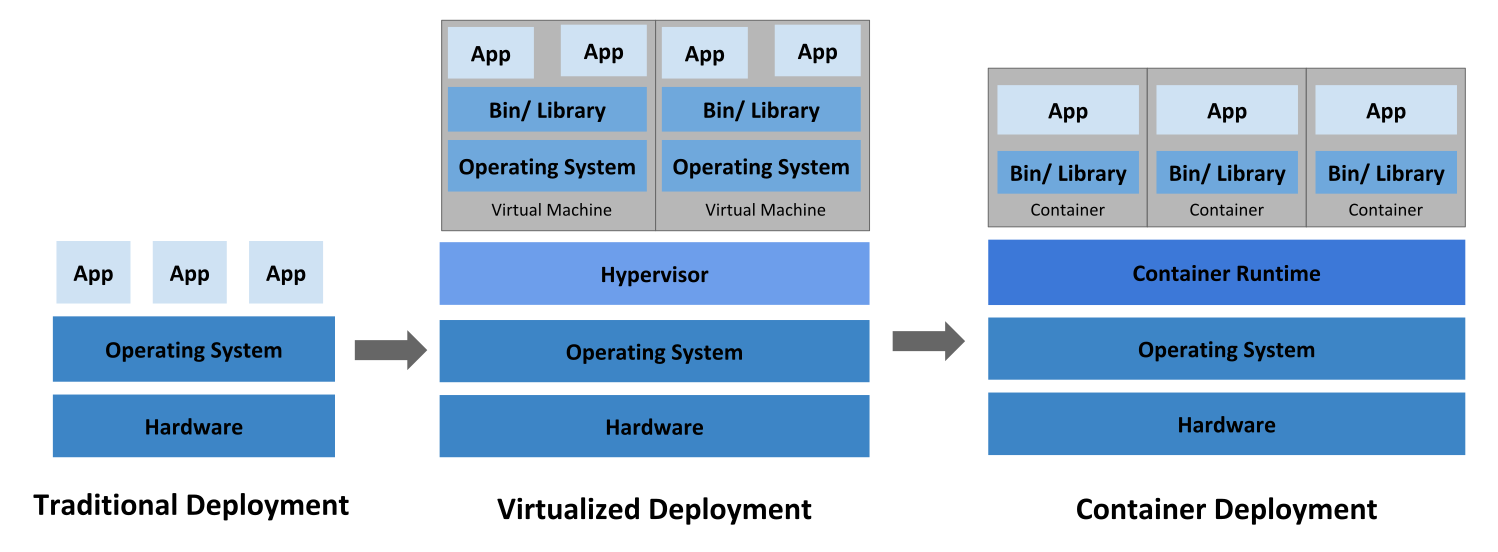
Traditional deployment era:
Early on, organizations ran applications on physical servers. There was no way to define resource boundaries for applications in a physical server, and this caused resource allocation issues. For example, if multiple applications run on a physical server, there can be instances where one application would take up most of the resources, and as a result, the other applications would underperform. A solution for this would be to run each application on a different physical server. But this did not scale as resources were underutilized, and it was expensive for organizations to maintain many physical servers.
Virtualized deployment era:
As a solution, virtualization was introduced. It allows you to run multiple Virtual Machines (VMs) on a single physical server's CPU. Virtualization allows applications to be isolated between VMs and provides a level of security as the information of one application cannot be freely accessed by another application.
Virtualization allows better utilization of resources in a physical server and allows better scalability because an application can be added or updated easily, reduces hardware costs, and much more. With virtualization you can present a set of physical resources as a cluster of disposable virtual machines.
Each VM is a full machine running all the components, including its own operating system, on top of the virtualized hardware.
Container deployment era:
Containers are similar to VMs, but they have relaxed isolation properties to share the Operating System (OS) among the applications. Therefore, containers are considered lightweight. Similar to a VM, a container has its own filesystem, share of CPU, memory, process space, and more. As they are decoupled from the underlying infrastructure, they are portable across clouds and OS distributions.
Containers have become popular because they provide extra benefits, such as:
This page provides a high-level overview of the essential components that make up a Kubernetes cluster.

The components of a Kubernetes cluster
A Kubernetes cluster consists of a control plane and one or more worker nodes. Here's a brief overview of the main components:
Manage the overall state of the cluster:
Run on every node, maintaining running pods and providing the Kubernetes runtime environment:
Your cluster may require additional software on each node; for example, you might also run systemd on a Linux node to supervise local components.
Addons extend the functionality of Kubernetes. A few important examples include:
Kubernetes allows for flexibility in how these components are deployed and managed. The architecture can be adapted to various needs, from small development environments to large-scale production deployments.
For more detailed information about each component and various ways to configure your cluster architecture, see the Cluster Architecture page.
This page explains how Kubernetes objects are represented in the Kubernetes API, and how you can
express them in .yaml format.
Kubernetes objects are persistent entities in the Kubernetes system. Kubernetes uses these entities to represent the state of your cluster. Specifically, they can describe:
A Kubernetes object is a "record of intent"--once you create the object, the Kubernetes system will constantly work to ensure that the object exists. By creating an object, you're effectively telling the Kubernetes system what you want your cluster's workload to look like; this is your cluster's desired state.
To work with Kubernetes objects—whether to create, modify, or delete them—you'll need to use the
Kubernetes API. When you use the kubectl command-line
interface, for example, the CLI makes the necessary Kubernetes API calls for you. You can also use
the Kubernetes API directly in your own programs using one of the
Client Libraries.
Almost every Kubernetes object includes two nested object fields that govern
the object's configuration: the object spec and the object status.
For objects that have a spec, you have to set this when you create the object,
providing a description of the characteristics you want the resource to have:
its desired state.
The status describes the current state of the object, supplied and updated
by the Kubernetes system and its components. The Kubernetes
control plane continually
and actively manages every object's actual state to match the desired state you
supplied.
For example: in Kubernetes, a Deployment is an object that can represent an
application running on your cluster. When you create the Deployment, you
might set the Deployment spec to specify that you want three replicas of
the application to be running. The Kubernetes system reads the Deployment
spec and starts three instances of your desired application--updating
the status to match your spec. If any of those instances should fail
(a status change), the Kubernetes system responds to the difference
between spec and status by making a correction--in this case, starting
a replacement instance.
For more information on the object spec, status, and metadata, see the Kubernetes API Conventions.
When you create an object in Kubernetes, you must provide the object spec that describes its
desired state, as well as some basic information about the object (such as a name). When you use
the Kubernetes API to create the object (either directly or via kubectl), that API request must
include that information as JSON in the request body.
Most often, you provide the information to kubectl in a file known as a manifest.
By convention, manifests are YAML (you could also use JSON format).
Tools such as kubectl convert the information from a manifest into JSON or another supported
serialization format when making the API request over HTTP.
Here's an example manifest that shows the required fields and object spec for a Kubernetes Deployment:
apiVersion: apps/v1
kind: Deployment
metadata:
  name: nginx-deployment
spec:
  selector:
    matchLabels:
      app: nginx
  replicas: 2 # tells deployment to run 2 pods matching the template
  template:
    metadata:
      labels:
        app: nginx
    spec:
      containers:
      - name: nginx
        image: nginx:1.14.2
        ports:
        - containerPort: 80
One way to create a Deployment using a manifest file like the one above is to use the
kubectl apply command
in the kubectl command-line interface, passing the .yaml file as an argument. Here's an example:
kubectl apply -f https://k8s.io/examples/application/deployment.yaml
The output is similar to this:
deployment.apps/nginx-deployment created
In the manifest (YAML or JSON file) for the Kubernetes object you want to create, you'll need to set values for the following fields:
apiVersion - Which version of the Kubernetes API you're using to create this objectkind - What kind of object you want to createmetadata - Data that helps uniquely identify the object, including a name string, UID, and optional namespacespec - What state you desire for the objectThe precise format of the object spec is different for every Kubernetes object, and contains
nested fields specific to that object. The Kubernetes API Reference
can help you find the spec format for all of the objects you can create using Kubernetes.
For example, see the spec field
for the Pod API reference.
For each Pod, the .spec field specifies the pod and its desired state (such as the container image name for
each container within that pod).
Another example of an object specification is the
spec field
for the StatefulSet API. For StatefulSet, the .spec field specifies the StatefulSet and
its desired state.
Within the .spec of a StatefulSet is a template
for Pod objects. That template describes Pods that the StatefulSet controller will create in order to
satisfy the StatefulSet specification.
Different kinds of objects can also have different .status; again, the API reference pages
detail the structure of that .status field, and its content for each different type of object.
See Kubernetes Configuration Best Practices for additional information on writing YAML configuration files.
Starting with Kubernetes v1.25, the API server offers server side
field validation
that detects unrecognized or duplicate fields in an object. It provides all the functionality
of kubectl --validate on the server side.
The kubectl tool uses the --validate flag to set the level of field validation. It accepts the
values ignore, warn, and strict while also accepting the values true (equivalent to strict)
and false (equivalent to ignore). The default validation setting for kubectl is --validate=true.
StrictWarnIgnoreWhen kubectl cannot connect to an API server that supports field validation it will fall back
to using client-side validation. Kubernetes 1.27 and later versions always offer field validation;
older Kubernetes releases might not. If your cluster is older than v1.27, check the documentation
for your version of Kubernetes.
If you're new to Kubernetes, read more about the following:
Kubernetes Object Management
explains how to use kubectl to manage objects.
You might need to install kubectl if you don't already have it available.
To learn about the Kubernetes API in general, visit:
To learn about objects in Kubernetes in more depth, read other pages in this section:
The kubectl command-line tool supports several different ways to create and manage
Kubernetes objects. This document provides an overview of the different
approaches. Read the Kubectl book for
details of managing objects by Kubectl.
| Management technique | Operates on | Recommended environment | Supported writers | Learning curve |
|---|---|---|---|---|
| Imperative commands | Live objects | Development projects | 1+ | Lowest |
| Imperative object configuration | Individual files | Production projects | 1 | Moderate |
| Declarative object configuration | Directories of files | Production projects | 1+ | Highest |
When using imperative commands, a user operates directly on live objects
in a cluster. The user provides operations to
the kubectl command as arguments or flags.
This is the recommended way to get started or to run a one-off task in a cluster. Because this technique operates directly on live objects, it provides no history of previous configurations.
Run an instance of the nginx container by creating a Deployment object:
kubectl create deployment nginx --image nginx
Advantages compared to object configuration:
Disadvantages compared to object configuration:
In imperative object configuration, the kubectl command specifies the operation (create, replace, etc.), optional flags and at least one file name. The file specified must contain a full definition of the object in YAML or JSON format.
See the API reference for more details on object definitions.
replace command replaces the existing
spec with the newly provided one, dropping all changes to the object missing from
the configuration file. This approach should not be used with resource
types whose specs are updated independently of the configuration file.
Services of type LoadBalancer, for example, have their externalIPs field updated
independently from the configuration by the cluster.Create the objects defined in a configuration file:
kubectl create -f nginx.yaml
Delete the objects defined in two configuration files:
kubectl delete -f nginx.yaml -f redis.yaml
Update the objects defined in a configuration file by overwriting the live configuration:
kubectl replace -f nginx.yaml
Advantages compared to imperative commands:
Disadvantages compared to imperative commands:
Advantages compared to declarative object configuration:
Disadvantages compared to declarative object configuration:
When using declarative object configuration, a user operates on object
configuration files stored locally, however the user does not define the
operations to be taken on the files. Create, update, and delete operations
are automatically detected per-object by kubectl. This enables working on
directories, where different operations might be needed for different objects.
patch API operation to write only
observed differences, instead of using the replace
API operation to replace the entire object configuration.Process all object configuration files in the configs directory, and create or
patch the live objects. You can first diff to see what changes are going to be
made, and then apply:
kubectl diff -f configs/
kubectl apply -f configs/
Recursively process directories:
kubectl diff -R -f configs/
kubectl apply -R -f configs/
Advantages compared to imperative object configuration:
Disadvantages compared to imperative object configuration:
Each object in your cluster has a Name that is unique for that type of resource. Every Kubernetes object also has a UID that is unique across your whole cluster.
For example, you can only have one Pod named myapp-1234 within the same namespace, but you can have one Pod and one Deployment that are each named myapp-1234.
For non-unique user-provided attributes, Kubernetes provides labels and annotations.
A client-provided string that refers to an object in a resource
URL, such as /api/v1/pods/some-name.
Only one object of a given kind can have a given name at a time. However, if you delete the object, you can make a new object with the same name.
Names must be unique across all API versions of the same resource. API resources are distinguished by their API group, resource type, namespace (for namespaced resources), and name. In other words, API version is irrelevant in this context.
The server may generate a name when generateName is provided instead of name in a resource create request.
When generateName is used, the provided value is used as a name prefix, which server appends a generated suffix
to. Even though the name is generated, it may conflict with existing names resulting in an HTTP 409 response. This
became far less likely to happen in Kubernetes v1.31 and later, since the server will make up to 8 attempts to generate a
unique name before returning an HTTP 409 response.
Below are four types of commonly used name constraints for resources.
Most resource types require a name that can be used as a DNS subdomain name as defined in RFC 1123. This means the name must:
Some resource types require their names to follow the DNS label standard as defined in RFC 1123. This means the name must:
RelaxedServiceNameValidation feature gate is enabled,
Service object names are allowed to start with a digit.Some resource types require their names to follow the DNS label standard as defined in RFC 1035. This means the name must:
RelaxedServiceNameValidation
feature gate is enabled for Service objects, which allows Service names to start with digits.Some resource types require their names to be able to be safely encoded as a path segment. In other words, the name may not be "." or ".." and the name may not contain "/" or "%".
Here's an example manifest for a Pod named nginx-demo.
apiVersion: v1
kind: Pod
metadata:
  name: nginx-demo
spec:
  containers:
  - name: nginx
    image: nginx:1.14.2
    ports:
    - containerPort: 80
A Kubernetes systems-generated string to uniquely identify objects.
Every object created over the whole lifetime of a Kubernetes cluster has a distinct UID. It is intended to distinguish between historical occurrences of similar entities.
Kubernetes UIDs are universally unique identifiers (also known as UUIDs). UUIDs are standardized as ISO/IEC 9834-8 and as ITU-T X.667.
Labels are key/value pairs that are attached to objects such as Pods. Labels are intended to be used to specify identifying attributes of objects that are meaningful and relevant to users, but do not directly imply semantics to the core system. Labels can be used to organize and to select subsets of objects. Labels can be attached to objects at creation time and subsequently added and modified at any time. Each object can have a set of key/value labels defined. Each Key must be unique for a given object.
"metadata": {
  "labels": {
    "key1" : "value1",
    "key2" : "value2"
  }
}
Labels allow for efficient queries and watches and are ideal for use in UIs and CLIs. Non-identifying information should be recorded using annotations.
Labels enable users to map their own organizational structures onto system objects in a loosely coupled fashion, without requiring clients to store these mappings.
Service deployments and batch processing pipelines are often multi-dimensional entities (e.g., multiple partitions or deployments, multiple release tracks, multiple tiers, multiple micro-services per tier). Management often requires cross-cutting operations, which breaks encapsulation of strictly hierarchical representations, especially rigid hierarchies determined by the infrastructure rather than by users.
Example labels:
"release" : "stable", "release" : "canary""environment" : "dev", "environment" : "qa", "environment" : "production""tier" : "frontend", "tier" : "backend", "tier" : "cache""partition" : "customerA", "partition" : "customerB""track" : "daily", "track" : "weekly"These are examples of commonly used labels; you are free to develop your own conventions. Keep in mind that label Key must be unique for a given object.
Labels are key/value pairs. Valid label keys have two segments: an optional
prefix and name, separated by a slash (/). The name segment is required and
must be 63 characters or less, beginning and ending with an alphanumeric
character ([a-z0-9A-Z]) with dashes (-), underscores (_), dots (.),
and alphanumerics between. The prefix is optional. If specified, the prefix
must be a DNS subdomain: a series of DNS labels separated by dots (.),
not longer than 253 characters in total, followed by a slash (/).
If the prefix is omitted, the label Key is presumed to be private to the user.
Automated system components (e.g. kube-scheduler, kube-controller-manager,
kube-apiserver, kubectl, or other third-party automation) which add labels
to end-user objects must specify a prefix.
The kubernetes.io/ and k8s.io/ prefixes are
reserved for Kubernetes core components.
Valid label value:
[a-z0-9A-Z]),-), underscores (_), dots (.), and alphanumerics between.For example, here's a manifest for a Pod that has two labels
environment: production and app: nginx:
apiVersion: v1
kind: Pod
metadata:
  name: label-demo
  labels:
    environment: production
    app: nginx
spec:
  containers:
  - name: nginx
    image: nginx:1.14.2
    ports:
    - containerPort: 80
Unlike names and UIDs, labels do not provide uniqueness. In general, we expect many objects to carry the same label(s).
Via a label selector, the client/user can identify a set of objects. The label selector is the core grouping primitive in Kubernetes.
The API currently supports two types of selectors: equality-based and set-based.
A label selector can be made of multiple requirements which are comma-separated.
In the case of multiple requirements, all must be satisfied so the comma separator
acts as a logical AND (&&) operator.
The semantics of empty or non-specified selectors are dependent on the context, and API types that use selectors should document the validity and meaning of them.
||) operator.
Ensure your filter statements are structured accordingly.Equality- or inequality-based requirements allow filtering by label keys and values.
Matching objects must satisfy all of the specified label constraints, though they may
have additional labels as well. Three kinds of operators are admitted =,==,!=.
The first two represent equality (and are synonyms), while the latter represents inequality.
For example:
environment = production
tier != frontend
The former selects all resources with key equal to environment and value equal to production.
The latter selects all resources with key equal to tier and value distinct from frontend,
and all resources with no labels with the tier key. One could filter for resources in production
excluding frontend using the comma operator: environment=production,tier!=frontend
One usage scenario for equality-based label requirement is for Pods to specify
node selection criteria. For example, the sample Pod below selects nodes where
the accelerator label exists and is set to nvidia-tesla-p100.
apiVersion: v1
kind: Pod
metadata:
  name: cuda-test
spec:
  containers:
    - name: cuda-test
      image: "registry.k8s.io/cuda-vector-add:v0.1"
      resources:
        limits:
          nvidia.com/gpu: 1
  nodeSelector:
    accelerator: nvidia-tesla-p100
Set-based label requirements allow filtering keys according to a set of values.
Three kinds of operators are supported: in,notin and exists (only the key identifier).
For example:
environment in (production, qa)
tier notin (frontend, backend)
partition
!partition
environment and value
equal to production or qa.tier and values other
than frontend and backend, and all resources with no labels with the tier key.partition;
no values are checked.partition;
no values are checked.Similarly the comma separator acts as an AND operator. So filtering resources
with a partition key (no matter the value) and with environment different
than qa can be achieved using partition,environment notin (qa).
The set-based label selector is a general form of equality since
environment=production is equivalent to environment in (production);
similarly for != and notin.
Set-based requirements can be mixed with equality-based requirements.
For example: partition in (customerA, customerB),environment!=qa.
For list and watch operations, you can specify label selectors to filter the sets of objects returned; you specify the filter using a query parameter. (To learn in detail about watches in Kubernetes, read efficient detection of changes). Both requirements are permitted (presented here as they would appear in a URL query string):
?labelSelector=environment%3Dproduction,tier%3Dfrontend?labelSelector=environment+in+%28production%2Cqa%29%2Ctier+in+%28frontend%29Both label selector styles can be used to list or watch resources via a REST client.
For example, targeting apiserver with kubectl and using equality-based one may write:
kubectl get pods -l environment=production,tier=frontend
or using set-based requirements:
kubectl get pods -l 'environment in (production),tier in (frontend)'
As already mentioned set-based requirements are more expressive. For instance, they can implement the OR operator on values:
kubectl get pods -l 'environment in (production, qa)'
or restricting negative matching via notin operator:
kubectl get pods -l 'environment,environment notin (frontend)'
Some Kubernetes objects, such as services
and replicationcontrollers,
also use label selectors to specify sets of other resources, such as
pods.
The set of pods that a service targets is defined with a label selector.
Similarly, the population of pods that a replicationcontroller should
manage is also defined with a label selector.
Label selectors for both objects are defined in json or yaml files using maps,
and only equality-based requirement selectors are supported:
"selector": {
    "component" : "redis",
}
or
selector:
  component: redis
This selector (respectively in json or yaml format) is equivalent to
component=redis or component in (redis).
Newer resources, such as Job,
Deployment,
ReplicaSet, and
DaemonSet,
support set-based requirements as well.
selector:
  matchLabels:
    component: redis
  matchExpressions:
    - { key: tier, operator: In, values: [cache] }
    - { key: environment, operator: NotIn, values: [dev] }
matchLabels is a map of {key,value} pairs. A single {key,value} in the
matchLabels map is equivalent to an element of matchExpressions, whose key
field is "key", the operator is "In", and the values array contains only "value".
matchExpressions is a list of pod selector requirements. Valid operators include
In, NotIn, Exists, and DoesNotExist. The values set must be non-empty in the case of
In and NotIn. All of the requirements, from both matchLabels and matchExpressions
are ANDed together -- they must all be satisfied in order to match.
One use case for selecting over labels is to constrain the set of nodes onto which a pod can schedule. See the documentation on node selection for more information.
You can apply a single label to any resources, but this is not always the best practice. There are many scenarios where multiple labels should be used to distinguish resource sets from one another.
For instance, different applications would use different values for the app label, but a
multi-tier application, such as the guestbook example,
would additionally need to distinguish each tier.
In the following examples, the app label is included for convenience in manual queries
and simple CLI usage. The app.kubernetes.io/name label follows the recommended Kubernetes
labeling conventions and is better suited for tooling and automation.
The frontend could carry the following labels:
labels:
  app: guestbook
  app.kubernetes.io/name: guestbook
  tier: frontend
while the Redis master and replica would have different tier labels, and perhaps even an
additional role label:
labels:
  app: guestbook
  app.kubernetes.io/name: guestbook
  tier: backend
  role: master
and
labels:
  app: guestbook
  app.kubernetes.io/name: guestbook
  tier: backend
  role: replica
The labels allow for slicing and dicing the resources along any dimension specified by a label:
kubectl apply -f examples/guestbook/all-in-one/guestbook-all-in-one.yaml
kubectl get pods -Lapp -Ltier -Lrole
NAME                           READY  STATUS    RESTARTS   AGE   APP         TIER       ROLE
guestbook-fe-4nlpb             1/1    Running   0          1m    guestbook   frontend   <none>
guestbook-fe-ght6d             1/1    Running   0          1m    guestbook   frontend   <none>
guestbook-fe-jpy62             1/1    Running   0          1m    guestbook   frontend   <none>
guestbook-redis-master-5pg3b   1/1    Running   0          1m    guestbook   backend    master
guestbook-redis-replica-2q2yf  1/1    Running   0          1m    guestbook   backend    replica
guestbook-redis-replica-qgazl  1/1    Running   0          1m    guestbook   backend    replica
my-nginx-divi2                 1/1    Running   0          29m   nginx       <none>     <none>
my-nginx-o0ef1                 1/1    Running   0          29m   nginx       <none>     <none>
kubectl get pods -lapp=guestbook,role=replica
NAME                           READY  STATUS   RESTARTS  AGE
guestbook-redis-replica-2q2yf  1/1    Running  0         3m
guestbook-redis-replica-qgazl  1/1    Running  0         3m
Sometimes you may want to relabel existing pods and other resources before creating
new resources. This can be done with kubectl label.
For example, if you want to label all your NGINX Pods as frontend tier, run:
kubectl label pods -l app=nginx tier=fe
pod/my-nginx-2035384211-j5fhi labeled
pod/my-nginx-2035384211-u2c7e labeled
pod/my-nginx-2035384211-u3t6x labeled
This first filters all pods with the label "app=nginx", and then labels them with the "tier=fe". To see the pods you labeled, run:
kubectl get pods -l app=nginx -L tier
NAME                        READY     STATUS    RESTARTS   AGE       TIER
my-nginx-2035384211-j5fhi   1/1       Running   0          23m       fe
my-nginx-2035384211-u2c7e   1/1       Running   0          23m       fe
my-nginx-2035384211-u3t6x   1/1       Running   0          23m       fe
This outputs all "app=nginx" pods, with an additional label column of pods' tier
(specified with -L or --label-columns).
For more information, please see kubectl label.
In Kubernetes, namespaces provide a mechanism for isolating groups of resources within a single cluster. Names of resources need to be unique within a namespace, but not across namespaces. Namespace-based scoping is applicable only for namespaced objects (e.g. Deployments, Services, etc.) and not for cluster-wide objects (e.g. StorageClass, Nodes, PersistentVolumes, etc.).
Namespaces are intended for use in environments with many users spread across multiple teams, or projects. For clusters with a few to tens of users, you should not need to create or think about namespaces at all. Start using namespaces when you need the features they provide.
Namespaces provide a scope for names. Names of resources need to be unique within a namespace, but not across namespaces. Namespaces cannot be nested inside one another and each Kubernetes resource can only be in one namespace.
Namespaces are a way to divide cluster resources between multiple users (via resource quota).
It is not necessary to use multiple namespaces to separate slightly different resources, such as different versions of the same software: use labels to distinguish resources within the same namespace.
default namespace. Instead, make other namespaces and use those.Kubernetes starts with four initial namespaces:
defaultkube-node-leasekube-publickube-systemCreation and deletion of namespaces are described in the Admin Guide documentation for namespaces.
kube-, since it is reserved for Kubernetes system namespaces.You can list the current namespaces in a cluster using:
kubectl get namespace
NAME              STATUS   AGE
default           Active   1d
kube-node-lease   Active   1d
kube-public       Active   1d
kube-system       Active   1d
To set the namespace for a current request, use the --namespace flag.
For example:
kubectl run nginx --image=nginx --namespace=<insert-namespace-name-here>
kubectl get pods --namespace=<insert-namespace-name-here>
You can permanently save the namespace for all subsequent kubectl commands in that context.
kubectl config set-context --current --namespace=<insert-namespace-name-here>
# Validate it
kubectl config view --minify | grep namespace:
When you create a Service,
it creates a corresponding DNS entry.
This entry is of the form <service-name>.<namespace-name>.svc.cluster.local, which means
that if a container only uses <service-name>, it will resolve to the service which
is local to a namespace. This is useful for using the same configuration across
multiple namespaces such as Development, Staging and Production. If you want to reach
across namespaces, you need to use the fully qualified domain name (FQDN).
As a result, all namespace names must be valid RFC 1123 DNS labels.
By creating namespaces with the same name as public top-level domains, Services in these namespaces can have short DNS names that overlap with public DNS records. Workloads from any namespace performing a DNS lookup without a trailing dot will be redirected to those services, taking precedence over public DNS.
To mitigate this, limit privileges for creating namespaces to trusted users. If required, you could additionally configure third-party security controls, such as admission webhooks, to block creating any namespace with the name of public TLDs.
Most Kubernetes resources (e.g. pods, services, replication controllers, and others) are in some namespaces. However namespace resources are not themselves in a namespace. And low-level resources, such as nodes and persistentVolumes, are not in any namespace.
To see which Kubernetes resources are and aren't in a namespace:
# In a namespace
kubectl api-resources --namespaced=true

# Not in a namespace
kubectl api-resources --namespaced=false
Kubernetes 1.22 [stable]
The Kubernetes control plane sets an immutable label
kubernetes.io/metadata.name on all namespaces.
The value of the label is the namespace name.
You can use Kubernetes annotations to attach arbitrary non-identifying metadata to objects. Clients such as tools and libraries can retrieve this metadata.
You can use either labels or annotations to attach metadata to Kubernetes objects. Labels can be used to select objects and to find collections of objects that satisfy certain conditions. In contrast, annotations are not used to identify and select objects. The metadata in an annotation can be small or large, structured or unstructured, and can include characters not permitted by labels. It is possible to use labels as well as annotations in the metadata of the same object.
Annotations, like labels, are key/value maps:
"metadata": {
  "annotations": {
    "key1" : "value1",
    "key2" : "value2"
  }
}
Here are some examples of information that could be recorded in annotations:
Fields managed by a declarative configuration layer. Attaching these fields as annotations distinguishes them from default values set by clients or servers, and from auto-generated fields and fields set by auto-sizing or auto-scaling systems.
Build, release, or image information like timestamps, release IDs, git branch, PR numbers, image hashes, and registry address.
Pointers to logging, monitoring, analytics, or audit repositories.
Client library or tool information that can be used for debugging purposes: for example, name, version, and build information.
User or tool/system provenance information, such as URLs of related objects from other ecosystem components.
Lightweight rollout tool metadata: for example, config or checkpoints.
Phone or pager numbers of persons responsible, or directory entries that specify where that information can be found, such as a team web site.
Directives from the end-user to the implementations to modify behavior or engage non-standard features.
Instead of using annotations, you could store this type of information in an external database or directory, but that would make it much harder to produce shared client libraries and tools for deployment, management, introspection, and the like.
Annotations are key/value pairs. Valid annotation keys have two segments: an optional prefix and name, separated by a slash (/). The name segment is required and must be 63 characters or less, beginning and ending with an alphanumeric character ([a-z0-9A-Z]) with dashes (-), underscores (_), dots (.), and alphanumerics between. The prefix is optional. If specified, the prefix must be a DNS subdomain: a series of DNS labels separated by dots (.), not longer than 253 characters in total, followed by a slash (/).
If the prefix is omitted, the annotation Key is presumed to be private to the user. Automated system components (e.g. kube-scheduler, kube-controller-manager, kube-apiserver, kubectl, or other third-party automation) which add annotations to end-user objects must specify a prefix.
The kubernetes.io/ and k8s.io/ prefixes are reserved for Kubernetes core components.
For example, here's a manifest for a Pod that has the annotation imageregistry: https://hub.docker.com/ :
apiVersion: v1
kind: Pod
metadata:
  name: annotations-demo
  annotations:
    imageregistry: "https://hub.docker.com/"
spec:
  containers:
  - name: nginx
    image: nginx:1.14.2
    ports:
    - containerPort: 80
Field selectors let you select Kubernetes objects based on the value of one or more resource fields. Here are some examples of field selector queries:
metadata.name=my-servicemetadata.namespace!=defaultstatus.phase=PendingThis kubectl command selects all Pods for which the value of the status.phase field is Running:
kubectl get pods --field-selector status.phase=Running
kubectl queries kubectl get pods and kubectl get pods --field-selector "" equivalent.Supported field selectors vary by Kubernetes resource type. All resource types support the metadata.name and metadata.namespace fields. Using unsupported field selectors produces an error. For example:
kubectl get ingress --field-selector foo.bar=baz
Error from server (BadRequest): Unable to find "ingresses" that match label selector "", field selector "foo.bar=baz": "foo.bar" is not a known field selector: only "metadata.name", "metadata.namespace"
| Kind | Fields |
|---|---|
| Pod | spec.nodeNamespec.restartPolicyspec.schedulerNamespec.serviceAccountNamespec.hostNetworkstatus.phasestatus.podIPstatus.podIPsstatus.nominatedNodeName |
| Event | involvedObject.kindinvolvedObject.namespaceinvolvedObject.nameinvolvedObject.uidinvolvedObject.apiVersioninvolvedObject.resourceVersioninvolvedObject.fieldPathreasonreportingComponentsourcetype |
| Secret | type |
| Namespace | status.phase |
| ReplicaSet | status.replicas |
| ReplicationController | status.replicas |
| Job | status.successful |
| Node | spec.unschedulable |
| CertificateSigningRequest | spec.signerName |
All custom resource types support the metadata.name and metadata.namespace fields.
Additionally, the spec.versions[*].selectableFields field of a CustomResourceDefinition
declares which other fields in a custom resource may be used in field selectors. See selectable fields for custom resources
for more information about how to use field selectors with CustomResourceDefinitions.
You can use the =, ==, and != operators with field selectors (= and == mean the same thing). This kubectl command, for example, selects all Kubernetes Services that aren't in the default namespace:
kubectl get services --all-namespaces --field-selector metadata.namespace!=default
As with label and other selectors, field selectors can be chained together as a comma-separated list. This kubectl command selects all Pods for which the status.phase does not equal Running and the spec.restartPolicy field equals Always:
kubectl get pods --field-selector=status.phase!=Running,spec.restartPolicy=Always
You can use field selectors across multiple resource types. This kubectl command selects all Statefulsets and Services that are not in the default namespace:
kubectl get statefulsets,services --all-namespaces --field-selector metadata.namespace!=default
Finalizers are namespaced keys that tell Kubernetes to wait until specific conditions are met before it fully deletes resources that are marked for deletion. Finalizers alert controllers to clean up resources the deleted object owned.
When you tell Kubernetes to delete an object that has finalizers specified for
it, the Kubernetes API marks the object for deletion by populating .metadata.deletionTimestamp,
and returns a 202 status code (HTTP "Accepted"). The target object remains in a terminating state while the
control plane, or other components, take the actions defined by the finalizers.
After these actions are complete, the controller removes the relevant finalizers
from the target object. When the metadata.finalizers field is empty,
Kubernetes considers the deletion complete and deletes the object.
You can use finalizers to control garbage collection of resources. For example, you can define a finalizer to clean up related API resources or infrastructure before the controller deletes the object being finalized.
You can use finalizers to control garbage collection of objects by alerting controllers to perform specific cleanup tasks before deleting the target resource.
Finalizers don't usually specify the code to execute. Instead, they are typically lists of keys on a specific resource similar to annotations. Kubernetes specifies some finalizers automatically, but you can also specify your own.
When you create a resource using a manifest file, you can specify finalizers in
the metadata.finalizers field. When you attempt to delete the resource, the
API server handling the delete request notices the values in the finalizers field
and does the following:
metadata.deletionTimestamp field with the
time you started the deletion.metadata.finalizers field202 status code (HTTP "Accepted")The controller managing that finalizer notices the update to the object setting the
metadata.deletionTimestamp, indicating deletion of the object has been requested.
The controller then attempts to satisfy the requirements of the finalizers
specified for that resource. Each time a finalizer condition is satisfied, the
controller removes that key from the resource's finalizers field. When the
finalizers field is emptied, an object with a deletionTimestamp field set
is automatically deleted. You can also use finalizers to prevent deletion of unmanaged resources.
A common example of a finalizer is kubernetes.io/pv-protection, which prevents
accidental deletion of PersistentVolume objects. When a PersistentVolume
object is in use by a Pod, Kubernetes adds the pv-protection finalizer. If you
try to delete the PersistentVolume, it enters a Terminating status, but the
controller can't delete it because the finalizer exists. When the Pod stops
using the PersistentVolume, Kubernetes clears the pv-protection finalizer,
and the controller deletes the volume.
When you DELETE an object, Kubernetes adds the deletion timestamp for that object and then
immediately starts to restrict changes to the .metadata.finalizers field for the object that is
now pending deletion. You can remove existing finalizers (deleting an entry from the finalizers
list) but you cannot add a new finalizer. You also cannot modify the deletionTimestamp for an
object once it is set.
After the deletion is requested, you can not resurrect this object. The only way is to delete it and make a new similar object.
example.com/finalizer-name.
Kubernetes enforces this format; the API server rejects writes to objects where the change does not use qualified finalizer names for any custom finalizer.Like labels, owner references describe the relationships between objects in Kubernetes, but are used for a different purpose. When a controller manages objects like Pods, it uses labels to track changes to groups of related objects. For example, when a Job creates one or more Pods, the Job controller applies labels to those pods and tracks changes to any Pods in the cluster with the same label.
The Job controller also adds owner references to those Pods, pointing at the Job that created the Pods. If you delete the Job while these Pods are running, Kubernetes uses the owner references (not labels) to determine which Pods in the cluster need cleanup.
Kubernetes also processes finalizers when it identifies owner references on a resource targeted for deletion.
In some situations, finalizers can block the deletion of dependent objects, which can cause the targeted owner object to remain for longer than expected without being fully deleted. In these situations, you should check finalizers and owner references on the target owner and dependent objects to troubleshoot the cause.
In Kubernetes, some objects are owners of other objects. For example, a ReplicaSet is the owner of a set of Pods. These owned objects are dependents of their owner.
Ownership is different from the labels and selectors
mechanism that some resources also use. For example, consider a Service that
creates EndpointSlice objects. The Service uses labels to allow the control plane to
determine which EndpointSlice objects are used for that Service. In addition
to the labels, each EndpointSlice that is managed on behalf of a Service has
an owner reference. Owner references help different parts of Kubernetes avoid
interfering with objects they don’t control.
Dependent objects have a metadata.ownerReferences field that references their
owner object. A valid owner reference consists of the object name and a UID
within the same namespace as the dependent object. Kubernetes sets the value of
this field automatically for objects that are dependents of other objects like
ReplicaSets, DaemonSets, Deployments, Jobs and CronJobs, and ReplicationControllers.
You can also configure these relationships manually by changing the value of
this field. However, you usually don't need to and can allow Kubernetes to
automatically manage the relationships.
Dependent objects also have an ownerReferences.blockOwnerDeletion field that
takes a boolean value and controls whether specific dependents can block garbage
collection from deleting their owner object. Kubernetes automatically sets this
field to true if a controller
(for example, the Deployment controller) sets the value of the
metadata.ownerReferences field. You can also set the value of the
blockOwnerDeletion field manually to control which dependents block garbage
collection.
A Kubernetes admission controller controls user access to change this field for dependent resources, based on the delete permissions of the owner. This control prevents unauthorized users from delaying owner object deletion.
Cross-namespace owner references are disallowed by design. Namespaced dependents can specify cluster-scoped or namespaced owners. A namespaced owner must exist in the same namespace as the dependent. If it does not, the owner reference is treated as absent, and the dependent is subject to deletion once all owners are verified absent.
Cluster-scoped dependents can only specify cluster-scoped owners. In v1.20+, if a cluster-scoped dependent specifies a namespaced kind as an owner, it is treated as having an unresolvable owner reference, and is not able to be garbage collected.
In v1.20+, if the garbage collector detects an invalid cross-namespace ownerReference,
or a cluster-scoped dependent with an ownerReference referencing a namespaced kind, a warning Event
with a reason of OwnerRefInvalidNamespace and an involvedObject of the invalid dependent is reported.
You can check for that kind of Event by running
kubectl get events -A --field-selector=reason=OwnerRefInvalidNamespace.
When you tell Kubernetes to delete a resource, the API server allows the
managing controller to process any finalizer rules
for the resource. Finalizers
prevent accidental deletion of resources your cluster may still need to function
correctly. For example, if you try to delete a PersistentVolume that is still
in use by a Pod, the deletion does not happen immediately because the
PersistentVolume has the kubernetes.io/pv-protection finalizer on it.
Instead, the volume remains in the Terminating status until Kubernetes clears
the finalizer, which only happens after the PersistentVolume is no longer
bound to a Pod.
Kubernetes also adds finalizers to an owner resource when you use either
foreground or orphan cascading deletion.
In foreground deletion, it adds the foreground finalizer so that the
controller must delete dependent resources that also have
ownerReferences.blockOwnerDeletion=true before it deletes the owner. If you
specify an orphan deletion policy, Kubernetes adds the orphan finalizer so
that the controller ignores dependent resources after it deletes the owner
object.
You can visualize and manage Kubernetes objects with more tools than kubectl and the dashboard. A common set of labels allows tools to work interoperably, describing objects in a common manner that all tools can understand.
In addition to supporting tooling, the recommended labels describe applications in a way that can be queried.
The metadata is organized around the concept of an application. Kubernetes is not a platform as a service (PaaS) and doesn't have or enforce a formal notion of an application. Instead, applications are informal and described with metadata. The definition of what an application contains is loose.
Shared labels and annotations share a common prefix: app.kubernetes.io. Labels
without a prefix are private to users. The shared prefix ensures that shared labels
do not interfere with custom user labels.
In order to take full advantage of using these labels, they should be applied on every resource object.
| Key | Description | Example | Type |
|---|---|---|---|
app.kubernetes.io/name |
The name of the application | mysql |
string |
app.kubernetes.io/instance |
A unique name identifying the instance of an application | mysql-abcxyz |
string |
app.kubernetes.io/version |
The current version of the application (e.g., a SemVer 1.0, revision hash, etc.) | 5.7.21 |
string |
app.kubernetes.io/component |
The component within the architecture | database |
string |
app.kubernetes.io/part-of |
The name of a higher level application this one is part of | wordpress |
string |
app.kubernetes.io/managed-by |
The tool being used to manage the operation of an application | Helm |
string |
To illustrate these labels in action, consider the following StatefulSet object:
# This is an excerpt
apiVersion: apps/v1
kind: StatefulSet
metadata:
  labels:
    app.kubernetes.io/name: mysql
    app.kubernetes.io/instance: mysql-abcxyz
    app.kubernetes.io/version: "5.7.21"
    app.kubernetes.io/component: database
    app.kubernetes.io/part-of: wordpress
    app.kubernetes.io/managed-by: Helm
An application can be installed one or more times into a Kubernetes cluster and, in some cases, the same namespace. For example, WordPress can be installed more than once where different websites are different installations of WordPress.
The name of an application and the instance name are recorded separately. For
example, WordPress has a app.kubernetes.io/name of wordpress while it has
an instance name, represented as app.kubernetes.io/instance with a value of
wordpress-abcxyz. This enables the application and instance of the application
to be identifiable. Every instance of an application must have a unique name.
To illustrate different ways to use these labels the following examples have varying complexity.
Consider the case for a simple stateless service deployed using Deployment and Service objects. The following two snippets represent how the labels could be used in their simplest form.
The Deployment is used to oversee the pods running the application itself.
apiVersion: apps/v1
kind: Deployment
metadata:
  labels:
    app.kubernetes.io/name: myservice
    app.kubernetes.io/instance: myservice-abcxyz
...
The Service is used to expose the application.
apiVersion: v1
kind: Service
metadata:
  labels:
    app.kubernetes.io/name: myservice
    app.kubernetes.io/instance: myservice-abcxyz
...
Consider a slightly more complicated application: a web application (WordPress) using a database (MySQL), installed using Helm. The following snippets illustrate the start of objects used to deploy this application.
The start to the following Deployment is used for WordPress:
apiVersion: apps/v1
kind: Deployment
metadata:
  labels:
    app.kubernetes.io/name: wordpress
    app.kubernetes.io/instance: wordpress-abcxyz
    app.kubernetes.io/version: "4.9.4"
    app.kubernetes.io/managed-by: Helm
    app.kubernetes.io/component: server
    app.kubernetes.io/part-of: wordpress
...
The Service is used to expose WordPress:
apiVersion: v1
kind: Service
metadata:
  labels:
    app.kubernetes.io/name: wordpress
    app.kubernetes.io/instance: wordpress-abcxyz
    app.kubernetes.io/version: "4.9.4"
    app.kubernetes.io/managed-by: Helm
    app.kubernetes.io/component: server
    app.kubernetes.io/part-of: wordpress
...
MySQL is exposed as a StatefulSet with metadata for both it and the larger application it belongs to:
apiVersion: apps/v1
kind: StatefulSet
metadata:
  labels:
    app.kubernetes.io/name: mysql
    app.kubernetes.io/instance: mysql-abcxyz
    app.kubernetes.io/version: "5.7.21"
    app.kubernetes.io/managed-by: Helm
    app.kubernetes.io/component: database
    app.kubernetes.io/part-of: wordpress
...
The Service is used to expose MySQL as part of WordPress:
apiVersion: v1
kind: Service
metadata:
  labels:
    app.kubernetes.io/name: mysql
    app.kubernetes.io/instance: mysql-abcxyz
    app.kubernetes.io/version: "5.7.21"
    app.kubernetes.io/managed-by: Helm
    app.kubernetes.io/component: database
    app.kubernetes.io/part-of: wordpress
...
With the MySQL StatefulSet and Service you'll notice information about both MySQL and WordPress, the broader application, are included.
The Kubernetes API server stores objects, relying on an etcd-compatible backing store (often, the backing storage is etcd itself). Each object is serialized using a particular version of that API type; for example, the v1 representation of a ConfigMap. Kubernetes uses the term storage version to describe how an object is stored in your cluster.
The Kubernetes API also relies on automatic conversion; for example, if you have a HorizontalPodAutoscaler, then you can interact with that HorizontalPodAutoscaler using any mix of the v1 and v2 versions of the HorizontalPodAutoscaler API. Kubernetes is responsible for converting each API call so that clients do not see what version is actually serialized.
For cluster administrators, object storage version is an important concept to understand since it is what links the API representation of the object to the actual encoding in the storage backend. This can be important for when the underlying binary encodings of the object matter, such as for encryption at rest, or API deprecation.
The same API may have multiple storage versions that the API Server can then convert to an object schema. A single object that is part of that resource must only have one storage version at any time. This means that the API Server is aware of the binary encodings of the objects and is able to convert between all the stored versions to the API Representation of the object dynamically.
The version of an object is separate from the storage version entirely. For
example, a v1alpha1 and v1beta1 API Object for the same Resource will be
encoded the same in storage as long as the storage version has not been updated
between the two objects.
Every resource will have 1 active storage version at any point in time, meaning that any write to an object will store the object at that storage version. The storage version can be updated however, making it so that objects can be stored at differing versions. One object will only be stored at one storage version at any time.
Reads from the API Server will convert the stored data to the API representation of the object. This makes it so that old storage versions can sit indefinitely as long as no updates occur to the object. Writes, on the other hand, will convert the stored object to the new representation upon update.
Custom resources are defined dynamically, and as such differ from built in Kubernetes types with their storage version. Builtin objects generally have their storage encoding defined separately from their API types, where the stored object acts as a hub and the specific version of the resource does not matter apart from being a field in the object schema.
However, for custom resources, a certain version of the resource must be set as the storage version. The schema defined by that specific version of the custom resource will be used as the encoding of the resource in the storage layer. See the advanced CRD featureset for more detailed information on the API setup and versioning.
For example see this CustomResourceDefinition for crontabs:
apiVersion: apiextensions.k8s.io/v1
kind: CustomResourceDefinition
metadata:
  name: crontabs.example.com
spec:
  group: example.com
  # list of versions supported by this CustomResourceDefinition
  versions:
  - name: v1beta1
    # Each version can be enabled/disabled by Served flag.
    served: true
    # One and only one version must be marked as the storage version.
    storage: true
    schema:
      openAPIV3Schema:
        type: object
        properties:
          host:
            type: string
          port:
            type: string
  - name: v1
    served: true
    storage: false
    schema:
      openAPIV3Schema:
        type: object
        properties:
          host:
            type: string
          port:
            type: string
          time:
            type: string
  conversion:
    strategy: None
  scope: Namespaced
  names:
    plural: crontabs
    singular: crontab
    kind: CronTab
    shortNames:
    - ct
The v1beta1 API definition is used as the storage version, meaning that any
updates or creation of crontabs will be stored with the object schema of the
v1beta1 api. In this case it actually would mean that the v1 API object
would never be able to store the time field since it is not part of the
storage definition. This schema is used in the storage layer as the binary
encoding of the object itself. Trying to set two versions as the stored version
at the same time is considered invalid, since that would mean that two data
schemes would be considered valid ways to store the objects at the same time.
Upon modification of the version that is used for storage, that version of the API will be used to store any new or update CRs. Watching or getting the object will have the object be in use but will just convert the object from the old storage version and not affect the object. Only updating or creating will have an effect and use the newly defined storage version.
There are tools to encrypt the at rest storage of a cluster, especially for cluster secrets. This adds an additional layer of protection for data exfiltration since the actual stored data in the cluster is encrypted. This means that the API Server is actually decrypting the data as it retrieves them from storage. The APIServer must have the key for that storage version in order to decode the object properly.
The storage version in this case is more than just the binary encoding of the object. As long as what is stored can be somehow converted into the API object, it can be used as a storage version.
Multiple storage versions for a single resource can pose problems for cluster administrators. A cluster administrator may not remove old versions of an API for CRDs which may be unsupported until they are sure that all objects are no longer using the storege version associated with it. With a large number of objects and an opaque view into which ones are new and which ones still are backed by old storage versions, it makes it difficult to tell when a version can be safely removed. If a version is removed prematurely, it can mean being unable to read the object entirely.
Another important issue is the use of encryption keys as defined in the section above. Since a resource must be actively in use to update the storage version, when a key rotation is done, both the old encryption key and the new encryption key must remain in use until the administrator is sure all objects have been written to at least once. This poses both security risks and usability issues, since a key cannot be fully removed from use until then.
See storage version migration on examples of how to run a migration to ensure that all objects are using a newer storage version without manual intervention.
The core of Kubernetes' control plane is the API server. The API server exposes an HTTP API that lets end users, different parts of your cluster, and external components communicate with one another.
The Kubernetes API lets you query and manipulate the state of API objects in Kubernetes (for example: Pods, Namespaces, ConfigMaps, and Events).
Most operations can be performed through the kubectl command-line interface or other command-line tools, such as kubeadm, which in turn use the API. However, you can also access the API directly using REST calls. Kubernetes provides a set of client libraries for those looking to write applications using the Kubernetes API.
Each Kubernetes cluster publishes the specification of the APIs that the cluster serves.
There are two mechanisms that Kubernetes uses to publish these API specifications; both are useful
to enable automatic interoperability. For example, the kubectl tool fetches and caches the API
specification for enabling command-line completion and other features.
The two supported mechanisms are as follows:
The Discovery API provides information about the Kubernetes APIs: API names, resources, versions, and supported operations. This is a Kubernetes specific term as it is a separate API from the Kubernetes OpenAPI. It is intended to be a brief summary of the available resources and it does not detail specific schema for the resources. For reference about resource schemas, please refer to the OpenAPI document.
The Kubernetes OpenAPI Document provides (full) OpenAPI v2.0 and 3.0 schemas for all Kubernetes API endpoints. The OpenAPI v3 is the preferred method for accessing OpenAPI as it provides a more comprehensive and accurate view of the API. It includes all the available API paths, as well as all resources consumed and produced for every operations on every endpoints. It also includes any extensibility components that a cluster supports. The data is a complete specification and is significantly larger than that from the Discovery API.
Kubernetes publishes a list of all group versions and resources supported via the Discovery API. This includes the following for each resource:
The API is available in both aggregated and unaggregated form. The aggregated discovery serves two endpoints, while the unaggregated discovery serves a separate endpoint for each group version.
Kubernetes v1.30 [stable](enabled by default)Kubernetes offers stable support for aggregated discovery, publishing
all resources supported by a cluster through two endpoints (/api and
/apis). Requesting this
endpoint drastically reduces the number of requests sent to fetch the
discovery data from the cluster. You can access the data by
requesting the respective endpoints with an Accept header indicating
the aggregated discovery resource:
Accept: application/json;v=v2;g=apidiscovery.k8s.io;as=APIGroupDiscoveryList.
Without indicating the resource type using the Accept header, the default
response for the /api and /apis endpoint is an unaggregated discovery
document.
The discovery document for the built-in resources can be found in the Kubernetes GitHub repository. This Github document can be used as a reference of the base set of the available resources if a Kubernetes cluster is not available to query.
The endpoint also supports ETag and protobuf encoding.
Without discovery aggregation, discovery is published in levels, with the root endpoints publishing discovery information for downstream documents.
A list of all group versions supported by a cluster is published at
the /api and /apis endpoints. Example:
{
  "kind": "APIGroupList",
  "apiVersion": "v1",
  "groups": [
    {
      "name": "apiregistration.k8s.io",
      "versions": [
        {
          "groupVersion": "apiregistration.k8s.io/v1",
          "version": "v1"
        }
      ],
      "preferredVersion": {
        "groupVersion": "apiregistration.k8s.io/v1",
        "version": "v1"
      }
    },
    {
      "name": "apps",
      "versions": [
        {
          "groupVersion": "apps/v1",
          "version": "v1"
        }
      ],
      "preferredVersion": {
        "groupVersion": "apps/v1",
        "version": "v1"
      }
    },
    ...
}
Additional requests are needed to obtain the discovery document for each group version at
/apis/<group>/<version> (for example:
/apis/rbac.authorization.k8s.io/v1alpha1), which advertises the list of
resources served under a particular group version. These endpoints are used by
kubectl to fetch the list of resources supported by a cluster.
For details about the OpenAPI specifications, see the OpenAPI documentation.
Kubernetes serves both OpenAPI v2.0 and OpenAPI v3.0. OpenAPI v3 is the
preferred method of accessing the OpenAPI because it offers a more comprehensive
(lossless) representation of Kubernetes resources. Due to limitations of OpenAPI
version 2, certain fields are dropped from the published OpenAPI including but not
limited to default, nullable, oneOf.
The Kubernetes API server serves an aggregated OpenAPI v2 spec via the
/openapi/v2 endpoint. You can request the response format using
request headers as follows:
| Header | Possible values | Notes |
|---|---|---|
Accept-Encoding |
gzip |
not supplying this header is also acceptable |
Accept |
application/com.github.proto-openapi.spec.v2@v1.0+protobuf |
mainly for intra-cluster use |
application/json |
default | |
* |
serves application/json |
kubectl apply --dry-run=server runs all the applicable validation (and also activates admission-time
checks).Kubernetes v1.27 [stable](enabled by default)Kubernetes supports publishing a description of its APIs as OpenAPI v3.
A discovery endpoint /openapi/v3 is provided to see a list of all
group/versions available. This endpoint only returns JSON. These
group/versions are provided in the following format:
{
    "paths": {
        ...,
        "api/v1": {
            "serverRelativeURL": "/openapi/v3/api/v1?hash=CC0E9BFD992D8C59AEC98A1E2336F899E8318D3CF4C68944C3DEC640AF5AB52D864AC50DAA8D145B3494F75FA3CFF939FCBDDA431DAD3CA79738B297795818CF"
        },
        "apis/admissionregistration.k8s.io/v1": {
            "serverRelativeURL": "/openapi/v3/apis/admissionregistration.k8s.io/v1?hash=E19CC93A116982CE5422FC42B590A8AFAD92CDE9AE4D59B5CAAD568F083AD07946E6CB5817531680BCE6E215C16973CD39003B0425F3477CFD854E89A9DB6597"
        },
        ....
    }
}
The relative URLs are pointing to immutable OpenAPI descriptions, in
order to improve client-side caching. The proper HTTP caching headers
are also set by the API server for that purpose (Expires to 1 year in
the future, and Cache-Control to immutable). When an obsolete URL is
used, the API server returns a redirect to the newest URL.
The Kubernetes API server publishes an OpenAPI v3 spec per Kubernetes
group version at the /openapi/v3/apis/<group>/<version>?hash=<hash>
endpoint.
Refer to the table below for accepted request headers.
| Header | Possible values | Notes |
|---|---|---|
Accept-Encoding |
gzip |
not supplying this header is also acceptable |
Accept |
application/com.github.proto-openapi.spec.v3@v1.0+protobuf |
mainly for intra-cluster use |
application/json |
default | |
* |
serves application/json |
A Golang implementation to fetch the OpenAPI V3 is provided in the package
k8s.io/client-go/openapi3.
Kubernetes 1.35 publishes OpenAPI v2.0 and v3.0; there are no plans to support 3.1 in the near future.
Kubernetes implements an alternative Protobuf based serialization format that is primarily intended for intra-cluster communication. For more information about this format, see the Kubernetes Protobuf serialization design proposal and the Interface Definition Language (IDL) files for each schema located in the Go packages that define the API objects.
Kubernetes stores the serialized state of objects by writing them into etcd.
To make it easier to eliminate fields or restructure resource representations,
Kubernetes supports multiple API versions, each at a different API path, such
as /api/v1 or /apis/rbac.authorization.k8s.io/v1alpha1.
Versioning is done at the API level rather than at the resource or field level to ensure that the API presents a clear, consistent view of system resources and behavior, and to enable controlling access to end-of-life and/or experimental APIs.
To make it easier to evolve and to extend its API, Kubernetes implements API groups that can be enabled or disabled.
API resources are distinguished by their API group, resource type, namespace (for namespaced resources), and name. The API server handles the conversion between API versions transparently: all the different versions are actually representations of the same persisted data. The API server may serve the same underlying data through multiple API versions.
For example, suppose there are two API versions, v1 and v1beta1, for the same
resource. If you originally created an object using the v1beta1 version of its
API, you can later read, update, or delete that object using either the v1beta1
or the v1 API version, until the v1beta1 version is deprecated and removed.
At that point you can continue accessing and modifying the object using the v1 API.
Any system that is successful needs to grow and change as new use cases emerge or existing ones change. Therefore, Kubernetes has designed the Kubernetes API to continuously change and grow. The Kubernetes project aims to not break compatibility with existing clients, and to maintain that compatibility for a length of time so that other projects have an opportunity to adapt.
In general, new API resources and new resource fields can be added often and frequently. Elimination of resources or fields requires following the API deprecation policy.
Kubernetes makes a strong commitment to maintain compatibility for official Kubernetes APIs
once they reach general availability (GA), typically at API version v1. Additionally,
Kubernetes maintains compatibility with data persisted via beta API versions of official Kubernetes APIs,
and ensures that data can be converted and accessed via GA API versions when the feature goes stable.
If you adopt a beta API version, you will need to transition to a subsequent beta or stable API version once the API graduates. The best time to do this is while the beta API is in its deprecation period, since objects are simultaneously accessible via both API versions. Once the beta API completes its deprecation period and is no longer served, the replacement API version must be used.
Refer to API versions reference for more details on the API version level definitions.
The Kubernetes API can be extended in one of two ways:
Kubernetes provides a command line tool for communicating with a Kubernetes cluster's control plane, using the Kubernetes API.
The kubectl tool communicates with your cluster through the Kubernetes API.
For configuration, kubectl looks for a file named config in the $HOME/.kube directory.
You can specify other kubeconfig
files by setting the KUBECONFIG environment variable or by setting the
--kubeconfig flag.
The kubectl tool is the primary interface for creating, inspecting, updating, and deleting Kubernetes objects.
It complements the Kubernetes Components that run inside your cluster
and the Kubernetes API that those components implement.
Whether you run kubectl from your laptop or from a Pod inside the cluster, it sends requests to the API server.
Other clients, such as client libraries and web dashboards
like Headlamp, also communicate through the same API.
The kubectl tool connects to the API server and authenticates using the cluster, user, and context defined in your
kubeconfig file.
When you run kubectl from outside a cluster, it uses the kubeconfig file to find the API server address and credentials.
When kubectl runs inside a Pod (for example, in a CI/CD pipeline), it can use in-cluster authentication
based on the ServiceAccount token mounted in the Pod.
When you run a command, kubectl translates your intent into one or more HTTP requests to the
Kubernetes API. The API server validates each request,
applies it to the cluster state stored in etcd, and
returns the result. This means every kubectl action, whether creating a Deployment or reading logs,
follows the same API-driven path.
Because your kubeconfig can define multiple clusters, users, and contexts, you can use kubectl to
switch between clusters without reconfiguring your environment. Run kubectl config use-context to
change the active context.
The kubectl tool supports many operations, which fall into these broad categories:
kubectl apply for declarative management from configuration files.For syntax, command reference, and examples, see the kubectl reference documentation.
For production workloads, prefer declarative object management
using kubectl apply with version-controlled configuration files.
Declarative management helps you track changes, collaborate, and integrate with GitOps workflows.
Imperative commands (such as kubectl create or kubectl run) are useful for development and experimentation,
but are harder to reproduce and audit.
You can extend kubectl with plugins that add new
sub-commands. Plugins are standalone binaries that follow the kubectl-<plugin-name> naming convention.
The Kubernetes community maintains many plugins, and you can manage them with the
Krew plugin manager.
The kubectl tool supports a version skew of plus-or-minus one minor version relative to the cluster's
control plane. For example, kubectl v1.32 works with control planes at v1.31, v1.32, and v1.33.
Using a compatible version avoids unexpected behavior. See the
version skew policy for details.
kubectl uses.A Kubernetes cluster consists of a control plane plus a set of worker machines, called nodes, that run containerized applications. Every cluster needs at least one worker node in order to run Pods.
The worker node(s) host the Pods that are the components of the application workload. The control plane manages the worker nodes and the Pods in the cluster. In production environments, the control plane usually runs across multiple computers and a cluster usually runs multiple nodes, providing fault-tolerance and high availability.
This document outlines the various components you need to have for a complete and working Kubernetes cluster.

Figure 1. Kubernetes cluster components.
The diagram in Figure 1 presents an example reference architecture for a Kubernetes cluster. The actual distribution of components can vary based on specific cluster setups and requirements.
In the diagram, each node runs the kube-proxy component. You need a
network proxy component on each node to ensure that the
Service API and associated behaviors
are available on your cluster network. However, some network plugins provide their own,
third party implementation of proxying. When you use that kind of network plugin,
the node does not need to run kube-proxy.
The control plane's components make global decisions about the cluster (for example, scheduling),
as well as detecting and responding to cluster events (for example, starting up a new
pod when a Deployment's
replicas field is unsatisfied).
Control plane components can be run on any machine in the cluster. However, for simplicity, setup scripts typically start all control plane components on the same machine, and do not run user containers on this machine. See Creating Highly Available clusters with kubeadm for an example control plane setup that runs across multiple machines.
The API server is a component of the Kubernetes control plane that exposes the Kubernetes API. The API server is the front end for the Kubernetes control plane.
The main implementation of a Kubernetes API server is kube-apiserver. kube-apiserver is designed to scale horizontally—that is, it scales by deploying more instances. You can run several instances of kube-apiserver and balance traffic between those instances.
Consistent and highly-available key value store used as Kubernetes' backing store for all cluster data.
If your Kubernetes cluster uses etcd as its backing store, make sure you have a back up plan for the data.
You can find in-depth information about etcd in the official documentation.
Control plane component that watches for newly created Pods with no assigned node, and selects a node for them to run on.
Factors taken into account for scheduling decisions include: individual and collective resource requirements, hardware/software/policy constraints, affinity and anti-affinity specifications, data locality, inter-workload interference, and deadlines.
Control plane component that runs controller processes.
Logically, each controller is a separate process, but to reduce complexity, they are all compiled into a single binary and run in a single process.
There are many different types of controllers. Some examples of them are:
The above is not an exhaustive list.
The cloud-controller-manager only runs controllers that are specific to your cloud provider. If you are running Kubernetes on your own premises, or in a learning environment inside your own PC, the cluster does not have a cloud controller manager.
As with the kube-controller-manager, the cloud-controller-manager combines several logically independent control loops into a single binary that you run as a single process. You can scale horizontally (run more than one copy) to improve performance or to help tolerate failures.
The following controllers can have cloud provider dependencies:
Node components run on every node, maintaining running pods and providing the Kubernetes runtime environment.
An agent that runs on each node in the cluster. It makes sure that containers are running in a Pod.
The kubelet takes a set of PodSpecs that are provided through various mechanisms and ensures that the containers described in those PodSpecs are running and healthy. The kubelet doesn't manage containers which were not created by Kubernetes.
kube-proxy is a network proxy that runs on each node in your cluster, implementing part of the Kubernetes Service concept.
kube-proxy maintains network rules on nodes. These network rules allow network communication to your Pods from network sessions inside or outside of your cluster.
kube-proxy uses the operating system packet filtering layer if there is one and it's available. Otherwise, kube-proxy forwards the traffic itself.
If you use a network plugin that implements packet forwarding for Services by itself, and providing equivalent behavior to kube-proxy, then you do not need to run kube-proxy on the nodes in your cluster.A fundamental component that empowers Kubernetes to run containers effectively. It is responsible for managing the execution and lifecycle of containers within the Kubernetes environment.
Kubernetes supports container runtimes such as containerd, CRI-O, and any other implementation of the Kubernetes CRI (Container Runtime Interface).
Addons use Kubernetes resources (DaemonSet,
Deployment, etc) to implement cluster features.
Because these are providing cluster-level features, namespaced resources for
addons belong within the kube-system namespace.
Selected addons are described below; for an extended list of available addons, please see Addons.
While the other addons are not strictly required, all Kubernetes clusters should have cluster DNS, as many examples rely on it.
Cluster DNS is a DNS server, in addition to the other DNS server(s) in your environment, which serves DNS records for Kubernetes services.
Containers started by Kubernetes automatically include this DNS server in their DNS searches.
Dashboard is a general purpose, web-based UI for Kubernetes clusters. It allows users to manage and troubleshoot applications running in the cluster, as well as the cluster itself.
Container Resource Monitoring records generic time-series metrics about containers in a central database, and provides a UI for browsing that data.
A cluster-level logging mechanism is responsible for saving container logs to a central log store with a search/browsing interface.
Network plugins are software components that implement the container network interface (CNI) specification. They are responsible for allocating IP addresses to pods and enabling them to communicate with each other within the cluster.
While the core components of Kubernetes remain consistent, the way they are deployed and managed can vary. Understanding these variations is crucial for designing and maintaining Kubernetes clusters that meet specific operational needs.
The control plane components can be deployed in several ways:
The placement of workloads, including the control plane components, can vary based on cluster size, performance requirements, and operational policies:
Tools like kubeadm, kops, and Kubespray offer different approaches to deploying and managing clusters, each with its own method of component layout and management.
Kubernetes architecture allows for significant customization:
The flexibility of Kubernetes architecture allows organizations to tailor their clusters to specific needs, balancing factors such as operational complexity, performance, and management overhead.
Learn more about the following:
Kubernetes runs your workload by placing containers into Pods to run on Nodes. A node may be a virtual or physical machine, depending on the cluster. Each node is managed by the control plane and contains the services necessary to run Pods.
Typically you have several nodes in a cluster; in a learning or resource-limited environment, you might have only one node.
The components on a node include the kubelet, a container runtime, and the kube-proxy.
There are two main ways to have Nodes added to the API server:
After you create a Node object, or the kubelet on a node self-registers, the control plane checks whether the new Node object is valid. For example, if you try to create a Node from the following JSON manifest:
{
  "kind": "Node",
  "apiVersion": "v1",
  "metadata": {
    "name": "10.240.79.157",
    "labels": {
      "name": "my-first-k8s-node"
    }
  }
}
Kubernetes creates a Node object internally (the representation). Kubernetes checks
that a kubelet has registered to the API server that matches the metadata.name
field of the Node. If the node is healthy (i.e. all necessary services are running),
then it is eligible to run a Pod. Otherwise, that node is ignored for any cluster activity
until it becomes healthy.
Kubernetes keeps the object for the invalid Node and continues checking to see whether it becomes healthy.
You, or a controller, must explicitly delete the Node object to stop that health checking.
The name of a Node object must be a valid DNS subdomain name.
The name identifies a Node. Two Nodes cannot have the same name at the same time. Kubernetes also assumes that a resource with the same name is the same object. In the case of a Node, it is implicitly assumed that an instance using the same name will have the same state (e.g. network settings, root disk contents) and attributes like node labels. This may lead to inconsistencies if an instance was modified without changing its name. If the Node needs to be replaced or updated significantly, the existing Node object needs to be removed from API server first and re-added after the update.
When the kubelet flag --register-node is true (the default), the kubelet will attempt to
register itself with the API server. This is the preferred pattern, used by most distros.
For self-registration, the kubelet is started with the following options:
--kubeconfig - Path to credentials to authenticate itself to the API server.
--cloud-provider - How to talk to a cloud provider
to read metadata about itself.
--register-node - Automatically register with the API server.
--register-with-taints - Register the node with the given list of
taints (comma separated <key>=<value>:<effect>).
No-op if register-node is false.
--node-ip - Optional comma-separated list of the IP addresses for the node.
You can only specify a single address for each address family.
For example, in a single-stack IPv4 cluster, you set this value to be the IPv4 address that the
kubelet should use for the node.
See configure IPv4/IPv6 dual stack
for details of running a dual-stack cluster.
If you don't provide this argument, the kubelet uses the node's default IPv4 address, if any; if the node has no IPv4 addresses then the kubelet uses the node's default IPv6 address.
--node-labels - Labels to add when registering the node
in the cluster (see label restrictions enforced by the
NodeRestriction admission plugin).
--node-status-update-frequency - Specifies how often kubelet posts its node status to the API server.
When the Node authorization mode and NodeRestriction admission plugin are enabled, kubelets are only authorized to create/modify their own Node resource.
As mentioned in the Node name uniqueness section,
when Node configuration needs to be updated, it is a good practice to re-register
the node with the API server. For example, if the kubelet is being restarted with
a new set of --node-labels, but the same Node name is used, the change will
not take effect, as labels are only set (or modified) upon Node registration with the API server.
Pods already scheduled on the Node may misbehave or cause issues if the Node configuration will be changed on kubelet restart. For example, an already running Pod may be tainted against the new labels assigned to the Node, while other Pods, that are incompatible with that Pod will be scheduled based on this new label. Node re-registration ensures all Pods will be drained and properly re-scheduled.
You can create and modify Node objects using kubectl.
When you want to create Node objects manually, set the kubelet flag --register-node=false.
You can modify Node objects regardless of the setting of --register-node.
For example, you can set labels on an existing Node or mark it unschedulable.
You can set optional node role(s) for nodes by adding one or more node-role.kubernetes.io/<role>: <role> labels to the node where characters of <role>
are limited by the syntax rules for labels.
Kubernetes ignores the label value for node roles; by convention, you can set it to the same string you used for the node role in the label key.
You can use labels on Nodes in conjunction with node selectors on Pods to control scheduling. For example, you can constrain a Pod to only be eligible to run on a subset of the available nodes.
Marking a node as unschedulable prevents the scheduler from placing new pods onto that Node but does not affect existing Pods on the Node. This is useful as a preparatory step before a node reboot or other maintenance.
To mark a Node unschedulable, run:
kubectl cordon $NODENAME
See Safely Drain a Node for more details.
A Node's status contains the following information:
You can use kubectl to view a Node's status and other details:
kubectl describe node <insert-node-name-here>
See Node Status for more details.
Heartbeats, sent by Kubernetes nodes, help your cluster determine the availability of each node, and to take action when failures are detected.
For nodes there are two forms of heartbeats:
.status of a Node.kube-node-lease
namespace.
Each Node has an associated Lease object.The node controller is a Kubernetes control plane component that manages various aspects of nodes.
The node controller has multiple roles in a node's life. The first is assigning a CIDR block to the node when it is registered (if CIDR assignment is turned on).
The second is keeping the node controller's internal list of nodes up to date with the cloud provider's list of available machines. When running in a cloud environment and whenever a node is unhealthy, the node controller asks the cloud provider if the VM for that node is still available. If not, the node controller deletes the node from its list of nodes.
The third is monitoring the nodes' health. The node controller is responsible for:
Ready condition
in the Node's .status field. In this case the node controller sets the
Ready condition to Unknown.Unknown and submitting
the first eviction request.By default, the node controller checks the state of each node every 5 seconds.
This period can be configured using the --node-monitor-period flag on the
kube-controller-manager component.
In most cases, the node controller limits the eviction rate to
--node-eviction-rate (default 0.1) per second, meaning it won't evict pods
from more than 1 node per 10 seconds.
The node eviction behavior changes when a node in a given availability zone
becomes unhealthy. The node controller checks what percentage of nodes in the zone
are unhealthy (the Ready condition is Unknown or False) at the same time:
--unhealthy-zone-threshold
(default 0.55), then the eviction rate is reduced.--large-cluster-size-threshold nodes - default 50), then evictions are stopped.--secondary-node-eviction-rate
(default 0.01) per second.The reason these policies are implemented per availability zone is because one availability zone might become partitioned from the control plane while the others remain connected. If your cluster does not span multiple cloud provider availability zones, then the eviction mechanism does not take per-zone unavailability into account.
A key reason for spreading your nodes across availability zones is so that the
workload can be shifted to healthy zones when one entire zone goes down.
Therefore, if all nodes in a zone are unhealthy, then the node controller evicts at
the normal rate of --node-eviction-rate. The corner case is when all zones are
completely unhealthy (none of the nodes in the cluster are healthy). In such a
case, the node controller assumes that there is some problem with connectivity
between the control plane and the nodes, and doesn't perform any evictions.
(If there has been an outage and some nodes reappear, the node controller does
evict pods from the remaining nodes that are unhealthy or unreachable).
The node controller is also responsible for evicting pods running on nodes with
NoExecute taints, unless those pods tolerate that taint.
The node controller also adds taints
corresponding to node problems like node unreachable or not ready. This means
that the scheduler won't place Pods onto unhealthy nodes.
Node objects track information about the Node's resource capacity: for example, the amount of memory available and the number of CPUs. Nodes that self register report their capacity during registration. If you manually add a Node, then you need to set the node's capacity information when you add it.
The Kubernetes scheduler ensures that there are enough resources for all the Pods on a Node. The scheduler checks that the sum of the requests of containers on the node is no greater than the node's capacity. That sum of requests includes all containers managed by the kubelet, but excludes any containers started directly by the container runtime, and also excludes any processes running outside of the kubelet's control.
Kubernetes v1.27 [stable](enabled by default)If you have enabled the TopologyManager
feature gate, then
the kubelet can use topology hints when making resource assignment decisions.
See Control Topology Management Policies on a Node
for more information.
Learn more about the following:
This document catalogs the communication paths between the API server and the Kubernetes cluster. The intent is to allow users to customize their installation to harden the network configuration such that the cluster can be run on an untrusted network (or on fully public IPs on a cloud provider).
Kubernetes has a "hub-and-spoke" API pattern. All API usage from nodes (or the pods they run) terminates at the API server. None of the other control plane components are designed to expose remote services. The API server is configured to listen for remote connections on a secure HTTPS port (typically 443) with one or more forms of client authentication enabled. One or more forms of authorization should be enabled, especially if anonymous requests or service account tokens are allowed.
Nodes should be provisioned with the public root certificate for the cluster such that they can connect securely to the API server along with valid client credentials. A good approach is that the client credentials provided to the kubelet are in the form of a client certificate. See kubelet TLS bootstrapping for automated provisioning of kubelet client certificates.
Pods that wish to connect to the API server can do so securely by leveraging a service account so
that Kubernetes will automatically inject the public root certificate and a valid bearer token
into the pod when it is instantiated.
The kubernetes service (in default namespace) is configured with a virtual IP address that is
redirected (via kube-proxy) to the HTTPS endpoint on the API server.
The control plane components also communicate with the API server over the secure port.
As a result, the default operating mode for connections from the nodes and pod running on the nodes to the control plane is secured by default and can run over untrusted and/or public networks.
There are two primary communication paths from the control plane (the API server) to the nodes. The first is from the API server to the kubelet process which runs on each node in the cluster. The second is from the API server to any node, pod, or service through the API server's proxy functionality.
The connections from the API server to the kubelet are used for:
kubectl) to running pods.These connections terminate at the kubelet's HTTPS endpoint. By default, the API server does not verify the kubelet's serving certificate, which makes the connection subject to man-in-the-middle attacks and unsafe to run over untrusted and/or public networks.
To verify this connection, use the --kubelet-certificate-authority flag to provide the API
server with a root certificate bundle to use to verify the kubelet's serving certificate.
If that is not possible, use SSH tunneling between the API server and kubelet if required to avoid connecting over an untrusted or public network.
Finally, Kubelet authentication and/or authorization should be enabled to secure the kubelet API.
The connections from the API server to a node, pod, or service default to plain HTTP connections
and are therefore neither authenticated nor encrypted. They can be run over a secure HTTPS
connection by prefixing https: to the node, pod, or service name in the API URL, but they will
not validate the certificate provided by the HTTPS endpoint nor provide client credentials. So
while the connection will be encrypted, it will not provide any guarantees of integrity. These
connections are not currently safe to run over untrusted or public networks.
Kubernetes supports SSH tunnels to protect the control plane to nodes communication paths. In this configuration, the API server initiates an SSH tunnel to each node in the cluster (connecting to the SSH server listening on port 22) and passes all traffic destined for a kubelet, node, pod, or service through the tunnel. This tunnel ensures that the traffic is not exposed outside of the network in which the nodes are running.
Kubernetes v1.18 [beta]
As a replacement to the SSH tunnels, the Konnectivity service provides TCP level proxy for the control plane to cluster communication. The Konnectivity service consists of two parts: the Konnectivity server in the control plane network and the Konnectivity agents in the nodes network. The Konnectivity agents initiate connections to the Konnectivity server and maintain the network connections. After enabling the Konnectivity service, all control plane to nodes traffic goes through these connections.
Follow the Konnectivity service task to set up the Konnectivity service in your cluster.
In robotics and automation, a control loop is a non-terminating loop that regulates the state of a system.
Here is one example of a control loop: a thermostat in a room.
When you set the temperature, that's telling the thermostat about your desired state. The actual room temperature is the current state. The thermostat acts to bring the current state closer to the desired state, by turning equipment on or off.
In Kubernetes, controllers are control loops that watch the state of your cluster, then make or request changes where needed. Each controller tries to move the current cluster state closer to the desired state.A controller tracks at least one Kubernetes resource type. These objects have a spec field that represents the desired state. The controller(s) for that resource are responsible for making the current state come closer to that desired state.
The controller might carry the action out itself; more commonly, in Kubernetes, a controller will send messages to the API server that have useful side effects. You'll see examples of this below.
The Job controller is an example of a Kubernetes built-in controller. Built-in controllers manage state by interacting with the cluster API server.
Job is a Kubernetes resource that runs a Pod, or perhaps several Pods, to carry out a task and then stop.
(Once scheduled, Pod objects become part of the desired state for a kubelet).
When the Job controller sees a new task it makes sure that, somewhere in your cluster, the kubelets on a set of Nodes are running the right number of Pods to get the work done. The Job controller does not run any Pods or containers itself. Instead, the Job controller tells the API server to create or remove Pods. Other components in the control plane act on the new information (there are new Pods to schedule and run), and eventually the work is done.
After you create a new Job, the desired state is for that Job to be completed. The Job controller makes the current state for that Job be nearer to your desired state: creating Pods that do the work you wanted for that Job, so that the Job is closer to completion.
Controllers also update the objects that configure them.
For example: once the work is done for a Job, the Job controller
updates that Job object to mark it Finished.
(This is a bit like how some thermostats turn a light off to indicate that your room is now at the temperature you set).
In contrast with Job, some controllers need to make changes to things outside of your cluster.
For example, if you use a control loop to make sure there are enough Nodes in your cluster, then that controller needs something outside the current cluster to set up new Nodes when needed.
Controllers that interact with external state find their desired state from the API server, then communicate directly with an external system to bring the current state closer in line.
(There actually is a controller that horizontally scales the nodes in your cluster.)
The important point here is that the controller makes some changes to bring about your desired state, and then reports the current state back to your cluster's API server. Other control loops can observe that reported data and take their own actions.
In the thermostat example, if the room is very cold then a different controller might also turn on a frost protection heater. With Kubernetes clusters, the control plane indirectly works with IP address management tools, storage services, cloud provider APIs, and other services by extending Kubernetes to implement that.
Kubernetes takes a cloud-native view of systems, and is able to handle constant change.
Your cluster could be changing at any point as work happens and control loops automatically fix failures. This means that, potentially, your cluster never reaches a stable state.
As long as the controllers for your cluster are running and able to make useful changes, it doesn't matter if the overall state is stable or not.
As a tenet of its design, Kubernetes uses lots of controllers that each manage a particular aspect of cluster state. Most commonly, a particular control loop (controller) uses one kind of resource as its desired state, and has a different kind of resource that it manages to make that desired state happen. For example, a controller for Jobs tracks Job objects (to discover new work) and Pod objects (to run the Jobs, and then to see when the work is finished). In this case something else creates the Jobs, whereas the Job controller creates Pods.
It's useful to have simple controllers rather than one, monolithic set of control loops that are interlinked. Controllers can fail, so Kubernetes is designed to allow for that.
There can be several controllers that create or update the same kind of object. Behind the scenes, Kubernetes controllers make sure that they only pay attention to the resources linked to their controlling resource.
For example, you can have Deployments and Jobs; these both create Pods. The Job controller does not delete the Pods that your Deployment created, because there is information (labels) the controllers can use to tell those Pods apart.
Kubernetes comes with a set of built-in controllers that run inside the kube-controller-manager. These built-in controllers provide important core behaviors.
The Deployment controller and Job controller are examples of controllers that come as part of Kubernetes itself ("built-in" controllers). Kubernetes lets you run a resilient control plane, so that if any of the built-in controllers were to fail, another part of the control plane will take over the work.
You can find controllers that run outside the control plane, to extend Kubernetes. Or, if you want, you can write a new controller yourself. You can run your own controller as a set of Pods, or externally to Kubernetes. What fits best will depend on what that particular controller does.
Distributed systems often have a need for leases, which provide a mechanism to lock shared resources
and coordinate activity between members of a set.
In Kubernetes, the lease concept is represented by Lease
objects in the coordination.k8s.io API Group,
which are used for system-critical capabilities such as node heartbeats and component-level leader election.
Kubernetes uses the Lease API to communicate kubelet node heartbeats to the Kubernetes API server.
For every Node , there is a Lease object with a matching name in the kube-node-lease
namespace. Under the hood, every kubelet heartbeat is an update request to this Lease object, updating
the spec.renewTime field for the Lease. The Kubernetes control plane uses the time stamp of this field
to determine the availability of this Node.
See Node Lease objects for more details.
Kubernetes also uses Leases to ensure only one instance of a component is running at any given time.
This is used by control plane components like kube-controller-manager and kube-scheduler in
HA configurations, where only one instance of the component should be actively running while the other
instances are on stand-by.
Read coordinated leader election to learn about how Kubernetes builds on the Lease API to select which component instance acts as leader.
Kubernetes v1.26 [beta](enabled by default)Starting in Kubernetes v1.26, each kube-apiserver uses the Lease API to publish its identity to the
rest of the system. While not particularly useful on its own, this provides a mechanism for clients to
discover how many instances of kube-apiserver are operating the Kubernetes control plane.
Existence of kube-apiserver leases enables future capabilities that may require coordination between
each kube-apiserver.
You can inspect Leases owned by each kube-apiserver by checking for lease objects in the kube-system namespace
with the name apiserver-<sha256-hash>. Alternatively you can use the label selector apiserver.kubernetes.io/identity=kube-apiserver:
kubectl -n kube-system get lease -l apiserver.kubernetes.io/identity=kube-apiserver
NAME                                        HOLDER                                                                           AGE
apiserver-07a5ea9b9b072c4a5f3d1c3702        apiserver-07a5ea9b9b072c4a5f3d1c3702_0c8914f7-0f35-440e-8676-7844977d3a05        5m33s
apiserver-7be9e061c59d368b3ddaf1376e        apiserver-7be9e061c59d368b3ddaf1376e_84f2a85d-37c1-4b14-b6b9-603e62e4896f        4m23s
apiserver-1dfef752bcb36637d2763d1868        apiserver-1dfef752bcb36637d2763d1868_c5ffa286-8a9a-45d4-91e7-61118ed58d2e        4m43s
The SHA256 hash used in the lease name is based on the OS hostname as seen by that API server. Each kube-apiserver should be
configured to use a hostname that is unique within the cluster. New instances of kube-apiserver that use the same hostname
will take over existing Leases using a new holder identity, as opposed to instantiating new Lease objects. You can check the
hostname used by kube-apiserver by checking the value of the kubernetes.io/hostname label:
kubectl -n kube-system get lease apiserver-07a5ea9b9b072c4a5f3d1c3702 -o yaml
apiVersion: coordination.k8s.io/v1
kind: Lease
metadata:
  creationTimestamp: "2023-07-02T13:16:48Z"
  labels:
    apiserver.kubernetes.io/identity: kube-apiserver
    kubernetes.io/hostname: master-1
  name: apiserver-07a5ea9b9b072c4a5f3d1c3702
  namespace: kube-system
  resourceVersion: "334899"
  uid: 90870ab5-1ba9-4523-b215-e4d4e662acb1
spec:
  holderIdentity: apiserver-07a5ea9b9b072c4a5f3d1c3702_0c8914f7-0f35-440e-8676-7844977d3a05
  leaseDurationSeconds: 3600
  renewTime: "2023-07-04T21:58:48.065888Z"
Expired leases from kube-apiservers that no longer exist are garbage collected by new kube-apiservers after 1 hour.
You can disable API server identity leases by disabling the APIServerIdentity
feature gate.
Your own workload can define its own use of Leases. For example, you might run a custom
controller where a primary or leader member
performs operations that its peers do not. You define a Lease so that the controller replicas can select
or elect a leader, using the Kubernetes API for coordination.
If you do use a Lease, it's a good practice to define a name for the Lease that is obviously linked to
the product or component. For example, if you have a component named Example Foo, use a Lease named
example-foo.
If a cluster operator or another end user could deploy multiple instances of a component, select a name prefix and pick a mechanism (such as hash of the name of the Deployment) to avoid name collisions for the Leases.
You can use another approach so long as it achieves the same outcome: different software products do not conflict with one another.
Kubernetes v1.11 [beta]
Cloud infrastructure technologies let you run Kubernetes on public, private, and hybrid clouds. Kubernetes believes in automated, API-driven infrastructure without tight coupling between components.
The cloud-controller-manager is a Kubernetes control plane component that embeds cloud-specific control logic. The cloud controller manager lets you link your cluster into your cloud provider's API, and separates out the components that interact with that cloud platform from components that only interact with your cluster.
By decoupling the interoperability logic between Kubernetes and the underlying cloud infrastructure, the cloud-controller-manager component enables cloud providers to release features at a different pace compared to the main Kubernetes project.
The cloud-controller-manager is structured using a plugin mechanism that allows different cloud providers to integrate their platforms with Kubernetes.
The cloud controller manager runs in the control plane as a replicated set of processes (usually, these are containers in Pods). Each cloud-controller-manager implements multiple controllers in a single process.
The controllers inside the cloud controller manager include:
The node controller is responsible for updating Node objects when new servers are created in your cloud infrastructure. The node controller obtains information about the hosts running inside your tenancy with the cloud provider. The node controller performs the following functions:
Some cloud provider implementations split this into a node controller and a separate node lifecycle controller.
The route controller is responsible for configuring routes in the cloud appropriately so that containers on different nodes in your Kubernetes cluster can communicate with each other.
Depending on the cloud provider, the route controller might also allocate blocks of IP addresses for the Pod network.
Services integrate with cloud infrastructure components such as managed load balancers, IP addresses, network packet filtering, and target health checking. The service controller interacts with your cloud provider's APIs to set up load balancers and other infrastructure components when you declare a Service resource that requires them.
This section breaks down the access that the cloud controller manager requires on various API objects, in order to perform its operations.
The Node controller only works with Node objects. It requires full access to read and modify Node objects.
v1/Node:
The route controller listens to Node object creation and configures routes appropriately. It requires Get access to Node objects.
v1/Node:
The service controller watches for Service object create, update and delete events and then configures load balancers for those Services appropriately.
To access Services, it requires list, and watch access. To update Services, it requires
patch and update access to the status subresource.
v1/Service:
The implementation of the core of the cloud controller manager requires access to create Event objects, and to ensure secure operation, it requires access to create ServiceAccounts.
v1/Event:
v1/ServiceAccount:
The RBAC ClusterRole for the cloud controller manager looks like:
apiVersion: rbac.authorization.k8s.io/v1
kind: ClusterRole
metadata:
  name: cloud-controller-manager
rules:
- apiGroups:
  - ""
  resources:
  - events
  verbs:
  - create
  - patch
  - update
- apiGroups:
  - ""
  resources:
  - nodes
  verbs:
  - '*'
- apiGroups:
  - ""
  resources:
  - nodes/status
  verbs:
  - patch
- apiGroups:
  - ""
  resources:
  - services
  verbs:
  - list
  - watch
- apiGroups:
  - ""
  resources:
  - services/status
  verbs:
  - patch
  - update
- apiGroups:
  - ""
  resources:
  - serviceaccounts
  verbs:
  - create
- apiGroups:
  - ""
  resources:
  - persistentvolumes
  verbs:
  - get
  - list
  - update
  - watch
Cloud Controller Manager Administration has instructions on running and managing the cloud controller manager.
To upgrade a HA control plane to use the cloud controller manager, see Migrate Replicated Control Plane To Use Cloud Controller Manager.
Want to know how to implement your own cloud controller manager, or extend an existing project?
CloudProvider interface defined in
cloud.go
from kubernetes/cloud-provider to allow
implementations from any cloud to be plugged in.CloudProvider interface.On Linux, control groups constrain resources that are allocated to processes.
The kubelet and the underlying container runtime need to interface with cgroups to enforce resource management for pods and containers which includes cpu/memory requests and limits for containerized workloads.
There are two versions of cgroups in Linux: cgroup v1 and cgroup v2. cgroup v2 is
the new generation of the cgroup API.
Kubernetes v1.25 [stable]
cgroup v2 is the next version of the Linux cgroup API. cgroup v2 provides a
unified control system with enhanced resource management
capabilities.
cgroup v2 offers several improvements over cgroup v1, such as the following:
Some Kubernetes features exclusively use cgroup v2 for enhanced resource management and isolation. For example, the MemoryQoS feature improves memory QoS and relies on cgroup v2 primitives.
The recommended way to use cgroup v2 is to use a Linux distribution that enables and uses cgroup v2 by default.
To check if your distribution uses cgroup v2, refer to Identify cgroup version on Linux nodes.
cgroup v2 has the following requirements:
For a list of Linux distributions that use cgroup v2, refer to the cgroup v2 documentation
To check if your distribution is using cgroup v2, refer to your distribution's documentation or follow the instructions in Identify the cgroup version on Linux nodes.
You can also enable cgroup v2 manually on your Linux distribution by modifying
the kernel cmdline boot arguments. If your distribution uses GRUB,
systemd.unified_cgroup_hierarchy=1 should be added in GRUB_CMDLINE_LINUX
under /etc/default/grub, followed by sudo update-grub. However, the
recommended approach is to use a distribution that already enables cgroup v2 by
default.
To migrate to cgroup v2, ensure that you meet the requirements, then upgrade to a kernel version that enables cgroup v2 by default.
The kubelet automatically detects that the OS is running on cgroup v2 and performs accordingly with no additional configuration required.
There should not be any noticeable difference in the user experience when switching to cgroup v2, unless users are accessing the cgroup file system directly, either on the node or from within the containers.
cgroup v2 uses a different API than cgroup v1, so if there are any applications that directly access the cgroup file system, they need to be updated to newer versions that support cgroup v2. For example:
The cgroup version depends on the Linux distribution being used and the
default cgroup version configured on the OS. To check which cgroup version your
distribution uses, run the stat -fc %T /sys/fs/cgroup/ command on
the node:
stat -fc %T /sys/fs/cgroup/
For cgroup v2, the output is cgroup2fs.
For cgroup v1, the output is tmpfs.
Kubernetes v1.35 [deprecated]
Kubernetes has deprecated cgroup v1. Removal will follow Kubernetes deprecation policy.
Kubelet will no longer start on a cgroup v1 node by default.
To disable this setting a cluster admin should set failCgroupV1 to false in the kubelet configuration file.
Kubernetes is designed with self-healing capabilities that help maintain the health and availability of workloads. It automatically replaces failed containers, reschedules workloads when nodes become unavailable, and ensures that the desired state of the system is maintained.
Container-level restarts: If a container inside a Pod fails, Kubernetes restarts it based on the restartPolicy.
Replica replacement: If a Pod in a Deployment or StatefulSet fails, Kubernetes creates a replacement Pod to maintain the specified number of replicas. If a Pod that is part of a DaemonSet fails, the control plane creates a replacement Pod to run on the same node.
Persistent storage recovery: If a node is running a Pod with a PersistentVolume (PV) attached, and the node fails, Kubernetes can reattach the volume to a new Pod on a different node.
Load balancing for Services: If a Pod behind a Service fails, Kubernetes automatically removes it from the Service's endpoints to route traffic only to healthy Pods.
Here are some of the key components that provide Kubernetes self-healing:
kubelet: Ensures that containers are running, and restarts those that fail.
Deployment (via ReplicaSet), ReplicaSet, StatefulSet and DaemonSet controllers: Maintain the desired number of Pod replicas.
PersistentVolume controller: Manages volume attachment and detachment for stateful workloads.
Storage Failures: If a persistent volume becomes unavailable, recovery steps may be required.
Application Errors: Kubernetes can restart containers, but underlying application issues must be addressed separately.
Garbage collection is a collective term for the various mechanisms Kubernetes uses to clean up cluster resources. This allows the clean up of resources like the following:
Many objects in Kubernetes link to each other through owner references. Owner references tell the control plane which objects are dependent on others. Kubernetes uses owner references to give the control plane, and other API clients, the opportunity to clean up related resources before deleting an object. In most cases, Kubernetes manages owner references automatically.
Ownership is different from the labels and selectors
mechanism that some resources also use. For example, consider a
Service that creates
EndpointSlice objects. The Service uses labels to allow the control plane to
determine which EndpointSlice objects are used for that Service. In addition
to the labels, each EndpointSlice that is managed on behalf of a Service has
an owner reference. Owner references help different parts of Kubernetes avoid
interfering with objects they don’t control.
Cross-namespace owner references are disallowed by design. Namespaced dependents can specify cluster-scoped or namespaced owners. A namespaced owner must exist in the same namespace as the dependent. If it does not, the owner reference is treated as absent, and the dependent is subject to deletion once all owners are verified absent.
Cluster-scoped dependents can only specify cluster-scoped owners. In v1.20+, if a cluster-scoped dependent specifies a namespaced kind as an owner, it is treated as having an unresolvable owner reference, and is not able to be garbage collected.
In v1.20+, if the garbage collector detects an invalid cross-namespace ownerReference,
or a cluster-scoped dependent with an ownerReference referencing a namespaced kind, a warning Event
with a reason of OwnerRefInvalidNamespace and an involvedObject of the invalid dependent is reported.
You can check for that kind of Event by running
kubectl get events -A --field-selector=reason=OwnerRefInvalidNamespace.
Kubernetes checks for and deletes objects that no longer have owner references, like the pods left behind when you delete a ReplicaSet. When you delete an object, you can control whether Kubernetes deletes the object's dependents automatically, in a process called cascading deletion. There are two types of cascading deletion, as follows:
You can also control how and when garbage collection deletes resources that have owner references using Kubernetes finalizers.
In foreground cascading deletion, the owner object you're deleting first enters a deletion in progress state. In this state, the following happens to the owner object:
metadata.deletionTimestamp
field to the time the object was marked for deletion.metadata.finalizers field to
foregroundDeletion.After the owner object enters the deletion in progress state, the controller deletes dependents it knows about. After deleting all the dependent objects it knows about, the controller deletes the owner object. At this point, the object is no longer visible in the Kubernetes API.
During foreground cascading deletion, the only dependents that block owner
deletion are those that have the ownerReference.blockOwnerDeletion=true field
and are in the garbage collection controller cache. The garbage collection controller
cache may not contain objects whose resource type cannot be listed / watched successfully,
or objects that are created concurrent with deletion of an owner object.
See Use foreground cascading deletion
to learn more.
In background cascading deletion, the Kubernetes API server deletes the owner object immediately and the garbage collector controller (custom or default) cleans up the dependent objects in the background. If a finalizer exists, it ensures that objects are not deleted until all necessary clean-up tasks are completed. By default, Kubernetes uses background cascading deletion unless you manually use foreground deletion or choose to orphan the dependent objects.
See Use background cascading deletion to learn more.
When Kubernetes deletes an owner object, the dependents left behind are called orphan objects. By default, Kubernetes deletes dependent objects. To learn how to override this behaviour, see Delete owner objects and orphan dependents.
The kubelet performs garbage collection on unused images every five minutes and on unused containers every minute. You should avoid using external garbage collection tools, as these can break the kubelet behavior and remove containers that should exist.
To configure options for unused container and image garbage collection, tune the
kubelet using a configuration file
and change the parameters related to garbage collection using the
KubeletConfiguration
resource type.
Kubernetes manages the lifecycle of all images through its image manager, which is part of the kubelet, with the cooperation of cadvisor. The kubelet considers the following disk usage limits when making garbage collection decisions:
HighThresholdPercentLowThresholdPercentDisk usage above the configured HighThresholdPercent value triggers garbage
collection, which deletes images in order based on the last time they were used,
starting with the oldest first. The kubelet deletes images
until disk usage reaches the LowThresholdPercent value.
You can specify the maximum time a local image can be unused for, regardless of disk usage. This is a kubelet setting that you configure for each node.
To configure the setting, you need to set a value for the imageMaximumGCAge
field in the kubelet configuration file.
The value is specified as a Kubernetes duration. See duration in the glossary for more details.
For example, you can set the configuration field to 12h45m,
which means 12 hours and 45 minutes.
imageMaximumGCAge duration before qualifying images for garbage collection
based on image age.The kubelet garbage collects unused containers based on the following variables, which you can define:
MinAge: the minimum age at which the kubelet can garbage collect a
container. Disable by setting to 0.MaxPerPodContainer: the maximum number of dead containers each Pod
can have. Disable by setting to less than 0.MaxContainers: the maximum number of dead containers the cluster can have.
Disable by setting to less than 0.In addition to these variables, the kubelet garbage collects unidentified and deleted containers, typically starting with the oldest first.
MaxPerPodContainer and MaxContainers may potentially conflict with each other
in situations where retaining the maximum number of containers per Pod
(MaxPerPodContainer) would go outside the allowable total of global dead
containers (MaxContainers). In this situation, the kubelet adjusts
MaxPerPodContainer to address the conflict. A worst-case scenario would be to
downgrade MaxPerPodContainer to 1 and evict the oldest containers.
Additionally, containers owned by pods that have been deleted are removed once
they are older than MinAge.
You can tune garbage collection of resources by configuring options specific to the controllers managing those resources. The following pages show you how to configure garbage collection:
Kubernetes v1.28 [alpha](disabled by default)Kubernetes 1.35 includes an alpha feature that lets an API Server proxy resource requests to other peer API servers. It also lets clients get a holistic view of resources served across the entire cluster through discovery. This is useful when there are multiple API servers running different versions of Kubernetes in one cluster (for example, during a long-lived rollout to a new release of Kubernetes).
This enables cluster administrators to configure highly available clusters that can be upgraded more safely, by :
Ensure that UnknownVersionInteroperabilityProxy feature gate
is enabled when you start the API Server:
kube-apiserver \
--feature-gates=UnknownVersionInteroperabilityProxy=true \
# required command line arguments for this feature
--peer-ca-file=<path to kube-apiserver CA cert>
--proxy-client-cert-file=<path to aggregator proxy cert>,
--proxy-client-key-file=<path to aggregator proxy key>,
--requestheader-client-ca-file=<path to aggregator CA cert>,
# requestheader-allowed-names can be set to blank to allow any Common Name
--requestheader-allowed-names=<valid Common Names to verify proxy client cert against>,

# optional flags for this feature
--peer-advertise-ip=`IP of this kube-apiserver that should be used by peers to proxy requests`
--peer-advertise-port=`port of this kube-apiserver that should be used by peers to proxy requests`

# …and other flags as usual
The source kube-apiserver reuses the
existing APIserver client authentication flags
--proxy-client-cert-file and --proxy-client-key-file to present its identity that
will be verified by its peer (the destination kube-apiserver). The destination API server
verifies that peer connection based on the configuration you specify using the
--requestheader-client-ca-file command line argument.
To authenticate the destination server's serving certs, you must configure a certificate
authority bundle by specifying the --peer-ca-file command line argument to the source API server.
To set the network location of a kube-apiserver that peers will use to proxy requests, use the
--peer-advertise-ip and --peer-advertise-port command line arguments to kube-apiserver or specify
these fields in the API server configuration file.
If these flags are unspecified, peers will use the value from either --advertise-address or
--bind-address command line argument to the kube-apiserver.
If those too, are unset, the host's default interface is used.
When you enable the feature, discovery requests are automatically enabled to serve a comprehensive discovery document (listing all resources served by any apiserver in the cluster) by default.
If you would like to request a non peer-aggregated discovery document, you can indicate so by adding the following Accept header to the discovery request:
application/json;g=apidiscovery.k8s.io;v=v2;as=APIGroupDiscoveryList;profile=nopeer
/apis endpoint and not for Unaggregated (Legacy) Discovery requests.When you enable mixed version proxying, the aggregation layer loads a special filter that does the following:
When an API Server receives a resource request, it first checks which API servers can serve the requested resource. This check happens using the non peer-aggregated discovery document.
If the resource is listed in the non peer-aggregated discovery document retrieved from the API server that received the request(for example, GET /api/v1/pods/some-pod), the request is handled locally.
If the resource in a request (for example, GET /apis/resource.k8s.io/v1beta1/resourceclaims) is not found in the non peer-aggregated discovery document retrieved from the API server trying to handle the request (the handling API server), likely because the resource.k8s.io/v1beta1 API was introduced in a newer Kubernetes version and the handling API server is running an older version that does not support it, then the handling API server fetches the peer API servers that do serve the relevant API group / version / resource (resource.k8s.io/v1beta1/resourceclaims in this case) by checking the non peer-aggregated discovery documents from all peer API servers. The handling API server then proxies the request to one of the matching peer kube-apiservers that are aware of the requested resource.
If there is no peer known for that API group / version / resource, the handling API server passes the request to its own handler chain which should eventually return a 404 ("Not Found") response.
If the handling API server has identified and selected a peer API server, but that peer fails to respond (for reasons such as network connectivity issues, or a data race between the request being received and a controller registering the peer's info into the control plane), then the handling API server responds with a 503 ("Service Unavailable") error.
This page will discuss containers and container images, as well as their use in operations and solution development.
The word container is an overloaded term. Whenever you use the word, check whether your audience uses the same definition.
Each container that you run is repeatable; the standardization from having dependencies included means that you get the same behavior wherever you run it.
Containers decouple applications from the underlying host infrastructure. This makes deployment easier in different cloud or OS environments.
Each node in a Kubernetes cluster runs the containers that form the Pods assigned to that node. Containers in a Pod are co-located and co-scheduled to run on the same node.
A container image is a ready-to-run software package containing everything needed to run an application: the code and any runtime it requires, application and system libraries, and default values for any essential settings.
Containers are intended to be stateless and immutable: you should not change the code of a container that is already running. If you have a containerized application and want to make changes, the correct process is to build a new image that includes the change, then recreate the container to start from the updated image.
A fundamental component that empowers Kubernetes to run containers effectively. It is responsible for managing the execution and lifecycle of containers within the Kubernetes environment.
Kubernetes supports container runtimes such as containerd, CRI-O, and any other implementation of the Kubernetes CRI (Container Runtime Interface).
Usually, you can allow your cluster to pick the default container runtime for a Pod. If you need to use more than one container runtime in your cluster, you can specify the RuntimeClass for a Pod to make sure that Kubernetes runs those containers using a particular container runtime.
You can also use RuntimeClass to run different Pods with the same container runtime but with different settings.
A container image represents binary data that encapsulates an application and all its software dependencies. Container images are executable software bundles that can run standalone and that make very well-defined assumptions about their runtime environment.
You typically create a container image of your application and push it to a registry before referring to it in a Pod.
This page provides an outline of the container image concept.
Container images are usually given a name such as pause, example/mycontainer, or kube-apiserver.
Images can also include a registry hostname; for example: fictional.registry.example/imagename,
and possibly a port number as well; for example: fictional.registry.example:10443/imagename.
If you don't specify a registry hostname, Kubernetes assumes that you mean the Docker public registry. You can change this behavior by setting a default image registry in the container runtime configuration.
After the image name part you can add a tag or digest (in the same way you would when using with commands
like docker or podman). Tags let you identify different versions of the same series of images.
Digests are a unique identifier for a specific version of an image. Digests are hashes of the image's content,
and are immutable. Tags can be moved to point to different images, but digests are fixed.
Image tags consist of lowercase and uppercase letters, digits, underscores (_),
periods (.), and dashes (-). A tag can be up to 128 characters long, and must
conform to the following regex pattern: [a-zA-Z0-9_][a-zA-Z0-9._-]{0,127}.
You can read more about it and find the validation regex in the
OCI Distribution Specification.
If you don't specify a tag, Kubernetes assumes you mean the tag latest.
Image digests consists of a hash algorithm (such as sha256) and a hash value. For example:
sha256:1ff6c18fbef2045af6b9c16bf034cc421a29027b800e4f9b68ae9b1cb3e9ae07.
You can find more information about the digest format in the
OCI Image Specification.
Some image name examples that Kubernetes can use are:
busybox — Image name only, no tag or digest. Kubernetes will use the Docker
public registry and latest tag. Equivalent to docker.io/library/busybox:latest.busybox:1.32.0 — Image name with tag. Kubernetes will use the Docker
public registry. Equivalent to docker.io/library/busybox:1.32.0.registry.k8s.io/pause:latest — Image name with a custom registry and latest tag.registry.k8s.io/pause:3.5 — Image name with a custom registry and non-latest tag.registry.k8s.io/pause@sha256:1ff6c18fbef2045af6b9c16bf034cc421a29027b800e4f9b68ae9b1cb3e9ae07 —
Image name with digest.registry.k8s.io/pause:3.5@sha256:1ff6c18fbef2045af6b9c16bf034cc421a29027b800e4f9b68ae9b1cb3e9ae07 —
Image name with tag and digest. Only the digest will be used for pulling.When you first create a Deployment,
StatefulSet, Pod, or other
object that includes a PodTemplate, and a pull policy was not explicitly specified,
then by default the pull policy of all containers in that Pod will be set to
IfNotPresent. This policy causes the
kubelet to skip pulling an
image if it already exists.
The imagePullPolicy for a container and the tag of the image both affect when the
kubelet attempts to pull
(download) the specified image.
Here's a list of the values you can set for imagePullPolicy and the effects
these values have:
IfNotPresentAlwaysNeverThe caching semantics of the underlying image provider make even
imagePullPolicy: Always efficient, as long as the registry is reliably accessible.
Your container runtime can notice that the image layers already exist on the node
so that they don't need to be downloaded again.
You should avoid using the :latest tag when deploying containers in production as
it is harder to track which version of the image is running and more difficult to
roll back properly.
Instead, specify a meaningful tag such as v1.42.0 and/or a digest.
To make sure the Pod always uses the same version of a container image, you can specify
the image's digest;
replace <image-name>:<tag> with <image-name>@<digest>
(for example, image@sha256:45b23dee08af5e43a7fea6c4cf9c25ccf269ee113168c19722f87876677c5cb2).
When using image tags, if the image registry were to change the code that the tag on that image represents, you might end up with a mix of Pods running the old and new code. An image digest uniquely identifies a specific version of the image, so Kubernetes runs the same code every time it starts a container with that image name and digest specified. Specifying an image by digest pins the code that you run so that a change at the registry cannot lead to that mix of versions.
There are third-party admission controllers that mutate Pods (and PodTemplates) when they are created, so that the running workload is defined based on an image digest rather than a tag. That might be useful if you want to make sure that your entire workload is running the same code no matter what tag changes happen at the registry.
When you (or a controller) submit a new Pod to the API server, your cluster sets the
imagePullPolicy field when specific conditions are met:
imagePullPolicy field, and you specify the digest for the
container image, the imagePullPolicy is automatically set to IfNotPresent.imagePullPolicy field, and the tag for the container image is
:latest, imagePullPolicy is automatically set to Always.imagePullPolicy field, and you don't specify the tag for the
container image, imagePullPolicy is automatically set to Always.imagePullPolicy field, and you specify a tag for the container
image that isn't :latest, the imagePullPolicy is automatically set to
IfNotPresent.The value of imagePullPolicy of the container is always set when the object is
first created, and is not updated if the image's tag or digest later changes.
For example, if you create a Deployment with an image whose tag is not
:latest, and later update that Deployment's image to a :latest tag, the
imagePullPolicy field will not change to Always. You must manually change
the pull policy of any object after its initial creation.
If you would like to always force a pull, you can do one of the following:
imagePullPolicy of the container to Always.imagePullPolicy and use :latest as the tag for the image to use;
Kubernetes will set the policy to Always when you submit the Pod.imagePullPolicy and the tag for the image to use;
Kubernetes will set the policy to Always when you submit the Pod.When a kubelet starts creating containers for a Pod using a container runtime,
it might be possible the container is in Waiting
state because of ImagePullBackOff.
The status ImagePullBackOff means that a container could not start because Kubernetes
could not pull a container image (for reasons such as invalid image name, or pulling
from a private registry without imagePullSecret). The BackOff part indicates
that Kubernetes will keep trying to pull the image, with an increasing back-off delay.
Kubernetes raises the delay between each attempt until it reaches a compiled-in limit, which is 300 seconds (5 minutes).
Kubernetes v1.29 [alpha](disabled by default)If you enable the RuntimeClassInImageCriApi feature gate,
the kubelet references container images by a tuple of image name and runtime handler
rather than just the image name or digest. Your
container runtime
may adapt its behavior based on the selected runtime handler.
Pulling images based on runtime class is useful for VM-based containers, such as
Windows Hyper-V containers.
By default, the kubelet pulls images serially. In other words, the kubelet sends only one image pull request to the image service at a time. Other image pull requests have to wait until the one being processed is complete.
Nodes make image pull decisions in isolation. Even when you use serialized image pulls, two different nodes can pull the same image in parallel.
If you would like to enable parallel image pulls, you can set the field
serializeImagePulls to false in the kubelet configuration.
With serializeImagePulls set to false, image pull requests will be sent to the image service immediately,
and multiple images will be pulled at the same time.
When enabling parallel image pulls, ensure that the image service of your container runtime can handle parallel image pulls.
The kubelet never pulls multiple images in parallel on behalf of one Pod. For example, if you have a Pod that has an init container and an application container, the image pulls for the two containers will not be parallelized. However, if you have two Pods that use different images, and the parallel image pull feature is enabled, the kubelet will pull the images in parallel on behalf of the two different Pods.
Kubernetes v1.35 [stable]
When serializeImagePulls is set to false, the kubelet defaults to no limit on
the maximum number of images being pulled at the same time. If you would like to
limit the number of parallel image pulls, you can set the field maxParallelImagePulls
in the kubelet configuration. With maxParallelImagePulls set to n, only n
images can be pulled at the same time, and any image pull beyond n will have to
wait until at least one ongoing image pull is complete.
Limiting the number of parallel image pulls prevents image pulling from consuming too much network bandwidth or disk I/O, when parallel image pulling is enabled.
You can set maxParallelImagePulls to a positive number that is greater than or
equal to 1. If you set maxParallelImagePulls to be greater than or equal to 2,
you must set serializeImagePulls to false. The kubelet will fail to start
with an invalid maxParallelImagePulls setting.
As well as providing binary images, a container registry can also serve a
container image index.
An image index can point to multiple image manifests
for architecture-specific versions of a container. The idea is that you can have
a name for an image (for example: pause, example/mycontainer, kube-apiserver)
and allow different systems to fetch the right binary image for the machine
architecture they are using.
The Kubernetes project typically creates container images for its releases with
names that include the suffix -$(ARCH). For backward compatibility, generate
older images with suffixes. For instance, an image named as pause would be a
multi-architecture image containing manifests for all supported architectures,
while pause-amd64 would be a backward-compatible version for older configurations,
or for YAML files with hardcoded image names containing suffixes.
Private registries may require authentication to be able to discover and/or pull images from them. Credentials can be provided in several ways:
Specifying imagePullSecrets when you define a Pod
Only Pods which provide their own keys can access the private registry.
Configuring Nodes to Authenticate to a Private Registry
Using a kubelet credential provider plugin to dynamically fetch credentials for private registries
The kubelet can be configured to use credential provider exec plugin for the respective private registry.
Vendor-specific or local extensions
If you're using a custom node configuration, you (or your cloud provider) can implement your mechanism for authenticating the node to the container registry.
These options are explained in more detail below.
imagePullSecrets on a PodKubernetes supports specifying container image registry keys on a Pod.
All imagePullSecrets must be Secrets that exist in the same
Namespace as the
Pod. These Secrets must be of type kubernetes.io/dockercfg or kubernetes.io/dockerconfigjson.
Specific instructions for setting credentials depends on the container runtime and registry you chose to use. You should refer to your solution's documentation for the most accurate information.
For an example of configuring a private container image registry, see the Pull an Image from a Private Registry task. That example uses a private registry in Docker Hub.
You can configure the kubelet to invoke a plugin binary to dynamically fetch registry credentials for a container image. This is the most robust and versatile way to fetch credentials for private registries, but also requires kubelet-level configuration to enable.
This technique can be especially useful for running static Pods that require container images hosted in a private registry. Using a ServiceAccount or a Secret to provide private registry credentials is not possible in the specification of a static Pod, because it cannot have references to other API resources in its specification.
See Configure a kubelet image credential provider for more details.
The interpretation of config.json varies between the original Docker
implementation and the Kubernetes interpretation. In Docker, the auths keys
can only specify root URLs, whereas Kubernetes allows glob URLs as well as
prefix-matched paths. The only limitation is that glob patterns (*) have to
include the dot (.) for each subdomain. The amount of matched subdomains has
to be equal to the amount of glob patterns (*.), for example:
*.kubernetes.io will not match kubernetes.io, but will match
abc.kubernetes.io.*.*.kubernetes.io will not match abc.kubernetes.io, but will match
abc.def.kubernetes.io.prefix.*.io will match prefix.kubernetes.io.*-good.kubernetes.io will match prefix-good.kubernetes.io.This means that a config.json like this is valid:
{
    "auths": {
        "my-registry.example/images": { "auth": "…" },
        "*.my-registry.example/images": { "auth": "…" }
    }
}
Image pull operations pass the credentials to the CRI container runtime for every valid pattern. For example, the following container image names would match successfully:
my-registry.example/imagesmy-registry.example/images/my-imagemy-registry.example/images/another-imagesub.my-registry.example/images/my-imageHowever, these container image names would not match:
a.sub.my-registry.example/images/my-imagea.b.sub.my-registry.example/images/my-imageThe kubelet performs image pulls sequentially for every found credential. This
means that multiple entries in config.json for different paths are possible, too:
{
    "auths": {
        "my-registry.example/images": {
            "auth": "…"
        },
        "my-registry.example/images/subpath": {
            "auth": "…"
        }
    }
}
If now a container specifies an image my-registry.example/images/subpath/my-image
to be pulled, then the kubelet will try to download it using both authentication
sources if one of them fails.
By default, the kubelet tries to pull each image from the specified registry.
However, if the imagePullPolicy property of the container is set to IfNotPresent or Never,
then a local image is used (preferentially or exclusively, respectively).
If you want to rely on pre-pulled images as a substitute for registry authentication, you must ensure all nodes in the cluster have the same pre-pulled images.
This can be used to preload certain images for speed or as an alternative to authenticating to a private registry.
Similar to the usage of the kubelet credential provider, pre-pulled images are also suitable for launching static Pods that depend on images hosted in a private registry.
Kubernetes v1.35 [beta](enabled by default)Access to pre-pulled images may be authorized according to image pull credential verification.
Kubernetes v1.35 [beta](enabled by default)If the KubeletEnsureSecretPulledImages feature gate is enabled for your cluster,
Kubernetes will validate image credentials for every image that requires credentials
to be pulled, even if that image is already present on the node. This validation
ensures that images in a Pod request which have not been successfully pulled
with the provided credentials must re-pull the images from the registry.
Additionally, image pulls that re-use the same credentials
which previously resulted in a successful image pull will not need to re-pull from
the registry and are instead validated locally without accessing the registry
(provided the image is available locally).
This is controlled by theimagePullCredentialsVerificationPolicy field in the
Kubelet configuration.
This configuration controls when image pull credentials must be verified if the image is already present on the node:
NeverVerify: Mimics the behavior of having this feature gate disabled.
If the image is present locally, image pull credentials are not verified.NeverVerifyPreloadedImages: Images pulled outside the kubelet are not verified,
but all other images will have their credentials verified. This is the default behavior.NeverVerifyAllowListedImages: Images pulled outside the kubelet and mentioned within the
preloadedImagesVerificationAllowlist specified in the kubelet config are not verified.AlwaysVerify: All images will have their credentials verified
before they can be used.This verification applies to pre-pulled images, images pulled using node-wide secrets, and images pulled using Pod-level secrets.
KubeletEnsureSecretPulledImages for the first timeWhen the KubeletEnsureSecretPulledImages gets enabled for the first time, either
by a kubelet upgrade or by explicitly enabling the feature, if a kubelet is able to
access any images at that time, these will all be considered pre-pulled. This happens
because in this case the kubelet has no records about the images being pulled.
The kubelet will only be able to start making image pull records as any image gets
pulled for the first time.
If this is a concern, it is advised to clean up nodes of all images that should not be considered pre-pulled before enabling the feature.
Note that removing the directory holding the image pulled records will have the same effect on kubelet restart, particularly the images currently cached in the nodes by the container runtime will all be considered pre-pulled.
You need to know the username, registry password and client email address for authenticating to the registry, as well as its hostname. Run the following command, substituting placeholders with the appropriate values:
kubectl create secret docker-registry <name> \
  --docker-server=<docker-registry-server> \
  --docker-username=<docker-user> \
  --docker-password=<docker-password> \
  --docker-email=<docker-email>
If you already have a Docker credentials file then, rather than using the above command, you can import the credentials file as a Kubernetes Secret. Create a Secret based on existing Docker credentials explains how to set this up.
This is particularly useful if you are using multiple private container
registries, as kubectl create secret docker-registry creates a Secret that
only works with a single private registry.
imagePullSecrets on a PodNow, you can create pods which reference that secret by adding the imagePullSecrets
section to a Pod definition. Each item in the imagePullSecrets array can only
reference one Secret in the same namespace.
For example:
cat <<EOF > pod.yaml
apiVersion: v1
kind: Pod
metadata:
  name: foo
  namespace: awesomeapps
spec:
  containers:
    - name: foo
      image: janedoe/awesomeapp:v1
  imagePullSecrets:
    - name: myregistrykey
EOF

cat <<EOF >> ./kustomization.yaml
resources:
- pod.yaml
EOF
This needs to be done for each Pod that is using a private registry.
However, you can automate this process by specifying the imagePullSecrets section
in a ServiceAccount
resource. See Add ImagePullSecrets to a Service Account
for detailed instructions.
You can use this in conjunction with a per-node .docker/config.json. The credentials
will be merged.
There are a number of solutions for configuring private registries. Here are some common use cases and suggested solutions.
imagePullSecrets.imagePullSecrets of each namespace.If you need access to multiple registries, you can create one Secret per registry.
In older versions of Kubernetes, the kubelet had a direct integration with cloud provider credentials. This provided the ability to dynamically fetch credentials for image registries.
There were three built-in implementations of the kubelet credential provider integration: ACR (Azure Container Registry), ECR (Elastic Container Registry), and GCR (Google Container Registry).
Starting with version 1.26 of Kubernetes, the legacy mechanism has been removed, so you would need to either:
imagePullSecrets and at least one Secret.This page describes the resources available to Containers in the Container environment.
The Kubernetes Container environment provides several important resources to Containers:
The hostname of a Container is the name of the Pod in which the Container is running.
It is available through the hostname command or the
gethostname
function call in libc.
The Pod name and namespace are available as environment variables through the downward API.
User-defined environment variables from the Pod definition are also available to the Container, as are any environment variables specified statically in the container image.
A list of all services that were running when a Container was created is available to that Container as environment variables. This list is limited to services within the same namespace as the new Container's Pod and Kubernetes control plane services.
For a service named foo that exposes a set of Pods, each running a container named bar, the following variables are defined:
FOO_SERVICE_HOST=<the host the service is running on>
FOO_SERVICE_PORT=<the port the service is running on>
Services have dedicated IP addresses and are available to the Container via DNS, if DNS addon is enabled.
Kubernetes v1.20 [stable]
This page describes the RuntimeClass resource and runtime selection mechanism.
RuntimeClass is a feature for selecting the container runtime configuration. The container runtime configuration is used to run a Pod's containers.
You can set a different RuntimeClass between different Pods to provide a balance of performance versus security. For example, if part of your workload deserves a high level of information security assurance, you might choose to schedule those Pods so that they run in a container runtime that uses hardware virtualization. You'd then benefit from the extra isolation of the alternative runtime, at the expense of some additional overhead.
You can also use RuntimeClass to run different Pods with the same container runtime but with different settings.
The configurations available through RuntimeClass are Container Runtime Interface (CRI) implementation dependent. See the corresponding documentation (below) for your CRI implementation for how to configure.
The configurations have a corresponding handler name, referenced by the RuntimeClass. The
handler must be a valid DNS label name.
The configurations setup in step 1 should each have an associated handler name, which identifies
the configuration. For each handler, create a corresponding RuntimeClass object.
The RuntimeClass resource currently only has 2 significant fields: the RuntimeClass name
(metadata.name) and the handler (handler). The object definition looks like this:
# RuntimeClass is defined in the node.k8s.io API group
apiVersion: node.k8s.io/v1
kind: RuntimeClass
metadata:
  # The name the RuntimeClass will be referenced by.
  # RuntimeClass is a non-namespaced resource.
  name: myclass
# The name of the corresponding CRI configuration
handler: myconfiguration
The name of a RuntimeClass object must be a valid DNS subdomain name.
Once RuntimeClasses are configured for the cluster, you can specify a
runtimeClassName in the Pod spec to use it. For example:
apiVersion: v1
kind: Pod
metadata:
  name: mypod
spec:
  runtimeClassName: myclass
  # ...
This will instruct the kubelet to use the named RuntimeClass to run this pod. If the named
RuntimeClass does not exist, or the CRI cannot run the corresponding handler, the pod will enter the
Failed terminal phase. Look for a
corresponding event for an
error message.
If no runtimeClassName is specified, the default RuntimeHandler will be used, which is equivalent
to the behavior when the RuntimeClass feature is disabled.
For more details on setting up CRI runtimes, see CRI installation.
Runtime handlers are configured through containerd's configuration at
/etc/containerd/config.toml. Valid handlers are configured under the runtimes section:
[plugins."io.containerd.grpc.v1.cri".containerd.runtimes.${HANDLER_NAME}]
See containerd's config documentation for more details:
Runtime handlers are configured through CRI-O's configuration at /etc/crio/crio.conf. Valid
handlers are configured under the
crio.runtime table:
[crio.runtime.runtimes.${HANDLER_NAME}]
  runtime_path = "${PATH_TO_BINARY}"
See CRI-O's config documentation for more details.
Kubernetes v1.16 [beta]
By specifying the scheduling field for a RuntimeClass, you can set constraints to
ensure that Pods running with this RuntimeClass are scheduled to nodes that support it.
If scheduling is not set, this RuntimeClass is assumed to be supported by all nodes.
To ensure pods land on nodes supporting a specific RuntimeClass, that set of nodes should have a
common label which is then selected by the runtimeclass.scheduling.nodeSelector field. The
RuntimeClass's nodeSelector is merged with the pod's nodeSelector in admission, effectively taking
the intersection of the set of nodes selected by each. If there is a conflict, the pod will be
rejected.
If the supported nodes are tainted to prevent other RuntimeClass pods from running on the node, you
can add tolerations to the RuntimeClass. As with the nodeSelector, the tolerations are merged
with the pod's tolerations in admission, effectively taking the union of the set of nodes tolerated
by each.
To learn more about configuring the node selector and tolerations, see Assigning Pods to Nodes.
Kubernetes v1.24 [stable]
You can specify overhead resources that are associated with running a Pod. Declaring overhead allows the cluster (including the scheduler) to account for it when making decisions about Pods and resources.
Pod overhead is defined in RuntimeClass through the overhead field. Through the use of this field,
you can specify the overhead of running pods utilizing this RuntimeClass and ensure these overheads
are accounted for in Kubernetes.
This page describes how kubelet managed Containers can use the Container lifecycle hook framework to run code triggered by events during their management lifecycle.
Analogous to many programming language frameworks that have component lifecycle hooks, such as Angular, Kubernetes provides Containers with lifecycle hooks. The hooks enable Containers to be aware of events in their management lifecycle and run code implemented in a handler when the corresponding lifecycle hook is executed.
There are two hooks that are exposed to Containers:
PostStart
This hook is executed immediately after a container is created.
It runs concurrently with the container's ENTRYPOINT (main process),
meaning the hook may run before, during, or after the main process starts.
No parameters are passed to the handler.
Running until the hook completes.PreStop
This hook is called immediately before a container is terminated due to an API request or management
event such as a liveness/startup probe failure, preemption, resource contention and others. A call
to the PreStop hook fails if the container is already in a terminated or completed state and the
hook must complete before the TERM signal to stop the container can be sent. The Pod's termination
grace period countdown begins before the PreStop hook is executed, so regardless of the outcome of
the handler, the container will eventually terminate within the Pod's termination grace period. No
parameters are passed to the handler.
A more detailed description of the termination behavior can be found in Termination of Pods.
StopSignal
The StopSignal lifecycle can be used to define a stop signal which would be sent to the container when it is
stopped. If you set this, it overrides any STOPSIGNAL instruction defined within the container image.
A more detailed description of termination behaviour with custom stop signals can be found in Stop Signals.
Containers can access a hook by implementing and registering a handler for that hook. There are three types of hook handlers that can be implemented for Containers:
pre-stop.sh, inside the cgroups and namespaces of the Container.
Resources consumed by the command are counted against the Container.When a Container lifecycle management hook is called,
the Kubernetes management system executes the handler according to the hook action,
httpGet, tcpSocket (deprecated)
and sleep are executed by the kubelet process, and exec is executed in the container.
The PostStart hook handler call is initiated when a container is created,
meaning the container ENTRYPOINT and the PostStart hook are triggered simultaneously.
(This means it generally doesn't make sense to use an HTTP hook for PostStart, since
there is no guarantee that the container's process will have fully started up when the
hook runs.)
If the PostStart hook takes too long to execute or if it hangs,
it can prevent the container from transitioning to a running state.
PreStop hooks are not executed asynchronously from the signal to stop the Container; the hook must
complete its execution before the TERM signal can be sent. If a PreStop hook hangs during
execution, the Pod's phase will be Terminating and remain there until the Pod is killed after its
terminationGracePeriodSeconds expires. This grace period applies to the total time it takes for
both the PreStop hook to execute and for the Container to stop normally. If, for example,
terminationGracePeriodSeconds is 60, and the hook takes 55 seconds to complete, and the Container
takes 10 seconds to stop normally after receiving the signal, then the Container will be killed
before it can stop normally, since terminationGracePeriodSeconds is less than the total time
(55+10) it takes for these two things to happen.
If either a PostStart or PreStop hook fails,
it kills the Container.
Users should make their hook handlers as lightweight as possible. There are cases, however, when long running commands make sense, such as when saving state prior to stopping a Container.
Hook delivery is intended to be at least once,
which means that a hook may be called multiple times for any given event,
such as for PostStart or PreStop.
It is up to the hook implementation to handle this correctly.
Generally, only single deliveries are made. If, for example, an HTTP hook receiver is down and is unable to take traffic, there is no attempt to resend. In some rare cases, however, double delivery may occur. For instance, if a kubelet restarts in the middle of sending a hook, the hook might be resent after the kubelet comes back up.
The logs for a Hook handler are not exposed in Pod events.
If a handler fails for some reason, it broadcasts an event.
For PostStart, this is the FailedPostStartHook event,
and for PreStop, this is the FailedPreStopHook event.
To generate a failed FailedPostStartHook event yourself, modify the
lifecycle-events.yaml
file to change the postStart command to "badcommand" and apply it.
Here is some example output of the resulting events you see from running kubectl describe pod lifecycle-demo:
Events:
  Type     Reason               Age              From               Message
  ----     ------               ----             ----               -------
  Normal   Scheduled            7s               default-scheduler  Successfully assigned default/lifecycle-demo to ip-XXX-XXX-XX-XX.us-east-2...
  Normal   Pulled               6s               kubelet            Successfully pulled image "nginx" in 229.604315ms
  Normal   Pulling              4s (x2 over 6s)  kubelet            Pulling image "nginx"
  Normal   Created              4s (x2 over 5s)  kubelet            Created container lifecycle-demo-container
  Normal   Started              4s (x2 over 5s)  kubelet            Started container lifecycle-demo-container
  Warning  FailedPostStartHook  4s (x2 over 5s)  kubelet            Exec lifecycle hook ([badcommand]) for Container "lifecycle-demo-container" in Pod "lifecycle-demo_default(30229739-9651-4e5a-9a32-a8f1688862db)" failed - error: command 'badcommand' exited with 126: , message: "OCI runtime exec failed: exec failed: container_linux.go:380: starting container process caused: exec: \"badcommand\": executable file not found in $PATH: unknown\r\n"
  Normal   Killing              4s (x2 over 5s)  kubelet            FailedPostStartHook
  Normal   Pulled               4s               kubelet            Successfully pulled image "nginx" in 215.66395ms
  Warning  BackOff              2s (x2 over 3s)  kubelet            Back-off restarting failed container
The CRI is a plugin interface which enables the kubelet to use a wide variety of container runtimes, without having a need to recompile the cluster components.
You need a working container runtime on each Node in your cluster, so that the kubelet can launch Pods and their containers.
The Container Runtime Interface (CRI) is the main protocol for the communication between the kubelet and Container Runtime.
The Kubernetes Container Runtime Interface (CRI) defines the main gRPC protocol for the communication between the node components kubelet and container runtime.
Kubernetes v1.23 [stable]
The kubelet acts as a client when connecting to the container runtime via gRPC.
The runtime and image service endpoints have to be available in the container
runtime, which can be configured separately within the kubelet by using the
--container-runtime-endpoint
command line flag.
For Kubernetes v1.26 and later, the kubelet requires that the container runtime
supports the v1 CRI API. If a container runtime does not support the v1 API,
the kubelet will not register the node.
When upgrading the Kubernetes version on a node, the kubelet restarts. If the
container runtime does not support the v1 CRI API, the kubelet will fail to
register and report an error. If a gRPC re-dial is required because the container
runtime has been upgraded, the runtime must support the v1 CRI API for the
connection to succeed. This might require a restart of the kubelet after the
container runtime is correctly configured.
A workload is an application running on Kubernetes. Whether your workload is a single component or several that work together, on Kubernetes you run it inside a set of pods. In Kubernetes, a Pod represents a set of running containers on your cluster.
Kubernetes pods have a defined lifecycle. For example, once a pod is running in your cluster then a critical fault on the node where that pod is running means that all the pods on that node fail. Kubernetes treats that level of failure as final: you would need to create a new Pod to recover, even if the node later becomes healthy.
However, to make life considerably easier, you don't need to manage each Pod directly. Instead, you can use workload resources that manage a set of pods on your behalf. These resources configure controllers that make sure the right number of the right kind of pod are running, to match the state you specified.
Kubernetes provides several built-in workload resources:
In the wider Kubernetes ecosystem, you can find third-party workload resources that provide additional behaviors. Using a custom resource definition, you can add in a third-party workload resource if you want a specific behavior that's not part of Kubernetes' core. For example, if you wanted to run a group of Pods for your application but stop work unless all the Pods are available (perhaps for some high-throughput distributed task), then you can implement or install an extension that does provide that feature.
Kubernetes v1.35 [alpha](disabled by default)While standard workload resources (like Deployments and Jobs) manage the lifecycle of Pods, you may have complex scheduling requirements where groups of Pods must be treated as a single unit.
The Workload API allows you to define a group of Pods and apply advanced scheduling policies to them, such as gang scheduling. This is particularly useful for batch processing and machine learning workloads where "all-or-nothing" placement is required.
As well as reading about each API kind for workload management, you can read how to do specific tasks:
To learn about Kubernetes' mechanisms for separating code from configuration, visit Configuration.
There are two supporting concepts that provide backgrounds about how Kubernetes manages pods for applications:
Once your application is running, you might want to make it available on the internet as a Service or, for web application only, using an Ingress.
Pods are the smallest deployable units of computing that you can create and manage in Kubernetes.
A Pod (as in a pod of whales or pea pod) is a group of one or more containers, with shared storage and network resources, and a specification for how to run the containers. A Pod's contents are always co-located and co-scheduled, and run in a shared context. A Pod models an application-specific "logical host": it contains one or more application containers which are relatively tightly coupled. In non-cloud contexts, applications executed on the same physical or virtual machine are analogous to cloud applications executed on the same logical host.
As well as application containers, a Pod can contain init containers that run during Pod startup. You can also inject ephemeral containers for debugging a running Pod.
The shared context of a Pod is a set of Linux namespaces, cgroups, and potentially other facets of isolation - the same things that isolate a container. Within a Pod's context, the individual applications may have further sub-isolations applied.
A Pod is similar to a set of containers with shared namespaces and shared filesystem volumes.
Pods in a Kubernetes cluster are used in two main ways:
Pods that run a single container. The "one-container-per-Pod" model is the most common Kubernetes use case; in this case, you can think of a Pod as a wrapper around a single container; Kubernetes manages Pods rather than managing the containers directly.
Pods that run multiple containers that need to work together. A Pod can encapsulate an application composed of multiple co-located containers that are tightly coupled and need to share resources. These co-located containers form a single cohesive unit.
Grouping multiple co-located and co-managed containers in a single Pod is a relatively advanced use case. You should use this pattern only in specific instances in which your containers are tightly coupled.
You don't need to run multiple containers to provide replication (for resilience or capacity); if you need multiple replicas, see Workload management.
The following is an example of a Pod which consists of a container running the image nginx:1.14.2.
apiVersion: v1
kind: Pod
metadata:
  name: nginx
spec:
  containers:
  - name: nginx
    image: nginx:1.14.2
    ports:
    - containerPort: 80
To create the Pod shown above, run the following command:
kubectl apply -f https://k8s.io/examples/pods/simple-pod.yaml
Pods are generally not created directly and are created using workload resources. See Working with Pods for more information on how Pods are used with workload resources.
Usually you don't need to create Pods directly, even singleton Pods. Instead, create them using workload resources such as Deployment or Job. If your Pods need to track state, consider the StatefulSet resource.
Each Pod is meant to run a single instance of a given application. If you want to scale your application horizontally (to provide more overall resources by running more instances), you should use multiple Pods, one for each instance. In Kubernetes, this is typically referred to as replication. Replicated Pods are usually created and managed as a group by a workload resource and its controller.
See Pods and controllers for more information on how Kubernetes uses workload resources, and their controllers, to implement application scaling and auto-healing.
Pods natively provide two kinds of shared resources for their constituent containers: networking and storage.
You'll rarely create individual Pods directly in Kubernetes—even singleton Pods. This is because Pods are designed as relatively ephemeral, disposable entities. When a Pod gets created (directly by you, or indirectly by a controller), the new Pod is scheduled to run on a Node in your cluster. The Pod remains on that node until the Pod finishes execution, the Pod object is deleted, the Pod is evicted for lack of resources, or the node fails.
The name of a Pod must be a valid DNS subdomain value, but this can produce unexpected results for the Pod hostname. For best compatibility, the name should follow the more restrictive rules for a DNS label.
Kubernetes v1.25 [stable]
You should set the .spec.os.name field to either windows or linux to indicate the OS on
which you want the pod to run. These two are the only operating systems supported for now by
Kubernetes. In the future, this list may be expanded.
In Kubernetes v1.35, the value of .spec.os.name does not affect
how the kube-scheduler
picks a node for the Pod to run on. In any cluster where there is more than one operating system for
running nodes, you should set the
kubernetes.io/os
label correctly on each node, and define pods with a nodeSelector based on the operating system
label. The kube-scheduler assigns your pod to a node based on other criteria and may or may not
succeed in picking a suitable node placement where the node OS is right for the containers in that Pod.
The Pod security standards also use this
field to avoid enforcing policies that aren't relevant to the operating system.
You can use workload resources to create and manage multiple Pods for you. A controller for the resource handles replication and rollout and automatic healing in case of Pod failure. For example, if a Node fails, a controller notices that Pods on that Node have stopped working and creates a replacement Pod. The scheduler places the replacement Pod onto a healthy Node.
Here are some examples of workload resources that manage one or more Pods:
Kubernetes v1.35 [alpha](disabled by default)By default, Kubernetes schedules every Pod individually. However, some tightly-coupled applications need a group of Pods to be scheduled simultaneously to function correctly.
You can link a Pod to a Workload object
using a Workload reference.
This tells the kube-scheduler that the Pod is part of a specific group,
enabling it to make coordinated placement decisions for the entire group at once.
Controllers for workload resources create Pods from a pod template and manage those Pods on your behalf.
PodTemplates are specifications for creating Pods, and are included in workload resources such as Deployments, Jobs, and DaemonSets.
Each controller for a workload resource uses the PodTemplate inside the workload
object to make actual Pods. The PodTemplate is part of the desired state of whatever
workload resource you used to run your app.
When you create a Pod, you can include environment variables in the Pod template for the containers that run in the Pod.
The sample below is a manifest for a simple Job with a template that starts one
container. The container in that Pod prints a message then pauses.
apiVersion: batch/v1
kind: Job
metadata:
  name: hello
spec:
  template:
    # This is the pod template
    spec:
      containers:
      - name: hello
        image: busybox:1.28
        command: ['sh', '-c', 'echo "Hello, Kubernetes!" && sleep 3600']
      restartPolicy: OnFailure
    # The pod template ends here
Modifying the pod template or switching to a new pod template has no direct effect on the Pods that already exist. If you change the pod template for a workload resource, that resource needs to create replacement Pods that use the updated template.
For example, the StatefulSet controller ensures that the running Pods match the current pod template for each StatefulSet object. If you edit the StatefulSet to change its pod template, the StatefulSet starts to create new Pods based on the updated template. Eventually, all of the old Pods are replaced with new Pods, and the update is complete.
Each workload resource implements its own rules for handling changes to the Pod template. If you want to read more about StatefulSet specifically, read Update strategy in the StatefulSet Basics tutorial.
On Nodes, the kubelet does not directly observe or manage any of the details around pod templates and updates; those details are abstracted away. That abstraction and separation of concerns simplifies system semantics, and makes it feasible to extend the cluster's behavior without changing existing code.
As mentioned in the previous section, when the Pod template for a workload resource is changed, the controller creates new Pods based on the updated template instead of updating or patching the existing Pods.
Kubernetes doesn't prevent you from managing Pods directly. It is possible to
update some fields of a running Pod, in place. However, Pod update operations
like
patch, and
replace
have some limitations:
Most of the metadata about a Pod is immutable. For example, you cannot
change the namespace, name, uid, or creationTimestamp fields.
If the metadata.deletionTimestamp is set, no new entry can be added to the
metadata.finalizers list.
Pod updates may not change fields other than spec.containers[*].image,
spec.initContainers[*].image, spec.activeDeadlineSeconds, spec.terminationGracePeriodSeconds,
spec.tolerations or spec.schedulingGates. For spec.tolerations, you can only add new entries.
When updating the spec.activeDeadlineSeconds field, two types of updates
are allowed:
The above update rules apply to regular pod updates, but other pod fields can be updated through subresources.
resize subresource allows container resources (spec.containers[*].resources) to be updated.
See Resize Container Resources for more details.ephemeralContainers subresource allows
ephemeral containers
to be added to a Pod.
See Ephemeral Containers for more details.status subresource allows the pod status to be updated.
This is typically only used by the Kubelet and other system controllers.binding subresource allows setting the pod's spec.nodeName via a Binding request.
This is typically only used by the scheduler.metadata.generation field is unique. It will be automatically set by the
system such that new pods have a metadata.generation of 1, and every update to
mutable fields in the pod's spec will increment the metadata.generation by 1.Kubernetes v1.35 [stable](enabled by default)observedGeneration is a field that is captured in the status section of the Pod
object. The Kubelet will set status.observedGeneration
to track the pod state to the current pod status. The pod's status.observedGeneration will reflect the
metadata.generation of the pod at the point that the pod status is being reported.status.observedGeneration field is managed by the kubelet and external controllers should not modify this field.Different status fields may either be associated with the metadata.generation of the current sync loop, or with the
metadata.generation of the previous sync loop. The key distinction is whether a change in the spec is reflected
directly in the status or is an indirect result of a running process.
For status fields where the allocated spec is directly reflected, the observedGeneration will
be associated with the current metadata.generation (Generation N).
This behavior applies to:
Waiting state.For status fields that are an indirect result of running the spec, the observedGeneration will be associated
with the metadata.generation of the previous sync loop (Generation N-1).
This behavior applies to:
ContainerStatus.ImageID reflects the image from the previous generation until the new image
is pulled and the container is updated.Pods enable data sharing and communication among their constituent containers.
A Pod can specify a set of shared storage volumes. All containers in the Pod can access the shared volumes, allowing those containers to share data. Volumes also allow persistent data in a Pod to survive in case one of the containers within needs to be restarted. See Storage for more information on how Kubernetes implements shared storage and makes it available to Pods.
Each Pod is assigned a unique IP address for each address family. Every
container in a Pod shares the network namespace, including the IP address and
network ports. Inside a Pod (and only then), the containers that belong to the Pod
can communicate with one another using localhost. When containers in a Pod communicate
with entities outside the Pod,
they must coordinate how they use the shared network resources (such as ports).
Within a Pod, containers share an IP address and port space, and
can find each other via localhost. The containers in a Pod can also communicate
with each other using standard inter-process communications like SystemV semaphores
or POSIX shared memory. Containers in different Pods have distinct IP addresses
and can not communicate by OS-level IPC without special configuration.
Containers that want to interact with a container running in a different Pod can
use IP networking to communicate.
Containers within the Pod see the system hostname as being the same as the configured
name for the Pod. There's more about this in the networking
section.
To set security constraints on Pods and containers, you use the
securityContext field in the Pod specification. This field gives you
granular control over what a Pod or individual containers can do. See Advanced Pod Configuration for more details.
For basic security configuration, you should meet the Baseline Pod security standard and run containers as non-root. You can set simple security contexts:
apiVersion: v1
kind: Pod
metadata:
  name: security-context-demo
spec:
  securityContext:
    runAsUser: 1000
    runAsGroup: 3000
    fsGroup: 2000
  containers:
  - name: sec-ctx-demo
    image: busybox
    command: ["sh", "-c", "sleep 1h"]
For advanced security context configuration including capabilities, seccomp profiles, and detailed security options, see the security concepts section.
When you specify a Pod, you can optionally specify how much of each resource a container needs. The most common resources to specify are CPU and memory (RAM).
When you specify the resource request for containers in a Pod, the kube-scheduler uses this information to decide which node to place the Pod on. When you specify a resource limit for a container, the kubelet enforces those limits so that the running container is not allowed to use more of that resource than the limit you set.
CPU limits are enforced by CPU throttling. When a container approaches its CPU limit, the kernel restricts its access to CPU. Memory limits are enforced by the kernel with out-of-memory (OOM) kills when a container exceeds its limit.
For details on resource units, enforcement behavior, and configuration examples, see Resource Management for Pods and Containers.
Static Pods are managed directly by the kubelet daemon on a specific node, without the API server observing them. Whereas most Pods are managed by the control plane (for example, a Deployment), for static Pods, the kubelet directly supervises each static Pod (and restarts it if it fails).
Static Pods are always bound to one Kubelet on a specific node. The main use for static Pods is to run a self-hosted control plane: in other words, using the kubelet to supervise the individual control plane components.
The kubelet automatically tries to create a mirror Pod on the Kubernetes API server for each static Pod. This means that the Pods running on a node are visible on the API server, but cannot be controlled from there. See the guide Create static Pods for more information.
spec of a static Pod cannot refer to other API objects
(e.g., ServiceAccount,
ConfigMap,
Secret, etc).Pods are designed to support multiple cooperating processes (as containers) that form a cohesive unit of service. The containers in a Pod are automatically co-located and co-scheduled on the same physical or virtual machine in the cluster. The containers can share resources and dependencies, communicate with one another, and coordinate when and how they are terminated.
Pods in a Kubernetes cluster are used in two main ways:
For example, you might have a container that acts as a web server for files in a shared volume, and a separate sidecar container that updates those files from a remote source, as in the following diagram:
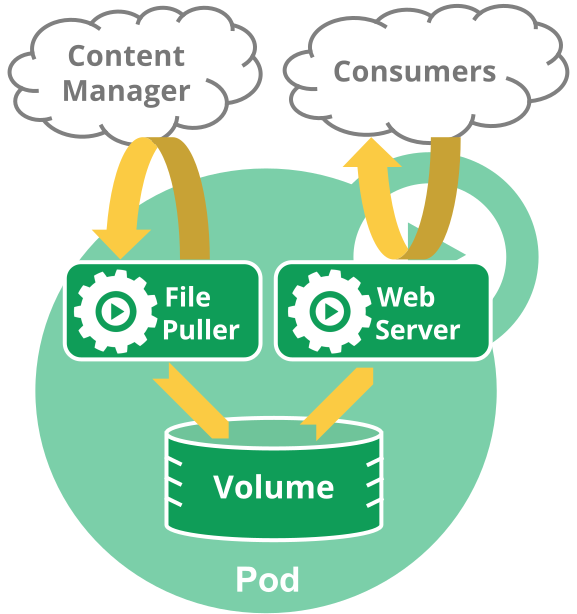
Some Pods have init containers as well as app containers. By default, init containers run and complete before the app containers are started.
You can also have sidecar containers that provide auxiliary services to the main application Pod (for example: a service mesh).
Kubernetes v1.33 [stable](enabled by default)Enabled by default, the SidecarContainers feature gate
allows you to specify restartPolicy: Always for init containers.
Setting the Always restart policy ensures that the containers where you set it are
treated as sidecars that are kept running during the entire lifetime of the Pod.
Containers that you explicitly define as sidecar containers
start up before the main application Pod and remain running until the Pod is
shut down.
A probe is a diagnostic performed periodically by the kubelet on a container. To perform a diagnostic, the kubelet can invoke different actions:
ExecAction (performed with the help of the container runtime)TCPSocketAction (checked directly by the kubelet)HTTPGetAction (checked directly by the kubelet)You can read more about probes in the Pod Lifecycle documentation.
To understand the context for why Kubernetes wraps a common Pod API in other resources (such as StatefulSets or Deployments), you can read about the prior art, including:
This page describes the lifecycle of a Pod. Pods follow a defined lifecycle, starting
in the Pending phase, moving through Running if at least one
of its primary containers starts OK, and then through either the Succeeded or
Failed phases depending on whether any container in the Pod terminated in failure.
Like individual application containers, Pods are considered to be relatively ephemeral (rather than durable) entities. Pods are created, assigned a unique ID (UID), and scheduled to run on nodes where they remain until termination (according to restart policy) or deletion. If a Node dies, the Pods running on (or scheduled to run on) that node are marked for deletion. The control plane marks the Pods for removal after a timeout period.
Whilst a Pod is running, the kubelet is able to restart containers to handle some kind of faults. Within a Pod, Kubernetes tracks different container states and determines what action to take to make the Pod healthy again.
In the Kubernetes API, Pods have both a specification and an actual status. The status for a Pod object consists of a set of Pod conditions. You can also inject custom readiness information into the condition data for a Pod, if that is useful to your application.
Pods are only scheduled once in their lifetime; assigning a Pod to a specific node is called binding, and the process of selecting which node to use is called scheduling. Once a Pod has been scheduled and is bound to a node, Kubernetes tries to run that Pod on the node. The Pod runs on that node until it stops, or until the Pod is terminated; if Kubernetes isn't able to start the Pod on the selected node (for example, if the node crashes before the Pod starts), then that particular Pod never starts.
You can use Pod Scheduling Readiness to delay scheduling for a Pod until all its scheduling gates are removed. For example, you might want to define a set of Pods but only trigger scheduling once all the Pods have been created.
If one of the containers in the Pod fails, then Kubernetes may try to restart that specific container. Read How Pods handle problems with containers to learn more.
Pods can however fail in a way that the cluster cannot recover from, and in that case Kubernetes does not attempt to heal the Pod further; instead, Kubernetes deletes the Pod and relies on other components to provide automatic healing.
If a Pod is scheduled to a node and that node then fails, the Pod is treated as unhealthy and Kubernetes eventually deletes the Pod. A Pod won't survive an eviction due to a lack of resources or Node maintenance.
Kubernetes uses a higher-level abstraction, called a controller, that handles the work of managing the relatively disposable Pod instances.
A given Pod (as defined by a UID) is never "rescheduled" to a different node; instead,
that Pod can be replaced by a new, near-identical Pod. If you make a replacement Pod, it can
even have same name (as in .metadata.name) that the old Pod had, but the replacement
would have a different .metadata.uid from the old Pod.
Kubernetes does not guarantee that a replacement for an existing Pod would be scheduled to the same node as the old Pod that was being replaced.
When something is said to have the same lifetime as a Pod, such as a volume, that means that the thing exists as long as that specific Pod (with that exact UID) exists. If that Pod is deleted for any reason, and even if an identical replacement is created, the related thing (a volume, in this example) is also destroyed and created anew.
A multi-container Pod that contains a file puller sidecar and a web server. The Pod uses an ephemeral emptyDir volume for shared storage between the containers.
A Pod's status field is a
PodStatus
object, which has a phase field.
The phase of a Pod is a simple, high-level summary of where the Pod is in its lifecycle. The phase is not intended to be a comprehensive rollup of observations of container or Pod state, nor is it intended to be a comprehensive state machine.
The number and meanings of Pod phase values are tightly guarded.
Other than what is documented here, nothing should be assumed about Pods that
have a given phase value.
Here are the possible values for phase:
| Value | Description |
|---|---|
Pending |
The Pod has been accepted by the Kubernetes cluster, but one or more of the containers has not been set up and made ready to run. This includes time a Pod spends waiting to be scheduled as well as the time spent downloading container images over the network. |
Running |
The Pod has been bound to a node, and all of the containers have been created. At least one container is still running, or is in the process of starting or restarting. |
Succeeded |
All containers in the Pod have terminated in success, and will not be restarted. |
Failed |
All containers in the Pod have terminated, and at least one container has terminated in failure. That is, the container either exited with non-zero status or was terminated by the system, and is not set for automatic restarting. |
Unknown |
For some reason the state of the Pod could not be obtained. This phase typically occurs due to an error in communicating with the node where the Pod should be running. |
When a pod is failing to start repeatedly, CrashLoopBackOff may appear in the Status field of some kubectl commands.
Similarly, when a pod is being deleted, Terminating may appear in the Status field of some kubectl commands.
Make sure not to confuse Status, a kubectl display field for user intuition, with the pod's phase.
Pod phase is an explicit part of the Kubernetes data model and of the
Pod API.
  NAMESPACE               NAME               READY   STATUS             RESTARTS   AGE
  alessandras-namespace   alessandras-pod    0/1     CrashLoopBackOff   200        2d9h
A Pod is granted a term to terminate gracefully, which defaults to 30 seconds.
You can use the flag --force to terminate a Pod by force.
Since Kubernetes 1.27, the kubelet transitions deleted Pods, except for
static Pods and
force-deleted Pods
without a finalizer, to a terminal phase (Failed or Succeeded depending on
the exit statuses of the pod containers) before their deletion from the API server.
If a node dies or is disconnected from the rest of the cluster, Kubernetes
applies a policy for setting the phase of all Pods on the lost node to Failed.
As well as the phase of the Pod overall, Kubernetes tracks the state of each container inside a Pod. You can use container lifecycle hooks to trigger events to run at certain points in a container's lifecycle.
Once the scheduler
assigns a Pod to a Node, the kubelet starts creating containers for that Pod
using a container runtime.
There are three possible container states: Waiting, Running, and Terminated.
To check the state of a Pod's containers, you can use
kubectl describe pod <name-of-pod>. The output shows the state for each container
within that Pod.
Each state has a specific meaning:
WaitingIf a container is not in either the Running or Terminated state, it is Waiting.
A container in the Waiting state is still running the operations it requires in
order to complete start up: for example, pulling the container image from a container
image registry, or applying Secret
data.
When you use kubectl to query a Pod with a container that is Waiting, you also see
a Reason field to summarize why the container is in that state.
RunningThe Running status indicates that a container is executing without issues. If there
was a postStart hook configured, it has already executed and finished. When you use
kubectl to query a Pod with a container that is Running, you also see information
about when the container entered the Running state.
TerminatedA container in the Terminated state began execution and then either ran to
completion or failed for some reason. When you use kubectl to query a Pod with
a container that is Terminated, you see a reason, an exit code, and the start and
finish time for that container's period of execution.
If a container has a preStop hook configured, this hook runs before the container enters
the Terminated state.
Kubernetes manages container failures within Pods using a restartPolicy defined
in the Pod spec. This policy determines how Kubernetes reacts to containers exiting due to errors
or other reasons, which falls in the following sequence:
restartPolicy.restartPolicy.
This prevents rapid, repeated restart attempts from overloading the system.In practice, a CrashLoopBackOff is a condition or event that might be seen as output
from the kubectl command, while describing or listing Pods, when a container in the Pod
fails to start properly and then continually tries and fails in a loop.
In other words, when a container enters the crash loop, Kubernetes applies the exponential backoff delay mentioned in the Container restart policy. This mechanism prevents a faulty container from overwhelming the system with continuous failed start attempts.
The CrashLoopBackOff can be caused by issues like the following:
Failure result
as mentioned in the probes section.To investigate the root cause of a CrashLoopBackOff issue, a user can:
kubectl logs <name-of-pod> to check the logs of the container.
This is often the most direct way to diagnose the issue causing the crashes.kubectl describe pod <name-of-pod> to see events
for the Pod, which can provide hints about configuration or resource issues.When a container in your Pod stops, or experiences failure, Kubernetes can restart it. A restart isn't always appropriate; for example, init containers run only once (if successful), during Pod startup. You can configure restarts as a policy that applies to all Pods, or using container-level configuration (for example: when you define a sidecar container) or define container-level override.
The Kubernetes project recommends following cloud-native principles, including resilient design that accounts for unannounced or arbitrary restarts. You can achieve this either by failing the Pod and relying on automatic replacement, or you can design for container-level resilience. Either approach helps to ensure that your overall workload remains available despite partial failure.
The spec of a Pod has a restartPolicy field with possible values Always, OnFailure,
and Never. The default value is Always.
The restartPolicy for a Pod applies to app containers
in the Pod and to regular init containers.
Sidecar containers
ignore the Pod-level restartPolicy field: in Kubernetes, a sidecar is defined as an
entry inside initContainers that has its container-level restartPolicy set to Always.
For init containers that exit with an error, the kubelet restarts the init container if
the Pod level restartPolicy is either OnFailure or Always:
Always: Automatically restarts the container after any termination.OnFailure: Only restarts the container if it exits with an error (non-zero exit status).Never: Does not automatically restart the terminated container.The following table shows how containers behave under different restart policies and exit codes:
| Exit Code | restartPolicy: Always |
restartPolicy: OnFailure |
restartPolicy: Never |
Sidecar Containers |
|---|---|---|---|---|
| 0 (Success) | Restarts | Does not restart | Does not restart | Always restarts |
| Non-zero (Failure) | Restarts | Restarts | Does not restart | Always restarts |
The restart behavior is particularly important when choosing between Deployments and Jobs:
restartPolicy: Always (the only allowed value) to keep applications running continuouslyrestartPolicy: OnFailure or restartPolicy: Never to handle batch processing tasks appropriatelyrestartPolicy because they have their own container-level restartPolicy: AlwaysHere are concrete examples demonstrating the different restart behaviors:
Example 1: Web server with restartPolicy: Always (typical for Deployments)
apiVersion: v1
kind: Pod
metadata:
  name: web-server
spec:
  restartPolicy: Always  # Container restarts regardless of exit code
  containers:
  - name: nginx
    image: nginx:1.14.2
    # If this container crashes or exits for any reason, it will be restarted
Example 2: Batch job with restartPolicy: OnFailure
apiVersion: batch/v1
kind: Job
metadata:
  name: data-processor
spec:
  template:
    spec:
      restartPolicy: OnFailure  # Only restart on non-zero exit codes
      containers:
      - name: processor
        image: busybox:1.28
        command: ['sh', '-c', 'echo "Processing data..."; exit 0']
        # Exit code 0: Job completes successfully, no restart
        # Exit code 1+: Container restarts to retry the task
Example 3: One-time task with restartPolicy: Never
apiVersion: v1
kind: Pod
metadata:
  name: migration-task
spec:
  restartPolicy: Never  # Never restart, regardless of exit code
  containers:
  - name: migrate
    image: busybox:1.28
    command: ['sh', '-c', 'echo "Running migration..."; exit 1']
    # Even with exit code 1 (failure), the container will not restart
    # The Pod will remain in Failed state
Sidecar containers have special restart behavior that differs from regular app containers:
restartPolicy: They use their own container-level restartPolicy field, which is always set to AlwaysExample: Pod with sidecar container
apiVersion: v1
kind: Pod
metadata:
  name: app-with-sidecar
spec:
  restartPolicy: OnFailure  # Applies to main container only
  initContainers:
  - name: logging-sidecar    # This is a sidecar container
    image: fluent/fluent-bit:1.8
    restartPolicy: Always    # Sidecar always restarts regardless of exit code
    # Provides logging services throughout Pod lifetime
  containers:
  - name: main-app          # This follows Pod-level restartPolicy
    image: nginx:1.14.2
    # Will only restart on failure (non-zero exit) due to Pod's OnFailure policy
restartPolicy: OnFailure, the sidecar container will restart regardless of its exit code because sidecar containers always have restartPolicy: Always at the container level.When the kubelet is handling container restarts according to the configured restart
policy, that only applies to restarts that make replacement containers inside the
same Pod and running on the same node. After containers in a Pod exit, the kubelet
restarts them with an exponential backoff delay (10s, 20s, 40s, …), that is capped at
300 seconds (5 minutes). Once a container has executed for 10 minutes without any
problems, the kubelet resets the restart backoff timer for that container.
Sidecar containers and Pod lifecycle
explains the behaviour of init containers when specify restartPolicy field on it.
Kubernetes v1.35 [beta](enabled by default)If your cluster has the feature gate ContainerRestartRules enabled, you can specify
restartPolicy and restartPolicyRules on individual containers to override the Pod
restart policy. Container restart policy and rules applies to app containers
in the Pod and to regular init containers.
A Kubernetes-native sidecar container
has its container-level restartPolicy set to Always.
The container restarts will follow the same exponential backoff as pod restart policy described above. Supported container restart policies:
Always: Automatically restarts the container after any termination.OnFailure: Only restarts the container if it exits with an error (non-zero exit status).Never: Does not automatically restart the terminated container.Additionally, individual containers can specify restartPolicyRules. If the restartPolicyRules
field is specified, then container restartPolicy must also be specified. The restartPolicyRules
define a list of rules to apply on container exit. Each rule will consist of a condition
and an action. The supported condition is exitCodes, which compares the exit code of the container
with a list of given values. The supported action is Restart, which means the container will be
restarted. The rules will be evaluated in order. On the first match, the action will be applied.
If none of the rules’ conditions matched, Kubernetes fallback to container’s configured
restartPolicy.
For example, a Pod with OnFailure restart policy that have a try-once container. This allows
Pod to only restart certain containers:
apiVersion: v1
kind: Pod
metadata:
  name: on-failure-pod
spec:
  restartPolicy: OnFailure
  containers:
  - name: try-once-container    # This container will run only once because the restartPolicy is Never.
    image: registry.k8s.io/busybox:1.27.2
    command: ['sh', '-c', 'echo "Only running once" && sleep 10 && exit 1']
    restartPolicy: Never
  - name: on-failure-container  # This container will be restarted on failure.
    image: registry.k8s.io/busybox:1.27.2
    command: ['sh', '-c', 'echo "Keep restarting" && sleep 1800 && exit 1']
A Pod with Always restart policy with an init container that only execute once. If the init
container fails, the Pod fails. This allows the Pod to fail if the initialization failed,
but also keep running once the initialization succeeds:
apiVersion: v1
kind: Pod
metadata:
  name: fail-pod-if-init-fails
spec:
  restartPolicy: Always
  initContainers:
  - name: init-once      # This init container will only try once. If it fails, the pod will fail.
    image: registry.k8s.io/busybox:1.27.2
    command: ['sh', '-c', 'echo "Failing initialization" && sleep 10 && exit 1']
    restartPolicy: Never
  containers:
  - name: main-container # This container will always be restarted once initialization succeeds.
    image: registry.k8s.io/busybox:1.27.2
    command: ['sh', '-c', 'sleep 1800 && exit 0']
A Pod with Never restart policy with a container that ignores and restarts on specific exit codes. This is useful to differentiate between restartable errors and non-restartable errors:
apiVersion: v1
kind: Pod
metadata:
  name: restart-on-exit-codes
spec:
  restartPolicy: Never
  containers:
  - name: restart-on-exit-codes
    image: registry.k8s.io/busybox:1.27.2
    command: ['sh', '-c', 'sleep 60 && exit 0']
    restartPolicy: Never     # Container restart policy must be specified if rules are specified
    restartPolicyRules:      # Only restart the container if it exits with code 42
    - action: Restart
      exitCodes:
        operator: In
        values: [42]
Restart rules can be used for many more advanced lifecycle management scenarios. Note, restart rules are affected by the same inconsistencies as the regular restart policy. The kubelet restarts, container runtime garbage collection, intermitted connectivity issues with the control plane may cause the state loss and containers may be re-run even when you expect a container not to be restarted.
Kubernetes v1.35 [alpha](disabled by default)If your cluster has the feature gate RestartAllContainersOnContainerExits enabled, you can specify
RestartAllContainers as an action in restartPolicyRules at container level. When a container's exit
matches a rule with this action, the entire Pod is terminated and restarted in-place.
This "in-place" restart offers a more efficient way to reset a Pod's state compared to full deletion and recreation. This is especially valuable for workloads where rescheduling is costly, such as batch jobs or AI/ML training tasks.
When a RestartAllContainers action is triggered, the kubelet performs the following steps:
Fast Termination: All running containers in the Pod are terminated.
The configured terminationGracePeriodSeconds is not respected, and any configured preStop hooks
are not executed. This ensures a swift shutdown.
Preservation of Pod Resources: The Pod's essential resources are preserved:
emptyDir and mounted volumesPod Status Update: The Pod's status is updated with a PodRestartInPlace condition set to True.
This makes the restart process observable.
Full Restart Sequence: Once all containers are terminated, the PodRestartInPlace condition
is set to False, and the Pod begins the standard startup process:
A key aspect of this feature is that all containers are restarted, including those that
previously completed successfully or failed. The RestartAllContainers action overrides
any configured container-level or Pod-level restartPolicy.
This mechanism is useful in scenarios where a clean slate for all containers is necessary, such as:
init container sets up an environment that can become corrupted, this feature ensures
the setup process is re-executed.Consider a workload where a watcher sidecar is responsible for restarting the main application from a known-good state if it encounters an error. The watcher can exit with a specific code to trigger a full, in-place restart of the worker Pod.
apiVersion: v1
kind: Pod
metadata:
  name: ml-worker
spec:
  restartPolicy: Never # The pod itself should not restart unless explicitly told to.
  initContainers:
  - name: setup-environment
    image: registry.k8s.io/busybox:1.27.2
    command: ['sh', '-c', 'echo "Setting up environment"']
    # This init container runs once to prepare the environment.
    # It will run again after a RestartAllContainers action.
  - name: watcher-sidecar
    image: registry.k8s.io/busybox:1.27.2
    # In a real-world scenario, this would be a dedicated watcher image.
    # This command simulates the watcher exiting with a special code.
    command: ['sh', '-c', 'sleep 60; exit 88']
    restartPolicy: Always
    restartPolicyRules:
    - action: RestartAllContainers
      exitCodes:
        # Exit code 88 triggers a full pod restart.
        operator: In
        values: [88]
  containers:
  - name: main-application
    image: registry.k8s.io/busybox:1.27.2
    command: ['sh', '-c', 'echo "Application is running"; sleep 3600']
In this example:
restartPolicy is Never.watcher-sidecar runs a command and then exits with code 88.RestartAllContainers action.setup-environment init container and the main-application container,
is then restarted in-place. The pod keeps its UID, sandbox, IP, and volumes.Kubernetes v1.33 [alpha](disabled by default)With the alpha feature gate ReduceDefaultCrashLoopBackOffDecay enabled,
container start retries across your cluster will be reduced to begin at 1s
(instead of 10s) and increase exponentially by 2x each restart until a maximum
delay of 60s (instead of 300s which is 5 minutes).
If you use this feature along with the alpha feature
KubeletCrashLoopBackOffMax (described below), individual nodes may have
different maximum delays.
Kubernetes v1.35 [beta](enabled by default)With the feature gate KubeletCrashLoopBackOffMax enabled, you can
reconfigure the maximum delay between container start retries from the default
of 300s (5 minutes). This configuration is set per node using kubelet
configuration. In your kubelet configuration,
under crashLoopBackOff set the maxContainerRestartPeriod field between "1s" and
"300s". As described above in Container restart policy,
delays on that node will still start at 10s and increase exponentially by 2x
each restart, but will now be capped at your configured maximum. If the
maxContainerRestartPeriod you configure is less than the default initial value
of 10s, the initial delay will instead be set to the configured maximum.
See the following kubelet configuration examples:
# container restart delays will start at 10s, increasing
# 2x each time they are restarted, to a maximum of 100s
kind: KubeletConfiguration
crashLoopBackOff:
    maxContainerRestartPeriod: "100s"
# delays between container restarts will always be 2s
kind: KubeletConfiguration
crashLoopBackOff:
    maxContainerRestartPeriod: "2s"
If you use this feature along with the alpha feature
ReduceDefaultCrashLoopBackOffDecay (described above), your cluster defaults
for initial backoff and maximum backoff will no longer be 10s and 300s, but 1s
and 60s. Per node configuration takes precedence over the defaults set by
ReduceDefaultCrashLoopBackOffDecay, even if this would result in a node having
a longer maximum backoff than other nodes in the cluster.
A Pod has a PodStatus, which has an array of PodConditions through which the Pod has or has not passed. The kubelet manages the following PodConditions:
PodScheduled: the Pod has been scheduled to a node.PodReadyToStartContainers: (beta feature; enabled by default) the
Pod sandbox has been successfully created and networking configured.ContainersReady: all containers in the Pod are ready.Initialized: all init containers
have completed successfully.Ready: the Pod is able to serve requests and should be added to the load
balancing pools of all matching Services.DisruptionTarget: the pod is about to be terminated due to a disruption (such as preemption, eviction or garbage-collection).PodResizePending: a pod resize was requested but cannot be applied. See Pod resize status.PodResizeInProgress: the pod is in the process of resizing. See
Pod resize status.| Field name | Description |
|---|---|
type |
Name of this Pod condition. |
status |
Indicates whether that condition is applicable, with possible values "True", "False", or "Unknown". |
lastProbeTime |
Timestamp of when the Pod condition was last probed. |
lastTransitionTime |
Timestamp for when the Pod last transitioned from one status to another. |
reason |
Machine-readable, UpperCamelCase text indicating the reason for the condition's last transition. |
message |
Human-readable message indicating details about the last status transition. |
Kubernetes v1.14 [stable]
Your application can inject extra feedback or signals into PodStatus:
Pod readiness. To use this, set readinessGates in the Pod's spec to
specify a list of additional conditions that the kubelet evaluates for Pod readiness.
Readiness gates are determined by the current state of status.condition
fields for the Pod. If Kubernetes cannot find such a condition in the
status.conditions field of a Pod, the status of the condition
is defaulted to "False".
Here is an example:
kind: Pod
...
spec:
  readinessGates:
    - conditionType: "www.example.com/feature-1"
status:
  conditions:
    - type: Ready                              # a built-in PodCondition
      status: "False"
      lastProbeTime: null
      lastTransitionTime: 2018-01-01T00:00:00Z
    - type: "www.example.com/feature-1"        # an extra PodCondition
      status: "False"
      lastProbeTime: null
      lastTransitionTime: 2018-01-01T00:00:00Z
  containerStatuses:
    - containerID: docker://abcd...
      ready: true
...
The Pod conditions you add must have names that meet the Kubernetes label key format.
The kubectl patch command does not support patching object status.
To set these status.conditions for the Pod, applications and
operators should use
the PATCH action.
You can use a Kubernetes client library to
write code that sets custom Pod conditions for Pod readiness.
For a Pod that uses custom conditions, that Pod is evaluated to be ready only when both the following statements apply:
readinessGates are True.When a Pod's containers are Ready but at least one custom condition is missing or
False, the kubelet sets the Pod's condition to ContainersReady.
Kubernetes v1.29 [beta]
PodHasNetwork.After a Pod gets scheduled on a node, it needs to be admitted by the kubelet and
to have any required storage volumes mounted. Once these phases are complete,
the kubelet works with
a container runtime (using Container Runtime Interface (CRI)) to set up a
runtime sandbox and configure networking for the Pod. If the
PodReadyToStartContainersCondition
feature gate is enabled
(it is enabled by default for Kubernetes 1.35), the
PodReadyToStartContainers condition will be added to the status.conditions field of a Pod.
The PodReadyToStartContainers condition is set to False by the kubelet when it detects a
Pod does not have a runtime sandbox with networking configured. This occurs in
the following scenarios:
The PodReadyToStartContainers condition is set to True by the kubelet after the
successful completion of sandbox creation and network configuration for the Pod
by the runtime plugin. The kubelet can start pulling container images and create
containers after PodReadyToStartContainers condition has been set to True.
For a Pod with init containers, the kubelet sets the Initialized condition to
True after the init containers have successfully completed (which happens
after successful sandbox creation and network configuration by the runtime
plugin). For a Pod without init containers, the kubelet sets the Initialized
condition to True before sandbox creation and network configuration starts.
Kubernetes v1.35 [stable](enabled by default)Kubernetes supports changing the CPU and memory resources allocated to Pods after they are created. (For other infrastructure resources, you would need to use different techniques specific to those resources.) There are two main approaches to resizing CPU and memory:
You can resize a Pod's container-level CPU and memory resources without recreating the Pod. This is also called in-place Pod vertical scaling. This allows you to adjust resource allocation for running containers while potentially avoiding application disruption.
To perform an in-place resize, you update the Pod's desired state using the /resize
subresource. The kubelet then attempts to apply the new resource values to the running
containers. The Pod conditions
PodResizePending and PodResizeInProgress (described in Pod conditions)
indicate the status of the resize operation. For more details about resize status, see
Container Resize Status.
Key considerations for in-place resize:
resizePolicy in the container specification.For detailed instructions on performing in-place resize, see Resize CPU and Memory Resources assigned to Containers.
The more cloud native approach to changing a Pod's resources is through the workload resource that manages it (such as a Deployment or StatefulSet). When you update the resource specifications in the Pod template, the workload's controller creates new Pods with the updated resources and terminates the old Pods according to its update strategy.
This approach:
You can also use a VerticalPodAutoscaler to automatically manage Pod resource recommendations and updates.
A probe is a diagnostic performed periodically by the kubelet on a container. To perform a diagnostic, the kubelet either executes code within the container, or makes a network request.
There are four different ways to check a container using a probe. Each probe must define exactly one of these four mechanisms:
execgrpcstatus
of the response is SERVING.httpGetGET request against the Pod's IP
address on a specified port and path. The diagnostic is
considered successful if the response has a status code
greater than or equal to 200 and less than 400. See
Configure Probes
for more information on how the kubelet follows redirects.tcpSocketexec probe's implementation involves
the creation/forking of multiple processes each time when executed.
As a result, in case of the clusters having higher pod densities,
lower intervals of initialDelaySeconds, periodSeconds,
configuring any probe with exec mechanism might introduce an overhead on the cpu usage of the node.
In such scenarios, consider using the alternative probe mechanisms to avoid the overhead.Each probe has one of three results:
SuccessFailureUnknownThe kubelet can optionally perform and react to three kinds of probes on running containers:
livenessProbeSuccess.readinessProbeFailure. If a container does
not provide a readiness probe, the default state is Success.startupProbeSuccess.For more information about how to set up a liveness, readiness, or startup probe, see Configure Liveness, Readiness and Startup Probes.
If the process in your container is able to crash on its own whenever it
encounters an issue or becomes unhealthy, you do not necessarily need a liveness
probe; the kubelet will automatically perform the correct action in accordance
with the Pod's restartPolicy.
If you'd like your container to be killed and restarted if a probe fails, then
specify a liveness probe, and specify a restartPolicy of Always or OnFailure.
If you'd like to start sending traffic to a Pod only when a probe succeeds, specify a readiness probe. In this case, the readiness probe might be the same as the liveness probe, but the existence of the readiness probe in the spec means that the Pod will start without receiving any traffic and only start receiving traffic after the probe starts succeeding.
If you want your container to be able to take itself down for maintenance, you can specify a readiness probe that checks an endpoint specific to readiness that is different from the liveness probe.
If your app has a strict dependency on back-end services, you can implement both a liveness and a readiness probe. The liveness probe passes when the app itself is healthy, but the readiness probe additionally checks that each required back-end service is available. This helps you avoid directing traffic to Pods that can only respond with error messages.
If your container needs to work on loading large data, configuration files, or migrations during startup, you can use a startup probe. However, if you want to detect the difference between an app that has failed and an app that is still processing its startup data, you might prefer a readiness probe.
EndpointSlice will update its conditions:
the endpoint ready condition will be set to false, so load balancers
will not use the Pod for regular traffic. See Pod termination
for more information about how the kubelet handles Pod deletion.Startup probes are useful for Pods that have containers that take a long time to come into service. Rather than set a long liveness interval, you can configure a separate configuration for probing the container as it starts up, allowing a time longer than the liveness interval would allow.
If your container usually starts in more than
\( initialDelaySeconds + failureThreshold \times periodSeconds \), you should specify a
startup probe that checks the same endpoint as the liveness probe. The default for
periodSeconds is 10s. You should then set its failureThreshold high enough to
allow the container to start, without changing the default values of the liveness
probe. This helps to protect against deadlocks.
Because Pods represent processes running on nodes in the cluster, it is important to
allow those processes to gracefully terminate when they are no longer needed (rather
than being abruptly stopped with a KILL signal and having no chance to clean up).
The design aim is for you to be able to request deletion and know when processes terminate, but also be able to ensure that deletes eventually complete. When you request deletion of a Pod, the cluster records and tracks the intended grace period before the Pod is allowed to be forcefully killed. With that forceful shutdown tracking in place, the kubelet attempts graceful shutdown.
Typically, with this graceful termination of the pod, kubelet makes requests to the container runtime
to attempt to stop the containers in the pod by first sending a TERM (aka. SIGTERM) signal,
with a grace period timeout, to the main process in each container.
The requests to stop the containers are processed by the container runtime asynchronously.
There is no guarantee to the order of processing for these requests.
Many container runtimes respect the STOPSIGNAL value defined in the container image and,
if different, send the container image configured STOPSIGNAL instead of TERM.
Once the grace period has expired, the KILL signal is sent to any remaining
processes, and the Pod is then deleted from the
API Server. If the kubelet or the
container runtime's management service is restarted while waiting for processes to terminate, the
cluster retries from the start including the full original grace period.
The stop signal used to kill the container can be defined in the container image with the STOPSIGNAL instruction.
If no stop signal is defined in the image, the default signal of the container runtime
(SIGTERM for both containerd and CRI-O) would be used to kill the container.
Kubernetes v1.33 [alpha](disabled by default)If the ContainerStopSignals feature gate is enabled, you can configure a custom stop signal
for your containers from the container Lifecycle. We require the Pod's spec.os.name field
to be present as a requirement for defining stop signals in the container lifecycle.
The list of signals that are valid depends on the OS the Pod is scheduled to.
For Pods scheduled to Windows nodes, we only support SIGTERM and SIGKILL as valid signals.
Here is an example Pod spec defining a custom stop signal:
spec:
  os:
    name: linux
  containers:
    - name: my-container
      image: container-image:latest
      lifecycle:
        stopSignal: SIGUSR1
If a stop signal is defined in the lifecycle, this will override the signal defined in the container image. If no stop signal is defined in the container spec, the container would fall back to the default behavior.
Pod termination flow, illustrated with an example:
You use the kubectl tool to manually delete a specific Pod, with the default grace period
(30 seconds).
The Pod in the API server is updated with the time beyond which the Pod is considered "dead"
along with the grace period.
If you use kubectl describe to check the Pod you're deleting, that Pod shows up as "Terminating".
On the node where the Pod is running: as soon as the kubelet sees that a Pod has been marked
as terminating (a graceful shutdown duration has been set), the kubelet begins the local Pod
shutdown process.
If one of the Pod's containers has defined a preStop
hook and the terminationGracePeriodSeconds
in the Pod spec is not set to 0, the kubelet runs that hook inside of the container.
The default terminationGracePeriodSeconds setting is 30 seconds.
If the preStop hook is still running after the grace period expires, the kubelet requests
a small, one-off grace period extension of 2 seconds.
preStop hook needs longer to complete than the default grace period allows,
you must modify terminationGracePeriodSeconds to suit this.The kubelet triggers the container runtime to send a TERM signal to process 1 inside each container.
There is special ordering if the Pod has any
sidecar containers defined.
Otherwise, the containers in the Pod receive the TERM signal at different times and in
an arbitrary order. If the order of shutdowns matters, consider using a preStop hook
to synchronize (or switch to using sidecar containers).
At the same time as the kubelet is starting graceful shutdown of the Pod, the control plane evaluates whether to remove that shutting-down Pod from EndpointSlice objects, where those objects represent a Service with a configured selector. ReplicaSets and other workload resources no longer treat the shutting-down Pod as a valid, in-service replica.
Pods that shut down slowly should not continue to serve regular traffic and should start terminating and finish processing open connections. Some applications need to go beyond finishing open connections and need more graceful termination, for example, session draining and completion.
Any endpoints that represent the terminating Pods are not immediately removed from
EndpointSlices, and a status indicating terminating state
is exposed from the EndpointSlice API.
Terminating endpoints always have their ready status as false (for backward compatibility
with versions before 1.26), so load balancers will not use it for regular traffic.
If traffic draining on terminating Pod is needed, the actual readiness can be checked as a
condition serving. You can find more details on how to implement connections draining in the
tutorial Pods And Endpoints Termination Flow
The kubelet ensures the Pod is shut down and terminated
SIGKILL to any processes still running in any container in the Pod.
The kubelet also cleans up a hidden pause container if that container runtime uses one.Failed or Succeeded depending on
the end state of its containers).By default, all deletes are graceful within 30 seconds. The kubectl delete command supports
the --grace-period=<seconds> option which allows you to override the default and specify your
own value.
Setting the grace period to 0 forcibly and immediately deletes the Pod from the API
server. If the Pod was still running on a node, that forcible deletion triggers the kubelet to
begin immediate cleanup.
Using kubectl, You must specify an additional flag --force along with --grace-period=0
in order to perform force deletions.
When a force deletion is performed, the API server does not wait for confirmation from the kubelet that the Pod has been terminated on the node it was running on. It removes the Pod in the API immediately so a new Pod can be created with the same name. On the node, Pods that are set to terminate immediately will still be given a small grace period before being force killed.
If you need to force-delete Pods that are part of a StatefulSet, refer to the task documentation for deleting Pods from a StatefulSet.
If your Pod includes one or more
sidecar containers
(init containers with an Always restart policy), the kubelet will delay sending
the TERM signal to these sidecar containers until the last main container has fully terminated.
The sidecar containers will be terminated in the reverse order they are defined in the Pod spec.
This ensures that sidecar containers continue serving the other containers in the Pod until they
are no longer needed.
This means that slow termination of a main container will also delay the termination of the sidecar containers. If the grace period expires before the termination process is complete, the Pod may enter forced termination. In this case, all remaining containers in the Pod will be terminated simultaneously with a short grace period.
Similarly, if the Pod has a preStop hook that exceeds the termination grace period, emergency termination may occur.
In general, if you have used preStop hooks to control the termination order without sidecar containers, you can now
remove them and allow the kubelet to manage sidecar termination automatically.
For failed Pods, the API objects remain in the cluster's API until a human or controller process explicitly removes them.
The Pod garbage collector (PodGC), which is a controller in the control plane, cleans up
terminated Pods (with a phase of Succeeded or Failed), when the number of Pods exceeds the
configured threshold (determined by terminated-pod-gc-threshold in the kube-controller-manager).
This avoids a resource leak as Pods are created and terminated over time.
Additionally, PodGC cleans up any Pods which satisfy any of the following conditions:
node.kubernetes.io/out-of-service.Along with cleaning up the Pods, PodGC will also mark them as failed if they are in a non-terminal phase. Also, PodGC adds a Pod disruption condition when cleaning up an orphan Pod. See Pod disruption conditions for more details.
If you restart the kubelet, Pods (and their containers) continue to run
even during the restart.
When there are running Pods on a node, stopping or restarting the kubelet
on that node does not cause the kubelet to stop all local Pods
before the kubelet itself stops.
To stop the Pods on a node, you can use kubectl drain.
Kubernetes v1.35 [deprecated](disabled by default)When the kubelet starts, it checks to see if there is already a Node with bound Pods.
If the Node's Ready condition remains unchanged,
in other words the condition has not transitioned from true to false, Kubernetes detects this a kubelet restart.
(It's possible to restart the kubelet in other ways, for example to fix a node bug,
but in these cases, Kubernetes picks the safe option and treats this as if you
stopped the kubelet and then later started it).
When the kubelet restarts, the container statuses are managed differently based on the feature gate setting:
By default, the kubelet does not change container statuses after a restart.
Containers that were in set to ready: true state remain remain ready.
If you stop the kubelet long enough for it to fail a series of
node heartbeat checks,
and then you wait before you start the kubelet again, Kubernetes may begin to evict Pods from that Node.
However, even though Pod evictions begin to happen, Kubernetes does not mark the
individual containers in those Pods as ready: false. The Pod-level eviction
happens after the control plane taints the node as node.kubernetes.io/not-ready (due to the failed heartbeats).
In Kubernetes 1.35 you can opt in to a legacy behavior where the kubelet always modify
the containers ready value, after a kubelet restart, to be false.
This legacy behavior was the default for a long time, but caused issue for people using Kubernetes,
especially in large scale deployments. Althought the feature gate allows reverting to this legacy
behavior temporarily, the Kubernetes project recommends that you file a bug report if you encounter problems.
The ChangeContainerStatusOnKubeletRestart
feature gate
will be removed in the future.
Get hands-on experience attaching handlers to container lifecycle events.
Get hands-on experience configuring Liveness, Readiness and Startup Probes.
Learn more about container lifecycle hooks.
Learn more about sidecar containers.
For detailed information about Pod and container status in the API, see
the API reference documentation covering
status for Pod.
This page provides an overview of init containers: specialized containers that run before app containers in a Pod. Init containers can contain utilities or setup scripts not present in an app image.
You can specify init containers in the Pod specification alongside the containers
array (which describes app containers).
In Kubernetes, a sidecar container is a container that starts before the main application container and continues to run. This document is about init containers: containers that run to completion during Pod initialization.
A Pod can have multiple containers running apps within it, but it can also have one or more init containers, which are run before the app containers are started.
Init containers are exactly like regular containers, except:
If a Pod's init container fails, the kubelet repeatedly restarts that init container until it succeeds.
However, if the Pod has a restartPolicy of Never, and an init container fails during startup of that Pod, Kubernetes treats the overall Pod as failed.
To specify an init container for a Pod, add the initContainers field into
the Pod specification,
as an array of container items (similar to the app containers field and its contents).
See Container in the
API reference for more details.
The status of the init containers is returned in .status.initContainerStatuses
field as an array of the container statuses (similar to the .status.containerStatuses
field).
Init containers support all the fields and features of app containers, including resource limits, volumes, and security settings. However, the resource requests and limits for an init container are handled differently, as documented in Resource sharing within containers.
Regular init containers (in other words: excluding sidecar containers) do not support the
lifecycle, livenessProbe, readinessProbe, or startupProbe fields. Init containers
must run to completion before the Pod can be ready; sidecar containers continue running
during a Pod's lifetime, and do support some probes. See sidecar container
for further details about sidecar containers.
If you specify multiple init containers for a Pod, kubelet runs each init container sequentially. Each init container must succeed before the next can run. When all of the init containers have run to completion, kubelet initializes the application containers for the Pod and runs them as usual.
Init containers run and complete their tasks before the main application container starts. Unlike sidecar containers, init containers are not continuously running alongside the main containers.
Init containers run to completion sequentially, and the main container does not start until all the init containers have successfully completed.
init containers do not support lifecycle, livenessProbe, readinessProbe, or
startupProbe whereas sidecar containers support all these probes to control their lifecycle.
Init containers share the same resources (CPU, memory, network) with the main application containers but do not interact directly with them. They can, however, use shared volumes for data exchange.
Because init containers have separate images from app containers, they have some advantages for start-up related code:
FROM another image just to use a tool like
sed, awk, python, or dig during setup.Here are some ideas for how to use init containers:
Wait for a Service to be created, using a shell one-line command like:
for i in {1..100}; do sleep 1; if nslookup myservice; then exit 0; fi; done; exit 1
Register this Pod with a remote server from the downward API with a command like:
curl -X POST http://$MANAGEMENT_SERVICE_HOST:$MANAGEMENT_SERVICE_PORT/register -d 'instance=$(<POD_NAME>)&ip=$(<POD_IP>)'
Wait for some time before starting the app container with a command like
sleep 60
Clone a Git repository into a Volume
Place values into a configuration file and run a template tool to dynamically
generate a configuration file for the main app container. For example,
place the POD_IP value in a configuration and generate the main app
configuration file using Jinja.
This example defines a simple Pod that has two init containers.
The first waits for myservice, and the second waits for mydb. Once both
init containers complete, the Pod runs the app container from its spec section.
apiVersion: v1
kind: Pod
metadata:
  name: myapp-pod
  labels:
    app.kubernetes.io/name: MyApp
spec:
  containers:
  - name: myapp-container
    image: busybox:1.28
    command: ['sh', '-c', 'echo The app is running! && sleep 3600']
  initContainers:
  - name: init-myservice
    image: busybox:1.28
    command: ['sh', '-c', "until nslookup myservice.$(cat /var/run/secrets/kubernetes.io/serviceaccount/namespace).svc.cluster.local; do echo waiting for myservice; sleep 2; done"]
  - name: init-mydb
    image: busybox:1.28
    command: ['sh', '-c', "until nslookup mydb.$(cat /var/run/secrets/kubernetes.io/serviceaccount/namespace).svc.cluster.local; do echo waiting for mydb; sleep 2; done"]
You can start this Pod by running:
kubectl apply -f myapp.yaml
The output is similar to this:
pod/myapp-pod created
And check on its status with:
kubectl get -f myapp.yaml
The output is similar to this:
NAME        READY     STATUS     RESTARTS   AGE
myapp-pod   0/1       Init:0/2   0          6m
or for more details:
kubectl describe -f myapp.yaml
The output is similar to this:
Name:          myapp-pod
Namespace:     default
[...]
Labels:        app.kubernetes.io/name=MyApp
Status:        Pending
[...]
Init Containers:
  init-myservice:
[...]
    State:         Running
[...]
  init-mydb:
[...]
    State:         Waiting
      Reason:      PodInitializing
    Ready:         False
[...]
Containers:
  myapp-container:
[...]
    State:         Waiting
      Reason:      PodInitializing
    Ready:         False
[...]
Events:
  FirstSeen    LastSeen    Count    From                      SubObjectPath                           Type          Reason        Message
  ---------    --------    -----    ----                      -------------                           --------      ------        -------
  16s          16s         1        {default-scheduler }                                              Normal        Scheduled     Successfully assigned myapp-pod to 172.17.4.201
  16s          16s         1        {kubelet 172.17.4.201}    spec.initContainers{init-myservice}     Normal        Pulling       pulling image "busybox"
  13s          13s         1        {kubelet 172.17.4.201}    spec.initContainers{init-myservice}     Normal        Pulled        Successfully pulled image "busybox"
  13s          13s         1        {kubelet 172.17.4.201}    spec.initContainers{init-myservice}     Normal        Created       Created container init-myservice
  13s          13s         1        {kubelet 172.17.4.201}    spec.initContainers{init-myservice}     Normal        Started       Started container init-myservice
To see logs for the init containers in this Pod, run:
kubectl logs myapp-pod -c init-myservice # Inspect the first init container
kubectl logs myapp-pod -c init-mydb      # Inspect the second init container
At this point, those init containers will be waiting to discover Services named
mydb and myservice.
Here's a configuration you can use to make those Services appear:
---
apiVersion: v1
kind: Service
metadata:
  name: myservice
spec:
  ports:
  - protocol: TCP
    port: 80
    targetPort: 9376
---
apiVersion: v1
kind: Service
metadata:
  name: mydb
spec:
  ports:
  - protocol: TCP
    port: 80
    targetPort: 9377
To create the mydb and myservice services:
kubectl apply -f services.yaml
The output is similar to this:
service/myservice created
service/mydb created
You'll then see that those init containers complete, and that the myapp-pod
Pod moves into the Running state:
kubectl get -f myapp.yaml
The output is similar to this:
NAME        READY     STATUS    RESTARTS   AGE
myapp-pod   1/1       Running   0          9m
This simple example should provide some inspiration for you to create your own init containers. What's next contains a link to a more detailed example.
During Pod startup, the kubelet delays running init containers until the networking and storage are ready. Then the kubelet runs the Pod's init containers in the order they appear in the Pod's spec.
Each init container must exit successfully before
the next container starts. If a container fails to start due to the runtime or
exits with failure, it is retried according to the Pod restartPolicy. However,
if the Pod restartPolicy is set to Always, the init containers use
restartPolicy OnFailure.
A Pod cannot be Ready until all init containers have succeeded. The ports on an
init container are not aggregated under a Service. A Pod that is initializing
is in the Pending state but should have a condition Initialized set to false.
If the Pod restarts, or is restarted, all init containers must execute again.
Changes to the init container spec are limited to the container image field.
Directly altering the image field of an init container does not restart the
Pod or trigger its recreation. If the Pod has yet to start, that change may
have an effect on how the Pod boots up.
For a pod template you can typically change any field for an init container; the impact of making that change depends on where the pod template is used.
Because init containers can be restarted, retried, or re-executed, init container
code should be idempotent. In particular, code that writes into any emptyDir volume
should be prepared for the possibility that an output file already exists.
Init containers have all of the fields of an app container. However, Kubernetes
prohibits readinessProbe from being used because init containers cannot
define readiness distinct from completion. This is enforced during validation.
Use activeDeadlineSeconds on the Pod to prevent init containers from failing forever.
The active deadline includes init containers.
However it is recommended to use activeDeadlineSeconds only if teams deploy their application
as a Job, because activeDeadlineSeconds has an effect even after initContainer finished.
The Pod which is already running correctly would be killed by activeDeadlineSeconds if you set.
The name of each app and init container in a Pod must be unique; a validation error is thrown for any container sharing a name with another.
Given the order of execution for init, sidecar and app containers, the following rules for resource usage apply:
Quota and limits are applied based on the effective Pod request and limit.
On Linux, resource allocations for Pod level control groups (cgroups) are based on the effective Pod request and limit, the same as the scheduler.
A Pod can restart, causing re-execution of init containers, for the following reasons:
restartPolicy is set to Always,
forcing a restart, and the init container completion record has been lost due
to garbage collection.The Pod will not be restarted when the init container image is changed, or the init container completion record has been lost due to garbage collection. This applies for Kubernetes v1.20 and later. If you are using an earlier version of Kubernetes, consult the documentation for the version you are using.
Learn more about the following:
Kubernetes v1.33 [stable](enabled by default)Sidecar containers are the secondary containers that run along with the main application container within the same Pod. These containers are used to enhance or to extend the functionality of the primary app container by providing additional services, or functionality such as logging, monitoring, security, or data synchronization, without directly altering the primary application code.
Typically, you only have one app container in a Pod. For example, if you have a web application that requires a local webserver, the local webserver is a sidecar and the web application itself is the app container.
Kubernetes implements sidecar containers as a special case of init containers; sidecar containers remain running after Pod startup. This document uses the term regular init containers to clearly refer to containers that only run during Pod startup.
Provided that your cluster has the SidecarContainers
feature gate enabled
(the feature is active by default since Kubernetes v1.29), you can specify a restartPolicy
for containers listed in a Pod's initContainers field.
These restartable sidecar containers are independent from other init containers and from
the main application container(s) within the same pod.
These can be started, stopped, or restarted without affecting the main application container
and other init containers.
You can also run a Pod with multiple containers that are not marked as init or sidecar
containers. This is appropriate if the containers within the Pod are required for the
Pod to work overall, but you don't need to control which containers start or stop first.
You could also do this if you need to support older versions of Kubernetes that don't
support a container-level restartPolicy field.
Here's an example of a Deployment with two containers, one of which is a sidecar:
initContainers
with restartPolicy: Always. Kubernetes treats such containers as sidecars that continue
running for the lifetime of the Pod.apiVersion: apps/v1
kind: Deployment
metadata:
name: myapp
labels:
app: myapp
spec:
replicas: 1
selector:
matchLabels:
app: myapp
template:
metadata:
labels:
app: myapp
spec:
containers:
- name: myapp
image: alpine:latest
command: ['sh', '-c', 'while true; do echo "logging" >> /opt/logs.txt; sleep 1; done']
volumeMounts:
- name: data
mountPath: /opt
initContainers:
- name: logshipper
image: alpine:latest
# Setting restartPolicy: Always makes this a sidecar container.
restartPolicy: Always
command: ['sh', '-c', 'tail -F /opt/logs.txt']
volumeMounts:
- name: data
mountPath: /opt
volumes:
- name: data
emptyDir: {}If an init container is created with its restartPolicy set to Always, it will
start and remain running during the entire life of the Pod. This can be helpful for
running supporting services separated from the main application containers.
If a readinessProbe is specified for this init container, its result will be used
to determine the ready state of the Pod.
Since these containers are defined as init containers, they benefit from the same ordering and sequential guarantees as regular init containers, allowing you to mix sidecar containers with regular init containers for complex Pod initialization flows.
Compared to regular init containers, sidecars defined within initContainers continue to
run after they have started. This is important when there is more than one entry inside
.spec.initContainers for a Pod. After a sidecar-style init container is running (the kubelet
has set the started status for that init container to true), the kubelet then starts the
next init container from the ordered .spec.initContainers list.
That status either becomes true because there is a process running in the
container and no startup probe defined, or as a result of its startupProbe succeeding.
Upon Pod termination, the kubelet postpones terminating sidecar containers until the main application container has fully stopped. The sidecar containers are then shut down in the opposite order of their appearance in the Pod specification. This approach ensures that the sidecars remain operational, supporting other containers within the Pod, until their service is no longer required.
If you define a Job that uses sidecar using Kubernetes-style init containers, the sidecar container in each Pod does not prevent the Job from completing after the main container has finished.
Here's an example of a Job with two containers, one of which is a sidecar:
apiVersion: batch/v1
kind: Job
metadata:
  name: myjob
spec:
  template:
    spec:
      containers:
        - name: myjob
          image: alpine:latest
          command: ['sh', '-c', 'echo "logging" > /opt/logs.txt']
          volumeMounts:
            - name: data
              mountPath: /opt
      initContainers:
        - name: logshipper
          image: alpine:latest
          # Setting restartPolicy: Always makes this a sidecar container.
          restartPolicy: Always
          command: ['sh', '-c', 'tail -F /opt/logs.txt']
          volumeMounts:
            - name: data
              mountPath: /opt
      restartPolicy: Never
      volumes:
        - name: data
emptyDir: {}Sidecar containers run alongside app containers in the same pod. However, they do not execute the primary application logic; instead, they provide supporting functionality to the main application.
Sidecar containers have their own independent lifecycles. They can be started, stopped, and restarted independently of app containers. This means you can update, scale, or maintain sidecar containers without affecting the primary application.
Sidecar containers share the same network and storage namespaces with the primary container. This co-location allows them to interact closely and share resources.
From a Kubernetes perspective, the sidecar container's graceful termination is less important.
When other containers take all allotted graceful termination time, the sidecar containers
will receive the SIGTERM signal, followed by the SIGKILL signal, before they have time to terminate gracefully.
So exit codes different from 0 (0 indicates successful exit), for sidecar containers are normal
on Pod termination and should be generally ignored by the external tooling.
Sidecar containers work alongside the main container, extending its functionality and providing additional services.
Sidecar containers run concurrently with the main application container. They are active throughout the lifecycle of the pod and can be started and stopped independently of the main container. Unlike init containers, sidecar containers support probes to control their lifecycle.
Sidecar containers can interact directly with the main application containers, because like init containers they always share the same network, and can optionally also share volumes (filesystems).
Init containers stop before the main containers start up, so init containers cannot
exchange messages with the app container in a Pod. Any data passing is one-way
(for example, an init container can put information inside an emptyDir volume).
Changing the image of a sidecar container will not cause the Pod to restart, but will trigger a container restart.
Given the order of execution for init, sidecar and app containers, the following rules for resource usage apply:
Quota and limits are applied based on the effective Pod request and limit.
On Linux, resource allocations for Pod level control groups (cgroups) are based on the effective Pod request and limit, the same as the scheduler.
Kubernetes v1.25 [stable]
This page provides an overview of ephemeral containers: a special type of container that runs temporarily in an existing Pod to accomplish user-initiated actions such as troubleshooting. You use ephemeral containers to inspect services rather than to build applications.
Pods are the fundamental building block of Kubernetes applications. Since Pods are intended to be disposable and replaceable, you cannot add a container to a Pod once it has been created. Instead, you usually delete and replace Pods in a controlled fashion using deployments.
Sometimes it's necessary to inspect the state of an existing Pod, however, for example to troubleshoot a hard-to-reproduce bug. In these cases you can run an ephemeral container in an existing Pod to inspect its state and run arbitrary commands.
Ephemeral containers differ from other containers in that they lack guarantees
for resources or execution, and they will never be automatically restarted, so
they are not appropriate for building applications. Ephemeral containers are
described using the same ContainerSpec as regular containers, but many fields
are incompatible and disallowed for ephemeral containers.
ports,
livenessProbe, readinessProbe are disallowed.resources is disallowed.Ephemeral containers are created using a special ephemeralcontainers handler
in the API rather than by adding them directly to pod.spec, so it's not
possible to add an ephemeral container using kubectl edit.
Like regular containers, you may not change or remove an ephemeral container after you have added it to a Pod.
Ephemeral containers are useful for interactive troubleshooting when kubectl exec is insufficient because a container has crashed or a container image
doesn't include debugging utilities.
In particular, distroless images
enable you to deploy minimal container images that reduce attack surface
and exposure to bugs and vulnerabilities. Since distroless images do not include a
shell or any debugging utilities, it's difficult to troubleshoot distroless
images using kubectl exec alone.
When using ephemeral containers, it's helpful to enable process namespace sharing so you can view processes in other containers.
This guide is for application owners who want to build highly available applications, and thus need to understand what types of disruptions can happen to Pods.
It is also for cluster administrators who want to perform automated cluster actions, like upgrading and autoscaling clusters.
Pods do not disappear until someone (a person or a controller) destroys them, or there is an unavoidable hardware or system software error.
We call these unavoidable cases involuntary disruptions to an application. Examples are:
Except for the out-of-resources condition, all these conditions should be familiar to most users; they are not specific to Kubernetes.
We call other cases voluntary disruptions. These include both actions initiated by the application owner and those initiated by a Cluster Administrator. Typical application owner actions include:
Cluster administrator actions include:
These actions might be taken directly by the cluster administrator, or by automation run by the cluster administrator, or by your cluster hosting provider.
Ask your cluster administrator or consult your cloud provider or distribution documentation to determine if any sources of voluntary disruptions are enabled for your cluster. If none are enabled, you can skip creating Pod Disruption Budgets.
Here are some ways to mitigate involuntary disruptions:
The frequency of voluntary disruptions varies. On a basic Kubernetes cluster, there are no automated voluntary disruptions (only user-triggered ones). However, your cluster administrator or hosting provider may run some additional services which cause voluntary disruptions. For example, rolling out node software updates can cause voluntary disruptions. Also, some implementations of cluster (node) autoscaling may cause voluntary disruptions to defragment and compact nodes. Your cluster administrator or hosting provider should have documented what level of voluntary disruptions, if any, to expect. Certain configuration options, such as using PriorityClasses in your pod spec can also cause voluntary (and involuntary) disruptions.
Kubernetes v1.21 [stable]
Kubernetes offers features to help you run highly available applications even when you introduce frequent voluntary disruptions.
As an application owner, you can create a PodDisruptionBudget (PDB) for each application. A PDB limits the number of Pods of a replicated application that are down simultaneously from voluntary disruptions. For example, a quorum-based application would like to ensure that the number of replicas running is never brought below the number needed for a quorum. A web front end might want to ensure that the number of replicas serving load never falls below a certain percentage of the total.
Cluster managers and hosting providers should use tools which respect PodDisruptionBudgets by calling the Eviction API instead of directly deleting pods or deployments.
For example, the kubectl drain subcommand lets you mark a node as going out of
service. When you run kubectl drain, the tool tries to evict all of the Pods on
the Node you're taking out of service. The eviction request that kubectl submits on
your behalf may be temporarily rejected, so the tool periodically retries all failed
requests until all Pods on the target node are terminated, or until a configurable timeout
is reached.
A PDB specifies the number of replicas that an application can tolerate having, relative to how
many it is intended to have. For example, a Deployment which has a .spec.replicas: 5 is
supposed to have 5 pods at any given time. If its PDB allows for there to be 4 at a time,
then the Eviction API will allow voluntary disruption of one (but not two) pods at a time.
The group of pods that comprise the application is specified using a label selector, the same as the one used by the application's controller (deployment, stateful-set, etc).
The "intended" number of pods is computed from the .spec.replicas of the workload resource
that is managing those pods. The control plane discovers the owning workload resource by
examining the .metadata.ownerReferences of the Pod.
Involuntary disruptions cannot be prevented by PDBs; however they do count against the budget.
Pods which are deleted or unavailable due to a rolling upgrade to an application do count against the disruption budget, but workload resources (such as Deployment and StatefulSet) are not limited by PDBs when doing rolling upgrades. Instead, the handling of failures during application updates is configured in the spec for the specific workload resource.
It is recommended to set AlwaysAllow Unhealthy Pod Eviction Policy
to your PodDisruptionBudgets to support eviction of misbehaving applications during a node drain.
The default behavior is to wait for the application pods to become healthy
before the drain can proceed.
When a pod is evicted using the eviction API, it is gracefully
terminated, honoring the
terminationGracePeriodSeconds setting in its PodSpec.
Consider a cluster with 3 nodes, node-1 through node-3.
The cluster is running several applications. One of them has 3 replicas initially called
pod-a, pod-b, and pod-c. Another, unrelated pod without a PDB, called pod-x, is also shown.
Initially, the pods are laid out as follows:
| node-1 | node-2 | node-3 |
|---|---|---|
| pod-a available | pod-b available | pod-c available |
| pod-x available |
All 3 pods are part of a deployment, and they collectively have a PDB which requires there be at least 2 of the 3 pods to be available at all times.
For example, assume the cluster administrator wants to reboot into a new kernel version to fix a bug in the kernel.
The cluster administrator first tries to drain node-1 using the kubectl drain command.
That tool tries to evict pod-a and pod-x. This succeeds immediately.
Both pods go into the terminating state at the same time.
This puts the cluster in this state:
| node-1 draining | node-2 | node-3 |
|---|---|---|
| pod-a terminating | pod-b available | pod-c available |
| pod-x terminating |
The deployment notices that one of the pods is terminating, so it creates a replacement
called pod-d. Since node-1 is cordoned, it lands on another node. Something has
also created pod-y as a replacement for pod-x.
(Note: for a StatefulSet, pod-a, which would be called something like pod-0, would need
to terminate completely before its replacement, which is also called pod-0 but has a
different UID, could be created. Otherwise, the example applies to a StatefulSet as well.)
Now the cluster is in this state:
| node-1 draining | node-2 | node-3 |
|---|---|---|
| pod-a terminating | pod-b available | pod-c available |
| pod-x terminating | pod-d starting | pod-y |
At some point, the pods terminate, and the cluster looks like this:
| node-1 drained | node-2 | node-3 |
|---|---|---|
| pod-b available | pod-c available | |
| pod-d starting | pod-y |
At this point, if an impatient cluster administrator tries to drain node-2 or
node-3, the drain command will block, because there are only 2 available
pods for the deployment, and its PDB requires at least 2. After some time passes, pod-d becomes available.
The cluster state now looks like this:
| node-1 drained | node-2 | node-3 |
|---|---|---|
| pod-b available | pod-c available | |
| pod-d available | pod-y |
Now, the cluster administrator tries to drain node-2.
The drain command will try to evict the two pods in some order, say
pod-b first and then pod-d. It will succeed at evicting pod-b.
But, when it tries to evict pod-d, it will be refused because that would leave only
one pod available for the deployment.
The deployment creates a replacement for pod-b called pod-e.
Because there are not enough resources in the cluster to schedule
pod-e the drain will again block. The cluster may end up in this
state:
| node-1 drained | node-2 | node-3 | no node |
|---|---|---|---|
| pod-b terminating | pod-c available | pod-e pending | |
| pod-d available | pod-y |
At this point, the cluster administrator needs to add a node back to the cluster to proceed with the upgrade.
You can see how Kubernetes varies the rate at which disruptions can happen, according to:
Kubernetes v1.31 [stable](enabled by default)A dedicated Pod DisruptionTarget condition
is added to indicate
that the Pod is about to be deleted due to a disruption.
The reason field of the condition additionally
indicates one of the following reasons for the Pod termination:
PreemptionBySchedulerDeletionByTaintManagerkube-controller-manager) due to a NoExecute taint that the Pod does not tolerate; see taint-based evictions.EvictionByEvictionAPIDeletionByPodGCTerminationByKubeletIn all other disruption scenarios, like eviction due to exceeding
Pod container limits,
Pods don't receive the DisruptionTarget condition because the disruptions were
probably caused by the Pod and would reoccur on retry.
DisruptionTarget condition might be added to a Pod, but that Pod might then not actually be
deleted. In such a situation, after some time, the
Pod disruption condition will be cleared.Along with cleaning up the pods, the Pod garbage collector (PodGC) will also mark them as failed if they are in a non-terminal phase (see also Pod garbage collection).
When using a Job (or CronJob), you may want to use these Pod disruption conditions as part of your Job's Pod failure policy.
Often, it is useful to think of the Cluster Manager and Application Owner as separate roles with limited knowledge of each other. This separation of responsibilities may make sense in these scenarios:
Pod Disruption Budgets support this separation of roles by providing an interface between the roles.
If you do not have such a separation of responsibilities in your organization, you may not need to use Pod Disruption Budgets.
If you are a Cluster Administrator, and you need to perform a disruptive action on all the nodes in your cluster, such as a node or system software upgrade, here are some options:
Follow steps to protect your application by configuring a Pod Disruption Budget.
Learn more about draining nodes
Learn about updating a deployment including steps to maintain its availability during the rollout.
This page explains how to set a Pod's hostname, potential side effects after configuration, and the underlying mechanics.
When a Pod is created, its hostname (as observed from within the Pod) is derived from the Pod's metadata.name value. Both the hostname and its corresponding fully qualified domain name (FQDN) are set to the metadata.name value (from the Pod's perspective)
apiVersion: v1
kind: Pod
metadata:
  name: busybox-1
spec:
  containers:
  - image: busybox:1.28
    command:
      - sleep
      - "3600"
    name: busybox
The Pod created by this manifest will have its hostname and fully qualified domain name (FQDN) set to busybox-1.
The Pod spec includes an optional hostname field.
When set, this value takes precedence over the Pod's metadata.name as the
hostname (observed from within the Pod).
For example, a Pod with spec.hostname set to my-host will have its hostname set to my-host.
The Pod spec also includes an optional subdomain field,
indicating the Pod belongs to a subdomain within its namespace.
If a Pod has spec.hostname set to "foo" and spec.subdomain set
to "bar" in the namespace my-namespace, its hostname becomes foo and its
fully qualified domain name (FQDN) becomes
foo.bar.my-namespace.svc.cluster-domain.example (observed from within the Pod).
When both hostname and subdomain are set, the cluster's DNS server will create A and/or AAAA records based on these fields. Refer to: Pod's hostname and subdomain fields.
Kubernetes v1.22 [stable]
When a Pod is configured to have fully qualified domain name (FQDN), its
hostname is the short hostname. For example, if you have a Pod with the fully
qualified domain name busybox-1.busybox-subdomain.my-namespace.svc.cluster-domain.example,
then by default the hostname command inside that Pod returns busybox-1 and the
hostname --fqdn command returns the FQDN.
When both setHostnameAsFQDN: true and the subdomain field is set in the Pod spec,
the kubelet writes the Pod's FQDN
into the hostname for that Pod's namespace. In this case, both hostname and hostname --fqdn
return the Pod's FQDN.
The Pod's FQDN is constructed in the same manner as previously defined.
It is composed of the Pod's spec.hostname (if specified) or metadata.name field,
the spec.subdomain, the namespace name, and the cluster domain suffix.
In Linux, the hostname field of the kernel (the nodename field of struct utsname) is limited to 64 characters.
If a Pod enables this feature and its FQDN is longer than 64 character, it will fail to start.
The Pod will remain in Pending status (ContainerCreating as seen by kubectl) generating
error events, such as "Failed to construct FQDN from Pod hostname and cluster domain".
This means that when using this field,
you must ensure the combined length of the Pod's metadata.name (or spec.hostname)
and spec.subdomain fields results in an FQDN that does not exceed 64 characters.
Kubernetes v1.35 [beta](enabled by default)Setting a value for hostnameOverride in the Pod spec causes the kubelet
to unconditionally set both the Pod's hostname and fully qualified domain name (FQDN)
to the hostnameOverride value.
The hostnameOverride field has a length limitation of 64 characters
and must adhere to the DNS subdomain names standard defined in RFC 1123.
Example:
apiVersion: v1
kind: Pod
metadata:
  name: busybox-2-busybox-example-domain
spec:
  hostnameOverride: busybox-2.busybox.example.domain
  containers:
  - image: busybox:1.28
    command:
      - sleep
      - "3600"
    name: busybox
If hostnameOverride is set alongside hostname and subdomain fields:
The hostname inside the Pod is overridden to the hostnameOverride value.
The Pod's A and/or AAAA records in the cluster DNS server are still generated based on the hostname and subdomain fields.
Note: If hostnameOverride is set, you cannot simultaneously set the hostNetwork and setHostnameAsFQDN fields.
The API server will explicitly reject any create request attempting this combination.
For details on behavior when hostnameOverride is set in combination with
other fields (hostname, subdomain, setHostnameAsFQDN, hostNetwork),
see the table in the KEP-4762 design details.
This page introduces Quality of Service (QoS) classes in Kubernetes, and explains how Kubernetes assigns a QoS class to each Pod as a consequence of the resource constraints that you specify for the containers in that Pod. Kubernetes relies on this classification to make decisions about which Pods to evict when there are not enough available resources on a Node.
Kubernetes classifies the Pods that you run and allocates each Pod into a specific
quality of service (QoS) class. Kubernetes uses that classification to influence how different
pods are handled. Kubernetes does this classification based on the
resource requests
of the Containers in that Pod, along with
how those requests relate to resource limits.
This is known as Quality of Service
(QoS) class. Kubernetes assigns every Pod a QoS class based on the resource requests
and limits of its component Containers. QoS classes are used by Kubernetes to decide
which Pods to evict from a Node experiencing
Node Pressure. The possible
QoS classes are Guaranteed, Burstable, and BestEffort. When a Node runs out of resources,
Kubernetes will first evict BestEffort Pods running on that Node, followed by Burstable and
finally Guaranteed Pods. When this eviction is due to resource pressure, only Pods exceeding
resource requests are candidates for eviction.
Pods that are Guaranteed have the strictest resource limits and are least likely
to face eviction. They are guaranteed not to be killed until they exceed their limits
or there are no lower-priority Pods that can be preempted from the Node. They may
not acquire resources beyond their specified limits. These Pods can also make
use of exclusive CPUs using the
static CPU management policy.
For a Pod to be given a QoS class of Guaranteed:
If instead the Pod uses Pod-level resources:
Kubernetes v1.34 [beta](enabled by default)Pods that are Burstable have some lower-bound resource guarantees based on the request, but
do not require a specific limit. If a limit is not specified, it defaults to a
limit equivalent to the capacity of the Node, which allows the Pods to flexibly increase
their resources if resources are available. In the event of Pod eviction due to Node
resource pressure, these Pods are evicted only after all BestEffort Pods are evicted.
Because a Burstable Pod can include a Container that has no resource limits or requests, a Pod
that is Burstable can try to use any amount of node resources.
A Pod is given a QoS class of Burstable if:
Guaranteed.Pods in the BestEffort QoS class can use node resources that aren't specifically assigned
to Pods in other QoS classes. For example, if you have a node with 16 CPU cores available to the
kubelet, and you assign 4 CPU cores to a Guaranteed Pod, then a Pod in the BestEffort
QoS class can try to use any amount of the remaining 12 CPU cores.
The kubelet prefers to evict BestEffort Pods if the node comes under resource pressure.
A Pod has a QoS class of BestEffort if it doesn't meet the criteria for either Guaranteed
or Burstable. In other words, a Pod is BestEffort only if none of the Containers in the Pod have a
memory limit or a memory request, and none of the Containers in the Pod have a
CPU limit or a CPU request, and the Pod does not have any Pod-level memory or CPU limits or requests.
Containers in a Pod can request other resources (not CPU or memory) and still be classified as
BestEffort.
Kubernetes v1.22 [alpha](disabled by default)Memory QoS uses the memory controller of cgroup v2 to guarantee memory resources in Kubernetes.
Memory requests and limits of containers in pod are used to set specific interfaces memory.min
and memory.high provided by the memory controller. When memory.min is set to memory requests,
memory resources are reserved and never reclaimed by the kernel; this is how Memory QoS ensures
memory availability for Kubernetes pods. And if memory limits are set in the container,
this means that the system needs to limit container memory usage; Memory QoS uses memory.high
to throttle workload approaching its memory limit, ensuring that the system is not overwhelmed
by instantaneous memory allocation.
Memory QoS relies on QoS class to determine which settings to apply; however, these are different mechanisms that both provide controls over quality of service.
Certain behavior is independent of the QoS class assigned by Kubernetes. For example:
Any Container exceeding a resource limit will be killed and restarted by the kubelet without affecting other Containers in that Pod.
If a Container exceeds its resource request and the node it runs on faces resource pressure, the Pod it is in becomes a candidate for eviction. If this occurs, all Containers in the Pod will be terminated. Kubernetes may create a replacement Pod, usually on a different node.
The resource request of a Pod is equal to the sum of the resource requests of its component Containers, and the resource limit of a Pod is equal to the sum of the resource limits of its component Containers.
The kube-scheduler does not consider QoS class when selecting which Pods to preempt. Preemption can occur when a cluster does not have enough resources to run all the Pods you defined.
The QoS class is determined when the Pod is created and remains unchanged for the lifetime of the Pod. If you later attempt an in-place resize that would result in a different QoS class, the resize is rejected by admission.
Kubernetes v1.35 [alpha](disabled by default)You can link a Pod to a Workload object to indicate that the Pod belongs to a larger application or group. This enables the scheduler to make decisions based on the group's requirements rather than treating the Pod as an independent entity.
When the GenericWorkload
feature gate is enabled, you can use the spec.workloadRef field in your Pod manifest.
This field establishes a link to a specific pod group defined within a Workload resource
in the same namespace.
apiVersion: v1
kind: Pod
metadata:
  name: worker-0
  namespace: some-ns
spec:
  workloadRef:
    # The name of the Workload object in the same namespace
    name: training-job-workload
    # The name of the specific pod group inside that Workload
    podGroup: workers
For more complex scenarios, you can replicate a single pod group into multiple, independent scheduling units.
You achieve this using the podGroupReplicaKey field within a Pod's workloadRef. This key acts as a label
to create logical subgroups.
For example, if you have a pod group with minCount: 2 and you create four Pods: two with podGroupReplicaKey: "0"
and two with podGroupReplicaKey: "1", they will be treated as two independent groups of two Pods.
spec:
  workloadRef:
    name: training-job-workload
    podGroup: workers
    # All workers with the replica key "0" will be scheduled together as one group.
    podGroupReplicaKey: "0"
When you define a workloadRef, the Pod behaves differently depending on the
policy defined in the referenced pod group.
basic policy, the workload reference acts primarily as a grouping label.gang policy
(and the GangScheduling feature gate is enabled),
the Pod enters a gang scheduling lifecycle. It will wait for other Pods in the group to be created
and scheduled before binding to a node.The scheduler validates the workloadRef before making any placement decisions.
If a Pod references a Workload that does not exist, or a pod group that is not defined within that Workload,
the Pod will remain pending. It is not considered for placement until you create the missing Workload object
or recreate it to include the missing PodGroup definition.
This behavior applies to all Pods with a workloadRef, regardless of whether the eventual policy will be basic or gang,
as the scheduler requires the Workload definition to determine the policy.
Kubernetes v1.30 [beta]
This page explains how user namespaces are used in Kubernetes pods. A user namespace isolates the user running inside the container from the one in the host.
A process running as root in a container can run as a different (non-root) user in the host; in other words, the process has full privileges for operations inside the user namespace, but is unprivileged for operations outside the namespace.
You can use this feature to reduce the damage a compromised container can do to the host or other pods in the same node. There are several security vulnerabilities rated either HIGH or CRITICAL that were not exploitable when user namespaces is active. It is expected user namespace will mitigate some future vulnerabilities too.
This is a Linux-only feature and support is needed in Linux for idmap mounts on the filesystems used. This means:
/var/lib/kubelet/pods/, or the
custom directory you configure for this, needs idmap mount support.In practice this means you need at least Linux 6.3, as tmpfs started supporting idmap mounts in that version. This is usually needed as several Kubernetes features use tmpfs (the service account token that is mounted by default uses a tmpfs, Secrets use a tmpfs, etc.)
Some popular filesystems that support idmap mounts in Linux 6.3 are: btrfs, ext4, xfs, fat, tmpfs, overlayfs.
In addition, the container runtime and its underlying OCI runtime must support user namespaces. The following OCI runtimes offer support:
To use user namespaces with Kubernetes, you also need to use a CRI container runtime to use this feature with Kubernetes pods:
You can see the status of user namespaces support in cri-dockerd tracked in an issue on GitHub.
User namespaces is a Linux feature that allows to map users in the container to different users in the host. Furthermore, the capabilities granted to a pod in a user namespace are valid only in the namespace and void outside of it.
A pod can opt-in to use user namespaces by setting the pod.spec.hostUsers field
to false.
The kubelet will pick host UIDs/GIDs a pod is mapped to, and will do so in a way to guarantee that no two pods on the same node use the same mapping.
The runAsUser, runAsGroup, fsGroup, etc. fields in the pod.spec always
refer to the user inside the container. These users will be used for volume
mounts (specified in pod.spec.volumes) and therefore the host UID/GID will not
have any effect on writes/reads from volumes the pod can mount. In other words,
the inodes created/read in volumes mounted by the pod will be the same as if the
pod wasn't using user namespaces.
This way, a pod can easily enable and disable user namespaces (without affecting
its volume's file ownerships) and can also share volumes with pods without user
namespaces by just setting the appropriate users inside the container
(RunAsUser, RunAsGroup, fsGroup, etc.). This applies to any volume the pod
can mount, including hostPath (if the pod is allowed to mount hostPath
volumes).
By default, the valid UIDs/GIDs when this feature is enabled is the range 0-65535.
This applies to files and processes (runAsUser, runAsGroup, etc.).
Files using a UID/GID outside this range will be seen as belonging to the
overflow ID, usually 65534 (configured in /proc/sys/kernel/overflowuid and
/proc/sys/kernel/overflowgid). However, it is not possible to modify those
files, even by running as the 65534 user/group.
If the range 0-65535 is extended with a configuration knob, the aforementioned restrictions apply to the extended range.
Most applications that need to run as root but don't access other host namespaces or resources, should continue to run fine without any changes needed if user namespaces is activated.
Several container runtimes with their default configuration (like Docker Engine, containerd, CRI-O) use Linux namespaces for isolation. Other technologies exist and can be used with those runtimes too (e.g. Kata Containers uses VMs instead of Linux namespaces). This page is applicable for container runtimes using Linux namespaces for isolation.
When creating a pod, by default, several new namespaces are used for isolation: a network namespace to isolate the network of the container, a PID namespace to isolate the view of processes, etc. If a user namespace is used, this will isolate the users in the container from the users in the node.
This means containers can run as root and be mapped to a non-root user on the
host. Inside the container the process will think it is running as root (and
therefore tools like apt, yum, etc. work fine), while in reality the process
doesn't have privileges on the host. You can verify this, for example, if you
check which user the container process is running by executing ps aux from
the host. The user ps shows is not the same as the user you see if you
execute inside the container the command id.
This abstraction limits what can happen, for example, if the container manages to escape to the host. Given that the container is running as a non-privileged user on the host, it is limited what it can do to the host.
Furthermore, as users on each pod will be mapped to different non-overlapping users in the host, it is limited what they can do to other pods too.
Capabilities granted to a pod are also limited to the pod user namespace and mostly invalid out of it, some are even completely void. Here are two examples:
CAP_SYS_MODULE does not have any effect if granted to a pod using user
namespaces, the pod isn't able to load kernel modules.CAP_SYS_ADMIN is limited to the pod's user namespace and invalid outside
of it.Without using a user namespace a container running as root, in the case of a container breakout, has root privileges on the node. And if some capability were granted to the container, the capabilities are valid on the host too. None of this is true when we use user namespaces.
If you want to know more details about what changes when user namespaces are in
use, see man 7 user_namespaces.
By default, the kubelet assigns pods UIDs/GIDs above the range 0-65535, based on the assumption that the host's files and processes use UIDs/GIDs within this range, which is standard for most Linux distributions. This approach prevents any overlap between the UIDs/GIDs of the host and those of the pods.
Avoiding the overlap is important to mitigate the impact of vulnerabilities such as CVE-2021-25741, where a pod can potentially read arbitrary files in the host. If the UIDs/GIDs of the pod and the host don't overlap, it is limited what a pod would be able to do: the pod UID/GID won't match the host's file owner/group.
The kubelet can use a custom range for user IDs and group IDs for pods. To configure a custom range, the node needs to have:
kubelet in the system (you cannot use any other username here)getsubids installed (part of shadow-utils) and
in the PATH for the kubelet binary.kubelet user (see
man 5 subuid and
man 5 subgid).This setting only gathers the UID/GID range configuration and does not change
the user executing the kubelet.
You must follow some constraints for the subordinate ID range that you assign
to the kubelet user:
The subordinate user ID, that starts the UID range for Pods, must be a multiple of 65536 and must also be greater than or equal to 65536. In other words, you cannot use any ID from the range 0-65535 for Pods; the kubelet imposes this restriction to make it difficult to create an accidentally insecure configuration.
The subordinate ID count must be a multiple of 65536
The subordinate ID count must be at least 65536 x <maxPods> where <maxPods>
is the maximum number of pods that can run on the node.
You must assign the same range for both user IDs and for group IDs, It doesn't matter if other users have user ID ranges that don't align with the group ID ranges.
None of the assigned ranges should overlap with any other assignment.
The subordinate configuration must be only one line. In other words, you can't have multiple ranges.
For example, you could define /etc/subuid and /etc/subgid to both have
these entries for the kubelet user:
# The format is
#   name:firstID:count of IDs
# where
# - firstID is 65536 (the minimum value possible)
# - count of IDs is 110 * 65536
#   (110 is the default limit for number of pods on the node)

kubelet:65536:7208960
Starting with Kubernetes v1.33, the ID count for each of Pods can be set in
KubeletConfiguration.
apiVersion: kubelet.config.k8s.io/v1beta1
kind: KubeletConfiguration
userNamespaces:
  idsPerPod: 1048576
The value of idsPerPod (uint32) must be a multiple of 65536.
The default value is 65536.
This value only applies to containers created after the kubelet was started with
this KubeletConfiguration.
Running containers are not affected by this config.
In Kubernetes prior to v1.33, the ID count for each of Pods was hard-coded to 65536.
Kubernetes v1.29 [alpha]
For Linux Pods that enable user namespaces, Kubernetes relaxes the application of Pod Security Standards in a controlled way.
If you create a Pod that uses user
namespaces, the following fields won't be constrained even in contexts that enforce the
Baseline or Restricted pod security standard. This behavior does not
present a security concern because root inside a Pod with user namespaces
actually refers to the user inside the container, that is never mapped to a
privileged user on the host. Here's the list of fields that are not checks for Pods in those
circumstances:
spec.securityContext.runAsNonRootspec.containers[*].securityContext.runAsNonRootspec.initContainers[*].securityContext.runAsNonRootspec.ephemeralContainers[*].securityContext.runAsNonRootspec.securityContext.runAsUserspec.containers[*].securityContext.runAsUserspec.initContainers[*].securityContext.runAsUserspec.ephemeralContainers[*].securityContext.runAsUserFurther, if the pod is in a context with the Baseline pod security standard, validation for the following fields will similarly be relaxed:
spec.containers[*].securityContext.procMountspec.initContainers[*].securityContext.procMountspec.ephemeralContainers[*].securityContext.procMountwith the Restricted pod security standard, a pod still must only use the default or empty ProcMount.
When using a user namespace for the pod, it is disallowed to use other host
namespaces. In particular, if you set hostUsers: false then you are not
allowed to set any of:
hostNetwork: truehostIPC: truehostPID: trueNo container can use volumeDevices (raw block volumes, like /dev/sda) either.
This includes all the container arrays in the pod spec:
containersinitContainersephemeralContainersThe kubelet exports two prometheus metrics specific to user-namespaces:
started_user_namespaced_pods_total: a counter that tracks the number of user namespaced pods that are attempted to be created.started_user_namespaced_pods_errors_total: a counter that tracks the number of errors creating user namespaced pods.It is sometimes useful for a container to have information about itself, without being overly coupled to Kubernetes. The downward API allows containers to consume information about themselves or the cluster without using the Kubernetes client or API server.
An example is an existing application that assumes a particular well-known environment variable holds a unique identifier. One possibility is to wrap the application, but that is tedious and error-prone, and it violates the goal of low coupling. A better option would be to use the Pod's name as an identifier, and inject the Pod's name into the well-known environment variable.
In Kubernetes, there are two ways to expose Pod and container fields to a running container:
Together, these two ways of exposing Pod and container fields are called the downward API.
Only some Kubernetes API fields are available through the downward API. This section lists which fields you can make available.
You can pass information from available Pod-level fields using fieldRef.
At the API level, the spec for a Pod always defines at least one
Container.
You can pass information from available Container-level fields using
resourceFieldRef.
fieldRefFor some Pod-level fields, you can provide them to a container either as
an environment variable or using a downwardAPI volume. The fields available
via either mechanism are:
metadata.namemetadata.namespacemetadata.uidmetadata.annotations['<KEY>']<KEY> (for example, metadata.annotations['myannotation'])metadata.labels['<KEY>']<KEY> (for example, metadata.labels['mylabel'])The following information is available through environment variables but not as a downwardAPI volume fieldRef:
spec.serviceAccountNamespec.nodeNamestatus.hostIPstatus.hostIPsstatus.hostIP, the first is always the same as status.hostIP.status.podIPstatus.podIPsstatus.podIP, the first is always the same as status.podIPThe following information is available through a downwardAPI volume
fieldRef, but not as environment variables:
metadata.labelslabel-key="escaped-label-value" with one label per linemetadata.annotationsannotation-key="escaped-annotation-value" with one annotation per lineresourceFieldRefThese container-level fields allow you to provide information about requests and limits for resources such as CPU and memory.
Kubernetes v1.35 [stable](enabled by default)Container CPU and memory resources can be resized while the container is running. If this happens, a downward API volume will be updated, but environment variables will not be updated unless the container restarts. See Resize CPU and Memory Resources assigned to Containers for more details.
resource: limits.cpuresource: requests.cpuresource: limits.memoryresource: requests.memoryresource: limits.hugepages-*resource: requests.hugepages-*resource: limits.ephemeral-storageresource: requests.ephemeral-storageIf CPU and memory limits are not specified for a container, and you use the downward API to try to expose that information, then the kubelet defaults to exposing the maximum allocatable value for CPU and memory based on the node allocatable calculation.
You can read about downwardAPI volumes.
You can try using the downward API to expose container- or Pod-level information:
This page covers advanced Pod configuration topics including PriorityClasses, RuntimeClasses, security context within Pods, and introduces aspects of scheduling.
PriorityClasses allow you to set the importance of Pods relative to other Pods.
If you assign a priority class to a Pod, Kubernetes sets the .spec.priority field for that Pod
based on the PriorityClass you specified (you cannot set .spec.priority directly).
If or when a Pod cannot be scheduled, and the problem is due to a lack of resources, the kube-scheduler
tries to preempt lower priority
Pods, in order to make scheduling of the higher priority Pod possible.
A PriorityClass is a cluster-scoped API object that maps a priority class name to an integer priority value. Higher numbers indicate higher priority.
apiVersion: scheduling.k8s.io/v1
kind: PriorityClass
metadata:
  name: high-priority
value: 10000
globalDefault: false
description: "Priority class for high-priority workloads"
apiVersion: v1
kind: Pod
metadata:
  name: nginx
spec:
  containers:
  - name: nginx
    image: nginx
priorityClassName: high-priorityKubernetes provides two built-in PriorityClasses:
system-cluster-critical: For system components that are critical to the clustersystem-node-critical: For system components that are critical to individual nodes. This is the highest priority that Pods can have in Kubernetes.For more information, see Pod Priority and Preemption.
A RuntimeClass allows you to specify the low-level container runtime for a Pod. It is useful when you want to specify different container runtimes for different kinds of Pod, such as when you need different isolation levels or runtime features.
apiVersion: v1
kind: Pod
metadata:
  name: mypod
spec:
  runtimeClassName: myclass
  containers:
  - name: mycontainer
    image: nginx
A RuntimeClass is a cluster-scoped object that represents a container runtime that is available on some or all of your node.
The cluster administrator installs and configures the concrete runtimes backing the RuntimeClass.
They might set up that special container runtime configuration on all nodes, or perhaps just on some of them.
For more information, see the RuntimeClass documentation.
The Security context field in the Pod specification provides granular control over security settings for Pods and containers.
securityContextSome aspects of security apply to the whole Pod; for other aspects, you might want to set a default, without any container-level overrides.
Here's an example of using securityContext at the Pod level:
apiVersion: v1
kind: Pod
metadata:
  name: security-context-demo
spec:
  securityContext:  # This applies to the entire Pod
    runAsUser: 1000
    runAsGroup: 3000
    fsGroup: 2000
  containers:
  - name: sec-ctx-demo
    image: registry.k8s.io/e2e-test-images/agnhost:2.45
command: ["sh", "-c", "sleep 1h"]You can specify the security context just for a specific container. Here's an example:
apiVersion: v1
kind: Pod
metadata:
  name: security-context-demo-2
spec:
  containers:
  - name: sec-ctx-demo-2
    image: gcr.io/google-samples/node-hello:1.0
    securityContext:
      allowPrivilegeEscalation: false
      runAsNonRoot: true
      runAsUser: 1000
      capabilities:
        drop:
        - ALL
      seccompProfile:
type: RuntimeDefaultsecurityContext to allow
privileged mode
in Linux containers. Privileged mode overrides many of the other security settings in the securityContext.
Avoid using this setting unless you can't grant the equivalent permissions by using other fields in the securityContext.
You can run Windows containers in a similarly
privileged mode by setting the windowsOptions.hostProcess flag on the
Pod-level security context. For details and instructions, see
Create a Windows HostProcess Pod.For more information, see Configure a Security Context for a Pod or Container.
Kubernetes provides several mechanisms to control which nodes your Pods are scheduled on.
The simplest form of node selection constraint:
apiVersion: v1
kind: Pod
metadata:
  name: nginx
spec:
  containers:
  - name: nginx
    image: nginx
  nodeSelector:
    disktype: ssd
Node affinity allows you to specify rules that constrain which nodes your Pod can be scheduled on. Here's an example of a Pod that prefers running on nodes labelled as being on a particular continent, selecting based on the value of topology.kubernetes.io/zone label.
apiVersion: v1
kind: Pod
metadata:
  name: with-node-affinity
spec:
  affinity:
    nodeAffinity:
      requiredDuringSchedulingIgnoredDuringExecution:
        nodeSelectorTerms:
        - matchExpressions:
          - key: topology.kubernetes.io/zone
            operator: In
            values:
            - antarctica-east1
            - antarctica-west1
  containers:
  - name: with-node-affinity
image: registry.k8s.io/pause:3.8In addition to node affinity, you can also constrain which nodes a Pod can be scheduled on based on the labels of other Pods that are already running on nodes. Pod affinity allows you to specify rules about where a Pod should be placed relative to other Pods.
apiVersion: v1
kind: Pod
metadata:
  name: with-pod-affinity
spec:
  affinity:
    podAffinity:
      requiredDuringSchedulingIgnoredDuringExecution:
      - labelSelector:
          matchExpressions:
          - key: app
            operator: In
            values:
            - database
        topologyKey: topology.kubernetes.io/zone
  containers:
  - name: with-pod-affinity
    image: registry.k8s.io/pause:3.8
Tolerations allow Pods to be scheduled on nodes with matching taints:
apiVersion: v1
kind: Pod
metadata:
  name: mypod
spec:
  containers:
  - name: myapp
    image: nginx
  tolerations:
  - key: "key"
    operator: "Equal"
    value: "value"
    effect: "NoSchedule"
For more information, see Assign Pods to Nodes.
Pod overhead allows you to account for the resources consumed by the Pod infrastructure on top of the container requests and limits.
---
apiVersion: node.k8s.io/v1
kind: RuntimeClass
metadata:
  name: kvisor-runtime
handler: kvisor-runtime
overhead:
  podFixed:
    memory: "2Gi"
    cpu: "500m"
---
apiVersion: v1
kind: Pod
metadata:
  name: mypod
spec:
  runtimeClassName: kvisor-runtime
  containers:
  - name: myapp
    image: nginx
    resources:
      requests:
        memory: "64Mi"
        cpu: "250m"
      limits:
        memory: "128Mi"
cpu: "500m"Kubernetes v1.35 [alpha](disabled by default)The Workload API resource allows you to describe the scheduling requirements and structure of a multi-Pod application. While workload controllers provide runtime behavior for the workloads, the Workload API is supposed to provide scheduling constraints for the "true" workloads, such as Job and others.
The Workload API resource is part of the scheduling.k8s.io/v1alpha1
API group
(and your cluster must have that API group enabled, as well as the GenericWorkload
feature gate,
before you can benefit from this API).
This resource acts as a structured, machine-readable definition of the scheduling requirements
of a multi-Pod application. While user-facing workloads like Jobs
define what to run, the Workload resource determines how a group of Pods should be scheduled
and how its placement should be managed throughout its lifecycle.
A Workload allows you to define a group of Pods and apply a scheduling policy to them. It consists of two sections: a list of pod groups and a reference to a controller.
The podGroups list defines the distinct components of your workload.
For example, a machine learning job might have a driver group and a worker group.
Each entry in podGroups must have:
name that can be used in the Pod's Workload reference.basic or gang).apiVersion: scheduling.k8s.io/v1alpha1
kind: Workload
metadata:
name: training-job-workload
namespace: some-ns
spec:
controllerRef:
apiGroup: batch
kind: Job
name: training-job
podGroups:
- name: workers
policy:
gang:
# The gang is schedulable only if 4 pods can run at once
minCount: 4
The controllerRef field links the Workload back to the specific high-level object defining the application,
such as a Job or a custom CRD. This is useful for observability and tooling.
This data is not used to schedule or manage the Workload.
Kubernetes v1.35 [alpha](disabled by default)Every pod group defined in a Workload must declare a scheduling policy. This policy dictates how the scheduler treats the collection of Pods.
The API currently supports two policy types: basic and gang.
You must specify exactly one policy for each group.
The basic policy instructs the scheduler to treat all Pods in the group as independent entities,
scheduling them using the standard Kubernetes behavior.
The main reason to use the basic policy is to organize the Pods within your Workload
for better observability and management.
This policy can be used for groups of a Workload that do not require simultaneous startup but logically belong to the application, or to open the way for future group constraints that do not imply "all-or-nothing" placement.
policy:
  basic: {}
The gang policy enforces "all-or-nothing" scheduling. This is essential for tightly-coupled workloads
where partial startup results in deadlocks or wasted resources.
This can be used for Jobs or any other batch process where all workers must run concurrently to make progress.
The gang policy requires a minCount parameter:
policy:
  gang:
    # The number of Pods that must be schedulable simultaneously
    # for the group to be admitted.
    minCount: 4
Kubernetes provides several built-in APIs for declarative management of your workloads and the components of those workloads.
Ultimately, your applications run as containers inside Pods; however, managing individual Pods would be a lot of effort. For example, if a Pod fails, you probably want to run a new Pod to replace it. Kubernetes can do that for you.
You use the Kubernetes API to create a workload object that represents a higher abstraction level than a Pod, and then the Kubernetes control plane automatically manages Pod objects on your behalf, based on the specification for the workload object you defined.
The built-in APIs for managing workloads are:
Deployment (and, indirectly, ReplicaSet), the most common way to run an application on your cluster. Deployment is a good fit for managing a stateless application workload on your cluster, where any Pod in the Deployment is interchangeable and can be replaced if needed. (Deployments are a replacement for the legacy ReplicationController API).
A StatefulSet lets you manage one or more Pods – all running the same application code – where the Pods rely on having a distinct identity. This is different from a Deployment where the Pods are expected to be interchangeable. The most common use for a StatefulSet is to be able to make a link between its Pods and their persistent storage. For example, you can run a StatefulSet that associates each Pod with a PersistentVolume. If one of the Pods in the StatefulSet fails, Kubernetes makes a replacement Pod that is connected to the same PersistentVolume.
A DaemonSet defines Pods that provide facilities that are local to a specific node; for example, a driver that lets containers on that node access a storage system. You use a DaemonSet when the driver, or other node-level service, has to run on the node where it's useful. Each Pod in a DaemonSet performs a role similar to a system daemon on a classic Unix / POSIX server. A DaemonSet might be fundamental to the operation of your cluster, such as a plugin to let that node access cluster networking, it might help you to manage the node, or it could provide less essential facilities that enhance the container platform you are running. You can run DaemonSets (and their pods) across every node in your cluster, or across just a subset (for example, only install the GPU accelerator driver on nodes that have a GPU installed).
You can use a Job and / or a CronJob to define tasks that run to completion and then stop. A Job represents a one-off task, whereas each CronJob repeats according to a schedule.
Other topics in this section:
A Deployment provides declarative updates for Pods and ReplicaSets.
You describe a desired state in a Deployment, and the Deployment Controller changes the actual state to the desired state at a controlled rate. You can define Deployments to create new ReplicaSets, or to remove existing Deployments and adopt all their resources with new Deployments.
The following are typical use cases for Deployments:
The following is an example of a Deployment. It creates a ReplicaSet to bring up three nginx Pods:
apiVersion: apps/v1
kind: Deployment
metadata:
  name: nginx-deployment
  labels:
    app: nginx
spec:
  replicas: 3
  selector:
    matchLabels:
      app: nginx
  template:
    metadata:
      labels:
        app: nginx
    spec:
      containers:
      - name: nginx
        image: nginx:1.14.2
        ports:
        - containerPort: 80
In this example:
A Deployment named nginx-deployment is created, indicated by the
.metadata.name field. This name will become the basis for the ReplicaSets
and Pods which are created later. See Writing a Deployment Spec
for more details.
The Deployment creates a ReplicaSet that creates three replicated Pods, indicated by the .spec.replicas field.
The .spec.selector field defines how the created ReplicaSet finds which Pods to manage.
In this case, you select a label that is defined in the Pod template (app: nginx).
However, more sophisticated selection rules are possible,
as long as the Pod template itself satisfies the rule.
.spec.selector.matchLabels field is a map of {key,value} pairs.
A single {key,value} in the matchLabels map is equivalent to an element of matchExpressions,
whose key field is "key", the operator is "In", and the values array contains only "value".
All of the requirements, from both matchLabels and matchExpressions, must be satisfied in order to match.The .spec.template field contains the following sub-fields:
app: nginxusing the .metadata.labels field..spec field, indicates that
the Pods run one container, nginx, which runs the nginx
Docker Hub image at version 1.14.2.nginx using the .spec.containers[0].name field.Before you begin, make sure your Kubernetes cluster is up and running. Follow the steps given below to create the above Deployment:
Create the Deployment by running the following command:
kubectl apply -f https://k8s.io/examples/controllers/nginx-deployment.yaml
Run kubectl get deployments to check if the Deployment was created.
If the Deployment is still being created, the output is similar to the following:
NAME               READY   UP-TO-DATE   AVAILABLE   AGE
nginx-deployment   0/3     0            0           1s
When you inspect the Deployments in your cluster, the following fields are displayed:
NAME lists the names of the Deployments in the namespace.READY displays how many replicas of the application are available to your users. It follows the pattern ready/desired.UP-TO-DATE displays the number of replicas that have been updated to achieve the desired state.AVAILABLE displays how many replicas of the application are available to your users.AGE displays the amount of time that the application has been running.Notice how the number of desired replicas is 3 according to .spec.replicas field.
To see the Deployment rollout status, run kubectl rollout status deployment/nginx-deployment.
The output is similar to:
Waiting for rollout to finish: 2 out of 3 new replicas have been updated...
deployment "nginx-deployment" successfully rolled out
Run the kubectl get deployments again a few seconds later.
The output is similar to this:
NAME               READY   UP-TO-DATE   AVAILABLE   AGE
nginx-deployment   3/3     3            3           18s
Notice that the Deployment has created all three replicas, and all replicas are up-to-date (they contain the latest Pod template) and available.
To see the ReplicaSet (rs) created by the Deployment, run kubectl get rs. The output is similar to this:
NAME                          DESIRED   CURRENT   READY   AGE
nginx-deployment-75675f5897   3         3         3       18s
ReplicaSet output shows the following fields:
NAME lists the names of the ReplicaSets in the namespace.DESIRED displays the desired number of replicas of the application, which you define when you create the Deployment. This is the desired state.CURRENT displays how many replicas are currently running.READY displays how many replicas of the application are available to your users.AGE displays the amount of time that the application has been running.Notice that the name of the ReplicaSet is always formatted as
[DEPLOYMENT-NAME]-[HASH]. This name will become the basis for the Pods
which are created.
The HASH string is the same as the pod-template-hash label on the ReplicaSet.
To see the labels automatically generated for each Pod, run kubectl get pods --show-labels.
The output is similar to:
NAME                                READY     STATUS    RESTARTS   AGE       LABELS
nginx-deployment-75675f5897-7ci7o   1/1       Running   0          18s       app=nginx,pod-template-hash=75675f5897
nginx-deployment-75675f5897-kzszj   1/1       Running   0          18s       app=nginx,pod-template-hash=75675f5897
nginx-deployment-75675f5897-qqcnn   1/1       Running   0          18s       app=nginx,pod-template-hash=75675f5897
The created ReplicaSet ensures that there are three nginx Pods.
You must specify an appropriate selector and Pod template labels in a Deployment
(in this case, app: nginx).
Do not overlap labels or selectors with other controllers (including other Deployments and StatefulSets). Kubernetes doesn't stop you from overlapping, and if multiple controllers have overlapping selectors those controllers might conflict and behave unexpectedly.
The pod-template-hash label is added by the Deployment controller to every ReplicaSet that a Deployment creates or adopts.
This label ensures that child ReplicaSets of a Deployment do not overlap. It is generated by hashing the PodTemplate of the ReplicaSet and using the resulting hash as the label value that is added to the ReplicaSet selector, Pod template labels,
and in any existing Pods that the ReplicaSet might have.
.spec.template)
is changed, for example if the labels or container images of the template are updated. Other updates, such as scaling the Deployment, do not trigger a rollout.Follow the steps given below to update your Deployment:
Let's update the nginx Pods to use the nginx:1.16.1 image instead of the nginx:1.14.2 image.
kubectl set image deployment.v1.apps/nginx-deployment nginx=nginx:1.16.1
or use the following command:
kubectl set image deployment/nginx-deployment nginx=nginx:1.16.1
where deployment/nginx-deployment indicates the Deployment,
nginx indicates the Container the update will take place and
nginx:1.16.1 indicates the new image and its tag.
The output is similar to:
deployment.apps/nginx-deployment image updated
Alternatively, you can edit the Deployment and change .spec.template.spec.containers[0].image from nginx:1.14.2 to nginx:1.16.1:
kubectl edit deployment/nginx-deployment
The output is similar to:
deployment.apps/nginx-deployment edited
To see the rollout status, run:
kubectl rollout status deployment/nginx-deployment
The output is similar to this:
Waiting for rollout to finish: 2 out of 3 new replicas have been updated...
or
deployment "nginx-deployment" successfully rolled out
Get more details on your updated Deployment:
After the rollout succeeds, you can view the Deployment by running kubectl get deployments.
The output is similar to this:
NAME               READY   UP-TO-DATE   AVAILABLE   AGE
nginx-deployment   3/3     3            3           36s
Run kubectl get rs to see that the Deployment updated the Pods by creating a new ReplicaSet and scaling it
up to 3 replicas, as well as scaling down the old ReplicaSet to 0 replicas.
kubectl get rs
The output is similar to this:
NAME                          DESIRED   CURRENT   READY   AGE
nginx-deployment-1564180365   3         3         3       6s
nginx-deployment-2035384211   0         0         0       36s
Running get pods should now show only the new Pods:
kubectl get pods
The output is similar to this:
NAME                                READY     STATUS    RESTARTS   AGE
nginx-deployment-1564180365-khku8   1/1       Running   0          14s
nginx-deployment-1564180365-nacti   1/1       Running   0          14s
nginx-deployment-1564180365-z9gth   1/1       Running   0          14s
Next time you want to update these Pods, you only need to update the Deployment's Pod template again.
Deployment ensures that only a certain number of Pods are down while they are being updated. By default, it ensures that at least 75% of the desired number of Pods are up (25% max unavailable).
Deployment also ensures that only a certain number of Pods are created above the desired number of Pods. By default, it ensures that at most 125% of the desired number of Pods are up (25% max surge).
For example, if you look at the above Deployment closely, you will see that it first creates a new Pod, then deletes an old Pod, and creates another new one. It does not kill old Pods until a sufficient number of new Pods have come up, and does not create new Pods until a sufficient number of old Pods have been killed. It makes sure that at least 3 Pods are available and that at max 4 Pods in total are available. In case of a Deployment with 4 replicas, the number of Pods would be between 3 and 5.
Get details of your Deployment:
kubectl describe deployments
The output is similar to this:
Name:                   nginx-deployment
Namespace:              default
CreationTimestamp:      Thu, 30 Nov 2017 10:56:25 +0000
Labels:                 app=nginx
Annotations:            deployment.kubernetes.io/revision=2
Selector:               app=nginx
Replicas:               3 desired | 3 updated | 3 total | 3 available | 0 unavailable
StrategyType:           RollingUpdate
MinReadySeconds:        0
RollingUpdateStrategy:  25% max unavailable, 25% max surge
Pod Template:
  Labels:  app=nginx
   Containers:
    nginx:
      Image:        nginx:1.16.1
      Port:         80/TCP
      Environment:  <none>
      Mounts:       <none>
    Volumes:        <none>
  Conditions:
    Type           Status  Reason
    ----           ------  ------
    Available      True    MinimumReplicasAvailable
    Progressing    True    NewReplicaSetAvailable
  OldReplicaSets:  <none>
  NewReplicaSet:   nginx-deployment-1564180365 (3/3 replicas created)
  Events:
    Type    Reason             Age   From                   Message
    ----    ------             ----  ----                   -------
    Normal  ScalingReplicaSet  2m    deployment-controller  Scaled up replica set nginx-deployment-2035384211 to 3
    Normal  ScalingReplicaSet  24s   deployment-controller  Scaled up replica set nginx-deployment-1564180365 to 1
    Normal  ScalingReplicaSet  22s   deployment-controller  Scaled down replica set nginx-deployment-2035384211 to 2
    Normal  ScalingReplicaSet  22s   deployment-controller  Scaled up replica set nginx-deployment-1564180365 to 2
    Normal  ScalingReplicaSet  19s   deployment-controller  Scaled down replica set nginx-deployment-2035384211 to 1
    Normal  ScalingReplicaSet  19s   deployment-controller  Scaled up replica set nginx-deployment-1564180365 to 3
    Normal  ScalingReplicaSet  14s   deployment-controller  Scaled down replica set nginx-deployment-2035384211 to 0
Here you see that when you first created the Deployment, it created a ReplicaSet (nginx-deployment-2035384211) and scaled it up to 3 replicas directly. When you updated the Deployment, it created a new ReplicaSet (nginx-deployment-1564180365) and scaled it up to 1 and waited for it to come up. Then it scaled down the old ReplicaSet to 2 and scaled up the new ReplicaSet to 2 so that at least 3 Pods were available and at most 4 Pods were created at all times. It then continued scaling up and down the new and the old ReplicaSet, with the same rolling update strategy. Finally, you'll have 3 available replicas in the new ReplicaSet, and the old ReplicaSet is scaled down to 0.
availableReplicas, which must be between
replicas - maxUnavailable and replicas + maxSurge. As a result, you might notice that there are more Pods than
expected during a rollout, and that the total resources consumed by the Deployment is more than replicas + maxSurge
until the terminationGracePeriodSeconds of the terminating Pods expires.Each time a new Deployment is observed by the Deployment controller, a ReplicaSet is created to bring up
the desired Pods. If the Deployment is updated, the existing ReplicaSet that controls Pods whose labels
match .spec.selector but whose template does not match .spec.template is scaled down. Eventually, the new
ReplicaSet is scaled to .spec.replicas and all old ReplicaSets is scaled to 0.
If you update a Deployment while an existing rollout is in progress, the Deployment creates a new ReplicaSet as per the update and start scaling that up, and rolls over the ReplicaSet that it was scaling up previously -- it will add it to its list of old ReplicaSets and start scaling it down.
For example, suppose you create a Deployment to create 5 replicas of nginx:1.14.2,
but then update the Deployment to create 5 replicas of nginx:1.16.1, when only 3
replicas of nginx:1.14.2 had been created. In that case, the Deployment immediately starts
killing the 3 nginx:1.14.2 Pods that it had created, and starts creating
nginx:1.16.1 Pods. It does not wait for the 5 replicas of nginx:1.14.2 to be created
before changing course.
It is generally discouraged to make label selector updates and it is suggested to plan your selectors up front.
A Deployment's label selector is immutable after creation;
it cannot be updated via kubectl patch, kubectl edit, kubectl apply, or tools like helm upgrade.
If you must change the selector, you have to delete the Deployment and recreate it. Exercise great caution and ensure you grasp the following implications:
v1 to v2)
results in the same behavior as additions (orphaning and recreation).Sometimes, you may want to rollback a Deployment; for example, when the Deployment is not stable, such as crash looping. By default, all of the Deployment's rollout history is kept in the system so that you can rollback anytime you want (you can change that by modifying revision history limit).
.spec.template) is changed,
for example if you update the labels or container images of the template. Other updates, such as scaling the Deployment,
do not create a Deployment revision, so that you can facilitate simultaneous manual- or auto-scaling.
This means that when you roll back to an earlier revision, only the Deployment's Pod template part is
rolled back.Suppose that you made a typo while updating the Deployment, by putting the image name as nginx:1.161 instead of nginx:1.16.1:
kubectl set image deployment/nginx-deployment nginx=nginx:1.161
The output is similar to this:
deployment.apps/nginx-deployment image updated
The rollout gets stuck. You can verify it by checking the rollout status:
kubectl rollout status deployment/nginx-deployment
The output is similar to this:
Waiting for rollout to finish: 1 out of 3 new replicas have been updated...
Press Ctrl-C to stop the above rollout status watch. For more information on stuck rollouts, read more here.
You see that the number of old replicas (adding the replica count from
nginx-deployment-1564180365 and nginx-deployment-2035384211) is 3, and the number of
new replicas (from nginx-deployment-3066724191) is 1.
kubectl get rs
The output is similar to this:
NAME                          DESIRED   CURRENT   READY   AGE
nginx-deployment-1564180365   3         3         3       25s
nginx-deployment-2035384211   0         0         0       36s
nginx-deployment-3066724191   1         1         0       6s
Looking at the Pods created, you see that 1 Pod created by new ReplicaSet is stuck in an image pull loop.
kubectl get pods
The output is similar to this:
NAME                                READY     STATUS             RESTARTS   AGE
nginx-deployment-1564180365-70iae   1/1       Running            0          25s
nginx-deployment-1564180365-jbqqo   1/1       Running            0          25s
nginx-deployment-1564180365-hysrc   1/1       Running            0          25s
nginx-deployment-3066724191-08mng   0/1       ImagePullBackOff   0          6s
maxUnavailable specifically) that you have specified. Kubernetes by default sets the value to 25%.Get the description of the Deployment:
kubectl describe deployment
The output is similar to this:
Name:           nginx-deployment
Namespace:      default
CreationTimestamp:  Tue, 15 Mar 2016 14:48:04 -0700
Labels:         app=nginx
Selector:       app=nginx
Replicas:       3 desired | 1 updated | 4 total | 3 available | 1 unavailable
StrategyType:       RollingUpdate
MinReadySeconds:    0
RollingUpdateStrategy:  25% max unavailable, 25% max surge
Pod Template:
  Labels:  app=nginx
  Containers:
   nginx:
    Image:        nginx:1.161
    Port:         80/TCP
    Host Port:    0/TCP
    Environment:  <none>
    Mounts:       <none>
  Volumes:        <none>
Conditions:
  Type           Status  Reason
  ----           ------  ------
  Available      True    MinimumReplicasAvailable
  Progressing    True    ReplicaSetUpdated
OldReplicaSets:     nginx-deployment-1564180365 (3/3 replicas created)
NewReplicaSet:      nginx-deployment-3066724191 (1/1 replicas created)
Events:
  FirstSeen LastSeen    Count   From                    SubObjectPath   Type        Reason              Message
  --------- --------    -----   ----                    -------------   --------    ------              -------
  1m        1m          1       {deployment-controller }                Normal      ScalingReplicaSet   Scaled up replica set nginx-deployment-2035384211 to 3
  22s       22s         1       {deployment-controller }                Normal      ScalingReplicaSet   Scaled up replica set nginx-deployment-1564180365 to 1
  22s       22s         1       {deployment-controller }                Normal      ScalingReplicaSet   Scaled down replica set nginx-deployment-2035384211 to 2
  22s       22s         1       {deployment-controller }                Normal      ScalingReplicaSet   Scaled up replica set nginx-deployment-1564180365 to 2
  21s       21s         1       {deployment-controller }                Normal      ScalingReplicaSet   Scaled down replica set nginx-deployment-2035384211 to 1
  21s       21s         1       {deployment-controller }                Normal      ScalingReplicaSet   Scaled up replica set nginx-deployment-1564180365 to 3
  13s       13s         1       {deployment-controller }                Normal      ScalingReplicaSet   Scaled down replica set nginx-deployment-2035384211 to 0
  13s       13s         1       {deployment-controller }                Normal      ScalingReplicaSet   Scaled up replica set nginx-deployment-3066724191 to 1
To fix this, you need to rollback to a previous revision of Deployment that is stable.
Follow the steps given below to check the rollout history:
First, check the revisions of this Deployment:
kubectl rollout history deployment/nginx-deployment
The output is similar to this:
deployments "nginx-deployment"
REVISION    CHANGE-CAUSE
1           <none>
2           <none>
3           <none>
CHANGE-CAUSE is copied from the Deployment annotation kubernetes.io/change-cause to its revisions upon creation. You can specify theCHANGE-CAUSE message by:
kubectl annotate deployment/nginx-deployment kubernetes.io/change-cause="image updated to 1.16.1"--record flag with kubectl commands to automatically populate the CHANGE-CAUSE field. This flag is deprecated and will be removed in a future release.To see the details of each revision, run:
kubectl rollout history deployment/nginx-deployment --revision=2
The output is similar to this:
deployments "nginx-deployment" revision 2
  Labels:       app=nginx
          pod-template-hash=1159050644
  Containers:
   nginx:
    Image:      nginx:1.16.1
    Port:       80/TCP
     QoS Tier:
        cpu:      BestEffort
        memory:   BestEffort
    Environment Variables:      <none>
  No volumes.
Follow the steps given below to rollback the Deployment from the current version to the previous version, which is version 2.
Now you've decided to undo the current rollout and rollback to the previous revision:
kubectl rollout undo deployment/nginx-deployment
The output is similar to this:
deployment.apps/nginx-deployment rolled back
Alternatively, you can rollback to a specific revision by specifying it with --to-revision:
kubectl rollout undo deployment/nginx-deployment --to-revision=2
The output is similar to this:
deployment.apps/nginx-deployment rolled back
For more details about rollout related commands, read kubectl rollout.
The Deployment is now rolled back to a previous stable revision. As you can see, a DeploymentRollback event
for rolling back to revision 2 is generated from Deployment controller.
Check if the rollback was successful and the Deployment is running as expected, run:
kubectl get deployment nginx-deployment
The output is similar to this:
NAME               READY   UP-TO-DATE   AVAILABLE   AGE
nginx-deployment   3/3     3            3           30m
Get the description of the Deployment:
kubectl describe deployment nginx-deployment
The output is similar to this:
Name:                   nginx-deployment
Namespace:              default
CreationTimestamp:      Sun, 02 Sep 2018 18:17:55 -0500
Labels:                 app=nginx
Annotations:            deployment.kubernetes.io/revision=4
Selector:               app=nginx
Replicas:               3 desired | 3 updated | 3 total | 3 available | 0 unavailable
StrategyType:           RollingUpdate
MinReadySeconds:        0
RollingUpdateStrategy:  25% max unavailable, 25% max surge
Pod Template:
  Labels:  app=nginx
  Containers:
   nginx:
    Image:        nginx:1.16.1
    Port:         80/TCP
    Host Port:    0/TCP
    Environment:  <none>
    Mounts:       <none>
  Volumes:        <none>
Conditions:
  Type           Status  Reason
  ----           ------  ------
  Available      True    MinimumReplicasAvailable
  Progressing    True    NewReplicaSetAvailable
OldReplicaSets:  <none>
NewReplicaSet:   nginx-deployment-c4747d96c (3/3 replicas created)
Events:
  Type    Reason              Age   From                   Message
  ----    ------              ----  ----                   -------
  Normal  ScalingReplicaSet   12m   deployment-controller  Scaled up replica set nginx-deployment-75675f5897 to 3
  Normal  ScalingReplicaSet   11m   deployment-controller  Scaled up replica set nginx-deployment-c4747d96c to 1
  Normal  ScalingReplicaSet   11m   deployment-controller  Scaled down replica set nginx-deployment-75675f5897 to 2
  Normal  ScalingReplicaSet   11m   deployment-controller  Scaled up replica set nginx-deployment-c4747d96c to 2
  Normal  ScalingReplicaSet   11m   deployment-controller  Scaled down replica set nginx-deployment-75675f5897 to 1
  Normal  ScalingReplicaSet   11m   deployment-controller  Scaled up replica set nginx-deployment-c4747d96c to 3
  Normal  ScalingReplicaSet   11m   deployment-controller  Scaled down replica set nginx-deployment-75675f5897 to 0
  Normal  ScalingReplicaSet   11m   deployment-controller  Scaled up replica set nginx-deployment-595696685f to 1
  Normal  DeploymentRollback  15s   deployment-controller  Rolled back deployment "nginx-deployment" to revision 2
  Normal  ScalingReplicaSet   15s   deployment-controller  Scaled down replica set nginx-deployment-595696685f to 0
You can scale a Deployment by using the following command:
kubectl scale deployment/nginx-deployment --replicas=10
The output is similar to this:
deployment.apps/nginx-deployment scaled
Assuming horizontal Pod autoscaling is enabled in your cluster, you can set up an autoscaler for your Deployment and choose the minimum and maximum number of Pods you want to run based on the CPU utilization of your existing Pods.
kubectl autoscale deployment/nginx-deployment --min=10 --max=15 --cpu-percent=80%
The output is similar to this:
deployment.apps/nginx-deployment scaled
RollingUpdate Deployments support running multiple versions of an application at the same time. When you or an autoscaler scales a RollingUpdate Deployment that is in the middle of a rollout (either in progress or paused), the Deployment controller balances the additional replicas in the existing active ReplicaSets (ReplicaSets with Pods) in order to mitigate risk. This is called proportional scaling.
For example, you are running a Deployment with 10 replicas, maxSurge=3, and maxUnavailable=2.
Ensure that the 10 replicas in your Deployment are running.
kubectl get deploy
The output is similar to this:
NAME                 DESIRED   CURRENT   UP-TO-DATE   AVAILABLE   AGE
nginx-deployment     10        10        10           10          50s
You update to a new image which happens to be unresolvable from inside the cluster.
kubectl set image deployment/nginx-deployment nginx=nginx:sometag
The output is similar to this:
deployment.apps/nginx-deployment image updated
The image update starts a new rollout with ReplicaSet nginx-deployment-1989198191, but it's blocked due to the
maxUnavailable requirement that you mentioned above. Check out the rollout status:
kubectl get rs
The output is similar to this:
NAME                          DESIRED   CURRENT   READY     AGE
nginx-deployment-1989198191   5         5         0         9s
nginx-deployment-618515232    8         8         8         1m
Then a new scaling request for the Deployment comes along. The autoscaler increments the Deployment replicas to 15. The Deployment controller needs to decide where to add these new 5 replicas. If you weren't using proportional scaling, all 5 of them would be added in the new ReplicaSet. With proportional scaling, you spread the additional replicas across all ReplicaSets. Bigger proportions go to the ReplicaSets with the most replicas and lower proportions go to ReplicaSets with less replicas. Any leftovers are added to the ReplicaSet with the most replicas. ReplicaSets with zero replicas are not scaled up.
In our example above, 3 replicas are added to the old ReplicaSet and 2 replicas are added to the new ReplicaSet. The rollout process should eventually move all replicas to the new ReplicaSet, assuming the new replicas become healthy. To confirm this, run:
kubectl get deploy
The output is similar to this:
NAME                 DESIRED   CURRENT   UP-TO-DATE   AVAILABLE   AGE
nginx-deployment     15        18        7            8           7m
The rollout status confirms how the replicas were added to each ReplicaSet.
kubectl get rs
The output is similar to this:
NAME                          DESIRED   CURRENT   READY     AGE
nginx-deployment-1989198191   7         7         0         7m
nginx-deployment-618515232    11        11        11        7m
When you update a Deployment, or plan to, you can pause rollouts for that Deployment before you trigger one or more updates. When you're ready to apply those changes, you resume rollouts for the Deployment. This approach allows you to apply multiple fixes in between pausing and resuming without triggering unnecessary rollouts.
For example, with a Deployment that was created:
Get the Deployment details:
kubectl get deploy
The output is similar to this:
NAME      DESIRED   CURRENT   UP-TO-DATE   AVAILABLE   AGE
nginx     3         3         3            3           1m
Get the rollout status:
kubectl get rs
The output is similar to this:
NAME               DESIRED   CURRENT   READY     AGE
nginx-2142116321   3         3         3         1m
Pause by running the following command:
kubectl rollout pause deployment/nginx-deployment
The output is similar to this:
deployment.apps/nginx-deployment paused
Then update the image of the Deployment:
kubectl set image deployment/nginx-deployment nginx=nginx:1.16.1
The output is similar to this:
deployment.apps/nginx-deployment image updated
Notice that no new rollout started:
kubectl rollout history deployment/nginx-deployment
The output is similar to this:
deployments "nginx"
REVISION  CHANGE-CAUSE
1   <none>
Get the rollout status to verify that the existing ReplicaSet has not changed:
kubectl get rs
The output is similar to this:
NAME               DESIRED   CURRENT   READY     AGE
nginx-2142116321   3         3         3         2m
You can make as many updates as you wish, for example, update the resources that will be used:
kubectl set resources deployment/nginx-deployment -c=nginx --limits=cpu=200m,memory=512Mi
The output is similar to this:
deployment.apps/nginx-deployment resource requirements updated
The initial state of the Deployment prior to pausing its rollout will continue its function, but new updates to the Deployment will not have any effect as long as the Deployment rollout is paused.
Eventually, resume the Deployment rollout and observe a new ReplicaSet coming up with all the new updates:
kubectl rollout resume deployment/nginx-deployment
The output is similar to this:
deployment.apps/nginx-deployment resumed
Watch the status of the rollout until it's done.
kubectl get rs --watch
The output is similar to this:
NAME               DESIRED   CURRENT   READY     AGE
nginx-2142116321   2         2         2         2m
nginx-3926361531   2         2         0         6s
nginx-3926361531   2         2         1         18s
nginx-2142116321   1         2         2         2m
nginx-2142116321   1         2         2         2m
nginx-3926361531   3         2         1         18s
nginx-3926361531   3         2         1         18s
nginx-2142116321   1         1         1         2m
nginx-3926361531   3         3         1         18s
nginx-3926361531   3         3         2         19s
nginx-2142116321   0         1         1         2m
nginx-2142116321   0         1         1         2m
nginx-2142116321   0         0         0         2m
nginx-3926361531   3         3         3         20s
Get the status of the latest rollout:
kubectl get rs
The output is similar to this:
NAME               DESIRED   CURRENT   READY     AGE
nginx-2142116321   0         0         0         2m
nginx-3926361531   3         3         3         28s
A Deployment enters various states during its lifecycle. It can be progressing while rolling out a new ReplicaSet, it can be complete, or it can fail to progress.
Kubernetes marks a Deployment as progressing when one of the following tasks is performed:
When the rollout becomes “progressing”, the Deployment controller adds a condition with the following
attributes to the Deployment's .status.conditions:
type: Progressingstatus: "True"reason: NewReplicaSetCreated | reason: FoundNewReplicaSet | reason: ReplicaSetUpdatedYou can monitor the progress for a Deployment by using kubectl rollout status.
Kubernetes marks a Deployment as complete when it has the following characteristics:
When the rollout becomes “complete”, the Deployment controller sets a condition with the following
attributes to the Deployment's .status.conditions:
type: Progressingstatus: "True"reason: NewReplicaSetAvailableThis Progressing condition will retain a status value of "True" until a new rollout
is initiated. The condition holds even when availability of replicas changes (which
does instead affect the Available condition).
You can check if a Deployment has completed by using kubectl rollout status. If the rollout completed
successfully, kubectl rollout status returns a zero exit code.
kubectl rollout status deployment/nginx-deployment
The output is similar to this:
Waiting for rollout to finish: 2 of 3 updated replicas are available...
deployment "nginx-deployment" successfully rolled out
and the exit status from kubectl rollout is 0 (success):
echo $?
0
Your Deployment may get stuck trying to deploy its newest ReplicaSet without ever completing. This can occur due to some of the following factors:
One way you can detect this condition is to specify a deadline parameter in your Deployment spec:
(.spec.progressDeadlineSeconds). .spec.progressDeadlineSeconds denotes the
number of seconds the Deployment controller waits before indicating (in the Deployment status) that the
Deployment progress has stalled.
The following kubectl command sets the spec with progressDeadlineSeconds to make the controller report
lack of progress of a rollout for a Deployment after 10 minutes:
kubectl patch deployment/nginx-deployment -p '{"spec":{"progressDeadlineSeconds":600}}'
The output is similar to this:
deployment.apps/nginx-deployment patched
Once the deadline has been exceeded, the Deployment controller adds a DeploymentCondition with the following
attributes to the Deployment's .status.conditions:
type: Progressingstatus: "False"reason: ProgressDeadlineExceededThis condition can also fail early and is then set to status value of "False" due to reasons as ReplicaSetCreateError.
Also, the deadline is not taken into account anymore once the Deployment rollout completes.
See the Kubernetes API conventions for more information on status conditions.
reason: ProgressDeadlineExceeded. Higher level orchestrators can take advantage of it and act accordingly, for
example, rollback the Deployment to its previous version.You may experience transient errors with your Deployments, either due to a low timeout that you have set or due to any other kind of error that can be treated as transient. For example, let's suppose you have insufficient quota. If you describe the Deployment you will notice the following section:
kubectl describe deployment nginx-deployment
The output is similar to this:
<...>
Conditions:
  Type            Status  Reason
  ----            ------  ------
  Available       True    MinimumReplicasAvailable
  Progressing     True    ReplicaSetUpdated
  ReplicaFailure  True    FailedCreate
<...>
If you run kubectl get deployment nginx-deployment -o yaml, the Deployment status is similar to this:
status:
  availableReplicas: 2
  conditions:
  - lastTransitionTime: 2016-10-04T12:25:39Z
    lastUpdateTime: 2016-10-04T12:25:39Z
    message: Replica set "nginx-deployment-4262182780" is progressing.
    reason: ReplicaSetUpdated
    status: "True"
    type: Progressing
  - lastTransitionTime: 2016-10-04T12:25:42Z
    lastUpdateTime: 2016-10-04T12:25:42Z
    message: Deployment has minimum availability.
    reason: MinimumReplicasAvailable
    status: "True"
    type: Available
  - lastTransitionTime: 2016-10-04T12:25:39Z
    lastUpdateTime: 2016-10-04T12:25:39Z
    message: 'Error creating: pods "nginx-deployment-4262182780-" is forbidden: exceeded quota:
      object-counts, requested: pods=1, used: pods=3, limited: pods=2'
    reason: FailedCreate
    status: "True"
    type: ReplicaFailure
  observedGeneration: 3
  replicas: 2
  unavailableReplicas: 2
Eventually, once the Deployment progress deadline is exceeded, Kubernetes updates the status and the reason for the Progressing condition:
Conditions:
  Type            Status  Reason
  ----            ------  ------
  Available       True    MinimumReplicasAvailable
  Progressing     False   ProgressDeadlineExceeded
  ReplicaFailure  True    FailedCreate
You can address an issue of insufficient quota by scaling down your Deployment, by scaling down other
controllers you may be running, or by increasing quota in your namespace. If you satisfy the quota
conditions and the Deployment controller then completes the Deployment rollout, you'll see the
Deployment's status update with a successful condition (status: "True" and reason: NewReplicaSetAvailable).
Conditions:
  Type          Status  Reason
  ----          ------  ------
  Available     True    MinimumReplicasAvailable
  Progressing   True    NewReplicaSetAvailable
type: Available with status: "True" means that your Deployment has minimum availability. Minimum availability is dictated
by the parameters specified in the deployment strategy. type: Progressing with status: "True" means that your Deployment
is either in the middle of a rollout and it is progressing or that it has successfully completed its progress and the minimum
required new replicas are available (see the Reason of the condition for the particulars - in our case
reason: NewReplicaSetAvailable means that the Deployment is complete).
You can check if a Deployment has failed to progress by using kubectl rollout status. kubectl rollout status
returns a non-zero exit code if the Deployment has exceeded the progression deadline.
kubectl rollout status deployment/nginx-deployment
The output is similar to this:
Waiting for rollout to finish: 2 out of 3 new replicas have been updated...
error: deployment "nginx" exceeded its progress deadline
and the exit status from kubectl rollout is 1 (indicating an error):
echo $?
1
All actions that apply to a complete Deployment also apply to a failed Deployment. You can scale it up/down, roll back to a previous revision, or even pause it if you need to apply multiple tweaks in the Deployment Pod template.
You can set .spec.revisionHistoryLimit field in a Deployment to specify how many old ReplicaSets for
this Deployment you want to retain. The rest will be garbage-collected in the background. By default,
it is 10.
The cleanup only starts after a Deployment reaches a
complete state.
If you set .spec.revisionHistoryLimit to 0, any rollout nonetheless triggers creation of a new
ReplicaSet before Kubernetes removes the old one.
Even with a non-zero revision history limit, you can have more ReplicaSets than the limit
you configure. For example, if pods are crash looping, and there are multiple rolling updates
events triggered over time, you might end up with more ReplicaSets than the
.spec.revisionHistoryLimit because the Deployment never reaches a complete state.
If you want to roll out releases to a subset of users or servers using the Deployment, you can create multiple Deployments, one for each release, following the canary pattern described in managing resources.
As with all other Kubernetes configs, a Deployment needs .apiVersion, .kind, and .metadata fields.
For general information about working with config files, see
deploying applications,
configuring containers, and using kubectl to manage resources documents.
When the control plane creates new Pods for a Deployment, the .metadata.name of the
Deployment is part of the basis for naming those Pods. The name of a Deployment must be a valid
DNS subdomain
value, but this can produce unexpected results for the Pod hostnames. For best compatibility,
the name should follow the more restrictive rules for a
DNS label.
A Deployment also needs a .spec section.
The .spec.template and .spec.selector are the only required fields of the .spec.
The .spec.template is a Pod template. It has exactly the same schema as a Pod, except it is nested and does not have an apiVersion or kind.
In addition to required fields for a Pod, a Pod template in a Deployment must specify appropriate labels and an appropriate restart policy. For labels, make sure not to overlap with other controllers. See selector.
Only a .spec.template.spec.restartPolicy equal to Always is
allowed, which is the default if not specified.
.spec.replicas is an optional field that specifies the number of desired Pods. It defaults to 1.
Should you manually scale a Deployment, example via kubectl scale deployment deployment --replicas=X, and then you update that Deployment based on a manifest
(for example: by running kubectl apply -f deployment.yaml),
then applying that manifest overwrites the manual scaling that you previously did.
If a HorizontalPodAutoscaler (or any
similar API for horizontal scaling) is managing scaling for a Deployment, don't set .spec.replicas.
Instead, allow the Kubernetes
control plane to manage the
.spec.replicas field automatically.
.spec.selector is a required field that specifies a label selector
for the Pods targeted by this Deployment.
.spec.selector must match .spec.template.metadata.labels, or it will be rejected by the API.
In API version apps/v1, .spec.selector and .metadata.labels do not default to .spec.template.metadata.labels if not set. So they must be set explicitly. Also note that .spec.selector is immutable after creation of the Deployment in apps/v1.
A Deployment may terminate Pods whose labels match the selector if their template is different
from .spec.template or if the total number of such Pods exceeds .spec.replicas. It brings up new
Pods with .spec.template if the number of Pods is less than the desired number.
If you have multiple controllers that have overlapping selectors, the controllers will fight with each other and won't behave correctly.
.spec.strategy specifies the strategy used to replace old Pods by new ones.
.spec.strategy.type can be "Recreate" or "RollingUpdate". "RollingUpdate" is
the default value.
All existing Pods are killed before new ones are created when .spec.strategy.type==Recreate.
The Deployment updates Pods in a rolling update
fashion (gradually scale down the old ReplicaSets and scale up the new one) when .spec.strategy.type==RollingUpdate. You can specify maxUnavailable and maxSurge to control
the rolling update process.
.spec.strategy.rollingUpdate.maxUnavailable is an optional field that specifies the maximum number
of Pods that can be unavailable during the update process. The value can be an absolute number (for example, 5)
or a percentage of desired Pods (for example, 10%). The absolute number is calculated from percentage by
rounding down. The value cannot be 0 if .spec.strategy.rollingUpdate.maxSurge is 0. The default value is 25%.
For example, when this value is set to 30%, the old ReplicaSet can be scaled down to 70% of desired Pods immediately when the rolling update starts. Once new Pods are ready, old ReplicaSet can be scaled down further, followed by scaling up the new ReplicaSet, ensuring that the total number of Pods available at all times during the update is at least 70% of the desired Pods.
.spec.strategy.rollingUpdate.maxSurge is an optional field that specifies the maximum number of Pods
that can be created over the desired number of Pods. The value can be an absolute number (for example, 5) or a
percentage of desired Pods (for example, 10%). The value cannot be 0 if maxUnavailable is 0. The absolute number
is calculated from the percentage by rounding up. The default value is 25%.
For example, when this value is set to 30%, the new ReplicaSet can be scaled up immediately when the rolling update starts, such that the total number of old and new Pods does not exceed 130% of desired Pods. Once old Pods have been killed, the new ReplicaSet can be scaled up further, ensuring that the total number of Pods running at any time during the update is at most 130% of desired Pods.
Here are some Rolling Update Deployment examples that use the maxUnavailable and maxSurge:
apiVersion: apps/v1
kind: Deployment
metadata:
 name: nginx-deployment
 labels:
   app: nginx
spec:
 replicas: 3
 selector:
   matchLabels:
     app: nginx
 template:
   metadata:
     labels:
       app: nginx
   spec:
     containers:
     - name: nginx
       image: nginx:1.14.2
       ports:
       - containerPort: 80
 strategy:
   type: RollingUpdate
   rollingUpdate:
     maxUnavailable: 1
apiVersion: apps/v1
kind: Deployment
metadata:
 name: nginx-deployment
 labels:
   app: nginx
spec:
 replicas: 3
 selector:
   matchLabels:
     app: nginx
 template:
   metadata:
     labels:
       app: nginx
   spec:
     containers:
     - name: nginx
       image: nginx:1.14.2
       ports:
       - containerPort: 80
 strategy:
   type: RollingUpdate
   rollingUpdate:
     maxSurge: 1
apiVersion: apps/v1
kind: Deployment
metadata:
 name: nginx-deployment
 labels:
   app: nginx
spec:
 replicas: 3
 selector:
   matchLabels:
     app: nginx
 template:
   metadata:
     labels:
       app: nginx
   spec:
     containers:
     - name: nginx
       image: nginx:1.14.2
       ports:
       - containerPort: 80
 strategy:
   type: RollingUpdate
   rollingUpdate:
     maxSurge: 1
     maxUnavailable: 1
.spec.progressDeadlineSeconds is an optional field that specifies the number of seconds you want
to wait for your Deployment to progress before the system reports back that the Deployment has
failed progressing - surfaced as a condition with type: Progressing, status: "False".
and reason: ProgressDeadlineExceeded in the status of the resource. The Deployment controller will keep
retrying the Deployment. This defaults to 600. In the future, once automatic rollback will be implemented, the Deployment
controller will roll back a Deployment as soon as it observes such a condition.
If specified, this field needs to be greater than .spec.minReadySeconds.
.spec.minReadySeconds is an optional field that specifies the minimum number of seconds for which a newly
created Pod should be ready without any of its containers crashing, for it to be considered available.
This defaults to 0 (the Pod will be considered available as soon as it is ready). To learn more about when
a Pod is considered ready, see Container Probes.
Kubernetes v1.35 [beta](enabled by default)You can see the terminating pods only if the DeploymentReplicaSetTerminatingReplicas
feature gate is enabled
on the API server
and on the kube-controller-manager
Pods that become terminating due to deletion or scale down may take a long time to terminate, and may consume
additional resources during that period. As a result, the total number of all pods can temporarily exceed
.spec.replicas. Terminating pods can be tracked using the .status.terminatingReplicas field of the Deployment.
A Deployment's revision history is stored in the ReplicaSets it controls.
.spec.revisionHistoryLimit is an optional field that specifies the number of old ReplicaSets to retain
to allow rollback. These old ReplicaSets consume resources in etcd and crowd the output of kubectl get rs. The configuration of each Deployment revision is stored in its ReplicaSets; therefore, once an old ReplicaSet is deleted, you lose the ability to rollback to that revision of Deployment. By default, 10 old ReplicaSets will be kept, however its ideal value depends on the frequency and stability of new Deployments.
More specifically, setting this field to zero means that all old ReplicaSets with 0 replicas will be cleaned up. In this case, a new Deployment rollout cannot be undone, since its revision history is cleaned up.
.spec.paused is an optional boolean field for pausing and resuming a Deployment. The only difference between
a paused Deployment and one that is not paused, is that any changes into the PodTemplateSpec of the paused
Deployment will not trigger new rollouts as long as it is paused. A Deployment is not paused by default when
it is created.
A ReplicaSet's purpose is to maintain a stable set of replica Pods running at any given time. As such, it is often used to guarantee the availability of a specified number of identical Pods.
A ReplicaSet is defined with fields, including a selector that specifies how to identify Pods it can acquire, a number of replicas indicating how many Pods it should be maintaining, and a pod template specifying the data of new Pods it should create to meet the number of replicas criteria. A ReplicaSet then fulfills its purpose by creating and deleting Pods as needed to reach the desired number. When a ReplicaSet needs to create new Pods, it uses its Pod template.
A ReplicaSet is linked to its Pods via the Pods' metadata.ownerReferences field, which specifies what resource the current object is owned by. All Pods acquired by a ReplicaSet have their owning ReplicaSet's identifying information within their ownerReferences field. It's through this link that the ReplicaSet knows of the state of the Pods it is maintaining and plans accordingly.
A ReplicaSet identifies new Pods to acquire by using its selector. If there is a Pod that has no OwnerReference or the OwnerReference is not a Controller and it matches a ReplicaSet's selector, it will be immediately acquired by said ReplicaSet.
A ReplicaSet ensures that a specified number of pod replicas are running at any given time. However, a Deployment is a higher-level concept that manages ReplicaSets and provides declarative updates to Pods along with a lot of other useful features. Therefore, we recommend using Deployments instead of directly using ReplicaSets, unless you require custom update orchestration or don't require updates at all.
This actually means that you may never need to manipulate ReplicaSet objects: use a Deployment instead, and define your application in the spec section.
apiVersion: apps/v1
kind: ReplicaSet
metadata:
  name: frontend
  labels:
    app: guestbook
    tier: frontend
spec:
  # modify replicas according to your case
  replicas: 3
  selector:
    matchLabels:
      tier: frontend
  template:
    metadata:
      labels:
        tier: frontend
    spec:
      containers:
      - name: php-redis
        image: us-docker.pkg.dev/google-samples/containers/gke/gb-frontend:v5
Saving this manifest into frontend.yaml and submitting it to a Kubernetes cluster will
create the defined ReplicaSet and the Pods that it manages.
kubectl apply -f https://kubernetes.io/examples/controllers/frontend.yaml
You can then get the current ReplicaSets deployed:
kubectl get rs
And see the frontend one you created:
NAME       DESIRED   CURRENT   READY   AGE
frontend   3         3         3       6s
You can also check on the state of the ReplicaSet:
kubectl describe rs/frontend
And you will see output similar to:
Name:         frontend
Namespace:    default
Selector:     tier=frontend
Labels:       app=guestbook
              tier=frontend
Annotations:  <none>
Replicas:     3 current / 3 desired
Pods Status:  3 Running / 0 Waiting / 0 Succeeded / 0 Failed
Pod Template:
  Labels:  tier=frontend
  Containers:
   php-redis:
    Image:        us-docker.pkg.dev/google-samples/containers/gke/gb-frontend:v5
    Port:         <none>
    Host Port:    <none>
    Environment:  <none>
    Mounts:       <none>
  Volumes:        <none>
Events:
  Type    Reason            Age   From                   Message
  ----    ------            ----  ----                   -------
  Normal  SuccessfulCreate  13s   replicaset-controller  Created pod: frontend-gbgfx
  Normal  SuccessfulCreate  13s   replicaset-controller  Created pod: frontend-rwz57
  Normal  SuccessfulCreate  13s   replicaset-controller  Created pod: frontend-wkl7w
And lastly you can check for the Pods brought up:
kubectl get pods
You should see Pod information similar to:
NAME             READY   STATUS    RESTARTS   AGE
frontend-gbgfx   1/1     Running   0          10m
frontend-rwz57   1/1     Running   0          10m
frontend-wkl7w   1/1     Running   0          10m
You can also verify that the owner reference of these pods is set to the frontend ReplicaSet. To do this, get the yaml of one of the Pods running:
kubectl get pods frontend-gbgfx -o yaml
The output will look similar to this, with the frontend ReplicaSet's info set in the metadata's ownerReferences field:
apiVersion: v1
kind: Pod
metadata:
  creationTimestamp: "2024-02-28T22:30:44Z"
  generateName: frontend-
  labels:
    tier: frontend
  name: frontend-gbgfx
  namespace: default
  ownerReferences:
  - apiVersion: apps/v1
    blockOwnerDeletion: true
    controller: true
    kind: ReplicaSet
    name: frontend
    uid: e129deca-f864-481b-bb16-b27abfd92292
...
While you can create bare Pods with no problems, it is strongly recommended to make sure that the bare Pods do not have labels which match the selector of one of your ReplicaSets. The reason for this is because a ReplicaSet is not limited to owning Pods specified by its template-- it can acquire other Pods in the manner specified in the previous sections.
Take the previous frontend ReplicaSet example, and the Pods specified in the following manifest:
apiVersion: v1
kind: Pod
metadata:
  name: pod1
  labels:
    tier: frontend
spec:
  containers:
  - name: hello1
    image: gcr.io/google-samples/hello-app:2.0

---

apiVersion: v1
kind: Pod
metadata:
  name: pod2
  labels:
    tier: frontend
spec:
  containers:
  - name: hello2
    image: gcr.io/google-samples/hello-app:1.0
As those Pods do not have a Controller (or any object) as their owner reference and match the selector of the frontend ReplicaSet, they will immediately be acquired by it.
Suppose you create the Pods after the frontend ReplicaSet has been deployed and has set up its initial Pod replicas to fulfill its replica count requirement:
kubectl apply -f https://kubernetes.io/examples/pods/pod-rs.yaml
The new Pods will be acquired by the ReplicaSet, and then immediately terminated as the ReplicaSet would be over its desired count.
Fetching the Pods:
kubectl get pods
The output shows that the new Pods are either already terminated, or in the process of being terminated:
NAME             READY   STATUS        RESTARTS   AGE
frontend-b2zdv   1/1     Running       0          10m
frontend-vcmts   1/1     Running       0          10m
frontend-wtsmm   1/1     Running       0          10m
pod1             0/1     Terminating   0          1s
pod2             0/1     Terminating   0          1s
If you create the Pods first:
kubectl apply -f https://kubernetes.io/examples/pods/pod-rs.yaml
And then create the ReplicaSet however:
kubectl apply -f https://kubernetes.io/examples/controllers/frontend.yaml
You shall see that the ReplicaSet has acquired the Pods and has only created new ones according to its spec until the number of its new Pods and the original matches its desired count. As fetching the Pods:
kubectl get pods
Will reveal in its output:
NAME             READY   STATUS    RESTARTS   AGE
frontend-hmmj2   1/1     Running   0          9s
pod1             1/1     Running   0          36s
pod2             1/1     Running   0          36s
In this manner, a ReplicaSet can own a non-homogeneous set of Pods
As with all other Kubernetes API objects, a ReplicaSet needs the apiVersion, kind, and metadata fields.
For ReplicaSets, the kind is always a ReplicaSet.
When the control plane creates new Pods for a ReplicaSet, the .metadata.name of the
ReplicaSet is part of the basis for naming those Pods. The name of a ReplicaSet must be a valid
DNS subdomain
value, but this can produce unexpected results for the Pod hostnames. For best compatibility,
the name should follow the more restrictive rules for a
DNS label.
A ReplicaSet also needs a .spec section.
The .spec.template is a pod template which is also
required to have labels in place. In our frontend.yaml example we had one label: tier: frontend.
Be careful not to overlap with the selectors of other controllers, lest they try to adopt this Pod.
For the template's restart policy field,
.spec.template.spec.restartPolicy, the only allowed value is Always, which is the default.
The .spec.selector field is a label selector. As discussed
earlier these are the labels used to identify potential Pods to acquire. In our
frontend.yaml example, the selector was:
matchLabels:
  tier: frontend
In the ReplicaSet, .spec.template.metadata.labels must match spec.selector, or it will
be rejected by the API.
.spec.selector but different
.spec.template.metadata.labels and .spec.template.spec fields, each ReplicaSet ignores the
Pods created by the other ReplicaSet.You can specify how many Pods should run concurrently by setting .spec.replicas. The ReplicaSet will create/delete
its Pods to match this number.
If you do not specify .spec.replicas, then it defaults to 1.
To delete a ReplicaSet and all of its Pods, use
kubectl delete. The
Garbage collector automatically deletes all of
the dependent Pods by default.
When using the REST API or the client-go library, you must set propagationPolicy to
Background or Foreground in the -d option. For example:
kubectl proxy --port=8080
curl -X DELETE  'localhost:8080/apis/apps/v1/namespaces/default/replicasets/frontend' \
  -d '{"kind":"DeleteOptions","apiVersion":"v1","propagationPolicy":"Foreground"}' \
  -H "Content-Type: application/json"
You can delete a ReplicaSet without affecting any of its Pods using
kubectl delete
with the --cascade=orphan option.
When using the REST API or the client-go library, you must set propagationPolicy to Orphan.
For example:
kubectl proxy --port=8080
curl -X DELETE  'localhost:8080/apis/apps/v1/namespaces/default/replicasets/frontend' \
  -d '{"kind":"DeleteOptions","apiVersion":"v1","propagationPolicy":"Orphan"}' \
  -H "Content-Type: application/json"
Once the original is deleted, you can create a new ReplicaSet to replace it. As long
as the old and new .spec.selector are the same, then the new one will adopt the old Pods.
However, it will not make any effort to make existing Pods match a new, different pod template.
To update Pods to a new spec in a controlled way, use a
Deployment, as
ReplicaSets do not support a rolling update directly.
Kubernetes v1.35 [beta](enabled by default)You can enable this feature by setting the DeploymentReplicaSetTerminatingReplicas
feature gate
on the API server
and on the kube-controller-manager
Pods that become terminating due to deletion or scale down may take a long time to terminate, and may consume
additional resources during that period. As a result, the total number of all pods can temporarily exceed
.spec.replicas. Terminating pods can be tracked using the .status.terminatingReplicas field of the ReplicaSet.
You can remove Pods from a ReplicaSet by changing their labels. This technique may be used to remove Pods from service for debugging, data recovery, etc. Pods that are removed in this way will be replaced automatically ( assuming that the number of replicas is not also changed).
A ReplicaSet can be easily scaled up or down by simply updating the .spec.replicas field. The ReplicaSet controller
ensures that a desired number of Pods with a matching label selector are available and operational.
When scaling down, the ReplicaSet controller chooses which pods to delete by sorting the available pods to prioritize scaling down pods based on the following general algorithm:
controller.kubernetes.io/pod-deletion-cost annotation is set, then
the pod with the lower value will come first.If all of the above match, then selection is random.
Kubernetes v1.22 [beta]
Using the controller.kubernetes.io/pod-deletion-cost
annotation, users can set a preference regarding which pods to remove first when downscaling a ReplicaSet.
The annotation should be set on the pod, the range is [-2147483648, 2147483647]. It represents the cost of deleting a pod compared to other pods belonging to the same ReplicaSet. Pods with lower deletion cost are preferred to be deleted before pods with higher deletion cost.
The implicit value for this annotation for pods that don't set it is 0; negative values are permitted. Invalid values will be rejected by the API server.
This feature is beta and enabled by default. You can disable it using the
feature gate
PodDeletionCost in both kube-apiserver and kube-controller-manager.
The different pods of an application could have different utilization levels. On scale down, the application
may prefer to remove the pods with lower utilization. To avoid frequently updating the pods, the application
should update controller.kubernetes.io/pod-deletion-cost once before issuing a scale down (setting the
annotation to a value proportional to pod utilization level). This works if the application itself controls
the down scaling; for example, the driver pod of a Spark deployment.
A ReplicaSet can also be a target for Horizontal Pod Autoscalers (HPA). That is, a ReplicaSet can be auto-scaled by an HPA. Here is an example HPA targeting the ReplicaSet we created in the previous example.
apiVersion: autoscaling/v1
kind: HorizontalPodAutoscaler
metadata:
  name: frontend-scaler
spec:
  scaleTargetRef:
    apiVersion: apps/v1
    kind: ReplicaSet
    name: frontend
  minReplicas: 3
  maxReplicas: 10
  targetCPUUtilizationPercentage: 50
Saving this manifest into hpa-rs.yaml and submitting it to a Kubernetes cluster should
create the defined HPA that autoscales the target ReplicaSet depending on the CPU usage
of the replicated Pods.
kubectl apply -f https://k8s.io/examples/controllers/hpa-rs.yaml
Alternatively, you can use the kubectl autoscale command to accomplish the same
(and it's easier!)
kubectl autoscale rs frontend --max=10 --min=3 --cpu=50%
Deployment is an object which can own ReplicaSets and update
them and their Pods via declarative, server-side rolling updates.
While ReplicaSets can be used independently, today they're mainly used by Deployments as a mechanism to orchestrate Pod
creation, deletion and updates. When you use Deployments you don't have to worry about managing the ReplicaSets that
they create. Deployments own and manage their ReplicaSets.
As such, it is recommended to use Deployments when you want ReplicaSets.
Unlike the case where a user directly created Pods, a ReplicaSet replaces Pods that are deleted or terminated for any reason, such as in the case of node failure or disruptive node maintenance, such as a kernel upgrade. For this reason, we recommend that you use a ReplicaSet even if your application requires only a single Pod. Think of it similarly to a process supervisor, only it supervises multiple Pods across multiple nodes instead of individual processes on a single node. A ReplicaSet delegates local container restarts to some agent on the node such as Kubelet.
Use a Job instead of a ReplicaSet for Pods that are
expected to terminate on their own (that is, batch jobs).
Use a DaemonSet instead of a ReplicaSet for Pods that provide a
machine-level function, such as machine monitoring or machine logging. These Pods have a lifetime that is tied
to a machine lifetime: the Pod needs to be running on the machine before other Pods start, and are
safe to terminate when the machine is otherwise ready to be rebooted/shutdown.
ReplicaSets are the successors to ReplicationControllers. The two serve the same purpose, and behave similarly, except that a ReplicationController does not support set-based selector requirements as described in the labels user guide. As such, ReplicaSets are preferred over ReplicationControllers
ReplicaSet is a top-level resource in the Kubernetes REST API.
Read the
ReplicaSet
object definition to understand the API for replica sets.StatefulSet is the workload API object used to manage stateful applications.
Manages the deployment and scaling of a set of Pods, and provides guarantees about the ordering and uniqueness of these Pods.
Like a Deployment, a StatefulSet manages Pods that are based on an identical container spec. Unlike a Deployment, a StatefulSet maintains a sticky identity for each of its Pods. These pods are created from the same spec, but are not interchangeable: each has a persistent identifier that it maintains across any rescheduling.
If you want to use storage volumes to provide persistence for your workload, you can use a StatefulSet as part of the solution. Although individual Pods in a StatefulSet are susceptible to failure, the persistent Pod identifiers make it easier to match existing volumes to the new Pods that replace any that have failed.
StatefulSets are valuable for applications that require one or more of the following:
In the above, stable is synonymous with persistence across Pod (re)scheduling. If an application doesn't require any stable identifiers or ordered deployment, deletion, or scaling, you should deploy your application using a workload object that provides a set of stateless replicas. Deployment or ReplicaSet may be better suited to your stateless needs.
OrderedReady),
it's possible to get into a broken state that requires
manual intervention to repair.The example below demonstrates the components of a StatefulSet.
apiVersion: v1
kind: Service
metadata:
  name: nginx
  labels:
    app: nginx
spec:
  ports:
  - port: 80
    name: web
  clusterIP: None
  selector:
    app: nginx
---
apiVersion: apps/v1
kind: StatefulSet
metadata:
  name: web
spec:
  selector:
    matchLabels:
      app: nginx # has to match .spec.template.metadata.labels
  serviceName: "nginx"
  replicas: 3 # by default is 1
  minReadySeconds: 10 # by default is 0
  template:
    metadata:
      labels:
        app: nginx # has to match .spec.selector.matchLabels
    spec:
      terminationGracePeriodSeconds: 10
      containers:
      - name: nginx
        image: registry.k8s.io/nginx-slim:0.24
        ports:
        - containerPort: 80
          name: web
        volumeMounts:
        - name: www
          mountPath: /usr/share/nginx/html
  volumeClaimTemplates:
  - metadata:
      name: www
    spec:
      accessModes: [ "ReadWriteOnce" ]
      storageClassName: "my-storage-class"
      resources:
        requests:
          storage: 1Gi
ReadWriteOnce access mode, for simplicity. For
production use, the Kubernetes project recommends using the ReadWriteOncePod
access mode instead.In the above example:
nginx, is used to control the network domain.web, has a Spec that indicates that 3 replicas of the nginx container will be launched in unique Pods.volumeClaimTemplates will provide stable storage using
PersistentVolumes provisioned by a
PersistentVolume Provisioner.The name of a StatefulSet object must be a valid DNS label.
You must set the .spec.selector field of a StatefulSet to match the labels of its
.spec.template.metadata.labels. Failing to specify a matching Pod Selector will result in a
validation error during StatefulSet creation.
You can set the .spec.volumeClaimTemplates field to create a
PersistentVolumeClaim.
This will provide stable storage to the StatefulSet if either:
Kubernetes v1.25 [stable]
.spec.minReadySeconds is an optional field that specifies the minimum number of seconds for which a newly
created Pod should be running and ready without any of its containers crashing, for it to be considered available.
This is used to check progression of a rollout when using a Rolling Update strategy.
This field defaults to 0 (the Pod will be considered available as soon as it is ready). To learn more about when
a Pod is considered ready, see Container Probes.
StatefulSet Pods have a unique identity that consists of an ordinal, a stable network identity, and stable storage. The identity sticks to the Pod, regardless of which node it's (re)scheduled on.
For a StatefulSet with N replicas, each Pod in the StatefulSet
will be assigned an integer ordinal, that is unique over the Set. By default,
pods will be assigned ordinals from 0 up through N-1. The StatefulSet controller
will also add a pod label with this index: apps.kubernetes.io/pod-index.
Kubernetes v1.31 [stable](enabled by default).spec.ordinals is an optional field that allows you to configure the integer
ordinals assigned to each Pod. It defaults to nil. Within the field, you can
configure the following options:
.spec.ordinals.start: If the .spec.ordinals.start field is set, Pods will
be assigned ordinals from .spec.ordinals.start up through
.spec.ordinals.start + .spec.replicas - 1.Each Pod in a StatefulSet derives its hostname from the name of the StatefulSet
and the ordinal of the Pod. The pattern for the constructed hostname
is $(statefulset name)-$(ordinal). The example above will create three Pods
named web-0,web-1,web-2.
A StatefulSet can use a Headless Service
to control the domain of its Pods. The domain managed by this Service takes the form:
$(service name).$(namespace).svc.cluster.local, where "cluster.local" is the
cluster domain.
As each Pod is created, it gets a matching DNS subdomain, taking the form:
$(podname).$(governing service domain), where the governing service is defined
by the serviceName field on the StatefulSet.
Depending on how DNS is configured in your cluster, you may not be able to look up the DNS name for a newly-run Pod immediately. This behavior can occur when other clients in the cluster have already sent queries for the hostname of the Pod before it was created. Negative caching (normal in DNS) means that the results of previous failed lookups are remembered and reused, even after the Pod is running, for at least a few seconds.
If you need to discover Pods promptly after they are created, you have a few options:
As mentioned in the limitations section, you are responsible for creating the Headless Service responsible for the network identity of the pods.
Here are some examples of choices for Cluster Domain, Service name, StatefulSet name, and how that affects the DNS names for the StatefulSet's Pods.
| Cluster Domain | Service (ns/name) | StatefulSet (ns/name) | StatefulSet Domain | Pod DNS | Pod Hostname |
|---|---|---|---|---|---|
| cluster.local | default/nginx | default/web | nginx.default.svc.cluster.local | web-{0..N-1}.nginx.default.svc.cluster.local | web-{0..N-1} |
| cluster.local | foo/nginx | foo/web | nginx.foo.svc.cluster.local | web-{0..N-1}.nginx.foo.svc.cluster.local | web-{0..N-1} |
| kube.local | foo/nginx | foo/web | nginx.foo.svc.kube.local | web-{0..N-1}.nginx.foo.svc.kube.local | web-{0..N-1} |
For each VolumeClaimTemplate entry defined in a StatefulSet, each Pod receives one
PersistentVolumeClaim. In the nginx example above, each Pod receives a single PersistentVolume
with a StorageClass of my-storage-class and 1 GiB of provisioned storage. If no StorageClass
is specified, then the default StorageClass will be used. When a Pod is (re)scheduled
onto a node, its volumeMounts mount the PersistentVolumes associated with its
PersistentVolume Claims. Note that, the PersistentVolumes associated with the
Pods' PersistentVolume Claims are not deleted when the Pods, or StatefulSet are deleted.
This must be done manually.
When the StatefulSet controller creates a Pod,
it adds a label, statefulset.kubernetes.io/pod-name, that is set to the name of
the Pod. This label allows you to attach a Service to a specific Pod in
the StatefulSet.
Kubernetes v1.32 [stable](enabled by default)When the StatefulSet controller creates a Pod,
the new Pod is labelled with apps.kubernetes.io/pod-index. The value of this label is the ordinal index of
the Pod. This label allows you to route traffic to a particular pod index, filter logs/metrics
using the pod index label, and more. Note the feature gate PodIndexLabel is enabled and locked by default for this
feature, in order to disable it, users will have to use server emulated version v1.31.
.spec.minReadySeconds is set, predecessors must be available (Ready for at least minReadySeconds).The StatefulSet should not specify a pod.Spec.TerminationGracePeriodSeconds of 0. This practice
is unsafe and strongly discouraged. For further explanation, please refer to
force deleting StatefulSet Pods.
When the nginx example above is created, three Pods will be deployed in the order web-0, web-1, web-2. web-1 will not be deployed before web-0 is Running and Ready, and web-2 will not be deployed until web-1 is Running and Ready. If web-0 should fail, after web-1 is Running and Ready, but before web-2 is launched, web-2 will not be launched until web-0 is successfully relaunched and becomes Running and Ready.
If a user were to scale the deployed example by patching the StatefulSet such that
replicas=1, web-2 would be terminated first. web-1 would not be terminated until web-2
is fully shutdown and deleted. If web-0 were to fail after web-2 has been terminated and
is completely shutdown, but prior to web-1's termination, web-1 would not be terminated
until web-0 is Running and Ready.
StatefulSet allows you to relax its ordering guarantees while
preserving its uniqueness and identity guarantees via its .spec.podManagementPolicy field.
OrderedReady pod management is the default for StatefulSets. It implements the behavior
described in Deployment and Scaling Guarantees.
Parallel pod management tells the StatefulSet controller to launch or
terminate all Pods in parallel, and to not wait for Pods to become Running
and Ready or completely terminated prior to launching or terminating another
Pod.
For scaling operations, this means all Pods are created or terminated simultaneously.
For rolling updates when .spec.updateStrategy.rollingUpdate.maxUnavailable
is greater than 1, the StatefulSet controller terminates and creates up to maxUnavailable Pods
simultaneously (also known as "bursting"). This can speed up updates but may result in Pods becoming ready out of order, which might not be suitable for applications requiring strict ordering.
A StatefulSet's .spec.updateStrategy field allows you to configure
and disable automated rolling updates for containers, labels, resource request/limits, and
annotations for the Pods in a StatefulSet. There are two possible values:
OnDelete.spec.updateStrategy.type is set to OnDelete,
the StatefulSet controller will not automatically update the Pods in a
StatefulSet. Users must manually delete Pods to cause the controller to
create new Pods that reflect modifications made to a StatefulSet's .spec.template.RollingUpdateRollingUpdate update strategy implements automated, rolling updates for the Pods in a
StatefulSet. This is the default update strategy.When a StatefulSet's .spec.updateStrategy.type is set to RollingUpdate, the
StatefulSet controller will delete and recreate each Pod in the StatefulSet. It will proceed
in the same order as Pod termination (from the largest ordinal to the smallest), updating
each Pod one at a time.
The Kubernetes control plane waits until an updated Pod is Running and Ready prior
to updating its predecessor. If you have set .spec.minReadySeconds (see
Minimum Ready Seconds), the control plane additionally waits that
amount of time after the Pod turns ready, before moving on.
The RollingUpdate update strategy can be partitioned, by specifying a
.spec.updateStrategy.rollingUpdate.partition. If a partition is specified, all Pods with an
ordinal that is greater than or equal to the partition will be updated when the StatefulSet's
.spec.template is updated. All Pods with an ordinal that is less than the partition will not
be updated, and, even if they are deleted, they will be recreated at the previous version. If a
StatefulSet's .spec.updateStrategy.rollingUpdate.partition is greater than its .spec.replicas,
updates to its .spec.template will not be propagated to its Pods.
In most cases you will not need to use a partition, but they are useful if you want to stage an
update, roll out a canary, or perform a phased roll out.
Kubernetes v1.35 [beta]
You can control the maximum number of Pods that can be unavailable during an update
by specifying the .spec.updateStrategy.rollingUpdate.maxUnavailable field.
The value can be an absolute number (for example, 5) or a percentage of desired
Pods (for example, 10%). Absolute number is calculated from the percentage value
by rounding it up. This field cannot be 0. The default setting is 1.
This field applies to all Pods in the range 0 to replicas - 1. If there is any
unavailable Pod in the range 0 to replicas - 1, it will be counted towards
maxUnavailable.
maxUnavailable field is in Beta stage and it is enabled by default.When using Rolling Updates with the default
Pod Management Policy (OrderedReady),
it's possible to get into a broken state that requires manual intervention to repair.
If you update the Pod template to a configuration that never becomes Running and Ready (for example, due to a bad binary or application-level configuration error), StatefulSet will stop the rollout and wait.
In this state, it's not enough to revert the Pod template to a good configuration. Due to a known issue, StatefulSet will continue to wait for the broken Pod to become Ready (which never happens) before it will attempt to revert it back to the working configuration.
After reverting the template, you must also delete any Pods that StatefulSet had already attempted to run with the bad configuration. StatefulSet will then begin to recreate the Pods using the reverted template.
ControllerRevision is a Kubernetes API resource used by controllers, such as the StatefulSet controller, to track historical configuration changes.
StatefulSets use ControllerRevisions to maintain a revision history, enabling rollbacks and version tracking.
When you update a StatefulSet's Pod template (spec.template), the StatefulSet controller:
See ControllerRevision to learn more about key properties and other details.
Control retained revisions with .spec.revisionHistoryLimit:
apiVersion: apps/v1
kind: StatefulSet
metadata:
  name: webapp
spec:
  revisionHistoryLimit: 5  # Keep last 5 revisions
  # ... other spec fields ...
You can revert to a previous configuration using:
# View revision history
kubectl rollout history statefulset/webapp

# Rollback to a specific revision
kubectl rollout undo statefulset/webapp --to-revision=3
This will:
To view associated ControllerRevisions:
# List all revisions for the StatefulSet
kubectl get controllerrevisions -l app.kubernetes.io/name=webapp

# View detailed configuration of a specific revision
kubectl get controllerrevision/webapp-3 -o yaml
revisionHistoryLimit between 5–10 for most workloads.Regularly check revisions with:
kubectl get controllerrevisions
revisionHistoryLimit: 0 (disables rollback capability).Kubernetes v1.32 [stable](enabled by default)The optional .spec.persistentVolumeClaimRetentionPolicy field controls if
and how PVCs are deleted during the lifecycle of a StatefulSet. You must enable the
StatefulSetAutoDeletePVC feature gate
on the API server and the controller manager to use this field.
Once enabled, there are two policies you can configure for each StatefulSet:
whenDeletedwhenScaledFor each policy that you can configure, you can set the value to either Delete or Retain.
DeletevolumeClaimTemplate are deleted for each Pod
affected by the policy. With the whenDeleted policy all PVCs from the
volumeClaimTemplate are deleted after their Pods have been deleted. With the
whenScaled policy, only PVCs corresponding to Pod replicas being scaled down are
deleted, after their Pods have been deleted.Retain (default)volumeClaimTemplate are not affected when their Pod is
deleted. This is the behavior before this new feature.Bear in mind that these policies only apply when Pods are being removed due to the StatefulSet being deleted or scaled down. For example, if a Pod associated with a StatefulSet fails due to node failure, and the control plane creates a replacement Pod, the StatefulSet retains the existing PVC. The existing volume is unaffected, and the cluster will attach it to the node where the new Pod is about to launch.
The default for policies is Retain, matching the StatefulSet behavior before this new feature.
Here is an example policy:
apiVersion: apps/v1
kind: StatefulSet
...
spec:
  persistentVolumeClaimRetentionPolicy:
    whenDeleted: Retain
    whenScaled: Delete
...
The StatefulSet controller adds
owner references
to its PVCs, which are then deleted by the garbage collector after the Pod is terminated. This enables the Pod to
cleanly unmount all volumes before the PVCs are deleted (and before the backing PV and
volume are deleted, depending on the retain policy). When you set the whenDeleted
policy to Delete, an owner reference to the StatefulSet instance is placed on all PVCs
associated with that StatefulSet.
The whenScaled policy must delete PVCs only when a Pod is scaled down, and not when a
Pod is deleted for another reason. When reconciling, the StatefulSet controller compares
its desired replica count to the actual Pods present on the cluster. Any StatefulSet Pod
whose id greater than the replica count is condemned and marked for deletion. If the
whenScaled policy is Delete, the condemned Pods are first set as owners to the
associated StatefulSet template PVCs, before the Pod is deleted. This causes the PVCs
to be garbage collected after only the condemned Pods have terminated.
This means that if the controller crashes and restarts, no Pod will be deleted before its owner reference has been updated appropriate to the policy. If a condemned Pod is force-deleted while the controller is down, the owner reference may or may not have been set up, depending on when the controller crashed. It may take several reconcile loops to update the owner references, so some condemned Pods may have set up owner references and others may not. For this reason we recommend waiting for the controller to come back up, which will verify owner references before terminating Pods. If that is not possible, the operator should verify the owner references on PVCs to ensure the expected objects are deleted when Pods are force-deleted.
.spec.replicas is an optional field that specifies the number of desired Pods. It defaults to 1.
Should you manually scale a StatefulSet, via kubectl scale statefulset statefulset --replicas=X, and then you update that StatefulSet
based on a manifest (for example: by running kubectl apply -f statefulset.yaml), then applying that manifest overwrites the manual scaling
that you previously did.
If a HorizontalPodAutoscaler
(or any similar API for horizontal scaling) is managing scaling for a
Statefulset, don't set .spec.replicas. Instead, allow the Kubernetes
control plane to manage
the .spec.replicas field automatically.
StatefulSet is a top-level resource in the Kubernetes REST API.
Read the
StatefulSet
object definition to understand the API for stateful sets.A DaemonSet ensures that all (or some) Nodes run a copy of a Pod. As nodes are added to the cluster, Pods are added to them. As nodes are removed from the cluster, those Pods are garbage collected. Deleting a DaemonSet will clean up the Pods it created.
Some typical uses of a DaemonSet are:
In a simple case, one DaemonSet, covering all nodes, would be used for each type of daemon. A more complex setup might use multiple DaemonSets for a single type of daemon, but with different flags and/or different memory and cpu requests for different hardware types.
You can describe a DaemonSet in a YAML file. For example, the daemonset.yaml file below
describes a DaemonSet that runs the fluentd-elasticsearch Docker image:
apiVersion: apps/v1
kind: DaemonSet
metadata:
  name: fluentd-elasticsearch
  namespace: kube-system
  labels:
    k8s-app: fluentd-logging
spec:
  selector:
    matchLabels:
      name: fluentd-elasticsearch
  template:
    metadata:
      labels:
        name: fluentd-elasticsearch
    spec:
      tolerations:
      # these tolerations are to have the daemonset runnable on control plane nodes
      # remove them if your control plane nodes should not run pods
      - key: node-role.kubernetes.io/control-plane
        operator: Exists
        effect: NoSchedule
      - key: node-role.kubernetes.io/master
        operator: Exists
        effect: NoSchedule
      containers:
      - name: fluentd-elasticsearch
        image: quay.io/fluentd_elasticsearch/fluentd:v5.0.1
        resources:
          limits:
            memory: 200Mi
          requests:
            cpu: 100m
            memory: 200Mi
        volumeMounts:
        - name: varlog
          mountPath: /var/log
      # it may be desirable to set a high priority class to ensure that a DaemonSet Pod
      # preempts running Pods
      # priorityClassName: important
      terminationGracePeriodSeconds: 30
      volumes:
      - name: varlog
        hostPath:
          path: /var/log
Create a DaemonSet based on the YAML file:
kubectl apply -f https://k8s.io/examples/controllers/daemonset.yaml
As with all other Kubernetes config, a DaemonSet needs apiVersion, kind, and metadata fields. For
general information about working with config files, see
running stateless applications
and object management using kubectl.
The name of a DaemonSet object must be a valid DNS subdomain name.
A DaemonSet also needs a
.spec
section.
The .spec.template is one of the required fields in .spec.
The .spec.template is a pod template.
It has exactly the same schema as a Pod,
except it is nested and does not have an apiVersion or kind.
In addition to required fields for a Pod, a Pod template in a DaemonSet has to specify appropriate labels (see pod selector).
A Pod Template in a DaemonSet must have a RestartPolicy
equal to Always, or be unspecified, which defaults to Always.
The .spec.selector field is a pod selector. It works the same as the .spec.selector of
a Job.
You must specify a pod selector that matches the labels of the
.spec.template.
Also, once a DaemonSet is created,
its .spec.selector can not be mutated. Mutating the pod selector can lead to the
unintentional orphaning of Pods, and it was found to be confusing to users.
The .spec.selector is an object consisting of two fields:
matchLabels - works the same as the .spec.selector of a
ReplicationController.matchExpressions - allows to build more sophisticated selectors by specifying key,
list of values and an operator that relates the key and values.When the two are specified the result is ANDed.
The .spec.selector must match the .spec.template.metadata.labels.
Config with these two not matching will be rejected by the API.
If you specify a .spec.template.spec.nodeSelector, then the DaemonSet controller will
create Pods on nodes which match that node selector.
Likewise if you specify a .spec.template.spec.affinity,
then DaemonSet controller will create Pods on nodes which match that
node affinity.
If you do not specify either, then the DaemonSet controller will create Pods on all nodes.
A DaemonSet can be used to ensure that all eligible nodes run a copy of a Pod.
The DaemonSet controller creates a Pod for each eligible node and adds the
spec.affinity.nodeAffinity field of the Pod to match the target host. After
the Pod is created, the default scheduler typically takes over and then binds
the Pod to the target host by setting the .spec.nodeName field. If the new
Pod cannot fit on the node, the default scheduler may preempt (evict) some of
the existing Pods based on the
priority
of the new Pod.
.spec.template.spec.priorityClassName of the DaemonSet to a
PriorityClass
with a higher priority to ensure that this eviction occurs.The user can specify a different scheduler for the Pods of the DaemonSet, by
setting the .spec.template.spec.schedulerName field of the DaemonSet.
The original node affinity specified at the
.spec.template.spec.affinity.nodeAffinity field (if specified) is taken into
consideration by the DaemonSet controller when evaluating the eligible nodes,
but is replaced on the created Pod with the node affinity that matches the name
of the eligible node.
nodeAffinity:
  requiredDuringSchedulingIgnoredDuringExecution:
    nodeSelectorTerms:
    - matchFields:
      - key: metadata.name
        operator: In
        values:
        - target-host-name
The DaemonSet controller automatically adds a set of tolerations to DaemonSet Pods:
| Toleration key | Effect | Details |
|---|---|---|
node.kubernetes.io/not-ready |
NoExecute |
DaemonSet Pods can be scheduled onto nodes that are not healthy or ready to accept Pods. Any DaemonSet Pods running on such nodes will not be evicted. |
node.kubernetes.io/unreachable |
NoExecute |
DaemonSet Pods can be scheduled onto nodes that are unreachable from the node controller. Any DaemonSet Pods running on such nodes will not be evicted. |
node.kubernetes.io/disk-pressure |
NoSchedule |
DaemonSet Pods can be scheduled onto nodes with disk pressure issues. |
node.kubernetes.io/memory-pressure |
NoSchedule |
DaemonSet Pods can be scheduled onto nodes with memory pressure issues. |
node.kubernetes.io/pid-pressure |
NoSchedule |
DaemonSet Pods can be scheduled onto nodes with process pressure issues. |
node.kubernetes.io/unschedulable |
NoSchedule |
DaemonSet Pods can be scheduled onto nodes that are unschedulable. |
node.kubernetes.io/network-unavailable |
NoSchedule |
Only added for DaemonSet Pods that request host networking, i.e., Pods having spec.hostNetwork: true. Such DaemonSet Pods can be scheduled onto nodes with unavailable network. |
You can add your own tolerations to the Pods of a DaemonSet as well, by defining these in the Pod template of the DaemonSet.
Because the DaemonSet controller sets the
node.kubernetes.io/unschedulable:NoSchedule toleration automatically,
Kubernetes can run DaemonSet Pods on nodes that are marked as unschedulable.
If you use a DaemonSet to provide an important node-level function, such as cluster networking, it is helpful that Kubernetes places DaemonSet Pods on nodes before they are ready. For example, without that special toleration, you could end up in a deadlock situation where the node is not marked as ready because the network plugin is not running there, and at the same time the network plugin is not running on that node because the node is not yet ready.
Some possible patterns for communicating with Pods in a DaemonSet are:
hostPort, so that the pods
are reachable via the node IPs.
Clients know the list of node IPs somehow, and know the port by convention.endpoints
resource or retrieve multiple A records from DNS.If node labels are changed, the DaemonSet will promptly add Pods to newly matching nodes and delete Pods from newly not-matching nodes.
You can modify the Pods that a DaemonSet creates. However, Pods do not allow all fields to be updated. Also, the DaemonSet controller will use the original template the next time a node (even with the same name) is created.
You can delete a DaemonSet. If you specify --cascade=orphan with kubectl, then the Pods
will be left on the nodes. If you subsequently create a new DaemonSet with the same selector,
the new DaemonSet adopts the existing Pods. If any Pods need replacing the DaemonSet replaces
them according to its updateStrategy.
You can perform a rolling update on a DaemonSet.
It is certainly possible to run daemon processes by directly starting them on a node (e.g. using
init, upstartd, or systemd). This is perfectly fine. However, there are several advantages to
running such processes via a DaemonSet:
kubectl) for daemons and applications.It is possible to create Pods directly which specify a particular node to run on. However, a DaemonSet replaces Pods that are deleted or terminated for any reason, such as in the case of node failure or disruptive node maintenance, such as a kernel upgrade. For this reason, you should use a DaemonSet rather than creating individual Pods.
It is possible to create Pods by writing a file to a certain directory watched by Kubelet. These are called static pods. Unlike DaemonSet, static Pods cannot be managed with kubectl or other Kubernetes API clients. Static Pods do not depend on the apiserver, making them useful in cluster bootstrapping cases. Also, static Pods may be deprecated in the future.
DaemonSets are similar to Deployments in that they both create Pods, and those Pods have processes which are not expected to terminate (e.g. web servers, storage servers).
Use a Deployment for stateless services, like frontends, where scaling up and down the number of replicas and rolling out updates are more important than controlling exactly which host the Pod runs on. Use a DaemonSet when it is important that a copy of a Pod always run on all or certain hosts, if the DaemonSet provides node-level functionality that allows other Pods to run correctly on that particular node.
For example, network plugins often include a component that runs as a DaemonSet. The DaemonSet component makes sure that the node where it's running has working cluster networking.
DaemonSet is a top-level resource in the Kubernetes REST API.
Read the
DaemonSet
object definition to understand the API for daemon sets.A Job creates one or more Pods and will continue to retry execution of the Pods until a specified number of them successfully terminate. As pods successfully complete, the Job tracks the successful completions. When a specified number of successful completions is reached, the task (ie, Job) is complete. Deleting a Job will clean up the Pods it created. Suspending a Job will delete its active Pods until the Job is resumed again.
A simple case is to create one Job object in order to reliably run one Pod to completion. The Job object will start a new Pod if the first Pod fails or is deleted (for example due to a node hardware failure or a node reboot).
You can also use a Job to run multiple Pods in parallel.
If you want to run a Job (either a single task, or several in parallel) on a schedule, see CronJob.
Here is an example Job config. It computes π to 2000 places and prints it out. It takes around 10s to complete.
apiVersion: batch/v1
kind: Job
metadata:
  name: pi
spec:
  template:
    spec:
      containers:
      - name: pi
        image: perl:5.34.0
        command: ["perl",  "-Mbignum=bpi", "-wle", "print bpi(2000)"]
      restartPolicy: Never
  backoffLimit: 4
You can run the example with this command:
kubectl apply -f https://kubernetes.io/examples/controllers/job.yaml
The output is similar to this:
job.batch/pi created
Check on the status of the Job with kubectl:
Name:           pi
Namespace:      default
Selector:       batch.kubernetes.io/controller-uid=c9948307-e56d-4b5d-8302-ae2d7b7da67c
Labels:         batch.kubernetes.io/controller-uid=c9948307-e56d-4b5d-8302-ae2d7b7da67c
                batch.kubernetes.io/job-name=pi
                ...
Annotations:    batch.kubernetes.io/job-tracking: ""
Parallelism:    1
Completions:    1
Start Time:     Mon, 02 Dec 2019 15:20:11 +0200
Completed At:   Mon, 02 Dec 2019 15:21:16 +0200
Duration:       65s
Pods Statuses:  0 Running / 1 Succeeded / 0 Failed
Pod Template:
  Labels:  batch.kubernetes.io/controller-uid=c9948307-e56d-4b5d-8302-ae2d7b7da67c
           batch.kubernetes.io/job-name=pi
  Containers:
   pi:
    Image:      perl:5.34.0
    Port:       <none>
    Host Port:  <none>
    Command:
      perl
      -Mbignum=bpi
      -wle
      print bpi(2000)
    Environment:  <none>
    Mounts:       <none>
  Volumes:        <none>
Events:
  Type    Reason            Age   From            Message
  ----    ------            ----  ----            -------
  Normal  SuccessfulCreate  21s   job-controller  Created pod: pi-xf9p4
  Normal  Completed         18s   job-controller  Job completed
apiVersion: batch/v1
kind: Job
metadata:
  annotations: batch.kubernetes.io/job-tracking: ""
             ...
  creationTimestamp: "2022-11-10T17:53:53Z"
  generation: 1
  labels:
    batch.kubernetes.io/controller-uid: 863452e6-270d-420e-9b94-53a54146c223
    batch.kubernetes.io/job-name: pi
  name: pi
  namespace: default
  resourceVersion: "4751"
  uid: 204fb678-040b-497f-9266-35ffa8716d14
spec:
  backoffLimit: 4
  completionMode: NonIndexed
  completions: 1
  parallelism: 1
  selector:
    matchLabels:
      batch.kubernetes.io/controller-uid: 863452e6-270d-420e-9b94-53a54146c223
  suspend: false
  template:
    metadata:
      creationTimestamp: null
      labels:
        batch.kubernetes.io/controller-uid: 863452e6-270d-420e-9b94-53a54146c223
        batch.kubernetes.io/job-name: pi
    spec:
      containers:
      - command:
        - perl
        - -Mbignum=bpi
        - -wle
        - print bpi(2000)
        image: perl:5.34.0
        imagePullPolicy: IfNotPresent
        name: pi
        resources: {}
        terminationMessagePath: /dev/termination-log
        terminationMessagePolicy: File
      dnsPolicy: ClusterFirst
      restartPolicy: Never
      schedulerName: default-scheduler
      securityContext: {}
      terminationGracePeriodSeconds: 30
status:
  active: 1
  ready: 0
  startTime: "2022-11-10T17:53:57Z"
  uncountedTerminatedPods: {}
To view completed Pods of a Job, use kubectl get pods.
To list all the Pods that belong to a Job in a machine readable form, you can use a command like this:
pods=$(kubectl get pods --selector=batch.kubernetes.io/job-name=pi --output=jsonpath='{.items[*].metadata.name}')
echo $pods
The output is similar to this:
pi-5rwd7
Here, the selector is the same as the selector for the Job. The --output=jsonpath option specifies an expression
with the name from each Pod in the returned list.
View the standard output of one of the pods:
kubectl logs $pods
Another way to view the logs of a Job:
kubectl logs jobs/pi
The output is similar to this:
3.1415926535897932384626433832795028841971693993751058209749445923078164062862089986280348253421170679821480865132823066470938446095505822317253594081284811174502841027019385211055596446229489549303819644288109756659334461284756482337867831652712019091456485669234603486104543266482133936072602491412737245870066063155881748815209209628292540917153643678925903600113305305488204665213841469519415116094330572703657595919530921861173819326117931051185480744623799627495673518857527248912279381830119491298336733624406566430860213949463952247371907021798609437027705392171762931767523846748184676694051320005681271452635608277857713427577896091736371787214684409012249534301465495853710507922796892589235420199561121290219608640344181598136297747713099605187072113499999983729780499510597317328160963185950244594553469083026425223082533446850352619311881710100031378387528865875332083814206171776691473035982534904287554687311595628638823537875937519577818577805321712268066130019278766111959092164201989380952572010654858632788659361533818279682303019520353018529689957736225994138912497217752834791315155748572424541506959508295331168617278558890750983817546374649393192550604009277016711390098488240128583616035637076601047101819429555961989467678374494482553797747268471040475346462080466842590694912933136770289891521047521620569660240580381501935112533824300355876402474964732639141992726042699227967823547816360093417216412199245863150302861829745557067498385054945885869269956909272107975093029553211653449872027559602364806654991198818347977535663698074265425278625518184175746728909777727938000816470600161452491921732172147723501414419735685481613611573525521334757418494684385233239073941433345477624168625189835694855620992192221842725502542568876717904946016534668049886272327917860857843838279679766814541009538837863609506800642251252051173929848960841284886269456042419652850222106611863067442786220391949450471237137869609563643719172874677646575739624138908658326459958133904780275901
As with all other Kubernetes config, a Job needs apiVersion, kind, and metadata fields.
When the control plane creates new Pods for a Job, the .metadata.name of the
Job is part of the basis for naming those Pods. The name of a Job must be a valid
DNS subdomain
value, but this can produce unexpected results for the Pod hostnames. For best compatibility,
the name should follow the more restrictive rules for a
DNS label.
Even when the name is a DNS subdomain, the name must be no longer than 63
characters.
A Job also needs a .spec section.
Job labels will have batch.kubernetes.io/ prefix for job-name and controller-uid.
The .spec.template is the only required field of the .spec.
The .spec.template is a pod template.
It has exactly the same schema as a Pod,
except it is nested and does not have an apiVersion or kind.
In addition to required fields for a Pod, a pod template in a Job must specify appropriate labels (see pod selector) and an appropriate restart policy.
Only a RestartPolicy
equal to Never or OnFailure is allowed.
The .spec.selector field is optional. In almost all cases you should not specify it.
See section specifying your own pod selector.
There are three main types of task suitable to run as a Job:
.spec.completions..spec.completions successful Pods..spec.completionMode="Indexed", each Pod gets a different index in the range 0 to .spec.completions-1..spec.completions, default to .spec.parallelism.For a non-parallel Job, you can leave both .spec.completions and .spec.parallelism unset.
When both are unset, both are defaulted to 1.
For a fixed completion count Job, you should set .spec.completions to the number of completions needed.
You can set .spec.parallelism, or leave it unset and it will default to 1.
For a work queue Job, you must leave .spec.completions unset, and set .spec.parallelism to
a non-negative integer.
For more information about how to make use of the different types of job, see the job patterns section.
The requested parallelism (.spec.parallelism) can be set to any non-negative value.
If it is unspecified, it defaults to 1.
If it is specified as 0, then the Job is effectively paused until it is increased.
Actual parallelism (number of pods running at any instant) may be more or less than requested parallelism, for a variety of reasons:
.spec.parallelism are effectively ignored.ResourceQuota, lack of permission, etc.),
then there may be fewer pods than requested.Kubernetes v1.24 [stable]
Jobs with fixed completion count - that is, jobs that have non null
.spec.completions - can have a completion mode that is specified in .spec.completionMode:
NonIndexed (default): the Job is considered complete when there have been
.spec.completions successfully completed Pods. In other words, each Pod
completion is homologous to each other. Note that Jobs that have null
.spec.completions are implicitly NonIndexed.
Indexed: the Pods of a Job get an associated completion index from 0 to
.spec.completions-1. The index is available through four mechanisms:
batch.kubernetes.io/job-completion-index.batch.kubernetes.io/job-completion-index (for v1.28 and later). Note
the feature gate PodIndexLabel must be enabled to use this label, and it is enabled
by default.$(job-name)-$(index).
When you use an Indexed Job in combination with a
Service, Pods within the Job can use
the deterministic hostnames to address each other via DNS. For more information about
how to configure this, see Job with Pod-to-Pod Communication.JOB_COMPLETION_INDEX.The Job is considered complete when there is one successfully completed Pod for each index. For more information about how to use this mode, see Indexed Job for Parallel Processing with Static Work Assignment.
A container in a Pod may fail for a number of reasons, such as because the process in it exited with
a non-zero exit code, or the container was killed for exceeding a memory limit, etc. If this
happens, and the .spec.template.spec.restartPolicy = "OnFailure", then the Pod stays
on the node, but the container is re-run. Therefore, your program needs to handle the case when it is
restarted locally, or else specify .spec.template.spec.restartPolicy = "Never".
See pod lifecycle for more information on restartPolicy.
An entire Pod can also fail, for a number of reasons, such as when the pod is kicked off the node
(node is upgraded, rebooted, deleted, etc.), or if a container of the Pod fails and the
.spec.template.spec.restartPolicy = "Never". When a Pod fails, then the Job controller
starts a new Pod. This means that your application needs to handle the case when it is restarted in a new
pod. In particular, it needs to handle temporary files, locks, incomplete output and the like
caused by previous runs.
By default, each pod failure is counted towards the .spec.backoffLimit limit,
see pod backoff failure policy. However, you can
customize handling of pod failures by setting the Job's pod failure policy.
Additionally, you can choose to count the pod failures independently for each
index of an Indexed Job by setting the .spec.backoffLimitPerIndex field
(for more information, see backoff limit per index).
Note that even if you specify .spec.parallelism = 1 and .spec.completions = 1 and
.spec.template.spec.restartPolicy = "Never", the same program may
sometimes be started twice.
If you do specify .spec.parallelism and .spec.completions both greater than 1, then there may be
multiple pods running at once. Therefore, your pods must also be tolerant of concurrency.
If you specify the .spec.podFailurePolicy field, the Job controller does not consider a terminating
Pod (a pod that has a .metadata.deletionTimestamp field set) as a failure until that Pod is
terminal (its .status.phase is Failed or Succeeded). However, the Job controller
creates a replacement Pod as soon as the termination becomes apparent. Once the
pod terminates, the Job controller evaluates .backoffLimit and .podFailurePolicy
for the relevant Job, taking this now-terminated Pod into consideration.
If either of these requirements is not satisfied, the Job controller counts
a terminating Pod as an immediate failure, even if that Pod later terminates
with phase: "Succeeded".
There are situations where you want to fail a Job after some amount of retries
due to a logical error in configuration etc.
To do so, set .spec.backoffLimit to specify the number of retries before
considering a Job as failed.
The .spec.backoffLimit is set by default to 6, unless the
backoff limit per index (only Indexed Job) is specified.
When .spec.backoffLimitPerIndex is specified, then .spec.backoffLimit defaults
to 2147483647 (MaxInt32).
Failed Pods associated with the Job are recreated by the Job controller with an exponential back-off delay (10s, 20s, 40s ...) capped at six minutes.
The number of retries is calculated in two ways:
.status.phase = "Failed".restartPolicy = "OnFailure", the number of retries in all the
containers of Pods with .status.phase equal to Pending or Running.If either of the calculations reaches the .spec.backoffLimit, the Job is
considered failed.
restartPolicy = "OnFailure", keep in mind that your Pod running the job
will be terminated once the job backoff limit has been reached. This can make debugging
the Job's executable more difficult. We suggest setting
restartPolicy = "Never" when debugging the Job or using a logging system to ensure output
from failed Jobs is not lost inadvertently.Kubernetes v1.33 [stable](enabled by default)When you run an indexed Job, you can choose to handle retries
for pod failures independently for each index. To do so, set the
.spec.backoffLimitPerIndex to specify the maximal number of pod failures
per index.
When the per-index backoff limit is exceeded for an index, Kubernetes considers the index as failed and adds it to the
.status.failedIndexes field. The succeeded indexes, those with a successfully
executed pods, are recorded in the .status.completedIndexes field, regardless of whether you set
the backoffLimitPerIndex field.
Note that a failing index does not interrupt execution of other indexes. Once all indexes finish for a Job where you specified a backoff limit per index, if at least one of those indexes did fail, the Job controller marks the overall Job as failed, by setting the Failed condition in the status. The Job gets marked as failed even if some, potentially nearly all, of the indexes were processed successfully.
You can additionally limit the maximal number of indexes marked failed by
setting the .spec.maxFailedIndexes field.
When the number of failed indexes exceeds the maxFailedIndexes field, the
Job controller triggers termination of all remaining running Pods for that Job.
Once all pods are terminated, the entire Job is marked failed by the Job
controller, by setting the Failed condition in the Job status.
Here is an example manifest for a Job that defines a backoffLimitPerIndex:
apiVersion: batch/v1
kind: Job
metadata:
  name: job-backoff-limit-per-index-example
spec:
  completions: 10
  parallelism: 3
  completionMode: Indexed  # required for the feature
  backoffLimitPerIndex: 1  # maximal number of failures per index
  maxFailedIndexes: 5      # maximal number of failed indexes before terminating the Job execution
  template:
    spec:
      restartPolicy: Never # required for the feature
      containers:
      - name: example
        image: python
        command:           # The jobs fails as there is at least one failed index
                           # (all even indexes fail in here), yet all indexes
                           # are executed as maxFailedIndexes is not exceeded.
        - python3
        - -c
        - |
          import os, sys
          print("Hello world")
          if int(os.environ.get("JOB_COMPLETION_INDEX")) % 2 == 0:
            sys.exit(1)
In the example above, the Job controller allows for one restart for each of the indexes. When the total number of failed indexes exceeds 5, then the entire Job is terminated.
Once the job is finished, the Job status looks as follows:
kubectl get -o yaml job job-backoff-limit-per-index-example
  status:
    completedIndexes: 1,3,5,7,9
    failedIndexes: 0,2,4,6,8
    succeeded: 5          # 1 succeeded pod for each of 5 succeeded indexes
    failed: 10            # 2 failed pods (1 retry) for each of 5 failed indexes
    conditions:
    - message: Job has failed indexes
      reason: FailedIndexes
      status: "True"
      type: FailureTarget
    - message: Job has failed indexes
      reason: FailedIndexes
      status: "True"
      type: Failed
The Job controller adds the FailureTarget Job condition to trigger
Job termination and cleanup. When all of the
Job Pods are terminated, the Job controller adds the Failed condition
with the same values for reason and message as the FailureTarget Job
condition. For details, see Termination of Job Pods.
Additionally, you may want to use the per-index backoff along with a
pod failure policy. When using
per-index backoff, there is a new FailIndex action available which allows you to
avoid unnecessary retries within an index.
Kubernetes v1.31 [stable](enabled by default)A Pod failure policy, defined with the .spec.podFailurePolicy field, enables
your cluster to handle Pod failures based on the container exit codes and the
Pod conditions.
In some situations, you may want to have a better control when handling Pod
failures than the control provided by the Pod backoff failure policy,
which is based on the Job's .spec.backoffLimit. These are some examples of use cases:
.spec.backoffLimit limit of retries.You can configure a Pod failure policy, in the .spec.podFailurePolicy field,
to meet the above use cases. This policy can handle Pod failures based on the
container exit codes and the Pod conditions.
Here is a manifest for a Job that defines a podFailurePolicy:
apiVersion: batch/v1
kind: Job
metadata:
  name: job-pod-failure-policy-example
spec:
  completions: 12
  parallelism: 3
  template:
    spec:
      restartPolicy: Never
      containers:
      - name: main
        image: docker.io/library/bash:5
        command: ["bash"]        # example command simulating a bug which triggers the FailJob action
        args:
        - -c
        - echo "Hello world!" && sleep 5 && exit 42
  backoffLimit: 6
  podFailurePolicy:
    rules:
    - action: FailJob
      onExitCodes:
        containerName: main      # optional
        operator: In             # one of: In, NotIn
        values: [42]
    - action: Ignore             # one of: Ignore, FailJob, Count
      onPodConditions:
      - type: DisruptionTarget   # indicates Pod disruption
In the example above, the first rule of the Pod failure policy specifies that
the Job should be marked failed if the main container fails with the 42 exit
code. The following are the rules for the main container specifically:
backoffLimit. If the backoffLimit is reached the entire Job failed.restartPolicy: Never,
the kubelet does not restart the main container in that particular Pod.The second rule of the Pod failure policy, specifying the Ignore action for
failed Pods with condition DisruptionTarget excludes Pod disruptions from
being counted towards the .spec.backoffLimit limit of retries.
These are some requirements and semantics of the API:
.spec.podFailurePolicy field for a Job, you must
also define that Job's pod template with .spec.restartPolicy set to Never.spec.podFailurePolicy.rules
are evaluated in order. Once a rule matches a Pod failure, the remaining rules
are ignored. When no rule matches the Pod failure, the default
handling applies.spec.podFailurePolicy.rules[*].onExitCodes.containerName. When not specified the rule
applies to all containers. When specified, it should match one the container
or initContainer names in the Pod template.spec.podFailurePolicy.rules[*].action. Possible values are:
FailJob: use to indicate that the Pod's job should be marked as Failed and
all running Pods should be terminated.Ignore: use to indicate that the counter towards the .spec.backoffLimit
should not be incremented and a replacement Pod should be created.Count: use to indicate that the Pod should be handled in the default way.
The counter towards the .spec.backoffLimit should be incremented.FailIndex: use this action along with backoff limit per index
to avoid unnecessary retries within the index of a failed pod.podFailurePolicy, the job controller only matches Pods in the
Failed phase. Pods with a deletion timestamp that are not in a terminal phase
(Failed or Succeeded) are considered still terminating. This implies that
terminating pods retain a tracking finalizer
until they reach a terminal phase.
Since Kubernetes 1.27, Kubelet transitions deleted pods to a terminal phase
(see: Pod Phase). This
ensures that deleted pods have their finalizers removed by the Job controller.Failed phase. This behavior is similar
to podReplacementPolicy: Failed. For more information, see Pod replacement policy.When you use the podFailurePolicy, and the Job fails due to the pod
matching the rule with the FailJob action, then the Job controller triggers
the Job termination process by adding the FailureTarget condition.
For more details, see Job termination and cleanup.
When creating an Indexed Job, you can define when a Job can be declared as succeeded using a .spec.successPolicy,
based on the pods that succeeded.
By default, a Job succeeds when the number of succeeded Pods equals .spec.completions.
These are some situations where you might want additional control for declaring a Job succeeded:
You can configure a success policy, in the .spec.successPolicy field,
to meet the above use cases. This policy can handle Job success based on the
succeeded pods. After the Job meets the success policy, the job controller terminates the lingering Pods.
A success policy is defined by rules. Each rule can take one of the following forms:
succeededIndexes only,
once all indexes specified in the succeededIndexes succeed, the job controller marks the Job as succeeded.
The succeededIndexes must be a list of intervals between 0 and .spec.completions-1.succeededCount only,
once the number of succeeded indexes reaches the succeededCount, the job controller marks the Job as succeeded.succeededIndexes and succeededCount,
once the number of succeeded indexes from the subset of indexes specified in the succeededIndexes reaches the succeededCount,
the job controller marks the Job as succeeded.Note that when you specify multiple rules in the .spec.successPolicy.rules,
the job controller evaluates the rules in order. Once the Job meets a rule, the job controller ignores remaining rules.
Here is a manifest for a Job with successPolicy:
apiVersion: batch/v1
kind: Job
metadata:
  name: job-success
spec:
  parallelism: 10
  completions: 10
  completionMode: Indexed # Required for the success policy
  successPolicy:
    rules:
      - succeededIndexes: 0,2-3
        succeededCount: 1
  template:
    spec:
      containers:
      - name: main
        image: python
        command:          # Provided that at least one of the Pods with 0, 2, and 3 indexes has succeeded,
                          # the overall Job is a success.
          - python3
          - -c
          - |
            import os, sys
            if os.environ.get("JOB_COMPLETION_INDEX") == "2":
              sys.exit(0)
            else:
              sys.exit(1)
      restartPolicy: Never
In the example above, both succeededIndexes and succeededCount have been specified.
Therefore, the job controller will mark the Job as succeeded and terminate the lingering Pods
when either of the specified indexes, 0, 2, or 3, succeed.
The Job that meets the success policy gets the SuccessCriteriaMet condition with a SuccessPolicy reason.
After the removal of the lingering Pods is issued, the Job gets the Complete condition.
Note that the succeededIndexes is represented as intervals separated by a hyphen.
The number are listed in represented by the first and last element of the series, separated by a hyphen.
.spec.backoffLimit and .spec.podFailurePolicy,
once the Job meets either policy, the job controller respects the terminating policy and ignores the success policy.When a Job completes, no more Pods are created, but the Pods are usually not deleted either.
Keeping them around allows you to still view the logs of completed pods to check for errors, warnings, or other diagnostic output.
The job object also remains after it is completed so that you can view its status. It is up to the user to delete
old jobs after noting their status. Delete the job with kubectl (e.g. kubectl delete jobs/pi or kubectl delete -f ./job.yaml).
When you delete the job using kubectl, all the pods it created are deleted too.
By default, a Job will run uninterrupted unless a Pod fails (restartPolicy=Never)
or a Container exits in error (restartPolicy=OnFailure), at which point the Job defers to the
.spec.backoffLimit described above. Once .spec.backoffLimit has been reached the Job will
be marked as failed and any running Pods will be terminated.
Another way to terminate a Job is by setting an active deadline.
Do this by setting the .spec.activeDeadlineSeconds field of the Job to a number of seconds.
The activeDeadlineSeconds applies to the duration of the job, no matter how many Pods are created.
Once a Job reaches activeDeadlineSeconds, all of its running Pods are terminated and the Job status
will become type: Failed with reason: DeadlineExceeded.
Note that a Job's .spec.activeDeadlineSeconds takes precedence over its .spec.backoffLimit.
Therefore, a Job that is retrying one or more failed Pods will not deploy additional Pods once
it reaches the time limit specified by activeDeadlineSeconds, even if the backoffLimit is not yet reached.
Example:
apiVersion: batch/v1
kind: Job
metadata:
  name: pi-with-timeout
spec:
  backoffLimit: 5
  activeDeadlineSeconds: 100
  template:
    spec:
      containers:
      - name: pi
        image: perl:5.34.0
        command: ["perl", "-Mbignum=bpi", "-wle", "print bpi(2000)"]
      restartPolicy: Never
Note that both the Job spec and the Pod template spec
within the Job have an activeDeadlineSeconds field. Ensure that you set this field at the proper level.
Keep in mind that the restartPolicy applies to the Pod, and not to the Job itself:
there is no automatic Job restart once the Job status is type: Failed.
That is, the Job termination mechanisms activated with .spec.activeDeadlineSeconds
and .spec.backoffLimit result in a permanent Job failure that requires manual intervention to resolve.
A Job has two possible terminal states, each of which has a corresponding Job condition:
CompleteFailedJobs fail for the following reasons:
.spec.backoffLimit in the Job
specification. For details, see Pod backoff failure policy..spec.activeDeadlineSeconds.spec.backoffLimitPerIndex has failed indexes.
For details, see Backoff limit per index.spec.maxFailedIndexes. For details, see Backoff limit per index.spec.podFailurePolicy that has the FailJob
action. For details about how Pod failure policy rules might affect failure
evaluation, see Pod failure policy.Jobs succeed for the following reasons:
.spec.completions.spec.successPolicy are met. For details, see
Success policy.In Kubernetes v1.31 and later the Job controller delays the addition of the
terminal conditions,Failed or Complete, until all of the Job Pods are terminated.
In Kubernetes v1.30 and earlier, the Job controller added the Complete or the
Failed Job terminal conditions as soon as the Job termination process was
triggered and all Pod finalizers were removed. However, some Pods would still
be running or terminating at the moment that the terminal condition was added.
In Kubernetes v1.31 and later, the controller only adds the Job terminal conditions
after all of the Pods are terminated. You can control this behavior by using the
JobManagedBy and the JobPodReplacementPolicy (both enabled by default)
feature gates.
The Job controller adds the FailureTarget condition or the SuccessCriteriaMet
condition to the Job to trigger Pod termination after a Job meets either the
success or failure criteria.
Factors like terminationGracePeriodSeconds might increase the amount of time
from the moment that the Job controller adds the FailureTarget condition or the
SuccessCriteriaMet condition to the moment that all of the Job Pods terminate
and the Job controller adds a terminal condition
(Failed or Complete).
You can use the FailureTarget or the SuccessCriteriaMet condition to evaluate
whether the Job has failed or succeeded without having to wait for the controller
to add a terminal condition.
For example, you might want to decide when to create a replacement Job
that replaces a failed Job. If you replace the failed Job when the FailureTarget
condition appears, your replacement Job runs sooner, but could result in Pods
from the failed and the replacement Job running at the same time, using
extra compute resources.
Alternatively, if your cluster has limited resource capacity, you could choose to
wait until the Failed condition appears on the Job, which would delay your
replacement Job but would ensure that you conserve resources by waiting
until all of the failed Pods are removed.
Finished Jobs are usually no longer needed in the system. Keeping them around in the system will put pressure on the API server. If the Jobs are managed directly by a higher level controller, such as CronJobs, the Jobs can be cleaned up by CronJobs based on the specified capacity-based cleanup policy.
Kubernetes v1.23 [stable]
Another way to clean up finished Jobs (either Complete or Failed)
automatically is to use a TTL mechanism provided by a
TTL controller for
finished resources, by specifying the .spec.ttlSecondsAfterFinished field of
the Job.
When the TTL controller cleans up the Job, it will delete the Job cascadingly, i.e. delete its dependent objects, such as Pods, together with the Job. Note that when the Job is deleted, its lifecycle guarantees, such as finalizers, will be honored.
For example:
apiVersion: batch/v1
kind: Job
metadata:
  name: pi-with-ttl
spec:
  ttlSecondsAfterFinished: 100
  template:
    spec:
      containers:
      - name: pi
        image: perl:5.34.0
        command: ["perl", "-Mbignum=bpi", "-wle", "print bpi(2000)"]
      restartPolicy: Never
The Job pi-with-ttl will be eligible to be automatically deleted, 100
seconds after it finishes.
If the field is set to 0, the Job will be eligible to be automatically deleted
immediately after it finishes. If the field is unset, this Job won't be cleaned
up by the TTL controller after it finishes.
It is recommended to set ttlSecondsAfterFinished field because unmanaged jobs
(Jobs that you created directly, and not indirectly through other workload APIs
such as CronJob) have a default deletion
policy of orphanDependents causing Pods created by an unmanaged Job to be left around
after that Job is fully deleted.
Even though the control plane eventually
garbage collects
the Pods from a deleted Job after they either fail or complete, sometimes those
lingering pods may cause cluster performance degradation or in worst case cause the
cluster to go offline due to this degradation.
You can use LimitRanges and ResourceQuotas to place a cap on the amount of resources that a particular namespace can consume.
The Job object can be used to process a set of independent but related work items. These might be emails to be sent, frames to be rendered, files to be transcoded, ranges of keys in a NoSQL database to scan, and so on.
In a complex system, there may be multiple different sets of work items. Here we are just considering one set of work items that the user wants to manage together — a batch job.
There are several different patterns for parallel computation, each with strengths and weaknesses. The tradeoffs are:
The tradeoffs are summarized here, with columns 2 to 4 corresponding to the above tradeoffs. The pattern names are also links to examples and more detailed description.
| Pattern | Single Job object | Fewer pods than work items? | Use app unmodified? |
|---|---|---|---|
| Queue with Pod Per Work Item | ✓ | sometimes | |
| Queue with Variable Pod Count | ✓ | ✓ | |
| Indexed Job with Static Work Assignment | ✓ | ✓ | |
| Job with Pod-to-Pod Communication | ✓ | sometimes | sometimes |
| Job Template Expansion | ✓ |
When you specify completions with .spec.completions, each Pod created by the Job controller
has an identical spec.
This means that all pods for a task will have the same command line and the same
image, the same volumes, and (almost) the same environment variables. These patterns
are different ways to arrange for pods to work on different things.
This table shows the required settings for .spec.parallelism and .spec.completions for each of the patterns.
Here, W is the number of work items.
| Pattern | .spec.completions |
.spec.parallelism |
|---|---|---|
| Queue with Pod Per Work Item | W | any |
| Queue with Variable Pod Count | null | any |
| Indexed Job with Static Work Assignment | W | any |
| Job with Pod-to-Pod Communication | W | W |
| Job Template Expansion | 1 | should be 1 |
Kubernetes v1.24 [stable]
When a Job is created, the Job controller will immediately begin creating Pods to satisfy the Job's requirements and will continue to do so until the Job is complete. However, you may want to temporarily suspend a Job's execution and resume it later, or start Jobs in suspended state and have a custom controller decide later when to start them.
To suspend a Job, you can update the .spec.suspend field of
the Job to true; later, when you want to resume it again, update it to false.
Creating a Job with .spec.suspend set to true will create it in the suspended
state.
In Kubernetes 1.35 or later the .status.startTime field is cleared on Job suspension
when the MutableSchedulingDirectivesForSuspendedJobs
feature gate is enabled.
When a Job is resumed from suspension, its .status.startTime field will be
reset to the current time. This means that the .spec.activeDeadlineSeconds
timer will be stopped and reset when a Job is suspended and resumed.
When you suspend a Job, any running Pods that don't have a status of Completed
will be terminated
with a SIGTERM signal. The Pod's graceful termination period will be honored and
your Pod must handle this signal in this period. This may involve saving
progress for later or undoing changes. Pods terminated this way will not count
towards the Job's completions count.
An example Job definition in the suspended state can be like so:
kubectl get job myjob -o yaml
apiVersion: batch/v1
kind: Job
metadata:
  name: myjob
spec:
  suspend: true
  parallelism: 1
  completions: 5
  template:
    spec:
      ...
You can also toggle Job suspension by patching the Job using the command line.
Suspend an active Job:
kubectl patch job/myjob --type=strategic --patch '{"spec":{"suspend":true}}'
Resume a suspended Job:
kubectl patch job/myjob --type=strategic --patch '{"spec":{"suspend":false}}'
The Job's status can be used to determine if a Job is suspended or has been suspended in the past:
kubectl get jobs/myjob -o yaml
apiVersion: batch/v1
kind: Job
# .metadata and .spec omitted
status:
  conditions:
  - lastProbeTime: "2021-02-05T13:14:33Z"
    lastTransitionTime: "2021-02-05T13:14:33Z"
    status: "True"
    type: Suspended
  startTime: "2021-02-05T13:13:48Z"
The Job condition of type "Suspended" with status "True" means the Job is
suspended; the lastTransitionTime field can be used to determine how long the
Job has been suspended for. If the status of that condition is "False", then the
Job was previously suspended and is now running. If such a condition does not
exist in the Job's status, the Job has never been stopped.
Events are also created when the Job is suspended and resumed:
kubectl describe jobs/myjob
Name:           myjob
...
Events:
  Type    Reason            Age   From            Message
  ----    ------            ----  ----            -------
  Normal  SuccessfulCreate  12m   job-controller  Created pod: myjob-hlrpl
  Normal  SuccessfulDelete  11m   job-controller  Deleted pod: myjob-hlrpl
  Normal  Suspended         11m   job-controller  Job suspended
  Normal  SuccessfulCreate  3s    job-controller  Created pod: myjob-jvb44
  Normal  Resumed           3s    job-controller  Job resumed
The last four events, particularly the "Suspended" and "Resumed" events, are
directly a result of toggling the .spec.suspend field. In the time between
these two events, we see that no Pods were created, but Pod creation restarted
as soon as the Job was resumed.
Kubernetes v1.27 [stable]
In most cases, a parallel job will want the pods to run with constraints, like all in the same zone, or all either on GPU model x or y but not a mix of both.
The suspend field is the first step towards achieving those semantics. Suspend allows a custom queue controller to decide when a job should start; However, once a job is unsuspended, a custom queue controller has no influence on where the pods of a job will actually land.
This feature allows updating a Job's scheduling directives before it starts, which gives custom queue controllers the ability to influence pod placement while at the same time offloading actual pod-to-node assignment to kube-scheduler.
The fields in a Job's pod template that can be updated are node affinity, node selector, tolerations, labels, annotations and scheduling gates.
Kubernetes v1.35 [alpha](disabled by default)In Kubernetes 1.34 or earlier mutating of Pod's scheduling directives is allowed only for
suspended Jobs that have never been unsuspended before. In Kubernetes 1.35, this is allowed
for any suspended Jobs when the MutableSchedulingDirectivesForSuspendedJobs feature gate is enabled.
Additionally, this feature gate enables clearing of the .status.startTime field on Job suspension.
Kubernetes v1.35 [alpha](disabled by default)A cluster administrator can define admission controls in Kubernetes, modifying the resource requests or limits for a Job, based on policy rules.
With this feature, Kubernetes also lets you modify the pod template of a suspended job, to change the resource requirements of the Pods in the Job. This is different from in-place Pod resize which lets you update resources, one Pod at a time, for Pods that are already running.
The client that sets the new resource requests or limits can be different from the client that initially created the Job, and does not need to be a cluster administrator.
Normally, when you create a Job object, you do not specify .spec.selector.
The system defaulting logic adds this field when the Job is created.
It picks a selector value that will not overlap with any other jobs.
However, in some cases, you might need to override this automatically set selector.
To do this, you can specify the .spec.selector of the Job.
Be very careful when doing this. If you specify a label selector which is not
unique to the pods of that Job, and which matches unrelated Pods, then pods of the unrelated
job may be deleted, or this Job may count other Pods as completing it, or one or both
Jobs may refuse to create Pods or run to completion. If a non-unique selector is
chosen, then other controllers (e.g. ReplicationController) and their Pods may behave
in unpredictable ways too. Kubernetes will not stop you from making a mistake when
specifying .spec.selector.
Here is an example of a case when you might want to use this feature.
Say Job old is already running. You want existing Pods
to keep running, but you want the rest of the Pods it creates
to use a different pod template and for the Job to have a new name.
You cannot update the Job because these fields are not updatable.
Therefore, you delete Job old but leave its pods
running, using kubectl delete jobs/old --cascade=orphan.
Before deleting it, you make a note of what selector it uses:
kubectl get job old -o yaml
The output is similar to this:
kind: Job
metadata:
  name: old
  ...
spec:
  selector:
    matchLabels:
      batch.kubernetes.io/controller-uid: a8f3d00d-c6d2-11e5-9f87-42010af00002
  ...
Then you create a new Job with name new and you explicitly specify the same selector.
Since the existing Pods have label batch.kubernetes.io/controller-uid=a8f3d00d-c6d2-11e5-9f87-42010af00002,
they are controlled by Job new as well.
You need to specify manualSelector: true in the new Job since you are not using
the selector that the system normally generates for you automatically.
kind: Job
metadata:
  name: new
  ...
spec:
  manualSelector: true
  selector:
    matchLabels:
      batch.kubernetes.io/controller-uid: a8f3d00d-c6d2-11e5-9f87-42010af00002
  ...
The new Job itself will have a different uid from a8f3d00d-c6d2-11e5-9f87-42010af00002. Setting
manualSelector: true tells the system that you know what you are doing and to allow this
mismatch.
Kubernetes v1.26 [stable]
The control plane keeps track of the Pods that belong to any Job and notices if
any such Pod is removed from the API server. To do that, the Job controller
creates Pods with the finalizer batch.kubernetes.io/job-tracking. The
controller removes the finalizer only after the Pod has been accounted for in
the Job status, allowing the Pod to be removed by other controllers or users.
Kubernetes v1.31 [stable](enabled by default)You can scale Indexed Jobs up or down by mutating both .spec.parallelism
and .spec.completions together such that .spec.parallelism == .spec.completions.
When scaling down, Kubernetes removes the Pods with higher indexes.
Use cases for elastic Indexed Jobs include batch workloads which require scaling an indexed Job, such as MPI, Horovod, Ray, and PyTorch training jobs.
Kubernetes v1.34 [stable](enabled by default)By default, the Job controller recreates Pods as soon they either fail or are terminating (have a deletion timestamp).
This means that, at a given time, when some of the Pods are terminating, the number of running Pods for a Job
can be greater than parallelism or greater than one Pod per index (if you are using an Indexed Job).
You may choose to create replacement Pods only when the terminating Pod is fully terminal (has status.phase: Failed).
To do this, set the .spec.podReplacementPolicy: Failed.
The default replacement policy depends on whether the Job has a podFailurePolicy set.
With no Pod failure policy defined for a Job, omitting the podReplacementPolicy field selects the
TerminatingOrFailed replacement policy:
the control plane creates replacement Pods immediately upon Pod deletion
(as soon as the control plane sees that a Pod for this Job has deletionTimestamp set).
For Jobs with a Pod failure policy set, the default podReplacementPolicy is Failed, and no other
value is permitted.
See Pod failure policy to learn more about Pod failure policies for Jobs.
kind: Job
metadata:
  name: new
  ...
spec:
  podReplacementPolicy: Failed
  ...
Provided your cluster has the feature gate enabled, you can inspect the .status.terminating field of a Job.
The value of the field is the number of Pods owned by the Job that are currently terminating.
kubectl get jobs/myjob -o yaml
apiVersion: batch/v1
kind: Job
# .metadata and .spec omitted
status:
  terminating: 3 # three Pods are terminating and have not yet reached the Failed phase
Kubernetes v1.35 [stable](enabled by default)This feature allows you to disable the built-in Job controller, for a specific Job, and delegate reconciliation of the Job to an external controller.
You indicate the controller that reconciles the Job by setting a custom value
for the spec.managedBy field - any value
other than kubernetes.io/job-controller. The value of the field is immutable.
When developing an external Job controller be aware that your controller needs to operate in a fashion conformant with the definitions of the API spec and status fields of the Job object.
Please review these in detail in the Job API. We also recommend that you run the e2e conformance tests for the Job object to verify your implementation.
Finally, when developing an external Job controller make sure it does not use the
batch.kubernetes.io/job-tracking finalizer, reserved for the built-in controller.
When the node that a Pod is running on reboots or fails, the pod is terminated and will not be restarted. However, a Job will create new Pods to replace terminated ones. For this reason, we recommend that you use a Job rather than a bare Pod, even if your application requires only a single Pod.
Jobs are complementary to Replication Controllers. A Replication Controller manages Pods which are not expected to terminate (e.g. web servers), and a Job manages Pods that are expected to terminate (e.g. batch tasks).
As discussed in Pod Lifecycle, Job is only appropriate
for pods with RestartPolicy equal to OnFailure or Never.
RestartPolicy is not set, the default value is Always.Another pattern is for a single Job to create a Pod which then creates other Pods, acting as a sort of custom controller for those Pods. This allows the most flexibility, but may be somewhat complicated to get started with and offers less integration with Kubernetes.
An advantage of this approach is that the overall process gets the completion guarantee of a Job object, but maintains complete control over what Pods are created and how work is assigned to them.
Job is part of the Kubernetes REST API.
Read the
Job
object definition to understand the API for jobs.CronJob, which you
can use to define a series of Jobs that will run based on a schedule, similar to
the UNIX tool cron.podFailurePolicy, based on the step-by-step examples.Kubernetes v1.23 [stable]
When your Job has finished, it's useful to keep that Job in the API (and not immediately delete the Job) so that you can tell whether the Job succeeded or failed.
Kubernetes' TTL-after-finished controller provides a TTL (time to live) mechanism to limit the lifetime of Job objects that have finished execution.
The TTL-after-finished controller is only supported for Jobs. You can use this mechanism to clean
up finished Jobs (either Complete or Failed) automatically by specifying the
.spec.ttlSecondsAfterFinished field of a Job, as in this
example.
The TTL-after-finished controller assumes that a Job is eligible to be cleaned up
TTL seconds after the Job has finished. The timer starts once the
status condition of the Job changes to show that the Job is either Complete or Failed; once the TTL has
expired, that Job becomes eligible for
cascading removal. When the
TTL-after-finished controller cleans up a job, it will delete it cascadingly, that is to say it will delete
its dependent objects together with it.
Kubernetes honors object lifecycle guarantees on the Job, such as waiting for finalizers.
You can set the TTL seconds at any time. Here are some examples for setting the
.spec.ttlSecondsAfterFinished field of a Job:
.status of the Job and only set a TTL when the Job
is being marked as completed.You can modify the TTL period, e.g. .spec.ttlSecondsAfterFinished field of Jobs,
after the job is created or has finished. If you extend the TTL period after the
existing ttlSecondsAfterFinished period has expired, Kubernetes doesn't guarantee
to retain that Job, even if an update to extend the TTL returns a successful API
response.
Because the TTL-after-finished controller uses timestamps stored in the Kubernetes jobs to determine whether the TTL has expired or not, this feature is sensitive to time skew in your cluster, which may cause the control plane to clean up Job objects at the wrong time.
Clocks aren't always correct, but the difference should be very small. Please be aware of this risk when setting a non-zero TTL.
Refer to the Kubernetes Enhancement Proposal (KEP) for adding this mechanism.
Kubernetes v1.21 [stable]
A CronJob creates Jobs on a repeating schedule.
CronJob is meant for performing regular scheduled actions such as backups, report generation, and so on. One CronJob object is like one line of a crontab (cron table) file on a Unix system. It runs a Job periodically on a given schedule, written in Cron format.
CronJobs have limitations and idiosyncrasies. For example, in certain circumstances, a single CronJob can create multiple concurrent Jobs. See the limitations below.
When the control plane creates new Jobs and (indirectly) Pods for a CronJob, the .metadata.name
of the CronJob is part of the basis for naming those Pods. The name of a CronJob must be a valid
DNS subdomain
value, but this can produce unexpected results for the Pod hostnames. For best compatibility,
the name should follow the more restrictive rules for a
DNS label.
Even when the name is a DNS subdomain, the name must be no longer than 52
characters. This is because the CronJob controller will automatically append
11 characters to the name you provide and there is a constraint that the
length of a Job name is no more than 63 characters.
This example CronJob manifest prints the current time and a hello message every minute:
apiVersion: batch/v1
kind: CronJob
metadata:
  name: hello
spec:
  schedule: "* * * * *"
  jobTemplate:
    spec:
      template:
        spec:
          containers:
          - name: hello
            image: busybox:1.28
            imagePullPolicy: IfNotPresent
            command:
            - /bin/sh
            - -c
            - date; echo Hello from the Kubernetes cluster
          restartPolicy: OnFailure
(Running Automated Tasks with a CronJob takes you through this example in more detail).
The .spec.schedule field is required. The value of that field follows the Cron syntax:
# ┌───────────── minute (0 - 59)
# │ ┌───────────── hour (0 - 23)
# │ │ ┌───────────── day of the month (1 - 31)
# │ │ │ ┌───────────── month (1 - 12)
# │ │ │ │ ┌───────────── day of the week (0 - 6) (Sunday to Saturday)
# │ │ │ │ │                                   OR sun, mon, tue, wed, thu, fri, sat
# │ │ │ │ │
# │ │ │ │ │
# * * * * *
For example, 0 3 * * 1 means this task is scheduled to run weekly on a Monday at 3 AM.
The format also includes extended "Vixie cron" step values. As explained in the FreeBSD manual:
Step values can be used in conjunction with ranges. Following a range with
/<number>specifies skips of the number's value through the range. For example,0-23/2can be used in the hours field to specify command execution every other hour (the alternative in the V7 standard is0,2,4,6,8,10,12,14,16,18,20,22). Steps are also permitted after an asterisk, so if you want to say "every two hours", just use*/2.
?) in the schedule has the same meaning as an asterisk *, that is,
it stands for any of available value for a given field.Other than the standard syntax, some macros like @monthly can also be used:
| Entry | Description | Equivalent to |
|---|---|---|
| @yearly (or @annually) | Run once a year at midnight of 1 January | 0 0 1 1 * |
| @monthly | Run once a month at midnight of the first day of the month | 0 0 1 * * |
| @weekly | Run once a week at midnight on Sunday morning | 0 0 * * 0 |
| @daily (or @midnight) | Run once a day at midnight | 0 0 * * * |
| @hourly | Run once an hour at the beginning of the hour | 0 * * * * |
To generate CronJob schedule expressions, you can also use web tools like crontab.guru.
The .spec.jobTemplate defines a template for the Jobs that the CronJob creates, and it is required.
It has exactly the same schema as a Job, except that
it is nested and does not have an apiVersion or kind.
You can specify common metadata for the templated Jobs, such as
labels or
annotations.
For information about writing a Job .spec, see Writing a Job Spec.
The .spec.startingDeadlineSeconds field is optional.
This field defines a deadline (in whole seconds) for starting the Job, if that Job misses its scheduled time
for any reason.
After missing the deadline, the CronJob skips that instance of the Job (future occurrences are still scheduled). For example, if you have a backup Job that runs twice a day, you might allow it to start up to 8 hours late, but no later, because a backup taken any later wouldn't be useful: you would instead prefer to wait for the next scheduled run.
For Jobs that miss their configured deadline, Kubernetes treats them as failed Jobs.
If you don't specify startingDeadlineSeconds for a CronJob, the Job occurrences have no deadline.
If the .spec.startingDeadlineSeconds field is set (not null), the CronJob
controller measures the time between when a Job is expected to be created and
now. If the difference is higher than that limit, it will skip this execution.
For example, if it is set to 200, it allows a Job to be created for up to 200
seconds after the actual schedule.
The .spec.concurrencyPolicy field is also optional.
It specifies how to treat concurrent executions of a Job that is created by this CronJob.
The spec may specify only one of the following concurrency policies:
Allow (default): The CronJob allows concurrently running JobsForbid: The CronJob does not allow concurrent runs; if it is time for a new Job run and the
previous Job run hasn't finished yet, the CronJob skips the new Job run. Also note that when the
previous Job run finishes, .spec.startingDeadlineSeconds is still taken into account and may
result in a new Job run.Replace: If it is time for a new Job run and the previous Job run hasn't finished yet, the
CronJob replaces the currently running Job run with a new Job runNote that concurrency policy only applies to the Jobs created by the same CronJob. If there are multiple CronJobs, their respective Jobs are always allowed to run concurrently.
You can suspend execution of Jobs for a CronJob, by setting the optional .spec.suspend field
to true. The field defaults to false.
This setting does not affect Jobs that the CronJob has already started.
If you do set that field to true, all subsequent executions are suspended (they remain scheduled, but the CronJob controller does not start the Jobs to run the tasks) until you unsuspend the CronJob.
.spec.suspend changes from true to false on an existing CronJob without a
starting deadline, the missed Jobs are scheduled immediately.The .spec.successfulJobsHistoryLimit and .spec.failedJobsHistoryLimit fields specify
how many completed and failed Jobs should be kept. Both fields are optional.
.spec.successfulJobsHistoryLimit: This field specifies the number of successful finished
jobs to keep. The default value is 3. Setting this field to 0 will not keep any successful jobs.
.spec.failedJobsHistoryLimit: This field specifies the number of failed finished jobs to keep.
The default value is 1. Setting this field to 0 will not keep any failed jobs.
For another way to clean up Jobs automatically, see Clean up finished Jobs automatically.
Kubernetes v1.27 [stable]
For CronJobs with no time zone specified, the kube-controller-manager interprets schedules relative to its local time zone.
You can specify a time zone for a CronJob by setting .spec.timeZone to the name
of a valid time zone.
For example, setting .spec.timeZone: "Etc/UTC" instructs Kubernetes to interpret
the schedule relative to Coordinated Universal Time.
A time zone database from the Go standard library is included in the binaries and used as a fallback in case an external database is not available on the system.
Specifying a timezone using CRON_TZ or TZ variables inside .spec.schedule
is not officially supported (and never has been). If you try to set a schedule
that includes TZ or CRON_TZ timezone specification, Kubernetes will fail to
create or update the resource with a validation error. You should specify time zones
using the time zone field, instead.
By design, a CronJob contains a template for new Jobs. If you modify an existing CronJob, the changes you make will apply to new Jobs that start to run after your modification is complete. Jobs (and their Pods) that have already started continue to run without changes. That is, the CronJob does not update existing Jobs, even if those remain running.
A CronJob creates a Job object approximately once per execution time of its schedule. The scheduling is approximate because there are certain circumstances where two Jobs might be created, or no Job might be created. Kubernetes tries to avoid those situations, but does not completely prevent them. Therefore, the Jobs that you define should be idempotent.
Starting with Kubernetes v1.32, CronJobs apply an annotation
batch.kubernetes.io/cronjob-scheduled-timestamp to their created Jobs. This annotation
indicates the originally scheduled creation time for the Job and is formatted in RFC3339.
If startingDeadlineSeconds is set to a large value or left unset (the default)
and if concurrencyPolicy is set to Allow, the Jobs will always run
at least once.
startingDeadlineSeconds is set to a value less than 10 seconds, the CronJob may not be scheduled. This is because the CronJob controller checks things every 10 seconds.For every CronJob, the CronJob Controller checks how many schedules it missed in the duration from its last scheduled time until now. If there are more than 100 missed schedules, then it does not start the Job and logs the error.
too many missed start times. Set or decrease .spec.startingDeadlineSeconds or check clock skew
This behavior is applicable for catch-up scheduling and does not mean the CronJob will stop running.
For example, when using concurrencyPolicy: Forbid, long-running Jobs may cause scheduled times to be skipped, but a new Job can be created once the previous Job completes.
It is important to note that if the startingDeadlineSeconds field is set (not nil), the controller counts how many missed Jobs occurred from the value of startingDeadlineSeconds until now rather than from the last scheduled time until now. For example, if startingDeadlineSeconds is 200, the controller counts how many missed Jobs occurred in the last 200 seconds.
A CronJob is counted as missed if it has failed to be created at its scheduled time. For example, if concurrencyPolicy is set to Forbid and a CronJob was attempted to be scheduled when there was a previous schedule still running, then it would count as missed.
For example, suppose a CronJob is set to schedule a new Job every one minute beginning at 08:30:00, and its
startingDeadlineSeconds field is not set. If the CronJob controller happens to
be down from 08:29:00 to 10:21:00, the Job will not start as the number of missed Jobs which missed their schedule is greater than 100.
To illustrate this concept further, suppose a CronJob is set to schedule a new Job every one minute beginning at 08:30:00, and its
startingDeadlineSeconds is set to 200 seconds. If the CronJob controller happens to
be down for the same period as the previous example (08:29:00 to 10:21:00,) the Job will still start at 10:22:00. This happens as the controller now checks how many missed schedules happened in the last 200 seconds (i.e., 3 missed schedules), rather than from the last scheduled time until now.
The CronJob is only responsible for creating Jobs that match its schedule, and the Job in turn is responsible for the management of the Pods it represents.
.spec.schedule fields.CronJob is part of the Kubernetes REST API.
Read the
CronJob
API reference for more details.A ReplicationController ensures that a specified number of pod replicas are running at any one time. In other words, a ReplicationController makes sure that a pod or a homogeneous set of pods is always up and available.
If there are too many pods, the ReplicationController terminates the extra pods. If there are too few, the ReplicationController starts more pods. Unlike manually created pods, the pods maintained by a ReplicationController are automatically replaced if they fail, are deleted, or are terminated. For example, your pods are re-created on a node after disruptive maintenance such as a kernel upgrade. For this reason, you should use a ReplicationController even if your application requires only a single pod. A ReplicationController is similar to a process supervisor, but instead of supervising individual processes on a single node, the ReplicationController supervises multiple pods across multiple nodes.
ReplicationController is often abbreviated to "rc" in discussion, and as a shortcut in kubectl commands.
A simple case is to create one ReplicationController object to reliably run one instance of a Pod indefinitely. A more complex use case is to run several identical replicas of a replicated service, such as web servers.
This example ReplicationController config runs three copies of the nginx web server.
apiVersion: v1
kind: ReplicationController
metadata:
  name: nginx
spec:
  replicas: 3
  selector:
    app: nginx
  template:
    metadata:
      name: nginx
      labels:
        app: nginx
    spec:
      containers:
      - name: nginx
        image: nginx
        ports:
        - containerPort: 80
Run the example job by downloading the example file and then running this command:
kubectl apply -f https://k8s.io/examples/controllers/replication.yaml
The output is similar to this:
replicationcontroller/nginx created
Check on the status of the ReplicationController using this command:
kubectl describe replicationcontrollers/nginx
The output is similar to this:
Name:        nginx
Namespace:   default
Selector:    app=nginx
Labels:      app=nginx
Annotations:    <none>
Replicas:    3 current / 3 desired
Pods Status: 0 Running / 3 Waiting / 0 Succeeded / 0 Failed
Pod Template:
  Labels:       app=nginx
  Containers:
   nginx:
    Image:              nginx
    Port:               80/TCP
    Environment:        <none>
    Mounts:             <none>
  Volumes:              <none>
Events:
  FirstSeen       LastSeen     Count    From                        SubobjectPath    Type      Reason              Message
  ---------       --------     -----    ----                        -------------    ----      ------              -------
  20s             20s          1        {replication-controller }                    Normal    SuccessfulCreate    Created pod: nginx-qrm3m
  20s             20s          1        {replication-controller }                    Normal    SuccessfulCreate    Created pod: nginx-3ntk0
  20s             20s          1        {replication-controller }                    Normal    SuccessfulCreate    Created pod: nginx-4ok8v
Here, three pods are created, but none is running yet, perhaps because the image is being pulled. A little later, the same command may show:
Pods Status: 3 Running / 0 Waiting / 0 Succeeded / 0 Failed
To list all the pods that belong to the ReplicationController in a machine readable form, you can use a command like this:
pods=$(kubectl get pods --selector=app=nginx --output=jsonpath={.items..metadata.name})
echo $pods
The output is similar to this:
nginx-3ntk0 nginx-4ok8v nginx-qrm3m
Here, the selector is the same as the selector for the ReplicationController (seen in the
kubectl describe output), and in a different form in replication.yaml. The --output=jsonpath option
specifies an expression with the name from each pod in the returned list.
As with all other Kubernetes config, a ReplicationController needs apiVersion, kind, and metadata fields.
When the control plane creates new Pods for a ReplicationController, the .metadata.name of the
ReplicationController is part of the basis for naming those Pods. The name of a ReplicationController must be a valid
DNS subdomain
value, but this can produce unexpected results for the Pod hostnames. For best compatibility,
the name should follow the more restrictive rules for a
DNS label.
For general information about working with configuration files, see object management.
A ReplicationController also needs a .spec section.
The .spec.template is the only required field of the .spec.
The .spec.template is a pod template. It has exactly the same schema as a Pod, except it is nested and does not have an apiVersion or kind.
In addition to required fields for a Pod, a pod template in a ReplicationController must specify appropriate labels and an appropriate restart policy. For labels, make sure not to overlap with other controllers. See pod selector.
Only a .spec.template.spec.restartPolicy equal to Always is allowed, which is the default if not specified.
For local container restarts, ReplicationControllers delegate to an agent on the node, for example the Kubelet.
The ReplicationController can itself have labels (.metadata.labels). Typically, you
would set these the same as the .spec.template.metadata.labels; if .metadata.labels is not specified
then it defaults to .spec.template.metadata.labels. However, they are allowed to be
different, and the .metadata.labels do not affect the behavior of the ReplicationController.
The .spec.selector field is a label selector. A ReplicationController
manages all the pods with labels that match the selector. It does not distinguish
between pods that it created or deleted and pods that another person or process created or
deleted. This allows the ReplicationController to be replaced without affecting the running pods.
If specified, the .spec.template.metadata.labels must be equal to the .spec.selector, or it will
be rejected by the API. If .spec.selector is unspecified, it will be defaulted to
.spec.template.metadata.labels.
Also you should not normally create any pods whose labels match this selector, either directly, with another ReplicationController, or with another controller such as Job. If you do so, the ReplicationController thinks that it created the other pods. Kubernetes does not stop you from doing this.
If you do end up with multiple controllers that have overlapping selectors, you will have to manage the deletion yourself (see below).
You can specify how many pods should run concurrently by setting .spec.replicas to the number
of pods you would like to have running concurrently. The number running at any time may be higher
or lower, such as if the replicas were just increased or decreased, or if a pod is gracefully
shutdown, and a replacement starts early.
If you do not specify .spec.replicas, then it defaults to 1.
To delete a ReplicationController and all its pods, use kubectl delete. Kubectl will scale the ReplicationController to zero and wait
for it to delete each pod before deleting the ReplicationController itself. If this kubectl
command is interrupted, it can be restarted.
When using the REST API or client library, you need to do the steps explicitly (scale replicas to 0, wait for pod deletions, then delete the ReplicationController).
You can delete a ReplicationController without affecting any of its pods.
Using kubectl, specify the --cascade=orphan option to kubectl delete.
When using the REST API or client library, you can delete the ReplicationController object.
Once the original is deleted, you can create a new ReplicationController to replace it. As long
as the old and new .spec.selector are the same, then the new one will adopt the old pods.
However, it will not make any effort to make existing pods match a new, different pod template.
To update pods to a new spec in a controlled way, use a rolling update.
Pods may be removed from a ReplicationController's target set by changing their labels. This technique may be used to remove pods from service for debugging and data recovery. Pods that are removed in this way will be replaced automatically (assuming that the number of replicas is not also changed).
As mentioned above, whether you have 1 pod you want to keep running, or 1000, a ReplicationController will ensure that the specified number of pods exists, even in the event of node failure or pod termination (for example, due to an action by another control agent).
The ReplicationController enables scaling the number of replicas up or down, either manually or by an auto-scaling control agent, by updating the replicas field.
The ReplicationController is designed to facilitate rolling updates to a service by replacing pods one-by-one.
As explained in #1353, the recommended approach is to create a new ReplicationController with 1 replica, scale the new (+1) and old (-1) controllers one by one, and then delete the old controller after it reaches 0 replicas. This predictably updates the set of pods regardless of unexpected failures.
Ideally, the rolling update controller would take application readiness into account, and would ensure that a sufficient number of pods were productively serving at any given time.
The two ReplicationControllers would need to create pods with at least one differentiating label, such as the image tag of the primary container of the pod, since it is typically image updates that motivate rolling updates.
In addition to running multiple releases of an application while a rolling update is in progress, it's common to run multiple releases for an extended period of time, or even continuously, using multiple release tracks. The tracks would be differentiated by labels.
For instance, a service might target all pods with tier in (frontend), environment in (prod). Now say you have 10 replicated pods that make up this tier. But you want to be able to 'canary' a new version of this component. You could set up a ReplicationController with replicas set to 9 for the bulk of the replicas, with labels tier=frontend, environment=prod, track=stable, and another ReplicationController with replicas set to 1 for the canary, with labels tier=frontend, environment=prod, track=canary. Now the service is covering both the canary and non-canary pods. But you can mess with the ReplicationControllers separately to test things out, monitor the results, etc.
Multiple ReplicationControllers can sit behind a single service, so that, for example, some traffic goes to the old version, and some goes to the new version.
A ReplicationController will never terminate on its own, but it isn't expected to be as long-lived as services. Services may be composed of pods controlled by multiple ReplicationControllers, and it is expected that many ReplicationControllers may be created and destroyed over the lifetime of a service (for instance, to perform an update of pods that run the service). Both services themselves and their clients should remain oblivious to the ReplicationControllers that maintain the pods of the services.
Pods created by a ReplicationController are intended to be fungible and semantically identical, though their configurations may become heterogeneous over time. This is an obvious fit for replicated stateless servers, but ReplicationControllers can also be used to maintain availability of master-elected, sharded, and worker-pool applications. Such applications should use dynamic work assignment mechanisms, such as the RabbitMQ work queues, as opposed to static/one-time customization of the configuration of each pod, which is considered an anti-pattern. Any pod customization performed, such as vertical auto-sizing of resources (for example, cpu or memory), should be performed by another online controller process, not unlike the ReplicationController itself.
The ReplicationController ensures that the desired number of pods matches its label selector and are operational. Currently, only terminated pods are excluded from its count. In the future, readiness and other information available from the system may be taken into account, we may add more controls over the replacement policy, and we plan to emit events that could be used by external clients to implement arbitrarily sophisticated replacement and/or scale-down policies.
The ReplicationController is forever constrained to this narrow responsibility. It itself will not perform readiness nor liveness probes. Rather than performing auto-scaling, it is intended to be controlled by an external auto-scaler (as discussed in #492), which would change its replicas field. We will not add scheduling policies (for example, spreading) to the ReplicationController. Nor should it verify that the pods controlled match the currently specified template, as that would obstruct auto-sizing and other automated processes. Similarly, completion deadlines, ordering dependencies, configuration expansion, and other features belong elsewhere. We even plan to factor out the mechanism for bulk pod creation (#170).
The ReplicationController is intended to be a composable building-block primitive. We expect higher-level APIs and/or tools to be built on top of it and other complementary primitives for user convenience in the future. The "macro" operations currently supported by kubectl (run, scale) are proof-of-concept examples of this. For instance, we could imagine something like Asgard managing ReplicationControllers, auto-scalers, services, scheduling policies, canaries, etc.
Replication controller is a top-level resource in the Kubernetes REST API. More details about the API object can be found at: ReplicationController API object.
ReplicaSet is the next-generation ReplicationController that supports the new set-based label selector.
It's mainly used by Deployment as a mechanism to orchestrate pod creation, deletion and updates.
Note that we recommend using Deployments instead of directly using Replica Sets, unless you require custom update orchestration or don't require updates at all.
Deployment is a higher-level API object that updates its underlying Replica Sets and their Pods. Deployments are recommended if you want the rolling update functionality, because they are declarative, server-side, and have additional features.
Unlike in the case where a user directly created pods, a ReplicationController replaces pods that are deleted or terminated for any reason, such as in the case of node failure or disruptive node maintenance, such as a kernel upgrade. For this reason, we recommend that you use a ReplicationController even if your application requires only a single pod. Think of it similarly to a process supervisor, only it supervises multiple pods across multiple nodes instead of individual processes on a single node. A ReplicationController delegates local container restarts to some agent on the node, such as the kubelet.
Use a Job instead of a ReplicationController for pods that are expected to terminate on their own
(that is, batch jobs).
Use a DaemonSet instead of a ReplicationController for pods that provide a
machine-level function, such as machine monitoring or machine logging. These pods have a lifetime that is tied
to a machine lifetime: the pod needs to be running on the machine before other pods start, and are
safe to terminate when the machine is otherwise ready to be rebooted/shutdown.
ReplicationController is part of the Kubernetes REST API.
Read the
ReplicationController
object definition to understand the API for replication controllers.You've deployed your application and exposed it via a Service. Now what? Kubernetes provides a number of tools to help you manage your application deployment, including scaling and updating.
Many applications require multiple resources to be created, such as a Deployment along with a Service.
Management of multiple resources can be simplified by grouping them together in the same file
(separated by --- in YAML). For example:
apiVersion: v1
kind: Service
metadata:
  name: my-nginx-svc
  labels:
    app: nginx
spec:
  type: LoadBalancer
  ports:
  - port: 80
  selector:
    app: nginx
---
apiVersion: apps/v1
kind: Deployment
metadata:
  name: my-nginx
  labels:
    app: nginx
spec:
  replicas: 3
  selector:
    matchLabels:
      app: nginx
  template:
    metadata:
      labels:
        app: nginx
    spec:
      containers:
      - name: nginx
        image: nginx:1.14.2
        ports:
        - containerPort: 80
Multiple resources can be created the same way as a single resource:
kubectl apply -f https://k8s.io/examples/application/nginx-app.yaml
service/my-nginx-svc created
deployment.apps/my-nginx created
The resources will be created in the order they appear in the manifest. Therefore, it's best to specify the Service first, since that will ensure the scheduler can spread the pods associated with the Service as they are created by the controller(s), such as Deployment.
kubectl apply also accepts multiple -f arguments:
kubectl apply -f https://k8s.io/examples/application/nginx/nginx-svc.yaml \
  -f https://k8s.io/examples/application/nginx/nginx-deployment.yaml
It is a recommended practice to put resources related to the same microservice or application tier into the same file, and to group all of the files associated with your application in the same directory. If the tiers of your application bind to each other using DNS, you can deploy all of the components of your stack together.
A URL can also be specified as a configuration source, which is handy for deploying directly from manifests in your source control system:
kubectl apply -f https://k8s.io/examples/application/nginx/nginx-deployment.yaml
deployment.apps/my-nginx created
If you need to define more manifests, such as adding a ConfigMap, you can do that too.
This section lists only the most common tools used for managing workloads on Kubernetes. To see a larger list, view Application definition and image build in the CNCF Landscape.
Helm is a tool for managing packages of pre-configured Kubernetes resources. These packages are known as Helm charts.
Kustomize traverses a Kubernetes manifest to add, remove or update configuration options. It is available both as a standalone binary and as a native feature of kubectl.
Resource creation isn't the only operation that kubectl can perform in bulk. It can also extract
resource names from configuration files in order to perform other operations, in particular to
delete the same resources you created:
kubectl delete -f https://k8s.io/examples/application/nginx-app.yaml
deployment.apps "my-nginx" deleted
service "my-nginx-svc" deleted
In the case of two resources, you can specify both resources on the command line using the resource/name syntax:
kubectl delete deployments/my-nginx services/my-nginx-svc
For larger numbers of resources, you'll find it easier to specify the selector (label query)
specified using -l or --selector, to filter resources by their labels:
kubectl delete deployment,services -l app=nginx
deployment.apps "my-nginx" deleted
service "my-nginx-svc" deleted
Because kubectl outputs resource names in the same syntax it accepts, you can chain operations
using $() or xargs:
kubectl get $(kubectl create -f docs/concepts/cluster-administration/nginx/ -o name | grep service/ )
kubectl create -f docs/concepts/cluster-administration/nginx/ -o name | grep service/ | xargs -i kubectl get '{}'
The output might be similar to:
NAME           TYPE           CLUSTER-IP   EXTERNAL-IP   PORT(S)      AGE
my-nginx-svc   LoadBalancer   10.0.0.208   <pending>     80/TCP       0s
With the above commands, first you create resources under docs/concepts/cluster-administration/nginx/ and print
the resources created with -o name output format (print each resource as resource/name).
Then you grep only the Service, and then print it with kubectl get.
If you happen to organize your resources across several subdirectories within a particular
directory, you can recursively perform the operations on the subdirectories also, by specifying
--recursive or -R alongside the --filename/-f argument.
For instance, assume there is a directory project/k8s/development that holds all of the
manifests needed for the development environment,
organized by resource type:
project/k8s/development
├── configmap
│   └── my-configmap.yaml
├── deployment
│   └── my-deployment.yaml
└── pvc
    └── my-pvc.yaml
By default, performing a bulk operation on project/k8s/development will stop at the first level
of the directory, not processing any subdirectories. If you had tried to create the resources in
this directory using the following command, we would have encountered an error:
kubectl apply -f project/k8s/development
error: you must provide one or more resources by argument or filename (.json|.yaml|.yml|stdin)
Instead, specify the --recursive or -R command line argument along with the --filename/-f argument:
kubectl apply -f project/k8s/development --recursive
configmap/my-config created
deployment.apps/my-deployment created
persistentvolumeclaim/my-pvc created
The --recursive argument works with any operation that accepts the --filename/-f argument such as:
kubectl create, kubectl get, kubectl delete, kubectl describe, or even kubectl rollout.
The --recursive argument also works when multiple -f arguments are provided:
kubectl apply -f project/k8s/namespaces -f project/k8s/development --recursive
namespace/development created
namespace/staging created
configmap/my-config created
deployment.apps/my-deployment created
persistentvolumeclaim/my-pvc created
If you're interested in learning more about kubectl, go ahead and read
Command line tool (kubectl).
At some point, you'll eventually need to update your deployed application, typically by specifying
a new image or image tag. kubectl supports several update operations, each of which is applicable
to different scenarios.
You can run multiple copies of your app, and use a rollout to gradually shift the traffic to new healthy Pods. Eventually, all the running Pods would have the new software.
This section of the page guides you through how to create and update applications with Deployments.
Let's say you were running version 1.14.2 of nginx:
kubectl create deployment my-nginx --image=nginx:1.14.2
deployment.apps/my-nginx created
Ensure that there is 1 replica:
kubectl scale --replicas 1 deployments/my-nginx --subresource='scale' --type='merge' -p '{"spec":{"replicas": 1}}'
deployment.apps/my-nginx scaled
and allow Kubernetes to add more temporary replicas during a rollout, by setting a surge maximum of 100%:
kubectl patch --type='merge' -p '{"spec":{"strategy":{"rollingUpdate":{"maxSurge": "100%" }}}}'
deployment.apps/my-nginx patched
To update to version 1.16.1, change .spec.template.spec.containers[0].image from nginx:1.14.2
to nginx:1.16.1 using kubectl edit:
kubectl edit deployment/my-nginx
# Change the manifest to use the newer container image, then save your changes
That's it! The Deployment will declaratively update the deployed nginx application progressively behind the scene. It ensures that only a certain number of old replicas may be down while they are being updated, and only a certain number of new replicas may be created above the desired number of pods. To learn more details about how this happens, visit Deployment.
You can use rollouts with DaemonSets, Deployments, or StatefulSets.
You can use kubectl rollout to manage a
progressive update of an existing application.
For example:
kubectl apply -f my-deployment.yaml

# wait for rollout to finish
kubectl rollout status deployment/my-deployment --timeout 10m # 10 minute timeout
or
kubectl apply -f backing-stateful-component.yaml

# don't wait for rollout to finish, just check the status
kubectl rollout status statefulsets/backing-stateful-component --watch=false
You can also pause, resume or cancel a rollout.
Visit kubectl rollout to learn more.
Another scenario where multiple labels are needed is to distinguish deployments of different releases or configurations of the same component. It is common practice to deploy a canary of a new application release (specified via image tag in the pod template) side by side with the previous release so that the new release can receive live production traffic before fully rolling it out.
For instance, you can use a track label to differentiate different releases.
The primary, stable release would have a track label with value as stable:
name: frontend
replicas: 3
...
labels:
   app: guestbook
   tier: frontend
   track: stable
...
image: gb-frontend:v3
and then you can create a new release of the guestbook frontend that carries the track label
with different value (i.e. canary), so that two sets of pods would not overlap:
name: frontend-canary
replicas: 1
...
labels:
   app: guestbook
   tier: frontend
   track: canary
...
image: gb-frontend:v4
The frontend service would span both sets of replicas by selecting the common subset of their
labels (i.e. omitting the track label), so that the traffic will be redirected to both
applications:
selector:
   app: guestbook
   tier: frontend
You can tweak the number of replicas of the stable and canary releases to determine the ratio of each release that will receive live production traffic (in this case, 3:1). Once you're confident, you can update the stable track to the new application release and remove the canary one.
Sometimes you would want to attach annotations to resources. Annotations are arbitrary
non-identifying metadata for retrieval by API clients such as tools or libraries.
This can be done with kubectl annotate. For example:
kubectl annotate pods my-nginx-v4-9gw19 description='my frontend running nginx'
kubectl get pods my-nginx-v4-9gw19 -o yaml
apiVersion: v1
kind: pod
metadata:
  annotations:
    description: my frontend running nginx
...
For more information, see annotations and kubectl annotate.
When load on your application grows or shrinks, use kubectl to scale your application.
For instance, to decrease the number of nginx replicas from 3 to 1, do:
kubectl scale deployment/my-nginx --replicas=1
deployment.apps/my-nginx scaled
Now you only have one pod managed by the deployment.
kubectl get pods -l app=my-nginx
NAME                        READY     STATUS    RESTARTS   AGE
my-nginx-2035384211-j5fhi   1/1       Running   0          30m
To have the system automatically choose the number of nginx replicas as needed, ranging from 1 to 3, do:
# This requires an existing source of container and Pod metrics
kubectl autoscale deployment/my-nginx --min=1 --max=3
horizontalpodautoscaler.autoscaling/my-nginx autoscaled
Now your nginx replicas will be scaled up and down as needed, automatically.
For more information, please see kubectl scale, kubectl autoscale and horizontal pod autoscaler document.
Sometimes it's necessary to make narrow, non-disruptive updates to resources you've created.
It is suggested to maintain a set of configuration files in source control
(see configuration as code),
so that they can be maintained and versioned along with the code for the resources they configure.
Then, you can use kubectl apply
to push your configuration changes to the cluster.
This command will compare the version of the configuration that you're pushing with the previous version and apply the changes you've made, without overwriting any automated changes to properties you haven't specified.
kubectl apply -f https://k8s.io/examples/application/nginx/nginx-deployment.yaml
deployment.apps/my-nginx configured
To learn more about the underlying mechanism, read server-side apply.
Alternatively, you may also update resources with kubectl edit:
kubectl edit deployment/my-nginx
This is equivalent to first get the resource, edit it in text editor, and then apply the
resource with the updated version:
kubectl get deployment my-nginx -o yaml > /tmp/nginx.yaml
vi /tmp/nginx.yaml
# do some edit, and then save the file

kubectl apply -f /tmp/nginx.yaml
deployment.apps/my-nginx configured

rm /tmp/nginx.yaml
This allows you to do more significant changes more easily. Note that you can specify the editor
with your EDITOR or KUBE_EDITOR environment variables.
For more information, please see kubectl edit.
You can use kubectl patch to update API objects in place.
This subcommand supports JSON patch,
JSON merge patch, and strategic merge patch.
See Update API Objects in Place Using kubectl patch for more details.
In some cases, you may need to update resource fields that cannot be updated once initialized, or
you may want to make a recursive change immediately, such as to fix broken pods created by a
Deployment. To change such fields, use replace --force, which deletes and re-creates the
resource. In this case, you can modify your original configuration file:
kubectl replace -f https://k8s.io/examples/application/nginx/nginx-deployment.yaml --force
deployment.apps/my-nginx deleted
deployment.apps/my-nginx replaced
In Kubernetes, you can scale a workload depending on the current demand of resources. This allows your cluster to react to changes in resource demand more elastically and efficiently.
When you scale a workload, you can either increase or decrease the number of replicas managed by the workload, or adjust the resources available to the replicas in-place.
The first approach is referred to as horizontal scaling, while the second is referred to as vertical scaling.
There are manual and automatic ways to scale your workloads, depending on your use case.
Kubernetes supports manual scaling of workloads. Horizontal scaling can be done
using the kubectl CLI.
For vertical scaling, you need to patch the resource definition of your workload.
See below for examples of both strategies.
Kubernetes also supports automatic scaling of workloads, which is the focus of this page.
The concept of Autoscaling in Kubernetes refers to the ability to automatically update an object that manages a set of Pods (for example a Deployment).
In Kubernetes, you can automatically scale a workload horizontally using a HorizontalPodAutoscaler (HPA).
It is implemented as a Kubernetes API resource and a controller and periodically adjusts the number of replicas in a workload to match observed resource utilization such as CPU or memory usage.
There is a walkthrough tutorial of configuring a HorizontalPodAutoscaler for a Deployment.
Kubernetes v1.25 [stable]
You can automatically scale a workload vertically using a VerticalPodAutoscaler (VPA). Unlike the HPA, the VPA doesn't come with Kubernetes by default, but is a an add-on that you or a cluster administrator may need to deploy before you can use it.
Once installed, it allows you to create CustomResourceDefinitions (CRDs) for your workloads which define how and when to scale the resources of the managed replicas.
Kubernetes v1.35 [stable](enabled by default)As of Kubernetes 1.35, VPA does not support resizing pods in-place, but this integration is being worked on. For manually resizing pods in-place, see Resize Container Resources In-Place.
For workloads that need to be scaled based on the size of the cluster (for example
cluster-dns or other system components), you can use the
Cluster Proportional Autoscaler.
Just like the VPA, it is not part of the Kubernetes core, but hosted as its
own project on GitHub.
The Cluster Proportional Autoscaler watches the number of schedulable nodes and cores and scales the number of replicas of the target workload accordingly.
If the number of replicas should stay the same, you can scale your workloads vertically according to the cluster size using the Cluster Proportional Vertical Autoscaler. The project is currently in beta and can be found on GitHub.
While the Cluster Proportional Autoscaler scales the number of replicas of a workload, the Cluster Proportional Vertical Autoscaler adjusts the resource requests for a workload (for example a Deployment or DaemonSet) based on the number of nodes and/or cores in the cluster.
It is also possible to scale workloads based on events, for example using the Kubernetes Event Driven Autoscaler (KEDA).
KEDA is a CNCF-graduated project enabling you to scale your workloads based on the number of events to be processed, for example the amount of messages in a queue. There exists a wide range of adapters for different event sources to choose from.
Another strategy for scaling your workloads is to schedule the scaling operations, for example in order to reduce resource consumption during off-peak hours.
Similar to event driven autoscaling, such behavior can be achieved using KEDA in conjunction with
its Cron scaler.
The Cron scaler allows you to define schedules (and time zones) for scaling your workloads in or out.
If scaling workloads isn't enough to meet your needs, you can also scale your cluster infrastructure itself.
Scaling the cluster infrastructure normally means adding or removing nodes. Read Node autoscaling for more information.
In Kubernetes, a HorizontalPodAutoscaler automatically updates a workload resource (such as a Deployment or StatefulSet), with the aim of automatically scaling capacity to match demand.
Horizontal scaling means that the response to increased load is to deploy more Pods. This is different from vertical scaling, which for Kubernetes would mean assigning more resources (for example: memory or CPU) to the Pods that are already running for the workload.
If the load decreases, and the number of Pods is above the configured minimum, the HorizontalPodAutoscaler instructs the workload resource (the Deployment, StatefulSet, or other similar resource) to scale back down.
Horizontal pod autoscaling does not apply to objects that can't be scaled (for example: a DaemonSet.)
The HorizontalPodAutoscaler is implemented as a Kubernetes API resource and a controller. The resource determines the behavior of the controller. The horizontal pod autoscaling controller, running within the Kubernetes control plane, periodically adjusts the desired scale of its target (for example, a Deployment) to match observed metrics such as average CPU utilization, average memory utilization, or any other custom metric you specify.
There is walkthrough example of using horizontal pod autoscaling.
Figure 1. HorizontalPodAutoscaler controls the scale of a Deployment and its ReplicaSet
Kubernetes implements horizontal pod autoscaling as a control loop that runs intermittently
(it is not a continuous process). The interval is set by the
--horizontal-pod-autoscaler-sync-period parameter to the
kube-controller-manager
(and the default interval is 15 seconds).
Once during each period, the controller manager queries the resource utilization against the
metrics specified in each HorizontalPodAutoscaler definition. The controller manager
finds the target resource defined by the scaleTargetRef,
then selects the pods based on the target resource's .spec.selector labels,
and obtains the metrics from either the resource metrics API (for per-pod resource metrics),
or the custom metrics API (for all other metrics).
For per-pod resource metrics (like CPU), the controller fetches the metrics from the resource metrics API for each Pod targeted by the HorizontalPodAutoscaler. Then, if a target utilization value is set, the controller calculates the utilization value as a percentage of the equivalent resource request on the containers in each Pod. If a target raw value is set, the raw metric values are used directly. The controller then takes the mean of the utilization or the raw value (depending on the type of target specified) across all targeted Pods, and produces a ratio used to scale the number of desired replicas.
Please note that if some of the Pod's containers do not have the relevant resource request set, CPU utilization for the Pod will not be defined and the autoscaler will not take any action for that metric. See the algorithm details section below for more information about how the autoscaling algorithm works.
For per-pod custom metrics, the controller functions similarly to per-pod resource metrics, except that it works with raw values, not utilization values.
For object metrics and external metrics, a single metric is fetched, which describes
the object in question. This metric is compared to the target
value, to produce a ratio as above. In the autoscaling/v2 API
version, this value can optionally be divided by the number of Pods before the
comparison is made.
The common use for HorizontalPodAutoscaler is to configure it to fetch metrics from
aggregated APIs
(metrics.k8s.io, custom.metrics.k8s.io, or external.metrics.k8s.io). The metrics.k8s.io API is
usually provided by an add-on named Metrics Server, which needs to be launched separately.
For more information about resource metrics, see
Metrics Server.
Support for metrics APIs explains the stability guarantees and support status for these different APIs.
The HorizontalPodAutoscaler controller accesses corresponding workload resources that support scaling (such as Deployments
and StatefulSet). These resources each have a subresource named scale, an interface that allows you to dynamically set the
number of replicas and examine each of their current states.
For general information about subresources in the Kubernetes API, see
Kubernetes API Concepts.
From the most basic perspective, the HorizontalPodAutoscaler controller operates on the ratio between desired metric value and current metric value:
For example, if the current metric value is 200m, and the desired value
is 100m, the number of replicas will be doubled, since
\( { 200.0 \div 100.0 } = 2.0 \).
If the current value is instead 50m, you'll halve the number of
replicas, since \( { 50.0 \div 100.0 } = 0.5 \). The control plane skips any scaling
action if the ratio is sufficiently close to 1.0 (within a
configurable tolerance, 0.1 by default).
When a targetAverageValue or targetAverageUtilization is specified,
the currentMetricValue is computed by taking the average of the given
metric across all Pods in the HorizontalPodAutoscaler's scale target.
Before checking the tolerance and deciding on the final values, the control
plane also considers whether any metrics are missing, and how many Pods
are Ready.
All Pods with a deletion timestamp set (objects with a deletion timestamp are
in the process of being shut down / removed) are ignored, and all failed Pods
are discarded.
If a particular Pod is missing metrics, it is set aside for later; Pods with missing metrics will be used to adjust the final scaling amount.
When scaling on CPU, if any pod has yet to become ready (it's still initializing, or possibly is unhealthy) or the most recent metric point for the pod was before it became ready, that pod is set aside as well.
Due to technical constraints, the HorizontalPodAutoscaler controller
cannot exactly determine the first time a pod becomes ready when
determining whether to set aside certain CPU metrics. Instead, it
considers a Pod "not yet ready" if it's unready and transitioned to
ready within a short, configurable window of time since it started.
This value is configured with the --horizontal-pod-autoscaler-initial-readiness-delay
command line option, and its default is 30 seconds.
Once a pod has become ready, it considers any transition to
ready to be the first if it occurred within a longer, configurable time
since it started. This value is configured with the
--horizontal-pod-autoscaler-cpu-initialization-period command line option,
and its default is 5 minutes.
The \( currentMetricValue \over desiredMetricValue \) base scale ratio is then calculated, using the remaining pods not set aside or discarded from above.
If there were any missing metrics, the control plane recomputes the average more conservatively, assuming those pods were consuming 100% of the desired value in case of a scale down, and 0% in case of a scale up. This dampens the magnitude of any potential scale.
Furthermore, if any not-yet-ready pods were present, and the workload would have scaled up without factoring in missing metrics or not-yet-ready pods, the controller conservatively assumes that the not-yet-ready pods are consuming 0% of the desired metric, further dampening the magnitude of a scale up.
After factoring in the not-yet-ready pods and missing metrics, the controller recalculates the usage ratio. If the new ratio reverses the scale direction, or is within the tolerance, the controller doesn't take any scaling action. In other cases, the new ratio is used to decide any change to the number of Pods.
Note that the original value for the average utilization is reported back via the HorizontalPodAutoscaler status, without factoring in the not-yet-ready pods or missing metrics, even when the new usage ratio is used.
If multiple metrics are specified in a HorizontalPodAutoscaler, this
calculation is done for each metric, and then the largest of the desired
replica counts is chosen. If any of these metrics cannot be converted
into a desired replica count (e.g. due to an error fetching the metrics
from the metrics APIs) and a scale down is suggested by the metrics which
can be fetched, scaling is skipped. This means that the HPA is still capable
of scaling up if one or more metrics give a desiredReplicas greater than
the current value.
Finally, right before HPA scales the target, the scale recommendation is recorded. The
controller considers all recommendations within a configurable window choosing the
highest recommendation from within that window. You can configure this value using the
--horizontal-pod-autoscaler-downscale-stabilization command line option, which defaults to 5 minutes.
This means that scaledowns will occur gradually, smoothing out the impact of rapidly
fluctuating metric values.
The HorizontalPodAutoscaler (HPA) controller includes two command line options that influence how CPU metrics are collected from Pods during startup:
--horizontal-pod-autoscaler-cpu-initialization-period (default: 5 minutes)This defines the time window after a Pod starts during which its CPU usage is ignored unless:
- The Pod is in a Ready state and
- The metric sample was taken entirely during the period it was Ready.
This command line option helps exclude misleading high CPU usage from initializing Pods (for example: Java apps warming up) in HPA scaling decisions.
--horizontal-pod-autoscaler-initial-readiness-delay (default: 30 seconds)This defines a short delay period after a Pod starts during which the HPA controller treats Pods that are currently Unready as still initializing, even if they have previously transitioned to Ready briefly.
It is designed to:
- Avoid including Pods that rapidly fluctuate between Ready and Unready during startup.
- Ensure stability in the initial readiness signal before HPA considers their metrics valid.
You can only set these command line options cluster-wide.
Ready and remains Ready, it can be counted as contributing metrics even within the delay.Ready and Unready, metrics are ignored until it’s considered stably Ready.startupProbe that doesn't pass until the high CPU usage has passed, orreadinessProbe only reports Ready after the CPU spike subsides, using initialDelaySeconds.And ideally also set --horizontal-pod-autoscaler-cpu-initialization-period to cover the startup duration.
The HorizontalPodAutoscaler is an API kind in the Kubernetes
autoscaling API group. The current stable version can be found in
the autoscaling/v2 API version which includes support for scaling on
memory and custom metrics. The new fields introduced in
autoscaling/v2 are preserved as annotations when working with
autoscaling/v1.
When you create a HorizontalPodAutoscaler API object, make sure the name specified is a valid DNS subdomain name. More details about the API object can be found at HorizontalPodAutoscaler Object.
When managing the scale of a group of replicas using the HorizontalPodAutoscaler, it is possible that the number of replicas keeps fluctuating frequently due to the dynamic nature of the metrics evaluated. This is sometimes referred to as thrashing, or flapping. It's similar to the concept of hysteresis in cybernetics.
Kubernetes lets you perform a rolling update on a Deployment. In that
case, the Deployment manages the underlying ReplicaSets for you.
When you configure autoscaling for a Deployment, you bind a
HorizontalPodAutoscaler to a single Deployment. The HorizontalPodAutoscaler
manages the replicas field of the Deployment. The deployment controller is responsible
for setting the replicas of the underlying ReplicaSets so that they add up to a suitable
number during the rollout and also afterwards.
If you perform a rolling update of a StatefulSet that has an autoscaled number of replicas, the StatefulSet directly manages its set of Pods (there is no intermediate resource similar to ReplicaSet).
Any HPA target can be scaled based on the resource usage of the pods in the scaling target.
When defining the pod specification the resource requests like cpu and memory should
be specified. This is used to determine the resource utilization and used by the HPA controller
to scale the target up or down. To use resource utilization based scaling specify a metric source
like this:
type: Resource
resource:
  name: cpu
  target:
    type: Utilization
    averageUtilization: 60
With this metric the HPA controller will keep the average utilization of the pods in the scaling target at 60%. Utilization is the ratio between the current usage of resource to the requested resources of the pod. See Algorithm for more details about how the utilization is calculated and averaged.
Kubernetes v1.30 [stable](enabled by default)The HorizontalPodAutoscaler API also supports a container metric source where the HPA can track the resource usage of individual containers across a set of Pods, in order to scale the target resource. This lets you configure scaling thresholds for the containers that matter most in a particular Pod. For example, if you have a web application and a sidecar container that provides logging, you can scale based on the resource use of the web application, ignoring the sidecar container and its resource use.
If you revise the target resource to have a new Pod specification with a different set of containers, you should revise the HPA spec if that newly added container should also be used for scaling. If the specified container in the metric source is not present or only present in a subset of the pods then those pods are ignored and the recommendation is recalculated. See Algorithm for more details about the calculation. To use container resources for autoscaling define a metric source as follows:
type: ContainerResource
containerResource:
  name: cpu
  container: application
  target:
    type: Utilization
    averageUtilization: 60
In the above example the HPA controller scales the target such that the average utilization of the cpu
in the application container of all the pods is 60%.
If you change the name of a container that a HorizontalPodAutoscaler is tracking, you can make that change in a specific order to ensure scaling remains available and effective whilst the change is being applied. Before you update the resource that defines the container (such as a Deployment), you should update the associated HPA to track both the new and old container names. This way, the HPA is able to calculate a scaling recommendation throughout the update process.
Once you have rolled out the container name change to the workload resource, tidy up by removing the old container name from the HPA specification.
Kubernetes v1.23 [stable]
(the autoscaling/v2beta2 API version previously provided this ability as a beta feature)
Provided that you use the autoscaling/v2 API version, you can configure a HorizontalPodAutoscaler
to scale based on a custom metric (that is not built in to Kubernetes or any Kubernetes component).
The HorizontalPodAutoscaler controller then queries for these custom metrics from the Kubernetes
API.
See Support for metrics APIs for the requirements.
Kubernetes v1.23 [stable]
(the autoscaling/v2beta2 API version previously provided this ability as a beta feature)
Provided that you use the autoscaling/v2 API version, you can specify multiple metrics for a
HorizontalPodAutoscaler to scale on. Then, the HorizontalPodAutoscaler controller evaluates each metric,
and proposes a new scale based on that metric. The HorizontalPodAutoscaler takes the maximum scale
recommended for each metric and sets the workload to that size (provided that this isn't larger than the
overall maximum that you configured).
By default, the HorizontalPodAutoscaler controller retrieves metrics from a series of APIs. In order for it to access these APIs, cluster administrators must ensure that:
The API aggregation layer is enabled.
The corresponding APIs are registered:
For resource metrics, this is the metrics.k8s.io API,
generally provided by metrics-server.
It can be launched as a cluster add-on.
For custom metrics, this is the custom.metrics.k8s.io API.
It's provided by "adapter" API servers provided by metrics solution vendors.
Check with your metrics pipeline to see if there is a Kubernetes metrics adapter available.
For external metrics, this is the external.metrics.k8s.io API.
It may be provided by the custom metrics adapters provided above.
For more information on these different metrics paths and how they differ please see the relevant design proposals for the HPA V2, custom.metrics.k8s.io and external.metrics.k8s.io.
For examples of how to use them see the walkthrough for using custom metrics and the walkthrough for using external metrics.
Kubernetes v1.23 [stable]
(the autoscaling/v2beta2 API version previously provided this ability as a beta feature)
If you use the v2 HorizontalPodAutoscaler API, you can use the behavior field
(see the API reference)
to configure separate scale-up and scale-down behaviors.
You specify these behaviors by setting scaleUp and / or scaleDown
under the behavior field.
Scaling policies let you control the rate of change of replicas while scaling. Also two settings can be used to prevent flapping: you can specify a stabilization window for smoothing replica counts, and a tolerance to ignore minor metric fluctuations below a specified threshold.
One or more scaling policies can be specified in the behavior section of the spec.
When multiple policies are specified the policy which allows the highest amount of
change is the policy which is selected by default. The following example shows this behavior
while scaling down:
behavior:
  scaleDown:
    policies:
    - type: Pods
      value: 4
      periodSeconds: 60
    - type: Percent
      value: 10
      periodSeconds: 60
periodSeconds indicates the length of time in the past for which the policy must hold true.
The maximum value that you can set for periodSeconds is 1800 (half an hour).
The first policy (Pods) allows at most 4 replicas to be scaled down in one minute. The second policy
(Percent) allows at most 10% of the current replicas to be scaled down in one minute.
Since by default the policy which allows the highest amount of change is selected, the second policy will only be used when the number of pod replicas is more than 40. With 40 or less replicas, the first policy will be applied. For instance if there are 80 replicas and the target has to be scaled down to 10 replicas then during the first step 8 replicas will be reduced. In the next iteration when the number of replicas is 72, 10% of the pods is 7.2 but the number is rounded up to 8. On each loop of the autoscaler controller the number of pods to be change is re-calculated based on the number of current replicas. When the number of replicas falls below 40 the first policy (Pods) is applied and 4 replicas will be reduced at a time.
The policy selection can be changed by specifying the selectPolicy field for a scaling
direction. By setting the value to Min which would select the policy which allows the
smallest change in the replica count. Setting the value to Disabled completely disables
scaling in that direction.
The stabilization window is used to restrict the flapping of replica count when the metrics used for scaling keep fluctuating. The autoscaling algorithm uses this window to infer a previous desired state and avoid unwanted changes to workload scale.
For example, in the following example snippet, a stabilization window is specified for scaleDown.
behavior:
  scaleDown:
    stabilizationWindowSeconds: 300
When the metrics indicate that the target should be scaled down the algorithm looks into previously computed desired states, and uses the highest value from the specified interval. In the above example, all desired states from the past 5 minutes will be considered.
This approximates a rolling maximum, and avoids having the scaling algorithm frequently remove Pods only to trigger recreating an equivalent Pod just moments later.
Kubernetes v1.35 [beta](enabled by default)The tolerance field configures a threshold for metric variations, preventing the
autoscaler from scaling for changes below that value.
This tolerance is defined as the amount of variation around the desired metric value under which no scaling will occur. For example, consider a HorizontalPodAutoscaler configured with a target memory consumption of 100MiB and a scale-up tolerance of 5%:
behavior:
  scaleUp:
    tolerance: 0.05 # 5% tolerance for scale up
With this configuration, the HPA algorithm will only consider scaling up if the memory consumption is higher than 105MiB (that is: 5% above the target).
If you don't set this field, the HPA applies the default cluster-wide tolerance of 10%. This
default can be updated for both scale-up and scale-down using the
kube-controller-manager
--horizontal-pod-autoscaler-tolerance command line argument. (You can't use the Kubernetes API
to configure this default value.)
To use the custom scaling not all fields have to be specified. Only values which need to be customized can be specified. These custom values are merged with default values. The default values match the existing behavior in the HPA algorithm.
behavior:
  scaleDown:
    stabilizationWindowSeconds: 300
    policies:
    - type: Percent
      value: 100
      periodSeconds: 15
  scaleUp:
    stabilizationWindowSeconds: 0
    policies:
    - type: Percent
      value: 100
      periodSeconds: 15
    - type: Pods
      value: 4
      periodSeconds: 15
    selectPolicy: Max
For scaling down the stabilization window is 300 seconds (or the value of the
--horizontal-pod-autoscaler-downscale-stabilization command line option, if provided). There is only a single policy
for scaling down which allows a 100% of the currently running replicas to be removed which
means the scaling target can be scaled down to the minimum allowed replicas.
For scaling up there is no stabilization window. When the metrics indicate that the target should be
scaled up the target is scaled up immediately. There are 2 policies where 4 pods or a 100% of the currently
running replicas may at most be added every 15 seconds till the HPA reaches its steady state.
To provide a custom downscale stabilization window of 1 minute, the following behavior would be added to the HPA:
behavior:
  scaleDown:
    stabilizationWindowSeconds: 60
To limit the rate at which pods are removed by the HPA to 10% per minute, the following behavior would be added to the HPA:
behavior:
scaleDown:
policies:
- type: Percent
value: 10
periodSeconds: 60
To ensure that no more than 5 Pods are removed per minute, you can add a second scale-down
policy with a fixed size of 5, and set selectPolicy to minimum. Setting selectPolicy to Min means
that the autoscaler chooses the policy that affects the smallest number of Pods:
behavior:
scaleDown:
policies:
- type: Percent
value: 10
periodSeconds: 60
- type: Pods
value: 5
periodSeconds: 60
selectPolicy: Min
The selectPolicy value of Disabled turns off scaling the given direction.
So to prevent downscaling the following policy would be used:
behavior:
scaleDown:
selectPolicy: Disabled
HorizontalPodAutoscaler, like every API resource, is supported in a standard way by kubectl.
You can create a new autoscaler using kubectl create command.
You can list autoscalers by kubectl get hpa or get detailed description by kubectl describe hpa.
Finally, you can delete an autoscaler using kubectl delete hpa.
In addition, there is a special kubectl autoscale command for creating a HorizontalPodAutoscaler object.
For instance, executing kubectl autoscale rs foo --min=2 --max=5 --cpu=80%
will create an autoscaler for ReplicaSet foo, with target CPU utilization set to 80%
and the number of replicas between 2 and 5.
You can implicitly deactivate the HPA for a target without the
need to change the HPA configuration itself. If the target's desired replica count
is set to 0, and the HPA's minimum replica count is greater than 0, the HPA
stops adjusting the target (and sets the ScalingActive Condition on itself
to false) until you reactivate it by manually adjusting the target's desired
replica count or HPA's minimum replica count.
When an HPA is enabled, it is recommended that the value of spec.replicas of
the Deployment and / or StatefulSet be removed from their
manifest(s). If this isn't done, any time
a change to that object is applied, for example via kubectl apply -f deployment.yaml, this will instruct Kubernetes to scale the current number of Pods
to the value of the spec.replicas key. This may not be
desired and could be troublesome when an HPA is active, resulting in thrashing or flapping behavior.
Keep in mind that the removal of spec.replicas may incur a one-time
degradation of Pod counts as the default value of this key is 1 (reference
Deployment Replicas).
Upon the update, all Pods except 1 will begin their termination procedures. Any
deployment application afterwards will behave as normal and respect a rolling
update configuration as desired. You can avoid this degradation by choosing one of the following two
methods based on how you are modifying your deployments:
kubectl apply edit-last-applied deployment/<deployment_name>spec.replicas. When you save and exit the editor, kubectl
applies the update. No changes to Pod counts happen at this step.spec.replicas from the manifest. If you use source code management,
also commit your changes or take whatever other steps for revising the source code
are appropriate for how you track updates.kubectl apply -f deployment.yamlWhen using the Server-Side Apply you can follow the transferring ownership guidelines, which cover this exact use case.
If you configure autoscaling in your cluster, you may also want to consider using node autoscaling to ensure you are running the right number of nodes. You can also read more about vertical Pod autoscaling.
For more information on HorizontalPodAutoscaler:
kubectl autoscale.In Kubernetes, a VerticalPodAutoscaler automatically updates a workload management resource (such as a Deployment or StatefulSet), with the aim of automatically adjusting infrastructure resource requests and limits to match actual usage.
Vertical scaling means that the response to increased resource demand is to assign more resources (for example: memory or CPU) to the Pods that are already running for the workload. This is also known as rightsizing, or sometimes autopilot. This is different from horizontal scaling, which for Kubernetes would mean deploying more Pods to distribute the load.
If the resource usage decreases, and the Pod resource requests are above optimal levels, the VerticalPodAutoscaler instructs the workload resource (the Deployment, StatefulSet, or other similar resource) to adjust resource requests back down, preventing resource waste.
The VerticalPodAutoscaler is implemented as a Kubernetes API resource and a controller. The resource determines the behavior of the controller. The vertical pod autoscaling controller, running within the Kubernetes data plane, periodically adjusts the resource requests and limits of its target (for example, a Deployment) based on analysis of historical resource utilization, the amount of resources available in the cluster, and real-time events such as out-of-memory (OOM) conditions.
The VerticalPodAutoscaler is defined as a Custom Resource Definition (CRD) in Kubernetes. Unlike HorizontalPodAutoscaler, which is part of the core Kubernetes API, VPA must be installed separately in your cluster.
The current stable API version is autoscaling.k8s.io/v1. More details about the VPA installation and API can be found in the VPA GitHub repository.

Figure 1. VerticalPodAutoscaler controls the resource requests and limits of Pods in a Deployment
Kubernetes implements vertical pod autoscaling through multiple cooperating components that run intermittently (it is not a continuous process). The VPA consists of three main components:
Once during each period, the Recommender queries the resource utilization for Pods targeted by each VerticalPodAutoscaler definition. The Recommender finds the target resource defined by the targetRef, then selects the pods based on the target resource's .spec.selector labels, and obtains the metrics from the resource metrics API to analyze actual CPU and memory consumption.
The Recommender analyzes both current and historical resource usage data (CPU and memory) for each Pod targeted by the VerticalPodAutoscaler. It examines:
Based on this analysis, the Recommender calculates three types of recommendations:
These recommendations are stored in the VerticalPodAutoscaler resource's .status.recommendation field.
The updater component monitors the VerticalPodAutoscaler resources and compares current Pod resource requests with the recommendations. When the difference exceeds configured thresholds and the update policy allows it, the updater can either:
The chosen method depends on the configured update mode, cluster capabilities, and the type of resource change needed. In-place updates, when available, avoid Pod disruption but may have limitations on which resources can be modified. The updater respects PodDisruptionBudgets to minimize service impact.
The admission controller operates as a mutating webhook that intercepts Pod creation requests. It
checks if the Pod is targeted by a VerticalPodAutoscaler and, if so, applies the recommended
resource requests and limits before the Pod is created. More specifically, the admission controller uses the Target recommendation in the VerticalPodAutoscaler resource's .status.recommendation stanza as the new resource requests. The admission controller ensures new Pods start with appropriately sized resource allocations, whether they're created during initial deployment, after an eviction by the updater, or due to scaling operations.
The VerticalPodAutoscaler requires a metrics source, such as Kubernetes' Metrics Server add-on,
to be installed in the cluster.
The VPA components fetch metrics from the metrics.k8s.io API. The Metrics Server needs to be launched separately as it is not deployed by default in most clusters. For more information about resource metrics, see Metrics Server.
A VerticalPodAutoscaler supports different update modes that control how and when
resource recommendations are applied to your Pods. You configure the update mode using
the updateMode field in the VPA spec under updatePolicy:
---
apiVersion: autoscaling.k8s.io/v1
kind: VerticalPodAutoscaler
metadata:
name: my-app-vpa
spec:
targetRef:
apiVersion: "apps/v1"
kind: Deployment
name: my-app
updatePolicy:
updateMode: "Recreate" # Off, Initial, Recreate, InPlaceOrRecreate
In the Off update mode, the VPA recommender still analyzes resource usage and generates
recommendations, but these recommendations are not automatically applied to Pods.
The recommendations are only stored in the VPA object's .status field.
You can use a tool such as kubectl to view the .status and the recommendations in it.
In Initial mode, VPA only sets resource requests when Pods are first created. It does not update resources for already running Pods, even if recommendations change over time. The recommendations apply only during Pod creation.
In Recreate mode, VPA actively manages Pod resources by evicting Pods when their current resource requests differ significantly from recommendations. When a Pod is evicted, the workload controller (managing a Deployment, StatefulSet, etc) creates a replacement Pod, and the VPA admission controller applies the updated resource requests to the new Pod.
In InPlaceOrRecreate mode, VPA attempts to update Pod resource requests and limits without restarting the Pod when possible. However, if in-place updates cannot be performed for a particular resource change, VPA falls back to evicting the Pod
(similar to Recreate mode) and allowing the workload controller to create a replacement Pod with updated resources.
In this mode, the updater applies recommendations in-place using the Resize Container Resources In-Place feature.
Auto update mode is deprecated since VPA version 1.4.0. Use Recreate for
eviction-based updates, or InPlaceOrRecreate for in-place updates with eviction fallback.Auto mode is currently an alias for Recreate mode and behaves identically. It was introduced to allow for future expansion of automatic update strategies.
Resource policies allow you to fine-tune how the VerticalPodAutoscaler generates recommendations and applies updates. You can set boundaries for resource recommendations, specify which resources to manage, and configure different policies for individual containers within a Pod.
You define resource policies in the resourcePolicy field of the VPA spec:
apiVersion: autoscaling.k8s.io/v1
kind: VerticalPodAutoscaler
metadata:
name: my-app-vpa
spec:
targetRef:
apiVersion: "apps/v1"
kind: Deployment
name: my-app
updatePolicy:
updateMode: "Recreate"
resourcePolicy:
containerPolicies:
- containerName: "application"
minAllowed:
cpu: 100m
memory: 128Mi
maxAllowed:
cpu: 2
memory: 2Gi
controlledResources:
- cpu
- memory
controlledValues: RequestsAndLimits
These fields set boundaries for VPA recommendations.
The VPA will never recommend resources below minAllowed or above maxAllowed, even if the actual usage data suggests different values.
The controlledResources field specifies which resource types VPA should manage for a container in a Pod.
If not specified, VPA manages both CPU and memory by default. You can restrict VPA to manage only specific resources.
Valid resource names include cpu and memory.
The controlledValues field determines whether VPA controls resource requests, limits, or both:
See requests and limits to learn more about those two concepts.
The admission controller and updater VPA components post-process recommendations to comply with the constraints defined in LimitRanges. The LimitRange resources with type Pod and Container are checked in the Kubernetes cluster.
For example, if the max field in a Container LimitRange resource is exceeded, both VPA components lower the limit to the value defined in the max field, and the request is proportionally decreased to maintain the request-to-limit ratio in the Pod spec.
If you configure autoscaling in your cluster, you may also want to consider using node autoscaling to ensure you are running the right number of nodes. You can also read more about horizontal Pod autoscaling.
The Kubernetes network model is built out of several pieces:
Each pod in a cluster gets its own unique cluster-wide IP address.
localhost.The pod network (also called a cluster network) handles communication between pods. It ensures that (barring intentional network segmentation):
All pods can communicate with all other pods, whether they are on the same node or on different nodes. Pods can communicate with each other directly, without the use of proxies or address translation (NAT).
On Windows, this rule does not apply to host-network pods.
Agents on a node (such as system daemons, or kubelet) can communicate with all pods on that node.
The Service API lets you provide a stable (long lived) IP address or hostname for a service implemented by one or more backend pods, where the individual pods making up the service can change over time.
Kubernetes automatically manages EndpointSlice objects to provide information about the pods currently backing a Service.
A service proxy implementation monitors the set of Service and EndpointSlice objects, and programs the data plane to route service traffic to its backends, by using operating system or cloud provider APIs to intercept or rewrite packets.
The Gateway API (or its predecessor, Ingress) allows you to make Services accessible to clients that are outside the cluster.
type: LoadBalancer,
when using a supported Cloud Provider.NetworkPolicy is a built-in Kubernetes API that allows you to control traffic between pods, or between pods and the outside world.
In older container systems, there was no automatic connectivity between containers on different hosts, and so it was often necessary to explicitly create links between containers, or to map container ports to host ports to make them reachable by containers on other hosts. This is not needed in Kubernetes; Kubernetes's model is that pods can be treated much like VMs or physical hosts from the perspectives of port allocation, naming, service discovery, load balancing, application configuration, and migration.
Only a few parts of this model are implemented by Kubernetes itself. For the other parts, Kubernetes defines the APIs, but the corresponding functionality is provided by external components, some of which are optional:
Pod network namespace setup is handled by system-level software implementing the Container Runtime Interface.
The pod network itself is managed by a pod network implementation. On Linux, most container runtimes use the Container Networking Interface (CNI) to interact with the pod network implementation, so these implementations are often called CNI plugins.
Kubernetes provides a default implementation of service proxying, called kube-proxy, but some pod network implementations instead use their own service proxy that is more tightly integrated with the rest of the implementation.
NetworkPolicy is generally also implemented by the pod network implementation. (Some simpler pod network implementations don't implement NetworkPolicy, or an administrator may choose to configure the pod network without NetworkPolicy support. In these cases, the API will still be present, but it will have no effect.)
There are many implementations of the Gateway API, some of which are specific to particular cloud environments, some more focused on "bare metal" environments, and others more generic.
The Connecting Applications with Services tutorial lets you learn about Services and Kubernetes networking with a hands-on example.
Cluster Networking explains how to set up networking for your cluster, and also provides an overview of the technologies involved.
To learn about specific networking concepts, see:
In Kubernetes, a Service is a method for exposing a network application that is running as one or more Pods in your cluster.
A key aim of Services in Kubernetes is that you don't need to modify your existing application to use an unfamiliar service discovery mechanism. You can run code in Pods, whether this is a code designed for a cloud-native world, or an older app you've containerized. You use a Service to make that set of Pods available on the network so that clients can interact with it.
If you use a Deployment to run your app, that Deployment can create and destroy Pods dynamically. From one moment to the next, you don't know how many of those Pods are working and healthy; you might not even know what those healthy Pods are named. Kubernetes Pods are created and destroyed to match the desired state of your cluster. Pods are ephemeral resources (you should not expect that an individual Pod is reliable and durable).
Each Pod gets its own IP address (Kubernetes expects network plugins to ensure this). For a given Deployment in your cluster, the set of Pods running in one moment in time could be different from the set of Pods running that application a moment later.
This leads to a problem: if some set of Pods (call them "backends") provides functionality to other Pods (call them "frontends") inside your cluster, how do the frontends find out and keep track of which IP address to connect to, so that the frontend can use the backend part of the workload?
Enter Services.
The Service API, part of Kubernetes, is an abstraction to help you expose groups of Pods over a network. Each Service object defines a logical set of endpoints (usually these endpoints are Pods) along with a policy about how to make those pods accessible.
For example, consider a stateless image-processing backend which is running with 3 replicas. Those replicas are fungible—frontends do not care which backend they use. While the actual Pods that compose the backend set may change, the frontend clients should not need to be aware of that, nor should they need to keep track of the set of backends themselves.
The Service abstraction enables this decoupling.
The set of Pods targeted by a Service is usually determined by a selector that you define. To learn about other ways to define Service endpoints, see Services without selectors.
If your workload speaks HTTP, you might choose to use an Ingress to control how web traffic reaches that workload. Ingress is not a Service type, but it acts as the entry point for your cluster. An Ingress lets you consolidate your routing rules into a single resource, so that you can expose multiple components of your workload, running separately in your cluster, behind a single listener.
The Gateway API for Kubernetes provides extra capabilities beyond Ingress and Service. You can add Gateway to your cluster - it is a family of extension APIs, implemented using CustomResourceDefinitions - and then use these to configure access to network services that are running in your cluster.
If you're able to use Kubernetes APIs for service discovery in your application, you can query the API server for matching EndpointSlices. Kubernetes updates the EndpointSlices for a Service whenever the set of Pods in a Service changes.
For non-native applications, Kubernetes offers ways to place a network port or load balancer in between your application and the backend Pods.
Either way, your workload can use these service discovery mechanisms to find the target it wants to connect to.
A Service is an object
(the same way that a Pod or a ConfigMap is an object). You can create,
view or modify Service definitions using the Kubernetes API. Usually
you use a tool such as kubectl to make those API calls for you.
For example, suppose you have a set of Pods that each listen on TCP port 9376
and are labelled as app.kubernetes.io/name=MyApp. You can define a Service to
publish that TCP listener:
apiVersion: v1
kind: Service
metadata:
name: my-service
spec:
selector:
app.kubernetes.io/name: MyApp
ports:
- protocol: TCP
port: 80
targetPort: 9376
Applying this manifest creates a new Service named "my-service" with the default
ClusterIP service type. The Service
targets TCP port 9376 on any Pod with the app.kubernetes.io/name: MyApp label.
Kubernetes assigns this Service an IP address (the cluster IP), that is used by the virtual IP address mechanism. For more details on that mechanism, read Virtual IPs and Service Proxies.
The controller for that Service continuously scans for Pods that match its selector, and then makes any necessary updates to the set of EndpointSlices for the Service.
The name of a Service object must be a valid RFC 1035 label name.
port to a targetPort. By default and
for convenience, the targetPort is set to the same value as the port
field.Kubernetes v1.34 [alpha](disabled by default)The RelaxedServiceNameValidation feature gate allows Service object names to start with a digit. When this feature gate is enabled, Service object names must be valid RFC 1123 label names.
Port definitions in Pods have names, and you can reference these names in the
targetPort attribute of a Service. For example, we can bind the targetPort
of the Service to the Pod port in the following way:
apiVersion: v1
kind: Service
metadata:
name: nginx-service
spec:
selector:
app.kubernetes.io/name: proxy
ports:
- name: name-of-service-port
protocol: TCP
port: 80
targetPort: http-web-svc
---
apiVersion: v1
kind: Pod
metadata:
name: nginx
labels:
app.kubernetes.io/name: proxy
spec:
containers:
- name: nginx
image: nginx:stable
ports:
- containerPort: 80
name: http-web-svc
This works even if there is a mixture of Pods in the Service using a single configured name, with the same network protocol available via different port numbers. This offers a lot of flexibility for deploying and evolving your Services. For example, you can change the port numbers that Pods expose in the next version of your backend software, without breaking clients.
The default protocol for Services is TCP; you can also use any other supported protocol.
Because many Services need to expose more than one port, Kubernetes supports
multiple port definitions for a single Service.
Each port definition can have the same protocol, or a different one.
Services most commonly abstract access to Kubernetes Pods thanks to the selector, but when used with a corresponding set of EndpointSlices objects and without a selector, the Service can abstract other kinds of backends, including ones that run outside the cluster.
For example:
In any of these scenarios you can define a Service without specifying a selector to match Pods. For example:
apiVersion: v1
kind: Service
metadata:
name: my-service
spec:
ports:
- name: http
protocol: TCP
port: 80
targetPort: 9376
Because this Service has no selector, the corresponding EndpointSlice objects are not created automatically. You can map the Service to the network address and port where it's running, by adding an EndpointSlice object manually. For example:
apiVersion: discovery.k8s.io/v1
kind: EndpointSlice
metadata:
name: my-service-1 # by convention, use the name of the Service
# as a prefix for the name of the EndpointSlice
labels:
# You should set the "kubernetes.io/service-name" label.
# Set its value to match the name of the Service
kubernetes.io/service-name: my-service
addressType: IPv4
ports:
- name: http # should match with the name of the service port defined above
appProtocol: http
protocol: TCP
port: 9376
endpoints:
- addresses:
- "10.4.5.6"
- addresses:
- "10.1.2.3"
When you create an EndpointSlice object for a Service, you can
use any name for the EndpointSlice. Each EndpointSlice in a namespace must have a
unique name. You link an EndpointSlice to a Service by setting the
kubernetes.io/service-name label
on that EndpointSlice.
The endpoint IPs must not be: loopback (127.0.0.0/8 for IPv4, ::1/128 for IPv6), or link-local (169.254.0.0/16 and 224.0.0.0/24 for IPv4, fe80::/64 for IPv6).
The endpoint IP addresses cannot be the cluster IPs of other Kubernetes Services, because kube-proxy doesn't support virtual IPs as a destination.
For an EndpointSlice that you create yourself, or in your own code,
you should also pick a value to use for the label
endpointslice.kubernetes.io/managed-by.
If you create your own controller code to manage EndpointSlices, consider using a
value similar to "my-domain.example/name-of-controller". If you are using a third
party tool, use the name of the tool in all-lowercase and change spaces and other
punctuation to dashes (-).
If people are directly using a tool such as kubectl to manage EndpointSlices,
use a name that describes this manual management, such as "staff" or
"cluster-admins". You should
avoid using the reserved value "controller", which identifies EndpointSlices
managed by Kubernetes' own control plane.
Accessing a Service without a selector works the same as if it had a selector. In the example for a Service without a selector, traffic is routed to one of the two endpoints defined in the EndpointSlice manifest: a TCP connection to 10.1.2.3 or 10.4.5.6, on port 9376.
kubectl port-forward service/<service-name> forwardedPort:servicePort where the service has no
selector will fail due to this constraint. This prevents the Kubernetes API server
from being used as a proxy to endpoints the caller may not be authorized to access.An ExternalName Service is a special case of Service that does not have
selectors and uses DNS names instead. For more information, see the
ExternalName section.
Kubernetes v1.21 [stable]
EndpointSlices are objects that represent a subset (a slice) of the backing network endpoints for a Service.
Your Kubernetes cluster tracks how many endpoints each EndpointSlice represents. If there are so many endpoints for a Service that a threshold is reached, then Kubernetes adds another empty EndpointSlice and stores new endpoint information there. By default, Kubernetes makes a new EndpointSlice once the existing EndpointSlices all contain at least 100 endpoints. Kubernetes does not make the new EndpointSlice until an extra endpoint needs to be added.
See EndpointSlices for more information about this API.
Kubernetes v1.33 [deprecated]
The EndpointSlice API is the evolution of the older Endpoints API. The deprecated Endpoints API has several problems relative to EndpointSlice:
Because of this, it is recommended that all clients use the EndpointSlice API rather than Endpoints.
Kubernetes limits the number of endpoints that can fit in a single Endpoints object. When there are over 1000 backing endpoints for a Service, Kubernetes truncates the data in the Endpoints object. Because a Service can be linked with more than one EndpointSlice, the 1000 backing endpoint limit only affects the legacy Endpoints API.
In that case, Kubernetes selects at most 1000 possible backend endpoints to store
into the Endpoints object, and sets an
annotation on the Endpoints:
endpoints.kubernetes.io/over-capacity: truncated.
The control plane also removes that annotation if the number of backend Pods drops below 1000.
Traffic is still sent to backends, but any load balancing mechanism that relies on the legacy Endpoints API only sends traffic to at most 1000 of the available backing endpoints.
The same API limit means that you cannot manually update an Endpoints to have more than 1000 endpoints.
Kubernetes v1.20 [stable]
The appProtocol field provides a way to specify an application protocol for
each Service port. This is used as a hint for implementations to offer
richer behavior for protocols that they understand.
The value of this field is mirrored by the corresponding
Endpoints and EndpointSlice objects.
This field follows standard Kubernetes label syntax. Valid values are one of:
Implementation-defined prefixed names such as mycompany.com/my-custom-protocol.
Kubernetes-defined prefixed names:
| Protocol | Description |
|---|---|
kubernetes.io/h2c |
HTTP/2 over cleartext as described in RFC 7540 |
kubernetes.io/ws |
WebSocket over cleartext as described in RFC 6455 |
kubernetes.io/wss |
WebSocket over TLS as described in RFC 6455 |
For some Services, you need to expose more than one port. Kubernetes lets you configure multiple port definitions on a Service object. When using multiple ports for a Service, you must give all of your ports names so that these are unambiguous. For example:
apiVersion: v1
kind: Service
metadata:
name: my-service
spec:
selector:
app.kubernetes.io/name: MyApp
ports:
- name: http
protocol: TCP
port: 80
targetPort: 9376
- name: https
protocol: TCP
port: 443
targetPort: 9377
As with Kubernetes names in general, names for ports
must only contain lowercase alphanumeric characters and -. Port names must
also start and end with an alphanumeric character.
For example, the names 123-abc and web are valid, but 123_abc and -web are not.
For some parts of your application (for example, frontends) you may want to expose a Service onto an external IP address, one that's accessible from outside of your cluster.
Kubernetes Service types allow you to specify what kind of Service you want.
The available type values and their behaviors are:
ClusterIPtype for a Service.
You can expose the Service to the public internet using an
Ingress or a
Gateway.NodePortNodePort).
To make the node port available, Kubernetes sets up a cluster IP address,
the same as if you had requested a Service of type: ClusterIP.LoadBalancerExternalNameexternalName field (for example,
to the hostname api.foo.bar.example). The mapping configures your cluster's
DNS server to return a CNAME record with that external hostname value.
No proxying of any kind is set up.The type field in the Service API is designed as nested functionality - each level
adds to the previous. However there is an exception to this nested design. You can
define a LoadBalancer Service by
disabling the load balancer NodePort allocation.
type: ClusterIPThis default Service type assigns an IP address from a pool of IP addresses that your cluster has reserved for that purpose.
Several of the other types for Service build on the ClusterIP type as a
foundation.
If you define a Service that has the .spec.clusterIP set to "None" then
Kubernetes does not assign an IP address. See headless Services
for more information.
You can specify your own cluster IP address as part of a Service creation
request. To do this, set the .spec.clusterIP field. For example, if you
already have an existing DNS entry that you wish to reuse, or legacy systems
that are configured for a specific IP address and difficult to re-configure.
The IP address that you choose must be a valid IPv4 or IPv6 address from within the
service-cluster-ip-range CIDR range that is configured for the API server.
If you try to create a Service with an invalid clusterIP address value, the API
server will return a 422 HTTP status code to indicate that there's a problem.
Read avoiding collisions to learn how Kubernetes helps reduce the risk and impact of two different Services both trying to use the same IP address.
type: NodePortIf you set the type field to NodePort, the Kubernetes control plane
allocates a port from a range specified by --service-node-port-range flag (default: 30000-32767).
Each node proxies that port (the same port number on every Node) into your Service.
Your Service reports the allocated port in its .spec.ports[*].nodePort field.
Using a NodePort gives you the freedom to set up your own load balancing solution, to configure environments that are not fully supported by Kubernetes, or even to expose one or more nodes' IP addresses directly.
For a node port Service, Kubernetes additionally allocates a port (TCP, UDP or
SCTP to match the protocol of the Service). Every node in the cluster configures
itself to listen on that assigned port and to forward traffic to one of the ready
endpoints associated with that Service. You'll be able to contact the type: NodePort
Service, from outside the cluster, by connecting to any node using the appropriate
protocol (for example: TCP), and the appropriate port (as assigned to that Service).
If you want a specific port number, you can specify a value in the nodePort
field. The control plane will either allocate you that port or report that
the API transaction failed.
This means that you need to take care of possible port collisions yourself.
You also have to use a valid port number, one that's inside the range configured
for NodePort use.
Here is an example manifest for a Service of type: NodePort that specifies
a NodePort value (30007, in this example):
apiVersion: v1
kind: Service
metadata:
name: my-service
spec:
type: NodePort
selector:
app.kubernetes.io/name: MyApp
ports:
- port: 80
# By default and for convenience, the `targetPort` is set to
# the same value as the `port` field.
targetPort: 80
# Optional field
# By default and for convenience, the Kubernetes control plane
# will allocate a port from a range (default: 30000-32767)
nodePort: 30007
The policy for assigning ports to NodePort services applies to both the auto-assignment and the manual assignment scenarios. When a user wants to create a NodePort service that uses a specific port, the target port may conflict with another port that has already been assigned.
To avoid this problem, the port range for NodePort services is divided into two bands. Dynamic port assignment uses the upper band by default, and it may use the lower band once the upper band has been exhausted. Users can then allocate from the lower band with a lower risk of port collision.
When using the default NodePort range 30000-32767, the bands are partitioned as follows:
See Avoid Collisions Assigning Ports to NodePort Services for more details on how the static and dynamic bands are calculated.
type: NodePort ServicesYou can set up nodes in your cluster to use a particular IP address for serving node port services. You might want to do this if each node is connected to multiple networks (for example: one network for application traffic, and another network for traffic between nodes and the control plane).
If you want to specify particular IP address(es) to proxy the port, you can set the
--nodeport-addresses flag for kube-proxy or the equivalent nodePortAddresses
field of the kube-proxy configuration file
to particular IP block(s).
This flag takes a comma-delimited list of IP blocks (e.g. 10.0.0.0/8, 192.0.2.0/25)
to specify IP address ranges that kube-proxy should consider as local to this node.
For example, if you start kube-proxy with the --nodeport-addresses=127.0.0.0/8 flag,
kube-proxy only selects the loopback interface for NodePort Services.
The default for --nodeport-addresses is an empty list.
This means that kube-proxy should consider all available network interfaces for NodePort.
(That's also compatible with earlier Kubernetes releases.)
<NodeIP>:spec.ports[*].nodePort and .spec.clusterIP:spec.ports[*].port.
If the --nodeport-addresses flag for kube-proxy or the equivalent field
in the kube-proxy configuration file is set, <NodeIP> would be a filtered
node IP address (or possibly IP addresses).type: LoadBalancerOn cloud providers which support external load balancers, setting the type
field to LoadBalancer provisions a load balancer for your Service.
The actual creation of the load balancer happens asynchronously, and
information about the provisioned balancer is published in the Service's
.status.loadBalancer field.
For example:
apiVersion: v1
kind: Service
metadata:
name: my-service
spec:
selector:
app.kubernetes.io/name: MyApp
ports:
- protocol: TCP
port: 80
targetPort: 9376
clusterIP: 10.0.171.239
type: LoadBalancer
status:
loadBalancer:
ingress:
- ip: 192.0.2.127
Traffic from the external load balancer is directed at the backend Pods. The cloud provider decides how it is load balanced.
To implement a Service of type: LoadBalancer, Kubernetes typically starts off
by making the changes that are equivalent to you requesting a Service of
type: NodePort. The cloud-controller-manager component then configures the external
load balancer to forward traffic to that assigned node port.
You can configure a load balanced Service to omit assigning a node port, provided that the cloud provider implementation supports this.
Some cloud providers allow you to specify the loadBalancerIP. In those cases, the load-balancer is created
with the user-specified loadBalancerIP. If the loadBalancerIP field is not specified,
the load balancer is set up with an ephemeral IP address. If you specify a loadBalancerIP
but your cloud provider does not support the feature, the loadbalancerIP field that you
set is ignored.
The.spec.loadBalancerIP field for a Service was deprecated in Kubernetes v1.24.
This field was under-specified and its meaning varies across implementations. It also cannot support dual-stack networking. This field may be removed in a future API version.
If you're integrating with a provider that supports specifying the load balancer IP address(es) for a Service via a (provider specific) annotation, you should switch to doing that.
If you are writing code for a load balancer integration with Kubernetes, avoid using this field. You can integrate with Gateway rather than Service, or you can define your own (provider specific) annotations on the Service that specify the equivalent detail.
Load balancer health checks are critical to modern applications. They are used to
determine which server (virtual machine, or IP address) the load balancer should
dispatch traffic to. The Kubernetes APIs do not define how health checks have to be
implemented for Kubernetes managed load balancers, instead it's the cloud providers
(and the people implementing integration code) who decide on the behavior. Load
balancer health checks are extensively used within the context of supporting the
externalTrafficPolicy field for Services.
Kubernetes v1.26 [stable](enabled by default)By default, for LoadBalancer type of Services, when there is more than one port defined, all ports must have the same protocol, and the protocol must be one which is supported by the cloud provider.
The feature gate MixedProtocolLBService (enabled by default for the kube-apiserver as of v1.24) allows the use of
different protocols for LoadBalancer type of Services, when there is more than one port defined.
Kubernetes v1.24 [stable]
You can optionally disable node port allocation for a Service of type: LoadBalancer, by setting
the field spec.allocateLoadBalancerNodePorts to false. This should only be used for load balancer implementations
that route traffic directly to pods as opposed to using node ports. By default, spec.allocateLoadBalancerNodePorts
is true and type LoadBalancer Services will continue to allocate node ports. If spec.allocateLoadBalancerNodePorts
is set to false on an existing Service with allocated node ports, those node ports will not be de-allocated automatically.
You must explicitly remove the nodePorts entry in every Service port to de-allocate those node ports.
Kubernetes v1.24 [stable]
For a Service with type set to LoadBalancer, the .spec.loadBalancerClass field
enables you to use a load balancer implementation other than the cloud provider default.
By default, .spec.loadBalancerClass is not set and a LoadBalancer
type of Service uses the cloud provider's default load balancer implementation if the
cluster is configured with a cloud provider using the --cloud-provider component
flag.
If you specify .spec.loadBalancerClass, it is assumed that a load balancer
implementation that matches the specified class is watching for Services.
Any default load balancer implementation (for example, the one provided by
the cloud provider) will ignore Services that have this field set.
spec.loadBalancerClass can be set on a Service of type LoadBalancer only.
Once set, it cannot be changed.
The value of spec.loadBalancerClass must be a label-style identifier,
with an optional prefix such as "internal-vip" or "example.com/internal-vip".
Unprefixed names are reserved for end-users.
For a Service of type: LoadBalancer, a controller can set .status.loadBalancer.ingress.ipMode.
The .status.loadBalancer.ingress.ipMode specifies how the load-balancer IP behaves.
It may be specified only when the .status.loadBalancer.ingress.ip field is also specified.
There are two possible values for .status.loadBalancer.ingress.ipMode: "VIP" and "Proxy".
The default value is "VIP" meaning that traffic is delivered to the node
with the destination set to the load-balancer's IP and port.
There are two cases when setting this to "Proxy", depending on how the load-balancer
from the cloud provider delivers the traffics:
Service implementations may use this information to adjust traffic routing.
In a mixed environment it is sometimes necessary to route traffic from Services inside the same (virtual) network address block.
In a split-horizon DNS environment you would need two Services to be able to route both external and internal traffic to your endpoints.
To set an internal load balancer, add one of the following annotations to your Service depending on the cloud service provider you're using:
Select one of the tabs.
metadata:
name: my-service
annotations:
networking.gke.io/load-balancer-type: "Internal"
metadata:
name: my-service
annotations:
service.beta.kubernetes.io/aws-load-balancer-scheme: "internal"
metadata:
name: my-service
annotations:
service.beta.kubernetes.io/azure-load-balancer-internal: "true"
metadata:
name: my-service
annotations:
service.kubernetes.io/ibm-load-balancer-cloud-provider-ip-type: "private"
metadata:
name: my-service
annotations:
service.beta.kubernetes.io/openstack-internal-load-balancer: "true"
metadata:
name: my-service
annotations:
service.beta.kubernetes.io/cce-load-balancer-internal-vpc: "true"
metadata:
annotations:
service.kubernetes.io/qcloud-loadbalancer-internal-subnetid: subnet-xxxxx
metadata:
annotations:
service.beta.kubernetes.io/alibaba-cloud-loadbalancer-address-type: "intranet"
metadata:
name: my-service
annotations:
service.beta.kubernetes.io/oci-load-balancer-internal: true
type: ExternalNameServices of type ExternalName map a Service to a DNS name, not to a typical selector such as
my-service or cassandra. You specify these Services with the spec.externalName parameter.
This Service definition, for example, maps
the my-service Service in the prod namespace to my.database.example.com:
apiVersion: v1
kind: Service
metadata:
name: my-service
namespace: prod
spec:
type: ExternalName
externalName: my.database.example.com
A Service of type: ExternalName accepts an IPv4 address string,
but treats that string as a DNS name comprised of digits,
not as an IP address (the internet does not however allow such names in DNS).
Services with external names that resemble IPv4
addresses are not resolved by DNS servers.
If you want to map a Service directly to a specific IP address, consider using headless Services.
When looking up the host my-service.prod.svc.cluster.local, the cluster DNS Service
returns a CNAME record with the value my.database.example.com. Accessing
my-service works in the same way as other Services but with the crucial
difference that redirection happens at the DNS level rather than via proxying or
forwarding. Should you later decide to move your database into your cluster, you
can start its Pods, add appropriate selectors or endpoints, and change the
Service's type.
You may have trouble using ExternalName for some common protocols, including HTTP and HTTPS. If you use ExternalName then the hostname used by clients inside your cluster is different from the name that the ExternalName references.
For protocols that use hostnames this difference may lead to errors or unexpected responses.
HTTP requests will have a Host: header that the origin server does not recognize;
TLS servers will not be able to provide a certificate matching the hostname that the client connected to.
Sometimes you don't need load-balancing and a single Service IP. In
this case, you can create what are termed headless Services, by explicitly
specifying "None" for the cluster IP address (.spec.clusterIP).
You can use a headless Service to interface with other service discovery mechanisms, without being tied to Kubernetes' implementation.
For headless Services, a cluster IP is not allocated, kube-proxy does not handle these Services, and there is no load balancing or proxying done by the platform for them.
A headless Service allows a client to connect to whichever Pod it prefers, directly. Services that are headless don't
configure routes and packet forwarding using
virtual IP addresses and proxies; instead, headless Services report the
endpoint IP addresses of the individual pods via internal DNS records, served through the cluster's
DNS service.
To define a headless Service, you make a Service with .spec.type set to ClusterIP (which is also the default for type),
and you additionally set .spec.clusterIP to None.
The string value None is a special case and is not the same as leaving the .spec.clusterIP field unset.
How DNS is automatically configured depends on whether the Service has selectors defined:
For headless Services that define selectors, the endpoints controller creates EndpointSlices in the Kubernetes API, and modifies the DNS configuration to return A or AAAA records (IPv4 or IPv6 addresses) that point directly to the Pods backing the Service.
For headless Services that do not define selectors, the control plane does not create EndpointSlice objects. However, the DNS system looks for and configures either:
type: ExternalName Services.ExternalName.
When you define a headless Service without a selector, the port must
match the targetPort.
For clients running inside your cluster, Kubernetes supports two primary modes of finding a Service: environment variables and DNS.
When a Pod is run on a Node, the kubelet adds a set of environment variables
for each active Service. It adds {SVCNAME}_SERVICE_HOST and {SVCNAME}_SERVICE_PORT variables,
where the Service name is upper-cased and dashes are converted to underscores.
For example, the Service redis-primary which exposes TCP port 6379 and has been
allocated cluster IP address 10.0.0.11, produces the following environment
variables:
REDIS_PRIMARY_SERVICE_HOST=10.0.0.11
REDIS_PRIMARY_SERVICE_PORT=6379
REDIS_PRIMARY_PORT=tcp://10.0.0.11:6379
REDIS_PRIMARY_PORT_6379_TCP=tcp://10.0.0.11:6379
REDIS_PRIMARY_PORT_6379_TCP_PROTO=tcp
REDIS_PRIMARY_PORT_6379_TCP_PORT=6379
REDIS_PRIMARY_PORT_6379_TCP_ADDR=10.0.0.11
When you have a Pod that needs to access a Service, and you are using the environment variable method to publish the port and cluster IP to the client Pods, you must create the Service before the client Pods come into existence. Otherwise, those client Pods won't have their environment variables populated.
If you only use DNS to discover the cluster IP for a Service, you don't need to worry about this ordering issue.
Kubernetes also supports and provides variables that are compatible with Docker
Engine's "legacy container links" feature.
You can read makeLinkVariables
to see how this is implemented in Kubernetes.
You can (and almost always should) set up a DNS service for your Kubernetes cluster using an add-on.
A cluster-aware DNS server, such as CoreDNS, watches the Kubernetes API for new Services and creates a set of DNS records for each one. If DNS has been enabled throughout your cluster then all Pods should automatically be able to resolve Services by their DNS name.
For example, if you have a Service called my-service in a Kubernetes
namespace my-ns, the control plane and the DNS Service acting together
create a DNS record for my-service.my-ns. Pods in the my-ns namespace
should be able to find the service by doing a name lookup for my-service
(my-service.my-ns would also work).
Pods in other namespaces must qualify the name as my-service.my-ns. These names
will resolve to the cluster IP assigned for the Service.
Kubernetes also supports DNS SRV (Service) records for named ports. If the
my-service.my-ns Service has a port named http with the protocol set to
TCP, you can do a DNS SRV query for _http._tcp.my-service.my-ns to discover
the port number for http, as well as the IP address.
The Kubernetes DNS server is the only way to access ExternalName Services.
You can find more information about ExternalName resolution in
DNS for Services and Pods.
Read Virtual IPs and Service Proxies explains the mechanism Kubernetes provides to expose a Service with a virtual IP address.
You can set the .spec.internalTrafficPolicy and .spec.externalTrafficPolicy fields
to control how Kubernetes routes traffic to healthy (“ready”) backends.
See Traffic Policies for more details.
The .spec.trafficDistribution field provides another way to influence traffic
routing within a Kubernetes Service. While traffic policies focus on strict
semantic guarantees, traffic distribution allows you to express preferences
(such as routing to topologically closer endpoints). This can help optimize for
performance, cost, or reliability. In Kubernetes 1.35, the
following values are supported:
PreferSameZonePreferSameNodePreferClose (deprecated)PreferSameZone that is less clear about
the semantics.If the field is not set, the implementation will apply its default routing strategy.
See Traffic Distribution for more details
If you want to make sure that connections from a particular client are passed to the same Pod each time, you can configure session affinity based on the client's IP address. Read session affinity to learn more.
If there are external IPs that route to one or more cluster nodes, Kubernetes Services
can be exposed on those externalIPs. When network traffic arrives into the cluster, with
the external IP (as destination IP) and the port matching that Service, rules and routes
that Kubernetes has configured ensure that the traffic is routed to one of the endpoints
for that Service.
When you define a Service, you can specify externalIPs for any
service type.
In the example below, the Service named "my-service" can be accessed by clients using TCP,
on "198.51.100.32:80" (calculated from .spec.externalIPs[] and .spec.ports[].port).
apiVersion: v1
kind: Service
metadata:
name: my-service
spec:
selector:
app.kubernetes.io/name: MyApp
ports:
- name: http
protocol: TCP
port: 80
targetPort: 49152
externalIPs:
- 198.51.100.32
externalIPs; these are the responsibility
of the cluster administrator.Service is a top-level resource in the Kubernetes REST API. You can find more details about the Service API object.
Learn more about Services and how they fit into Kubernetes:
For more context, read the following:
Kubernetes v1.19 [stable]
An API object that manages external access to the services in a cluster, typically HTTP.
Ingress may provide load balancing, SSL termination and name-based virtual hosting.
The Kubernetes project recommends using Gateway instead of Ingress. The Ingress API has been frozen.
This means that:
For clarity, this guide defines the following terms:
Ingress exposes HTTP and HTTPS routes from outside the cluster to services within the cluster. Traffic routing is controlled by rules defined on the Ingress resource.
Here is a simple example where an Ingress sends all its traffic to one Service:

Figure. Ingress
An Ingress may be configured to give Services externally-reachable URLs, load balance traffic, terminate SSL / TLS, and offer name-based virtual hosting. An Ingress controller is responsible for fulfilling the Ingress, usually with a load balancer, though it may also configure your edge router or additional frontends to help handle the traffic.
An Ingress does not expose arbitrary ports or protocols. Exposing services other than HTTP and HTTPS to the internet typically uses a service of type Service.Type=NodePort or Service.Type=LoadBalancer.
You must have an Ingress controller to satisfy an Ingress. Only creating an Ingress resource has no effect.
You can choose from a number of Ingress controllers.
Ideally, all Ingress controllers should fit the reference specification. In reality, the various Ingress controllers operate slightly differently.
A minimal Ingress resource example:
apiVersion: networking.k8s.io/v1
kind: Ingress
metadata:
name: minimal-ingress
spec:
ingressClassName: nginx-example
rules:
- http:
paths:
- path: /testpath
pathType: Prefix
backend:
service:
name: test
port:
number: 80
An Ingress needs apiVersion, kind, metadata and spec fields.
The name of an Ingress object must be a valid
DNS subdomain name.
For general information about working with config files, see
deploying applications,
configuring containers,
managing resources.
Ingress controllers frequently use annotations to configure behavior.
Review the documentation for your choice of ingress controller to learn which annotations are expected and / or supported.
The Ingress spec has all the information needed to configure a load balancer or proxy server. Most importantly, it contains a list of rules matched against all incoming requests. Ingress resource only supports rules for directing HTTP(S) traffic.
If the ingressClassName is omitted, a default Ingress class
should be defined.
Some ingress controllers work even without the definition of a default IngressClass. Even if you use an ingress controller that is able to operate without any IngressClass, the Kubernetes project still recommends that you define a default IngressClass.
Each HTTP rule contains the following information:
/testpath), each of which has an associated
backend defined with a service.name and a service.port.name or
service.port.number. Both the host and path must match the content of an
incoming request before the load balancer directs traffic to the referenced
Service.A defaultBackend is often configured in an Ingress controller to service any requests that do not
match a path in the spec.
An Ingress with no rules sends all traffic to a single default backend and .spec.defaultBackend
is the backend that should handle requests in that case.
The defaultBackend is conventionally a configuration option of the
Ingress controller and
is not specified in your Ingress resources.
If no .spec.rules are specified, .spec.defaultBackend must be specified.
If defaultBackend is not set, the handling of requests that do not match any of the rules will be up to the
ingress controller (consult the documentation for your ingress controller to find out how it handles this case).
If none of the hosts or paths match the HTTP request in the Ingress objects, the traffic is routed to your default backend.
A Resource backend is an ObjectRef to another Kubernetes resource within the
same namespace as the Ingress object. A Resource is a mutually exclusive
setting with Service, and will fail validation if both are specified. A common
usage for a Resource backend is to ingress data to an object storage backend
with static assets.
apiVersion: networking.k8s.io/v1
kind: Ingress
metadata:
name: ingress-resource-backend
spec:
defaultBackend:
resource:
apiGroup: k8s.example.com
kind: StorageBucket
name: static-assets
rules:
- http:
paths:
- path: /icons
pathType: ImplementationSpecific
backend:
resource:
apiGroup: k8s.example.com
kind: StorageBucket
name: icon-assets
After creating the Ingress above, you can view it with the following command:
kubectl describe ingress ingress-resource-backend
Name: ingress-resource-backend
Namespace: default
Address:
Default backend: APIGroup: k8s.example.com, Kind: StorageBucket, Name: static-assets
Rules:
Host Path Backends
---- ---- --------
*
/icons APIGroup: k8s.example.com, Kind: StorageBucket, Name: icon-assets
Annotations: <none>
Events: <none>
Each path in an Ingress is required to have a corresponding path type. Paths
that do not include an explicit pathType will fail validation. There are three
supported path types:
ImplementationSpecific: With this path type, matching is up to the
IngressClass. Implementations can treat this as a separate pathType or treat
it identically to Prefix or Exact path types.
Exact: Matches the URL path exactly and with case sensitivity.
Prefix: Matches based on a URL path prefix split by /. Matching is case
sensitive and done on a path element by element basis. A path element refers
to the list of labels in the path split by the / separator. A request is a
match for path p if every p is an element-wise prefix of p of the
request path.
/foo/bar
matches /foo/bar/baz, but does not match /foo/barbaz).| Kind | Path(s) | Request path(s) | Matches? |
|---|---|---|---|
| Prefix | / |
(all paths) | Yes |
| Exact | /foo |
/foo |
Yes |
| Exact | /foo |
/bar |
No |
| Exact | /foo |
/foo/ |
No |
| Exact | /foo/ |
/foo |
No |
| Prefix | /foo |
/foo, /foo/ |
Yes |
| Prefix | /foo/ |
/foo, /foo/ |
Yes |
| Prefix | /aaa/bb |
/aaa/bbb |
No |
| Prefix | /aaa/bbb |
/aaa/bbb |
Yes |
| Prefix | /aaa/bbb/ |
/aaa/bbb |
Yes, ignores trailing slash |
| Prefix | /aaa/bbb |
/aaa/bbb/ |
Yes, matches trailing slash |
| Prefix | /aaa/bbb |
/aaa/bbb/ccc |
Yes, matches subpath |
| Prefix | /aaa/bbb |
/aaa/bbbxyz |
No, does not match string prefix |
| Prefix | /, /aaa |
/aaa/ccc |
Yes, matches /aaa prefix |
| Prefix | /, /aaa, /aaa/bbb |
/aaa/bbb |
Yes, matches /aaa/bbb prefix |
| Prefix | /, /aaa, /aaa/bbb |
/ccc |
Yes, matches / prefix |
| Prefix | /aaa |
/ccc |
No, uses default backend |
| Mixed | /foo (Prefix), /foo (Exact) |
/foo |
Yes, prefers Exact |
In some cases, multiple paths within an Ingress will match a request. In those cases precedence will be given first to the longest matching path. If two paths are still equally matched, precedence will be given to paths with an exact path type over prefix path type.
Hosts can be precise matches (for example “foo.bar.com”) or a wildcard (for
example “*.foo.com”). Precise matches require that the HTTP host header
matches the host field. Wildcard matches require the HTTP host header is
equal to the suffix of the wildcard rule.
| Host | Host header | Match? |
|---|---|---|
*.foo.com |
bar.foo.com |
Matches based on shared suffix |
*.foo.com |
baz.bar.foo.com |
No match, wildcard only covers a single DNS label |
*.foo.com |
foo.com |
No match, wildcard only covers a single DNS label |
apiVersion: networking.k8s.io/v1
kind: Ingress
metadata:
name: ingress-wildcard-host
spec:
rules:
- host: "foo.bar.com"
http:
paths:
- pathType: Prefix
path: "/bar"
backend:
service:
name: service1
port:
number: 80
- host: "*.foo.com"
http:
paths:
- pathType: Prefix
path: "/foo"
backend:
service:
name: service2
port:
number: 80
Ingresses can be implemented by different controllers, often with different configuration. Each Ingress should specify a class, a reference to an IngressClass resource that contains additional configuration including the name of the controller that should implement the class.
apiVersion: networking.k8s.io/v1
kind: IngressClass
metadata:
name: external-lb
spec:
controller: example.com/ingress-controller
parameters:
apiGroup: k8s.example.com
kind: IngressParameters
name: external-lb
The .spec.parameters field of an IngressClass lets you reference another
resource that provides configuration related to that IngressClass.
The specific type of parameters to use depends on the ingress controller
that you specify in the .spec.controller field of the IngressClass.
Depending on your ingress controller, you may be able to use parameters that you set cluster-wide, or just for one namespace.
The default scope for IngressClass parameters is cluster-wide.
If you set the .spec.parameters field and don't set
.spec.parameters.scope, or if you set .spec.parameters.scope to
Cluster, then the IngressClass refers to a cluster-scoped resource.
The kind (in combination the apiGroup) of the parameters
refers to a cluster-scoped API (possibly a custom resource), and
the name of the parameters identifies a specific cluster scoped
resource for that API.
For example:
---
apiVersion: networking.k8s.io/v1
kind: IngressClass
metadata:
name: external-lb-1
spec:
controller: example.com/ingress-controller
parameters:
# The parameters for this IngressClass are specified in a
# ClusterIngressParameter (API group k8s.example.net) named
# "external-config-1". This definition tells Kubernetes to
# look for a cluster-scoped parameter resource.
scope: Cluster
apiGroup: k8s.example.net
kind: ClusterIngressParameter
name: external-config-1
Kubernetes v1.23 [stable]
If you set the .spec.parameters field and set
.spec.parameters.scope to Namespace, then the IngressClass refers
to a namespaced-scoped resource. You must also set the namespace
field within .spec.parameters to the namespace that contains
the parameters you want to use.
The kind (in combination the apiGroup) of the parameters
refers to a namespaced API (for example: ConfigMap), and
the name of the parameters identifies a specific resource
in the namespace you specified in namespace.
Namespace-scoped parameters help the cluster operator delegate control over the configuration (for example: load balancer settings, API gateway definition) that is used for a workload. If you used a cluster-scoped parameter then either:
The IngressClass API itself is always cluster-scoped.
Here is an example of an IngressClass that refers to parameters that are namespaced:
---
apiVersion: networking.k8s.io/v1
kind: IngressClass
metadata:
name: external-lb-2
spec:
controller: example.com/ingress-controller
parameters:
# The parameters for this IngressClass are specified in an
# IngressParameter (API group k8s.example.com) named "external-config",
# that's in the "external-configuration" namespace.
scope: Namespace
apiGroup: k8s.example.com
kind: IngressParameter
namespace: external-configuration
name: external-config
Before the IngressClass resource and ingressClassName field were added in
Kubernetes 1.18, Ingress classes were specified with a
kubernetes.io/ingress.class annotation on the Ingress. This annotation was
never formally defined, but was widely supported by Ingress controllers.
The newer ingressClassName field on Ingresses is a replacement for that
annotation, but is not a direct equivalent. While the annotation was generally
used to reference the name of the Ingress controller that should implement the
Ingress, the field is a reference to an IngressClass resource that contains
additional Ingress configuration, including the name of the Ingress controller.
You can mark a particular IngressClass as default for your cluster. Setting the
ingressclass.kubernetes.io/is-default-class annotation to true on an
IngressClass resource will ensure that new Ingresses without an
ingressClassName field specified will be assigned this default IngressClass.
ingressClassName specified. You can resolve this by ensuring that at most 1
IngressClass is marked as default in your cluster.Start by defining a default IngressClass. It is recommended though, to specify the default IngressClass:
apiVersion: networking.k8s.io/v1
kind: IngressClass
metadata:
labels:
app.kubernetes.io/component: controller
name: example-class
annotations:
ingressclass.kubernetes.io/is-default-class: "true"
spec:
controller: k8s.io/example-class
There are existing Kubernetes concepts that allow you to expose a single Service (see alternatives). You can also do this with an Ingress by specifying a default backend with no rules.
apiVersion: networking.k8s.io/v1
kind: Ingress
metadata:
name: test-ingress
spec:
defaultBackend:
service:
name: test
port:
number: 80
If you create it using kubectl apply -f you should be able to view the state
of the Ingress you added:
kubectl get ingress test-ingress
NAME CLASS HOSTS ADDRESS PORTS AGE
test-ingress external-lb * 203.0.113.123 80 59s
Where 203.0.113.123 is the IP allocated by the Ingress controller to satisfy
this Ingress.
<pending>.A fanout configuration routes traffic from a single IP address to more than one Service, based on the HTTP URI being requested. An Ingress allows you to keep the number of load balancers down to a minimum. For example, a setup like:

Figure. Ingress Fan Out
It would require an Ingress such as:
apiVersion: networking.k8s.io/v1
kind: Ingress
metadata:
name: simple-fanout-example
spec:
rules:
- host: foo.bar.com
http:
paths:
- path: /foo
pathType: Prefix
backend:
service:
name: service1
port:
number: 4200
- path: /bar
pathType: Prefix
backend:
service:
name: service2
port:
number: 8080
When you create the Ingress with kubectl apply -f:
kubectl describe ingress simple-fanout-example
Name: simple-fanout-example
Namespace: default
Address: 178.91.123.132
Default backend: default-http-backend:80 (10.8.2.3:8080)
Rules:
Host Path Backends
---- ---- --------
foo.bar.com
/foo service1:4200 (10.8.0.90:4200)
/bar service2:8080 (10.8.0.91:8080)
Events:
Type Reason Age From Message
---- ------ ---- ---- -------
Normal ADD 22s loadbalancer-controller default/test
The Ingress controller provisions an implementation-specific load balancer
that satisfies the Ingress, as long as the Services (service1, service2) exist.
When it has done so, you can see the address of the load balancer at the
Address field.
Name-based virtual hosts support routing HTTP traffic to multiple host names at the same IP address.

Figure. Ingress Name Based Virtual hosting
The following Ingress tells the backing load balancer to route requests based on the Host header.
apiVersion: networking.k8s.io/v1
kind: Ingress
metadata:
name: name-virtual-host-ingress
spec:
rules:
- host: foo.bar.com
http:
paths:
- pathType: Prefix
path: "/"
backend:
service:
name: service1
port:
number: 80
- host: bar.foo.com
http:
paths:
- pathType: Prefix
path: "/"
backend:
service:
name: service2
port:
number: 80
If you create an Ingress resource without any hosts defined in the rules, then any web traffic to the IP address of your Ingress controller can be matched without a name based virtual host being required.
For example, the following Ingress routes traffic
requested for first.bar.com to service1, second.bar.com to service2,
and any traffic whose request host header doesn't match first.bar.com
and second.bar.com to service3.
apiVersion: networking.k8s.io/v1
kind: Ingress
metadata:
name: name-virtual-host-ingress-no-third-host
spec:
rules:
- host: first.bar.com
http:
paths:
- pathType: Prefix
path: "/"
backend:
service:
name: service1
port:
number: 80
- host: second.bar.com
http:
paths:
- pathType: Prefix
path: "/"
backend:
service:
name: service2
port:
number: 80
- http:
paths:
- pathType: Prefix
path: "/"
backend:
service:
name: service3
port:
number: 80
You can secure an Ingress by specifying a Secret
that contains a TLS private key and certificate. The Ingress resource only
supports a single TLS port, 443, and assumes TLS termination at the ingress point
(traffic to the Service and its Pods is in plaintext).
If the TLS configuration section in an Ingress specifies different hosts, they are
multiplexed on the same port according to the hostname specified through the
SNI TLS extension (provided the Ingress controller supports SNI). The TLS secret
must contain keys named tls.crt and tls.key that contain the certificate
and private key to use for TLS. For example:
apiVersion: v1
kind: Secret
metadata:
name: testsecret-tls
namespace: default
data:
tls.crt: base64 encoded cert
tls.key: base64 encoded key
type: kubernetes.io/tls
Referencing this secret in an Ingress tells the Ingress controller to
secure the channel from the client to the load balancer using TLS. You need to make
sure the TLS secret you created came from a certificate that contains a Common
Name (CN), also known as a Fully Qualified Domain Name (FQDN) for https-example.foo.com.
hosts in the tls section need to explicitly match the host in the rules
section.apiVersion: networking.k8s.io/v1
kind: Ingress
metadata:
name: tls-example-ingress
spec:
tls:
- hosts:
- https-example.foo.com
secretName: testsecret-tls
rules:
- host: https-example.foo.com
http:
paths:
- path: /
pathType: Prefix
backend:
service:
name: service1
port:
number: 80
An Ingress controller is bootstrapped with some load balancing policy settings that it applies to all Ingress, such as the load balancing algorithm, backend weight scheme, and others. More advanced load balancing concepts (e.g. persistent sessions, dynamic weights) are not yet exposed through the Ingress. You can instead get these features through the load balancer used for a Service.
It's also worth noting that even though health checks are not exposed directly through the Ingress, there exist parallel concepts in Kubernetes such as readiness probes that allow you to achieve the same end result. Please review the controller specific documentation to see how they handle health checks.
To update an existing Ingress to add a new Host, you can update it by editing the resource:
kubectl describe ingress test
Name: test
Namespace: default
Address: 178.91.123.132
Default backend: default-http-backend:80 (10.8.2.3:8080)
Rules:
Host Path Backends
---- ---- --------
foo.bar.com
/foo service1:80 (10.8.0.90:80)
Events:
Type Reason Age From Message
---- ------ ---- ---- -------
Normal ADD 35s loadbalancer-controller default/test
kubectl edit ingress test
This pops up an editor with the existing configuration in YAML format. Modify it to include the new Host:
spec:
rules:
- host: foo.bar.com
http:
paths:
- backend:
service:
name: service1
port:
number: 80
path: /foo
pathType: Prefix
- host: bar.baz.com
http:
paths:
- backend:
service:
name: service2
port:
number: 80
path: /foo
pathType: Prefix
..
After you save your changes, kubectl updates the resource in the API server, which tells the Ingress controller to reconfigure the load balancer.
Verify this:
kubectl describe ingress test
Name: test
Namespace: default
Address: 178.91.123.132
Default backend: default-http-backend:80 (10.8.2.3:8080)
Rules:
Host Path Backends
---- ---- --------
foo.bar.com
/foo service1:80 (10.8.0.90:80)
bar.baz.com
/foo service2:80 (10.8.0.91:80)
Events:
Type Reason Age From Message
---- ------ ---- ---- -------
Normal ADD 45s loadbalancer-controller default/test
You can achieve the same outcome by invoking kubectl replace -f on a modified Ingress YAML file.
Techniques for spreading traffic across failure domains differ between cloud providers. Please check the documentation of the relevant Ingress controller for details.
You can expose a Service in multiple ways that don't directly involve the Ingress resource:
The Kubernetes project recommends using Gateway instead of Ingress. The Ingress API has been frozen.
This means that:
Kubernetes as a project supports and maintains AWS, and GCE ingress controllers.
You may deploy any number of ingress controllers using ingress class
within a cluster. Note the .metadata.name of your ingress class resource. When you create an ingress you would need that name to specify the ingressClassName field on your Ingress object (refer to IngressSpec v1 reference). ingressClassName is a replacement of the older annotation method.
If you do not specify an IngressClass for an Ingress, and your cluster has exactly one IngressClass marked as default, then Kubernetes applies the cluster's default IngressClass to the Ingress.
You mark an IngressClass as default by setting the ingressclass.kubernetes.io/is-default-class annotation on that IngressClass, with the string value "true".
Ideally, all ingress controllers should fulfill this specification, but the various ingress controllers operate slightly differently.
Make network services available by using an extensible, role-oriented, protocol-aware configuration mechanism. Gateway API is an add-on containing API kinds that provide dynamic infrastructure provisioning and advanced traffic routing.
The following principles shaped the design and architecture of Gateway API:
Gateway API has four stable API kinds:
GatewayClass: Defines a set of gateways with common configuration and managed by a controller that implements the class.
Gateway: Defines an instance of traffic handling infrastructure, such as cloud load balancer.
HTTPRoute: Defines HTTP-specific rules for mapping traffic from a Gateway listener to a representation of backend network endpoints. These endpoints are often represented as a Service.
GRPCRoute: Defines gRPC-specific rules for mapping traffic from a Gateway listener to a representation of backend network endpoints. These endpoints are often represented as a Service.
Gateway API is organized into different API kinds that have interdependent relationships to support
the role-oriented nature of organizations. A Gateway object is associated with exactly one GatewayClass;
the GatewayClass describes the gateway controller responsible for managing Gateways of this class.
One or more route kinds such as HTTPRoute, are then associated to Gateways. A Gateway can filter the routes
that may be attached to its listeners, forming a bidirectional trust model with routes.
The following figure illustrates the relationships of the three stable Gateway API kinds:

Gateways can be implemented by different controllers, often with different configurations. A Gateway must reference a GatewayClass that contains the name of the controller that implements the class.
A minimal GatewayClass example:
apiVersion: gateway.networking.k8s.io/v1
kind: GatewayClass
metadata:
name: example-class
spec:
controllerName: example.com/gateway-controller
In this example, a controller that has implemented Gateway API is configured to manage GatewayClasses
with the controller name example.com/gateway-controller. Gateways of this class will be managed by
the implementation's controller.
See the GatewayClass reference for a full definition of this API kind.
A Gateway describes an instance of traffic handling infrastructure. It defines a network endpoint that can be used for processing traffic, i.e. filtering, balancing, splitting, etc. for backends such as a Service. For example, a Gateway may represent a cloud load balancer or an in-cluster proxy server that is configured to accept HTTP traffic.
A typical Gateway resource example:
apiVersion: gateway.networking.k8s.io/v1
kind: Gateway
metadata:
name: example-gateway
namespace: example-namespace
spec:
gatewayClassName: example-class
listeners:
- name: http
protocol: HTTP
port: 80
hostname: "www.example.com"
allowedRoutes:
namespaces:
from: Same
In this example, an instance of traffic handling infrastructure is programmed to listen for HTTP
traffic on port 80. Since the addresses field is unspecified, an address or hostname is assigned
to the Gateway by the implementation's controller. This address is used as a network endpoint for
processing traffic of backend network endpoints defined in routes.
See the Gateway reference for a full definition of this API kind.
allowedRoutes.The HTTPRoute kind specifies routing behavior of HTTP requests from a Gateway listener to backend network endpoints. For a Service backend, an implementation may represent the backend network endpoint as a Service IP or the backing EndpointSlices of the Service. An HTTPRoute represents configuration that is applied to the underlying Gateway implementation. For example, defining a new HTTPRoute may result in configuring additional traffic routes in a cloud load balancer or in-cluster proxy server.
A typical HTTPRoute example:
apiVersion: gateway.networking.k8s.io/v1
kind: HTTPRoute
metadata:
name: example-httproute
spec:
parentRefs:
- name: example-gateway
hostnames:
- "www.example.com"
rules:
- matches:
- path:
type: PathPrefix
value: /login
backendRefs:
- name: example-svc
port: 8080
In this example, HTTP traffic from Gateway example-gateway with the Host: header set to www.example.com
and the request path specified as /login will be routed to Service example-svc on port 8080.
See the HTTPRoute reference for a full definition of this API kind.
The GRPCRoute kind specifies routing behavior of gRPC requests from a Gateway listener to backend network endpoints. For a Service backend, an implementation may represent the backend network endpoint as a Service IP or the backing EndpointSlices of the Service. A GRPCRoute represents configuration that is applied to the underlying Gateway implementation. For example, defining a new GRPCRoute may result in configuring additional traffic routes in a cloud load balancer or in-cluster proxy server.
Gateways supporting GRPCRoute are required to support HTTP/2 without an initial upgrade from HTTP/1, so gRPC traffic is guaranteed to flow properly.
A typical GRPCRoute example:
apiVersion: gateway.networking.k8s.io/v1
kind: GRPCRoute
metadata:
name: example-grpcroute
spec:
parentRefs:
- name: example-gateway
hostnames:
- "svc.example.com"
rules:
- backendRefs:
- name: example-svc
port: 50051
In this example, gRPC traffic from Gateway example-gateway with the host set to svc.example.com
will be directed to the service example-svc on port 50051 from the same namespace.
GRPCRoute allows matching specific gRPC services, as per the following example:
apiVersion: gateway.networking.k8s.io/v1
kind: GRPCRoute
metadata:
name: example-grpcroute
spec:
parentRefs:
- name: example-gateway
hostnames:
- "svc.example.com"
rules:
- matches:
- method:
service: com.example
method: Login
backendRefs:
- name: foo-svc
port: 50051
In this case, the GRPCRoute will match any traffic for svc.example.com and apply its routing rules to forward the traffic to the correct backend. Since there is only one match specified,only requests for the com.example.User.Login method to svc.example.com will be forwarded. RPCs of any other method` will not be matched by this Route.
See the GRPCRoute reference for a full definition of this API kind.
Here is a simple example of HTTP traffic being routed to a Service by using a Gateway and an HTTPRoute:

In this example, the request flow for a Gateway implemented as a reverse proxy is:
http://www.example.comGateway API covers a broad set of features and is widely implemented. This combination requires clear conformance definitions and tests to ensure that the API provides a consistent experience wherever it is used.
See the conformance documentation to understand details such as release channels, support levels, and running conformance tests.
Gateway API is the successor to the Ingress API. However, it does not include the Ingress kind. As a result, a one-time conversion from your existing Ingress resources to Gateway API resources is necessary.
Refer to the ingress migration guide for details on migrating Ingress resources to Gateway API resources.
Instead of Gateway API resources being natively implemented by Kubernetes, the specifications are defined as Custom Resources supported by a wide range of implementations. Install the Gateway API CRDs or follow the installation instructions of your selected implementation. After installing an implementation, use the Getting Started guide to help you quickly start working with Gateway API.
Refer to the API specification for additional details of all Gateway API kinds.
Kubernetes v1.21 [stable]
In Kubernetes, an EndpointSlice contains references to a set of network endpoints. The control plane automatically creates EndpointSlices for any Kubernetes Service that has a selector specified. These EndpointSlices include references to all the Pods that match the Service selector. EndpointSlices group network endpoints together by unique combinations of IP family, protocol, port number, and Service name. The name of a EndpointSlice object must be a valid DNS subdomain name.
As an example, here's a sample EndpointSlice object, that's owned by the example
Kubernetes Service.
apiVersion: discovery.k8s.io/v1
kind: EndpointSlice
metadata:
name: example-abc
labels:
kubernetes.io/service-name: example
addressType: IPv4
ports:
- name: http
protocol: TCP
port: 80
endpoints:
- addresses:
- "10.1.2.3"
conditions:
ready: true
hostname: pod-1
nodeName: node-1
zone: us-west2-a
By default, the control plane creates and manages EndpointSlices to have no
more than 100 endpoints each. You can configure this with the
--max-endpoints-per-slice
kube-controller-manager
flag, up to a maximum of 1000.
EndpointSlices act as the source of truth for kube-proxy when it comes to how to route internal traffic.
EndpointSlices support two address types:
Each EndpointSlice object represents a specific IP address type. If you have
a Service that is available via IPv4 and IPv6, there will be at least two
EndpointSlice objects (one for IPv4, and one for IPv6).
The EndpointSlice API stores conditions about endpoints that may be useful for consumers.
The three conditions are serving, terminating, and ready.
Kubernetes v1.26 [stable]
The serving condition indicates that the endpoint is currently serving responses, and
so it should be used as a target for Service traffic. For endpoints backed by a Pod, this
maps to the Pod's Ready condition.
Kubernetes v1.26 [stable]
The terminating condition indicates that the endpoint is
terminating. For endpoints backed by a Pod, this condition is set when
the Pod is first deleted (that is, when it receives a deletion
timestamp, but most likely before the Pod's containers exit).
Service proxies will normally ignore endpoints that are terminating,
but they may route traffic to endpoints that are both serving and
terminating if all available endpoints are terminating. (This
helps to ensure that no Service traffic is lost during rolling updates
of the underlying Pods.)
The ready condition is essentially a shortcut for checking
"serving and not terminating" (though it will also always be
true for Services with spec.publishNotReadyAddresses set to
true).
Each endpoint within an EndpointSlice can contain relevant topology information. The topology information includes the location of the endpoint and information about the corresponding Node and zone. These are available in the following per endpoint fields on EndpointSlices:
nodeName - The name of the Node this endpoint is on.zone - The zone this endpoint is in.Most often, the control plane (specifically, the endpoint slice controller) creates and manages EndpointSlice objects. There are a variety of other use cases for EndpointSlices, such as service mesh implementations, that could result in other entities or controllers managing additional sets of EndpointSlices.
To ensure that multiple entities can manage EndpointSlices without interfering
with each other, Kubernetes defines the
label
endpointslice.kubernetes.io/managed-by, which indicates the entity managing
an EndpointSlice.
The endpoint slice controller sets endpointslice-controller.k8s.io as the value
for this label on all EndpointSlices it manages. Other entities managing
EndpointSlices should also set a unique value for this label.
In most use cases, EndpointSlices are owned by the Service that the endpoint
slice object tracks endpoints for. This ownership is indicated by an owner
reference on each EndpointSlice as well as a kubernetes.io/service-name
label that enables simple lookups of all EndpointSlices belonging to a Service.
Each EndpointSlice has a set of ports that applies to all endpoints within the resource. When named ports are used for a Service, Pods may end up with different target port numbers for the same named port, requiring different EndpointSlices.
The control plane tries to fill EndpointSlices as full as possible, but does not actively rebalance them. The logic is fairly straightforward:
Importantly, the third step prioritizes limiting EndpointSlice updates over a perfectly full distribution of EndpointSlices. As an example, if there are 10 new endpoints to add and 2 EndpointSlices with room for 5 more endpoints each, this approach will create a new EndpointSlice instead of filling up the 2 existing EndpointSlices. In other words, a single EndpointSlice creation is preferable to multiple EndpointSlice updates.
With kube-proxy running on each Node and watching EndpointSlices, every change to an EndpointSlice becomes relatively expensive since it will be transmitted to every Node in the cluster. This approach is intended to limit the number of changes that need to be sent to every Node, even if it may result with multiple EndpointSlices that are not full.
In practice, this less than ideal distribution should be rare. Most changes processed by the EndpointSlice controller will be small enough to fit in an existing EndpointSlice, and if not, a new EndpointSlice is likely going to be necessary soon anyway. Rolling updates of Deployments also provide a natural repacking of EndpointSlices with all Pods and their corresponding endpoints getting replaced.
Due to the nature of EndpointSlice changes, endpoints may be represented in more than one EndpointSlice at the same time. This naturally occurs as changes to different EndpointSlice objects can arrive at the Kubernetes client watch / cache at different times.
Clients of the EndpointSlice API must iterate through all the existing EndpointSlices associated to a Service and build a complete list of unique network endpoints. It is important to mention that endpoints may be duplicated in different EndpointSlices.
You can find a reference implementation for how to perform this endpoint aggregation
and deduplication as part of the EndpointSliceCache code within kube-proxy.
Kubernetes v1.33 [deprecated]
The EndpointSlice API is a replacement for the older Endpoints API. To preserve compatibility with older controllers and user workloads that expect kube-proxy to route traffic based on Endpoints resources, the cluster's control plane mirrors most user-created Endpoints resources to corresponding EndpointSlices.
(However, this feature, like the rest of the Endpoints API, is deprecated. Users who manually specify endpoints for selectorless Services should do so by creating EndpointSlice resources directly, rather than by creating Endpoints resources and allowing them to be mirrored.)
The control plane mirrors Endpoints resources unless:
endpointslice.kubernetes.io/skip-mirror label
set to true.control-plane.alpha.kubernetes.io/leader
annotation.Individual Endpoints resources may translate into multiple EndpointSlices. This will occur if an Endpoints resource has multiple subsets or includes endpoints with multiple IP families (IPv4 and IPv6). A maximum of 1000 addresses per subset will be mirrored to EndpointSlices.
If you want to control traffic flow at the IP address or port level for TCP, UDP, and SCTP protocols, then you might consider using Kubernetes NetworkPolicies for particular applications in your cluster. NetworkPolicies are an application-centric construct which allow you to specify how a pod is allowed to communicate with various network "entities" (we use the word "entity" here to avoid overloading the more common terms such as "endpoints" and "services", which have specific Kubernetes connotations) over the network. NetworkPolicies apply to a connection with a pod on one or both ends, and are not relevant to other connections.
The entities that a Pod can communicate with are identified through a combination of the following three identifiers:
When defining a pod- or namespace-based NetworkPolicy, you use a selector to specify what traffic is allowed to and from the Pod(s) that match the selector.
Meanwhile, when IP-based NetworkPolicies are created, we define policies based on IP blocks (CIDR ranges).
Network policies are implemented by the network plugin. To use network policies, you must be using a networking solution which supports NetworkPolicy. Creating a NetworkPolicy resource without a controller that implements it will have no effect.
There are two sorts of isolation for a pod: isolation for egress, and isolation for ingress. They concern what connections may be established. "Isolation" here is not absolute, rather it means "some restrictions apply". The alternative, "non-isolated for $direction", means that no restrictions apply in the stated direction. The two sorts of isolation (or not) are declared independently, and are both relevant for a connection from one pod to another.
By default, a pod is non-isolated for egress; all outbound connections are allowed.
A pod is isolated for egress if there is any NetworkPolicy that both selects the pod and has
"Egress" in its policyTypes; we say that such a policy applies to the pod for egress.
When a pod is isolated for egress, the only allowed connections from the pod are those allowed by
the egress list of some NetworkPolicy that applies to the pod for egress. Reply traffic for those
allowed connections will also be implicitly allowed.
The effects of those egress lists combine additively.
By default, a pod is non-isolated for ingress; all inbound connections are allowed.
A pod is isolated for ingress if there is any NetworkPolicy that both selects the pod and
has "Ingress" in its policyTypes; we say that such a policy applies to the pod for ingress.
When a pod is isolated for ingress, the only allowed connections into the pod are those from
the pod's node and those allowed by the ingress list of some NetworkPolicy that applies to
the pod for ingress. Reply traffic for those allowed connections will also be implicitly allowed.
The effects of those ingress lists combine additively.
Network policies do not conflict; they are additive. If any policy or policies apply to a given pod for a given direction, the connections allowed in that direction from that pod is the union of what the applicable policies allow. Thus, order of evaluation does not affect the policy result.
For a connection from a source pod to a destination pod to be allowed, both the egress policy on the source pod and the ingress policy on the destination pod need to allow the connection. If either side does not allow the connection, it will not happen.
See the NetworkPolicy reference for a full definition of the resource.
An example NetworkPolicy might look like this:
apiVersion: networking.k8s.io/v1
kind: NetworkPolicy
metadata:
name: test-network-policy
namespace: default
spec:
podSelector:
matchLabels:
role: db
policyTypes:
- Ingress
- Egress
ingress:
- from:
- ipBlock:
cidr: 172.17.0.0/16
except:
- 172.17.1.0/24
- namespaceSelector:
matchLabels:
project: myproject
- podSelector:
matchLabels:
role: frontend
ports:
- protocol: TCP
port: 6379
egress:
- to:
- ipBlock:
cidr: 10.0.0.0/24
ports:
- protocol: TCP
port: 5978
Mandatory Fields: As with all other Kubernetes config, a NetworkPolicy needs apiVersion,
kind, and metadata fields. For general information about working with config files, see
Configure a Pod to Use a ConfigMap,
and Object Management.
spec: NetworkPolicy spec has all the information needed to define a particular network policy in the given namespace.
podSelector: Each NetworkPolicy includes a podSelector which selects the grouping of pods to
which the policy applies. The example policy selects pods with the label "role=db". An empty
podSelector selects all pods in the namespace.
policyTypes: Each NetworkPolicy includes a policyTypes list which may include either
Ingress, Egress, or both. The policyTypes field indicates whether or not the given policy
applies to ingress traffic to selected pod, egress traffic from selected pods, or both. If no
policyTypes are specified on a NetworkPolicy then by default Ingress will always be set and
Egress will be set if the NetworkPolicy has any egress rules.
ingress: Each NetworkPolicy may include a list of allowed ingress rules. Each rule allows
traffic which matches both the from and ports sections. The example policy contains a single
rule, which matches traffic on a single port, from one of three sources, the first specified via
an ipBlock, the second via a namespaceSelector and the third via a podSelector.
egress: Each NetworkPolicy may include a list of allowed egress rules. Each rule allows
traffic which matches both the to and ports sections. The example policy contains a single
rule, which matches traffic on a single port to any destination in 10.0.0.0/24.
So, the example NetworkPolicy:
isolates role=db pods in the default namespace for both ingress and egress traffic
(if they weren't already isolated)
(Ingress rules) allows connections to all pods in the default namespace with the label
role=db on TCP port 6379 from:
default namespace with the label role=frontendproject=myproject172.17.0.0–172.17.0.255 and 172.17.2.0–172.17.255.255
(ie, all of 172.17.0.0/16 except 172.17.1.0/24)(Egress rules) allows connections from any pod in the default namespace with the label
role=db to CIDR 10.0.0.0/24 on TCP port 5978
See the Declare Network Policy walkthrough for further examples.
to and from selectorsThere are four kinds of selectors that can be specified in an ingress from section or egress
to section:
podSelector: This selects particular Pods in the same namespace as the NetworkPolicy which should be allowed as ingress sources or egress destinations.
namespaceSelector: This selects particular namespaces for which all Pods should be allowed as ingress sources or egress destinations.
namespaceSelector and podSelector: A single to/from entry that specifies both
namespaceSelector and podSelector selects particular Pods within particular namespaces. Be
careful to use correct YAML syntax. For example:
...
ingress:
- from:
- namespaceSelector:
matchLabels:
user: alice
podSelector:
matchLabels:
role: client
...
This policy contains a single from element allowing connections from Pods with the label
role=client in namespaces with the label user=alice. But the following policy is different:
...
ingress:
- from:
- namespaceSelector:
matchLabels:
user: alice
- podSelector:
matchLabels:
role: client
...
It contains two elements in the from array, and allows connections from Pods in the local
Namespace with the label role=client, or from any Pod in any namespace with the label
user=alice.
When in doubt, use kubectl describe to see how Kubernetes has interpreted the policy.
ipBlock: This selects particular IP CIDR ranges to allow as ingress sources or egress destinations. These should be cluster-external IPs, since Pod IPs are ephemeral and unpredictable.
Cluster ingress and egress mechanisms often require rewriting the source or destination IP
of packets. In cases where this happens, it is not defined whether this happens before or
after NetworkPolicy processing, and the behavior may be different for different
combinations of network plugin, cloud provider, Service implementation, etc.
In the case of ingress, this means that in some cases you may be able to filter incoming
packets based on the actual original source IP, while in other cases, the "source IP" that
the NetworkPolicy acts on may be the IP of a LoadBalancer or of the Pod's node, etc.
For egress, this means that connections from pods to Service IPs that get rewritten to
cluster-external IPs may or may not be subject to ipBlock-based policies.
By default, if no policies exist in a namespace, then all ingress and egress traffic is allowed to and from pods in that namespace. The following examples let you change the default behavior in that namespace.
You can create a "default" ingress isolation policy for a namespace by creating a NetworkPolicy that selects all pods but does not allow any ingress traffic to those pods.
---
apiVersion: networking.k8s.io/v1
kind: NetworkPolicy
metadata:
name: default-deny-ingress
spec:
podSelector: {}
policyTypes:
- Ingress
This ensures that even pods that aren't selected by any other NetworkPolicy will still be isolated for ingress. This policy does not affect isolation for egress from any pod.
If you want to allow all incoming connections to all pods in a namespace, you can create a policy that explicitly allows that.
---
apiVersion: networking.k8s.io/v1
kind: NetworkPolicy
metadata:
name: allow-all-ingress
spec:
podSelector: {}
ingress:
- {}
policyTypes:
- Ingress
With this policy in place, no additional policy or policies can cause any incoming connection to those pods to be denied. This policy has no effect on isolation for egress from any pod.
You can create a "default" egress isolation policy for a namespace by creating a NetworkPolicy that selects all pods but does not allow any egress traffic from those pods.
---
apiVersion: networking.k8s.io/v1
kind: NetworkPolicy
metadata:
name: default-deny-egress
spec:
podSelector: {}
policyTypes:
- Egress
This ensures that even pods that aren't selected by any other NetworkPolicy will not be allowed egress traffic. This policy does not change the ingress isolation behavior of any pod.
If you want to allow all connections from all pods in a namespace, you can create a policy that explicitly allows all outgoing connections from pods in that namespace.
---
apiVersion: networking.k8s.io/v1
kind: NetworkPolicy
metadata:
name: allow-all-egress
spec:
podSelector: {}
egress:
- {}
policyTypes:
- Egress
With this policy in place, no additional policy or policies can cause any outgoing connection from those pods to be denied. This policy has no effect on isolation for ingress to any pod.
You can create a "default" policy for a namespace which prevents all ingress AND egress traffic by creating the following NetworkPolicy in that namespace.
---
apiVersion: networking.k8s.io/v1
kind: NetworkPolicy
metadata:
name: default-deny-all
spec:
podSelector: {}
policyTypes:
- Ingress
- Egress
This ensures that even pods that aren't selected by any other NetworkPolicy will not be allowed ingress or egress traffic.
NetworkPolicy is defined for layer 4 connections (TCP, UDP, and optionally SCTP). For all the other protocols, the behaviour may vary across network plugins.
When a deny all network policy is defined, it is only guaranteed to deny TCP, UDP and SCTP
connections. For other protocols, such as ARP or ICMP, the behaviour is undefined.
The same applies to allow rules: when a specific pod is allowed as ingress source or egress destination,
it is undefined what happens with (for example) ICMP packets. Protocols such as ICMP may be allowed by some
network plugins and denied by others.
Kubernetes v1.25 [stable]
When writing a NetworkPolicy, you can target a range of ports instead of a single port.
This is achievable with the usage of the endPort field, as the following example:
apiVersion: networking.k8s.io/v1
kind: NetworkPolicy
metadata:
name: multi-port-egress
namespace: default
spec:
podSelector:
matchLabels:
role: db
policyTypes:
- Egress
egress:
- to:
- ipBlock:
cidr: 10.0.0.0/24
ports:
- protocol: TCP
port: 32000
endPort: 32768
The above rule allows any Pod with label role=db on the namespace default to communicate
with any IP within the range 10.0.0.0/24 over TCP, provided that the target
port is between the range 32000 and 32768.
The following restrictions apply when using this field:
endPort field must be equal to or greater than the port field.endPort can only be defined if port is also defined.endPort field in NetworkPolicy specifications.
If your network plugin
does not support the endPort field and you specify a NetworkPolicy with that,
the policy will be applied only for the single port field.In this scenario, your Egress NetworkPolicy targets more than one namespace using their
label names. For this to work, you need to label the target namespaces. For example:
kubectl label namespace frontend namespace=frontend
kubectl label namespace backend namespace=backend
Add the labels under namespaceSelector in your NetworkPolicy document. For example:
apiVersion: networking.k8s.io/v1
kind: NetworkPolicy
metadata:
name: egress-namespaces
spec:
podSelector:
matchLabels:
app: myapp
policyTypes:
- Egress
egress:
- to:
- namespaceSelector:
matchExpressions:
- key: namespace
operator: In
values: ["frontend", "backend"]
namespaceSelector with matchLabels or matchExpressions to select the
namespaces based on their labels.The Kubernetes control plane sets an immutable label kubernetes.io/metadata.name on all
namespaces, the value of the label is the namespace name.
While NetworkPolicy cannot target a namespace by its name with some object field, you can use the standardized label to target a specific namespace.
When a new NetworkPolicy object is created, it may take some time for a network plugin to handle the new object. If a pod that is affected by a NetworkPolicy is created before the network plugin has completed NetworkPolicy handling, that pod may be started unprotected, and isolation rules will be applied when the NetworkPolicy handling is completed.
Once the NetworkPolicy is handled by a network plugin,
All newly created pods affected by a given NetworkPolicy will be isolated before they are started. Implementations of NetworkPolicy must ensure that filtering is effective throughout the Pod lifecycle, even from the very first instant that any container in that Pod is started. Because they are applied at Pod level, NetworkPolicies apply equally to init containers, sidecar containers, and regular containers.
Allow rules will be applied eventually after the isolation rules (or may be applied at the same time). In the worst case, a newly created pod may have no network connectivity at all when it is first started, if isolation rules were already applied, but no allow rules were applied yet.
Every created NetworkPolicy will be handled by a network plugin eventually, but there is no way to tell from the Kubernetes API when exactly that happens.
Therefore, pods must be resilient against being started up with different network connectivity than expected. If you need to make sure the pod can reach certain destinations before being started, you can use an init container to wait for those destinations to be reachable before kubelet starts the app containers.
Every NetworkPolicy will be applied to all selected pods eventually. Because the network plugin may implement NetworkPolicy in a distributed manner, it is possible that pods may see a slightly inconsistent view of network policies when the pod is first created, or when pods or policies change. For example, a newly-created pod that is supposed to be able to reach both Pod A on Node 1 and Pod B on Node 2 may find that it can reach Pod A immediately, but cannot reach Pod B until a few seconds later.
hostNetwork podsNetworkPolicy behaviour for hostNetwork pods is undefined, but it should be limited to 2 possibilities:
hostNetwork pod traffic from all other traffic
(including being able to distinguish traffic from different hostNetwork pods on
the same node), and will apply NetworkPolicy to hostNetwork pods just like it does
to pod-network pods.hostNetwork pod traffic,
and so it ignores hostNetwork pods when matching podSelector and namespaceSelector.
Traffic to/from hostNetwork pods is treated the same as all other traffic to/from the node IP.
(This is the most common implementation.)This applies when
a hostNetwork pod is selected by spec.podSelector.
...
spec:
podSelector:
matchLabels:
role: client
...
a hostNetwork pod is selected by a podSelector or namespaceSelector in an ingress or egress rule.
...
ingress:
- from:
- podSelector:
matchLabels:
role: client
...
At the same time, since hostNetwork pods have the same IP addresses as the nodes they reside on,
their connections will be treated as node connections. For example, you can allow traffic
from a hostNetwork Pod using an ipBlock rule.
As of Kubernetes 1.35, the following functionality does not exist in the NetworkPolicy API, but you might be able to implement workarounds using Operating System components (such as SELinux, OpenVSwitch, IPTables, and so on) or Layer 7 technologies (Ingress controllers, Service Mesh implementations) or admission controllers. In case you are new to network security in Kubernetes, its worth noting that the following User Stories cannot (yet) be implemented using the NetworkPolicy API.
When the set of NetworkPolicies that applies to an existing connection changes - this could happen either due to a change in NetworkPolicies or if the relevant labels of the namespaces/pods selected by the policy (both subject and peers) are changed in the middle of an existing connection - it is implementation defined as to whether the change will take effect for that existing connection or not. Example: A policy is created that leads to denying a previously allowed connection, the underlying network plugin implementation is responsible for defining if that new policy will close the existing connections or not. It is recommended not to modify policies/pods/namespaces in ways that might affect existing connections.
Kubernetes creates DNS records for Services and Pods. You can contact Services with consistent DNS names instead of IP addresses.
Kubernetes publishes information about Pods and Services which is used to program DNS. kubelet configures Pods' DNS so that running containers can look up Services by name rather than IP.
Services defined in the cluster are assigned DNS names. By default, a client Pod's DNS search list includes the Pod's own namespace and the cluster's default domain.
A DNS query may return different results based on the namespace of the Pod making it. DNS queries that don't specify a namespace are limited to the Pod's namespace. Access Services in other namespaces by specifying it in the DNS query.
For example, consider a Pod in a test namespace. A data Service is in
the prod namespace.
A query for data returns no results, because it uses the Pod's test namespace.
A query for data.prod returns the intended result, because it specifies the
namespace.
DNS queries may be expanded using the Pod's /etc/resolv.conf. kubelet
configures this file for each Pod. For example, a query for just data may be
expanded to data.test.svc.cluster.local. The values of the search option
are used to expand queries. To learn more about DNS queries, see
the resolv.conf manual page.
nameserver 10.32.0.10
search <namespace>.svc.cluster.local svc.cluster.local cluster.local
options ndots:5
In summary, a Pod in the test namespace can successfully resolve either
data.prod or data.prod.svc.cluster.local.
What objects get DNS records?
The following sections detail the supported DNS record types and layout that is supported. Any other layout or names or queries that happen to work are considered implementation details and are subject to change without warning. For more up-to-date specification, see Kubernetes DNS-Based Service Discovery.
"Normal" (not headless) Services are assigned DNS A and/or AAAA records,
depending on the IP family or families of the Service, with a name of the form
my-svc.my-namespace.svc.cluster-domain.example. This resolves to the cluster IP
of the Service.
Headless Services
(without a cluster IP) are also assigned DNS A and/or AAAA records,
with a name of the form my-svc.my-namespace.svc.cluster-domain.example. Unlike normal
Services, this resolves to the set of IPs of all of the Pods selected by the Service.
Clients are expected to consume the set or else use standard round-robin
selection from the set.
SRV Records are created for named ports that are part of normal or headless services.
_port-name._port-protocol.my-svc.my-namespace.svc.cluster-domain.example.my-svc.my-namespace.svc.cluster-domain.example.hostname.my-svc.my-namespace.svc.cluster-domain.example.Kube-DNS versions, prior to the implementation of the DNS specification, had the following DNS resolution:
<pod-IPv4-address>.<namespace>.pod.<cluster-domain>
For example, if a Pod in the default namespace has the IP address 172.17.0.3,
and the domain name for your cluster is cluster.local, then the Pod has a DNS name:
172-17-0-3.default.pod.cluster.local
Some cluster DNS mechanisms, like CoreDNS, also provide A records for:
<pod-ipv4-address>.<service-name>.<my-namespace>.svc.<cluster-domain.example>
For example, if a Pod in the cafe namespace has the IP address 172.17.0.3,
is an endpoint of a Service named barista, and the domain name for your cluster is
cluster.local, then the Pod would have this service-scoped DNS A record.
172-17-0-3.barista.cafe.svc.cluster.local
Currently when a Pod is created, its hostname (as observed from within the Pod)
is the Pod's metadata.name value.
The Pod spec has an optional hostname field, which can be used to specify a
different hostname. When specified, it takes precedence over the Pod's name to be
the hostname of the Pod (again, as observed from within the Pod). For example,
given a Pod with spec.hostname set to "my-host", the Pod will have its
hostname set to "my-host".
The Pod spec also has an optional subdomain field which can be used to indicate
that the pod is part of sub-group of the namespace. For example, a Pod with spec.hostname
set to "foo", and spec.subdomain set to "bar", in namespace "my-namespace", will
have its hostname set to "foo" and its fully qualified domain name (FQDN) set to
"foo.bar.my-namespace.svc.cluster.local" (once more, as observed from within
the Pod).
If there exists a headless Service in the same namespace as the Pod, with the same name as the subdomain, the cluster's DNS Server also returns A and/or AAAA records for the Pod's fully qualified hostname.
Example:
apiVersion: v1
kind: Service
metadata:
name: busybox-subdomain
spec:
selector:
name: busybox
clusterIP: None
ports:
- name: foo # name is not required for single-port Services
port: 1234
---
apiVersion: v1
kind: Pod
metadata:
name: busybox1
labels:
name: busybox
spec:
hostname: busybox-1
subdomain: busybox-subdomain
containers:
- image: busybox:1.28
command:
- sleep
- "3600"
name: busybox
---
apiVersion: v1
kind: Pod
metadata:
name: busybox2
labels:
name: busybox
spec:
hostname: busybox-2
subdomain: busybox-subdomain
containers:
- image: busybox:1.28
command:
- sleep
- "3600"
name: busybox
Given the above Service "busybox-subdomain" and the Pods which set spec.subdomain
to "busybox-subdomain", the first Pod will see its own FQDN as
"busybox-1.busybox-subdomain.my-namespace.svc.cluster-domain.example". DNS serves
A and/or AAAA records at that name, pointing to the Pod's IP. Both Pods "busybox1" and
"busybox2" will have their own address records.
An EndpointSlice can specify the DNS hostname for any endpoint addresses, along with its IP.
hostname is missing for the Pod.
A Pod with no hostname but with subdomain will only create the
A or AAAA record for the headless Service (busybox-subdomain.my-namespace.svc.cluster-domain.example),
pointing to the Pods' IP addresses. Also, the Pod needs to be ready in order to have a
record unless publishNotReadyAddresses=True is set on the Service.Kubernetes v1.22 [stable]
When a Pod is configured to have fully qualified domain name (FQDN), its
hostname is the short hostname. For example, if you have a Pod with the fully
qualified domain name busybox-1.busybox-subdomain.my-namespace.svc.cluster-domain.example,
then by default the hostname command inside that Pod returns busybox-1 and the
hostname --fqdn command returns the FQDN.
When you set setHostnameAsFQDN: true in the Pod spec, the kubelet writes the Pod's FQDN
into the hostname for that Pod's namespace. In this case, both hostname and hostname --fqdn
return the Pod's FQDN.
In Linux, the hostname field of the kernel (the nodename field of struct utsname) is limited to 64 characters.
If a Pod enables this feature and its FQDN is longer than 64 character, it will fail to start.
The Pod will remain in Pending status (ContainerCreating as seen by kubectl) generating
error events, such as Failed to construct FQDN from Pod hostname and cluster domain,
FQDN long-FQDN is too long (64 characters is the max, 70 characters requested).
One way of improving user experience for this scenario is to create an
admission webhook controller
to control FQDN size when users create top level objects, for example, Deployment.
DNS policies can be set on a per-Pod basis. Currently Kubernetes supports the
following Pod-specific DNS policies. These policies are specified in the
dnsPolicy field of a Pod Spec.
"Default": The Pod inherits the name resolution configuration from the node
that the Pods run on.
See related discussion
for more details.
"ClusterFirst": Any DNS query that does not match the configured cluster
domain suffix, such as "www.kubernetes.io", is forwarded to an upstream
nameserver by the DNS server. Cluster administrators may have extra
stub-domain and upstream DNS servers configured.
See related discussion
for details on how DNS queries are handled in those cases.
"ClusterFirstWithHostNet": For Pods running with hostNetwork, you should
explicitly set its DNS policy to "ClusterFirstWithHostNet". Otherwise, Pods
running with hostNetwork and "ClusterFirst" will fallback to the behavior
of the "Default" policy.
"None": It allows a Pod to ignore DNS settings from the Kubernetes
environment. All DNS settings are supposed to be provided using the
dnsConfig field in the Pod Spec.
See Pod's DNS config subsection below.
dnsPolicy is not
explicitly specified, then "ClusterFirst" is used.The example below shows a Pod with its DNS policy set to
"ClusterFirstWithHostNet" because it has hostNetwork set to true.
apiVersion: v1
kind: Pod
metadata:
name: busybox
namespace: default
spec:
containers:
- image: busybox:1.28
command:
- sleep
- "3600"
imagePullPolicy: IfNotPresent
name: busybox
restartPolicy: Always
hostNetwork: true
dnsPolicy: ClusterFirstWithHostNet
Kubernetes v1.14 [stable]
Pod's DNS Config allows users more control on the DNS settings for a Pod.
The dnsConfig field is optional and it can work with any dnsPolicy settings.
However, when a Pod's dnsPolicy is set to "None", the dnsConfig field has
to be specified.
Below are the properties a user can specify in the dnsConfig field:
nameservers: a list of IP addresses that will be used as DNS servers for the
Pod. There can be at most 3 IP addresses specified. When the Pod's dnsPolicy
is set to "None", the list must contain at least one IP address, otherwise
this property is optional.
The servers listed will be combined to the base nameservers generated from the
specified DNS policy with duplicate addresses removed.searches: a list of DNS search domains for hostname lookup in the Pod.
This property is optional. When specified, the provided list will be merged
into the base search domain names generated from the chosen DNS policy.
Duplicate domain names are removed.
Kubernetes allows up to 32 search domains.options: an optional list of objects where each object may have a name
property (required) and a value property (optional). The contents in this
property will be merged to the options generated from the specified DNS policy.
Duplicate entries are removed.The following is an example Pod with custom DNS settings:
apiVersion: v1
kind: Pod
metadata:
namespace: default
name: dns-example
spec:
containers:
- name: test
image: nginx
dnsPolicy: "None"
dnsConfig:
nameservers:
- 192.0.2.1 # this is an example
searches:
- ns1.svc.cluster-domain.example
- my.dns.search.suffix
options:
- name: ndots
value: "2"
- name: edns0
When the Pod above is created, the container test gets the following contents
in its /etc/resolv.conf file:
nameserver 192.0.2.1
search ns1.svc.cluster-domain.example my.dns.search.suffix
options ndots:2 edns0
For IPv6 setup, search path and name server should be set up like this:
kubectl exec -it dns-example -- cat /etc/resolv.conf
The output is similar to this:
nameserver 2001:db8:30::a
search default.svc.cluster-domain.example svc.cluster-domain.example cluster-domain.example
options ndots:5
Kubernetes 1.28 [stable]
Kubernetes itself does not limit the DNS Config until the length of the search domain list exceeds 32 or the total length of all search domains exceeds 2048. This limit applies to the node's resolver configuration file, the Pod's DNS Config, and the merged DNS Config respectively.
Some container runtimes of earlier versions may have their own restrictions on the number of DNS search domains. Depending on the container runtime environment, the pods with a large number of DNS search domains may get stuck in the pending state.
It is known that containerd v1.5.5 or earlier and CRI-O v1.21 or earlier have this problem.
ClusterFirstWithHostNet is not supported for Pods that run on Windows nodes.
Windows treats all names with a . as a FQDN and skips FQDN resolution.Resolve-DNSName
powershell cmdlet for name query resolutions is recommended.mydns.svc.cluster.local). Windows can resolve FQDNs, Services,
or network name which can be resolved with this single suffix. For example, a Pod spawned
in the default namespace, will have the DNS suffix default.svc.cluster.local.
Inside a Windows Pod, you can resolve both kubernetes.default.svc.cluster.local
and kubernetes, but not the partially qualified names (kubernetes.default or
kubernetes.default.svc).For guidance on administering DNS configurations, check Configure DNS Service.
Kubernetes v1.23 [stable]
IPv4/IPv6 dual-stack networking enables the allocation of both IPv4 and IPv6 addresses to Pods and Services.
IPv4/IPv6 dual-stack networking is enabled by default for your Kubernetes cluster starting in 1.21, allowing the simultaneous assignment of both IPv4 and IPv6 addresses.
IPv4/IPv6 dual-stack on your Kubernetes cluster provides the following features:
The following prerequisites are needed in order to utilize IPv4/IPv6 dual-stack Kubernetes clusters:
Kubernetes 1.20 or later
For information about using dual-stack services with earlier Kubernetes versions, refer to the documentation for that version of Kubernetes.
Provider support for dual-stack networking (Cloud provider or otherwise must be able to provide Kubernetes nodes with routable IPv4/IPv6 network interfaces)
A network plugin that supports dual-stack networking.
To configure IPv4/IPv6 dual-stack, set dual-stack cluster network assignments:
--service-cluster-ip-range=<IPv4 CIDR>,<IPv6 CIDR>--cluster-cidr=<IPv4 CIDR>,<IPv6 CIDR>--service-cluster-ip-range=<IPv4 CIDR>,<IPv6 CIDR>--node-cidr-mask-size-ipv4|--node-cidr-mask-size-ipv6 defaults to /24 for IPv4 and /64 for IPv6--cluster-cidr=<IPv4 CIDR>,<IPv6 CIDR>--node-ip=<IPv4 IP>,<IPv6 IP>
--cloud-provider flag). If you are using a cloud provider
and choose to override the node IPs chosen by the cloud provider, set the
--node-ip option.--node-ip.)An example of an IPv4 CIDR: 10.244.0.0/16 (though you would supply your own address range)
An example of an IPv6 CIDR: fdXY:IJKL:MNOP:15::/64 (this shows the format but is not a valid
address - see RFC 4193)
You can create Services which can use IPv4, IPv6, or both.
The address family of a Service defaults to the address family of the first service cluster IP
range (configured via the --service-cluster-ip-range flag to the kube-apiserver).
When you define a Service you can optionally configure it as dual stack. To specify the behavior you want, you
set the .spec.ipFamilyPolicy field to one of the following values:
SingleStack: Single-stack service. The control plane allocates a cluster IP for the Service,
using the first configured service cluster IP range.PreferDualStack: Allocates both IPv4 and IPv6 cluster IPs for the Service when dual-stack is enabled. If dual-stack is not enabled or supported, it falls back to single-stack behavior.RequireDualStack: Allocates Service .spec.clusterIPs from both IPv4 and IPv6 address ranges when dual-stack is enabled. If dual-stack is not enabled or supported, the Service API object creation fails.
.spec.clusterIP from the list of .spec.clusterIPs based on the address family
of the first element in the .spec.ipFamilies array.If you would like to define which IP family to use for single stack or define the order of IP
families for dual-stack, you can choose the address families by setting an optional field,
.spec.ipFamilies, on the Service.
.spec.ipFamilies field is conditionally mutable: you can add or remove a secondary
IP address family, but you cannot change the primary IP address family of an existing Service.You can set .spec.ipFamilies to any of the following array values:
["IPv4"]["IPv6"]["IPv4","IPv6"] (dual stack)["IPv6","IPv4"] (dual stack)The first family you list is used for the legacy .spec.clusterIP field.
These examples demonstrate the behavior of various dual-stack Service configuration scenarios.
This Service specification does not explicitly define .spec.ipFamilyPolicy. When you create
this Service, Kubernetes assigns a cluster IP for the Service from the first configured
service-cluster-ip-range and sets the .spec.ipFamilyPolicy to SingleStack. (Services
without selectors and
headless Services with selectors
will behave in this same way.)
apiVersion: v1
kind: Service
metadata:
name: my-service
labels:
app.kubernetes.io/name: MyApp
spec:
selector:
app.kubernetes.io/name: MyApp
ports:
- protocol: TCP
port: 80
This Service specification explicitly defines PreferDualStack in .spec.ipFamilyPolicy. When
you create this Service on a dual-stack cluster, Kubernetes assigns both IPv4 and IPv6
addresses for the service. The control plane updates the .spec for the Service to record the IP
address assignments. The field .spec.clusterIPs is the primary field, and contains both assigned
IP addresses; .spec.clusterIP is a secondary field with its value calculated from
.spec.clusterIPs.
.spec.clusterIP field, the control plane records the IP address that is from the
same address family as the first service cluster IP range..spec.clusterIPs and .spec.clusterIP fields both only list
one address.RequireDualStack in .spec.ipFamilyPolicy
behaves the same as PreferDualStack.apiVersion: v1
kind: Service
metadata:
name: my-service
labels:
app.kubernetes.io/name: MyApp
spec:
ipFamilyPolicy: PreferDualStack
selector:
app.kubernetes.io/name: MyApp
ports:
- protocol: TCP
port: 80
This Service specification explicitly defines IPv6 and IPv4 in .spec.ipFamilies as well
as defining PreferDualStack in .spec.ipFamilyPolicy. When Kubernetes assigns an IPv6 and
IPv4 address in .spec.clusterIPs, .spec.clusterIP is set to the IPv6 address because that is
the first element in the .spec.clusterIPs array, overriding the default.
apiVersion: v1
kind: Service
metadata:
name: my-service
labels:
app.kubernetes.io/name: MyApp
spec:
ipFamilyPolicy: PreferDualStack
ipFamilies:
- IPv6
- IPv4
selector:
app.kubernetes.io/name: MyApp
ports:
- protocol: TCP
port: 80
These examples demonstrate the default behavior when dual-stack is newly enabled on a cluster where Services already exist. (Upgrading an existing cluster to 1.21 or beyond will enable dual-stack.)
When dual-stack is enabled on a cluster, existing Services (whether IPv4 or IPv6) are
configured by the control plane to set .spec.ipFamilyPolicy to SingleStack and set
.spec.ipFamilies to the address family of the existing Service. The existing Service cluster IP
will be stored in .spec.clusterIPs.
apiVersion: v1
kind: Service
metadata:
name: my-service
labels:
app.kubernetes.io/name: MyApp
spec:
selector:
app.kubernetes.io/name: MyApp
ports:
- protocol: TCP
port: 80
You can validate this behavior by using kubectl to inspect an existing service.
kubectl get svc my-service -o yaml
apiVersion: v1
kind: Service
metadata:
labels:
app.kubernetes.io/name: MyApp
name: my-service
spec:
clusterIP: 10.0.197.123
clusterIPs:
- 10.0.197.123
ipFamilies:
- IPv4
ipFamilyPolicy: SingleStack
ports:
- port: 80
protocol: TCP
targetPort: 80
selector:
app.kubernetes.io/name: MyApp
type: ClusterIP
status:
loadBalancer: {}
When dual-stack is enabled on a cluster, existing
headless Services with selectors are
configured by the control plane to set .spec.ipFamilyPolicy to SingleStack and set
.spec.ipFamilies to the address family of the first service cluster IP range (configured via the
--service-cluster-ip-range flag to the kube-apiserver) even though .spec.clusterIP is set to
None.
apiVersion: v1
kind: Service
metadata:
name: my-service
labels:
app.kubernetes.io/name: MyApp
spec:
selector:
app.kubernetes.io/name: MyApp
ports:
- protocol: TCP
port: 80
You can validate this behavior by using kubectl to inspect an existing headless service with selectors.
kubectl get svc my-service -o yaml
apiVersion: v1
kind: Service
metadata:
labels:
app.kubernetes.io/name: MyApp
name: my-service
spec:
clusterIP: None
clusterIPs:
- None
ipFamilies:
- IPv4
ipFamilyPolicy: SingleStack
ports:
- port: 80
protocol: TCP
targetPort: 80
selector:
app.kubernetes.io/name: MyApp
Services can be changed from single-stack to dual-stack and from dual-stack to single-stack.
To change a Service from single-stack to dual-stack, change .spec.ipFamilyPolicy from
SingleStack to PreferDualStack or RequireDualStack as desired. When you change this
Service from single-stack to dual-stack, Kubernetes assigns the missing address family so that the
Service now has IPv4 and IPv6 addresses.
Edit the Service specification updating the .spec.ipFamilyPolicy from SingleStack to PreferDualStack.
Before:
spec:
ipFamilyPolicy: SingleStack
After:
spec:
ipFamilyPolicy: PreferDualStack
To change a Service from dual-stack to single-stack, change .spec.ipFamilyPolicy from
PreferDualStack or RequireDualStack to SingleStack. When you change this Service from
dual-stack to single-stack, Kubernetes retains only the first element in the .spec.clusterIPs
array, and sets .spec.clusterIP to that IP address and sets .spec.ipFamilies to the address
family of .spec.clusterIPs.
For Headless Services without selectors
and without .spec.ipFamilyPolicy explicitly set, the .spec.ipFamilyPolicy field defaults to
RequireDualStack.
To provision a dual-stack load balancer for your Service:
.spec.type field to LoadBalancer.spec.ipFamilyPolicy field to PreferDualStack or RequireDualStackLoadBalancer type Service, your cloud provider must support IPv4 and IPv6
load balancers.If you want to enable egress traffic in order to reach off-cluster destinations (eg. the public Internet) from a Pod that uses non-publicly routable IPv6 addresses, you need to enable the Pod to use a publicly routed IPv6 address via a mechanism such as transparent proxying or IP masquerading. The ip-masq-agent project supports IP masquerading on dual-stack clusters.
Kubernetes on Windows does not support single-stack "IPv6-only" networking. However, dual-stack IPv4/IPv6 networking for pods and nodes with single-family services is supported.
You can use IPv4/IPv6 dual-stack networking with l2bridge networks.
You can read more about the different network modes for Windows within the Networking on Windows topic.
Kubernetes v1.23 [beta]
Topology Aware Routing adjusts routing behavior to prefer keeping traffic in the zone it originated from. In some cases this can help reduce costs or improve network performance.
Kubernetes clusters are increasingly deployed in multi-zone environments. Topology Aware Routing provides a mechanism to help keep traffic within the zone it originated from. When calculating the endpoints for a Service, the EndpointSlice controller considers the topology (region and zone) of each endpoint and populates the hints field to allocate it to a zone. Cluster components such as kube-proxy can then consume those hints, and use them to influence how the traffic is routed (favoring topologically closer endpoints).
service.kubernetes.io/topology-aware-hints annotation.You can enable Topology Aware Routing for a Service by setting the
service.kubernetes.io/topology-mode annotation to Auto. When there are
enough endpoints available in each zone, Topology Hints will be populated on
EndpointSlices to allocate individual endpoints to specific zones, resulting in
traffic being routed closer to where it originated from.
This feature works best when:
If a large proportion of traffic is originating from a single zone, that traffic could overload the subset of endpoints that have been allocated to that zone. This feature is not recommended when incoming traffic is expected to originate from a single zone.
In a three zone cluster, this means 9 or more endpoints. If there are fewer than 3 endpoints per zone, there is a high (≈50%) probability that the EndpointSlice controller will not be able to allocate endpoints evenly and instead will fall back to the default cluster-wide routing approach.
The "Auto" heuristic attempts to proportionally allocate a number of endpoints to each zone. Note that this heuristic works best for Services that have a significant number of endpoints.
The EndpointSlice controller is responsible for setting hints on EndpointSlices when this heuristic is enabled. The controller allocates a proportional amount of endpoints to each zone. This proportion is based on the allocatable CPU cores for nodes running in that zone. For example, if one zone had 2 CPU cores and another zone only had 1 CPU core, the controller would allocate twice as many endpoints to the zone with 2 CPU cores.
The following example shows what an EndpointSlice looks like when hints have been populated:
apiVersion: discovery.k8s.io/v1
kind: EndpointSlice
metadata:
name: example-hints
labels:
kubernetes.io/service-name: example-svc
addressType: IPv4
ports:
- name: http
protocol: TCP
port: 80
endpoints:
- addresses:
- "10.1.2.3"
conditions:
ready: true
hostname: pod-1
zone: zone-a
hints:
forZones:
- name: "zone-a"
The kube-proxy component filters the endpoints it routes to based on the hints set by the EndpointSlice controller. In most cases, this means that the kube-proxy is able to route traffic to endpoints in the same zone. Sometimes the controller allocates endpoints from a different zone to ensure more even distribution of endpoints between zones. This would result in some traffic being routed to other zones.
The Kubernetes control plane and the kube-proxy on each node apply some safeguard rules before using Topology Aware Hints. If these don't check out, the kube-proxy selects endpoints from anywhere in your cluster, regardless of the zone.
Insufficient number of endpoints: If there are less endpoints than zones in a cluster, the controller will not assign any hints.
Impossible to achieve balanced allocation: In some cases, it will be impossible to achieve a balanced allocation of endpoints among zones. For example, if zone-a is twice as large as zone-b, but there are only 2 endpoints, an endpoint allocated to zone-a may receive twice as much traffic as zone-b. The controller does not assign hints if it can't get this "expected overload" value below an acceptable threshold for each zone. Importantly this is not based on real-time feedback. It is still possible for individual endpoints to become overloaded.
One or more Nodes has insufficient information: If any node does not have
a topology.kubernetes.io/zone label or is not reporting a value for
allocatable CPU, the control plane does not set any topology-aware endpoint
hints and so kube-proxy does not filter endpoints by zone.
One or more endpoints does not have a zone hint: When this happens, the kube-proxy assumes that a transition from or to Topology Aware Hints is underway. Filtering endpoints for a Service in this state would be dangerous so the kube-proxy falls back to using all endpoints.
A zone is not represented in hints: If the kube-proxy is unable to find at least one endpoint with a hint targeting the zone it is running in, it falls back to using endpoints from all zones. This is most likely to happen as you add a new zone into your existing cluster.
Topology Aware Hints are not used when internalTrafficPolicy is set to Local
on a Service. It is possible to use both features in the same cluster on different
Services, just not on the same Service.
This approach will not work well for Services that have a large proportion of traffic originating from a subset of zones. Instead this assumes that incoming traffic will be roughly proportional to the capacity of the Nodes in each zone.
The EndpointSlice controller ignores unready nodes as it calculates the proportions of each zone. This could have unintended consequences if a large portion of nodes are unready.
The EndpointSlice controller ignores nodes with the
node-role.kubernetes.io/control-plane or node-role.kubernetes.io/master
label set. This could be problematic if workloads are also running on those
nodes.
The EndpointSlice controller does not take into account tolerations when deploying or calculating the proportions of each zone. If the Pods backing a Service are limited to a subset of Nodes in the cluster, this will not be taken into account.
This may not work well with autoscaling. For example, if a lot of traffic is originating from a single zone, only the endpoints allocated to that zone will be handling that traffic. That could result in Horizontal Pod Autoscaler either not picking up on this event, or newly added pods starting in a different zone.
Kubernetes is deployed in many different ways, there is no single heuristic for allocating endpoints to zones will work for every use case. A key goal of this feature is to enable custom heuristics to be developed if the built in heuristic does not work for your use case. The first steps to enable custom heuristics were included in the 1.27 release. This is a limited implementation that may not yet cover some relevant and plausible situations.
service.kubernetes.io/topology-mode
annotation and provides flexible options for traffic routing within
Kubernetes.Kubernetes supports running nodes on either Linux or Windows. You can mix both kinds of node within a single cluster. This page provides an overview to networking specific to the Windows operating system.
Networking for Windows containers is exposed through CNI plugins. Windows containers function similarly to virtual machines in regards to networking. Each container has a virtual network adapter (vNIC) which is connected to a Hyper-V virtual switch (vSwitch). The Host Networking Service (HNS) and the Host Compute Service (HCS) work together to create containers and attach container vNICs to networks. HCS is responsible for the management of containers whereas HNS is responsible for the management of networking resources such as:
The Windows HNS and vSwitch implement namespacing and can
create virtual NICs as needed for a pod or container. However, many configurations such
as DNS, routes, and metrics are stored in the Windows registry database rather than as
files inside /etc, which is how Linux stores those configurations. The Windows registry for the container
is separate from that of the host, so concepts like mapping /etc/resolv.conf from
the host into a container don't have the same effect they would on Linux. These must
be configured using Windows APIs run in the context of that container. Therefore
CNI implementations need to call the HNS instead of relying on file mappings to pass
network details into the pod or container.
Windows supports five different networking drivers/modes: L2bridge, L2tunnel, Overlay (Beta), Transparent, and NAT. In a heterogeneous cluster with Windows and Linux worker nodes, you need to select a networking solution that is compatible on both Windows and Linux. The following table lists the out-of-tree plugins are supported on Windows, with recommendations on when to use each CNI:
| Network Driver | Description | Container Packet Modifications | Network Plugins | Network Plugin Characteristics |
|---|---|---|---|---|
| L2bridge | Containers are attached to an external vSwitch. Containers are attached to the underlay network, although the physical network doesn't need to learn the container MACs because they are rewritten on ingress/egress. | MAC is rewritten to host MAC, IP may be rewritten to host IP using HNS OutboundNAT policy. | win-bridge, Azure-CNI, Flannel host-gateway uses win-bridge | win-bridge uses L2bridge network mode, connects containers to the underlay of hosts, offering best performance. Requires user-defined routes (UDR) for inter-node connectivity. |
| L2Tunnel | This is a special case of l2bridge, but only used on Azure. All packets are sent to the virtualization host where SDN policy is applied. | MAC rewritten, IP visible on the underlay network | Azure-CNI | Azure-CNI allows integration of containers with Azure vNET, and allows them to leverage the set of capabilities that Azure Virtual Network provides. For example, securely connect to Azure services or use Azure NSGs. See azure-cni for some examples |
| Overlay | Containers are given a vNIC connected to an external vSwitch. Each overlay network gets its own IP subnet, defined by a custom IP prefix.The overlay network driver uses VXLAN encapsulation. | Encapsulated with an outer header. | win-overlay, Flannel VXLAN (uses win-overlay) | win-overlay should be used when virtual container networks are desired to be isolated from underlay of hosts (e.g. for security reasons). Allows for IPs to be re-used for different overlay networks (which have different VNID tags) if you are restricted on IPs in your datacenter. This option requires KB4489899 on Windows Server 2019. |
| Transparent (special use case for ovn-kubernetes) | Requires an external vSwitch. Containers are attached to an external vSwitch which enables intra-pod communication via logical networks (logical switches and routers). | Packet is encapsulated either via GENEVE or STT tunneling to reach pods which are not on the same host. Packets are forwarded or dropped via the tunnel metadata information supplied by the ovn network controller. NAT is done for north-south communication. |
ovn-kubernetes | Deploy via ansible. Distributed ACLs can be applied via Kubernetes policies. IPAM support. Load-balancing can be achieved without kube-proxy. NATing is done without using iptables/netsh. |
| NAT (not used in Kubernetes) | Containers are given a vNIC connected to an internal vSwitch. DNS/DHCP is provided using an internal component called WinNAT | MAC and IP is rewritten to host MAC/IP. | nat | Included here for completeness |
As outlined above, the Flannel CNI plugin is also supported on Windows via the VXLAN network backend (Beta support ; delegates to win-overlay) and host-gateway network backend (stable support; delegates to win-bridge).
This plugin supports delegating to one of the reference CNI plugins (win-overlay,
win-bridge), to work in conjunction with Flannel daemon on Windows (Flanneld) for
automatic node subnet lease assignment and HNS network creation. This plugin reads
in its own configuration file (cni.conf), and aggregates it with the environment
variables from the FlannelD generated subnet.env file. It then delegates to one of
the reference CNI plugins for network plumbing, and sends the correct configuration
containing the node-assigned subnet to the IPAM plugin (for example: host-local).
For Node, Pod, and Service objects, the following network flows are supported for TCP/UDP traffic:
The following IPAM options are supported on Windows:
Kubernetes v1.34 [stable](enabled by default)Load balancing mode where the IP address fixups and the LBNAT occurs at the container vSwitch port directly; service traffic arrives with the source IP set as the originating pod IP. This provides performance optimizations by allowing the return traffic routed through load balancers to bypass the load balancer and respond directly to the client; reducing load on the load balancer and also reducing overall latency. For more information, read Direct Server Return (DSR) in a nutshell.
A Kubernetes Service is an abstraction that defines a logical set of Pods and a means to access them over a network. In a cluster that includes Windows nodes, you can use the following types of Service:
NodePortClusterIPLoadBalancerExternalNameWindows container networking differs in some important ways from Linux networking. The Microsoft documentation for Windows Container Networking provides additional details and background.
On Windows, you can use the following settings to configure Services and load balancing behavior:
| Feature | Description | Minimum Supported Windows OS build | How to enable |
|---|---|---|---|
| Session affinity | Ensures that connections from a particular client are passed to the same Pod each time. | Windows Server 2022 | Set service.spec.sessionAffinity to "ClientIP" |
| Direct Server Return (DSR) | See DSR notes above. | Windows Server 2019 | Set the following command line argument (assuming version 1.35): --enable-dsr=true |
| Preserve-Destination | Skips DNAT of service traffic, thereby preserving the virtual IP of the target service in packets reaching the backend Pod. Also disables node-node forwarding. | Windows Server, version 1903 | Set "preserve-destination": "true" in service annotations and enable DSR in kube-proxy. |
| IPv4/IPv6 dual-stack networking | Native IPv4-to-IPv4 in parallel with IPv6-to-IPv6 communications to, from, and within a cluster | Windows Server 2019 | See IPv4/IPv6 dual-stack |
| Client IP preservation | Ensures that source IP of incoming ingress traffic gets preserved. Also disables node-node forwarding. | Windows Server 2019 | Set service.spec.externalTrafficPolicy to "Local" and enable DSR in kube-proxy |
The following networking functionality is not supported on Windows nodes:
win-overlay, win-bridge, or using the Azure-CNI plugin.
Specifically, the Windows data plane (VFP)
doesn't support ICMP packet transpositions, and this means:
ping <destination> with
curl <destination> when debugging connectivity with the outside world.Other limitations:
CHECK implementation.In Kubernetes, Services are an abstract way to expose
an application running on a set of Pods. Services
can have a cluster-scoped virtual IP address (using a Service of type: ClusterIP).
Clients can connect using that virtual IP address, and Kubernetes then load-balances traffic to that
Service across the different backing Pods.
When Kubernetes needs to assign a virtual IP address for a Service, that assignment happens one of two ways:
type: ClusterIP Services.Across your whole cluster, every Service ClusterIP must be unique.
Trying to create a Service with a specific ClusterIP that has already
been allocated will return an error.
Sometimes you may want to have Services running in well-known IP addresses, so other components and users in the cluster can use them.
The best example is the DNS Service for the cluster. As a soft convention, some Kubernetes installers assign the 10th IP address from the Service IP range to the DNS service. Assuming you configured your cluster with Service IP range 10.96.0.0/16 and you want your DNS Service IP to be 10.96.0.10, you'd have to create a Service like this:
apiVersion: v1
kind: Service
metadata:
labels:
k8s-app: kube-dns
kubernetes.io/cluster-service: "true"
kubernetes.io/name: CoreDNS
name: kube-dns
namespace: kube-system
spec:
clusterIP: 10.96.0.10
ports:
- name: dns
port: 53
protocol: UDP
targetPort: 53
- name: dns-tcp
port: 53
protocol: TCP
targetPort: 53
selector:
k8s-app: kube-dns
type: ClusterIP
But, as it was explained before, the IP address 10.96.0.10 has not been reserved. If other Services are created before or in parallel with dynamic allocation, there is a chance they can allocate this IP. Hence, you will not be able to create the DNS Service because it will fail with a conflict error.
The allocation strategy implemented in Kubernetes to allocate ClusterIPs to Services reduces the risk of collision.
The ClusterIP range is divided, based on the formula min(max(16, cidrSize / 16), 256),
described as never less than 16 or more than 256 with a graduated step between them.
Dynamic IP assignment uses the upper band by default, once this has been exhausted it will use the lower range. This will allow users to use static allocations on the lower band with a low risk of collision.
This example uses the IP address range: 10.96.0.0/24 (CIDR notation) for the IP addresses of Services.
Range Size: 28 - 2 = 254
Band Offset: min(max(16, 256/16), 256) = min(16, 256) = 16
Static band start: 10.96.0.1
Static band end: 10.96.0.16
Range end: 10.96.0.254
This example uses the IP address range: 10.96.0.0/20 (CIDR notation) for the IP addresses of Services.
Range Size: 212 - 2 = 4094
Band Offset: min(max(16, 4096/16), 256) = min(256, 256) = 256
Static band start: 10.96.0.1
Static band end: 10.96.1.0
Range end: 10.96.15.254
This example uses the IP address range: 10.96.0.0/16 (CIDR notation) for the IP addresses of Services.
Range Size: 216 - 2 = 65534
Band Offset: min(max(16, 65536/16), 256) = min(4096, 256) = 256
Static band start: 10.96.0.1
Static band ends: 10.96.1.0
Range end: 10.96.255.254
Kubernetes v1.26 [stable]
Service Internal Traffic Policy enables internal traffic restrictions to only route internal traffic to endpoints within the node the traffic originated from. The "internal" traffic here refers to traffic originated from Pods in the current cluster. This can help to reduce costs and improve performance.
You can enable the internal-only traffic policy for a
Service, by setting its
.spec.internalTrafficPolicy to Local. This tells kube-proxy to only use node local
endpoints for cluster internal traffic.
The following example shows what a Service looks like when you set
.spec.internalTrafficPolicy to Local:
apiVersion: v1
kind: Service
metadata:
name: my-service
spec:
selector:
app.kubernetes.io/name: MyApp
ports:
- protocol: TCP
port: 80
targetPort: 9376
internalTrafficPolicy: Local
The kube-proxy filters the endpoints it routes to based on the
spec.internalTrafficPolicy setting. When it's set to Local, only node local
endpoints are considered. When it's Cluster (the default), or is not set,
Kubernetes considers all endpoints.
Kubernetes volumes provide a way for containers in a Pod to access and share data via the filesystem. There are different kinds of volume that you can use for different purposes, such as:
Data sharing can be between different local processes within a container, or between different containers, or between Pods.
Data persistence: On-disk files in a container are ephemeral, which presents some problems for non-trivial applications when running in containers. One problem occurs when a container crashes or is stopped; the container state is not saved, so all of the files that were created or modified during the lifetime of the container are lost. After a crash, kubelet restarts the container with a clean state.
Shared storage: Another problem occurs when multiple containers are running in a Pod and
need to share files. It can be challenging to set up
and access a shared filesystem across all of the containers.
The Kubernetes volume abstraction can help you to solve both of these problems.
Before you learn about volumes, PersistentVolumes, and PersistentVolumeClaims, you should read up about Pods and make sure that you understand how Kubernetes uses Pods to run containers.
Kubernetes supports many types of volumes. A Pod can use any number of volume types simultaneously. Ephemeral volume types have a lifetime linked to a specific Pod, but persistent volumes exist beyond the lifetime of any individual Pod. When a Pod ceases to exist, Kubernetes destroys ephemeral volumes; however, Kubernetes does not destroy persistent volumes. For any kind of volume in a given Pod, data is preserved across container restarts.
At its core, a volume is a directory, possibly with some data in it, which is accessible to the containers in a pod. How that directory comes to be, the medium that backs it, and the contents of it are determined by the particular volume type used.
To use a volume, specify the volumes to provide for the Pod in .spec.volumes
and declare where to mount those volumes into containers in .spec.containers[*].volumeMounts.
When a Pod is launched, a process in the container sees a filesystem view composed from the initial contents of the container image, plus volumes (if defined) mounted inside the container. The process sees a root filesystem that initially matches the contents of the container image. Any writes to within that filesystem hierarchy, if allowed, affect what that process views when it performs a subsequent filesystem access. Volumes are mounted at specified paths within the container filesystem. For each container defined within a Pod, you must independently specify where to mount each volume that the container uses.
Volumes cannot mount within other volumes (but see Using subPath for a related mechanism). Also, a volume cannot contain a hard link to anything in a different volume.
Kubernetes supports several types of volumes.
A ConfigMap
provides a way to inject configuration data into Pods.
The data stored in a ConfigMap can be referenced in a volume of type
configMap and then consumed by containerized applications running in a Pod.
When referencing a ConfigMap, you provide the name of the ConfigMap in the
volume. You can customize the path to use for a specific
entry in the ConfigMap. The following configuration shows how to mount
the log-config ConfigMap onto a Pod called configmap-pod:
apiVersion: v1
kind: Pod
metadata:
name: configmap-pod
spec:
containers:
- name: test
image: busybox:1.28
command: ['sh', '-c', 'echo "The app is running!" && tail -f /dev/null']
volumeMounts:
- name: config-vol
mountPath: /etc/config
volumes:
- name: config-vol
configMap:
name: log-config
items:
- key: log_level
path: log_level.conf
The log-config ConfigMap is mounted as a volume, and all contents stored in
its log_level entry are mounted into the Pod at path /etc/config/log_level.conf.
Note that this path is derived from the volume's mountPath and the path
keyed with log_level.
You must create a ConfigMap before you can use it.
A ConfigMap is always mounted as readOnly.
A container using a ConfigMap as a subPath volume mount will not
receive updates when the ConfigMap changes.
Text data is exposed as files using the UTF-8 character encoding.
For other character encodings, use binaryData.
A downwardAPI volume makes downward API
data available to applications. Within the volume, you can find the exposed
data as read-only files in plain text format.
subPath volume mount does not
receive updates when field values change.See Expose Pod Information to Containers Through Files to learn more.
For a Pod that defines an emptyDir volume, the volume is created when the Pod is assigned to a node.
As the name says, the emptyDir volume is initially empty. All containers in the Pod can read and write the same
files in the emptyDir volume, though that volume can be mounted at the same
or different paths in each container. When a Pod is removed from a node for
any reason, the data in the emptyDir is deleted permanently.
emptyDir volume
is safe across container crashes.Some uses for an emptyDir are:
The emptyDir.medium field controls where emptyDir volumes are stored. By
default emptyDir volumes are stored on whatever medium that backs the node
such as disk, SSD, or network storage, depending on your environment. If you set
the emptyDir.medium field to "Memory", Kubernetes mounts a tmpfs (RAM-backed
filesystem) for you instead. While tmpfs is very fast, be aware that, unlike
disks, files you write count against the memory limit of the container that wrote them.
A size limit can be specified for the default medium, which limits the capacity
of the emptyDir volume. The storage is allocated from
node ephemeral storage.
If that is filled up from another source (for example, log files or image overlays),
the emptyDir may run out of capacity before this limit.
If no size is specified, memory-backed volumes are sized to node allocatable memory.
emptyDir.apiVersion: v1
kind: Pod
metadata:
name: test-pd
spec:
containers:
- image: registry.k8s.io/test-webserver
name: test-container
volumeMounts:
- mountPath: /cache
name: cache-volume
volumes:
- name: cache-volume
emptyDir:
sizeLimit: 500Mi
apiVersion: v1
kind: Pod
metadata:
name: test-pd
spec:
containers:
- image: registry.k8s.io/test-webserver
name: test-container
volumeMounts:
- mountPath: /cache
name: cache-volume
volumes:
- name: cache-volume
emptyDir:
sizeLimit: 500Mi
medium: Memory
An fc volume type allows an existing fibre channel block storage volume
to be mounted in a Pod. You can specify single or multiple target world wide names (WWNs)
using the parameter targetWWNs in your Volume configuration. If multiple WWNs are specified,
targetWWNs expect that those WWNs are from multi-path connections.
In Kubernetes 1.35, all operations for the in-tree gcePersistentDisk type
are redirected to the pd.csi.storage.gke.io CSI driver.
The gcePersistentDisk in-tree storage driver was deprecated in the Kubernetes v1.17 release
and then removed entirely in the v1.28 release.
The Kubernetes project suggests that you use the Google Compute Engine Persistent Disk CSI third party storage driver instead.
The gitRepo volume plugin is deprecated and is disabled by default.
To provision a Pod that has a Git repository mounted, you can mount an
emptyDir volume into an init container
that clones the repo using Git, then mount the EmptyDir into the Pod's container.
You can restrict the use of gitRepo volumes in your cluster using
policies, such as
ValidatingAdmissionPolicy.
You can use the following Common Expression Language (CEL) expression as
part of a policy to reject use of gitRepo volumes:
!has(object.spec.volumes) || !object.spec.volumes.exists(v, has(v.gitRepo))
You can use this deprecated storage plugin in your cluster if you explicitly
enable the GitRepoVolumeDriver
feature gate.
A gitRepo volume is an example of a volume plugin. This plugin
mounts an empty directory and clones a git repository into this directory
for your Pod to use.
Here is an example of a gitRepo volume:
apiVersion: v1
kind: Pod
metadata:
name: server
spec:
containers:
- image: nginx
name: nginx
volumeMounts:
- mountPath: /mypath
name: git-volume
volumes:
- name: git-volume
gitRepo:
repository: "git@somewhere:me/my-git-repository.git"
revision: "22f1d8406d464b0c0874075539c1f2e96c253775"
A hostPath volume mounts a file or directory from the host node's filesystem
into your Pod. This is not something that most Pods will need, but it offers a
powerful escape hatch for some applications.
Using the hostPath volume type presents many security risks.
If you can avoid using a hostPath volume, you should. For example,
define a local PersistentVolume, and use that instead.
If you are restricting access to specific directories on the node using
admission-time validation, that restriction is only effective when you
additionally require that any mounts of that hostPath volume are
read only. If you allow a read-write mount of any host path by an
untrusted Pod, the containers in that Pod may be able to subvert the
read-write host mount.
Take care when using hostPath volumes, whether these are mounted as read-only
or as read-write, because:
hostPath volume usage is not treated as ephemeral storage usage.
You need to monitor the disk usage by yourself because excessive hostPath disk
usage will lead to disk pressure on the node.Some uses for a hostPath are:
/var/log)hostPath volume typesIn addition to the required path property, you can optionally specify a
type for a hostPath volume.
The available values for type are:
| Value | Behavior |
|---|---|
"" |
Empty string (default) is for backward compatibility, which means that no checks will be performed before mounting the hostPath volume. |
DirectoryOrCreate |
If nothing exists at the given path, an empty directory will be created there as needed with permission set to 0755, having the same group and ownership with Kubelet. |
Directory |
A directory must exist at the given path. |
FileOrCreate |
If nothing exists at the given path, an empty file will be created there as needed with permission set to 0644, having the same group and ownership with Kubelet. |
File |
A file must exist at the given path. |
Socket |
A UNIX socket must exist at the given path. |
CharDevice |
(Linux nodes only) A character device must exist at the given path. |
BlockDevice |
(Linux nodes only) A block device must exist at the given path. |
FileOrCreate mode does not create the parent directory of the file. If the parent directory
of the mounted file does not exist, the Pod fails to start. To ensure that this mode works,
you can try to mount directories and files separately, as shown in the
FileOrCreate example for hostPath.Some files or directories created on the underlying hosts might only be
accessible by root. You then either need to run your process as root in a
privileged container
or modify the file permissions on the host to read from or write to a hostPath volume.
---
# This manifest mounts /data/foo on the host as /foo inside the
# single container that runs within the hostpath-example-linux Pod.
#
# The mount into the container is read-only.
apiVersion: v1
kind: Pod
metadata:
name: hostpath-example-linux
spec:
os: { name: linux }
nodeSelector:
kubernetes.io/os: linux
containers:
- name: example-container
image: registry.k8s.io/test-webserver
volumeMounts:
- mountPath: /foo
name: example-volume
readOnly: true
volumes:
- name: example-volume
# mount /data/foo, but only if that directory already exists
hostPath:
path: /data/foo # directory location on host
type: Directory # this field is optional
---
# This manifest mounts C:\Data\foo on the host as C:\foo, inside the
# single container that runs within the hostpath-example-windows Pod.
#
# The mount into the container is read-only.
apiVersion: v1
kind: Pod
metadata:
name: hostpath-example-windows
spec:
os: { name: windows }
nodeSelector:
kubernetes.io/os: windows
containers:
- name: example-container
image: microsoft/windowsservercore:1709
volumeMounts:
- name: example-volume
mountPath: "C:\\foo"
readOnly: true
volumes:
# mount C:\Data\foo from the host, but only if that directory already exists
- name: example-volume
hostPath:
path: "C:\\Data\\foo" # directory location on host
type: Directory # this field is optional
The following manifest defines a Pod that mounts /var/local/aaa
inside the single container in the Pod. If the node does not
already have a path /var/local/aaa, the kubelet creates
it as a directory and then mounts it into the Pod.
If /var/local/aaa already exists but is not a directory,
the Pod fails. Additionally, the kubelet attempts to make
a file named /var/local/aaa/1.txt inside that directory
(as seen from the host); if something already exists at
that path and isn't a regular file, the Pod fails.
Here's the example manifest:
apiVersion: v1
kind: Pod
metadata:
name: test-webserver
spec:
os: { name: linux }
nodeSelector:
kubernetes.io/os: linux
containers:
- name: test-webserver
image: registry.k8s.io/test-webserver:latest
volumeMounts:
- mountPath: /var/local/aaa
name: mydir
- mountPath: /var/local/aaa/1.txt
name: myfile
volumes:
- name: mydir
hostPath:
# Ensure the file directory is created.
path: /var/local/aaa
type: DirectoryOrCreate
- name: myfile
hostPath:
path: /var/local/aaa/1.txt
type: FileOrCreate
Kubernetes v1.35 [beta](enabled by default)An image volume source represents an OCI object (a container image or
artifact) which is available on the kubelet's host machine.
An example of using the image volume source is:
apiVersion: v1
kind: Pod
metadata:
name: image-volume
spec:
containers:
- name: shell
command: ["sleep", "infinity"]
image: debian
volumeMounts:
- name: volume
mountPath: /volume
volumes:
- name: volume
image:
reference: quay.io/crio/artifact:v2
pullPolicy: IfNotPresent
The volume is resolved at Pod startup, depending on which pullPolicy value is
provided:
AlwaysFailed.NeverFailed if any layers of the image aren't already present locally,
or if the manifest for that image isn't already cached.IfNotPresentFailed if the reference isn't present and the pull fails.The volume gets re-resolved if the Pod gets deleted and recreated, which means that new remote content will become available on Pod recreation. A failure to resolve or pull the image during Pod startup will block containers from starting and may add significant latency. Failures will be retried using normal volume backoff and will be reported on the Pod reason and message.
The types of objects that may be mounted by this volume are defined by the
container runtime implementation on a host machine. At a minimum, they must include
all valid types supported by the container image field. The OCI object gets
mounted in a single directory (spec.containers[*].volumeMounts[*].mountPath)
and will be mounted read-only.
Besides that:
subPath or
subPathExpr
mounts for containers (spec.containers[*].volumeMounts[*].subPath, spec.containers[*].volumeMounts[*].subPathExpr)
are only supported from Kubernetes v1.33.spec.securityContext.fsGroupChangePolicy has no effect on this
volume type.AlwaysPullImages Admission Controller
does also work for this volume source like for container images.The following fields are available for the image type:
referenceregistry.k8s.io/conformance:v1.35.0 to load the
files from the Kubernetes conformance test image. Behaves in the same way as
pod.spec.containers[*].image. Pull secrets will be assembled in the same way
as for the container image by looking up node credentials, service account image
pull secrets, and Pod spec image pull secrets. This field is optional to allow
higher level config management to default or override container images in
workload controllers like Deployments and StatefulSets.
More info about container images.pullPolicyAlways, Never, or
IfNotPresent. Defaults to Always if :latest tag is specified, or
IfNotPresent otherwise.See the Use an Image Volume With a Pod example for more details on how to use the volume source.
An iscsi volume allows an existing iSCSI (SCSI over IP) volume to be mounted
into your Pod. Unlike emptyDir, which is erased when a Pod is removed, the
contents of an iscsi volume are preserved, and the volume is merely
unmounted. This means that an iscsi volume can be pre-populated with data, and
that data can be shared between Pods.
A feature of iSCSI is that it can be mounted as read-only by multiple consumers simultaneously. This means that you can pre-populate a volume with your dataset and then serve it in parallel from as many Pods as you need. Unfortunately, iSCSI volumes can only be mounted by a single consumer in read-write mode. Simultaneous writers are not allowed.
A local volume represents a mounted local storage device such as a disk,
partition or directory.
Local volumes can only be used as a statically created PersistentVolume. Dynamic provisioning is not supported.
Compared to hostPath volumes, local volumes are used in a durable and
portable manner without manually scheduling Pods to nodes. The system is aware
of the volume's node constraints by looking at the node affinity on the PersistentVolume.
However, local volumes are subject to the availability of the underlying
node and are not suitable for all applications. If a node becomes unhealthy,
then the local volume becomes inaccessible to the Pod. The Pod using this volume
is unable to run. Applications using local volumes must be able to tolerate this
reduced availability, as well as potential data loss, depending on the
durability characteristics of the underlying disk.
The following example shows a PersistentVolume using a local volume and
nodeAffinity:
apiVersion: v1
kind: PersistentVolume
metadata:
name: example-pv
spec:
capacity:
storage: 100Gi
volumeMode: Filesystem
accessModes:
- ReadWriteOnce
persistentVolumeReclaimPolicy: Delete
storageClassName: local-storage
local:
path: /mnt/disks/ssd1
nodeAffinity:
required:
nodeSelectorTerms:
- matchExpressions:
- key: kubernetes.io/hostname
operator: In
values:
- example-node
You must set a PersistentVolume nodeAffinity when using local volumes.
The Kubernetes scheduler uses the PersistentVolume nodeAffinity to schedule
these Pods to the correct node.
PersistentVolume volumeMode can be set to "Block" (instead of the default
value "Filesystem") to expose the local volume as a raw block device.
When using local volumes, it is recommended to create a StorageClass with
volumeBindingMode set to WaitForFirstConsumer. For more details, see the
local StorageClass example.
Delaying volume binding ensures that the PersistentVolumeClaim binding decision
will also be evaluated with any other node constraints the Pod may have,
such as node resource requirements, node selectors, Pod affinity, and Pod anti-affinity.
An external static provisioner can be run separately for improved management of the local volume lifecycle. Note that this provisioner does not support dynamic provisioning yet. For an example on how to run an external local provisioner, see the local volume provisioner user guide.
An nfs volume allows an existing NFS (Network File System) share to be
mounted into a Pod. Unlike emptyDir, which is erased when a Pod is
removed, the contents of an nfs volume are preserved, and the volume is merely
unmounted. This means that an NFS volume can be pre-populated with data, and
that data can be shared between Pods. NFS can be mounted by multiple
writers simultaneously.
apiVersion: v1
kind: Pod
metadata:
name: test-pd
spec:
containers:
- image: registry.k8s.io/test-webserver
name: test-container
volumeMounts:
- mountPath: /my-nfs-data
name: test-volume
volumes:
- name: test-volume
nfs:
server: my-nfs-server.example.com
path: /my-nfs-volume
readOnly: true
You must have your own NFS server running with the share exported before you can use it.
Also note that you can't specify NFS mount options in a Pod spec. You can either set mount options server-side or use /etc/nfsmount.conf. You can also mount NFS volumes via PersistentVolumes, which do allow you to set mount options.
A persistentVolumeClaim volume is used to mount a
PersistentVolume into a Pod. PersistentVolumeClaims
are a way for users to "claim" durable storage (such as an iSCSI volume)
without knowing the details of the particular cloud environment.
See the information about PersistentVolumes for more details.
Kubernetes v1.25 [deprecated]
A portworxVolume is an elastic block storage layer that runs hyperconverged with
Kubernetes. Portworx fingerprints storage
in a server, tiers based on capabilities, and aggregates capacity across multiple servers.
Portworx runs in-guest in virtual machines or on bare metal Linux nodes.
A portworxVolume can be dynamically created through Kubernetes, or it can also
be pre-provisioned and referenced inside a Pod.
Here is an example Pod referencing a pre-provisioned Portworx volume:
apiVersion: v1
kind: Pod
metadata:
name: test-portworx-volume-pod
spec:
containers:
- image: registry.k8s.io/test-webserver
name: test-container
volumeMounts:
- mountPath: /mnt
name: pxvol
volumes:
- name: pxvol
# This Portworx volume must already exist.
portworxVolume:
volumeID: "pxvol"
fsType: "<fs-type>"
pxvol
before using it in the Pod.Kubernetes v1.33 [stable](enabled by default)In Kubernetes 1.35, all operations for the in-tree
Portworx volumes are redirected to the pxd.portworx.com
Container Storage Interface (CSI) Driver by default.
Portworx CSI Driver
must be installed on the cluster.
A projected volume maps several existing volume sources into the same directory. For more details, see projected volumes.
A secret volume is used to pass sensitive information, such as passwords, to
Pods. You can store secrets in the Kubernetes API and mount them as files for
use by Pods without coupling to Kubernetes directly. secret volumes are
backed by tmpfs (a RAM-backed filesystem), so they are never written to
non-volatile storage.
You must create a Secret in the Kubernetes API before you can use it.
A Secret is always mounted as readOnly.
A container using a Secret as a subPath volume mount will not
receive Secret updates.
For more details, see Configuring Secrets.
Sometimes, it is useful to share one volume for multiple uses in a single Pod.
The volumeMounts[*].subPath property specifies a sub-path inside the referenced volume
instead of its root.
The following example shows how to configure a Pod with a LAMP stack (Linux, Apache, MySQL, PHP)
using a single, shared volume. This sample subPath configuration is not recommended
for production use.
The PHP application's code and assets map to the volume's html folder and
the MySQL database is stored in the volume's mysql folder. For example:
apiVersion: v1
kind: Pod
metadata:
name: my-lamp-site
spec:
containers:
- name: mysql
image: mysql
env:
- name: MYSQL_ROOT_PASSWORD
value: "rootpasswd"
volumeMounts:
- mountPath: /var/lib/mysql
name: site-data
subPath: mysql
- name: php
image: php:7.0-apache
volumeMounts:
- mountPath: /var/www/html
name: site-data
subPath: html
volumes:
- name: site-data
persistentVolumeClaim:
claimName: my-lamp-site-data
Kubernetes v1.17 [stable]
Use the subPathExpr field to construct subPath directory names from
downward API environment variables.
The subPath and subPathExpr properties are mutually exclusive.
In this example, a Pod uses subPathExpr to create a directory pod1 within
the hostPath volume /var/log/pods.
The hostPath volume takes the Pod name from the downwardAPI.
The host directory /var/log/pods/pod1 is mounted at /logs in the container.
apiVersion: v1
kind: Pod
metadata:
name: pod1
spec:
containers:
- name: container1
env:
- name: POD_NAME
valueFrom:
fieldRef:
apiVersion: v1
fieldPath: metadata.name
image: busybox:1.28
command: [ "sh", "-c", "while [ true ]; do echo 'Hello'; sleep 10; done | tee -a /logs/hello.txt" ]
volumeMounts:
- name: workdir1
mountPath: /logs
# The variable expansion uses round brackets (not curly brackets).
subPathExpr: $(POD_NAME)
restartPolicy: Never
volumes:
- name: workdir1
hostPath:
path: /var/log/pods
The storage medium (such as Disk or SSD) of an emptyDir volume is determined by the
medium of the filesystem holding the kubelet root dir (typically
/var/lib/kubelet). There is no limit on how much space an emptyDir or
hostPath volume can consume, and no isolation between containers or
Pods.
To learn about requesting space using a resource specification, see how to manage resources.
The out-of-tree volume plugins include Container Storage Interface (CSI), and also FlexVolume (which is deprecated). These plugins enable storage vendors to create custom storage plugins without adding their plugin source code to the Kubernetes repository.
Previously, all volume plugins were "in-tree". The "in-tree" plugins were built, linked, compiled, and shipped with the core Kubernetes binaries. This meant that adding a new storage system to Kubernetes (a volume plugin) required checking code into the core Kubernetes code repository.
Both CSI and FlexVolume allow volume plugins to be developed independently of the Kubernetes code base, and deployed (installed) on Kubernetes clusters as extensions.
For storage vendors looking to create an out-of-tree volume plugin, please refer to the volume plugin FAQ.
Container Storage Interface (CSI) defines a standard interface for container orchestration systems (like Kubernetes) to expose arbitrary storage systems to their container workloads.
Please read the CSI design proposal for more information.
Once a CSI-compatible volume driver is deployed on a Kubernetes cluster, users
may use the csi volume type to attach or mount the volumes exposed by the
CSI driver.
A csi volume can be used in a Pod in three different ways:
The following fields are available to storage administrators to configure a CSI persistent volume:
driver: A string value that specifies the name of the volume driver to use.
This value must correspond to the value returned in the GetPluginInfoResponse
by the CSI driver as defined in the
CSI spec.
It is used by Kubernetes to identify which CSI driver to call out to, and by
CSI driver components to identify which PV objects belong to the CSI driver.volumeHandle: A string value that uniquely identifies the volume. This value
must correspond to the value returned in the volume.id field of the
CreateVolumeResponse by the CSI driver as defined in the
CSI spec.
The value is passed as volume_id in all calls to the CSI volume driver when
referencing the volume.readOnly: An optional boolean value indicating whether the volume is to be
"ControllerPublished" (attached) as read-only. Default is false. This value is passed
to the CSI driver via the readonly field in the ControllerPublishVolumeRequest.fsType: If the PV's VolumeMode is Filesystem, then this field may be used
to specify the filesystem that should be used to mount the volume. If the
volume has not been formatted and formatting is supported, this value will be
used to format the volume.
This value is passed to the CSI driver via the VolumeCapability field of
ControllerPublishVolumeRequest, NodeStageVolumeRequest, and
NodePublishVolumeRequest.volumeAttributes: A map of string to string that specifies static properties
of a volume. This map must correspond to the map returned in the
volume.attributes field of the CreateVolumeResponse by the CSI driver as
defined in the CSI spec.
The map is passed to the CSI driver via the volume_context field in the
ControllerPublishVolumeRequest, NodeStageVolumeRequest, and
NodePublishVolumeRequest.controllerPublishSecretRef: A reference to the secret object containing
sensitive information to pass to the CSI driver to complete the CSI
ControllerPublishVolume and ControllerUnpublishVolume calls. This field is
optional, and may be empty if no secret is required. If the Secret
contains more than one secret, all secrets are passed.nodeExpandSecretRef: A reference to the secret containing sensitive
information to pass to the CSI driver to complete the CSI
NodeExpandVolume call. This field is optional and may be empty if no
secret is required. If the object contains more than one secret, all
secrets are passed. When you have configured secret data for node-initiated
volume expansion, the kubelet passes that data via the NodeExpandVolume()
call to the CSI driver. All supported versions of Kubernetes offer the
nodeExpandSecretRef field, and have it available by default. Kubernetes releases
prior to v1.25 did not include this support.CSINodeExpandSecret for each kube-apiserver and for the kubelet on every
node. Since Kubernetes version 1.27, this feature has been enabled by default
and no explicit enablement of the feature gate is required.
You must also be using a CSI driver that supports or requires secret data during
node-initiated storage resize operations.nodePublishSecretRef: A reference to the secret object containing
sensitive information to pass to the CSI driver to complete the CSI
NodePublishVolume call. This field is optional and may be empty if no
secret is required. If the secret object contains more than one secret, all
secrets are passed.nodeStageSecretRef: A reference to the secret object containing
sensitive information to pass to the CSI driver to complete the CSI
NodeStageVolume call. This field is optional and may be empty if no secret
is required. If the Secret contains more than one secret, all secrets
are passed.Kubernetes v1.18 [stable]
Vendors with external CSI drivers can implement raw block volume support in Kubernetes workloads.
You can set up your PersistentVolume/PersistentVolumeClaim with raw block volume support as usual, without any CSI-specific changes.
Kubernetes v1.25 [stable]
You can directly configure CSI volumes within the Pod specification. Volumes specified in this way are ephemeral and do not persist across Pod restarts. See Ephemeral Volumes for more information.
For more information on how to develop a CSI driver, refer to the kubernetes-csi documentation
Kubernetes v1.22 [stable]
CSI node plugins need to perform various privileged operations like scanning of disk devices and mounting of file systems. These operations differ for each host operating system. For Linux worker nodes, containerized CSI node plugins are typically deployed as privileged containers. For Windows worker nodes, privileged operations for containerized CSI node plugins are supported using csi-proxy, a community-managed, stand-alone binary that needs to be pre-installed on each Windows node.
For more details, refer to the deployment guide of the CSI plugin you wish to deploy.
Kubernetes v1.25 [stable]
The CSIMigration feature directs operations against existing in-tree
plugins to corresponding CSI plugins (which are expected to be installed and configured).
As a result, operators do not have to make any
configuration changes to existing Storage Classes, PersistentVolumes, or PersistentVolumeClaims
(referring to in-tree plugins) when transitioning to a CSI driver that supersedes an in-tree plugin.
Existing PVs created by an in-tree volume plugin can still be used in the future without any configuration changes, even after the migration to CSI is completed for that volume type, and even after you upgrade to a version of Kubernetes that doesn't have compiled-in support for that kind of storage.
As part of that migration, you - or another cluster administrator - must have installed and configured the appropriate CSI driver for that storage. The core of Kubernetes does not install that software for you.
After that migration, you can also define new PVCs and PVs that refer to the legacy, built-in storage integrations. Provided you have the appropriate CSI driver installed and configured, the PV creation continues to work, even for brand-new volumes. The actual storage management now happens through the CSI driver.
The operations and features that are supported include: provisioning/delete, attach/detach, mount/unmount, and resizing of volumes.
In-tree plugins that support CSIMigration and have a corresponding CSI driver implemented
are listed in Types of Volumes.
Kubernetes v1.23 [deprecated]
FlexVolume is an out-of-tree plugin interface that uses an exec-based model to interface with storage drivers. The FlexVolume driver binaries must be installed in a pre-defined volume plugin path on each node, and in some cases, the control plane nodes as well.
Pods interact with FlexVolume drivers through the flexVolume in-tree volume plugin.
The following FlexVolume plugins, deployed as PowerShell scripts on the host, support Windows nodes:
FlexVolume is deprecated. Using an out-of-tree CSI driver is the recommended way to integrate external storage with Kubernetes.
Maintainers of the FlexVolume driver should implement a CSI Driver and help migrate users of FlexVolume drivers to CSI. Users of FlexVolume should move their workloads to use the equivalent CSI Driver.
hostPath
or memory-backed emptyDir volumes. See
Kubernetes issue #95049
for more context.Mount propagation allows for sharing volumes mounted by a container to other containers in the same Pod, or even to other Pods on the same node.
Mount propagation of a volume is controlled by the mountPropagation field
in containers[*].volumeMounts. Its values are:
None - This volume mount will not receive any subsequent mounts
that are mounted to this volume or any of its subdirectories by the host.
In a similar fashion, no mounts created by the container will be visible on
the host. This is the default mode.
This mode is equal to rprivate mount propagation as described in
mount(8)
However, the CRI runtime may choose rslave mount propagation (i.e.,
HostToContainer) when rprivate propagation is not applicable.
cri-dockerd (Docker) is known to choose rslave mount propagation when the
mount source contains the Docker daemon's root directory (/var/lib/docker).
HostToContainer - This volume mount will receive all subsequent mounts
that are mounted to this volume or any of its subdirectories.
In other words, if the host mounts anything inside the volume mount, the container will see it mounted there.
Similarly, if any Pod with Bidirectional mount propagation to the same
volume mounts anything there, the container with HostToContainer mount
propagation will see it.
This mode is equal to rslave mount propagation as described in the
mount(8)
Bidirectional - This volume mount behaves the same as the HostToContainer mount.
In addition, all volume mounts created by the container will be propagated
back to the host and to all containers of all Pods that use the same volume.
A typical use case for this mode is a Pod with a FlexVolume or CSI driver, or
a Pod that needs to mount something on the host using a hostPath volume.
This mode is equal to rshared mount propagation as described in the
mount(8)
Bidirectional mount propagation can be dangerous. It can damage
the host operating system, and therefore, it is allowed only in privileged
containers. Familiarity with Linux kernel behavior is strongly recommended.
In addition, any volume mounts created by containers in Pods must be destroyed
(unmounted) by the containers on termination.A mount can be made read-only by setting the .spec.containers[*].volumeMounts[*].readOnly
field to true.
This does not make the volume itself read-only, but that specific container will
not be able to write to it.
Other containers in the Pod may mount the same volume as read-write.
On Linux, read-only mounts are not recursively read-only by default.
For example, consider a Pod that mounts the hosts /mnt as a hostPath volume. If
there is another filesystem mounted read-write on /mnt/<SUBMOUNT> (such as tmpfs,
NFS, or USB storage), the volume mounted into the container(s) will also have a writeable
/mnt/<SUBMOUNT>, even if the mount itself was specified as read-only.
Kubernetes v1.33 [stable](enabled by default)Recursive read-only mounts can be enabled by setting the
RecursiveReadOnlyMounts feature gate
for kubelet and kube-apiserver, and setting the .spec.containers[*].volumeMounts[*].recursiveReadOnly
field for a Pod.
The allowed values are:
Disabled (default): no effect.
Enabled: makes the mount recursively read-only.
Needs all the following requirements to be satisfied:
readOnly is set to truemountPropagation is unset, or set to NoneIt will fail if any of these is not true.
IfPossible: attempts to apply Enabled, and falls back to Disabled
if the feature is not supported by the kernel or the runtime class.
Example:
apiVersion: v1
kind: Pod
metadata:
name: rro
spec:
volumes:
- name: mnt
hostPath:
# tmpfs is mounted on /mnt/tmpfs
path: /mnt
containers:
- name: busybox
image: busybox
args: ["sleep", "infinity"]
volumeMounts:
# /mnt-rro/tmpfs is not writable
- name: mnt
mountPath: /mnt-rro
readOnly: true
mountPropagation: None
recursiveReadOnly: Enabled
# /mnt-ro/tmpfs is writable
- name: mnt
mountPath: /mnt-ro
readOnly: true
# /mnt-rw/tmpfs is writable
- name: mnt
mountPath: /mnt-rw
When this property is recognized by kubelet and kube-apiserver,
the .status.containerStatuses[*].volumeMounts[*].recursiveReadOnly field is set to either
Enabled or Disabled.
The following container runtimes are known to support recursive read-only mounts.
CRI-level:
OCI-level:
Follow an example of deploying WordPress and MySQL with Persistent Volumes.
This document describes persistent volumes in Kubernetes. Familiarity with volumes, StorageClasses and VolumeAttributesClasses is suggested.
Managing storage is a distinct problem from managing compute instances. The PersistentVolume subsystem provides an API for users and administrators that abstracts details of how storage is provided from how it is consumed. To do this, we introduce two new API resources: PersistentVolume and PersistentVolumeClaim.
A PersistentVolume (PV) is a piece of storage in the cluster that has been provisioned by an administrator or dynamically provisioned using Storage Classes. It is a resource in the cluster just like a node is a cluster resource. PVs are volume plugins like Volumes, but have a lifecycle independent of any individual Pod that uses the PV. This API object captures the details of the implementation of the storage, be that NFS, iSCSI, or a cloud-provider-specific storage system.
A PersistentVolumeClaim (PVC) is a request for storage by a user. It is similar to a Pod. Pods consume node resources and PVCs consume PV resources. Pods can request specific levels of resources (CPU and Memory). Claims can request specific size and access modes (e.g., they can be mounted ReadWriteOnce, ReadOnlyMany, ReadWriteMany, or ReadWriteOncePod, see AccessModes).
While PersistentVolumeClaims allow a user to consume abstract storage resources, it is common that users need PersistentVolumes with varying properties, such as performance, for different problems. Cluster administrators need to be able to offer a variety of PersistentVolumes that differ in more ways than size and access modes, without exposing users to the details of how those volumes are implemented. For these needs, there is the StorageClass resource.
See the detailed walkthrough with working examples.
PVs are resources in the cluster. PVCs are requests for those resources and also act as claim checks to the resource. The interaction between PVs and PVCs follows this lifecycle:
There are two ways PVs may be provisioned: statically or dynamically.
A cluster administrator creates a number of PVs. They carry the details of the real storage, which is available for use by cluster users. They exist in the Kubernetes API and are available for consumption.
When none of the static PVs the administrator created match a user's PersistentVolumeClaim,
the cluster may try to dynamically provision a volume specially for the PVC.
This provisioning is based on StorageClasses: the PVC must request a
storage class and
the administrator must have created and configured that class for dynamic
provisioning to occur. Claims that request the class "" effectively disable
dynamic provisioning for themselves.
To enable dynamic storage provisioning based on storage class, the cluster administrator
needs to enable the DefaultStorageClass
admission controller
on the API server. This can be done, for example, by ensuring that DefaultStorageClass is
among the comma-delimited, ordered list of values for the --enable-admission-plugins flag of
the API server component. For more information on API server command-line flags,
check kube-apiserver documentation.
A user creates, or in the case of dynamic provisioning, has already created, a PersistentVolumeClaim with a specific amount of storage requested and with certain access modes. A control loop in the control plane watches for new PVCs, finds a matching PV (if possible), and binds them together. If a PV was dynamically provisioned for a new PVC, the loop will always bind that PV to the PVC. Otherwise, the user will always get at least what they asked for, but the volume may be in excess of what was requested. Once bound, PersistentVolumeClaim binds are exclusive, regardless of how they were bound. A PVC to PV binding is a one-to-one mapping, using a ClaimRef which is a bi-directional binding between the PersistentVolume and the PersistentVolumeClaim.
Claims will remain unbound indefinitely if a matching volume does not exist. Claims will be bound as matching volumes become available. For example, a cluster provisioned with many 50Gi PVs would not match a PVC requesting 100Gi. The PVC can be bound when a 100Gi PV is added to the cluster.
Pods use claims as volumes. The cluster inspects the claim to find the bound volume and mounts that volume for a Pod. For volumes that support multiple access modes, the user specifies which mode is desired when using their claim as a volume in a Pod.
Once a user has a claim and that claim is bound, the bound PV belongs to the
user for as long as they need it. Users schedule Pods and access their claimed
PVs by including a persistentVolumeClaim section in a Pod's volumes block.
See Claims As Volumes for more details on this.
The purpose of the Storage Object in Use Protection feature is to ensure that PersistentVolumeClaims (PVCs) in active use by a Pod and PersistentVolume (PVs) that are bound to PVCs are not removed from the system, as this may result in data loss.
If a user deletes a PVC in active use by a Pod, the PVC is not removed immediately. PVC removal is postponed until the PVC is no longer actively used by any Pods. Also, if an admin deletes a PV that is bound to a PVC, the PV is not removed immediately. PV removal is postponed until the PV is no longer bound to a PVC.
You can see that a PVC is protected when the PVC's status is Terminating and the
Finalizers list includes kubernetes.io/pvc-protection:
kubectl describe pvc hostpath
Name: hostpath
Namespace: default
StorageClass: example-hostpath
Status: Terminating
Volume:
Labels: <none>
Annotations: volume.beta.kubernetes.io/storage-class=example-hostpath
volume.beta.kubernetes.io/storage-provisioner=example.com/hostpath
Finalizers: [kubernetes.io/pvc-protection]
...
You can see that a PV is protected when the PV's status is Terminating and
the Finalizers list includes kubernetes.io/pv-protection too:
kubectl describe pv task-pv-volume
Name: task-pv-volume
Labels: type=local
Annotations: <none>
Finalizers: [kubernetes.io/pv-protection]
StorageClass: standard
Status: Terminating
Claim:
Reclaim Policy: Delete
Access Modes: RWO
Capacity: 1Gi
Message:
Source:
Type: HostPath (bare host directory volume)
Path: /tmp/data
HostPathType:
Events: <none>
When a user is done with their volume, they can delete the PVC objects from the API that allows reclamation of the resource. The reclaim policy for a PersistentVolume tells the cluster what to do with the volume after it has been released of its claim. Currently, volumes can either be Retained, Recycled, or Deleted.
The Retain reclaim policy allows for manual reclamation of the resource.
When the PersistentVolumeClaim is deleted, the PersistentVolume still exists
and the volume is considered "released". But it is not yet available for
another claim because the previous claimant's data remains on the volume.
An administrator can manually reclaim the volume with the following steps.
If you want to reuse the same storage asset, create a new PersistentVolume with the same storage asset definition.
For volume plugins that support the Delete reclaim policy, deletion removes
both the PersistentVolume object from Kubernetes, as well as the associated
storage asset in the external infrastructure. Volumes that were dynamically provisioned
inherit the reclaim policy of their StorageClass, which
defaults to Delete. The administrator should configure the StorageClass
according to users' expectations; otherwise, the PV must be edited or
patched after it is created. See
Change the Reclaim Policy of a PersistentVolume.
Recycle reclaim policy is deprecated. Instead, the recommended approach
is to use dynamic provisioning.If supported by the underlying volume plugin, the Recycle reclaim policy performs
a basic scrub (rm -rf /thevolume/*) on the volume and makes it available again for a new claim.
However, an administrator can configure a custom recycler Pod template using
the Kubernetes controller manager command line arguments as described in the
reference.
The custom recycler Pod template must contain a volumes specification, as
shown in the example below:
apiVersion: v1
kind: Pod
metadata:
name: pv-recycler
namespace: default
spec:
restartPolicy: Never
volumes:
- name: vol
hostPath:
path: /any/path/it/will/be/replaced
containers:
- name: pv-recycler
image: "registry.k8s.io/busybox"
command: ["/bin/sh", "-c", "test -e /scrub && rm -rf /scrub/..?* /scrub/.[!.]* /scrub/* && test -z \"$(ls -A /scrub)\" || exit 1"]
volumeMounts:
- name: vol
mountPath: /scrub
However, the particular path specified in the custom recycler Pod template in the
volumes part is replaced with the particular path of the volume that is being recycled.
Kubernetes v1.33 [stable](enabled by default)Finalizers can be added on a PersistentVolume to ensure that PersistentVolumes
having Delete reclaim policy are deleted only after the backing storage are deleted.
The finalizer external-provisioner.volume.kubernetes.io/finalizer(introduced
in v1.31) is added to both dynamically provisioned and statically provisioned
CSI volumes.
The finalizer kubernetes.io/pv-controller(introduced in v1.31) is added to
dynamically provisioned in-tree plugin volumes and skipped for statically
provisioned in-tree plugin volumes.
The following is an example of dynamically provisioned in-tree plugin volume:
kubectl describe pv pvc-74a498d6-3929-47e8-8c02-078c1ece4d78
Name: pvc-74a498d6-3929-47e8-8c02-078c1ece4d78
Labels: <none>
Annotations: kubernetes.io/createdby: vsphere-volume-dynamic-provisioner
pv.kubernetes.io/bound-by-controller: yes
pv.kubernetes.io/provisioned-by: kubernetes.io/vsphere-volume
Finalizers: [kubernetes.io/pv-protection kubernetes.io/pv-controller]
StorageClass: vcp-sc
Status: Bound
Claim: default/vcp-pvc-1
Reclaim Policy: Delete
Access Modes: RWO
VolumeMode: Filesystem
Capacity: 1Gi
Node Affinity: <none>
Message:
Source:
Type: vSphereVolume (a Persistent Disk resource in vSphere)
VolumePath: [vsanDatastore] d49c4a62-166f-ce12-c464-020077ba5d46/kubernetes-dynamic-pvc-74a498d6-3929-47e8-8c02-078c1ece4d78.vmdk
FSType: ext4
StoragePolicyName: vSAN Default Storage Policy
Events: <none>
The finalizer external-provisioner.volume.kubernetes.io/finalizer is added for CSI volumes.
The following is an example:
Name: pvc-2f0bab97-85a8-4552-8044-eb8be45cf48d
Labels: <none>
Annotations: pv.kubernetes.io/provisioned-by: csi.vsphere.vmware.com
Finalizers: [kubernetes.io/pv-protection external-provisioner.volume.kubernetes.io/finalizer]
StorageClass: fast
Status: Bound
Claim: demo-app/nginx-logs
Reclaim Policy: Delete
Access Modes: RWO
VolumeMode: Filesystem
Capacity: 200Mi
Node Affinity: <none>
Message:
Source:
Type: CSI (a Container Storage Interface (CSI) volume source)
Driver: csi.vsphere.vmware.com
FSType: ext4
VolumeHandle: 44830fa8-79b4-406b-8b58-621ba25353fd
ReadOnly: false
VolumeAttributes: storage.kubernetes.io/csiProvisionerIdentity=1648442357185-8081-csi.vsphere.vmware.com
type=vSphere CNS Block Volume
Events: <none>
When the CSIMigration{provider} feature flag is enabled for a specific in-tree volume plugin,
the kubernetes.io/pv-controller finalizer is replaced by the
external-provisioner.volume.kubernetes.io/finalizer finalizer.
The finalizers ensure that the PV object is removed only after the volume is deleted
from the storage backend provided the reclaim policy of the PV is Delete. This
also ensures that the volume is deleted from storage backend irrespective of the
order of deletion of PV and PVC.
The control plane can bind PersistentVolumeClaims to matching PersistentVolumes in the cluster. However, if you want a PVC to bind to a specific PV, you need to pre-bind them.
By specifying a PersistentVolume in a PersistentVolumeClaim, you declare a binding
between that specific PV and PVC. If the PersistentVolume exists and has not reserved
PersistentVolumeClaims through its claimRef field, then the PersistentVolume and
PersistentVolumeClaim will be bound.
The binding happens regardless of some volume matching criteria, including node affinity. The control plane still checks that storage class, access modes, and requested storage size are valid.
apiVersion: v1
kind: PersistentVolumeClaim
metadata:
name: foo-pvc
namespace: foo
spec:
storageClassName: "" # Empty string must be explicitly set otherwise default StorageClass will be set
volumeName: foo-pv
...
This method does not guarantee any binding privileges to the PersistentVolume.
If other PersistentVolumeClaims could use the PV that you specify, you first
need to reserve that storage volume. Specify the relevant PersistentVolumeClaim
in the claimRef field of the PV so that other PVCs can not bind to it.
apiVersion: v1
kind: PersistentVolume
metadata:
name: foo-pv
spec:
storageClassName: ""
claimRef:
name: foo-pvc
namespace: foo
...
This is useful if you want to consume PersistentVolumes that have their persistentVolumeReclaimPolicy set
to Retain, including cases where you are reusing an existing PV.
Kubernetes v1.24 [stable]
Support for expanding PersistentVolumeClaims (PVCs) is enabled by default. You can expand the following types of volumes:
You can only expand a PVC if its storage class's allowVolumeExpansion field is set to true.
apiVersion: storage.k8s.io/v1
kind: StorageClass
metadata:
name: example-vol-default
provisioner: vendor-name.example/magicstorage
parameters:
resturl: "http://192.168.10.100:8080"
restuser: ""
secretNamespace: ""
secretName: ""
allowVolumeExpansion: true
To request a larger volume for a PVC, edit the PVC object and specify a larger size. This triggers expansion of the volume that backs the underlying PersistentVolume. A new PersistentVolume is never created to satisfy the claim. Instead, an existing volume is resized.
.spec of a matching
PersistentVolumeClaim to make the size of the PersistentVolumeClaim match the PersistentVolume,
then no storage resize happens.
The Kubernetes control plane will see that the desired state of both resources matches,
conclude that the backing volume size has been manually
increased and that no resize is necessary.Kubernetes v1.24 [stable]
Support for expanding CSI volumes is enabled by default but it also requires a specific CSI driver to support volume expansion. Refer to documentation of the specific CSI driver for more information.
You can only resize volumes containing a file system if the file system is XFS, Ext3, or Ext4.
When a volume contains a file system, the file system is only resized when a new Pod is using
the PersistentVolumeClaim in ReadWrite mode. File system expansion is either done when a Pod is starting up
or when a Pod is running and the underlying file system supports online expansion.
FlexVolumes (deprecated since Kubernetes v1.23) allow resize if the driver is configured with the
RequiresFSResize capability to true. The FlexVolume can be resized on Pod restart.
Kubernetes v1.24 [stable]
In this case, you don't need to delete and recreate a Pod or deployment that is using an existing PVC. Any in-use PVC automatically becomes available to its Pod as soon as its file system has been expanded. This feature has no effect on PVCs that are not in use by a Pod or deployment. You must create a Pod that uses the PVC before the expansion can complete.
Similar to other volume types - FlexVolume volumes can also be expanded when in-use by a Pod.
If a user specifies a new size that is too big to be satisfied by underlying storage system, expansion of PVC will be continuously retried until user or cluster administrator takes some action. This can be undesirable and hence Kubernetes provides following methods of recovering from such failures.
If expanding underlying storage fails, the cluster administrator can manually recover the Persistent Volume Claim (PVC) state and cancel the resize requests. Otherwise, the resize requests are continuously retried by the controller without administrator intervention.
Retain reclaim policy.Retain reclaim policy - we will not lose any data
when we recreate the PVC.claimRef entry from PV specs, so as new PVC can bind to it.
This should make the PV Available.volumeName field of the
PVC to the name of the PV. This should bind new PVC to existing PV.If expansion has failed for a PVC, you can retry expansion with a
smaller size than the previously requested value. To request a new expansion attempt with a
smaller proposed size, edit .spec.resources for that PVC and choose a value that is less than the
value you previously tried.
This is useful if expansion to a higher value did not succeed because of capacity constraint.
If that has happened, or you suspect that it might have, you can retry expansion by specifying a
size that is within the capacity limits of underlying storage provider. You can monitor status of
resize operation by watching .status.allocatedResourceStatuses and events on the PVC.
Note that,
although you can specify a lower amount of storage than what was requested previously,
the new value must still be higher than .status.capacity.
Kubernetes does not support shrinking a PVC to less than its current size.
PersistentVolume types are implemented as plugins. Kubernetes currently supports the following plugins:
csi - Container Storage Interface (CSI)fc - Fibre Channel (FC) storagehostPath - HostPath volume
(for single node testing only; WILL NOT WORK in a multi-node cluster;
consider using local volume instead)iscsi - iSCSI (SCSI over IP) storagelocal - local storage devices
mounted on nodes.nfs - Network File System (NFS) storageThe following types of PersistentVolume are deprecated but still available.
If you are using these volume types except for flexVolume, cephfs and rbd,
please install corresponding CSI drivers.
awsElasticBlockStore - AWS Elastic Block Store (EBS)
(migration on by default starting v1.23)azureDisk - Azure Disk
(migration on by default starting v1.23)azureFile - Azure File
(migration on by default starting v1.24)cinder - Cinder (OpenStack block storage)
(migration on by default starting v1.21)flexVolume - FlexVolume
(deprecated starting v1.23, no migration plan and no plan to remove support)gcePersistentDisk - GCE Persistent Disk
(migration on by default starting v1.23)portworxVolume - Portworx volume
(migration on by default starting v1.31)vsphereVolume - vSphere VMDK volume
(migration on by default starting v1.25)Older versions of Kubernetes also supported the following in-tree PersistentVolume types:
cephfs
(not available starting v1.31)flocker - Flocker storage.
(not available starting v1.25)glusterfs - GlusterFS storage.
(not available starting v1.26)photonPersistentDisk - Photon controller persistent disk.
(not available starting v1.15)quobyte - Quobyte volume.
(not available starting v1.25)rbd - Rados Block Device (RBD) volume
(not available starting v1.31)scaleIO - ScaleIO volume.
(not available starting v1.21)storageos - StorageOS volume.
(not available starting v1.25)Each PV contains a spec and status, which is the specification and status of the volume. The name of a PersistentVolume object must be a valid DNS subdomain name.
apiVersion: v1
kind: PersistentVolume
metadata:
name: pv0003
spec:
capacity:
storage: 5Gi
volumeMode: Filesystem
accessModes:
- ReadWriteOnce
persistentVolumeReclaimPolicy: Recycle
storageClassName: slow
mountOptions:
- hard
- nfsvers=4.1
nfs:
path: /tmp
server: 172.17.0.2
Generally, a PV will have a specific storage capacity. This is set using the PV's
capacity attribute which is a Quantity value.
Currently, storage size is the only resource that can be set or requested. Future attributes may include IOPS, throughput, etc.
Kubernetes v1.18 [stable]
Kubernetes supports two volumeModes of PersistentVolumes: Filesystem and Block.
volumeMode is an optional API parameter.
Filesystem is the default mode used when volumeMode parameter is omitted.
A volume with volumeMode: Filesystem is mounted into Pods into a directory. If the volume
is backed by a block device and the device is empty, Kubernetes creates a filesystem
on the device before mounting it for the first time.
You can set the value of volumeMode to Block to use a volume as a raw block device.
Such volume is presented into a Pod as a block device, without any filesystem on it.
This mode is useful to provide a Pod the fastest possible way to access a volume, without
any filesystem layer between the Pod and the volume. On the other hand, the application
running in the Pod must know how to handle a raw block device.
See Raw Block Volume Support
for an example on how to use a volume with volumeMode: Block in a Pod.
A PersistentVolume can be mounted on a host in any way supported by the resource provider. As shown in the table below, providers will have different capabilities and each PV's access modes are set to the specific modes supported by that particular volume. For example, NFS can support multiple read/write clients, but a specific NFS PV might be exported on the server as read-only. Each PV gets its own set of access modes describing that specific PV's capabilities.
The access modes are:
ReadWriteOnceReadOnlyManyReadWriteManyReadWriteOncePodKubernetes v1.29 [stable]
The ReadWriteOncePod access mode is only supported for
CSI volumes and Kubernetes version
1.22+. To use this feature you will need to update the following
CSI sidecars
to these versions or greater:
In the CLI, the access modes are abbreviated to:
Important! A volume can only be mounted using one access mode at a time, even if it supports many.
| Volume Plugin | ReadWriteOnce | ReadOnlyMany | ReadWriteMany | ReadWriteOncePod |
|---|---|---|---|---|
| AzureFile | ✓ | ✓ | ✓ | - |
| CephFS | ✓ | ✓ | ✓ | - |
| CSI | depends on the driver | depends on the driver | depends on the driver | depends on the driver |
| FC | ✓ | ✓ | - | - |
| FlexVolume | ✓ | ✓ | depends on the driver | - |
| HostPath | ✓ | - | - | - |
| iSCSI | ✓ | ✓ | - | - |
| NFS | ✓ | ✓ | ✓ | - |
| RBD | ✓ | ✓ | - | - |
| VsphereVolume | ✓ | - | - (works when Pods are collocated) | - |
| PortworxVolume | ✓ | - | ✓ | - |
A PV can have a class, which is specified by setting the
storageClassName attribute to the name of a
StorageClass.
A PV of a particular class can only be bound to PVCs requesting
that class. A PV with no storageClassName has no class and can only be bound
to PVCs that request no particular class.
In the past, the annotation volume.beta.kubernetes.io/storage-class was used instead
of the storageClassName attribute. This annotation is still working; however,
it will become fully deprecated in a future Kubernetes release.
Current reclaim policies are:
rm -rf /thevolume/*)For Kubernetes 1.35, only nfs and hostPath volume types support recycling.
A Kubernetes administrator can specify additional mount options for when a Persistent Volume is mounted on a node.
The following volume types support mount options:
csi (including CSI migrated volume types)iscsinfsMount options are not validated. If a mount option is invalid, the mount fails.
In the past, the annotation volume.beta.kubernetes.io/mount-options was used instead
of the mountOptions attribute. This annotation is still working; however,
it will become fully deprecated in a future Kubernetes release.
A PV can specify node affinity to define constraints that limit what nodes this
volume can be accessed from. Pods that use a PV will only be scheduled to nodes
that are selected by the node affinity. To specify node affinity, set
nodeAffinity in the .spec of a PV. The
PersistentVolume
API reference has more details on this field.
Kubernetes v1.35 [alpha](disabled by default)If the MutablePVNodeAffinity feature gate is enabled in your cluster,
the .spec.nodeAffinity field of a PersistentVolume is mutable.
This allows cluster administrators or external storage controller to update the node affinity of a PersistentVolume when the data is migrated,
without interrupting the running pods.
When updating the node affinity, you should ensure that the new node affinity still matches the nodes where the volume is currently in use. For the pods violating the new affinity, if the pod is already running, it may continue to run. But Kubernetes does not support this configuration. You should terminate the violating pods soon. Due to in memory caching, the pods created after the update may still be scheduled according to the old node affinity for a short period of time.
To use this feature, you should enable the MutablePVNodeAffinity feature gate on the following components:
kube-apiserverkubeletA PersistentVolume will be in one of the following phases:
AvailableBoundReleasedFailedYou can see the name of the PVC bound to the PV using kubectl describe persistentvolume <name>.
Kubernetes v1.31 [stable](enabled by default)The .status field for a PersistentVolume can include an alpha lastPhaseTransitionTime field. This field records
the timestamp of when the volume last transitioned its phase. For newly created
volumes the phase is set to Pending and lastPhaseTransitionTime is set to
the current time.
Each PVC contains a spec and status, which is the specification and status of the claim. The name of a PersistentVolumeClaim object must be a valid DNS subdomain name.
apiVersion: v1
kind: PersistentVolumeClaim
metadata:
name: myclaim
spec:
accessModes:
- ReadWriteOnce
volumeMode: Filesystem
resources:
requests:
storage: 8Gi
storageClassName: slow
selector:
matchLabels:
release: "stable"
matchExpressions:
- {key: environment, operator: In, values: [dev]}
Claims use the same conventions as volumes when requesting storage with specific access modes.
Claims use the same convention as volumes to indicate the consumption of the volume as either a filesystem or block device.
Claims can use the volumeName field to explicitly bind to a specific PersistentVolume. You can also leave
volumeName unset, indicating that you'd like Kubernetes to set up a new PersistentVolume
that matches the claim.
If the specified PV is already bound to another PVC, the binding will be stuck
in a pending state.
Claims, like Pods, can request specific quantities of a resource. In this case, the request is for storage. The same resource model applies to both volumes and claims.
Filesystem volumes, the storage request refers to the "outer" volume size
(i.e. the allocated size from the storage backend).
This means that the writeable size may be slightly lower for providers that
build a filesystem on top of a block device, due to filesystem overhead.
This is especially visible with XFS, where many metadata features are enabled by default.Claims can specify a label selector to further filter the set of volumes. Only the volumes whose labels match the selector can be bound to the claim. The selector can consist of two fields:
matchLabels - the volume must have a label with this valuematchExpressions - a list of requirements made by specifying key, list of values,
and operator that relates the key and values.
Valid operators include In, NotIn, Exists, and DoesNotExist.All of the requirements, from both matchLabels and matchExpressions, are
ANDed together – they must all be satisfied in order to match.
A claim can request a particular class by specifying the name of a
StorageClass
using the attribute storageClassName.
Only PVs of the requested class, ones with the same storageClassName as the PVC,
can be bound to the PVC.
PVCs don't necessarily have to request a class. A PVC with its storageClassName set
equal to "" is always interpreted to be requesting a PV with no class, so it
can only be bound to PVs with no class (no annotation or one set equal to "").
A PVC with no storageClassName is not quite the same and is treated differently
by the cluster, depending on whether the
DefaultStorageClass admission plugin
is turned on.
storageClassName can be bound only to PVs of that default.
Specifying a default StorageClass is done by setting the annotation
storageclass.kubernetes.io/is-default-class equal to true in a StorageClass object.
If the administrator does not specify a default, the cluster responds to PVC creation
as if the admission plugin were turned off.
If more than one default StorageClass is specified, the newest default is used when
the PVC is dynamically provisioned.storageClassName set to "" can be bound only to PVs
that have storageClassName also set to "".
However, PVCs with missing storageClassName can be updated later once default StorageClass becomes available.
If the PVC gets updated it will no longer bind to PVs that have storageClassName also set to "".See retroactive default StorageClass assignment for more details.
Depending on installation method, a default StorageClass may be deployed to a Kubernetes cluster by addon manager during installation.
When a PVC specifies a selector in addition to requesting a StorageClass,
the requirements are ANDed together: only a PV of the requested class and with
the requested labels may be bound to the PVC.
selector can't have a PV dynamically provisioned for it.In the past, the annotation volume.beta.kubernetes.io/storage-class was used instead
of storageClassName attribute. This annotation is still working; however,
it won't be supported in a future Kubernetes release.
Kubernetes v1.28 [stable]
You can create a PersistentVolumeClaim without specifying a storageClassName
for the new PVC, and you can do so even when no default StorageClass exists
in your cluster. In this case, the new PVC creates as you defined it, and the
storageClassName of that PVC remains unset until default becomes available.
When a default StorageClass becomes available, the control plane identifies any
existing PVCs without storageClassName. For the PVCs that either have an empty
value for storageClassName or do not have this key, the control plane then
updates those PVCs to set storageClassName to match the new default StorageClass.
If you have an existing PVC where the storageClassName is "", and you configure
a default StorageClass, then this PVC will not get updated.
In order to keep binding to PVs with storageClassName set to ""
(while a default StorageClass is present), you need to set the storageClassName
of the associated PVC to "".
This behavior helps administrators change default StorageClass by removing the
old one first and then creating or setting another one. This brief window while
there is no default causes PVCs without storageClassName created at that time
to not have any default, but due to the retroactive default StorageClass
assignment this way of changing defaults is safe.
Pods access storage by using the claim as a volume. Claims must exist in the same namespace as the Pod using the claim. The cluster finds the claim in the Pod's namespace and uses it to get the PersistentVolume backing the claim. The volume is then mounted to the host and into the Pod.
apiVersion: v1
kind: Pod
metadata:
name: mypod
spec:
containers:
- name: myfrontend
image: nginx
volumeMounts:
- mountPath: "/var/www/html"
name: mypd
volumes:
- name: mypd
persistentVolumeClaim:
claimName: myclaim
PersistentVolumes binds are exclusive, and since PersistentVolumeClaims are
namespaced objects, mounting claims with "Many" modes (ROX, RWX) is only
possible within one namespace.
hostPathA hostPath PersistentVolume uses a file or directory on the Node to emulate
network-attached storage. See
an example of hostPath typed volume.
Kubernetes v1.18 [stable]
The following volume plugins support raw block volumes, including dynamic provisioning where applicable:
apiVersion: v1
kind: PersistentVolume
metadata:
name: block-pv
spec:
capacity:
storage: 10Gi
accessModes:
- ReadWriteOnce
volumeMode: Block
persistentVolumeReclaimPolicy: Retain
fc:
targetWWNs: ["50060e801049cfd1"]
lun: 0
readOnly: false
apiVersion: v1
kind: PersistentVolumeClaim
metadata:
name: block-pvc
spec:
accessModes:
- ReadWriteOnce
volumeMode: Block
resources:
requests:
storage: 10Gi
apiVersion: v1
kind: Pod
metadata:
name: pod-with-block-volume
spec:
containers:
- name: fc-container
image: fedora:26
command: ["/bin/sh", "-c"]
args: [ "tail -f /dev/null" ]
volumeDevices:
- name: data
devicePath: /dev/xvda
volumes:
- name: data
persistentVolumeClaim:
claimName: block-pvc
If a user requests a raw block volume by indicating this using the volumeMode
field in the PersistentVolumeClaim spec, the binding rules differ slightly from
previous releases that didn't consider this mode as part of the spec.
Listed is a table of possible combinations the user and admin might specify for
requesting a raw block device. The table indicates if the volume will be bound or
not given the combinations: Volume binding matrix for statically provisioned volumes:
| PV volumeMode | PVC volumeMode | Result |
|---|---|---|
| unspecified | unspecified | BIND |
| unspecified | Block | NO BIND |
| unspecified | Filesystem | BIND |
| Block | unspecified | NO BIND |
| Block | Block | BIND |
| Block | Filesystem | NO BIND |
| Filesystem | Filesystem | BIND |
| Filesystem | Block | NO BIND |
| Filesystem | unspecified | BIND |
Kubernetes v1.20 [stable]
Volume snapshots only support the out-of-tree CSI volume plugins. For details, see Volume Snapshots. In-tree volume plugins are deprecated. You can read about the deprecated volume plugins in the Volume Plugin FAQ.
apiVersion: v1
kind: PersistentVolumeClaim
metadata:
name: restore-pvc
spec:
storageClassName: csi-hostpath-sc
dataSource:
name: new-snapshot-test
kind: VolumeSnapshot
apiGroup: snapshot.storage.k8s.io
accessModes:
- ReadWriteOnce
resources:
requests:
storage: 10Gi
Volume Cloning only available for CSI volume plugins.
apiVersion: v1
kind: PersistentVolumeClaim
metadata:
name: cloned-pvc
spec:
storageClassName: my-csi-plugin
dataSource:
name: existing-src-pvc-name
kind: PersistentVolumeClaim
accessModes:
- ReadWriteOnce
resources:
requests:
storage: 10Gi
Kubernetes v1.24 [beta]
Kubernetes supports custom volume populators.
To use custom volume populators, you must enable the AnyVolumeDataSource
feature gate for
the kube-apiserver and kube-controller-manager.
Volume populators take advantage of a PVC spec field called dataSourceRef. Unlike the
dataSource field, which can only contain either a reference to another PersistentVolumeClaim
or to a VolumeSnapshot, the dataSourceRef field can contain a reference to any object in the
same namespace, except for core objects other than PVCs. For clusters that have the feature
gate enabled, use of the dataSourceRef is preferred over dataSource.
Kubernetes v1.26 [alpha]
Kubernetes supports cross namespace volume data sources.
To use cross namespace volume data sources, you must enable the AnyVolumeDataSource
and CrossNamespaceVolumeDataSource
feature gates for
the kube-apiserver and kube-controller-manager.
Also, you must enable the CrossNamespaceVolumeDataSource feature gate for the csi-provisioner.
Enabling the CrossNamespaceVolumeDataSource feature gate allows you to specify
a namespace in the dataSourceRef field.
gateway.networking.k8s.io extension APIs.
See ReferenceGrant
in the Gateway API documentation for details.
This means that you must extend your Kubernetes cluster with at least ReferenceGrant from the
Gateway API before you can use this mechanism.The dataSourceRef field behaves almost the same as the dataSource field. If one is
specified while the other is not, the API server will give both fields the same value. Neither
field can be changed after creation, and attempting to specify different values for the two
fields will result in a validation error. Therefore the two fields will always have the same
contents.
There are two differences between the dataSourceRef field and the dataSource field that
users should be aware of:
dataSource field ignores invalid values (as if the field was blank) while the
dataSourceRef field never ignores values and will cause an error if an invalid value is
used. Invalid values are any core object (objects with no apiGroup) except for PVCs.dataSourceRef field may contain different types of objects, while the dataSource field
only allows PVCs and VolumeSnapshots.When the CrossNamespaceVolumeDataSource feature is enabled, there are additional differences:
dataSource field only allows local objects, while the dataSourceRef field allows
objects in any namespaces.dataSource and dataSourceRef are not synced.Users should always use dataSourceRef on clusters that have the feature gate enabled, and
fall back to dataSource on clusters that do not. It is not necessary to look at both fields
under any circumstance. The duplicated values with slightly different semantics exist only for
backwards compatibility. In particular, a mixture of older and newer controllers are able to
interoperate because the fields are the same.
Volume populators are controllers that can
create non-empty volumes, where the contents of the volume are determined by a Custom Resource.
Users create a populated volume by referring to a Custom Resource using the dataSourceRef field:
apiVersion: v1
kind: PersistentVolumeClaim
metadata:
name: populated-pvc
spec:
dataSourceRef:
name: example-name
kind: ExampleDataSource
apiGroup: example.storage.k8s.io
accessModes:
- ReadWriteOnce
resources:
requests:
storage: 10Gi
Because volume populators are external components, attempts to create a PVC that uses one can fail if not all the correct components are installed. External controllers should generate events on the PVC to provide feedback on the status of the creation, including warnings if the PVC cannot be created due to some missing component.
You can install the alpha volume data source validator controller into your cluster. That controller generates warning Events on a PVC in the case that no populator is registered to handle that kind of data source. When a suitable populator is installed for a PVC, it's the responsibility of that populator controller to report Events that relate to volume creation and issues during the process.
Kubernetes v1.26 [alpha]
Create a ReferenceGrant to allow the namespace owner to accept the reference.
You define a populated volume by specifying a cross namespace volume data source
using the dataSourceRef field. You must already have a valid ReferenceGrant
in the source namespace:
apiVersion: gateway.networking.k8s.io/v1beta1
kind: ReferenceGrant
metadata:
name: allow-ns1-pvc
namespace: default
spec:
from:
- group: ""
kind: PersistentVolumeClaim
namespace: ns1
to:
- group: snapshot.storage.k8s.io
kind: VolumeSnapshot
name: new-snapshot-demo
apiVersion: v1
kind: PersistentVolumeClaim
metadata:
name: foo-pvc
namespace: ns1
spec:
storageClassName: example
accessModes:
- ReadWriteOnce
resources:
requests:
storage: 1Gi
dataSourceRef:
apiGroup: snapshot.storage.k8s.io
kind: VolumeSnapshot
name: new-snapshot-demo
namespace: default
volumeMode: Filesystem
If you're writing configuration templates or examples that run on a wide range of clusters and need persistent storage, it is recommended that you use the following pattern:
persistentVolumeClaim.storageClassName field.
This will cause the PVC to match the right storage
class if the cluster has StorageClasses enabled by the admin.persistentVolumeClaim.storageClassName field as nil. This will cause a
PV to be automatically provisioned for the user with the default StorageClass
in the cluster. Many cluster environments have a default StorageClass installed,
or administrators can create their own default StorageClass.Read about the APIs described in this page:
This document describes projected volumes in Kubernetes. Familiarity with volumes is suggested.
A projected volume maps several existing volume sources into the same directory.
Currently, the following types of volume sources can be projected:
All sources are required to be in the same namespace as the Pod. For more details, see the all-in-one volume design document.
apiVersion: v1
kind: Pod
metadata:
name: volume-test
spec:
containers:
- name: container-test
image: busybox:1.28
command: ["sleep", "3600"]
volumeMounts:
- name: all-in-one
mountPath: "/projected-volume"
readOnly: true
volumes:
- name: all-in-one
projected:
sources:
- secret:
name: mysecret
items:
- key: username
path: my-group/my-username
- downwardAPI:
items:
- path: "labels"
fieldRef:
fieldPath: metadata.labels
- path: "cpu_limit"
resourceFieldRef:
containerName: container-test
resource: limits.cpu
- configMap:
name: myconfigmap
items:
- key: config
path: my-group/my-config
apiVersion: v1
kind: Pod
metadata:
name: volume-test
spec:
containers:
- name: container-test
image: busybox:1.28
command: ["sleep", "3600"]
volumeMounts:
- name: all-in-one
mountPath: "/projected-volume"
readOnly: true
volumes:
- name: all-in-one
projected:
sources:
- secret:
name: mysecret
items:
- key: username
path: my-group/my-username
- secret:
name: mysecret2
items:
- key: password
path: my-group/my-password
mode: 511
Each projected volume source is listed in the spec under sources. The
parameters are nearly the same with two exceptions:
secretName field has been changed to name to be consistent
with ConfigMap naming.defaultMode can only be specified at the projected level and not for each
volume source. However, as illustrated above, you can explicitly set the mode
for each individual projection.You can inject the token for the current service account into a Pod at a specified path. For example:
apiVersion: v1
kind: Pod
metadata:
name: sa-token-test
spec:
containers:
- name: container-test
image: busybox:1.28
command: ["sleep", "3600"]
volumeMounts:
- name: token-vol
mountPath: "/service-account"
readOnly: true
serviceAccountName: default
volumes:
- name: token-vol
projected:
sources:
- serviceAccountToken:
audience: api
expirationSeconds: 3600
path: token
The example Pod has a projected volume containing the injected service account
token. Containers in this Pod can use that token to access the Kubernetes API
server, authenticating with the identity of the pod's ServiceAccount.
The audience field contains the intended audience of the
token. A recipient of the token must identify itself with an identifier specified
in the audience of the token, and otherwise should reject the token. This field
is optional and it defaults to the identifier of the API server.
The expirationSeconds is the expected duration of validity of the service account
token. It defaults to 1 hour and must be at least 10 minutes (600 seconds). An administrator
can also limit its maximum value by specifying the --service-account-max-token-expiration
option for the API server. The path field specifies a relative path to the mount point
of the projected volume.
subPath
volume mount will not receive updates for those volume sources.Kubernetes v1.33 [beta](disabled by default)ClusterTrustBundle feature gate and
--runtime-config=certificates.k8s.io/v1beta1/clustertrustbundles=true kube-apiserver flag,
then enable the ClusterTrustBundleProjection feature gate.The clusterTrustBundle projected volume source injects the contents of one or more
ClusterTrustBundle
objects as an automatically-updating file in the container filesystem.
ClusterTrustBundles can be selected either by name or by signer name.
To select by name, use the name field to designate a single ClusterTrustBundle object.
To select by signer name, use the signerName field (and optionally the
labelSelector field) to designate a set of ClusterTrustBundle objects that use
the given signer name. If labelSelector is not present, then all
ClusterTrustBundles for that signer are selected.
The kubelet deduplicates the certificates in the selected ClusterTrustBundle objects,
normalizes the PEM representations (discarding comments and headers), reorders the certificates,
and writes them into the file named by path.
As the set of selected ClusterTrustBundles or their content changes, kubelet keeps the file up-to-date.
By default, the kubelet will prevent the pod from starting if the named ClusterTrustBundle is not found,
or if signerName / labelSelector do not match any ClusterTrustBundles.
If this behavior is not what you want, then set the optional field to true,
and the pod will start up with an empty file at path.
apiVersion: v1
kind: Pod
metadata:
name: sa-ctb-name-test
spec:
containers:
- name: container-test
image: busybox
command: ["sleep", "3600"]
volumeMounts:
- name: token-vol
mountPath: "/root-certificates"
readOnly: true
serviceAccountName: default
volumes:
- name: token-vol
projected:
sources:
- clusterTrustBundle:
name: example
path: example-roots.pem
- clusterTrustBundle:
signerName: "example.com/mysigner"
labelSelector:
matchLabels:
version: live
path: mysigner-roots.pem
optional: true
Kubernetes v1.35 [beta](disabled by default)PodCertificateRequest feature gate
and the --runtime-config=certificates.k8s.io/v1beta1/podcertificaterequests=true
kube-apiserver flag.The podCertificate projected volumes source securely provisions a private key
and X.509 certificate chain for pod to use as client or server credentials.
Kubelet will then handle refreshing the private key and certificate chain when
they get close to expiration. The application just has to make sure that it
reloads the file promptly when it changes, with a mechanism like inotify or
polling.
Each podCertificate projection supports the following configuration fields:
signerName: The
signer
you want to issue the certificate. Note that signers may have their own
access requirements, and may refuse to issue certificates to your pod.keyType: The type of private key that should be generated. Valid values are
ED25519, ECDSAP256, ECDSAP384, ECDSAP521, RSA3072, and RSA4096.maxExpirationSeconds: The maximum lifetime you will accept for the
certificate issued to the pod. If not set, will be defaulted to 86400 (24
hours). Must be at least 3600 (1 hour), and at most 7862400 (91 days).
Kubernetes built-in signers are restricted to a max lifetime of 86400 (1
day). The signer is allowed to issue a certificate with a lifetime shorter
than what you've specified.credentialBundlePath: Relative path within the projection where the
credential bundle should be written. The credential bundle is a PEM-formatted
file, where the first block is a "PRIVATE KEY" block that contains a
PKCS#8-serialized private key, and the remaining blocks are "CERTIFICATE"
blocks that comprise the certificate chain (leaf certificate and any
intermediates).keyPath and certificateChainPath: Separate paths where Kubelet should
write just the private key or certificate chain.userAnnotations: a map that allows you to pass additional information to
the signer implementation. It is copied verbatim into the
spec.unverifiedUserAnnotations field of the
PodCertificateRequest objects
that Kubelet creates. Entries are subject to the same validation as object
metadata annotations, with the addition that all keys must be domain-prefixed.
No restrictions are placed on values, except an overall size limitation on the
entire field. Other than these basic validations, the API server does not
conduct any extra validations. The signer implementations should be very
careful when consuming this data. Signers must not inherently trust this data
without first performing the appropriate verification steps. Signers should
document the keys and values they support. Signers should deny requests that
contain keys they do not recognize.credentialBundlePath unless they need
the key and certificates in separate files for compatibility reasons. Kubelet
uses an atomic writing strategy based on symlinks to make sure that when you
open the files it projects, you read either the old content or the new content.
However, if you read the key and certificate chain from separate files, Kubelet
may rotate the credentials after your first read and before your second read,
resulting in your application loading a mismatched key and certificate.# Sample Pod spec that uses a podCertificate projection to request an ED25519
# private key, a certificate from the `coolcert.example.com/foo` signer, and
# write the results to `/var/run/my-x509-credentials/credentialbundle.pem`.
apiVersion: v1
kind: Pod
metadata:
namespace: default
name: podcertificate-pod
spec:
serviceAccountName: default
containers:
- image: debian
name: main
command: ["sleep", "infinity"]
volumeMounts:
- name: my-x509-credentials
mountPath: /var/run/my-x509-credentials
volumes:
- name: my-x509-credentials
projected:
defaultMode: 420
sources:
- podCertificate:
keyType: ED25519
signerName: coolcert.example.com/foo
credentialBundlePath: credentialbundle.pem
userAnnotations:
example.com/annotation1: "value1"
example.com/annotation2: "value2"
The proposal for file permission handling in projected service account volume enhancement introduced the projected files having the correct owner permissions set.
In Linux pods that have a projected volume and RunAsUser set in the Pod
SecurityContext,
the projected files have the correct ownership set including container user
ownership.
When all containers in a pod have the same runAsUser set in their
PodSecurityContext
or container
SecurityContext,
then the kubelet ensures that the contents of the serviceAccountToken volume are owned by that user,
and the token file has its permission mode set to 0600.
Ephemeral containers added to a Pod after it is created do not change volume permissions that were set when the pod was created.
If a Pod's serviceAccountToken volume permissions were set to 0600 because
all other containers in the Pod have the same runAsUser, ephemeral
containers must use the same runAsUser to be able to read the token.
In Windows pods that have a projected volume and RunAsUsername set in the
Pod SecurityContext, the ownership is not enforced due to the way user
accounts are managed in Windows. Windows stores and manages local user and group
accounts in a database file called Security Account Manager (SAM). Each
container maintains its own instance of the SAM database, to which the host has
no visibility into while the container is running. Windows containers are
designed to run the user mode portion of the OS in isolation from the host,
hence the maintenance of a virtual SAM database. As a result, the kubelet running
on the host does not have the ability to dynamically configure host file
ownership for virtualized container accounts. It is recommended that if files on
the host machine are to be shared with the container then they should be placed
into their own volume mount outside of C:\.
By default, the projected files will have the following ownership as shown for an example projected volume file:
PS C:\> Get-Acl C:\var\run\secrets\kubernetes.io\serviceaccount\..2021_08_31_22_22_18.318230061\ca.crt | Format-List
Path : Microsoft.PowerShell.Core\FileSystem::C:\var\run\secrets\kubernetes.io\serviceaccount\..2021_08_31_22_22_18.318230061\ca.crt
Owner : BUILTIN\Administrators
Group : NT AUTHORITY\SYSTEM
Access : NT AUTHORITY\SYSTEM Allow FullControl
BUILTIN\Administrators Allow FullControl
BUILTIN\Users Allow ReadAndExecute, Synchronize
Audit :
Sddl : O:BAG:SYD:AI(A;ID;FA;;;SY)(A;ID;FA;;;BA)(A;ID;0x1200a9;;;BU)
This implies all administrator users like ContainerAdministrator will have
read, write and execute access while, non-administrator users will have read and
execute access.
In general, granting the container access to the host is discouraged as it can open the door for potential security exploits.
Creating a Windows Pod with RunAsUser in it's SecurityContext will result in
the Pod being stuck at ContainerCreating forever. So it is advised to not use
the Linux only RunAsUser option with Windows Pods.
This document describes ephemeral volumes in Kubernetes. Familiarity with volumes is suggested, in particular PersistentVolumeClaim and PersistentVolume.
Some applications need additional storage but don't care whether that data is stored persistently across restarts. For example, caching services are often limited by memory size and can move infrequently used data into storage that is slower than memory with little impact on overall performance.
Other applications expect some read-only input data to be present in files, like configuration data or secret keys.
Ephemeral volumes are designed for these use cases. Because volumes follow the Pod's lifetime and get created and deleted along with the Pod, Pods can be stopped and restarted without being limited to where some persistent volume is available.
Ephemeral volumes are specified inline in the Pod spec, which simplifies application deployment and management.
Kubernetes supports several different kinds of ephemeral volumes for different purposes:
emptyDir, configMap, downwardAPI, secret are provided as
local ephemeral storage.
They are managed by kubelet on each node.
CSI ephemeral volumes must be provided by third-party CSI storage drivers.
Generic ephemeral volumes can be provided by third-party CSI storage drivers, but also by any other storage driver that supports dynamic provisioning. Some CSI drivers are written specifically for CSI ephemeral volumes and do not support dynamic provisioning: those then cannot be used for generic ephemeral volumes.
The advantage of using third-party drivers is that they can offer functionality that Kubernetes itself does not support, for example storage with different performance characteristics than the disk that is managed by kubelet, or injecting different data.
Kubernetes v1.25 [stable]
Conceptually, CSI ephemeral volumes are similar to configMap,
downwardAPI and secret volume types: the storage is managed locally on each
node and is created together with other local resources after a Pod has been
scheduled onto a node. Kubernetes has no concept of rescheduling Pods
anymore at this stage. Volume creation has to be unlikely to fail,
otherwise Pod startup gets stuck. In particular, storage capacity
aware Pod scheduling is not
supported for these volumes. They are currently also not covered by
the storage resource usage limits of a Pod, because that is something
that kubelet can only enforce for storage that it manages itself.
Here's an example manifest for a Pod that uses CSI ephemeral storage:
kind: Pod
apiVersion: v1
metadata:
name: my-csi-app
spec:
containers:
- name: my-frontend
image: busybox:1.28
volumeMounts:
- mountPath: "/data"
name: my-csi-inline-vol
command: [ "sleep", "1000000" ]
volumes:
- name: my-csi-inline-vol
csi:
driver: inline.storage.kubernetes.io
volumeAttributes:
foo: bar
The volumeAttributes determine what volume is prepared by the
driver. These attributes are specific to each driver and not
standardized. See the documentation of each CSI driver for further
instructions.
CSI ephemeral volumes allow users to provide volumeAttributes
directly to the CSI driver as part of the Pod spec. A CSI driver
allowing volumeAttributes that are typically restricted to
administrators is NOT suitable for use in an inline ephemeral volume.
For example, parameters that are normally defined in the StorageClass
should not be exposed to users through the use of inline ephemeral volumes.
Cluster administrators who need to restrict the CSI drivers that are allowed to be used as inline volumes within a Pod spec may do so by:
Ephemeral from volumeLifecycleModes in the CSIDriver spec, which prevents the
driver from being used as an inline ephemeral volume.Kubernetes v1.23 [stable]
Generic ephemeral volumes are similar to emptyDir volumes in the
sense that they provide a per-pod directory for scratch data that is
usually empty after provisioning. But they may also have additional
features:
Example:
kind: Pod
apiVersion: v1
metadata:
name: my-app
spec:
containers:
- name: my-frontend
image: busybox:1.28
volumeMounts:
- mountPath: "/scratch"
name: scratch-volume
command: [ "sleep", "1000000" ]
volumes:
- name: scratch-volume
ephemeral:
volumeClaimTemplate:
metadata:
labels:
type: my-frontend-volume
spec:
accessModes: [ "ReadWriteOnce" ]
storageClassName: "scratch-storage-class"
resources:
requests:
storage: 1Gi
The key design idea is that the parameters for a volume claim are allowed inside a volume source of the Pod. Labels, annotations and the whole set of fields for a PersistentVolumeClaim are supported. When such a Pod gets created, the ephemeral volume controller then creates an actual PersistentVolumeClaim object in the same namespace as the Pod and ensures that the PersistentVolumeClaim gets deleted when the Pod gets deleted.
That triggers volume binding and/or provisioning, either immediately if
the StorageClass uses immediate volume binding or when the Pod is
tentatively scheduled onto a node (WaitForFirstConsumer volume
binding mode). The latter is recommended for generic ephemeral volumes
because then the scheduler is free to choose a suitable node for
the Pod. With immediate binding, the scheduler is forced to select a node that has
access to the volume once it is available.
In terms of resource ownership,
a Pod that has generic ephemeral storage is the owner of the PersistentVolumeClaim(s)
that provide that ephemeral storage. When the Pod is deleted,
the Kubernetes garbage collector deletes the PVC, which then usually
triggers deletion of the volume because the default reclaim policy of
storage classes is to delete volumes. You can create quasi-ephemeral local storage
using a StorageClass with a reclaim policy of retain: the storage outlives the Pod,
and in this case you need to ensure that volume clean up happens separately.
While these PVCs exist, they can be used like any other PVC. In particular, they can be referenced as data source in volume cloning or snapshotting. The PVC object also holds the current status of the volume.
Naming of the automatically created PVCs is deterministic: the name is
a combination of the Pod name and volume name, with a hyphen (-) in the
middle. In the example above, the PVC name will be
my-app-scratch-volume. This deterministic naming makes it easier to
interact with the PVC because one does not have to search for it once
the Pod name and volume name are known.
The deterministic naming also introduces a potential conflict between different Pods (a Pod "pod-a" with volume "scratch" and another Pod with name "pod" and volume "a-scratch" both end up with the same PVC name "pod-a-scratch") and between Pods and manually created PVCs.
Such conflicts are detected: a PVC is only used for an ephemeral volume if it was created for the Pod. This check is based on the ownership relationship. An existing PVC is not overwritten or modified. But this does not resolve the conflict because without the right PVC, the Pod cannot start.
Using generic ephemeral volumes allows users to create PVCs indirectly if they can create Pods, even if they do not have permission to create PVCs directly. Cluster administrators must be aware of this. If this does not fit their security model, they should use an admission webhook that rejects objects like Pods that have a generic ephemeral volume.
The normal namespace quota for PVCs still applies, so even if users are allowed to use this new mechanism, they cannot use it to circumvent other policies.
This document describes the concept of a StorageClass in Kubernetes. Familiarity with volumes and persistent volumes is suggested.
A StorageClass provides a way for administrators to describe the classes of storage they offer. Different classes might map to quality-of-service levels, or to backup policies, or to arbitrary policies determined by the cluster administrators. Kubernetes itself is unopinionated about what classes represent.
The Kubernetes concept of a storage class is similar to “profiles” in some other storage system designs.
Each StorageClass contains the fields provisioner, parameters, and
reclaimPolicy, which are used when a PersistentVolume belonging to the
class needs to be dynamically provisioned to satisfy a PersistentVolumeClaim (PVC).
The name of a StorageClass object is significant, and is how users can request a particular class. Administrators set the name and other parameters of a class when first creating StorageClass objects.
As an administrator, you can specify a default StorageClass that applies to any PVCs that don't request a specific class. For more details, see the PersistentVolumeClaim concept.
Here's an example of a StorageClass:
apiVersion: storage.k8s.io/v1
kind: StorageClass
metadata:
name: low-latency
annotations:
storageclass.kubernetes.io/is-default-class: "false"
provisioner: csi-driver.example-vendor.example
reclaimPolicy: Retain # default value is Delete
allowVolumeExpansion: true
mountOptions:
- discard # this might enable UNMAP / TRIM at the block storage layer
volumeBindingMode: WaitForFirstConsumer
parameters:
guaranteedReadWriteLatency: "true" # provider-specific
You can mark a StorageClass as the default for your cluster. For instructions on setting the default StorageClass, see Change the default StorageClass.
When a PVC does not specify a storageClassName, the default StorageClass is
used.
If you set the
storageclass.kubernetes.io/is-default-class
annotation to true on more than one StorageClass in your cluster, and you then
create a PersistentVolumeClaim with no storageClassName set, Kubernetes
uses the most recently created default StorageClass.
You can create a PersistentVolumeClaim without specifying a storageClassName
for the new PVC, and you can do so even when no default StorageClass exists
in your cluster. In this case, the new PVC creates as you defined it, and the
storageClassName of that PVC remains unset until a default becomes available.
You can have a cluster without any default StorageClass. If you don't mark any StorageClass as default (and one hasn't been set for you by, for example, a cloud provider), then Kubernetes cannot apply that defaulting for PersistentVolumeClaims that need it.
If or when a default StorageClass becomes available, the control plane identifies any
existing PVCs without storageClassName. For the PVCs that either have an empty
value for storageClassName or do not have this key, the control plane then
updates those PVCs to set storageClassName to match the new default StorageClass.
If you have an existing PVC where the storageClassName is "", and you configure
a default StorageClass, then this PVC will not get updated.
In order to keep binding to PVs with storageClassName set to ""
(while a default StorageClass is present), you need to set the storageClassName
of the associated PVC to "".
Each StorageClass has a provisioner that determines what volume plugin is used for provisioning PVs. This field must be specified.
| Volume Plugin | Internal Provisioner | Config Example |
|---|---|---|
| AzureFile | ✓ | Azure File |
| CephFS | - | - |
| FC | - | - |
| FlexVolume | - | - |
| iSCSI | - | - |
| Local | - | Local |
| NFS | - | NFS |
| PortworxVolume | ✓ | Portworx Volume |
| RBD | - | Ceph RBD |
| VsphereVolume | ✓ | vSphere |
You are not restricted to specifying the "internal" provisioners listed here (whose names are prefixed with "kubernetes.io" and shipped alongside Kubernetes). You can also run and specify external provisioners, which are independent programs that follow a specification defined by Kubernetes. Authors of external provisioners have full discretion over where their code lives, how the provisioner is shipped, how it needs to be run, what volume plugin it uses (including Flex), etc. The repository kubernetes-sigs/sig-storage-lib-external-provisioner houses a library for writing external provisioners that implements the bulk of the specification. Some external provisioners are listed under the repository kubernetes-sigs/sig-storage-lib-external-provisioner.
For example, NFS doesn't provide an internal provisioner, but an external provisioner can be used. There are also cases when 3rd party storage vendors provide their own external provisioner.
PersistentVolumes that are dynamically created by a StorageClass will have the
reclaim policy
specified in the reclaimPolicy field of the class, which can be
either Delete or Retain. If no reclaimPolicy is specified when a
StorageClass object is created, it will default to Delete.
PersistentVolumes that are created manually and managed via a StorageClass will have whatever reclaim policy they were assigned at creation.
PersistentVolumes can be configured to be expandable. This allows you to resize the volume by editing the corresponding PVC object, requesting a new larger amount of storage.
The following types of volumes support volume expansion, when the underlying
StorageClass has the field allowVolumeExpansion set to true.
| Volume type | Required Kubernetes version for volume expansion |
|---|---|
| Azure File | 1.11 |
| CSI | 1.24 |
| FlexVolume | 1.13 |
| Portworx | 1.11 |
| rbd | 1.11 |
PersistentVolumes that are dynamically created by a StorageClass will have the
mount options specified in the mountOptions field of the class.
If the volume plugin does not support mount options but mount options are specified, provisioning will fail. Mount options are not validated on either the class or PV. If a mount option is invalid, the PV mount fails.
The volumeBindingMode field controls when
volume binding and dynamic provisioning
should occur. When unset, Immediate mode is used by default.
The Immediate mode indicates that volume binding and dynamic
provisioning occurs once the PersistentVolumeClaim is created. For storage
backends that are topology-constrained and not globally accessible from all Nodes
in the cluster, PersistentVolumes will be bound or provisioned without knowledge of the Pod's scheduling
requirements. This may result in unschedulable Pods.
A cluster administrator can address this issue by specifying the WaitForFirstConsumer mode which
will delay the binding and provisioning of a PersistentVolume until a Pod using the PersistentVolumeClaim is created.
PersistentVolumes will be selected or provisioned conforming to the topology that is
specified by the Pod's scheduling constraints. These include, but are not limited to, resource
requirements,
node selectors,
pod affinity and
anti-affinity,
and taints and tolerations.
The following plugins support WaitForFirstConsumer with dynamic provisioning:
The following plugins support WaitForFirstConsumer with pre-created PersistentVolume binding:
localIf you choose to use WaitForFirstConsumer, do not use nodeName in the Pod spec
to specify node affinity.
If nodeName is used in this case, the scheduler will be bypassed and PVC will remain in pending state.
Instead, you can use node selector for kubernetes.io/hostname:
apiVersion: v1
kind: Pod
metadata:
name: task-pv-pod
spec:
nodeSelector:
kubernetes.io/hostname: kube-01
volumes:
- name: task-pv-storage
persistentVolumeClaim:
claimName: task-pv-claim
containers:
- name: task-pv-container
image: nginx
ports:
- containerPort: 80
name: "http-server"
volumeMounts:
- mountPath: "/usr/share/nginx/html"
name: task-pv-storage
When a cluster operator specifies the WaitForFirstConsumer volume binding mode, it is no longer necessary
to restrict provisioning to specific topologies in most situations. However,
if still required, allowedTopologies can be specified.
This example demonstrates how to restrict the topology of provisioned volumes to specific
zones and should be used as a replacement for the zone and zones parameters for the
supported plugins.
apiVersion: storage.k8s.io/v1
kind: StorageClass
metadata:
name: standard
provisioner: example.com/example
parameters:
type: pd-standard
volumeBindingMode: WaitForFirstConsumer
allowedTopologies:
- matchLabelExpressions:
- key: topology.kubernetes.io/zone
values:
- us-central-1a
- us-central-1b
StorageClasses have parameters that describe volumes belonging to the storage
class. Different parameters may be accepted depending on the provisioner.
When a parameter is omitted, some default is used.
There can be at most 512 parameters defined for a StorageClass. The total length of the parameters object including its keys and values cannot exceed 256 KiB.
Kubernetes 1.35 does not include a awsElasticBlockStore volume type.
The AWSElasticBlockStore in-tree storage driver was deprecated in the Kubernetes v1.19 release and then removed entirely in the v1.27 release.
The Kubernetes project suggests that you use the AWS EBS out-of-tree storage driver instead.
Here is an example StorageClass for the AWS EBS CSI driver:
apiVersion: storage.k8s.io/v1
kind: StorageClass
metadata:
name: ebs-sc
provisioner: ebs.csi.aws.com
volumeBindingMode: WaitForFirstConsumer
parameters:
csi.storage.k8s.io/fstype: xfs
type: io1
iopsPerGB: "50"
encrypted: "true"
tagSpecification_1: "key1=value1"
tagSpecification_2: "key2=value2"
allowedTopologies:
- matchLabelExpressions:
- key: topology.ebs.csi.aws.com/zone
values:
- us-east-2c
tagSpecification: Tags with this prefix are applied to dynamically provisioned EBS volumes.
To configure AWS EFS storage, you can use the out-of-tree AWS_EFS_CSI_DRIVER.
kind: StorageClass
apiVersion: storage.k8s.io/v1
metadata:
name: efs-sc
provisioner: efs.csi.aws.com
parameters:
provisioningMode: efs-ap
fileSystemId: fs-92107410
directoryPerms: "700"
provisioningMode: The type of volume to be provisioned by Amazon EFS. Currently, only access point based provisioning is supported (efs-ap).fileSystemId: The file system under which the access point is created.directoryPerms: The directory permissions of the root directory created by the access point.For more details, refer to the AWS_EFS_CSI_Driver Dynamic Provisioning documentation.
To configure NFS storage, you can use the in-tree driver or the NFS CSI driver for Kubernetes (recommended).
apiVersion: storage.k8s.io/v1
kind: StorageClass
metadata:
name: example-nfs
provisioner: example.com/external-nfs
parameters:
server: nfs-server.example.com
path: /share
readOnly: "false"
server: Server is the hostname or IP address of the NFS server.path: Path that is exported by the NFS server.readOnly: A flag indicating whether the storage will be mounted as read only (default false).Kubernetes doesn't include an internal NFS provisioner. You need to use an external provisioner to create a StorageClass for NFS. Here are some examples:
There are two types of provisioners for vSphere storage classes:
csi.vsphere.vmware.comkubernetes.io/vsphere-volumeIn-tree provisioners are deprecated. For more information on the CSI provisioner, see Kubernetes vSphere CSI Driver and vSphereVolume CSI migration.
The vSphere CSI StorageClass provisioner works with Tanzu Kubernetes clusters. For an example, refer to the vSphere CSI repository.
The following examples use the VMware Cloud Provider (vCP) StorageClass provisioner.
Create a StorageClass with a user specified disk format.
apiVersion: storage.k8s.io/v1
kind: StorageClass
metadata:
name: fast
provisioner: kubernetes.io/vsphere-volume
parameters:
diskformat: zeroedthick
diskformat: thin, zeroedthick and eagerzeroedthick. Default: "thin".
Create a StorageClass with a disk format on a user specified datastore.
apiVersion: storage.k8s.io/v1
kind: StorageClass
metadata:
name: fast
provisioner: kubernetes.io/vsphere-volume
parameters:
diskformat: zeroedthick
datastore: VSANDatastore
datastore: The user can also specify the datastore in the StorageClass.
The volume will be created on the datastore specified in the StorageClass,
which in this case is VSANDatastore. This field is optional. If the
datastore is not specified, then the volume will be created on the datastore
specified in the vSphere config file used to initialize the vSphere Cloud
Provider.
Storage Policy Management inside kubernetes
Using existing vCenter SPBM policy
One of the most important features of vSphere for Storage Management is policy based Management. Storage Policy Based Management (SPBM) is a storage policy framework that provides a single unified control plane across a broad range of data services and storage solutions. SPBM enables vSphere administrators to overcome upfront storage provisioning challenges, such as capacity planning, differentiated service levels and managing capacity headroom.
The SPBM policies can be specified in the StorageClass using the
storagePolicyName parameter.
Virtual SAN policy support inside Kubernetes
Vsphere Infrastructure (VI) Admins will have the ability to specify custom Virtual SAN Storage Capabilities during dynamic volume provisioning. You can now define storage requirements, such as performance and availability, in the form of storage capabilities during dynamic volume provisioning. The storage capability requirements are converted into a Virtual SAN policy which are then pushed down to the Virtual SAN layer when a persistent volume (virtual disk) is being created. The virtual disk is distributed across the Virtual SAN datastore to meet the requirements.
You can see Storage Policy Based Management for dynamic provisioning of volumes for more details on how to use storage policies for persistent volumes management.
Kubernetes v1.28 [deprecated]
This internal provisioner of Ceph RBD is deprecated. Please use CephFS RBD CSI driver.
apiVersion: storage.k8s.io/v1
kind: StorageClass
metadata:
name: fast
provisioner: kubernetes.io/rbd # This provisioner is deprecated
parameters:
monitors: 198.19.254.105:6789
adminId: kube
adminSecretName: ceph-secret
adminSecretNamespace: kube-system
pool: kube
userId: kube
userSecretName: ceph-secret-user
userSecretNamespace: default
fsType: ext4
imageFormat: "2"
imageFeatures: "layering"
monitors: Ceph monitors, comma delimited. This parameter is required.
adminId: Ceph client ID that is capable of creating images in the pool.
Default is "admin".
adminSecretName: Secret Name for adminId. This parameter is required.
The provided secret must have type "kubernetes.io/rbd".
adminSecretNamespace: The namespace for adminSecretName. Default is "default".
pool: Ceph RBD pool. Default is "rbd".
userId: Ceph client ID that is used to map the RBD image. Default is the
same as adminId.
userSecretName: The name of Ceph Secret for userId to map RBD image. It
must exist in the same namespace as PVCs. This parameter is required.
The provided secret must have type "kubernetes.io/rbd", for example created in this
way:
kubectl create secret generic ceph-secret --type="kubernetes.io/rbd" \
--from-literal=key='QVFEQ1pMdFhPUnQrSmhBQUFYaERWNHJsZ3BsMmNjcDR6RFZST0E9PQ==' \
--namespace=kube-system
userSecretNamespace: The namespace for userSecretName.
fsType: fsType that is supported by kubernetes. Default: "ext4".
imageFormat: Ceph RBD image format, "1" or "2". Default is "2".
imageFeatures: This parameter is optional and should only be used if you
set imageFormat to "2". Currently supported features are layering only.
Default is "", and no features are turned on.
Kubernetes 1.35 does not include a azureDisk volume type.
The azureDisk in-tree storage driver was deprecated in the Kubernetes v1.19 release
and then removed entirely in the v1.27 release.
The Kubernetes project suggests that you use the Azure Disk third party storage driver instead.
apiVersion: storage.k8s.io/v1
kind: StorageClass
metadata:
name: azurefile
provisioner: kubernetes.io/azure-file
parameters:
skuName: Standard_LRS
location: eastus
storageAccount: azure_storage_account_name # example value
skuName: Azure storage account SKU tier. Default is empty.location: Azure storage account location. Default is empty.storageAccount: Azure storage account name. Default is empty. If a storage
account is not provided, all storage accounts associated with the resource
group are searched to find one that matches skuName and location. If a
storage account is provided, it must reside in the same resource group as the
cluster, and skuName and location are ignored.secretNamespace: the namespace of the secret that contains the Azure Storage
Account Name and Key. Default is the same as the Pod.secretName: the name of the secret that contains the Azure Storage Account Name and
Key. Default is azure-storage-account-<accountName>-secretreadOnly: a flag indicating whether the storage will be mounted as read only.
Defaults to false which means a read/write mount. This setting will impact the
ReadOnly setting in VolumeMounts as well.During storage provisioning, a secret named by secretName is created for the
mounting credentials. If the cluster has enabled both
RBAC and
Controller Roles,
add the create permission of resource secret for clusterrole
system:controller:persistent-volume-binder.
In a multi-tenancy context, it is strongly recommended to set the value for
secretNamespace explicitly, otherwise the storage account credentials may
be read by other users.
apiVersion: storage.k8s.io/v1
kind: StorageClass
metadata:
name: portworx-io-priority-high
provisioner: kubernetes.io/portworx-volume # This provisioner is deprecated
parameters:
repl: "1"
snap_interval: "70"
priority_io: "high"
fs: filesystem to be laid out: none/xfs/ext4 (default: ext4).block_size: block size in Kbytes (default: 32).repl: number of synchronous replicas to be provided in the form of
replication factor 1..3 (default: 1) A string is expected here i.e.
"1" and not 1.priority_io: determines whether the volume will be created from higher
performance or a lower priority storage high/medium/low (default: low).snap_interval: clock/time interval in minutes for when to trigger snapshots.
Snapshots are incremental based on difference with the prior snapshot, 0
disables snaps (default: 0). A string is expected here i.e.
"70" and not 70.aggregation_level: specifies the number of chunks the volume would be
distributed into, 0 indicates a non-aggregated volume (default: 0). A string
is expected here i.e. "0" and not 0ephemeral: specifies whether the volume should be cleaned-up after unmount
or should be persistent. emptyDir use case can set this value to true and
persistent volumes use case such as for databases like Cassandra should set
to false, true/false (default false). A string is expected here i.e.
"true" and not true.apiVersion: storage.k8s.io/v1
kind: StorageClass
metadata:
name: local-storage
provisioner: kubernetes.io/no-provisioner # indicates that this StorageClass does not support automatic provisioning
volumeBindingMode: WaitForFirstConsumer
Local volumes do not support dynamic provisioning in Kubernetes 1.35;
however a StorageClass should still be created to delay volume binding until a Pod is actually
scheduled to the appropriate node. This is specified by the WaitForFirstConsumer volume
binding mode.
Delaying volume binding allows the scheduler to consider all of a Pod's scheduling constraints when choosing an appropriate PersistentVolume for a PersistentVolumeClaim.
Kubernetes v1.34 [stable](enabled by default)This page assumes that you are familiar with StorageClasses, volumes and PersistentVolumes in Kubernetes.
A VolumeAttributesClass provides a way for administrators to describe the mutable "classes" of storage they offer. Different classes might map to different quality-of-service levels. Kubernetes itself is un-opinionated about what these classes represent.
This feature is generally available (GA) as of version 1.34, and users have the option to disable it.
You can also only use VolumeAttributesClasses with storage backed by
Container Storage Interface, and only where the
relevant CSI driver implements the ModifyVolume API.
Each VolumeAttributesClass contains the driverName and parameters, which are
used when a PersistentVolume (PV) belonging to the class needs to be dynamically provisioned
or modified.
The name of a VolumeAttributesClass object is significant and is how users can request a particular class.
Administrators set the name and other parameters of a class when first creating VolumeAttributesClass objects.
While the name of a VolumeAttributesClass object in a PersistentVolumeClaim is mutable, the parameters in an existing class are immutable.
apiVersion: storage.k8s.io/v1
kind: VolumeAttributesClass
metadata:
name: silver
driverName: pd.csi.storage.gke.io
parameters:
provisioned-iops: "3000"
provisioned-throughput: "50"
Each VolumeAttributesClass has a provisioner that determines what volume plugin is used for
provisioning PVs. The field driverName must be specified.
The feature support for VolumeAttributesClass is implemented in kubernetes-csi/external-provisioner.
You are not restricted to specifying the kubernetes-csi/external-provisioner. You can also run and specify external provisioners, which are independent programs that follow a specification defined by Kubernetes. Authors of external provisioners have full discretion over where their code lives, how the provisioner is shipped, how it needs to be run, what volume plugin it uses, etc.
To understand how the provisioner works with VolumeAttributesClass, refer to the CSI external-provisioner documentation.
Each VolumeAttributesClass has a resizer that determines what volume plugin is used
for modifying PVs. The field driverName must be specified.
The modifying volume feature support for VolumeAttributesClass is implemented in kubernetes-csi/external-resizer.
For example, an existing PersistentVolumeClaim is using a VolumeAttributesClass named silver:
apiVersion: v1
kind: PersistentVolumeClaim
metadata:
name: test-pv-claim
spec:
…
volumeAttributesClassName: silver
…
A new VolumeAttributesClass gold is available in the cluster:
apiVersion: storage.k8s.io/v1
kind: VolumeAttributesClass
metadata:
name: gold
driverName: pd.csi.storage.gke.io
parameters:
iops: "4000"
throughput: "60"
The end user can update the PVC with the new VolumeAttributesClass gold and apply:
apiVersion: v1
kind: PersistentVolumeClaim
metadata:
name: test-pv-claim
spec:
…
volumeAttributesClassName: gold
…
To understand how the resizer works with VolumeAttributesClass, refer to the CSI external-resizer documentation.
VolumeAttributeClasses have parameters that describe volumes belonging to them. Different parameters may be accepted
depending on the provisioner or the resizer. For example, the value 4000, for the parameter iops,
and the parameter throughput are specific to GCE PD.
When a parameter is omitted, the default is used at volume provisioning.
If a user applies the PVC with a different VolumeAttributesClass with omitted parameters, the default value of
the parameters may be used depending on the CSI driver implementation.
Please refer to the related CSI driver documentation for more details.
There can be at most 512 parameters defined for a VolumeAttributesClass. The total length of the parameters object including its keys and values cannot exceed 256 KiB.
Dynamic volume provisioning allows storage volumes to be created on-demand.
Without dynamic provisioning, cluster administrators have to manually make
calls to their cloud or storage provider to create new storage volumes, and
then create PersistentVolume objects
to represent them in Kubernetes. The dynamic provisioning feature eliminates
the need for cluster administrators to pre-provision storage. Instead, it
automatically provisions storage when users create
PersistentVolumeClaim objects.
The implementation of dynamic volume provisioning is based on the API object StorageClass
from the API group storage.k8s.io. A cluster administrator can define as many
StorageClass objects as needed, each specifying a volume plugin (aka
provisioner) that provisions a volume and the set of parameters to pass to
that provisioner when provisioning.
A cluster administrator can define and expose multiple flavors of storage (from
the same or different storage systems) within a cluster, each with a custom set
of parameters. This design also ensures that end users don't have to worry
about the complexity and nuances of how storage is provisioned, but still
have the ability to select from multiple storage options.
For more details, see the Storage Classes concept.
To enable dynamic provisioning, a cluster administrator needs to pre-create one or more StorageClass objects for users. StorageClass objects define which provisioner should be used and what parameters should be passed to that provisioner when dynamic provisioning is invoked. The name of a StorageClass object must be a valid DNS subdomain name.
The following manifest creates a storage class "slow" which provisions standard disk-like persistent disks.
apiVersion: storage.k8s.io/v1
kind: StorageClass
metadata:
name: slow
provisioner: kubernetes.io/gce-pd
parameters:
type: pd-standard
The following manifest creates a storage class "fast" which provisions SSD-like persistent disks.
apiVersion: storage.k8s.io/v1
kind: StorageClass
metadata:
name: fast
provisioner: kubernetes.io/gce-pd
parameters:
type: pd-ssd
Users request dynamically provisioned storage by including a storage class in
their PersistentVolumeClaim. Before Kubernetes v1.6, this was done via the
volume.beta.kubernetes.io/storage-class annotation. However, this annotation
is deprecated since v1.9. Users now can and should instead use the
storageClassName field of the PersistentVolumeClaim object. The value of
this field must match the name of a StorageClass configured by the
administrator (see Enabling Dynamic Provisioning).
To select the "fast" storage class, for example, a user would create the following PersistentVolumeClaim:
apiVersion: v1
kind: PersistentVolumeClaim
metadata:
name: claim1
spec:
accessModes:
- ReadWriteOnce
storageClassName: fast
resources:
requests:
storage: 30Gi
This claim results in an SSD-like Persistent Disk being automatically provisioned. When the claim is deleted, the volume is destroyed.
Dynamic provisioning can be enabled on a cluster such that all claims are dynamically provisioned if no storage class is specified. A cluster administrator can enable this behavior by:
StorageClass object as default.DefaultStorageClass admission controller
is enabled on the API server.An administrator can mark a specific StorageClass as default by adding the
storageclass.kubernetes.io/is-default-class annotation to it.
When a default StorageClass exists in a cluster and a user creates a
PersistentVolumeClaim with storageClassName unspecified, the
DefaultStorageClass admission controller automatically adds the
storageClassName field pointing to the default storage class.
Note that if you set the storageclass.kubernetes.io/is-default-class
annotation to true on more than one StorageClass in your cluster, and you then
create a PersistentVolumeClaim with no storageClassName set, Kubernetes
uses the most recently created default StorageClass.
In Multi-Zone clusters, Pods can be spread across Zones in a Region. Single-Zone storage backends should be provisioned in the Zones where Pods are scheduled. This can be accomplished by setting the Volume Binding Mode.
In Kubernetes, a VolumeSnapshot represents a snapshot of a volume on a storage system. This document assumes that you are already familiar with Kubernetes persistent volumes.
Similar to how API resources PersistentVolume and PersistentVolumeClaim are
used to provision volumes for users and administrators, VolumeSnapshotContent
and VolumeSnapshot API resources are provided to create volume snapshots for
users and administrators.
A VolumeSnapshotContent is a snapshot taken from a volume in the cluster that
has been provisioned by an administrator. It is a resource in the cluster just
like a PersistentVolume is a cluster resource.
A VolumeSnapshot is a request for snapshot of a volume by a user. It is similar
to a PersistentVolumeClaim.
VolumeSnapshotClass allows you to specify different attributes belonging to a
VolumeSnapshot. These attributes may differ among snapshots taken from the same
volume on the storage system and therefore cannot be expressed by using the same
StorageClass of a PersistentVolumeClaim.
Volume snapshots provide Kubernetes users with a standardized way to copy a volume's contents at a particular point in time without creating an entirely new volume. This functionality enables, for example, database administrators to backup databases before performing edit or delete modifications.
Users need to be aware of the following when using this feature:
VolumeSnapshot, VolumeSnapshotContent, and VolumeSnapshotClass
are CRDs, not
part of the core API.VolumeSnapshot support is only available for CSI drivers.VolumeSnapshot, the Kubernetes team provides
a snapshot controller to be deployed into the control plane, and a sidecar helper
container called csi-snapshotter to be deployed together with the CSI driver.
The snapshot controller watches VolumeSnapshot and VolumeSnapshotContent objects
and is responsible for the creation and deletion of VolumeSnapshotContent object.
The sidecar csi-snapshotter watches VolumeSnapshotContent objects and triggers
CreateSnapshot and DeleteSnapshot operations against a CSI endpoint.For advanced use cases, such as creating group snapshots of multiple volumes, see the external CSI Volume Group Snapshot documentation.
VolumeSnapshotContents are resources in the cluster. VolumeSnapshots are requests
for those resources. The interaction between VolumeSnapshotContents and VolumeSnapshots
follow this lifecycle:
There are two ways snapshots may be provisioned: pre-provisioned or dynamically provisioned.
A cluster administrator creates a number of VolumeSnapshotContents. They carry the details
of the real volume snapshot on the storage system which is available for use by cluster users.
They exist in the Kubernetes API and are available for consumption.
Instead of using a pre-existing snapshot, you can request that a snapshot to be dynamically taken from a PersistentVolumeClaim. The VolumeSnapshotClass specifies storage provider-specific parameters to use when taking a snapshot.
The snapshot controller handles the binding of a VolumeSnapshot object with an appropriate
VolumeSnapshotContent object, in both pre-provisioned and dynamically provisioned scenarios.
The binding is a one-to-one mapping.
In the case of pre-provisioned binding, the VolumeSnapshot will remain unbound until the requested VolumeSnapshotContent object is created.
The purpose of this protection is to ensure that in-use PersistentVolumeClaim API objects are not removed from the system while a snapshot is being taken from it (as this may result in data loss).
While a snapshot is being taken of a PersistentVolumeClaim, that PersistentVolumeClaim is in-use. If you delete a PersistentVolumeClaim API object in active use as a snapshot source, the PersistentVolumeClaim object is not removed immediately. Instead, removal of the PersistentVolumeClaim object is postponed until the snapshot is readyToUse or aborted.
Deletion is triggered by deleting the VolumeSnapshot object, and the DeletionPolicy
will be followed. If the DeletionPolicy is Delete, then the underlying storage snapshot
will be deleted along with the VolumeSnapshotContent object. If the DeletionPolicy is
Retain, then both the underlying snapshot and VolumeSnapshotContent remain.
Each VolumeSnapshot contains a spec and a status.
apiVersion: snapshot.storage.k8s.io/v1
kind: VolumeSnapshot
metadata:
name: new-snapshot-test
spec:
volumeSnapshotClassName: csi-hostpath-snapclass
source:
persistentVolumeClaimName: pvc-test
persistentVolumeClaimName is the name of the PersistentVolumeClaim data source
for the snapshot. This field is required for dynamically provisioning a snapshot.
A volume snapshot can request a particular class by specifying the name of a
VolumeSnapshotClass
using the attribute volumeSnapshotClassName. If nothing is set, then the
default class is used if available.
For pre-provisioned snapshots, you need to specify a volumeSnapshotContentName
as the source for the snapshot as shown in the following example. The
volumeSnapshotContentName source field is required for pre-provisioned snapshots.
apiVersion: snapshot.storage.k8s.io/v1
kind: VolumeSnapshot
metadata:
name: test-snapshot
spec:
source:
volumeSnapshotContentName: test-content
Each VolumeSnapshotContent contains a spec and status. In dynamic provisioning,
the snapshot common controller creates VolumeSnapshotContent objects. Here is an example:
apiVersion: snapshot.storage.k8s.io/v1
kind: VolumeSnapshotContent
metadata:
name: snapcontent-72d9a349-aacd-42d2-a240-d775650d2455
spec:
deletionPolicy: Delete
driver: hostpath.csi.k8s.io
source:
volumeHandle: ee0cfb94-f8d4-11e9-b2d8-0242ac110002
sourceVolumeMode: Filesystem
volumeSnapshotClassName: csi-hostpath-snapclass
volumeSnapshotRef:
name: new-snapshot-test
namespace: default
uid: 72d9a349-aacd-42d2-a240-d775650d2455
volumeHandle is the unique identifier of the volume created on the storage
backend and returned by the CSI driver during the volume creation. This field
is required for dynamically provisioning a snapshot.
It specifies the volume source of the snapshot.
For pre-provisioned snapshots, you (as cluster administrator) are responsible
for creating the VolumeSnapshotContent object as follows.
apiVersion: snapshot.storage.k8s.io/v1
kind: VolumeSnapshotContent
metadata:
name: new-snapshot-content-test
spec:
deletionPolicy: Delete
driver: hostpath.csi.k8s.io
source:
snapshotHandle: 7bdd0de3-aaeb-11e8-9aae-0242ac110002
sourceVolumeMode: Filesystem
volumeSnapshotRef:
name: new-snapshot-test
namespace: default
snapshotHandle is the unique identifier of the volume snapshot created on
the storage backend. This field is required for the pre-provisioned snapshots.
It specifies the CSI snapshot id on the storage system that this
VolumeSnapshotContent represents.
sourceVolumeMode is the mode of the volume whose snapshot is taken. The value
of the sourceVolumeMode field can be either Filesystem or Block. If the
source volume mode is not specified, Kubernetes treats the snapshot as if the
source volume's mode is unknown.
volumeSnapshotRef is the reference of the corresponding VolumeSnapshot. Note that
when the VolumeSnapshotContent is being created as a pre-provisioned snapshot, the
VolumeSnapshot referenced in volumeSnapshotRef might not exist yet.
If the VolumeSnapshots API installed on your cluster supports the sourceVolumeMode
field, then the API has the capability to prevent unauthorized users from converting
the mode of a volume.
To check if your cluster has capability for this feature, run the following command:
$ kubectl get crd volumesnapshotcontent -o yaml
If you want to allow users to create a PersistentVolumeClaim from an existing
VolumeSnapshot, but with a different volume mode than the source, the annotation
snapshot.storage.kubernetes.io/allow-volume-mode-change: "true"needs to be added to
the VolumeSnapshotContent that corresponds to the VolumeSnapshot.
For pre-provisioned snapshots, spec.sourceVolumeMode needs to be populated
by the cluster administrator.
An example VolumeSnapshotContent resource with this feature enabled would look like:
apiVersion: snapshot.storage.k8s.io/v1
kind: VolumeSnapshotContent
metadata:
name: new-snapshot-content-test
annotations:
- snapshot.storage.kubernetes.io/allow-volume-mode-change: "true"
spec:
deletionPolicy: Delete
driver: hostpath.csi.k8s.io
source:
snapshotHandle: 7bdd0de3-aaeb-11e8-9aae-0242ac110002
sourceVolumeMode: Filesystem
volumeSnapshotRef:
name: new-snapshot-test
namespace: default
You can provision a new volume, pre-populated with data from a snapshot, by using
the dataSource field in the PersistentVolumeClaim object.
For more details, see Volume Snapshot and Restore Volume from Snapshot.
This document describes the concept of VolumeSnapshotClass in Kubernetes. Familiarity with volume snapshots and storage classes is suggested.
Just like StorageClass provides a way for administrators to describe the "classes" of storage they offer when provisioning a volume, VolumeSnapshotClass provides a way to describe the "classes" of storage when provisioning a volume snapshot.
Each VolumeSnapshotClass contains the fields driver, deletionPolicy, and parameters,
which are used when a VolumeSnapshot belonging to the class needs to be
dynamically provisioned.
The name of a VolumeSnapshotClass object is significant, and is how users can request a particular class. Administrators set the name and other parameters of a class when first creating VolumeSnapshotClass objects, and the objects cannot be updated once they are created.
apiVersion: snapshot.storage.k8s.io/v1
kind: VolumeSnapshotClass
metadata:
name: csi-hostpath-snapclass
driver: hostpath.csi.k8s.io
deletionPolicy: Delete
parameters:
Administrators can specify a default VolumeSnapshotClass for VolumeSnapshots
that don't request any particular class to bind to by adding the
snapshot.storage.kubernetes.io/is-default-class: "true" annotation:
apiVersion: snapshot.storage.k8s.io/v1
kind: VolumeSnapshotClass
metadata:
name: csi-hostpath-snapclass
annotations:
snapshot.storage.kubernetes.io/is-default-class: "true"
driver: hostpath.csi.k8s.io
deletionPolicy: Delete
parameters:
If multiple CSI drivers exist, a default VolumeSnapshotClass can be specified for each of them.
When you create a VolumeSnapshot without specifying a VolumeSnapshotClass, Kubernetes automatically selects a default VolumeSnapshotClass that has a CSI driver matching the CSI driver of the PVC’s StorageClass.
This behavior allows multiple default VolumeSnapshotClass objects to coexist in a cluster, as long as each one is associated with a unique CSI driver.
Always ensure that there is only one default VolumeSnapshotClass for each CSI driver. If multiple default VolumeSnapshotClass objects are created using the same CSI driver, a VolumeSnapshot creation will fail because Kubernetes cannot determine which one to use.
Volume snapshot classes have a driver that determines what CSI volume plugin is used for provisioning VolumeSnapshots. This field must be specified.
Volume snapshot classes have a deletionPolicy.
It enables you to configure what happens to a VolumeSnapshotContent when the VolumeSnapshot
object it is bound to is to be deleted. The deletionPolicy of a volume snapshot class can
either be Retain or Delete. This field must be specified.
If the deletionPolicy is Delete, then the underlying storage snapshot will be
deleted along with the VolumeSnapshotContent object. If the deletionPolicy is Retain,
then both the underlying snapshot and VolumeSnapshotContent remain.
Volume snapshot classes have parameters that describe volume snapshots belonging to
the volume snapshot class. Different parameters may be accepted depending on the
driver.
This document describes the concept of cloning existing CSI Volumes in Kubernetes. Familiarity with Volumes is suggested.
The CSI Volume Cloning feature adds
support for specifying existing PVCs
in the dataSource field to indicate a user would like to clone a Volume.
A Clone is defined as a duplicate of an existing Kubernetes Volume that can be consumed as any standard Volume would be. The only difference is that upon provisioning, rather than creating a "new" empty Volume, the back end device creates an exact duplicate of the specified Volume.
The implementation of cloning, from the perspective of the Kubernetes API, adds the ability to specify an existing PVC as a dataSource during new PVC creation. The source PVC must be bound and available (not in use).
Users need to be aware of the following when using this feature:
VolumePVCDataSource) is only available for CSI drivers.Clones are provisioned like any other PVC with the exception of adding a dataSource that references an existing PVC in the same namespace.
apiVersion: v1
kind: PersistentVolumeClaim
metadata:
name: clone-of-pvc-1
namespace: myns
spec:
accessModes:
- ReadWriteOnce
storageClassName: cloning
resources:
requests:
storage: 5Gi
dataSource:
kind: PersistentVolumeClaim
name: pvc-1
spec.resources.requests.storage, and the
value you specify must be the same or larger than the capacity of the source volume.The result is a new PVC with the name clone-of-pvc-1 that has the exact same
content as the specified source pvc-1.
Upon availability of the new PVC, the cloned PVC is consumed the same as other PVC. It's also expected at this point that the newly created PVC is an independent object. It can be consumed, cloned, snapshotted, or deleted independently and without consideration for it's original dataSource PVC. This also implies that the source is not linked in any way to the newly created clone, it may also be modified or deleted without affecting the newly created clone.
Storage capacity is limited and may vary depending on the node on which a pod runs: network-attached storage might not be accessible by all nodes, or storage is local to a node to begin with.
Kubernetes v1.24 [stable]
This page describes how Kubernetes keeps track of storage capacity and how the scheduler uses that information to schedule Pods onto nodes that have access to enough storage capacity for the remaining missing volumes. Without storage capacity tracking, the scheduler may choose a node that doesn't have enough capacity to provision a volume and multiple scheduling retries will be needed.
Kubernetes v1.35 includes cluster-level API support for storage capacity tracking. To use this you must also be using a CSI driver that supports capacity tracking. Consult the documentation for the CSI drivers that you use to find out whether this support is available and, if so, how to use it. If you are not running Kubernetes v1.35, check the documentation for that version of Kubernetes.
There are two API extensions for this feature:
CSIDriverSpec.StorageCapacity field:
when set to true, the Kubernetes scheduler will consider storage
capacity for volumes that use the CSI driver.Storage capacity information is used by the Kubernetes scheduler if:
WaitForFirstConsumer volume binding
mode,
andCSIDriver object for the driver has StorageCapacity set to
true.In that case, the scheduler only considers nodes for the Pod which
have enough storage available to them. This check is very
simplistic and only compares the size of the volume against the
capacity listed in CSIStorageCapacity objects with a topology that
includes the node.
For volumes with Immediate volume binding mode, the storage driver
decides where to create the volume, independently of Pods that will
use the volume. The scheduler then schedules Pods onto nodes where the
volume is available after the volume has been created.
For CSI ephemeral volumes, scheduling always happens without considering storage capacity. This is based on the assumption that this volume type is only used by special CSI drivers which are local to a node and do not need significant resources there.
When a node has been selected for a Pod with WaitForFirstConsumer
volumes, that decision is still tentative. The next step is that the
CSI storage driver gets asked to create the volume with a hint that the
volume is supposed to be available on the selected node.
Because Kubernetes might have chosen a node based on out-dated capacity information, it is possible that the volume cannot really be created. The node selection is then reset and the Kubernetes scheduler tries again to find a node for the Pod.
Storage capacity tracking increases the chance that scheduling works on the first try, but cannot guarantee this because the scheduler has to decide based on potentially out-dated information. Usually, the same retry mechanism as for scheduling without any storage capacity information handles scheduling failures.
One situation where scheduling can fail permanently is when a Pod uses multiple volumes: one volume might have been created already in a topology segment which then does not have enough capacity left for another volume. Manual intervention is necessary to recover from this, for example by increasing capacity or deleting the volume that was already created.
This page describes the maximum number of volumes that can be attached to a Node for various cloud providers.
Cloud providers like Google, Amazon, and Microsoft typically have a limit on how many volumes can be attached to a Node. It is important for Kubernetes to respect those limits. Otherwise, Pods scheduled on a Node could get stuck waiting for volumes to attach.
The Kubernetes scheduler has default limits on the number of volumes that can be attached to a Node:
| Cloud service | Maximum volumes per Node |
|---|---|
| Amazon Elastic Block Store (EBS) | 39 |
| Google Persistent Disk | 16 |
| Microsoft Azure Disk Storage | 16 |
Kubernetes v1.17 [stable]
Dynamic volume limits are supported for following volume types.
For volumes managed by in-tree volume plugins, Kubernetes automatically determines the Node type and enforces the appropriate maximum number of volumes for the node. For example:
On Google Compute Engine, up to 127 volumes can be attached to a node, depending on the node type.
For Amazon EBS disks on M5,C5,R5,T3 and Z1D instance types, Kubernetes allows only 25 volumes to be attached to a Node. For other instance types on Amazon Elastic Compute Cloud (EC2), Kubernetes allows 39 volumes to be attached to a Node.
On Azure, up to 64 disks can be attached to a node, depending on the node type. For more details, refer to Sizes for virtual machines in Azure.
If a CSI storage driver advertises a maximum number of volumes for a Node (using NodeGetInfo), the kube-scheduler honors that limit.
Refer to the CSI specifications for details.
For volumes managed by in-tree plugins that have been migrated to a CSI driver, the maximum number of volumes will be the one reported by the CSI driver.
Kubernetes v1.35 [beta](enabled by default)CSI drivers can dynamically adjust the maximum number of volumes that can be attached to a Node at runtime. This enhances scheduling accuracy and reduces pod scheduling failures due to changes in resource availability.
To use this feature, you must enable the MutableCSINodeAllocatableCount feature gate on the following components:
kube-apiserverkubeletWhen enabled, CSI drivers can request periodic updates to their volume limits by setting the nodeAllocatableUpdatePeriodSeconds field in the CSIDriver specification. For example:
apiVersion: storage.k8s.io/v1
kind: CSIDriver
metadata:
name: hostpath.csi.k8s.io
spec:
nodeAllocatableUpdatePeriodSeconds: 60
Kubelet will periodically call the corresponding CSI driver’s NodeGetInfo endpoint to refresh the maximum number of attachable volumes, using the interval specified in nodeAllocatableUpdatePeriodSeconds. The minimum allowed value for this field is 10 seconds.
If a volume attachment operation fails with a ResourceExhausted error (gRPC code 8), Kubernetes triggers an immediate update to the allocatable volume count for that Node. Additionally, kubelet marks affected pods as Failed, allowing their controllers to handle recreation. This prevents pods from getting stuck indefinitely in the ContainerCreating state.
Kubernetes v1.35 [alpha](disabled by default)If VolumeLimitScaling feature gate is enabled and a CSI driver has corresponding CSIDriver object installed,
then scheduler will prevent pod placement to nodes that do not yet have CSI driver installed. This limitation
only applies to pods that require corresponding CSI volume.
Nodes have local ephemeral storage, backed by locally-attached writeable devices or, sometimes, by RAM. "Ephemeral" means that there is no long-term guarantee about durability.
Pods use ephemeral local storage for scratch space, caching, and for logs.
The kubelet can provide scratch space to Pods using local ephemeral storage to
mount emptyDir
volumes into containers.
The kubelet also uses this kind of storage to hold node-level container logs, container images, and the writable layers of running containers.
To make the resource quota work on ephemeral-storage, two things need to be done:
If the user doesn't specify the ephemeral-storage resource limit in the Pod spec, the resource quota is not enforced on ephemeral-storage.
Kubernetes lets you track, reserve and limit the amount of ephemeral local storage a Pod can consume.
Kubernetes supports two ways to configure local ephemeral storage on a node:
In this configuration, you place all different kinds of ephemeral local data
(emptyDir volumes, writeable layers, container images, logs) into one filesystem.
The most effective way to configure the kubelet means dedicating this filesystem
to Kubernetes (kubelet) data.
The kubelet also writes node-level container logs and treats these similarly to ephemeral local storage.
The kubelet writes logs to files inside its configured log directory (/var/log
by default); and has a base directory for other locally stored data
(/var/lib/kubelet by default).
Typically, both /var/lib/kubelet and /var/log are on the system root filesystem,
and the kubelet is designed with that layout in mind.
Your node can have as many other filesystems, not used for Kubernetes, as you like.
You have a filesystem on the node that you're using for ephemeral data that
comes from running Pods: logs, and emptyDir volumes. You can use this filesystem
for other data (for example: system logs not related to Kubernetes); it can even
be the root filesystem.
The kubelet also writes node-level container logs into the first filesystem, and treats these similarly to ephemeral local storage.
You also use a separate filesystem, backed by a different logical storage device. In this configuration, the directory where you tell the kubelet to place container image layers and writeable layers is on this second filesystem.
The first filesystem does not hold any image layers or writeable layers.
Your node can have as many other filesystems, not used for Kubernetes, as you like.
The kubelet can measure how much local storage it is using. It does this provided that you have set up the node using one of the supported configurations for local ephemeral storage.
If you have a different configuration, then the kubelet does not apply resource limits for ephemeral local storage.
tmpfs emptyDir volumes as container memory use, rather
than as local ephemeral storage./var/lib/kubelet or /var/lib/containers will not report ephemeral storage correctly.You can specify ephemeral-storage for managing local ephemeral storage. Each
container of a Pod can specify either or both of the following:
spec.containers[].resources.limits.ephemeral-storagespec.containers[].resources.requests.ephemeral-storageLimits and requests for ephemeral-storage are measured in byte quantities.
You can express storage as a plain integer or as a fixed-point number using one of these suffixes:
E, P, T, G, M, k. You can also use the power-of-two equivalents: Ei, Pi, Ti, Gi,
Mi, Ki. For example, the following quantities all represent roughly the same value:
128974848129e6129M123MiPay attention to the case of the suffixes. If you request 400m of ephemeral-storage, this is a request
for 0.4 bytes. Someone who types that probably meant to ask for 400 mebibytes (400Mi)
or 400 megabytes (400M).
In the following example, the Pod has two containers. Each container has a request of
2GiB of local ephemeral storage. Each container has a limit of 4GiB of local ephemeral
storage. Therefore, the Pod has a request of 4GiB of local ephemeral storage, and
a limit of 8GiB of local ephemeral storage. 500Mi of that limit could be
consumed by the emptyDir volume.
apiVersion: v1
kind: Pod
metadata:
name: frontend
spec:
containers:
- name: app
image: images.my-company.example/app:v4
resources:
requests:
ephemeral-storage: "2Gi"
limits:
ephemeral-storage: "4Gi"
volumeMounts:
- name: ephemeral
mountPath: "/tmp"
- name: log-aggregator
image: images.my-company.example/log-aggregator:v6
resources:
requests:
ephemeral-storage: "2Gi"
limits:
ephemeral-storage: "4Gi"
volumeMounts:
- name: ephemeral
mountPath: "/tmp"
volumes:
- name: ephemeral
emptyDir:
sizeLimit: 500Mi
When you create a Pod, the Kubernetes scheduler selects a node for the Pod to run on. Each node has a maximum amount of local ephemeral storage it can provide for Pods. For more information, see Node Allocatable.
The scheduler ensures that the sum of the resource requests of the scheduled containers is less than the capacity of the node.
If the kubelet is managing local ephemeral storage as a resource, then the kubelet measures storage use in:
emptyDir volumes, except tmpfs emptyDir volumesIf a Pod is using more ephemeral storage than you allow it to, the kubelet sets an eviction signal that triggers Pod eviction.
For container-level isolation, if a container's writable layer and log usage exceeds its storage limit, the kubelet marks the Pod for eviction.
For pod-level isolation the kubelet works out an overall Pod storage limit by
summing the limits for the containers in that Pod. In this case, if the sum of
the local ephemeral storage usage from all containers and also the Pod's emptyDir
volumes exceeds the overall Pod storage limit, then the kubelet also marks the Pod
for eviction.
If the kubelet is not measuring local ephemeral storage, then a Pod that exceeds its local storage limit will not be evicted for breaching local storage resource limits.
However, if the filesystem space for writeable container layers, node-level logs,
or emptyDir volumes falls low, the node
taints itself as short on local storage
and this taint triggers eviction for any Pods that don't specifically tolerate the taint.
See the supported configurations for ephemeral local storage.
The kubelet supports different ways to measure Pod storage use:
The kubelet performs regular, scheduled checks that scan each emptyDir volume,
container log directory, and writeable container layer.
The scan measures how much space is used.
In this mode, the kubelet does not track open file descriptors for deleted files.
If you (or a container) create a file inside an emptyDir volume,
something then opens that file, and you delete the file while it is still open,
then the inode for the deleted file stays until you close that file
but the kubelet does not categorize the space as in use.
Kubernetes v1.31 [beta](disabled by default)Project quotas are an operating-system level feature for managing
storage use on filesystems. With Kubernetes, you can enable project
quotas for monitoring storage use. Make sure that the filesystem
backing the emptyDir volumes, on the node, provides project quota support.
For example, XFS and ext4fs offer project quotas.
Kubernetes uses project IDs starting from 1048576. The IDs in use are
registered in /etc/projects and /etc/projid. If project IDs in
this range are used for other purposes on the system, those project
IDs must be registered in /etc/projects and /etc/projid so that
Kubernetes does not use them.
Quotas are faster and more accurate than directory scanning. When a directory is assigned to a project, all files created under a directory are created in that project, and the kernel merely has to keep track of how many blocks are in use by files in that project. If a file is created and deleted, but has an open file descriptor, it continues to consume space. Quota tracking records that space accurately whereas directory scans overlook the storage used by deleted files.
To use quotas to track a pod's resource usage, the pod must be in a user namespace. Within user namespaces, the kernel restricts changes to projectIDs on the filesystem, ensuring the reliability of storage metrics calculated by quotas.
If you want to use project quotas, you should:
Enable the LocalStorageCapacityIsolationFSQuotaMonitoring=true
feature gate
using the featureGates field in the
kubelet configuration.
Ensure the UserNamespacesSupport
feature gate
is enabled, and that the kernel, CRI implementation and OCI runtime support user namespaces.
Ensure that the root filesystem (or optional runtime filesystem) has project quotas enabled. All XFS filesystems support project quotas. For ext4 filesystems, you need to enable the project quota tracking feature while the filesystem is not mounted.
# For ext4, with /dev/block-device not mounted
sudo tune2fs -O project -Q prjquota /dev/block-device
Ensure that the root filesystem (or optional runtime filesystem) is
mounted with project quotas enabled. For both XFS and ext4fs, the
mount option is named prjquota.
If you don't want to use project quotas, you should:
LocalStorageCapacityIsolationFSQuotaMonitoring
feature gate
using the featureGates field in the
kubelet configuration.Kubernetes v1.21 [alpha]
CSI volume health monitoring allows CSI Drivers to detect abnormal volume conditions from the underlying storage systems and report them as events on PVCs or Pods.
Kubernetes volume health monitoring is part of how Kubernetes implements the Container Storage Interface (CSI). Volume health monitoring feature is implemented in two components: an External Health Monitor controller, and the kubelet.
If a CSI Driver supports Volume Health Monitoring feature from the controller side, an event will be reported on the related PersistentVolumeClaim (PVC) when an abnormal volume condition is detected on a CSI volume.
The External Health Monitor controller
also watches for node failure events. You can enable node failure monitoring by setting
the enable-node-watcher flag to true. When the external health monitor detects a node
failure event, the controller reports an Event will be reported on the PVC to indicate
that pods using this PVC are on a failed node.
If a CSI Driver supports Volume Health Monitoring feature from the node side,
an Event will be reported on every Pod using the PVC when an abnormal volume
condition is detected on a CSI volume. In addition, Volume Health information
is exposed as Kubelet VolumeStats metrics. A new metric kubelet_volume_stats_health_status_abnormal
is added. This metric includes two labels: namespace and persistentvolumeclaim.
The count is either 1 or 0. 1 indicates the volume is unhealthy, 0 indicates volume
is healthy. For more information, please check
KEP.
See the CSI driver documentation to find out which CSI drivers have implemented this feature.
This page provides an storage overview specific to the Windows operating system.
Windows has a layered filesystem driver to mount container layers and create a copy filesystem based on NTFS. All file paths in the container are resolved only within the context of that container.
As a result, the following storage functionality is not supported on Windows nodes:
readOnly)emptyDir.medium set to Memory)Kubernetes volumes enable complex applications, with data persistence and Pod volume sharing requirements, to be deployed on Kubernetes. Management of persistent volumes associated with a specific storage back-end or protocol includes actions such as provisioning/de-provisioning/resizing of volumes, attaching/detaching a volume to/from a Kubernetes node and mounting/dismounting a volume to/from individual containers in a pod that needs to persist data.
Volume management components are shipped as Kubernetes volume plugin. The following broad classes of Kubernetes volume plugins are supported on Windows:
FlexVolume plugins
CSI PluginsThe following in-tree plugins support persistent storage on Windows nodes:
A ConfigMap is an API object used to store non-confidential data in key-value pairs. Pods can consume ConfigMaps as environment variables, command-line arguments, or as configuration files in a volume.
A ConfigMap allows you to decouple environment-specific configuration from your container images, so that your applications are easily portable.
Use a ConfigMap for setting configuration data separately from application code.
For example, imagine that you are developing an application that you can run on your
own computer (for development) and in the cloud (to handle real traffic).
You write the code to look in an environment variable named DATABASE_HOST.
Locally, you set that variable to localhost. In the cloud, you set it to
refer to a Kubernetes Service
that exposes the database component to your cluster.
This lets you fetch a container image running in the cloud and
debug the exact same code locally if needed.
A ConfigMap is an API object
that lets you store configuration for other objects to use. Unlike most
Kubernetes objects that have a spec, a ConfigMap has data and binaryData
fields. These fields accept key-value pairs as their values. Both the data
field and the binaryData are optional. The data field is designed to
contain UTF-8 strings while the binaryData field is designed to
contain binary data as base64-encoded strings.
The name of a ConfigMap must be a valid DNS subdomain name.
Each key under the data or the binaryData field must consist of
alphanumeric characters, -, _ or .. The keys stored in data must not
overlap with the keys in the binaryData field.
Starting from v1.19, you can add an immutable field to a ConfigMap
definition to create an immutable ConfigMap.
You can write a Pod spec that refers to a ConfigMap and configures the container(s)
in that Pod based on the data in the ConfigMap. The Pod and the ConfigMap must be in
the same namespace.
Here's an example ConfigMap that has some keys with single values, and other keys where the value looks like a fragment of a configuration format.
apiVersion: v1
kind: ConfigMap
metadata:
name: game-demo
data:
# property-like keys; each key maps to a simple value
player_initial_lives: "3"
ui_properties_file_name: "user-interface.properties"
# file-like keys
game.properties: |
enemy.types=aliens,monsters
player.maximum-lives=5
user-interface.properties: |
color.good=purple
color.bad=yellow
allow.textmode=true
There are four different ways that you can use a ConfigMap to configure a container inside a Pod:
These different methods lend themselves to different ways of modeling the data being consumed. For the first three methods, the kubelet uses the data from the ConfigMap when it launches container(s) for a Pod.
The fourth method means you have to write code to read the ConfigMap and its data. However, because you're using the Kubernetes API directly, your application can subscribe to get updates whenever the ConfigMap changes, and react when that happens. By accessing the Kubernetes API directly, this technique also lets you access a ConfigMap in a different namespace.
Here's an example Pod that uses values from game-demo to configure a Pod:
apiVersion: v1
kind: Pod
metadata:
name: configmap-demo-pod
spec:
containers:
- name: demo
image: alpine
command: ["sleep", "3600"]
env:
# Define the environment variable
- name: PLAYER_INITIAL_LIVES # Notice that the case is different here
# from the key name in the ConfigMap.
valueFrom:
configMapKeyRef:
name: game-demo # The ConfigMap this value comes from.
key: player_initial_lives # The key to fetch.
- name: UI_PROPERTIES_FILE_NAME
valueFrom:
configMapKeyRef:
name: game-demo
key: ui_properties_file_name
volumeMounts:
- name: config
mountPath: "/config"
readOnly: true
volumes:
# You set volumes at the Pod level, then mount them into containers inside that Pod
- name: config
configMap:
# Provide the name of the ConfigMap you want to mount.
name: game-demo
# An array of keys from the ConfigMap to create as files
items:
- key: "game.properties"
path: "game.properties"
- key: "user-interface.properties"
path: "user-interface.properties"
A ConfigMap doesn't differentiate between single line property values and multi-line file-like values. What matters is how Pods and other objects consume those values.
For this example, defining a volume and mounting it inside the demo
container as /config creates two files,
/config/game.properties and /config/user-interface.properties,
even though there are four keys in the ConfigMap. This is because the Pod
definition specifies an items array in the volumes section.
If you omit the items array entirely, every key in the ConfigMap becomes
a file with the same name as the key, and you get 4 files.
ConfigMaps can be mounted as data volumes. ConfigMaps can also be used by other parts of the system, without being directly exposed to the Pod. For example, ConfigMaps can hold data that other parts of the system should use for configuration.
The most common way to use ConfigMaps is to configure settings for containers running in a Pod in the same namespace. You can also use a ConfigMap separately.
For example, you might encounter addons or operators that adjust their behavior based on a ConfigMap.
To consume a ConfigMap in a volume in a Pod:
.spec.volumes[]. Name
the volume anything, and have a .spec.volumes[].configMap.name field set
to reference your ConfigMap object..spec.containers[].volumeMounts[] to each container that needs the
ConfigMap. Specify .spec.containers[].volumeMounts[].readOnly = true and
.spec.containers[].volumeMounts[].mountPath to an unused directory name
where you would like the ConfigMap to appear.data map becomes the filename
under mountPath.This is an example of a Pod that mounts a ConfigMap in a volume:
apiVersion: v1
kind: Pod
metadata:
name: mypod
spec:
containers:
- name: mypod
image: redis
volumeMounts:
- name: foo
mountPath: "/etc/foo"
readOnly: true
volumes:
- name: foo
configMap:
name: myconfigmap
Each ConfigMap you want to use needs to be referred to in .spec.volumes.
If there are multiple containers in the Pod, then each container needs its
own volumeMounts block, but only one .spec.volumes is needed per ConfigMap.
When a ConfigMap currently consumed in a volume is updated, projected keys are eventually updated as well.
The kubelet checks whether the mounted ConfigMap is fresh on every periodic sync.
However, the kubelet uses its local cache for getting the current value of the ConfigMap.
The type of the cache is configurable using the configMapAndSecretChangeDetectionStrategy field in
the KubeletConfiguration struct.
A ConfigMap can be either propagated by watch (default), ttl-based, or by redirecting
all requests directly to the API server.
As a result, the total delay from the moment when the ConfigMap is updated to the moment
when new keys are projected to the Pod can be as long as the kubelet sync period + cache
propagation delay, where the cache propagation delay depends on the chosen cache type
(it equals to watch propagation delay, ttl of cache, or zero correspondingly).
ConfigMaps consumed as environment variables are not updated automatically and require a pod restart.
To use a Configmap in an environment variable in a Pod:
env[].valueFrom.configMapKeyRef field.This is an example of defining a ConfigMap as a pod environment variable:
The following ConfigMap (myconfigmap.yaml) stores two properties: username and access_level:
apiVersion: v1
kind: ConfigMap
metadata:
name: myconfigmap
data:
username: k8s-admin
access_level: "1"
The following command will create the ConfigMap object:
kubectl apply -f myconfigmap.yaml
The following Pod consumes the content of the ConfigMap as environment variables:
apiVersion: v1
kind: Pod
metadata:
name: env-configmap
spec:
containers:
- name: app
command: ["/bin/sh", "-c", "printenv"]
image: busybox:latest
envFrom:
- configMapRef:
name: myconfigmap
The envFrom field instructs Kubernetes to create environment variables from the sources nested within it.
The inner configMapRef refers to a ConfigMap by its name and selects all its key-value pairs.
Add the Pod to your cluster, then retrieve its logs to see the output from the printenv command.
This should confirm that the two key-value pairs from the ConfigMap have been set as environment variables:
kubectl apply -f env-configmap.yaml
kubectl logs pod/env-configmap
The output is similar to this:
...
username: "k8s-admin"
access_level: "1"
...
Sometimes a Pod won't require access to all the values in a ConfigMap.
For example, you could have another Pod which only uses the username value from the ConfigMap.
For this use case, you can use the env.valueFrom syntax instead, which lets you select individual keys in
a ConfigMap. The name of the environment variable can also be different from the key within the ConfigMap.
For example:
apiVersion: v1
kind: Pod
metadata:
name: env-configmap
spec:
containers:
- name: envars-test-container
image: nginx
env:
- name: CONFIGMAP_USERNAME
valueFrom:
configMapKeyRef:
name: myconfigmap
key: username
In the Pod created from this manifest, you will see that the environment variable
CONFIGMAP_USERNAME is set to the value of the username value from the ConfigMap.
Other keys from the ConfigMap data are not copied into the environment.
It's important to note that the range of characters allowed for environment variable names in pods is restricted. If any keys do not meet the rules, those keys are not made available to your container, though the Pod is allowed to start.
Kubernetes v1.21 [stable]
The Kubernetes feature Immutable Secrets and ConfigMaps provides an option to set individual Secrets and ConfigMaps as immutable. For clusters that extensively use ConfigMaps (at least tens of thousands of unique ConfigMap to Pod mounts), preventing changes to their data has the following advantages:
You can create an immutable ConfigMap by setting the immutable field to true.
For example:
apiVersion: v1
kind: ConfigMap
metadata:
...
data:
...
immutable: true
Once a ConfigMap is marked as immutable, it is not possible to revert this change
nor to mutate the contents of the data or the binaryData field. You can
only delete and recreate the ConfigMap. Because existing Pods maintain a mount point
to the deleted ConfigMap, it is recommended to recreate these pods.
A Secret is an object that contains a small amount of sensitive data such as a password, a token, or a key. Such information might otherwise be put in a Pod specification or in a container image. Using a Secret means that you don't need to include confidential data in your application code.
Because Secrets can be created independently of the Pods that use them, there is less risk of the Secret (and its data) being exposed during the workflow of creating, viewing, and editing Pods. Kubernetes, and applications that run in your cluster, can also take additional precautions with Secrets, such as avoiding writing sensitive data to nonvolatile storage.
Secrets are similar to ConfigMaps but are specifically intended to hold confidential data.
Kubernetes Secrets are, by default, stored unencrypted in the API server's underlying data store (etcd). Anyone with API access can retrieve or modify a Secret, and so can anyone with access to etcd. Additionally, anyone who is authorized to create a Pod in a namespace can use that access to read any Secret in that namespace; this includes indirect access such as the ability to create a Deployment.
In order to safely use Secrets, take at least the following steps:
For more guidelines to manage and improve the security of your Secrets, refer to Good practices for Kubernetes Secrets.
See Information security for Secrets for more details.
You can use Secrets for purposes such as the following:
The Kubernetes control plane also uses Secrets; for example, bootstrap token Secrets are a mechanism to help automate node registration.
You can make your data "hidden" by defining a key that begins with a dot.
This key represents a dotfile or "hidden" file. For example, when the following Secret
is mounted into a volume, secret-volume, the volume will contain a single file,
called .secret-file, and the dotfile-test-container will have this file
present at the path /etc/secret-volume/.secret-file.
ls -l;
you must use ls -la to see them when listing directory contents.apiVersion: v1
kind: Secret
metadata:
name: dotfile-secret
data:
.secret-file: dmFsdWUtMg0KDQo=
---
apiVersion: v1
kind: Pod
metadata:
name: secret-dotfiles-pod
spec:
volumes:
- name: secret-volume
secret:
secretName: dotfile-secret
containers:
- name: dotfile-test-container
image: registry.k8s.io/busybox
command:
- ls
- "-l"
- "/etc/secret-volume"
volumeMounts:
- name: secret-volume
readOnly: true
mountPath: "/etc/secret-volume"Consider a program that needs to handle HTTP requests, do some complex business logic, and then sign some messages with an HMAC. Because it has complex application logic, there might be an unnoticed remote file reading exploit in the server, which could expose the private key to an attacker.
This could be divided into two processes in two containers: a frontend container which handles user interaction and business logic, but which cannot see the private key; and a signer container that can see the private key, and responds to simple signing requests from the frontend (for example, over localhost networking).
With this partitioned approach, an attacker now has to trick the application server into doing something rather arbitrary, which may be harder than getting it to read a file.
Rather than using a Secret to protect confidential data, you can pick from alternatives.
Here are some of your options:
You can also combine two or more of those options, including the option to use Secret objects themselves.
For example: implement (or deploy) an operator that fetches short-lived session tokens from an external service, and then creates Secrets based on those short-lived session tokens. Pods running in your cluster can make use of the session tokens, and operator ensures they are valid. This separation means that you can run Pods that are unaware of the exact mechanisms for issuing and refreshing those session tokens.
When creating a Secret, you can specify its type using the type field of
the Secret
resource, or certain equivalent kubectl command line flags (if available).
The Secret type is used to facilitate programmatic handling of the Secret data.
Kubernetes provides several built-in types for some common usage scenarios. These types vary in terms of the validations performed and the constraints Kubernetes imposes on them.
| Built-in Type | Usage |
|---|---|
Opaque |
arbitrary user-defined data |
kubernetes.io/service-account-token |
ServiceAccount token |
kubernetes.io/dockercfg |
serialized ~/.dockercfg file |
kubernetes.io/dockerconfigjson |
serialized ~/.docker/config.json file |
kubernetes.io/basic-auth |
credentials for basic authentication |
kubernetes.io/ssh-auth |
credentials for SSH authentication |
kubernetes.io/tls |
data for a TLS client or server |
bootstrap.kubernetes.io/token |
bootstrap token data |
You can define and use your own Secret type by assigning a non-empty string as the
type value for a Secret object (an empty string is treated as an Opaque type).
Kubernetes doesn't impose any constraints on the type name. However, if you are using one of the built-in types, you must meet all the requirements defined for that type.
If you are defining a type of Secret that's for public use, follow the convention
and structure the Secret type to have your domain name before the name, separated
by a /. For example: cloud-hosting.example.net/cloud-api-credentials.
Opaque is the default Secret type if you don't explicitly specify a type in
a Secret manifest. When you create a Secret using kubectl, you must use the
generic subcommand to indicate an Opaque Secret type. For example, the
following command creates an empty Secret of type Opaque:
kubectl create secret generic empty-secret
kubectl get secret empty-secret
The output looks like:
NAME TYPE DATA AGE
empty-secret Opaque 0 2m6s
The DATA column shows the number of data items stored in the Secret.
In this case, 0 means you have created an empty Secret.
A kubernetes.io/service-account-token type of Secret is used to store a
token credential that identifies a
ServiceAccount. This
is a legacy mechanism that provides long-lived ServiceAccount credentials to
Pods.
In Kubernetes v1.22 and later, the recommended approach is to obtain a
short-lived, automatically rotating ServiceAccount token by using the
TokenRequest
API instead. You can get these short-lived tokens using the following methods:
TokenRequest API either directly or by using an API client like
kubectl. For example, you can use the
kubectl create token
command.TokenRequest API to obtain a token,
and the security exposure of persisting a non-expiring token credential
in a readable API object is acceptable to you. For instructions, see
Manually create a long-lived API token for a ServiceAccount.When using this Secret type, you need to ensure that the
kubernetes.io/service-account.name annotation is set to an existing
ServiceAccount name. If you are creating both the ServiceAccount and
the Secret objects, you should create the ServiceAccount object first.
After the Secret is created, a Kubernetes controller
fills in some other fields such as the kubernetes.io/service-account.uid annotation, and the
token key in the data field, which is populated with an authentication token.
The following example configuration declares a ServiceAccount token Secret:
apiVersion: v1
kind: Secret
metadata:
name: secret-sa-sample
annotations:
kubernetes.io/service-account.name: "sa-name"
type: kubernetes.io/service-account-token
data:
extra: YmFyCg==After creating the Secret, wait for Kubernetes to populate the token key in the data field.
See the ServiceAccount
documentation for more information on how ServiceAccounts work.
You can also check the automountServiceAccountToken field and the
serviceAccountName field of the
Pod
for information on referencing ServiceAccount credentials from within Pods.
If you are creating a Secret to store credentials for accessing a container image registry,
you must use one of the following type values for that Secret:
kubernetes.io/dockercfg: store a serialized ~/.dockercfg which is the
legacy format for configuring Docker command line. The Secret
data field contains a .dockercfg key whose value is the content of a
base64 encoded ~/.dockercfg file.kubernetes.io/dockerconfigjson: store a serialized JSON that follows the
same format rules as the ~/.docker/config.json file, which is a new format
for ~/.dockercfg. The Secret data field must contain a
.dockerconfigjson key for which the value is the content of a base64
encoded ~/.docker/config.json file.Below is an example for a kubernetes.io/dockercfg type of Secret:
apiVersion: v1
kind: Secret
metadata:
name: secret-dockercfg
type: kubernetes.io/dockercfg
data:
.dockercfg: |
eyJhdXRocyI6eyJodHRwczovL2V4YW1wbGUvdjEvIjp7ImF1dGgiOiJvcGVuc2VzYW1lIn19fQo= stringData field instead.When you create Docker config Secrets using a manifest, the API
server checks whether the expected key exists in the data field, and
it verifies if the value provided can be parsed as a valid JSON. The API
server doesn't validate if the JSON actually is a Docker config file.
You can also use kubectl to create a Secret for accessing a container
registry, such as when you don't have a Docker configuration file:
kubectl create secret docker-registry secret-tiger-docker \
--docker-email=tiger@acme.example \
--docker-username=tiger \
--docker-password=pass1234 \
--docker-server=my-registry.example:5000
This command creates a Secret of type kubernetes.io/dockerconfigjson.
Retrieve the .data.dockerconfigjson field from that new Secret and decode the
data:
kubectl get secret secret-tiger-docker -o jsonpath='{.data.*}' | base64 -d
The output is equivalent to the following JSON document (which is also a valid Docker configuration file):
{
"auths": {
"my-registry.example:5000": {
"username": "tiger",
"password": "pass1234",
"email": "tiger@acme.example",
"auth": "dGlnZXI6cGFzczEyMzQ="
}
}
}
The auth value there is base64 encoded; it is obscured but not secret.
Anyone who can read that Secret can learn the registry access bearer token.
It is suggested to use credential providers to dynamically and securely provide pull secrets on-demand.
The kubernetes.io/basic-auth type is provided for storing credentials needed
for basic authentication. When using this Secret type, the data field of the
Secret must contain one of the following two keys:
username: the user name for authenticationpassword: the password or token for authenticationBoth values for the above two keys are base64 encoded strings. You can
alternatively provide the clear text content using the stringData field in the
Secret manifest.
The following manifest is an example of a basic authentication Secret:
apiVersion: v1
kind: Secret
metadata:
name: secret-basic-auth
type: kubernetes.io/basic-auth
stringData:
username: admin # required field for kubernetes.io/basic-auth
password: t0p-Secret # required field for kubernetes.io/basic-authstringData field for a Secret does not work well with server-side apply.The basic authentication Secret type is provided only for convenience.
You can create an Opaque type for credentials used for basic authentication.
However, using the defined and public Secret type (kubernetes.io/basic-auth) helps other
people to understand the purpose of your Secret, and sets a convention for what key names
to expect.
The builtin type kubernetes.io/ssh-auth is provided for storing data used in
SSH authentication. When using this Secret type, you will have to specify a
ssh-privatekey key-value pair in the data (or stringData) field
as the SSH credential to use.
The following manifest is an example of a Secret used for SSH public/private key authentication:
apiVersion: v1
kind: Secret
metadata:
name: secret-ssh-auth
type: kubernetes.io/ssh-auth
data:
# the data is abbreviated in this example
ssh-privatekey: |
UG91cmluZzYlRW1vdGljb24lU2N1YmE= The SSH authentication Secret type is provided only for convenience.
You can create an Opaque type for credentials used for SSH authentication.
However, using the defined and public Secret type (kubernetes.io/ssh-auth) helps other
people to understand the purpose of your Secret, and sets a convention for what key names
to expect.
The Kubernetes API verifies that the required keys are set for a Secret of this type.
known_hosts file added to a ConfigMap.The kubernetes.io/tls Secret type is for storing
a certificate and its associated key that are typically used for TLS.
One common use for TLS Secrets is to configure encryption in transit for
an Ingress, but you can also use it
with other resources or directly in your workload.
When using this type of Secret, the tls.key and the tls.crt key must be provided
in the data (or stringData) field of the Secret configuration, although the API
server doesn't actually validate the values for each key.
As an alternative to using stringData, you can use the data field to provide
the base64 encoded certificate and private key. For details, see
Constraints on Secret names and data.
The following YAML contains an example config for a TLS Secret:
apiVersion: v1
kind: Secret
metadata:
name: secret-tls
type: kubernetes.io/tls
data:
# values are base64 encoded, which obscures them but does NOT provide
# any useful level of confidentiality
# Replace the following values with your own base64-encoded certificate and key.
tls.crt: "REPLACE_WITH_BASE64_CERT"
tls.key: "REPLACE_WITH_BASE64_KEY"The TLS Secret type is provided only for convenience.
You can create an Opaque type for credentials used for TLS authentication.
However, using the defined and public Secret type (kubernetes.io/tls)
helps ensure the consistency of Secret format in your project. The API server
verifies if the required keys are set for a Secret of this type.
To create a TLS Secret using kubectl, use the tls subcommand:
kubectl create secret tls my-tls-secret \
--cert=path/to/cert/file \
--key=path/to/key/file
The public/private key pair must exist before hand. The public key certificate for --cert must be .PEM encoded
and must match the given private key for --key.
The bootstrap.kubernetes.io/token Secret type is for
tokens used during the node bootstrap process. It stores tokens used to sign
well-known ConfigMaps.
A bootstrap token Secret is usually created in the kube-system namespace and
named in the form bootstrap-token-<token-id> where <token-id> is a 6 character
string of the token ID.
As a Kubernetes manifest, a bootstrap token Secret might look like the following:
apiVersion: v1
kind: Secret
metadata:
name: bootstrap-token-5emitj
namespace: kube-system
type: bootstrap.kubernetes.io/token
data:
auth-extra-groups: c3lzdGVtOmJvb3RzdHJhcHBlcnM6a3ViZWFkbTpkZWZhdWx0LW5vZGUtdG9rZW4=
expiration: MjAyMC0wOS0xM1QwNDozOToxMFo=
token-id: NWVtaXRq
token-secret: a3E0Z2lodnN6emduMXAwcg==
usage-bootstrap-authentication: dHJ1ZQ==
usage-bootstrap-signing: dHJ1ZQ==A bootstrap token Secret has the following keys specified under data:
token-id: A random 6 character string as the token identifier. Required.token-secret: A random 16 character string as the actual token Secret. Required.description: A human-readable string that describes what the token is
used for. Optional.expiration: An absolute UTC time using RFC3339 specifying when the token
should be expired. Optional.usage-bootstrap-<usage>: A boolean flag indicating additional usage for
the bootstrap token.auth-extra-groups: A comma-separated list of group names that will be
authenticated as in addition to the system:bootstrappers group.You can alternatively provide the values in the stringData field of the Secret
without base64 encoding them:
apiVersion: v1
kind: Secret
metadata:
# Note how the Secret is named
name: bootstrap-token-5emitj
# A bootstrap token Secret usually resides in the kube-system namespace
namespace: kube-system
type: bootstrap.kubernetes.io/token
stringData:
auth-extra-groups: "system:bootstrappers:kubeadm:default-node-token"
expiration: "2020-09-13T04:39:10Z"
# This token ID is used in the name
token-id: "5emitj"
token-secret: "kq4gihvszzgn1p0r"
# This token can be used for authentication
usage-bootstrap-authentication: "true"
# and it can be used for signing
usage-bootstrap-signing: "true"stringData field for a Secret does not work well with server-side apply.There are several options to create a Secret:
The name of a Secret object must be a valid DNS subdomain name.
You can specify the data and/or the stringData field when creating a
configuration file for a Secret. The data and the stringData fields are optional.
The values for all keys in the data field have to be base64-encoded strings.
If the conversion to base64 string is not desirable, you can choose to specify
the stringData field instead, which accepts arbitrary strings as values.
The keys of data and stringData must consist of alphanumeric characters,
-, _ or .. All key-value pairs in the stringData field are internally
merged into the data field. If a key appears in both the data and the
stringData field, the value specified in the stringData field takes
precedence.
Individual Secrets are limited to 1MiB in size. This is to discourage creation of very large Secrets that could exhaust the API server and kubelet memory. However, creation of many smaller Secrets could also exhaust memory. You can use a resource quota to limit the number of Secrets (or other resources) in a namespace.
You can edit an existing Secret unless it is immutable. To edit a Secret, use one of the following methods:
You can also edit the data in a Secret using the Kustomize tool. However, this
method creates a new Secret object with the edited data.
Depending on how you created the Secret, as well as how the Secret is used in
your Pods, updates to existing Secret objects are propagated automatically to
Pods that use the data. For more information, refer to Using Secrets as files from a Pod section.
Secrets can be mounted as data volumes or exposed as environment variables to be used by a container in a Pod. Secrets can also be used by other parts of the system, without being directly exposed to the Pod. For example, Secrets can hold credentials that other parts of the system should use to interact with external systems on your behalf.
Secret volume sources are validated to ensure that the specified object reference actually points to an object of type Secret. Therefore, a Secret needs to be created before any Pods that depend on it.
If the Secret cannot be fetched (perhaps because it does not exist, or due to a temporary lack of connection to the API server) the kubelet periodically retries running that Pod. The kubelet also reports an Event for that Pod, including details of the problem fetching the Secret.
When you reference a Secret in a Pod, you can mark the Secret as optional, such as in the following example. If an optional Secret doesn't exist, Kubernetes ignores it.
apiVersion: v1
kind: Pod
metadata:
name: mypod
spec:
containers:
- name: mypod
image: redis
volumeMounts:
- name: foo
mountPath: "/etc/foo"
readOnly: true
volumes:
- name: foo
secret:
secretName: mysecret
optional: trueBy default, Secrets are required. None of a Pod's containers will start until all non-optional Secrets are available.
If a Pod references a specific key in a non-optional Secret and that Secret does exist, but is missing the named key, the Pod fails during startup.
If you want to access data from a Secret in a Pod, one way to do that is to have Kubernetes make the value of that Secret be available as a file inside the filesystem of one or more of the Pod's containers.
For instructions, refer to Create a Pod that has access to the secret data through a Volume.
When a volume contains data from a Secret, and that Secret is updated, Kubernetes tracks this and updates the data in the volume, using an eventually-consistent approach.
The kubelet keeps a cache of the current keys and values for the Secrets that are used in
volumes for pods on that node.
You can configure the way that the kubelet detects changes from the cached values. The
configMapAndSecretChangeDetectionStrategy field in the
kubelet configuration controls
which strategy the kubelet uses. The default strategy is Watch.
Updates to Secrets can be either propagated by an API watch mechanism (the default), based on a cache with a defined time-to-live, or polled from the cluster API server on each kubelet synchronisation loop.
As a result, the total delay from the moment when the Secret is updated to the moment when new keys are projected to the Pod can be as long as the kubelet sync period + cache propagation delay, where the cache propagation delay depends on the chosen cache type (following the same order listed in the previous paragraph, these are: watch propagation delay, the configured cache TTL, or zero for direct polling).
To use a Secret in an environment variable in a Pod:
env[].valueFrom.secretKeyRef field.For instructions, refer to Define container environment variables using Secret data.
It's important to note that the range of characters allowed for environment variable names in pods is restricted. If any keys do not meet the rules, those keys are not made available to your container, though the Pod is allowed to start.
If you want to fetch container images from a private repository, you need a way for the kubelet on each node to authenticate to that repository. You can configure image pull Secrets to make this possible. These Secrets are configured at the Pod level.
The imagePullSecrets field is a list of references to Secrets in the same namespace.
You can use an imagePullSecrets to pass a Secret that contains a Docker (or other) image registry
password to the kubelet. The kubelet uses this information to pull a private image on behalf of your Pod.
See the PodSpec API
for more information about the imagePullSecrets field.
You can learn how to specify imagePullSecrets from the
container images
documentation.
You can manually create imagePullSecrets, and reference these from a ServiceAccount. Any Pods
created with that ServiceAccount or created with that ServiceAccount by default, will get their
imagePullSecrets field set to that of the service account.
See Add ImagePullSecrets to a service account
for a detailed explanation of that process.
You cannot use ConfigMaps or Secrets with static Pods.
Kubernetes v1.21 [stable]
Kubernetes lets you mark specific Secrets (and ConfigMaps) as immutable. Preventing changes to the data of an existing Secret has the following benefits:
You can create an immutable Secret by setting the immutable field to true. For example,
apiVersion: v1
kind: Secret
metadata: ...
data: ...
immutable: true
You can also update any existing mutable Secret to make it immutable.
data field. You can only delete and recreate the Secret.
Existing Pods maintain a mount point to the deleted Secret - it is recommended to recreate
these pods.Although ConfigMap and Secret work similarly, Kubernetes applies some additional protection for Secret objects.
Secrets often hold values that span a spectrum of importance, many of which can cause escalations within Kubernetes (e.g. service account tokens) and to external systems. Even if an individual app can reason about the power of the Secrets it expects to interact with, other apps within the same namespace can render those assumptions invalid.
Authorization configuration affects how Secret data can be accessed within a namespace.
For example, granting list or watch permissions on Secrets allows a subject
to read all Secret data in that namespace, not only the Secrets explicitly
referenced by its Pods. Restrict access to the minimum set of permissions
required for a workload to function, and avoid granting broad roles such as
cluster-admin unless required for administrative purposes.
Also see the Authorization documentation.
A Secret is only sent to a node if a Pod on that node requires it.
For mounting Secrets into Pods, the kubelet stores a copy of the data into a tmpfs
so that the confidential data is not written to durable storage.
Once the Pod that depends on the Secret is deleted, the kubelet deletes its local copy
of the confidential data from the Secret.
There may be several containers in a Pod. By default, containers you define only have access to the default ServiceAccount and its related Secret. You must explicitly define environment variables or map a volume into a container in order to provide access to any other Secret.
There may be Secrets for several Pods on the same node. However, only the Secrets that a Pod requests are potentially visible within its containers. Therefore, one Pod does not have access to the Secrets of another Pod.
To enhance the security measures around Secrets, use separate namespaces to isolate access to mounted secrets.
privileged: true on a node can access all
Secrets used on that node.kubectlSecretKubernetes lets you define probes to continuously monitor the health of containers in a Pod. Based on probe results, Kubernetes can restart unhealthy containers or stop sending traffic to containers that are not ready.
There are three types of probes, each serving a different purpose:
Startup probes verify whether the application within a container is started. If a startup probe is configured, Kubernetes does not execute liveness or readiness probes until the startup probe succeeds, allowing the application time to finish its initialization.
This type of probe is only executed at startup, unlike liveness and readiness probes, which are run periodically.
Liveness probes determine when to restart a container. For example, liveness probes could catch a deadlock when an application is running but unable to make progress.
If a container fails its liveness probe repeatedly, the kubelet restarts the container.
Liveness probes do not wait for readiness probes to succeed. If you want to wait before executing a liveness probe, you can either define initialDelaySeconds or use a
startup probe.
Readiness probes determine when a container is ready to accept traffic. This is useful when waiting for an application to perform time-consuming initial tasks that depend on its backing services; for example: establishing network connections, loading files, and warming caches. Readiness probes can also be useful later in the container’s lifecycle, for example, when recovering from temporary faults or overloads.
If the readiness probe returns a failed state, Kubernetes removes the pod from all matching service endpoints.
Readiness probes run on the container during its whole lifecycle.
When you specify a Pod, you can optionally specify how much of each resource a container needs. The most common resources to specify are CPU and memory (RAM); there are others.
When you specify the resource request for containers in a Pod, the kube-scheduler uses this information to decide which node to place the Pod on. When you specify a resource limit for a container, the kubelet enforces those limits so that the running container is not allowed to use more of that resource than the limit you set. The kubelet also reserves at least the request amount of that system resource specifically for that container to use.
If the node where a Pod is running has enough of a resource available, it's possible (and
allowed) for a container to use more resource than its request for that resource specifies.
For example, if you set a memory request of 256 MiB for a container, and that container is in
a Pod scheduled to a Node with 8GiB of memory and no other Pods, then the container can try to use
more RAM.
Limits are a different story. Both cpu and memory limits are applied by the kubelet (and
container runtime),
and are ultimately enforced by the kernel. On Linux nodes, the Linux kernel
enforces limits with
cgroups.
The behavior of cpu and memory limit enforcement is slightly different.
cpu limits are enforced by CPU throttling. When a container approaches
its cpu limit, the kernel will restrict access to the CPU corresponding to the
container's limit. Thus, a cpu limit is a hard limit the kernel enforces.
Containers may not use more CPU than is specified in their cpu limit.
memory limits are enforced by the kernel with out of memory (OOM) kills. When
a container uses more than its memory limit, the kernel may terminate it. However,
terminations only happen when the kernel detects memory pressure. Thus, a
container that over allocates memory may not be immediately killed. This means
memory limits are enforced reactively. A container may use more memory than
its memory limit, but if it does, it may get killed.
MemoryQoS which attempts to add more preemptive
limit enforcement for memory (as opposed to reactive enforcement by the OOM
killer). However, this effort is
stalled
due to a potential livelock situation a memory hungry can cause.CPU and memory are each a resource type. A resource type has a base unit. CPU represents compute processing and is specified in units of Kubernetes CPUs. Memory is specified in units of bytes. For Linux workloads, you can specify huge page resources. Huge pages are a Linux-specific feature where the node kernel allocates blocks of memory that are much larger than the default page size.
For example, on a system where the default page size is 4KiB, you could specify a limit,
hugepages-2Mi: 80Mi. If the container tries allocating over 40 2MiB huge pages (a
total of 80 MiB), that allocation fails.
hugepages-* resources.
This is different from the memory and cpu resources.CPU and memory are collectively referred to as compute resources, or resources. Compute resources are measurable quantities that can be requested, allocated, and consumed. They are distinct from API resources. API resources, such as Pods and Services are objects that can be read and modified through the Kubernetes API server.
For each container, you can specify resource limits and requests, including the following:
spec.containers[].resources.limits.cpuspec.containers[].resources.limits.memoryspec.containers[].resources.limits.hugepages-<size>spec.containers[].resources.requests.cpuspec.containers[].resources.requests.memoryspec.containers[].resources.requests.hugepages-<size>Although you can only specify requests and limits for individual containers, it is also useful to think about the overall resource requests and limits for a Pod. For a particular resource, a Pod resource request/limit is the sum of the resource requests/limits of that type for each container in the Pod.
Kubernetes v1.34 [beta](enabled by default)Provided your cluster has the PodLevelResources
feature gate enabled,
you can specify resource requests and limits at
the Pod level. At the Pod level, Kubernetes 1.35
only supports resource requests or limits for specific resource types: cpu and /
or memory and / or hugepages. With this feature, Kubernetes allows you to declare an overall resource
budget for the Pod, which is especially helpful when dealing with a large number of
containers where it can be difficult to accurately gauge individual resource needs.
Additionally, it enables containers within a Pod to share idle resources with each
other, improving resource utilization.
For a Pod, you can specify resource limits and requests for CPU and memory by including the following:
spec.resources.limits.cpuspec.resources.limits.memoryspec.resources.limits.hugepages-<size>spec.resources.requests.cpuspec.resources.requests.memoryspec.resources.requests.hugepages-<size>Limits and requests for CPU resources are measured in cpu units. In Kubernetes, 1 CPU unit is equivalent to 1 physical CPU core, or 1 virtual core, depending on whether the node is a physical host or a virtual machine running inside a physical machine.
Fractional requests are allowed. When you define a container with
spec.containers[].resources.requests.cpu set to 0.5, you are requesting half
as much CPU time compared to if you asked for 1.0 CPU.
For CPU resource units, the quantity expression 0.1 is equivalent to the
expression 100m, which can be read as "one hundred millicpu". Some people say
"one hundred millicores", and this is understood to mean the same thing.
CPU resource is always specified as an absolute amount of resource, never as a relative amount. For example,
500m CPU represents the roughly same amount of computing power whether that container
runs on a single-core, dual-core, or 48-core machine.
Kubernetes doesn't allow you to specify CPU resources with a precision finer than
1m or 0.001 CPU. To avoid accidentally using an invalid CPU quantity, it's useful to specify CPU units using the milliCPU form
instead of the decimal form when using less than 1 CPU unit.
For example, you have a Pod that uses 5m or 0.005 CPU and would like to decrease
its CPU resources. By using the decimal form, it's harder to spot that 0.0005 CPU
is an invalid value, while by using the milliCPU form, it's easier to spot that
0.5m is an invalid value.
Limits and requests for memory are measured in bytes. You can express memory as
a plain integer or as a fixed-point number using one of these
quantity suffixes:
E, P, T, G, M, k. You can also use the power-of-two equivalents: Ei, Pi, Ti, Gi,
Mi, Ki. For example, the following represent roughly the same value:
128974848, 129e6, 129M, 128974848000m, 123Mi
Pay attention to the case of the suffixes. If you request 400m of memory, this is a request
for 0.4 bytes. Someone who types that probably meant to ask for 400 mebibytes (400Mi)
or 400 megabytes (400M).
The following Pod has two containers. Both containers are defined with a request for 0.25 CPU and 64MiB (226 bytes) of memory. Each container has a limit of 0.5 CPU and 128MiB of memory. You can say the Pod has a request of 0.5 CPU and 128 MiB of memory, and a limit of 1 CPU and 256MiB of memory.
---
apiVersion: v1
kind: Pod
metadata:
name: frontend
spec:
containers:
- name: app
image: images.my-company.example/app:v4
resources:
requests:
memory: "64Mi"
cpu: "250m"
limits:
memory: "128Mi"
cpu: "500m"
- name: log-aggregator
image: images.my-company.example/log-aggregator:v6
resources:
requests:
memory: "64Mi"
cpu: "250m"
limits:
memory: "128Mi"
cpu: "500m"
Kubernetes v1.34 [beta](enabled by default)This feature can be enabled by setting the PodLevelResources
feature gate.
The following Pod has an explicit request of 1 CPU and 100 MiB of memory, and an
explicit limit of 1 CPU and 200 MiB of memory. The pod-resources-demo-ctr-1
container has explicit requests and limits set. However, the
pod-resources-demo-ctr-2 container will simply share the resources available
within the Pod resource boundaries, as it does not have explicit requests and limits
set.
apiVersion: v1
kind: Pod
metadata:
name: pod-resources-demo
namespace: pod-resources-example
spec:
resources:
limits:
cpu: "1"
memory: "200Mi"
requests:
cpu: "1"
memory: "100Mi"
containers:
- name: pod-resources-demo-ctr-1
image: nginx
resources:
limits:
cpu: "0.5"
memory: "100Mi"
requests:
cpu: "0.5"
memory: "50Mi"
- name: pod-resources-demo-ctr-2
image: fedora
command:
- sleep
- inf
When you create a Pod, the Kubernetes scheduler selects a node for the Pod to run on. Each node has a maximum capacity for each of the resource types: the amount of CPU and memory it can provide for Pods. The scheduler ensures that, for each resource type, the sum of the resource requests of the scheduled containers is less than the capacity of the node. Note that although actual memory or CPU resource usage on nodes is very low, the scheduler still refuses to place a Pod on a node if the capacity check fails. This protects against a resource shortage on a node when resource usage later increases, for example, during a daily peak in request rate.
When the kubelet starts a container as part of a Pod, the kubelet passes that container's requests and limits for memory and CPU to the container runtime.
On Linux, the container runtime typically configures kernel cgroups that apply and enforce the limits you defined.
memory.min and memory.low.emptyDir. The kubelet tracks tmpfs emptyDir volumes as container
memory use, rather than as local ephemeral storage.
When using memory backed emptyDir,
be sure to check the notes below.If a container exceeds its memory request and the node that it runs on becomes short of memory overall, it is likely that the Pod the container belongs to will be evicted.
A container might or might not be allowed to exceed its CPU limit for extended periods of time. However, container runtimes don't terminate Pods or containers for excessive CPU usage.
To determine whether a container cannot be scheduled or is being killed due to resource limits, see the Troubleshooting section.
After creating a Pod, you may need to adjust its CPU or memory resources based on actual usage patterns. Kubernetes provides two approaches for resizing Pod resources:
Kubernetes v1.35 [stable](enabled by default)You can modify the CPU and memory requests and limits of containers
in a running Pod without recreating it. This is called in-place Pod vertical scaling
or in-place Pod resize. To perform an in-place resize, update the container's resource
specifications using the Pod's /resize subresource. You can control whether a container
restart is required by setting the resizePolicy field in the container specification.
The cloud native approach to changing a Pod's resources is to update the Pod template in the workload object (such as a Deployment or StatefulSet) and let the workload's controller replace Pods with new ones that have the updated resources. This approach works with any Kubernetes version and can change any Pod specification.
For more details about Pod resizing, see Resizing Pods. For detailed instructions on in-place resize, see Resize CPU and Memory Resources assigned to Containers. You can also use the Vertical Pod Autoscaler to automatically manage Pod resource recommendations.
The kubelet reports the resource usage of a Pod as part of the Pod
status.
If optional tools for monitoring are available in your cluster, then Pod resource usage can be retrieved either from the Metrics API directly or from your monitoring tools.
emptyDir volumessizeLimit for an emptyDir volume, that volume may
consume up to that pod's memory limit (Pod.spec.containers[].resources.limits.memory).
If you do not set a memory limit, the pod has no upper bound on memory consumption,
and can consume all available memory on the node. Kubernetes schedules pods based
on resource requests (Pod.spec.containers[].resources.requests) and will not
consider memory usage above the request when deciding if another pod can fit on
a given node. This can result in a denial of service and cause the OS to do
out-of-memory (OOM) handling. It is possible to create any number of emptyDirs
that could potentially consume all available memory on the node, making OOM
more likely.From the perspective of memory management, there are some similarities between
when a process uses memory as a work area and when using memory-backed
emptyDir. But when using memory as a volume, like memory-backed emptyDir,
there are additional points below that you should be careful of:
emptyDir is useful because of its performance, but memory
is generally much smaller in size and much higher in cost than other storage
media, such as disks or SSDs. Using large amounts of memory for emptyDir
volumes may affect the normal operation of your pod or of the whole node,
so should be used carefully.If you are administering a cluster or namespace, you can also set
ResourceQuota that limits memory use;
you may also want to define a LimitRange
for additional enforcement.
If you specify a spec.containers[].resources.limits.memory for each Pod,
then the maximum size of an emptyDir volume will be the pod's memory limit.
As an alternative, a cluster administrator can enforce size limits for
emptyDir volumes in new Pods using a policy mechanism such as
ValidationAdmissionPolicy.
For general concepts about local ephemeral storage and hints about configuring the requests and/or limits of ephemeral storage for a container, please check the local ephemeral storage page.
The kubelet can measure how much local ephemeral storage is being used. It does this as long as you have enabled local ephemeral storage capacity isolation.
Kubernetes tracks the amount of ephemeral storage a Pod uses from the following:
emptyDir volumes./var/log/pods)./etc/hosts.Extended resources are fully-qualified resource names outside the
kubernetes.io domain. They allow cluster operators to advertise and users to
consume the non-Kubernetes-built-in resources.
There are two steps required to use Extended Resources. First, the cluster operator must advertise an Extended Resource. Second, users must request the Extended Resource in Pods.
Node-level extended resources are tied to nodes.
See Device Plugin for how to advertise device plugin managed resources on each node.
To advertise a new node-level extended resource, the cluster operator can
submit a PATCH HTTP request to the API server to specify the available
quantity in the status.capacity for a node in the cluster. After this
operation, the node's status.capacity will include a new resource. The
status.allocatable field is updated automatically with the new resource
asynchronously by the kubelet.
Because the scheduler uses the node's status.allocatable value when
evaluating Pod fitness, the scheduler only takes account of the new value after
that asynchronous update. There may be a short delay between patching the
node capacity with a new resource and the time when the first Pod that requests
the resource can be scheduled on that node.
Example:
Here is an example showing how to use curl to form an HTTP request that
advertises five "example.com/foo" resources on node k8s-node-1 whose master
is k8s-master.
curl --header "Content-Type: application/json-patch+json" \
--request PATCH \
--data '[{"op": "add", "path": "/status/capacity/example.com~1foo", "value": "5"}]' \
http://k8s-master:8080/api/v1/nodes/k8s-node-1/status
~1 is the encoding for the character /
in the patch path. The operation path value in JSON-Patch is interpreted as a
JSON-Pointer. For more details, see
IETF RFC 6901, section 3.Cluster-level extended resources are not tied to nodes. They are usually managed by scheduler extenders, which handle the resource consumption and resource quota.
You can specify the extended resources that are handled by scheduler extenders in scheduler configuration
Example:
The following configuration for a scheduler policy indicates that the cluster-level extended resource "example.com/foo" is handled by the scheduler extender.
ignoredByScheduler field specifies that the scheduler does not check
the "example.com/foo" resource in its PodFitsResources predicate.{
"kind": "Policy",
"apiVersion": "v1",
"extenders": [
{
"urlPrefix":"<extender-endpoint>",
"bindVerb": "bind",
"managedResources": [
{
"name": "example.com/foo",
"ignoredByScheduler": true
}
]
}
]
}
Extended resources allocation by DRA allows cluster administrators to specify an extendedResourceName
in DeviceClass, then the devices matching the DeviceClass can be requested from a pod's extended
resource requests. Read more about
Extended Resource allocation by DRA.
Users can consume extended resources in Pod specs like CPU and memory. The scheduler takes care of the resource accounting so that no more than the available amount is simultaneously allocated to Pods.
The API server restricts quantities of extended resources to whole numbers.
Examples of valid quantities are 3, 3000m and 3Ki. Examples of
invalid quantities are 0.5 and 1500m (because 1500m would result in 1.5).
kubernetes.io which is reserved.To consume an extended resource in a Pod, include the resource name as a key
in the spec.containers[].resources.limits map in the container spec.
A Pod is scheduled only if all of the resource requests are satisfied, including
CPU, memory and any extended resources. The Pod remains in the PENDING state
as long as the resource request cannot be satisfied.
Example:
The Pod below requests 2 CPUs and 1 "example.com/foo" (an extended resource).
apiVersion: v1
kind: Pod
metadata:
name: my-pod
spec:
containers:
- name: my-container
image: myimage
resources:
requests:
cpu: 2
example.com/foo: 1
limits:
example.com/foo: 1
Process ID (PID) limits allow for the configuration of a kubelet to limit the number of PIDs that a given Pod can consume. See PID Limiting for information.
FailedSchedulingIf the scheduler cannot find any node where a Pod can fit, the Pod remains
unscheduled until a place can be found. An
Event is produced
each time the scheduler fails to find a place for the Pod. You can use kubectl
to view the events for a Pod; for example:
kubectl describe pod frontend | grep -A 9999999999 Events
Events:
Type Reason Age From Message
---- ------ ---- ---- -------
Warning FailedScheduling 23s default-scheduler 0/42 nodes available: insufficient cpu
In the preceding example, the Pod named "frontend" fails to be scheduled due to insufficient CPU resource on any node. Similar error messages can also suggest failure due to insufficient memory (PodExceedsFreeMemory). In general, if a Pod is pending with a message of this type, there are several things to try:
cpu: 1, then a Pod with a request of cpu: 1.1 will
never be scheduled.You can check node capacities and amounts allocated with the
kubectl describe nodes command. For example:
kubectl describe nodes e2e-test-node-pool-4lw4
Name: e2e-test-node-pool-4lw4
[ ... lines removed for clarity ...]
Capacity:
cpu: 2
memory: 7679792Ki
pods: 110
Allocatable:
cpu: 1800m
memory: 7474992Ki
pods: 110
[ ... lines removed for clarity ...]
Non-terminated Pods: (5 in total)
Namespace Name CPU Requests CPU Limits Memory Requests Memory Limits
--------- ---- ------------ ---------- --------------- -------------
kube-system fluentd-gcp-v1.38-28bv1 100m (5%) 0 (0%) 200Mi (2%) 200Mi (2%)
kube-system kube-dns-3297075139-61lj3 260m (13%) 0 (0%) 100Mi (1%) 170Mi (2%)
kube-system kube-proxy-e2e-test-... 100m (5%) 0 (0%) 0 (0%) 0 (0%)
kube-system monitoring-influxdb-grafana-v4-z1m12 200m (10%) 200m (10%) 600Mi (8%) 600Mi (8%)
kube-system node-problem-detector-v0.1-fj7m3 20m (1%) 200m (10%) 20Mi (0%) 100Mi (1%)
Allocated resources:
(Total limits may be over 100 percent, i.e., overcommitted.)
CPU Requests CPU Limits Memory Requests Memory Limits
------------ ---------- --------------- -------------
680m (34%) 400m (20%) 920Mi (11%) 1070Mi (13%)
In the preceding output, you can see that if a Pod requests more than 1.120 CPUs or more than 6.23Gi of memory, that Pod will not fit on the node.
By looking at the “Pods” section, you can see which Pods are taking up space on the node.
The amount of resources available to Pods is less than the node capacity because
system daemons use a portion of the available resources. Within the Kubernetes API,
each Node has a .status.allocatable field
(see NodeStatus
for details).
The .status.allocatable field describes the amount of resources that are available
to Pods on that node (for example: 15 virtual CPUs and 7538 MiB of memory).
For more information on node allocatable resources in Kubernetes, see
Reserve Compute Resources for System Daemons.
You can configure resource quotas to limit the total amount of resources that a namespace can consume. Kubernetes enforces quotas for objects in particular namespace when there is a ResourceQuota in that namespace. For example, if you assign specific namespaces to different teams, you can add ResourceQuotas into those namespaces. Setting resource quotas helps to prevent one team from using so much of any resource that this over-use affects other teams.
You should also consider what access you grant to that namespace: full write access to a namespace allows someone with that access to remove any resource, including a configured ResourceQuota.
Your container might get terminated because it is resource-starved. To check
whether a container is being killed because it is hitting a resource limit, call
kubectl describe pod on the Pod of interest:
kubectl describe pod simmemleak-hra99
The output is similar to:
Name: simmemleak-hra99
Namespace: default
Image(s): saadali/simmemleak
Node: kubernetes-node-tf0f/10.240.216.66
Labels: name=simmemleak
Status: Running
Reason:
Message:
IP: 10.244.2.75
Containers:
simmemleak:
Image: saadali/simmemleak:latest
Limits:
cpu: 100m
memory: 50Mi
State: Running
Started: Tue, 07 Jul 2019 12:54:41 -0700
Last State: Terminated
Reason: OOMKilled
Exit Code: 137
Started: Fri, 07 Jul 2019 12:54:30 -0700
Finished: Fri, 07 Jul 2019 12:54:33 -0700
Ready: False
Restart Count: 5
Conditions:
Type Status
Ready False
Events:
Type Reason Age From Message
---- ------ ---- ---- -------
Normal Scheduled 42s default-scheduler Successfully assigned simmemleak-hra99 to kubernetes-node-tf0f
Normal Pulled 41s kubelet Container image "saadali/simmemleak:latest" already present on machine
Normal Created 41s kubelet Created container simmemleak
Normal Started 40s kubelet Started container simmemleak
Normal Killing 32s kubelet Killing container with id ead3fb35-5cf5-44ed-9ae1-488115be66c6: Need to kill Pod
In the preceding example, the Restart Count: 5 indicates that the simmemleak
container in the Pod was terminated and restarted five times (so far).
The OOMKilled reason shows that the container tried to use more memory than its limit.
Your next step might be to check the application code for a memory leak. If you find that the application is behaving how you expect, consider setting a higher memory limit (and possibly request) for that container.
Use kubeconfig files to organize information about clusters, users, namespaces, and
authentication mechanisms. The kubectl command-line tool uses kubeconfig files to
find the information it needs to choose a cluster and communicate with the API server
of a cluster.
kubeconfig.By default, kubectl looks for a file named config in the $HOME/.kube directory.
You can specify other kubeconfig files by setting the KUBECONFIG environment
variable or by setting the
--kubeconfig flag.
For step-by-step instructions on creating and specifying kubeconfig files, see Configure Access to Multiple Clusters.
Suppose you have several clusters, and your users and components authenticate in a variety of ways. For example:
With kubeconfig files, you can organize your clusters, users, and namespaces. You can also define contexts to quickly and easily switch between clusters and namespaces.
A context element in a kubeconfig file is used to group access parameters
under a convenient name. Each context has three parameters: cluster, namespace, and user.
By default, the kubectl command-line tool uses parameters from
the current context to communicate with the cluster.
To choose the current context:
kubectl config use-context
The KUBECONFIG environment variable holds a list of kubeconfig files.
For Linux and Mac, the list is colon-delimited. For Windows, the list
is semicolon-delimited. The KUBECONFIG environment variable is not
required. If the KUBECONFIG environment variable doesn't exist,
kubectl uses the default kubeconfig file, $HOME/.kube/config.
If the KUBECONFIG environment variable does exist, kubectl uses
an effective configuration that is the result of merging the files
listed in the KUBECONFIG environment variable.
To see your configuration, enter this command:
kubectl config view
As described previously, the output might be from a single kubeconfig file, or it might be the result of merging several kubeconfig files.
Here are the rules that kubectl uses when it merges kubeconfig files:
If the --kubeconfig flag is set, use only the specified file. Do not merge.
Only one instance of this flag is allowed.
Otherwise, if the KUBECONFIG environment variable is set, use it as a
list of files that should be merged.
Merge the files listed in the KUBECONFIG environment variable
according to these rules:
current-context.
Example: If two files specify a red-user, use only values from the first file's red-user.
Even if the second file has non-conflicting entries under red-user, discard them.For an example of setting the KUBECONFIG environment variable, see
Setting the KUBECONFIG environment variable.
Otherwise, use the default kubeconfig file, $HOME/.kube/config, with no merging.
Determine the context to use based on the first hit in this chain:
--context command-line flag if it exists.current-context from the merged kubeconfig files.An empty context is allowed at this point.
Determine the cluster and user. At this point, there might or might not be a context. Determine the cluster and user based on the first hit in this chain, which is run twice: once for user and once for cluster:
--user or --cluster.The user and cluster can be empty at this point.
Determine the actual cluster information to use. At this point, there might or might not be cluster information. Build each piece of the cluster information based on this chain; the first hit wins:
--server, --certificate-authority, --insecure-skip-tls-verify.Determine the actual user information to use. Build user information using the same rules as cluster information, except allow only one authentication technique per user:
--client-certificate, --client-key, --username, --password, --token.user fields from the merged kubeconfig files.For any information still missing, use default values and potentially prompt for authentication information.
File and path references in a kubeconfig file are relative to the location of the kubeconfig file.
File references on the command line are relative to the current working directory.
In $HOME/.kube/config, relative paths are stored relatively, and absolute paths
are stored absolutely.
You can configure kubectl to use a proxy per cluster using proxy-url in your kubeconfig file, like this:
apiVersion: v1
kind: Config
clusters:
- cluster:
proxy-url: http://proxy.example.org:3128
server: https://k8s.example.org/k8s/clusters/c-xxyyzz
name: development
users:
- name: developer
contexts:
- context:
name: development
This page outlines the differences in how resources are managed between Linux and Windows.
On Linux nodes, cgroups are used as a pod boundary for resource control. Containers are created within that boundary for network, process and file system isolation. The Linux cgroup APIs can be used to gather CPU, I/O, and memory use statistics.
In contrast, Windows uses a job object per container with a system namespace filter to contain all processes in a container and provide logical isolation from the host. (Job objects are a Windows process isolation mechanism and are different from what Kubernetes refers to as a Job).
There is no way to run a Windows container without the namespace filtering in place. This means that system privileges cannot be asserted in the context of the host, and thus privileged containers are not available on Windows. Containers cannot assume an identity from the host because the Security Account Manager (SAM) is separate.
Windows does not have an out-of-memory process killer as Linux does. Windows always treats all user-mode memory allocations as virtual, and pagefiles are mandatory.
Windows nodes do not overcommit memory for processes. The net effect is that Windows won't reach out of memory conditions the same way Linux does, and processes page to disk instead of being subject to out of memory (OOM) termination. If memory is over-provisioned and all physical memory is exhausted, then paging can slow down performance.
Windows can limit the amount of CPU time allocated for different processes but cannot guarantee a minimum amount of CPU time.
On Windows, the kubelet supports a command-line flag to set the
scheduling priority of the
kubelet process: --windows-priorityclass. This flag allows the kubelet process to get
more CPU time slices when compared to other processes running on the Windows host.
More information on the allowable values and their meaning is available at
Windows Priority Classes.
To ensure that running Pods do not starve the kubelet of CPU cycles, set this flag to ABOVE_NORMAL_PRIORITY_CLASS or above.
To account for memory and CPU used by the operating system, the container runtime, and by
Kubernetes host processes such as the kubelet, you can (and should) reserve
memory and CPU resources with the --kube-reserved and/or --system-reserved kubelet flags.
On Windows these values are only used to calculate the node's
allocatable resources.
As you deploy workloads, set resource memory and CPU limits on containers.
This also subtracts from NodeAllocatable and helps the cluster-wide scheduler in determining which pods to place on which nodes.
Scheduling pods without limits may over-provision the Windows nodes and in extreme cases can cause the nodes to become unhealthy.
On Windows, a good practice is to reserve at least 2GiB of memory.
To determine how much CPU to reserve, identify the maximum pod density for each node and monitor the CPU usage of the system services running there, then choose a value that meets your workload needs.
This section of the Kubernetes documentation aims to help you learn to run workloads more securely, and about the essential aspects of keeping a Kubernetes cluster secure.
Kubernetes is based on a cloud-native architecture, and draws on advice from the CNCF about good practice for cloud native information security.
Read Cloud Native Security and Kubernetes for the broader context about how to secure your cluster and the applications that you're running on it.
Kubernetes includes several APIs and security controls, as well as ways to define policies that can form part of how you manage information security.
A key security mechanism for any Kubernetes cluster is to control access to the Kubernetes API.
Kubernetes expects you to configure and use TLS to provide data encryption in transit within the control plane, and between the control plane and its clients. You can also enable encryption at rest for the data stored within Kubernetes control plane; this is separate from using encryption at rest for your own workloads' data, which might also be a good idea.
The Secret API provides basic protection for configuration values that require confidentiality.
Enforce Pod security standards to ensure that Pods and their containers are isolated appropriately. You can also use RuntimeClasses to define custom isolation if you need it.
Network policies let you control network traffic between Pods, or between Pods and the network outside your cluster.
You can deploy security controls from the wider ecosystem to implement preventative or detective controls around Pods, their containers, and the images that run in them.
Admission controllers are plugins that intercept Kubernetes API requests and can validate or mutate the requests based on specific fields in the request. Thoughtfully designing these controllers helps to avoid unintended disruptions as Kubernetes APIs change across version updates. For design considerations, see Admission Webhook Good Practices.
Kubernetes audit logging provides a security-relevant, chronological set of records documenting the sequence of actions in a cluster. The cluster audits the activities generated by users, by applications that use the Kubernetes API, and by the control plane itself.
If you are running a Kubernetes cluster on your own hardware or a different cloud provider, consult your documentation for security best practices. Here are links to some of the popular cloud providers' security documentation:
| IaaS Provider | Link |
|---|---|
| Alibaba Cloud | https://www.alibabacloud.com/trust-center |
| Amazon Web Services | https://aws.amazon.com/security |
| Google Cloud Platform | https://cloud.google.com/security |
| Huawei Cloud | https://www.huaweicloud.com/intl/en-us/securecenter/overallsafety |
| IBM Cloud | https://www.ibm.com/cloud/security |
| Microsoft Azure | https://docs.microsoft.com/en-us/azure/security/azure-security |
| Oracle Cloud Infrastructure | https://www.oracle.com/security |
| Tencent Cloud | https://www.tencentcloud.com/solutions/data-security-and-information-protection |
| VMware vSphere | https://www.vmware.com/solutions/security/hardening-guides |
You can define security policies using Kubernetes-native mechanisms, such as NetworkPolicy (declarative control over network packet filtering) or ValidatingAdmissionPolicy (declarative restrictions on what changes someone can make using the Kubernetes API).
However, you can also rely on policy implementations from the wider ecosystem around Kubernetes. Kubernetes provides extension mechanisms to let those ecosystem projects implement their own policy controls on source code review, container image approval, API access controls, networking, and more.
For more information about policy mechanisms and Kubernetes, read Policies.
Learn about related Kubernetes security topics:
Learn the context:
Get certified:
Read more in this section:
Kubernetes is based on a cloud native architecture and draws on advice from the CNCF about good practices for cloud native information security.
Read on for an overview of how Kubernetes is designed to help you deploy a secure cloud native platform.
The CNCF white paper on cloud native security defines security controls and practices that are appropriate to different lifecycle phases.
To achieve this, you can:
To achieve this, you can:
Ensure appropriate restrictions on what can be deployed, who can deploy it, and where it can be deployed. You can enforce measures from the distribute phase, such as verifying the cryptographic identity of container image artifacts.
You can deploy different applications and cluster components into different namespaces. Containers and namespaces both provide isolation mechanisms that are relevant to information security.
When you deploy Kubernetes, you also set the foundation for your applications' runtime environment: a Kubernetes cluster (or multiple clusters). That infrastructure must provide the security guarantees that higher layers expect.
The Runtime phase comprises three critical areas: access, compute, and storage.
The Kubernetes API is what makes your cluster work. Protecting this API is key to providing effective cluster security.
Other pages in the Kubernetes documentation have more detail about how to set up specific aspects of access control. The security checklist provides suggested basic checks for your cluster.
Beyond that, securing your cluster means implementing effective authentication and authorization for API access. Use ServiceAccounts to provide and manage security identities for workloads and cluster components.
Kubernetes uses TLS to protect API traffic; make sure to deploy the cluster using TLS (including for traffic between nodes and the control plane) and protect the encryption keys. If you use Kubernetes' own API for CertificateSigningRequests, pay special attention to restricting misuse there.
Containers provide two things: isolation between applications and a mechanism to combine those isolated applications to run on the same host computer. Those two aspects—isolation and aggregation—mean that runtime security involves identifying trade-offs and finding an appropriate balance.
Kubernetes relies on a container runtime to set up and run containers. The Kubernetes project does not recommend a specific container runtime, and you should make sure that the runtime(s) you choose meet your information security needs.
To protect your compute at runtime, you can:
Enforce Pod Security Standards for applications to help ensure they run with only the necessary privileges.
Run a specialized operating system on your nodes that is designed specifically for running containerized workloads. This is typically based on a read-only operating system (immutable image) that provides only the services essential for running containers.
Container-specific operating systems help isolate system components and present a reduced attack surface in case of a container escape.
Define ResourceQuotas to fairly allocate shared resources, and use mechanisms such as LimitRanges to ensure that Pods specify their resource requirements.
Partition workloads across different nodes to improve isolation. Use node isolation mechanisms, either from Kubernetes itself or from the ecosystem, to ensure that Pods with different trust contexts run on separate sets of nodes.
Use a container runtime that provides security restrictions.
On Linux nodes, use a Linux security module such as AppArmor or seccomp.
To protect storage for your cluster and the applications that run there, you can:
For encryption keys, generating these within specialized hardware provides the best protection against disclosure risks. A hardware security module can let you perform cryptographic operations without allowing the security key to be copied elsewhere.
You should also consider network security measures, such as NetworkPolicy or a service mesh. Some network plugins for Kubernetes provide encryption for your cluster network using technologies such as a virtual private network (VPN) overlay. By design, Kubernetes lets you use your own networking plugin for your cluster. If you use managed Kubernetes, the provider may have already selected a network plugin for you.
The network plugin you choose and the way you integrate it can have a strong impact on the security of information in transit.
Kubernetes lets you extend your cluster with extra tooling. You can set up third party solutions to help you monitor or troubleshoot your applications and the clusters they are running. You also get some basic observability features built in to Kubernetes itself. Your code running in containers can generate logs, publish metrics, or provide other observability data; at deploy time, you need to make sure your cluster provides an appropriate level of protection there.
If you set up a metrics dashboard or something similar, review the chain of components that populate data into that dashboard, as well as the dashboard itself. Make sure that the whole chain is designed with enough resilience and integrity protection that you can rely on it even during an incident where your cluster might be degraded.
Where appropriate, deploy security measures below the Kubernetes layer, such as cryptographically measured boot or authenticated distribution of time (which helps ensure the fidelity of logs and audit records).
For a high-assurance environment, deploy cryptographic protections to ensure that logs are both tamper-proof and confidential.
The Pod Security Standards define three different policies to broadly cover the security spectrum. These policies are cumulative and range from highly-permissive to highly-restrictive. This guide outlines the requirements of each policy.
| Profile | Description |
|---|---|
| Privileged | Unrestricted policy, providing the widest possible level of permissions. This policy allows for known privilege escalations. |
| Baseline | Minimally restrictive policy which prevents known privilege escalations. Allows the default (minimally specified) Pod configuration. |
| Restricted | Heavily restricted policy, following current Pod hardening best practices. |
The Privileged policy is purposely-open, and entirely unrestricted. This type of policy is typically aimed at system- and infrastructure-level workloads managed by privileged, trusted users.
The Privileged policy is defined by an absence of restrictions. If you define a Pod where the Privileged security policy applies, the Pod you define is able to bypass typical container isolation mechanisms. For example, you can define a Pod that has access to the node's host network.
The Baseline policy is aimed at ease of adoption for common containerized workloads while preventing known privilege escalations. This policy is targeted at application operators and developers of non-critical applications. The following listed controls should be enforced/disallowed:
*) indicate all elements in a list. For example,
spec.containers[*].securityContext refers to the Security Context object for all defined
containers. If any of the listed containers fails to meet the requirements, the entire pod will
fail validation.| Control | Policy |
|---|---|
| HostProcess |
Windows Pods offer the ability to run HostProcess containers which enables privileged access to the Windows host machine. Privileged access to the host is disallowed in the Baseline policy.
FEATURE STATE:
Kubernetes v1.26 [stable]
Restricted Fields
Allowed Values
|
| Host Namespaces |
Sharing the host namespaces must be disallowed. Restricted Fields
Allowed Values
|
| Privileged Containers |
Privileged Pods disable most security mechanisms and must be disallowed. Restricted Fields
Allowed Values
|
| Capabilities |
Adding additional capabilities beyond those listed below must be disallowed. Restricted Fields
Allowed Values
|
| HostPath Volumes |
HostPath volumes must be forbidden. Restricted Fields
Allowed Values
|
| Host Ports |
HostPorts should be disallowed entirely (recommended) or restricted to a known list Restricted Fields
Allowed Values
|
| Host Probes / Lifecycle Hooks (v1.34+) |
The Host field in probes and lifecycle hooks must be disallowed. Restricted Fields
Allowed Values
|
| AppArmor |
On supported hosts, the Restricted Fields
Allowed Values
Allowed Values
|
| SELinux |
Setting the SELinux type is restricted, and setting a custom SELinux user or role option is forbidden. Restricted Fields
Allowed Values
Restricted Fields
Allowed Values
|
/proc Mount Type |
The default Restricted Fields
Allowed Values
|
| Seccomp |
Seccomp profile must not be explicitly set to Restricted Fields
Allowed Values
|
| Sysctls |
Sysctls can disable security mechanisms or affect all containers on a host, and should be disallowed except for an allowed "safe" subset. A sysctl is considered safe if it is namespaced in the container or the Pod, and it is isolated from other Pods or processes on the same Node. Restricted Fields
Allowed Values
|
The Restricted policy is aimed at enforcing current Pod hardening best practices, at the expense of some compatibility. It is targeted at operators and developers of security-critical applications, as well as lower-trust users. The following listed controls should be enforced/disallowed:
*) indicate all elements in a list. For example,
spec.containers[*].securityContext refers to the Security Context object for all defined
containers. If any of the listed containers fails to meet the requirements, the entire pod will
fail validation.| Control | Policy |
| Everything from the Baseline policy | |
| Volume Types |
The Restricted policy only permits the following volume types. Restricted Fields
Allowed Values Every item in thespec.volumes[*] list must set one of the following fields to a non-null value:
|
| Privilege Escalation (v1.8+) |
Privilege escalation (such as via set-user-ID or set-group-ID file mode) should not be allowed. This is Linux only policy in v1.25+ Restricted Fields
Allowed Values
|
| Running as Non-root |
Containers must be required to run as non-root users. Restricted Fields
Allowed Values
nil if the pod-level
spec.securityContext.runAsNonRoot is set to true.
|
| Running as Non-root user (v1.23+) |
Containers must not set runAsUser to 0 Restricted Fields
Allowed Values
|
| Seccomp (v1.19+) |
Seccomp profile must be explicitly set to one of the allowed values. Both the Restricted Fields
Allowed Values
nil if the pod-level
spec.securityContext.seccompProfile.type field is set appropriately.
Conversely, the pod-level field may be undefined/nil if _all_ container-
level fields are set.
|
| Capabilities (v1.22+) |
Containers must drop Restricted Fields
Allowed Values
Restricted Fields
Allowed Values
|
Decoupling policy definition from policy instantiation allows for a common understanding and consistent language of policies across clusters, independent of the underlying enforcement mechanism.
As mechanisms mature, they will be defined below on a per-policy basis. The methods of enforcement of individual policies are not defined here.
Pod Security Admission Controller
Other alternatives for enforcing policies are being developed in the Kubernetes ecosystem, such as:
Kubernetes lets you use nodes that run either Linux or Windows. You can mix both kinds of
node in one cluster.
Windows in Kubernetes has some limitations and differentiators from Linux-based
workloads. Specifically, many of the Pod securityContext fields
have no effect on Windows.
Another important change, made in Kubernetes v1.25 is that the Restricted policy
has been updated to use the pod.spec.os.name field. Based on the OS name, certain policies that are specific
to a particular OS can be relaxed for the other OS.
Restrictions on the following controls are only required if .spec.os.name is not windows:
User Namespaces are a Linux-only feature to run workloads with increased isolation. How they work together with Pod Security Standards is described in the documentation for Pods that use user namespaces.
The three profiles defined here have a clear linear progression from most secure (Restricted) to least secure (Privileged), and cover a broad set of workloads. Privileges required above the Baseline policy are typically very application specific, so we do not offer a standard profile in this niche. This is not to say that the privileged profile should always be used in this case, but that policies in this space need to be defined on a case-by-case basis.
SIG Auth may reconsider this position in the future, should a clear need for other profiles arise.
Security Contexts configure Pods and Containers at runtime. Security contexts are defined as part of the Pod and container specifications in the Pod manifest, and represent parameters to the container runtime.
Security profiles are control plane mechanisms to enforce specific settings in the Security Context, as well as other related parameters outside the Security Context. As of July 2021, Pod Security Policies are deprecated in favor of the built-in Pod Security Admission Controller.
There is currently no API standard that controls whether a Pod is considered sandboxed or not. Sandbox Pods may be identified by the use of a sandboxed runtime (such as gVisor or Kata Containers), but there is no standard definition of what a sandboxed runtime is.
The protections necessary for sandboxed workloads can differ from others. For example, the need to restrict privileged permissions is lessened when the workload is isolated from the underlying kernel. This allows for workloads requiring heightened permissions to still be isolated.
Additionally, the protection of sandboxed workloads is highly dependent on the method of sandboxing. As such, no single recommended profile is recommended for all sandboxed workloads.
Kubernetes v1.25 [stable]
The Kubernetes Pod Security Standards define different isolation levels for Pods. These standards let you define how you want to restrict the behavior of pods in a clear, consistent fashion.
Kubernetes offers a built-in Pod Security admission controller to enforce the Pod Security Standards. Pod security restrictions are applied at the namespace level when pods are created.
This page is part of the documentation for Kubernetes v1.35. If you are running a different version of Kubernetes, consult the documentation for that release.
Pod Security admission places requirements on a Pod's Security
Context and other related fields according
to the three levels defined by the Pod Security
Standards: privileged, baseline, and
restricted. Refer to the Pod Security Standards
page for an in-depth look at those requirements.
Once the feature is enabled or the webhook is installed, you can configure namespaces to define the admission control mode you want to use for pod security in each namespace. Kubernetes defines a set of labels that you can set to define which of the predefined Pod Security Standard levels you want to use for a namespace. The label you select defines what action the control plane takes if a potential violation is detected:
| Mode | Description |
|---|---|
| enforce | Policy violations will cause the pod to be rejected. |
| audit | Policy violations will trigger the addition of an audit annotation to the event recorded in the audit log, but are otherwise allowed. |
| warn | Policy violations will trigger a user-facing warning, but are otherwise allowed. |
A namespace can configure any or all modes, or even set a different level for different modes.
For each mode, there are two labels that determine the policy used:
# The per-mode level label indicates which policy level to apply for the mode.
#
# MODE must be one of `enforce`, `audit`, or `warn`.
# LEVEL must be one of `privileged`, `baseline`, or `restricted`.
pod-security.kubernetes.io/<MODE>: <LEVEL>
# Optional: per-mode version label that can be used to pin the policy to the
# version that shipped with a given Kubernetes minor version (for example v1.35).
#
# MODE must be one of `enforce`, `audit`, or `warn`.
# VERSION must be a valid Kubernetes minor version, or `latest`.
pod-security.kubernetes.io/<MODE>-version: <VERSION>
Check out Enforce Pod Security Standards with Namespace Labels to see example usage.
Pods are often created indirectly, by creating a workload object such as a Deployment or Job. The workload object defines a Pod template and a controller for the workload resource creates Pods based on that template. To help catch violations early, both the audit and warning modes are applied to the workload resources. However, enforce mode is not applied to workload resources, only to the resulting pod objects.
You can define exemptions from pod security enforcement in order to allow the creation of pods that would have otherwise been prohibited due to the policy associated with a given namespace. Exemptions can be statically configured in the Admission Controller configuration.
Exemptions must be explicitly enumerated. Requests meeting exemption criteria are ignored by the
Admission Controller (all enforce, audit and warn behaviors are skipped). Exemption dimensions include:
system:serviceaccount:kube-system:replicaset-controller)
should generally not be exempted, as doing so would implicitly exempt any user that can create the
corresponding workload resource.Updates to the following pod fields are exempt from policy checks, meaning that if a pod update request only changes these fields, it will not be denied even if the pod is in violation of the current policy level:
seccomp.security.alpha.kubernetes.io/pod (deprecated)container.seccomp.security.alpha.kubernetes.io/* (deprecated)container.apparmor.security.beta.kubernetes.io/* (deprecated).spec.activeDeadlineSeconds.spec.tolerationsHere are the Prometheus metrics exposed by kube-apiserver:
pod_security_errors_total: This metric indicates the number of errors preventing normal evaluation.
Non-fatal errors may result in the latest restricted profile being used for enforcement.pod_security_evaluations_total: This metric indicates the number of policy evaluations that have occurred,
not counting ignored or exempt requests during exporting.pod_security_exemptions_total: This metric indicates the number of exempt requests, not counting ignored
or out of scope requests.If you are running an older version of Kubernetes and want to upgrade to a version of Kubernetes that does not include PodSecurityPolicies, read migrate from PodSecurityPolicy to the Built-In PodSecurity Admission Controller.
This page introduces the ServiceAccount object in Kubernetes, providing information about how service accounts work, use cases, limitations, alternatives, and links to resources for additional guidance.
A service account is a type of non-human account that, in Kubernetes, provides a distinct identity in a Kubernetes cluster. Application Pods, system components, and entities inside and outside the cluster can use a specific ServiceAccount's credentials to identify as that ServiceAccount. This identity is useful in various situations, including authenticating to the API server or implementing identity-based security policies.
Service accounts exist as ServiceAccount objects in the API server. Service accounts have the following properties:
Namespaced: Each service account is bound to a Kubernetes
namespace. Every namespace
gets a default ServiceAccount upon creation.
Lightweight: Service accounts exist in the cluster and are defined in the Kubernetes API. You can quickly create service accounts to enable specific tasks.
Portable: A configuration bundle for a complex containerized workload might include service account definitions for the system's components. The lightweight nature of service accounts and the namespaced identities make the configurations portable.
Service accounts are different from user accounts, which are authenticated human users in the cluster. By default, user accounts don't exist in the Kubernetes API server; instead, the API server treats user identities as opaque data. You can authenticate as a user account using multiple methods. Some Kubernetes distributions might add custom extension APIs to represent user accounts in the API server.
| Description | ServiceAccount | User or group |
|---|---|---|
| Location | Kubernetes API (ServiceAccount object) | External |
| Access control | Kubernetes RBAC or other authorization mechanisms | Kubernetes RBAC or other identity and access management mechanisms |
| Intended use | Workloads, automation | People |
When you create a cluster, Kubernetes automatically creates a ServiceAccount
object named default for every namespace in your cluster. The default
service accounts in each namespace get no permissions by default other than the
default API discovery permissions
that Kubernetes grants to all authenticated principals if role-based access control (RBAC) is enabled.
If you delete the default ServiceAccount object in a namespace, the
control plane
replaces it with a new one.
If you deploy a Pod in a namespace, and you don't
manually assign a ServiceAccount to the Pod, Kubernetes
assigns the default ServiceAccount for that namespace to the Pod.
As a general guideline, you can use service accounts to provide identities in the following scenarios:
example to read, list, and watch for Lease objects in
the kube-node-lease namespace.imagePullSecret.To use a Kubernetes service account, you do the following:
Create a ServiceAccount object using a Kubernetes
client like kubectl or a manifest that defines the object.
Grant permissions to the ServiceAccount object using an authorization mechanism such as RBAC.
Assign the ServiceAccount object to Pods during Pod creation.
If you're using the identity from an external service, retrieve the ServiceAccount token and use it from that service instead.
For instructions, refer to Configure Service Accounts for Pods.
You can use the built-in Kubernetes role-based access control (RBAC) mechanism to grant the minimum permissions required by each service account. You create a role, which grants access, and then bind the role to your ServiceAccount. RBAC lets you define a minimum set of permissions so that the service account permissions follow the principle of least privilege. Pods that use that service account don't get more permissions than are required to function correctly.
For instructions, refer to ServiceAccount permissions.
You can use RBAC to allow service accounts in one namespace to perform actions
on resources in a different namespace in the cluster. For example, consider a
scenario where you have a service account and Pod in the dev namespace and
you want your Pod to see Jobs running in the maintenance namespace. You could
create a Role object that grants permissions to list Job objects. Then,
you'd create a RoleBinding object in the maintenance namespace to bind the
Role to the ServiceAccount object. Now, Pods in the dev namespace can list
Job objects in the maintenance namespace using that service account.
To assign a ServiceAccount to a Pod, you set the spec.serviceAccountName
field in the Pod specification. Kubernetes then automatically provides the
credentials for that ServiceAccount to the Pod. In v1.22 and later, Kubernetes
gets a short-lived, automatically rotating token using the TokenRequest
API and mounts the token as a
projected volume.
By default, Kubernetes provides the Pod
with the credentials for an assigned ServiceAccount, whether that is the
default ServiceAccount or a custom ServiceAccount that you specify.
To prevent Kubernetes from automatically injecting
credentials for a specified ServiceAccount or the default ServiceAccount, set the
automountServiceAccountToken field in your Pod specification to false.
In versions earlier than 1.22, Kubernetes provides a long-lived, static token to the Pod as a Secret.
If you need the credentials for a ServiceAccount to mount in a non-standard location, or for an audience that isn't the API server, use one of the following methods:
For applications running outside your Kubernetes cluster, you might be considering
creating a long-lived ServiceAccount token that is stored in a Secret. This allows authentication, but the Kubernetes project recommends you avoid this approach.
Long-lived bearer tokens represent a security risk as, once disclosed, the token
can be misused. Instead, consider using an alternative. For example, your external
application can authenticate using a well-protected private key and a certificate,
or using a custom mechanism such as an authentication webhook that you implement yourself.
You can also use TokenRequest to obtain short-lived tokens for your external application.
Kubernetes v1.32 [deprecated]
kubernetes.io/enforce-mountable-secrets is deprecated since Kubernetes v1.32. Use separate namespaces to isolate access to mounted secrets.Kubernetes provides an annotation called kubernetes.io/enforce-mountable-secrets
that you can add to your ServiceAccounts. When this annotation is applied,
the ServiceAccount's secrets can only be mounted on specified types of resources,
enhancing the security posture of your cluster.
You can add the annotation to a ServiceAccount using a manifest:
apiVersion: v1
kind: ServiceAccount
metadata:
annotations:
kubernetes.io/enforce-mountable-secrets: "true"
name: my-serviceaccount
namespace: my-namespace
When this annotation is set to "true", the Kubernetes control plane ensures that the Secrets from this ServiceAccount are subject to certain mounting restrictions.
secrets field of the
Pod's ServiceAccount.envFrom in a Pod must also appear in the secrets
field of the Pod's ServiceAccount.imagePullSecrets in a Pod must also appear in the secrets
field of the Pod's ServiceAccount.By understanding and enforcing these restrictions, cluster administrators can maintain a tighter security profile and ensure that secrets are accessed only by the appropriate resources.
ServiceAccounts use signed
JSON Web Tokens (JWTs)
to authenticate to the Kubernetes API server, and to any other system where a
trust relationship exists. Depending on how the token was issued
(either time-limited using a TokenRequest or using a legacy mechanism with
a Secret), a ServiceAccount token might also have an expiry time, an audience,
and a time after which the token starts being valid. When a client that is
acting as a ServiceAccount tries to communicate with the Kubernetes API server,
the client includes an Authorization: Bearer <token> header with the HTTP
request. The API server checks the validity of that bearer token as follows:
The TokenRequest API produces bound tokens for a ServiceAccount. This binding is linked to the lifetime of the client, such as a Pod, that is acting as that ServiceAccount. See Token Volume Projection for an example of a bound pod service account token's JWT schema and payload.
For tokens issued using the TokenRequest API, the API server also checks that
the specific object reference that is using the ServiceAccount still exists,
matching by the unique ID of that
object. For legacy tokens that are mounted as Secrets in Pods, the API server
checks the token against the Secret.
For more information about the authentication process, refer to Authentication.
If you have services of your own that need to validate Kubernetes service account credentials, you can use the following methods:
The Kubernetes project recommends that you use the TokenReview API, because this method invalidates tokens that are bound to API objects such as Secrets, ServiceAccounts, Pods or Nodes when those objects are deleted. For example, if you delete the Pod that contains a projected ServiceAccount token, the cluster invalidates that token immediately and a TokenReview immediately fails. If you use OIDC validation instead, your clients continue to treat the token as valid until the token reaches its expiration timestamp.
Your application should always define the audience that it accepts, and should check that the token's audiences match the audiences that the application expects. This helps to minimize the scope of the token so that it can only be used in your application and nowhere else.
Use the SPIFFE CSI driver plugin to provide SPIFFE SVIDs as X.509 certificate pairs to Pods.
Use a service mesh such as Istio to provide certificates to Pods.
Instead of using PodSecurityPolicy, you can enforce similar restrictions on Pods using either or both:
For a migration guide, see Migrate from PodSecurityPolicy to the Built-In PodSecurity Admission Controller. For more information on the removal of this API, see PodSecurityPolicy Deprecation: Past, Present, and Future.
If you are not running Kubernetes v1.35, check the documentation for your version of Kubernetes.
This page describes security considerations and best practices specific to the Linux operating system.
On Linux nodes, memory-backed volumes (such as secret
volume mounts, or emptyDir with medium: Memory)
are implemented with a tmpfs filesystem.
If you have swap configured and use an older Linux kernel (or a current kernel and an unsupported configuration of Kubernetes), memory backed volumes can have data written to persistent storage.
The Linux kernel officially supports the noswap option from version 6.3,
therefore it is recommended the used kernel version is 6.3 or later,
or supports the noswap option via a backport, if swap is enabled on the node.
Read swap memory management for more info.
This page describes security considerations and best practices specific to the Windows operating system.
On Windows, data from Secrets are written out in clear text onto the node's local storage (as compared to using tmpfs / in-memory filesystems on Linux). As a cluster operator, you should take both of the following additional measures:
RunAsUsername can be specified for Windows Pods or containers to execute the container processes as specific user. This is roughly equivalent to RunAsUser.
Windows containers offer two default user accounts, ContainerUser and ContainerAdministrator. The differences between these two user accounts are covered in When to use ContainerAdmin and ContainerUser user accounts within Microsoft's Secure Windows containers documentation.
Local users can be added to container images during the container build process.
ContainerUser by defaultContainerAdministrator by defaultWindows containers can also run as Active Directory identities by utilizing Group Managed Service Accounts
Linux-specific pod security context mechanisms (such as SELinux, AppArmor, Seccomp, or custom POSIX capabilities) are not supported on Windows nodes.
Privileged containers are not supported on Windows. Instead HostProcess containers can be used on Windows to perform many of the tasks performed by privileged containers on Linux.
This page provides an overview of controlling access to the Kubernetes API.
Users access the Kubernetes API using kubectl,
client libraries, or by making REST requests. Both human users and
Kubernetes service accounts can be
authorized for API access.
When a request reaches the API, it goes through several stages, illustrated in the
following diagram:
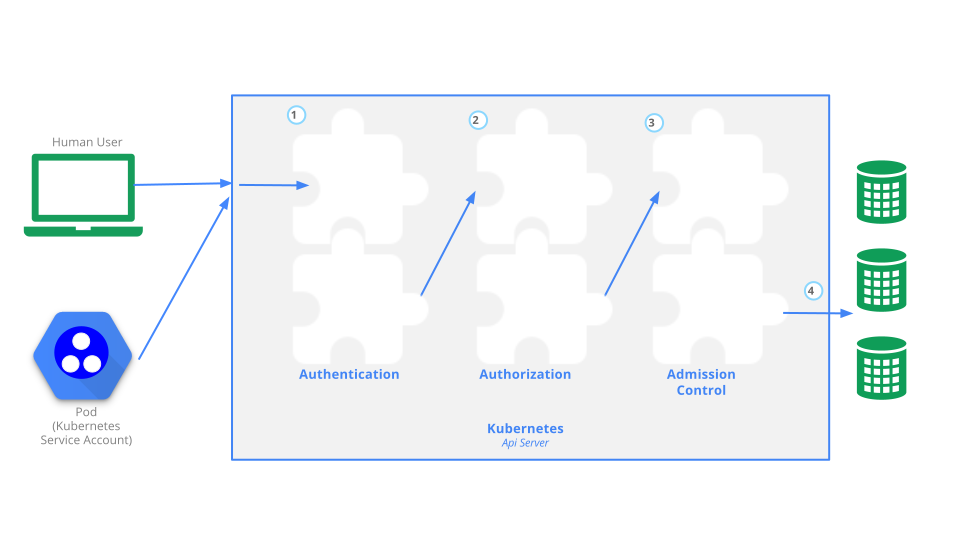
By default, the Kubernetes API server listens on port 6443 on the first non-localhost
network interface, protected by TLS. In a typical production Kubernetes cluster, the
API serves on port 443. The port can be changed with the --secure-port, and the
listening IP address with the --bind-address flag.
The API server presents a certificate. This certificate may be signed using
a private certificate authority (CA), or based on a public key infrastructure linked
to a generally recognized CA. The certificate and corresponding private key can be set
by using the --tls-cert-file and --tls-private-key-file flags.
If your cluster uses a private certificate authority, you need a copy of that CA
certificate configured into your ~/.kube/config on the client, so that you can
trust the connection and be confident it was not intercepted.
Your client can present a TLS client certificate at this stage.
Once TLS is established, the HTTP request moves to the Authentication step. This is shown as step 1 in the diagram. The cluster creation script or cluster admin configures the API server to run one or more Authenticator modules. Authenticators are described in more detail in Authentication.
The input to the authentication step is the entire HTTP request; however, it typically examines the headers and/or client certificate.
Authentication modules include client certificates, password, and plain tokens, bootstrap tokens, and JSON Web Tokens (used for service accounts).
Multiple authentication modules can be specified, in which case each one is tried in sequence, until one of them succeeds.
If the request cannot be authenticated, it is rejected with HTTP status code 401.
Otherwise, the user is authenticated as a specific username, and the user name
is available to subsequent steps to use in their decisions. Some authenticators
also provide the group memberships of the user, while other authenticators
do not.
While Kubernetes uses usernames for access control decisions and in request logging,
it does not have a User object nor does it store usernames or other information about
users in its API.
After the request is authenticated as coming from a specific user, the request must be authorized. This is shown as step 2 in the diagram.
A request must include the username of the requester, the requested action, and the object affected by the action. The request is authorized if an existing policy declares that the user has permissions to complete the requested action.
For example, if Bob has the policy below, then he can read pods only in the namespace projectCaribou:
{
"apiVersion": "abac.authorization.kubernetes.io/v1beta1",
"kind": "Policy",
"spec": {
"user": "bob",
"namespace": "projectCaribou",
"resource": "pods",
"readonly": true
}
}
If Bob makes the following request, the request is authorized because he is
allowed to read objects in the projectCaribou namespace:
{
"apiVersion": "authorization.k8s.io/v1beta1",
"kind": "SubjectAccessReview",
"spec": {
"resourceAttributes": {
"namespace": "projectCaribou",
"verb": "get",
"group": "unicorn.example.org",
"resource": "pods"
}
}
}
If Bob makes a request to write (create or update) to the objects in the
projectCaribou namespace, his authorization is denied. If Bob makes a request
to read (get) objects in a different namespace such as projectFish, then his authorization is denied.
Kubernetes authorization requires that you use common REST attributes to interact with existing organization-wide or cloud-provider-wide access control systems. It is important to use REST formatting because these control systems might interact with other APIs besides the Kubernetes API.
Kubernetes supports multiple authorization modules, such as ABAC mode, RBAC Mode, and Webhook mode. When an administrator creates a cluster, they configure the authorization modules that should be used in the API server. If more than one authorization modules are configured, Kubernetes checks each module, and if any module authorizes the request, then the request can proceed. If all of the modules deny the request, then the request is denied (HTTP status code 403).
To learn more about Kubernetes authorization, including details about creating policies using the supported authorization modules, see Authorization.
Admission Control modules are software modules that can modify or reject requests. In addition to the attributes available to Authorization modules, Admission Control modules can access the contents of the object that is being created or modified.
Admission controllers act on requests that create, modify, delete, or connect to (proxy) an object. Admission controllers do not act on requests that merely read objects. When multiple admission controllers are configured, they are called in order.
This is shown as step 3 in the diagram.
Unlike Authentication and Authorization modules, if any admission controller module rejects, then the request is immediately rejected.
In addition to rejecting objects, admission controllers can also set complex defaults for fields.
The available Admission Control modules are described in Admission Controllers.
Once a request passes all admission controllers, it is validated using the validation routines for the corresponding API object, and then written to the object store (shown as step 4).
Kubernetes auditing provides a security-relevant, chronological set of records documenting the sequence of actions in a cluster. The cluster audits the activities generated by users, by applications that use the Kubernetes API, and by the control plane itself.
For more information, see Auditing.
Read more documentation on authentication, authorization and API access control:
You can learn about:
Kubernetes RBAC is a key security control to ensure that cluster users and workloads have only the access to resources required to execute their roles. It is important to ensure that, when designing permissions for cluster users, the cluster administrator understands the areas where privilege escalation could occur, to reduce the risk of excessive access leading to security incidents.
The good practices laid out here should be read in conjunction with the general RBAC documentation.
Ideally, minimal RBAC rights should be assigned to users and service accounts. Only permissions explicitly required for their operation should be used. While each cluster will be different, some general rules that can be applied are :
cluster-admin accounts except where specifically needed.
Providing a low privileged account with
impersonation rights
can avoid accidental modification of cluster resources.system:masters group. Any user who is a member of this group
bypasses all RBAC rights checks and will always have unrestricted superuser access, which cannot be
revoked by removing RoleBindings or ClusterRoleBindings. As an aside, if a cluster is
using an authorization webhook, membership of this group also bypasses that webhook (requests
from users who are members of that group are never sent to the webhook)Ideally, pods shouldn't be assigned service accounts that have been granted powerful permissions (for example, any of the rights listed under privilege escalation risks). In cases where a workload requires powerful permissions, consider the following practices:
Kubernetes defaults to providing access which may not be required in every cluster. Reviewing
the RBAC rights provided by default can provide opportunities for security hardening.
In general, changes should not be made to rights provided to system: accounts some options
to harden cluster rights exist:
system:unauthenticated group and remove them where possible, as this gives
access to anyone who can contact the API server at a network level.automountServiceAccountToken: false. For more details, see
using default service account token.
Setting this value for a Pod will overwrite the service account setting, workloads
which require service account tokens can still mount them.It is vital to periodically review the Kubernetes RBAC settings for redundant entries and possible privilege escalations. If an attacker is able to create a user account with the same name as a deleted user, they can automatically inherit all the rights of the deleted user, especially the rights assigned to that user.
Within Kubernetes RBAC there are a number of privileges which, if granted, can allow a user or a service account to escalate their privileges in the cluster or affect systems outside the cluster.
This section is intended to provide visibility of the areas where cluster operators should take care, to ensure that they do not inadvertently allow for more access to clusters than intended.
It is generally clear that allowing get access on Secrets will allow a user to read their contents.
It is also important to note that list and watch access also effectively allow for users to reveal the Secret contents.
For example, when a List response is returned (for example, via kubectl get secrets -A -o yaml), the response
includes the contents of all Secrets.
Permission to create workloads (either Pods, or workload resources that manage Pods) in a namespace implicitly grants access to many other resources in that namespace, such as Secrets, ConfigMaps, and PersistentVolumes that can be mounted in Pods. Additionally, since Pods can run as any ServiceAccount, granting permission to create workloads also implicitly grants the API access levels of any service account in that namespace.
Users who can run privileged Pods can use that access to gain node access and potentially to further elevate their privileges. Where you do not fully trust a user or other principal with the ability to create suitably secure and isolated Pods, you should enforce either the Baseline or Restricted Pod Security Standard. You can use Pod Security admission or other (third party) mechanisms to implement that enforcement.
For these reasons, namespaces should be used to separate resources requiring different levels of trust or tenancy. It is still considered best practice to follow least privilege principles and assign the minimum set of permissions, but boundaries within a namespace should be considered weak.
If someone - or some application - is allowed to create arbitrary PersistentVolumes, that access
includes the creation of hostPath volumes, which then means that a Pod would get access
to the underlying host filesystem(s) on the associated node. Granting that ability is a security risk.
There are many ways a container with unrestricted access to the host filesystem can escalate privileges, including reading data from other containers, and abusing the credentials of system services, such as Kubelet.
You should only allow access to create PersistentVolume objects for:
Where access to persistent storage is required trusted administrators should create PersistentVolumes, and constrained users should use PersistentVolumeClaims to access that storage.
proxy subresource of NodesUsers with access to the nodes/proxy sub-resource have rights to the Kubelet API,
which allows for command execution on every pod on the node(s) to which they have rights.
This access bypasses audit logging and admission control, so care should be taken before
granting any rights to this resource.
These APIs can be exercised via websocket HTTP GET requests, which only requires authorization of the get verb.
This means that get permission on nodes/proxy is not a read-only permission.
See Kubelet authentication/authorization for more information.
Generally, the RBAC system prevents users from creating clusterroles with more rights than the user possesses.
The exception to this is the escalate verb. As noted in the RBAC documentation,
users with this right can effectively escalate their privileges.
Similar to the escalate verb, granting users this right allows for the bypass of Kubernetes
in-built protections against privilege escalation, allowing users to create bindings to
roles with rights they do not already have.
This verb allows users to impersonate and gain the rights of other users in the cluster. Care should be taken when granting it, to ensure that excessive permissions cannot be gained via one of the impersonated accounts.
The CSR API allows for users with create rights to CSRs and update rights on certificatesigningrequests/approval
where the signer is kubernetes.io/kube-apiserver-client to create new client certificates
which allow users to authenticate to the cluster. Those client certificates can have arbitrary
names including duplicates of Kubernetes system components. This will effectively allow for privilege escalation.
Users with create rights on serviceaccounts/token can create TokenRequests to issue
tokens for existing service accounts.
Users with control over validatingwebhookconfigurations or mutatingwebhookconfigurations
can control webhooks that can read any object admitted to the cluster, and in the case of
mutating webhooks, also mutate admitted objects.
Users who can perform patch operations on Namespace objects (through a namespaced RoleBinding to a Role with that access) can modify labels on that namespace. In clusters where Pod Security Admission is used, this may allow a user to configure the namespace for a more permissive policy than intended by the administrators. For clusters where NetworkPolicy is used, users may be set labels that indirectly allow access to services that an administrator did not intend to allow.
Users who have rights to create objects in a cluster may be able to create sufficient large objects to create a denial of service condition either based on the size or number of objects, as discussed in etcd used by Kubernetes is vulnerable to OOM attack. This may be specifically relevant in multi-tenant clusters if semi-trusted or untrusted users are allowed limited access to a system.
One option for mitigation of this issue would be to use resource quotas to limit the quantity of objects which can be created.
In Kubernetes, a Secret is an object that stores sensitive information, such as passwords, OAuth tokens, and SSH keys.
Secrets give you more control over how sensitive information is used and reduces the risk of accidental exposure. Secret values are encoded as base64 strings and are stored unencrypted by default, but can be configured to be encrypted at rest.
A Pod can reference the Secret in a variety of ways, such as in a volume mount or as an environment variable. Secrets are designed for confidential data and ConfigMaps are designed for non-confidential data.
The following good practices are intended for both cluster administrators and application developers. Use these guidelines to improve the security of your sensitive information in Secret objects, as well as to more effectively manage your Secrets.
This section provides good practices that cluster administrators can use to improve the security of confidential information in the cluster.
By default, Secret objects are stored unencrypted in etcd. You should configure encryption of your Secret
data in etcd. For instructions, refer to
Encrypt Secret Data at Rest.
When planning your access control mechanism, such as Kubernetes
Role-based Access Control (RBAC),
consider the following guidelines for access to Secret objects. You should
also follow the other guidelines in
RBAC good practices.
watch or list access to only the most
privileged, system-level components. Only grant get access for Secrets if
the component's normal behavior requires it.get, watch, or list access to Secrets. Only allow
cluster administrators to access etcd. This includes read-only access. For
more complex access control, such as restricting access to Secrets with
specific annotations, consider using third-party authorization mechanisms.list access to Secrets implicitly lets the subject fetch the
contents of the Secrets.A user who can create a Pod that uses a Secret can also see the value of that Secret. Even if cluster policies do not allow a user to read the Secret directly, the same user could have access to run a Pod that then exposes the Secret. You can detect or limit the impact caused by Secret data being exposed, either intentionally or unintentionally, by a user with this access. Some recommendations include:
Use separate namespaces to isolate access to mounted secrets.
Consider wiping or shredding the durable storage used by etcd once it is
no longer in use.
If there are multiple etcd instances, configure encrypted SSL/TLS
communication between the instances to protect the Secret data in transit.
You can use third-party Secrets store providers to keep your confidential data outside your cluster and then configure Pods to access that information. The Kubernetes Secrets Store CSI Driver is a DaemonSet that lets the kubelet retrieve Secrets from external stores, and mount the Secrets as a volume into specific Pods that you authorize to access the data.
For a list of supported providers, refer to Providers for the Secret Store CSI Driver.
For best practices for setting swap memory for Linux nodes, please refer to swap memory management.
This section provides good practices for developers to use to improve the security of confidential data when building and deploying Kubernetes resources.
If you are defining multiple containers in a Pod, and only one of those containers needs access to a Secret, define the volume mount or environment variable configuration so that the other containers do not have access to that Secret.
Applications still need to protect the value of confidential information after reading it from an environment variable or volume. For example, your application must avoid logging the secret data in the clear or transmitting it to an untrusted party.
If you configure a Secret through a manifest, with the secret data encoded as base64, sharing this file or checking it in to a source repository means the secret is available to everyone who can read the manifest.
This page provides an overview of available configuration options and best practices for cluster multi-tenancy.
Sharing clusters saves costs and simplifies administration. However, sharing clusters also presents challenges such as security, fairness, and managing noisy neighbors.
Clusters can be shared in many ways. In some cases, different applications may run in the same cluster. In other cases, multiple instances of the same application may run in the same cluster, one for each end user. All these types of sharing are frequently described using the umbrella term multi-tenancy.
While Kubernetes does not have first-class concepts of end users or tenants, it provides several features to help manage different tenancy requirements. These are discussed below.
The first step to determining how to share your cluster is understanding your use case, so you can evaluate the patterns and tools available. In general, multi-tenancy in Kubernetes clusters falls into two broad categories, though many variations and hybrids are also possible.
A common form of multi-tenancy is to share a cluster between multiple teams within an organization, each of whom may operate one or more workloads. These workloads frequently need to communicate with each other, and with other workloads located on the same or different clusters.
In this scenario, members of the teams often have direct access to Kubernetes resources via tools
such as kubectl, or indirect access through GitOps controllers or other types of release
automation tools. There is often some level of trust between members of different teams, but
Kubernetes policies such as RBAC, quotas, and network policies are essential to safely and fairly
share clusters.
The other major form of multi-tenancy frequently involves a Software-as-a-Service (SaaS) vendor running multiple instances of a workload for customers. This business model is so strongly associated with this deployment style that many people call it "SaaS tenancy." However, a better term might be "multi-customer tenancy," since SaaS vendors may also use other deployment models, and this deployment model can also be used outside of SaaS.
In this scenario, the customers do not have access to the cluster; Kubernetes is invisible from their perspective and is only used by the vendor to manage the workloads. Cost optimization is frequently a critical concern, and Kubernetes policies are used to ensure that the workloads are strongly isolated from each other.
When discussing multi-tenancy in Kubernetes, there is no single definition for a "tenant". Rather, the definition of a tenant will vary depending on whether multi-team or multi-customer tenancy is being discussed.
In multi-team usage, a tenant is typically a team, where each team typically deploys a small number of workloads that scales with the complexity of the service. However, the definition of "team" may itself be fuzzy, as teams may be organized into higher-level divisions or subdivided into smaller teams.
By contrast, if each team deploys dedicated workloads for each new client, they are using a multi-customer model of tenancy. In this case, a "tenant" is simply a group of users who share a single workload. This may be as large as an entire company, or as small as a single team at that company.
In many cases, the same organization may use both definitions of "tenants" in different contexts. For example, a platform team may offer shared services such as security tools and databases to multiple internal “customers” and a SaaS vendor may also have multiple teams sharing a development cluster. Finally, hybrid architectures are also possible, such as a SaaS provider using a combination of per-customer workloads for sensitive data, combined with multi-tenant shared services.
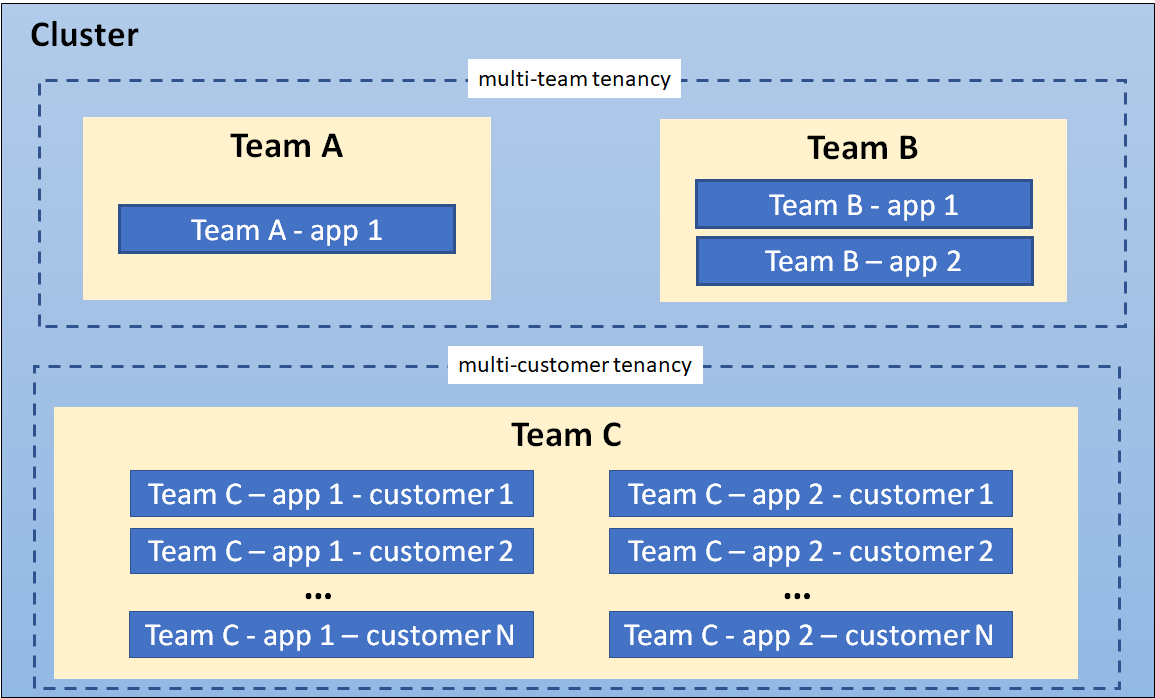
There are several ways to design and build multi-tenant solutions with Kubernetes. Each of these methods comes with its own set of tradeoffs that impact the isolation level, implementation effort, operational complexity, and cost of service.
A Kubernetes cluster consists of a control plane which runs Kubernetes software, and a data plane consisting of worker nodes where tenant workloads are executed as pods. Tenant isolation can be applied in both the control plane and the data plane based on organizational requirements.
The level of isolation offered is sometimes described using terms like “hard” multi-tenancy, which implies strong isolation, and “soft” multi-tenancy, which implies weaker isolation. In particular, "hard" multi-tenancy is often used to describe cases where the tenants do not trust each other, often from security and resource sharing perspectives (e.g. guarding against attacks such as data exfiltration or DoS). Since data planes typically have much larger attack surfaces, "hard" multi-tenancy often requires extra attention to isolating the data-plane, though control plane isolation also remains critical.
However, the terms "hard" and "soft" can often be confusing, as there is no single definition that will apply to all users. Rather, "hardness" or "softness" is better understood as a broad spectrum, with many different techniques that can be used to maintain different types of isolation in your clusters, based on your requirements.
In more extreme cases, it may be easier or necessary to forgo any cluster-level sharing at all and assign each tenant their dedicated cluster, possibly even running on dedicated hardware if VMs are not considered an adequate security boundary. This may be easier with managed Kubernetes clusters, where the overhead of creating and operating clusters is at least somewhat taken on by a cloud provider. The benefit of stronger tenant isolation must be evaluated against the cost and complexity of managing multiple clusters. The Multi-cluster SIG is responsible for addressing these types of use cases.
The remainder of this page focuses on isolation techniques used for shared Kubernetes clusters. However, even if you are considering dedicated clusters, it may be valuable to review these recommendations, as it will give you the flexibility to shift to shared clusters in the future if your needs or capabilities change.
Control plane isolation ensures that different tenants cannot access or affect each others' Kubernetes API resources.
In Kubernetes, a Namespace provides a mechanism for isolating groups of API resources within a single cluster. This isolation has two key dimensions:
Object names within a namespace can overlap with names in other namespaces, similar to files in folders. This allows tenants to name their resources without having to consider what other tenants are doing.
Many Kubernetes security policies are scoped to namespaces. For example, RBAC Roles and Network Policies are namespace-scoped resources. Using RBAC, Users and Service Accounts can be restricted to a namespace.
In a multi-tenant environment, a Namespace helps segment a tenant's workload into a logical and distinct management unit. In fact, a common practice is to isolate every workload in its own namespace, even if multiple workloads are operated by the same tenant. This ensures that each workload has its own identity and can be configured with an appropriate security policy.
The namespace isolation model requires configuration of several other Kubernetes resources, networking plugins, and adherence to security best practices to properly isolate tenant workloads. These considerations are discussed below.
The most important type of isolation for the control plane is authorization. If teams or their workloads can access or modify each others' API resources, they can change or disable all other types of policies thereby negating any protection those policies may offer. As a result, it is critical to ensure that each tenant has the appropriate access to only the namespaces they need, and no more. This is known as the "Principle of Least Privilege."
Role-based access control (RBAC) is commonly used to enforce authorization in the Kubernetes control plane, for both users and workloads (service accounts). Roles and RoleBindings are Kubernetes objects that are used at a namespace level to enforce access control in your application; similar objects exist for authorizing access to cluster-level objects, though these are less useful for multi-tenant clusters.
In a multi-team environment, RBAC must be used to restrict tenants' access to the appropriate namespaces, and ensure that cluster-wide resources can only be accessed or modified by privileged users such as cluster administrators.
If a policy ends up granting a user more permissions than they need, this is likely a signal that the namespace containing the affected resources should be refactored into finer-grained namespaces. Namespace management tools may simplify the management of these finer-grained namespaces by applying common RBAC policies to different namespaces, while still allowing fine-grained policies where necessary.
Kubernetes workloads consume node resources, like CPU and memory. In a multi-tenant environment, you can use Resource Quotas to manage resource usage of tenant workloads. For the multiple teams use case, where tenants have access to the Kubernetes API, you can use resource quotas to limit the number of API resources (for example: the number of Pods, or the number of ConfigMaps) that a tenant can create. Limits on object count ensure fairness and aim to avoid noisy neighbor issues from affecting other tenants that share a control plane.
Resource quotas are namespaced objects. By mapping tenants to namespaces, cluster admins can use quotas to ensure that a tenant cannot monopolize a cluster's resources or overwhelm its control plane. Namespace management tools simplify the administration of quotas. In addition, while Kubernetes quotas only apply within a single namespace, some namespace management tools allow groups of namespaces to share quotas, giving administrators far more flexibility with less effort than built-in quotas.
Quotas prevent a single tenant from consuming greater than their allocated share of resources hence minimizing the “noisy neighbor” issue, where one tenant negatively impacts the performance of other tenants' workloads.
When you apply a quota to namespace, Kubernetes requires you to also specify resource requests and limits for each container. Limits are the upper bound for the amount of resources that a container can consume. Containers that attempt to consume resources that exceed the configured limits will either be throttled or killed, based on the resource type. When resource requests are set lower than limits, each container is guaranteed the requested amount but there may still be some potential for impact across workloads.
Quotas cannot protect against all kinds of resource sharing, such as network traffic. Node isolation (described below) may be a better solution for this problem.
Data plane isolation ensures that pods and workloads for different tenants are sufficiently isolated.
By default, all pods in a Kubernetes cluster are allowed to communicate with each other, and all network traffic is unencrypted. This can lead to security vulnerabilities where traffic is accidentally or maliciously sent to an unintended destination, or is intercepted by a workload on a compromised node.
Pod-to-pod communication can be controlled using Network Policies, which restrict communication between pods using namespace labels or IP address ranges. In a multi-tenant environment where strict network isolation between tenants is required, starting with a default policy that denies communication between pods is recommended with another rule that allows all pods to query the DNS server for name resolution. With such a default policy in place, you can begin adding more permissive rules that allow for communication within a namespace. It is also recommended not to use empty label selector '{}' for namespaceSelector field in network policy definition, in case traffic need to be allowed between namespaces. This scheme can be further refined as required. Note that this only applies to pods within a single control plane; pods that belong to different virtual control planes cannot talk to each other via Kubernetes networking.
Namespace management tools may simplify the creation of default or common network policies. In addition, some of these tools allow you to enforce a consistent set of namespace labels across your cluster, ensuring that they are a trusted basis for your policies.
More advanced network isolation may be provided by service meshes, which provide OSI Layer 7 policies based on workload identity, in addition to namespaces. These higher-level policies can make it easier to manage namespace-based multi-tenancy, especially when multiple namespaces are dedicated to a single tenant. They frequently also offer encryption using mutual TLS, protecting your data even in the presence of a compromised node, and work across dedicated or virtual clusters. However, they can be significantly more complex to manage and may not be appropriate for all users.
Kubernetes offers several types of volumes that can be used as persistent storage for workloads. For security and data-isolation, dynamic volume provisioning is recommended and volume types that use node resources should be avoided.
StorageClasses allow you to describe custom "classes" of storage offered by your cluster, based on quality-of-service levels, backup policies, or custom policies determined by the cluster administrators.
Pods can request storage using a PersistentVolumeClaim. A PersistentVolumeClaim is a namespaced resource, which enables isolating portions of the storage system and dedicating it to tenants within the shared Kubernetes cluster. However, it is important to note that a PersistentVolume is a cluster-wide resource and has a lifecycle independent of workloads and namespaces.
For example, you can configure a separate StorageClass for each tenant and use this to strengthen isolation.
If a StorageClass is shared, you should set a reclaim policy of Delete
to ensure that a PersistentVolume cannot be reused across different namespaces.
Kubernetes pods are composed of one or more containers that execute on worker nodes. Containers utilize OS-level virtualization and hence offer a weaker isolation boundary than virtual machines that utilize hardware-based virtualization.
In a shared environment, unpatched vulnerabilities in the application and system layers can be exploited by attackers for container breakouts and remote code execution that allow access to host resources. In some applications, like a Content Management System (CMS), customers may be allowed the ability to upload and execute untrusted scripts or code. In either case, mechanisms to further isolate and protect workloads using strong isolation are desirable.
Sandboxing provides a way to isolate workloads running in a shared cluster. It typically involves
running each pod in a separate execution environment such as a virtual machine or a userspace
kernel. Sandboxing is often recommended when you are running untrusted code, where workloads are
assumed to be malicious. Part of the reason this type of isolation is necessary is because
containers are processes running on a shared kernel; they mount file systems like /sys and /proc
from the underlying host, making them less secure than an application that runs on a virtual
machine which has its own kernel. While controls such as seccomp, AppArmor, and SELinux can be
used to strengthen the security of containers, it is hard to apply a universal set of rules to all
workloads running in a shared cluster. Running workloads in a sandbox environment helps to
insulate the host from container escapes, where an attacker exploits a vulnerability to gain
access to the host system and all the processes/files running on that host.
Virtual machines and userspace kernels are two popular approaches to sandboxing.
Node isolation is another technique that you can use to isolate tenant workloads from each other. With node isolation, a set of nodes is dedicated to running pods from a particular tenant and co-mingling of tenant pods is prohibited. This configuration reduces the noisy tenant issue, as all pods running on a node will belong to a single tenant. The risk of information disclosure is slightly lower with node isolation because an attacker that manages to escape from a container will only have access to the containers and volumes mounted to that node.
Although workloads from different tenants are running on different nodes, it is important to be aware that the kubelet and (unless using virtual control planes) the API service are still shared services. A skilled attacker could use the permissions assigned to the kubelet or other pods running on the node to move laterally within the cluster and gain access to tenant workloads running on other nodes. If this is a major concern, consider implementing compensating controls such as seccomp, AppArmor or SELinux or explore using sandboxed containers or creating separate clusters for each tenant.
Node isolation is a little easier to reason about from a billing standpoint than sandboxing containers since you can charge back per node rather than per pod. It also has fewer compatibility and performance issues and may be easier to implement than sandboxing containers. For example, nodes for each tenant can be configured with taints so that only pods with the corresponding toleration can run on them. A mutating webhook could then be used to automatically add tolerations and node affinities to pods deployed into tenant namespaces so that they run on a specific set of nodes designated for that tenant.
Node isolation can be implemented using pod node selectors.
This section discusses other Kubernetes constructs and patterns that are relevant for multi-tenancy.
API priority and fairness is a Kubernetes feature that allows you to assign a priority to certain pods running within the cluster. When an application calls the Kubernetes API, the API server evaluates the priority assigned to pod. Calls from pods with higher priority are fulfilled before those with a lower priority. When contention is high, lower priority calls can be queued until the server is less busy or you can reject the requests.
Using API priority and fairness will not be very common in SaaS environments unless you are allowing customers to run applications that interface with the Kubernetes API, for example, a controller.
When you’re running a SaaS application, you may want the ability to offer different Quality-of-Service (QoS) tiers of service to different tenants. For example, you may have freemium service that comes with fewer performance guarantees and features and a for-fee service tier with specific performance guarantees. Fortunately, there are several Kubernetes constructs that can help you accomplish this within a shared cluster, including network QoS, storage classes, and pod priority and preemption. The idea with each of these is to provide tenants with the quality of service that they paid for. Let’s start by looking at networking QoS.
Typically, all pods on a node share a network interface. Without network QoS, some pods may consume an unfair share of the available bandwidth at the expense of other pods. The Kubernetes bandwidth plugin creates an extended resource for networking that allows you to use Kubernetes resources constructs, i.e. requests/limits, to apply rate limits to pods by using Linux tc queues. Be aware that the plugin is considered experimental as per the Network Plugins documentation and should be thoroughly tested before use in production environments.
For storage QoS, you will likely want to create different storage classes or profiles with different performance characteristics. Each storage profile can be associated with a different tier of service that is optimized for different workloads such IO, redundancy, or throughput. Additional logic might be necessary to allow the tenant to associate the appropriate storage profile with their workload.
Finally, there’s pod priority and preemption where you can assign priority values to pods. When scheduling pods, the scheduler will try evicting pods with lower priority when there are insufficient resources to schedule pods that are assigned a higher priority. If you have a use case where tenants have different service tiers in a shared cluster e.g. free and paid, you may want to give higher priority to certain tiers using this feature.
Kubernetes clusters include a Domain Name System (DNS) service to provide translations from names to IP addresses, for all Services and Pods. By default, the Kubernetes DNS service allows lookups across all namespaces in the cluster.
In multi-tenant environments where tenants can access pods and other Kubernetes resources, or where stronger isolation is required, it may be necessary to prevent pods from looking up services in other Namespaces. You can restrict cross-namespace DNS lookups by configuring security rules for the DNS service. For example, CoreDNS (the default DNS service for Kubernetes) can leverage Kubernetes metadata to restrict queries to Pods and Services within a namespace. For more information, read an example of configuring this within the CoreDNS documentation.
When a Virtual Control Plane per tenant model is used, a DNS service must be configured per tenant or a multi-tenant DNS service must be used. Here is an example of a customized version of CoreDNS that supports multiple tenants.
Operators are Kubernetes controllers that manage applications. Operators can simplify the management of multiple instances of an application, like a database service, which makes them a common building block in the multi-consumer (SaaS) multi-tenancy use case.
Operators used in a multi-tenant environment should follow a stricter set of guidelines. Specifically, the Operator should:
There are two primary ways to share a Kubernetes cluster for multi-tenancy: using Namespaces (that is, a Namespace per tenant) or by virtualizing the control plane (that is, virtual control plane per tenant).
In both cases, data plane isolation, and management of additional considerations such as API Priority and Fairness, is also recommended.
Namespace isolation is well-supported by Kubernetes, has a negligible resource cost, and provides mechanisms to allow tenants to interact appropriately, such as by allowing service-to-service communication. However, it can be difficult to configure, and doesn't apply to Kubernetes resources that can't be namespaced, such as Custom Resource Definitions, Storage Classes, and Webhooks.
Control plane virtualization allows for isolation of non-namespaced resources at the cost of somewhat higher resource usage and more difficult cross-tenant sharing. It is a good option when namespace isolation is insufficient but dedicated clusters are undesirable, due to the high cost of maintaining them (especially on-prem) or due to their higher overhead and lack of resource sharing. However, even within a virtualized control plane, you will likely see benefits by using namespaces as well.
The two options are discussed in more detail in the following sections.
As previously mentioned, you should consider isolating each workload in its own namespace, even if you are using dedicated clusters or virtualized control planes. This ensures that each workload only has access to its own resources, such as ConfigMaps and Secrets, and allows you to tailor dedicated security policies for each workload. In addition, it is a best practice to give each namespace names that are unique across your entire fleet (that is, even if they are in separate clusters), as this gives you the flexibility to switch between dedicated and shared clusters in the future, or to use multi-cluster tooling such as service meshes.
Conversely, there are also advantages to assigning namespaces at the tenant level, not just the workload level, since there are often policies that apply to all workloads owned by a single tenant. However, this raises its own problems. Firstly, this makes it difficult or impossible to customize policies to individual workloads, and secondly, it may be challenging to come up with a single level of "tenancy" that should be given a namespace. For example, an organization may have divisions, teams, and subteams - which should be assigned a namespace?
One possible approach is to organize your namespaces into hierarchies, and share certain policies and resources between them. This could include managing namespace labels, namespace lifecycles, delegated access, and shared resource quotas across related namespaces. These capabilities can be useful in both multi-team and multi-customer scenarios.
Another form of control-plane isolation is to use Kubernetes extensions to provide each tenant a virtual control-plane that enables segmentation of cluster-wide API resources. Data plane isolation techniques can be used with this model to securely manage worker nodes across tenants.
The virtual control plane based multi-tenancy model extends namespace-based multi-tenancy by providing each tenant with dedicated control plane components, and hence complete control over cluster-wide resources and add-on services. Worker nodes are shared across all tenants, and are managed by a Kubernetes cluster that is normally inaccessible to tenants. This cluster is often referred to as a super-cluster (or sometimes as a host-cluster). Since a tenant’s control-plane is not directly associated with underlying compute resources it is referred to as a virtual control plane.
A virtual control plane typically consists of the Kubernetes API server, the controller manager, and the etcd data store. It interacts with the super cluster via a metadata synchronization controller which coordinates changes across tenant control planes and the control plane of the super-cluster.
By using per-tenant dedicated control planes, most of the isolation problems due to sharing one API server among all tenants are solved. Examples include noisy neighbors in the control plane, uncontrollable blast radius of policy misconfigurations, and conflicts between cluster scope objects such as webhooks and CRDs. Hence, the virtual control plane model is particularly suitable for cases where each tenant requires access to a Kubernetes API server and expects the full cluster manageability.
The improved isolation comes at the cost of running and maintaining an individual virtual control plane per tenant. In addition, per-tenant control planes do not solve isolation problems in the data plane, such as node-level noisy neighbors or security threats. These must still be addressed separately.
Selecting the appropriate authentication mechanism(s) is a crucial aspect of securing your cluster. Kubernetes provides several built-in mechanisms, each with its own strengths and weaknesses that should be carefully considered when choosing the best authentication mechanism for your cluster.
In general, it is recommended to enable as few authentication mechanisms as possible to simplify user management and prevent cases where users retain access to a cluster that is no longer required.
It is important to note that Kubernetes does not have an in-built user database within the cluster. Instead, it takes user information from the configured authentication system and uses that to make authorization decisions. Therefore, to audit user access, you need to review credentials from every configured authentication source.
For production clusters with multiple users directly accessing the Kubernetes API, it is recommended to use external authentication sources such as OIDC. The internal authentication mechanisms, such as client certificates and service account tokens, described below, are not suitable for this use case.
Kubernetes leverages X.509 client certificate authentication for system components, such as when the kubelet authenticates to the API Server. While this mechanism can also be used for user authentication, it might not be suitable for production use due to several restrictions:
O value of the client certificate, which means the user's group
memberships cannot be changed for the lifetime of the certificate.Although Kubernetes allows you to load credentials from a static token file located on the control plane node disks, this approach is not recommended for production servers due to several reasons:
Bootstrap tokens are used for joining nodes to clusters and are not recommended for user authentication due to several reasons:
Service account secrets are available as an option to allow workloads running in the cluster to authenticate to the API server. In Kubernetes < 1.23, these were the default option, however, they are being replaced with TokenRequest API tokens. While these secrets could be used for user authentication, they are generally unsuitable for a number of reasons:
The TokenRequest API is a useful tool for generating short-lived credentials for service authentication to the API server or third-party systems. However, it is not generally recommended for user authentication as there is no revocation method available, and distributing credentials to users in a secure manner can be challenging.
When using TokenRequest tokens for service authentication, it is recommended to implement a short lifespan to reduce the impact of compromised tokens.
Kubernetes supports integrating external authentication services with the Kubernetes API using OpenID Connect (OIDC). There is a wide variety of software that can be used to integrate Kubernetes with an identity provider. However, when using OIDC authentication in Kubernetes, it is important to consider the following hardening measures:
Webhook token authentication is another option for integrating external authentication providers into Kubernetes. This mechanism allows for an authentication service, either running inside the cluster or externally, to be contacted for an authentication decision over a webhook. It is important to note that the suitability of this mechanism will likely depend on the software used for the authentication service, and there are some Kubernetes-specific considerations to take into account.
To configure Webhook authentication, access to control plane server filesystems is required. This means that it will not be possible with Managed Kubernetes unless the provider specifically makes it available. Additionally, any software installed in the cluster to support this access should be isolated from general workloads, as it will run with high privileges.
Another option for integrating external authentication systems into Kubernetes is to use an authenticating proxy. With this mechanism, Kubernetes expects to receive requests from the proxy with specific header values set, indicating the username and group memberships to assign for authorization purposes. It is important to note that there are specific considerations to take into account when using this mechanism.
Firstly, securely configured TLS must be used between the proxy and Kubernetes API server to mitigate the risk of traffic interception or sniffing attacks. This ensures that the communication between the proxy and Kubernetes API server is secure.
Secondly, it is important to be aware that an attacker who is able to modify the headers of the request may be able to gain unauthorized access to Kubernetes resources. As such, it is important to ensure that the headers are properly secured and cannot be tampered with.
The Kubernetes scheduler is one of the critical components of the control plane.
This document covers how to improve the security posture of the Scheduler.
A misconfigured scheduler can have security implications. Such a scheduler can target specific nodes and evict the workloads or applications that are sharing the node and its resources. This can aid an attacker with a Yo-Yo attack: an attack on a vulnerable autoscaler.
When setting up authentication configuration, it should be made sure that kube-scheduler's authentication remains consistent with kube-api-server's authentication. If any request has missing authentication headers, the authentication should happen through the kube-api-server allowing all authentication to be consistent in the cluster.
authentication-kubeconfig: Make sure to provide a proper kubeconfig so that
the scheduler can retrieve authentication configuration options from the API Server.
This kubeconfig file should be protected with strict file permissions.authentication-tolerate-lookup-failure: Set this to false to make sure
the scheduler always looks up its authentication configuration from the API server.authentication-skip-lookup: Set this to false to make sure
the scheduler always looks up its authentication configuration from the API server.authorization-always-allow-paths: These paths should respond with data that is appropriate
for anonymous authorization. Defaults to /healthz,/readyz,/livez.profiling: Set to false to disable the profiling endpoints which are provide debugging information
but which should not be enabled on production clusters as they present a risk of denial of service
or information leakage. The --profiling argument is deprecated and can now be provided through the
KubeScheduler DebuggingConfiguration.
Profiling can be disabled through the kube-scheduler config by setting enableProfiling to false.requestheader-client-ca-file: Avoid passing this argument.bind-address: In most cases, the kube-scheduler does not need to be externally accessible.
Setting the bind address to localhost is a secure practice.permit-address-sharing: Set this to false to disable connection sharing through SO_REUSEADDR.
SO_REUSEADDR can lead to reuse of terminated connections that are in TIME_WAIT state.permit-port-sharing: Default false. Use the default unless you are confident you understand the security implications.tls-cipher-suites: Always provide a list of preferred cipher suites.
This ensures encryption never happens with insecure cipher suites.When using custom schedulers based on the Kubernetes scheduling code, cluster administrators need to be careful with
plugins that use the queueSort, prefilter, filter, or permit extension points.
These extension points control various stages of a scheduling process,
and the wrong configuration can impact the kube-scheduler's behavior in your cluster.
queueSort extension point can be enabled at a time.
Any plugins that use queueSort should be scrutinized.prefilter or filter extension point can potentially mark all nodes as unschedulable.
This can bring scheduling of new pods to a halt.permit extension point can prevent or delay the binding of a Pod.
Such plugins should be thoroughly reviewed by the cluster administrator.When using a plugin that is not one of the default plugins,
consider disabling the queueSort, filter and permit extension points as follows:
apiVersion: kubescheduler.config.k8s.io/v1
kind: KubeSchedulerConfiguration
profiles:
- schedulerName: my-scheduler
plugins:
# Disable specific plugins for different extension points
# You can disable all plugins for an extension point using "*"
queueSort:
disabled:
- name: "*" # Disable all queueSort plugins
# - name: "PrioritySort" # Disable specific queueSort plugin
filter:
disabled:
- name: "*" # Disable all filter plugins
# - name: "NodeResourcesFit" # Disable specific filter plugin
permit:
disabled:
- name: "*" # Disables all permit plugins
# - name: "TaintToleration" # Disable specific permit plugin
This creates a scheduler profile my-scheduler.
Whenever the .spec of a Pod does not have a value for .spec.schedulerName, the kube-scheduler runs for that Pod,
using its main configuration, and default plugins.
If you define a Pod with .spec.schedulerName set to my-scheduler, the kube-scheduler runs
but with a custom configuration; in that custom configuration,
the queueSort, filter and permit extension points are disabled.
If you use this KubeSchedulerConfiguration, and don't run any custom scheduler,
and you then define a Pod with .spec.schedulerName set to nonexistent-scheduler
(or any other scheduler name that doesn't exist in your cluster), no events would be generated for a pod.
A cluster administrator should ensure that cluster users cannot label the nodes.
A malicious actor can use nodeSelector to schedule workloads on nodes where those workloads should not be present.
The Kubernetes API server is the main point of entry to a cluster for external parties (users and services) interacting with it.
As part of this role, the API server has several key built-in security controls, such as audit logging and admission controllers. However, there are ways to modify the configuration or content of the cluster that bypass these controls.
This page describes the ways in which the security controls built into the Kubernetes API server can be bypassed, so that cluster operators and security architects can ensure that these bypasses are appropriately restricted.
The kubelet on each node loads and directly manages any manifests that are stored in a named directory or fetched from a specific URL as static Pods in your cluster. The API server doesn't manage these static Pods. An attacker with write access to this location could modify the configuration of static pods loaded from that source, or could introduce new static Pods.
Static Pods are restricted from accessing other objects in the Kubernetes API. For example,
you can't configure a static Pod to mount a Secret from the cluster. However, these Pods can
take other security sensitive actions, such as using hostPath mounts from the underlying
node.
By default, the kubelet creates a mirror pod so that the static Pods are visible in the Kubernetes API. However, if the attacker uses an invalid namespace name when creating the Pod, it will not be visible in the Kubernetes API and can only be discovered by tooling that has access to the affected host(s).
If a static Pod fails admission control, the kubelet won't register the Pod with the API server. However, the Pod still runs on the node. For more information, refer to kubeadm issue #1541.
The kubelet provides an HTTP API that is typically exposed on TCP port 10250 on cluster worker nodes. The API might also be exposed on control plane nodes depending on the Kubernetes distribution in use. Direct access to the API allows for disclosure of information about the pods running on a node, the logs from those pods, and execution of commands in every container running on the node.
Some of these endpoints support Websocket protocols via HTTP GET requests, which are authorized with the get verb.
This means that get permission on nodes/proxy is not a read-only permission,
and authorizes access to endpoints which can be used to execute commands in any container running on the node.
When Kubernetes cluster users have RBAC access to Node object sub-resources, that access
serves as authorization to interact with the kubelet API. The exact access depends on
which sub-resource access has been granted, as detailed in
kubelet authorization.
Direct access to the kubelet API is not subject to admission control and is not logged by Kubernetes audit logging. An attacker with direct access to this API may be able to bypass controls that detect or prevent certain actions.
The kubelet API can be configured to authenticate requests in a number of ways.
By default, the kubelet configuration allows anonymous access. Most Kubernetes providers
change the default to use webhook and certificate authentication. This lets the control plane
ensure that the caller is authorized to access the nodes API resource or sub-resources.
The default anonymous access doesn't make this assertion with the control plane.
nodes API object using mechanisms such as
RBAC. Only grant this access when required,
such as by monitoring services.nodes/proxy catch-all permission, even with just the get verb.
Instead, grant granular permissions.Kubernetes clusters use etcd as a datastore. The etcd service listens on TCP port 2379.
The only clients that need access are the Kubernetes API server and any backup tooling
that you use. Direct access to this API allows for disclosure or modification of any
data held in the cluster.
Access to the etcd API is typically managed by client certificate authentication. Any certificate issued by a certificate authority that etcd trusts allows full access to the data stored inside etcd.
Direct access to etcd is not subject to Kubernetes admission control and is not logged by Kubernetes audit logging. An attacker who has read access to the API server's etcd client certificate private key (or can create a new trusted client certificate) can gain cluster admin rights by accessing cluster secrets or modifying access rules. Even without elevating their Kubernetes RBAC privileges, an attacker who can modify etcd can retrieve any API object or create new workloads inside the cluster.
Many Kubernetes providers configure etcd to use mutual TLS (both client and server verify each other's certificate for authentication). There is no widely accepted implementation of authorization for the etcd API, although the feature exists. Since there is no authorization model, any certificate with client access to etcd can be used to gain full access to etcd. Typically, etcd client certificates that are only used for health checking can also grant full read and write access.
On each node in a Kubernetes cluster, access to interact with containers is controlled by the container runtime (or runtimes, if you have configured more than one). Typically, the container runtime exposes a Unix socket that the kubelet can access. An attacker with access to this socket can launch new containers or interact with running containers.
At the cluster level, the impact of this access depends on whether the containers that run on the compromised node have access to Secrets or other confidential data that an attacker could use to escalate privileges to other worker nodes or to control plane components.
root user.hostPath mounts
that include the container runtime socket, either directly or by mounting a parent
directory. Also hostPath mounts must be set as read-only to mitigate risks
of attackers bypassing directory restrictions.This page describes some of the security features that are built into the Linux kernel that you can use in your Kubernetes workloads. To learn how to apply these features to your Pods and containers, refer to Configure a SecurityContext for a Pod or Container. You should already be familiar with Linux and with the basics of Kubernetes workloads.
When you deploy a workload in Kubernetes, use the Pod specification to restrict
that workload from running as the root user on the node. You can use the Pod
securityContext to define the specific Linux user and group for the processes in
the Pod, and explicitly restrict containers from running as root users. Setting
these values in the Pod manifest takes precedence over similar values in the
container image, which is especially useful if you're running images that you
don't own.
Configuring the kernel security features on this page provides fine-grained control over the actions that processes in your cluster can take, but managing these configurations can be challenging at scale. Running containers as non-root, or in user namespaces if you need root privileges, helps to reduce the chance that you'll need to enforce your configured kernel security capabilities.
Kubernetes lets you configure and use Linux kernel features to improve isolation and harden your containerized workloads. Common features include the following:
To configure settings for one of these features, the operating system that you choose for your nodes must enable the feature in the kernel. For example, Ubuntu 7.10 and later enable AppArmor by default. To learn whether your OS enables a specific feature, consult the OS documentation.
You use the securityContext field in your Pod specification to define the
constraints that apply to those processes. The securityContext field also
supports other security settings, such as specific Linux capabilities or file
access permissions using UIDs and GIDs. To learn more, refer to
Configure a SecurityContext for a Pod or Container.
Some of your workloads might need privileges to perform specific actions as the root user on your node's host machine. Linux uses capabilities to divide the available privileges into categories, so that processes can get the privileges required to perform specific actions without being granted all privileges. Each capability has a set of system calls (syscalls) that a process can make. seccomp lets you restrict these individual syscalls. It can be used to sandbox the privileges of a process, restricting the calls it is able to make from userspace into the kernel.
In Kubernetes, you use a container runtime on each node to run your containers. Example runtimes include CRI-O, Docker, or containerd. Each runtime allows only a subset of Linux capabilities by default. You can further limit the allowed syscalls individually by using a seccomp profile. Container runtimes usually include a default seccomp profile. Kubernetes lets you automatically apply seccomp profiles loaded onto a node to your Pods and containers.
allowPrivilegeEscalation setting for Pods and
containers. When set to false, this prevents processes from gaining new
capabilities and restricts unprivileged users from changing the applied seccomp
profile to a more permissive profile.To learn how to implement seccomp in Kubernetes, refer to Restrict a Container's Syscalls with seccomp or the Seccomp node reference
To learn more about seccomp, see Seccomp BPF in the Linux kernel documentation.
seccomp is a low-level security configuration that you should only configure yourself if you require fine-grained control over Linux syscalls. Using seccomp, especially at scale, has the following risks:
Recommendation: Use the default seccomp profile that's bundled with your container runtime. If you need a more isolated environment, consider using a sandbox, such as gVisor. Sandboxes solve the preceding risks with custom seccomp profiles, but require more compute resources on your nodes and might have compatibility issues with GPUs and other specialized hardware.
You can use Linux policy-based mandatory access control (MAC) mechanisms, such as AppArmor and SELinux, to harden your Kubernetes workloads.
AppArmor is a Linux kernel security module that supplements the standard Linux user and group based permissions to confine programs to a limited set of resources. AppArmor can be configured for any application to reduce its potential attack surface and provide greater in-depth defense. It is configured through profiles tuned to allow the access needed by a specific program or container, such as Linux capabilities, network access, and file permissions. Each profile can be run in either enforcing mode, which blocks access to disallowed resources, or complain mode, which only reports violations.
AppArmor can help you to run a more secure deployment by restricting what containers are allowed to do, and/or provide better auditing through system logs. The container runtime that you use might ship with a default AppArmor profile, or you can use a custom profile.
To learn how to use AppArmor in Kubernetes, refer to Restrict a Container's Access to Resources with AppArmor.
SELinux is a Linux kernel security module that lets you restrict the access that a specific subject, such as a process, has to the files on your system. You define security policies that apply to subjects that have specific SELinux labels. When a process that has an SELinux label attempts to access a file, the SELinux server checks whether that process' security policy allows the access and makes an authorization decision.
In Kubernetes, you can set an SELinux label in the securityContext field of
your manifest. The specified labels are assigned to those processes. If you
have configured security policies that affect those labels, the host OS kernel
enforces these policies.
To learn how to use SELinux in Kubernetes, refer to Assign SELinux labels to a container.
The operating system on your Linux nodes usually includes one of either AppArmor or SELinux. Both mechanisms provide similar types of protection, but have differences such as the following:
The following table describes the use cases and scope of each security control. You can use all of these controls together to build a more hardened system.
| Security feature | Description | How to use | Example |
|---|---|---|---|
| seccomp | Restrict individual kernel calls in the userspace. Reduces the likelihood that a vulnerability that uses a restricted syscall would compromise the system. | Specify a loaded seccomp profile in the Pod or container specification to apply its constraints to the processes in the Pod. | Reject the unshare syscall, which was used in
CVE-2022-0185. |
| AppArmor | Restrict program access to specific resources. Reduces the attack surface of the program. Improves audit logging. | Specify a loaded AppArmor profile in the container specification. | Restrict a read-only program from writing to any file path in the system. |
| SELinux | Restrict access to resources such as files, applications, ports, and processes using labels and security policies. | Specify access restrictions for specific labels. Tag processes with those labels to enforce the access restrictions related to the label. | Restrict a container from accessing files outside its own filesystem. |
seccomp, AppArmor, and SELinux usually have a default configuration that offers basic protections. You can also create custom profiles and policies that meet the requirements of your workloads. Managing and distributing these custom configurations at scale might be challenging, especially if you use all three features together. To help you to manage these configurations at scale, use a tool like the Kubernetes Security Profiles Operator.
Kubernetes lets you specify that some trusted containers can run in privileged mode. Any container in a Pod can run in privileged mode to use operating system administrative capabilities that would otherwise be inaccessible. This is available for both Windows and Linux.
Privileged containers explicitly override some of the Linux kernel constraints that you might use in your workloads, as follows:
Unconfined seccomp profile,
overriding any seccomp profile that you specified in your manifest.unconfined_t domain.Any container in a Pod can enable Privileged mode if you set the
privileged: true field in the
securityContext
field for the container. Privileged containers override or undo many other hardening settings such as the applied seccomp profile, AppArmor profile, or
SELinux constraints. Privileged containers are given all Linux capabilities,
including capabilities that they don't require. For example, a root user in a
privileged container might be able to use the CAP_SYS_ADMIN and
CAP_NET_ADMIN capabilities on the node, bypassing the runtime seccomp
configuration and other restrictions.
In most cases, you should avoid using privileged containers, and instead grant
the specific capabilities required by your container using the capabilities
field in the securityContext field. Only use privileged mode if you have a
capability that you can't grant with the securityContext. This is useful for
containers that want to use operating system administrative capabilities such
as manipulating the network stack or accessing hardware devices.
In Kubernetes version 1.26 and later, you can also run Windows containers in a
similarly privileged mode by setting the windowsOptions.hostProcess flag on
the security context of the Pod spec. For details and instructions, see
Create a Windows HostProcess Pod.
runAsNonRoot: true.Additionally, you can run workloads in user namespaces by setting
hostUsers: false in your Pod manifest. This lets you run containers as root
users in the user namespace, but as non-root users in the host namespace on the
node. This is still in early stages of development and might not have the level
of support that you need. For instructions, refer to
Use a User Namespace With a Pod.
This checklist aims at providing a basic list of guidance with links to more comprehensive documentation on each topic. It does not claim to be exhaustive and is meant to evolve.
On how to read and use this document:
system:masters group is not used for user or component authentication after bootstrapping.--use-service-account-credentials
enabled.After bootstrapping, neither users nor components should authenticate to the
Kubernetes API as system:masters. Similarly, running all of
kube-controller-manager as system:masters should be avoided. In fact,
system:masters should only be used as a break-glass mechanism, as opposed to
an admin user.
A number of Container Network Interface (CNI) plugins plugins provide the functionality to restrict network resources that pods may communicate with. This is most commonly done through Network Policies which provide a namespaced resource to define rules. Default network policies that block all egress and ingress, in each namespace, selecting all pods, can be useful to adopt an allow list approach to ensure that no workloads are missed.
Not all CNI plugins provide encryption in transit. If the chosen plugin lacks this feature, an alternative solution could be to use a service mesh to provide that functionality.
The etcd datastore of the control plane should have controls to limit access and not be publicly exposed on the Internet. Furthermore, mutual TLS (mTLS) should be used to communicate securely with it. The certificate authority for this should be unique to etcd.
External Internet access to the Kubernetes API server should be restricted to not expose the API publicly. Be careful, as many managed Kubernetes distributions are publicly exposing the API server by default. You can then use a bastion host to access the server.
The kubelet API access
should be restricted and not exposed publicly, the default authentication and
authorization settings, when no configuration file specified with the --config
flag, are overly permissive.
If a cloud provider is used for hosting Kubernetes, the access from pods to the cloud
metadata API 169.254.169.254 should also be restricted or blocked if not needed
because it may leak information.
For restricted LoadBalancer and ExternalIPs use, see CVE-2020-8554: Man in the middle using LoadBalancer or ExternalIPs and the DenyServiceExternalIPs admission controller for further information.
create, update, patch, delete workloads is only granted if necessary.RBAC authorization is crucial but
cannot be granular enough to have authorization on the Pods' resources
(or on any resource that manages Pods). The only granularity is the API verbs
on the resource itself, for example, create on Pods. Without
additional admission, the authorization to create these resources allows direct
unrestricted access to the schedulable nodes of a cluster.
The Pod Security Standards
define three different policies, privileged, baseline and restricted that limit
how fields can be set in the PodSpec regarding security.
These standards can be enforced at the namespace level with the new
Pod Security admission,
enabled by default, or by third-party admission webhook. Please note that,
contrary to the removed PodSecurityPolicy admission it replaces,
Pod Security
admission can be easily combined with admission webhooks and external services.
Pod Security admission restricted policy, the most restrictive policy of the
Pod Security Standards set,
can operate in several modes,
warn, audit or enforce to gradually apply the most appropriate
security context
according to security best practices. Nevertheless, pods'
security context
should be separately investigated to limit the privileges and access pods may
have on top of the predefined security standards, for specific use cases.
For a hands-on tutorial on Pod Security, see the blog post Kubernetes 1.23: Pod Security Graduates to Beta.
Memory and CPU limits should be set in order to restrict the memory and CPU resources a pod can consume on a node, and therefore prevent potential DoS attacks from malicious or breached workloads. Such policy can be enforced by an admission controller. Please note that CPU limits will throttle usage and thus can have unintended effects on auto-scaling features or efficiency i.e. running the process in best effort with the CPU resource available.
Seccomp stands for secure computing mode and has been a feature of the Linux kernel since version 2.6.12. It can be used to sandbox the privileges of a process, restricting the calls it is able to make from userspace into the kernel. Kubernetes lets you automatically apply seccomp profiles loaded onto a node to your Pods and containers.
Seccomp can improve the security of your workloads by reducing the Linux kernel syscall attack surface available inside containers. The seccomp filter mode leverages BPF to create an allow or deny list of specific syscalls, named profiles.
Since Kubernetes 1.27, you can enable the use of RuntimeDefault as the default seccomp profile
for all workloads. A security tutorial is available on this
topic. In addition, the
Kubernetes Security Profiles Operator
is a project that facilitates the management and use of seccomp in clusters.
AppArmor is a Linux kernel security module that can provide an easy way to implement Mandatory Access Control (MAC) and better auditing through system logs. A default AppArmor profile is enforced on nodes that support it, or a custom profile can be configured. Like seccomp, AppArmor is also configured through profiles, where each profile is either running in enforcing mode, which blocks access to disallowed resources or complain mode, which only reports violations. AppArmor profiles are enforced on a per-container basis, with an annotation, allowing for processes to gain just the right privileges.
SELinux is also a
Linux kernel security module that can provide a mechanism for supporting access
control security policies, including Mandatory Access Controls (MAC). SELinux
labels can be assigned to containers or pods
via their securityContext section.
Pods that are on different tiers of sensitivity, for example, an application pod and the Kubernetes API server, should be deployed onto separate nodes. The purpose of node isolation is to prevent an application container breakout to directly providing access to applications with higher level of sensitivity to easily pivot within the cluster. This separation should be enforced to prevent pods accidentally being deployed onto the same node. This could be enforced with the following features:
Secrets required for pods should be stored within Kubernetes Secrets as opposed to alternatives such as ConfigMap. Secret resources stored within etcd should be encrypted at rest.
Pods needing secrets should have these automatically mounted through volumes,
preferably stored in memory like with the emptyDir.medium option.
Mechanism can be used to also inject secrets from third-party storages as
volume, like the Secrets Store CSI Driver.
This should be done preferentially as compared to providing the pods service
account RBAC access to secrets. This would allow adding secrets into the pod as
environment variables or files. Please note that the environment variable method
might be more prone to leakage due to crash dumps in logs and the
non-confidential nature of environment variable in Linux, as opposed to the
permission mechanism on files.
Service account tokens should not be mounted into pods that do not require them. This can be configured by setting
automountServiceAccountToken
to false either within the service account to apply throughout the namespace
or specifically for a pod. For Kubernetes v1.22 and above, use
Bound Service Accounts
for time-bound service account credentials.
Container image should contain the bare minimum to run the program they package. Preferably, only the program and its dependencies, building the image from the minimal possible base. In particular, image used in production should not contain shells or debugging utilities, as an ephemeral debug container can be used for troubleshooting.
Build images to directly start with an unprivileged user by using the
USER instruction in Dockerfile.
The Security Context
allows a container image to be started with a specific user and group with
runAsUser and runAsGroup, even if not specified in the image manifest.
However, the file permissions in the image layers might make it impossible to just
start the process with a new unprivileged user without image modification.
Avoid using image tags to reference an image, especially the latest tag, the
image behind a tag can be easily modified in a registry. Prefer using the
complete sha256 digest which is unique to the image manifest. This policy can be
enforced via an ImagePolicyWebhook.
Image signatures can also be automatically verified with an admission controller
at deploy time to validate their authenticity and integrity.
Scanning a container image can prevent critical vulnerabilities from being deployed to the cluster alongside the container image. Image scanning should be completed before deploying a container image to a cluster and is usually done as part of the deployment process in a CI/CD pipeline. The purpose of an image scan is to obtain information about possible vulnerabilities and their prevention in the container image, such as a Common Vulnerability Scoring System (CVSS) score. If the result of the image scans is combined with the pipeline compliance rules, only properly patched container images will end up in Production.
Admission controllers can help improve the security of the cluster. However, they can present risks themselves as they extend the API server and should be properly secured.
The following lists present a number of admission controllers that could be considered to enhance the security posture of your cluster and application. It includes controllers that may be referenced in other parts of this document.
This first group of admission controllers includes plugins enabled by default, consider to leave them enabled unless you know what you are doing:
CertificateApprovalCertificateSigningCertificateSubjectRestrictionsystem:masters.LimitRangerMutatingAdmissionWebhookPodSecurityResourceQuotaValidatingAdmissionWebhookThe second group includes plugins that are not enabled by default but are in general availability state and are recommended to improve your security posture:
DenyServiceExternalIPsService.spec.externalIPs field. This is a mitigation for
CVE-2020-8554: Man in the middle using LoadBalancer or ExternalIPs.NodeRestrictionnode-restriction.kubernetes.io/ annotation, which can be used
by an attacker with access to the kubelet's credentials to influence pod
placement to the controlled node.The third group includes plugins that are not enabled by default but could be considered for certain use cases:
AlwaysPullImagesImagePolicyWebhookThis checklist aims to provide basic guidelines on securing applications running in Kubernetes from a developer's perspective. This list is not meant to be exhaustive and is intended to evolve over time.
On how to read and use this document:
developer is a Kubernetes cluster user who
interacts with namespaced scope objects.The following checklist provides base security hardening recommendations that would apply to most applications deploying to Kubernetes.
default ServiceAccount. Instead, create ServiceAccounts for
each workload or microservice.automountServiceAccountToken should be set to false unless the pod
specifically requires access to the Kubernetes API to operate.securityContext recommendationsrunAsNonRoot: true.runAsUser and runAsGroup), and configure appropriate
permissions on files or directories inside the container image.fsGroup to access persistent volumes.securityContext recommendationsallowPrivilegeEscalation: false.readOnlyRootFilesystem: true.privileged: false).system:unauthenticated group and remove them where
possible, as this gives access to anyone who can contact the API server at a network level.The create, update and delete verbs should be permitted judiciously. The patch verb if allowed on a Namespace can allow users to update labels on the namespace or deployments which can increase the attack surface.
For sensitive workloads, consider providing a recommended ValidatingAdmissionPolicy that further restricts the permitted write actions.
Make sure that your cluster provides and enforces NetworkPolicy. If you are writing an application that users will deploy to different clusters, consider whether you can assume that NetworkPolicy is available and enforced.
This section of this guide covers some advanced security hardening points which might be valuable based on different Kubernetes environment setup.
Configure Security Context for the pod-container.
Some containers may require a different isolation level from what is provided by
the default runtime of the cluster. runtimeClassName can be used in a podspec
to define a different runtime class.
For sensitive workloads consider using kernel emulation tools like gVisor, or virtualized isolation using a mechanism such as kata-containers.
In high trust environments, consider using confidential virtual machines to improve cluster security even further.
Kubernetes policies are configurations that manage other configurations or runtime behaviors. Kubernetes offers various forms of policies, described below:
Some API objects act as policies. Here are some examples:
An admission controller
runs in the API server
and can validate or mutate API requests. Some admission controllers act to apply policies.
For example, the AlwaysPullImages admission controller modifies a new Pod to set the image pull policy to Always.
Kubernetes has several built-in admission controllers that are configurable via the API server --enable-admission-plugins flag.
Details on admission controllers, with the complete list of available admission controllers, are documented in a dedicated section:
Validating admission policies allow configurable validation checks to be executed in the API server using the Common Expression Language (CEL). For example, a ValidatingAdmissionPolicy can be used to disallow use of the latest image tag.
A ValidatingAdmissionPolicy operates on an API request and can be used to block, audit, and warn users about non-compliant configurations.
Details on the ValidatingAdmissionPolicy API, with examples, are documented in a dedicated section:
Dynamic admission controllers (or admission webhooks) run outside the API server as separate applications that register to receive webhooks requests to perform validation or mutation of API requests.
Dynamic admission controllers can be used to apply policies on API requests and trigger other policy-based workflows. A dynamic admission controller can perform complex checks including those that require retrieval of other cluster resources and external data. For example, an image verification check can lookup data from OCI registries to validate the container image signatures and attestations.
Details on dynamic admission control are documented in a dedicated section:
Dynamic Admission Controllers that act as flexible policy engines are being developed in the Kubernetes ecosystem, such as:
Kubernetes allows configuring the Kubelet on each worker node. Some Kubelet configurations act as policies:
By default, containers run with unbounded compute resources on a Kubernetes cluster. Using Kubernetes resource quotas, administrators (also termed cluster operators) can restrict consumption and creation of cluster resources (such as CPU time, memory, and persistent storage) within a specified namespace. Within a namespace, a Pod can consume as much CPU and memory as is allowed by the ResourceQuotas that apply to that namespace. As a cluster operator, or as a namespace-level administrator, you might also be concerned about making sure that a single object cannot monopolize all available resources within a namespace.
A LimitRange is a policy to constrain the resource allocations (limits and requests) that you can specify for each applicable object kind (such as Pod or PersistentVolumeClaim) in a namespace.
A LimitRange provides constraints that can:
Kubernetes constrains resource allocations to Pods in a particular namespace whenever there is at least one LimitRange object in that namespace.
The name of a LimitRange object must be a valid DNS subdomain name.
403 Forbidden and a message explaining the constraint that has been violated.cpu and memory, you must specify requests or limits for those values.
Otherwise, the system may reject Pod creation.A LimitRange does not check the consistency of the default values it applies. This means that a default value for the limit that is set by LimitRange may be less than the request value specified for the container in the spec that a client submits to the API server. If that happens, the final Pod will not be schedulable.
For example, you define a LimitRange with below manifest:
metadata.namespace field.apiVersion: v1
kind: LimitRange
metadata:
name: cpu-resource-constraint
spec:
limits:
- default: # this section defines default limits
cpu: 500m
defaultRequest: # this section defines default requests
cpu: 500m
max: # max and min define the limit range
cpu: "1"
min:
cpu: 100m
type: Container
along with a Pod that declares a CPU resource request of 700m, but not a limit:
apiVersion: v1
kind: Pod
metadata:
name: example-conflict-with-limitrange-cpu
spec:
containers:
- name: demo
image: registry.k8s.io/pause:3.8
resources:
requests:
cpu: 700m
then that Pod will not be scheduled, failing with an error similar to:
Pod "example-conflict-with-limitrange-cpu" is invalid: spec.containers[0].resources.requests: Invalid value: "700m": must be less than or equal to cpu limit
If you set both request and limit, then that new Pod will be scheduled successfully
even with the same LimitRange in place:
apiVersion: v1
kind: Pod
metadata:
name: example-no-conflict-with-limitrange-cpu
spec:
containers:
- name: demo
image: registry.k8s.io/pause:3.8
resources:
requests:
cpu: 700m
limits:
cpu: 700m
Examples of policies that could be created using LimitRange are:
In the case where the total limits of the namespace is less than the sum of the limits of the Pods/Containers, there may be contention for resources. In this case, the Containers or Pods will not be created.
Neither contention nor changes to a LimitRange will affect already created resources.
For examples on using limits, see:
Refer to the LimitRanger design document for context and historical information.
When several users or teams share a cluster with a fixed number of nodes, there is a concern that one team could use more than its fair share of resources.
Resource quotas are a tool for administrators to address this concern.
A resource quota, defined by a ResourceQuota object, provides constraints that limit aggregate resource consumption per namespace. A ResourceQuota can also limit the quantity of objects that can be created in a namespace by API kind, as well as the total amount of infrastructure resources that may be consumed by API objects found in that namespace.
ResourceQuotas work like this:
Different teams work in different namespaces. This separation can be enforced with RBAC or any other authorization mechanism.
A cluster administrator creates at least one ResourceQuota for each namespace.
Users create resources (pods, services, etc.) in the namespace, and the quota system tracks usage to ensure it does not exceed hard resource limits defined in a ResourceQuota.
You can apply a scope to a ResourceQuota to limit where it applies,
If creating or updating a resource violates a quota constraint, the control plane rejects that request with HTTP
status code 403 Forbidden. The error includes a message explaining the constraint that would have been violated.
If quotas are enabled in a namespace for resource
such as cpu and memory, users must specify requests or limits for those values when they define a Pod; otherwise,
the quota system may reject pod creation.
The resource quota walkthrough shows an example of how to avoid this problem.
You often do not create Pods directly; for example, you more usually create a workload management
object such as a Deployment. If you create a Deployment that tries to use more
resources than are available, the creation of the Deployment (or other workload management object) succeeds, but
the Deployment may not be able to get all of the Pods it manages to exist. In that case you can check the status of
the Deployment, for example with kubectl describe, to see what has happened.
cpu and memory resources, ResourceQuotas enforce that every
(new) pod in that namespace sets a limit for that resource.
If you enforce a resource quota in a namespace for either cpu or memory,
you and other clients, must specify either requests or limits for that resource,
for every new Pod you submit. If you don't, the control plane may reject admission
for that Pod.You can use a LimitRange to automatically set a default request for these resources.
The name of a ResourceQuota object must be a valid DNS subdomain name.
Examples of policies that could be created using namespaces and quotas are:
In the case where the total capacity of the cluster is less than the sum of the quotas of the namespaces, there may be contention for resources. This is handled on a first-come-first-served basis.
ResourceQuota support is enabled by default for many Kubernetes distributions. It is
enabled when the API server
--enable-admission-plugins= flag has ResourceQuota as
one of its arguments.
A resource quota is enforced in a particular namespace when there is a ResourceQuota in that namespace.
The ResourceQuota mechanism lets you enforce different kinds of limits. This section describes the types of limit that you can enforce.
You can limit the total sum of compute resources that can be requested in a given namespace.
The following resource types are supported:
| Resource Name | Description |
|---|---|
limits.cpu |
Across all pods in a non-terminal state, the sum of CPU limits cannot exceed this value. |
limits.memory |
Across all pods in a non-terminal state, the sum of memory limits cannot exceed this value. |
requests.cpu |
Across all pods in a non-terminal state, the sum of CPU requests cannot exceed this value. |
requests.memory |
Across all pods in a non-terminal state, the sum of memory requests cannot exceed this value. |
hugepages-<size> |
Across all pods in a non-terminal state, the number of huge page requests of the specified size cannot exceed this value. |
cpu |
Same as requests.cpu |
memory |
Same as requests.memory |
In addition to the resources mentioned above, in release 1.10, quota support for extended resources is added.
As overcommit is not allowed for extended resources, it makes no sense to specify both requests
and limits for the same extended resource in a quota. So for extended resources, only quota items
with prefix requests. are allowed.
Take the GPU resource as an example, if the resource name is nvidia.com/gpu, and you want to
limit the total number of GPUs requested in a namespace to 4, you can define a quota as follows:
requests.nvidia.com/gpu: 4See Viewing and Setting Quotas for more details.
DRA (Dynamic Resource Allocation) resource claims can request DRA resources by device class. For an example
device class named examplegpu, you want to limit the total number of GPUs requested in a namespace to 4,
you can define a quota as follows:
examplegpu.deviceclass.resource.k8s.io/devices: 4When Extended Resource allocation by DRA
is enabled, the same device class named examplegpu can be requested via extended resource either explicitly
when the device class's ExtendedResourceName field is given, say, example.com/gpu, then you can define a quota as follows:
requests.example.com/gpu: 4or implicitly using the derived extended resource name from device class name examplegpu, you can define
a quota as follows:
requests.deviceclass.resource.kubernetes.io/examplegpu: 4All devices requested from resource claims or extended resources are counted towards all three quotas
listed above. The extended resource quota e.g. requests.example.com/gpu: 4, also counts the devices provided
by device plugin.
See Viewing and Setting Quotas for more details.
You can limit the total sum of storage for volumes that can be requested in a given namespace.
In addition, you can limit consumption of storage resources based on associated StorageClass.
| Resource Name | Description |
|---|---|
requests.storage |
Across all persistent volume claims, the sum of storage requests cannot exceed this value. |
persistentvolumeclaims |
The total number of PersistentVolumeClaims that can exist in the namespace. |
<storage-class-name>.storageclass.storage.k8s.io/requests.storage |
Across all persistent volume claims associated with the <storage-class-name>, the sum of storage requests cannot exceed this value. |
<storage-class-name>.storageclass.storage.k8s.io/persistentvolumeclaims |
Across all persistent volume claims associated with the <storage-class-name>, the total number of persistent volume claims that can exist in the namespace. |
For example, if you want to quota storage with gold StorageClass separate from
a bronze StorageClass, you can define a quota as follows:
gold.storageclass.storage.k8s.io/requests.storage: 500Gibronze.storageclass.storage.k8s.io/requests.storage: 100GiKubernetes v1.8 [alpha]
| Resource Name | Description |
|---|---|
requests.ephemeral-storage |
Across all pods in the namespace, the sum of local ephemeral storage requests cannot exceed this value. |
limits.ephemeral-storage |
Across all pods in the namespace, the sum of local ephemeral storage limits cannot exceed this value. |
ephemeral-storage |
Same as requests.ephemeral-storage. |
When using a CRI container runtime, container logs will count against the ephemeral storage quota. This can result in the unexpected eviction of pods that have exhausted their storage quotas.
Refer to Logging Architecture for details.
You can set quota for the total number of one particular resource kind in the Kubernetes API, using the following syntax:
count/<resource>.<group> for resources from non-core API groupscount/<resource> for resources from the core API groupFor example, the PodTemplate API is in the core API group and so if you want to limit the number of
PodTemplate objects in a namespace, you use count/podtemplates.
These types of quotas are useful to protect against exhaustion of control plane storage. For example, you may want to limit the number of Secrets in a server given their large size. Too many Secrets in a cluster can actually prevent servers and controllers from starting. You can set a quota for Jobs to protect against a poorly configured CronJob. CronJobs that create too many Jobs in a namespace can lead to a denial of service.
If you define a quota this way, it applies to Kubernetes' APIs that are part of the API server, and
to any custom resources backed by a CustomResourceDefinition.
For example, to create a quota on a widgets custom resource in the example.com API group,
use count/widgets.example.com.
If you use API aggregation to
add additional, custom APIs that are not defined as CustomResourceDefinitions, the core Kubernetes
control plane does not enforce quota for the aggregated API. The extension API server is expected to
provide quota enforcement if that's appropriate for the custom API.
This is a list of common examples of object kinds that you may want to put under object count quota, listed by the configuration string that you would use.
count/podscount/persistentvolumeclaimscount/servicescount/secretscount/configmapscount/deployments.appscount/replicasets.appscount/statefulsets.appscount/jobs.batchcount/cronjobs.batchThere is another syntax only to set the same type of quota, that only works for certain API kinds. The following types are supported:
| Resource Name | Description |
|---|---|
configmaps |
The total number of ConfigMaps that can exist in the namespace. |
persistentvolumeclaims |
The total number of PersistentVolumeClaims that can exist in the namespace. |
pods |
The total number of Pods in a non-terminal state that can exist in the namespace. A pod is in a terminal state if .status.phase in (Failed, Succeeded) is true. |
replicationcontrollers |
The total number of ReplicationControllers that can exist in the namespace. |
resourcequotas |
The total number of ResourceQuotas that can exist in the namespace. |
services |
The total number of Services that can exist in the namespace. |
services.loadbalancers |
The total number of Services of type LoadBalancer that can exist in the namespace. |
services.nodeports |
The total number of NodePorts allocated to Services of type NodePort or LoadBalancer that can exist in the namespace. |
secrets |
The total number of Secrets that can exist in the namespace. |
For example, pods quota counts and enforces a maximum on the number of pods
created in a single namespace that are not terminal. You might want to set a pods
quota on a namespace to avoid the case where a user creates many small pods and
exhausts the cluster's supply of Pod IPs.
You can find more examples on Viewing and Setting Quotas.
kubectl supports creating, updating, and viewing quotas:
kubectl create namespace myspace
cat <<EOF > compute-resources.yaml
apiVersion: v1
kind: ResourceQuota
metadata:
name: compute-resources
spec:
hard:
requests.cpu: "1"
requests.memory: "1Gi"
limits.cpu: "2"
limits.memory: "2Gi"
requests.nvidia.com/gpu: 4
EOF
kubectl create -f ./compute-resources.yaml --namespace=myspace
cat <<EOF > object-counts.yaml
apiVersion: v1
kind: ResourceQuota
metadata:
name: object-counts
spec:
hard:
configmaps: "10"
persistentvolumeclaims: "4"
pods: "4"
replicationcontrollers: "20"
secrets: "10"
services: "10"
services.loadbalancers: "2"
EOF
kubectl create -f ./object-counts.yaml --namespace=myspace
kubectl get quota --namespace=myspace
NAME AGE
compute-resources 30s
object-counts 32s
kubectl describe quota compute-resources --namespace=myspace
Name: compute-resources
Namespace: myspace
Resource Used Hard
-------- ---- ----
limits.cpu 0 2
limits.memory 0 2Gi
requests.cpu 0 1
requests.memory 0 1Gi
requests.nvidia.com/gpu 0 4
kubectl describe quota object-counts --namespace=myspace
Name: object-counts
Namespace: myspace
Resource Used Hard
-------- ---- ----
configmaps 0 10
persistentvolumeclaims 0 4
pods 0 4
replicationcontrollers 0 20
secrets 1 10
services 0 10
services.loadbalancers 0 2
kubectl also supports object count quota for all standard namespaced resources
using the syntax count/<resource>.<group>:
kubectl create namespace myspace
kubectl create quota test --hard=count/deployments.apps=2,count/replicasets.apps=4,count/pods=3,count/secrets=4 --namespace=myspace
kubectl create deployment nginx --image=nginx --namespace=myspace --replicas=2
kubectl describe quota --namespace=myspace
Name: test
Namespace: myspace
Resource Used Hard
-------- ---- ----
count/deployments.apps 1 2
count/pods 2 3
count/replicasets.apps 1 4
count/secrets 1 4
ResourceQuotas are independent of the cluster capacity. They are expressed in absolute units. So, if you add nodes to your cluster, this does not automatically give each namespace the ability to consume more resources.
Sometimes more complex policies may be desired, such as:
Such policies could be implemented using ResourceQuotas as building blocks, by
writing a "controller" that watches the quota usage and adjusts the quota
hard limits of each namespace according to other signals.
Note that resource quota divides up aggregate cluster resources, but it creates no restrictions around nodes: pods from several namespaces may run on the same node.
Each quota can have an associated set of scopes. A quota will only measure usage for a resource if it matches
the intersection of enumerated scopes.
When a scope is added to the quota, it limits the number of resources it supports to those that pertain to the scope. Resources specified on the quota outside of the allowed set results in a validation error.
Kubernetes 1.35 supports the following scopes:
| Scope | Description |
|---|---|
BestEffort |
Match pods that have best effort quality of service. |
CrossNamespacePodAffinity |
Match pods that have cross-namespace pod (anti)affinity terms. |
NotBestEffort |
Match pods that do not have best effort quality of service. |
NotTerminating |
Match pods where .spec.activeDeadlineSeconds is nil |
PriorityClass |
Match pods that references the specified priority class. |
Terminating |
Match pods where .spec.activeDeadlineSeconds >= 0 |
VolumeAttributesClass |
Match PersistentVolumeClaims that reference the specified volume attributes class. |
ResourceQuotas with a scope set can also have a optional scopeSelector field. You define one or more match expressions
that specify an operators and, if relevant, a set of values to match. For example:
scopeSelector:
matchExpressions:
- scopeName: BestEffort # Match pods that have best effort quality of service
operator: Exists # optional; "Exists" is implied for BestEffort scope
The scopeSelector supports the following values in the operator field:
InNotInExistsDoesNotExistIf the operator is In or NotIn, the values field must have at least
one value. For example:
scopeSelector:
matchExpressions:
- scopeName: PriorityClass
operator: In
values:
- middle
If the operator is Exists or DoesNotExist, the values field must NOT be
specified.
This scope only tracks quota consumed by Pods. It only matches pods that have the best effort QoS class.
The operator for a scopeSelector must be Exists.
This scope only tracks quota consumed by Pods. It only matches pods that have the Guaranteed or Burstable QoS class.
The operator for a scopeSelector must be Exists.
This scope only tracks quota consumed by Pods that are not terminating. The operator for a scopeSelector
must be Exists.
A Pod is not terminating if the .spec.activeDeadlineSeconds field is unset.
You can use a ResourceQuota with this scope to manage the following resources:
count.podspodscpumemoryrequests.cpurequests.memorylimits.cpulimits.memoryThis scope only tracks quota consumed by Pods that are terminating. The operator for a scopeSelector
must be Exists.
A Pod is considered as terminating if the .spec.activeDeadlineSeconds field is set to any number.
You can use a ResourceQuota with this scope to manage the following resources:
count.podspodscpumemoryrequests.cpurequests.memorylimits.cpulimits.memoryKubernetes v1.24 [stable]
You can use CrossNamespacePodAffinity quota scope to limit which namespaces are allowed to
have pods with affinity terms that cross namespaces. Specifically, it controls which pods are allowed
to set namespaces or namespaceSelector fields in pod (anti)affinity terms.
Preventing users from using cross-namespace affinity terms might be desired since a pod with anti-affinity constraints can block pods from all other namespaces from getting scheduled in a failure domain.
Using this scope, you (as a cluster administrator) can prevent certain namespaces - such as foo-ns in the example below -
from having pods that use cross-namespace pod affinity. You configure this creating a ResourceQuota object in
that namespace with CrossNamespacePodAffinity scope and hard limit of 0:
apiVersion: v1
kind: ResourceQuota
metadata:
name: disable-cross-namespace-affinity
namespace: foo-ns
spec:
hard:
pods: "0"
scopeSelector:
matchExpressions:
- scopeName: CrossNamespacePodAffinity
operator: Exists
If you want to disallow using namespaces and namespaceSelector by default, and
only allow it for specific namespaces, you could configure CrossNamespacePodAffinity
as a limited resource by setting the kube-apiserver flag --admission-control-config-file
to the path of the following configuration file:
apiVersion: apiserver.config.k8s.io/v1
kind: AdmissionConfiguration
plugins:
- name: "ResourceQuota"
configuration:
apiVersion: apiserver.config.k8s.io/v1
kind: ResourceQuotaConfiguration
limitedResources:
- resource: pods
matchScopes:
- scopeName: CrossNamespacePodAffinity
operator: Exists
With the above configuration, pods can use namespaces and namespaceSelector in pod affinity only
if the namespace where they are created have a resource quota object with
CrossNamespacePodAffinity scope and a hard limit greater than or equal to the number of pods using those fields.
Kubernetes v1.17 [stable]
A ResourceQuota with a PriorityClass scope only matches Pods that have a particular
priority class, and only
if any scopeSelector in the quota spec selects a particular Pod.
Pods can be created at a specific priority.
You can control a pod's consumption of system resources based on a pod's priority, by using the scopeSelector
field in the quota spec.
When quota is scoped for PriorityClass using the scopeSelector field, the ResourceQuota
can only track (and limit) the following resources:
podscpumemoryephemeral-storagelimits.cpulimits.memorylimits.ephemeral-storagerequests.cpurequests.memoryrequests.ephemeral-storageThis example creates a ResourceQuota matches it with pods at specific priorities. The example works as follows:
Inspect this set of ResourceQuotas:
apiVersion: v1
kind: ResourceQuota
metadata:
name: pods-high
spec:
hard:
cpu: "1000"
memory: "200Gi"
pods: "10"
scopeSelector:
matchExpressions:
- operator: In
scopeName: PriorityClass
values: ["high"]
---
apiVersion: v1
kind: ResourceQuota
metadata:
name: pods-medium
spec:
hard:
cpu: "10"
memory: "20Gi"
pods: "10"
scopeSelector:
matchExpressions:
- operator: In
scopeName: PriorityClass
values: ["medium"]
---
apiVersion: v1
kind: ResourceQuota
metadata:
name: pods-low
spec:
hard:
cpu: "5"
memory: "10Gi"
pods: "10"
scopeSelector:
matchExpressions:
- operator: In
scopeName: PriorityClass
values: ["low"]
Apply the YAML using kubectl create.
kubectl create -f https://k8s.io/examples/policy/quota.yaml
resourcequota/pods-high created
resourcequota/pods-medium created
resourcequota/pods-low created
Verify that Used quota is 0 using kubectl describe quota.
kubectl describe quota
Name: pods-high
Namespace: default
Resource Used Hard
-------- ---- ----
cpu 0 1k
memory 0 200Gi
pods 0 10
Name: pods-low
Namespace: default
Resource Used Hard
-------- ---- ----
cpu 0 5
memory 0 10Gi
pods 0 10
Name: pods-medium
Namespace: default
Resource Used Hard
-------- ---- ----
cpu 0 10
memory 0 20Gi
pods 0 10
Create a pod with priority "high".
apiVersion: v1
kind: Pod
metadata:
name: high-priority
spec:
containers:
- name: high-priority
image: ubuntu
command: ["/bin/sh"]
args: ["-c", "while true; do echo hello; sleep 10;done"]
resources:
requests:
memory: "10Gi"
cpu: "500m"
limits:
memory: "10Gi"
cpu: "500m"
priorityClassName: high
To create the Pod:
kubectl create -f https://k8s.io/examples/policy/high-priority-pod.yaml
Verify that "Used" stats for "high" priority quota, pods-high, has changed and that
the other two quotas are unchanged.
kubectl describe quota
Name: pods-high
Namespace: default
Resource Used Hard
-------- ---- ----
cpu 500m 1k
memory 10Gi 200Gi
pods 1 10
Name: pods-low
Namespace: default
Resource Used Hard
-------- ---- ----
cpu 0 5
memory 0 10Gi
pods 0 10
Name: pods-medium
Namespace: default
Resource Used Hard
-------- ---- ----
cpu 0 10
memory 0 20Gi
pods 0 10
It may be desired that pods at a particular priority, such as "cluster-services", should be allowed in a namespace, if and only if, a matching quota object exists.
With this mechanism, operators are able to restrict usage of certain high priority classes to a limited number of namespaces and not every namespace will be able to consume these priority classes by default.
To enforce this, kube-apiserver flag --admission-control-config-file should be
used to pass path to the following configuration file:
apiVersion: apiserver.config.k8s.io/v1
kind: AdmissionConfiguration
plugins:
- name: "ResourceQuota"
configuration:
apiVersion: apiserver.config.k8s.io/v1
kind: ResourceQuotaConfiguration
limitedResources:
- resource: pods
matchScopes:
- scopeName: PriorityClass
operator: In
values: ["cluster-services"]
Then, create a resource quota object in the kube-system namespace:
apiVersion: v1
kind: ResourceQuota
metadata:
name: pods-cluster-services
spec:
scopeSelector:
matchExpressions:
- operator : In
scopeName: PriorityClass
values: ["cluster-services"]kubectl apply -f https://k8s.io/examples/policy/priority-class-resourcequota.yaml -n kube-system
resourcequota/pods-cluster-services created
In this case, a pod creation will be allowed if:
priorityClassName is not specified.priorityClassName is specified to a value other than cluster-services.priorityClassName is set to cluster-services, it is to be created
in the kube-system namespace, and it has passed the resource quota check.A Pod creation request is rejected if its priorityClassName is set to cluster-services
and it is to be created in a namespace other than kube-system.
Kubernetes v1.34 [stable](enabled by default)This scope only tracks quota consumed by PersistentVolumeClaims.
PersistentVolumeClaims can be created with a specific
VolumeAttributesClass, and might be modified after creation.
You can control a PVC's consumption of storage resources based on the associated
VolumeAttributesClasses, by using the scopeSelector field in the quota spec.
The PVC references the associated VolumeAttributesClass by the following fields:
spec.volumeAttributesClassNamestatus.currentVolumeAttributesClassNamestatus.modifyVolumeStatus.targetVolumeAttributesClassNameA relevant ResourceQuota is matched and consumed only if the ResourceQuota has a scopeSelector that selects the PVC.
When the quota is scoped for the volume attributes class using the scopeSelector field, the quota object is restricted to track only the following resources:
persistentvolumeclaimsrequests.storageRead Limit Storage Consumption to learn more about this.
Kubernetes v1.20 [stable]
Kubernetes allow you to limit the number of process IDs (PIDs) that a Pod can use. You can also reserve a number of allocatable PIDs for each node for use by the operating system and daemons (rather than by Pods).
Process IDs (PIDs) are a fundamental resource on nodes. It is trivial to hit the task limit without hitting any other resource limits, which can then cause instability to a host machine.
Cluster administrators require mechanisms to ensure that Pods running in the cluster cannot induce PID exhaustion that prevents host daemons (such as the kubelet or kube-proxy, and potentially also the container runtime) from running. In addition, it is important to ensure that PIDs are limited among Pods in order to ensure they have limited impact on other workloads on the same node.
32768. Consider raising the value of /proc/sys/kernel/pid_max.You can configure a kubelet to limit the number of PIDs a given Pod can consume.
For example, if your node's host OS is set to use a maximum of 262144 PIDs and
expect to host less than 250 Pods, one can give each Pod a budget of 1000
PIDs to prevent using up that node's overall number of available PIDs. If the
admin wants to overcommit PIDs similar to CPU or memory, they may do so as well
with some additional risks. Either way, a single Pod will not be able to bring
the whole machine down. This kind of resource limiting helps to prevent simple
fork bombs from affecting operation of an entire cluster.
Per-Pod PID limiting allows administrators to protect one Pod from another, but does not ensure that all Pods scheduled onto that host are unable to impact the node overall. Per-Pod limiting also does not protect the node agents themselves from PID exhaustion.
You can also reserve an amount of PIDs for node overhead, separate from the allocation to Pods. This is similar to how you can reserve CPU, memory, or other resources for use by the operating system and other facilities outside of Pods and their containers.
PID limiting is an important sibling to compute
resource requests
and limits. However, you specify it in a different way: rather than defining a
Pod's resource limit in the .spec for a Pod, you configure the limit as a
setting on the kubelet. Pod-defined PID limits are not currently supported.
Kubernetes allows you to reserve a number of process IDs for the system use. To
configure the reservation, use the parameter pid=<number> in the
--system-reserved and --kube-reserved command line options to the kubelet.
The value you specified declares that the specified number of process IDs will
be reserved for the system as a whole and for Kubernetes system daemons
respectively.
Kubernetes allows you to limit the number of processes running in a Pod. You
specify this limit at the node level, rather than configuring it as a resource
limit for a particular Pod. Each Node can have a different PID limit.
To configure the limit, you can specify the command line parameter --pod-max-pids
to the kubelet, or set PodPidsLimit in the kubelet
configuration file.
You can configure kubelet to start terminating a Pod when it is misbehaving and consuming abnormal amount of resources.
This feature is called eviction. You can
Configure Out of Resource Handling
for various eviction signals.
Use pid.available eviction signal to configure the threshold for number of PIDs used by Pod.
You can set soft and hard eviction policies.
However, even with the hard eviction policy, if the number of PIDs growing very fast,
node can still get into unstable state by hitting the node PIDs limit.
Eviction signal value is calculated periodically and does NOT enforce the limit.
PID limiting - per Pod and per Node sets the hard limit. Once the limit is hit, workload will start experiencing failures when trying to get a new PID. It may or may not lead to rescheduling of a Pod, depending on how workload reacts on these failures and how liveness and readiness probes are configured for the Pod. However, if limits were set correctly, you can guarantee that other Pods workload and system processes will not run out of PIDs when one Pod is misbehaving.
In order to support latency-critical and high-throughput workloads, Kubernetes offers a suite of Resource Managers. The managers aim to co-ordinate and optimise the alignment of node's resources for pods configured with a specific requirement for CPUs, devices, and memory (hugepages) resources.
Topology Manager is a kubelet component that aims to coordinate the set of components that are responsible for these optimizations. The overall resource management process is governed using the policy you specify. To learn more, read Control Topology Management Policies on a Node.
Kubernetes v1.26 [stable](enabled by default)Once a Pod is bound to a Node, the kubelet on that node may need to either multiplex the existing hardware (for example, sharing CPUs across multiple Pods) or allocate hardware by dedicating some resource (for example, assigning one of more CPUs for a Pod's exclusive use).
By default, the kubelet uses CFS quota to enforce pod CPU limits. When the node runs many CPU-bound pods, the workload can move to different CPU cores depending on whether the pod is throttled and which CPU cores are available at scheduling time. Many workloads are not sensitive to this migration and thus work fine without any intervention.
However, in workloads where CPU cache affinity and scheduling latency significantly affect workload performance, the kubelet allows alternative CPU management policies to determine some placement preferences on the node. This is implemented using the CPU Manager and its policy. There are two available policies:
none: the none policy explicitly enables the existing default CPU
affinity scheme, providing no affinity beyond what the OS scheduler does
automatically. Limits on CPU usage for
Guaranteed pods and
Burstable pods
are enforced using CFS quota.static: the static policy allows containers in Guaranteed pods with integer CPU
requests access to exclusive CPUs on the node. This exclusivity is enforced
using the cpuset cgroup controller.CPU Manager doesn't support offlining and onlining of CPUs at runtime.
The static policy enables finer-grained CPU management and exclusive CPU assignment.
This policy manages a shared pool of CPUs that initially contains all CPUs in the
node. The amount of exclusively allocatable CPUs is equal to the total
number of CPUs in the node minus any CPU reservations set by the kubelet configuration.
CPUs reserved by these options are taken, in integer quantity, from the initial shared pool in ascending order by physical
core ID. This shared pool is the set of CPUs on which any containers in
BestEffort and Burstable pods run. Containers in Guaranteed pods with fractional
CPU requests also run on CPUs in the shared pool. Only containers that are
part of a Guaranteed pod and have integer CPU requests are assigned
exclusive CPUs.
As Guaranteed pods whose containers fit the requirements for being statically
assigned are scheduled to the node, CPUs are removed from the shared pool and
placed in the cpuset for the container. CFS quota is not used to bound
the CPU usage of these containers as their usage is bound by the scheduling domain
itself. In others words, the number of CPUs in the container cpuset is equal to the integer
CPU limit specified in the pod spec. This static assignment increases CPU
affinity and decreases context switches due to throttling for the CPU-bound
workload.
Consider the containers in the following pod specs:
spec:
containers:
- name: nginx
image: nginx
The pod above runs in the BestEffort QoS class because no resource requests or
limits are specified. It runs in the shared pool.
spec:
containers:
- name: nginx
image: nginx
resources:
limits:
memory: "200Mi"
requests:
memory: "100Mi"
The pod above runs in the Burstable QoS class because resource requests do not
equal limits and the cpu quantity is not specified. It runs in the shared
pool.
spec:
containers:
- name: nginx
image: nginx
resources:
limits:
memory: "200Mi"
cpu: "2"
requests:
memory: "100Mi"
cpu: "1"
The pod above runs in the Burstable QoS class because resource requests do not
equal limits. It runs in the shared pool.
spec:
containers:
- name: nginx
image: nginx
resources:
limits:
memory: "200Mi"
cpu: "2"
requests:
memory: "200Mi"
cpu: "2"
The pod above runs in the Guaranteed QoS class because requests are equal to limits.
And the container's resource limit for the CPU resource is an integer greater than
or equal to one. The nginx container is granted 2 exclusive CPUs.
spec:
containers:
- name: nginx
image: nginx
resources:
limits:
memory: "200Mi"
cpu: "1.5"
requests:
memory: "200Mi"
cpu: "1.5"
The pod above runs in the Guaranteed QoS class because requests are equal to limits.
But the container's resource limit for the CPU resource is a fraction. It runs in
the shared pool.
spec:
containers:
- name: nginx
image: nginx
resources:
limits:
memory: "200Mi"
cpu: "2"
The pod above runs in the Guaranteed QoS class because only limits are specified
and requests are set equal to limits when not explicitly specified. And the
container's resource limit for the CPU resource is an integer greater than or
equal to one. The nginx container is granted 2 exclusive CPUs.
Here are the available policy options for the static CPU management policy, listed in alphabetical order:
align-by-socket (alpha, hidden by default)distribute-cpus-across-cores (alpha, hidden by default)distribute-cpus-across-numa (beta, visible by default)full-pcpus-only (GA, visible by default)strict-cpu-reservation (GA, visible by default)prefer-align-cpus-by-uncorecache (beta, visible by default)You can toggle groups of options on and off based upon their maturity level using the following feature gates:
CPUManagerPolicyBetaOptions (default enabled). Disable to hide beta-level options.CPUManagerPolicyAlphaOptions (default disabled). Enable to show alpha-level options.You will still have to enable each option using the cpuManagerPolicyOptions field in the
kubelet configuration file.
For more detail about the individual options you can configure, read on.
full-pcpus-onlyIf the full-pcpus-only policy option is specified, the static policy will always allocate full physical cores.
By default, without this option, the static policy allocates CPUs using a topology-aware best-fit allocation.
On SMT enabled systems, the policy can allocate individual virtual cores, which correspond to hardware threads.
This can lead to different containers sharing the same physical cores; this behaviour in turn contributes
to the noisy neighbours problem.
With the option enabled, the pod will be admitted by the kubelet only if the CPU request of all its containers
can be fulfilled by allocating full physical cores.
If the pod does not pass the admission, it will be put in Failed state with the message SMTAlignmentError.
distribute-cpus-across-numaIf the distribute-cpus-across-numapolicy option is specified, the static
policy will evenly distribute CPUs across NUMA nodes in cases where more than
one NUMA node is required to satisfy the allocation.
By default, the CPUManager will pack CPUs onto one NUMA node until it is
filled, with any remaining CPUs simply spilling over to the next NUMA node.
This can cause undesired bottlenecks in parallel code relying on barriers (and
similar synchronization primitives), as this type of code tends to run only as
fast as its slowest worker (which is slowed down by the fact that fewer CPUs
are available on at least one NUMA node).
By distributing CPUs evenly across NUMA nodes, application developers can more
easily ensure that no single worker suffers from NUMA effects more than any
other, improving the overall performance of these types of applications.
align-by-socketIf the align-by-socket policy option is specified, CPUs will be considered
aligned at the socket boundary when deciding how to allocate CPUs to a
container. By default, the CPUManager aligns CPU allocations at the NUMA
boundary, which could result in performance degradation if CPUs need to be
pulled from more than one NUMA node to satisfy the allocation. Although it
tries to ensure that all CPUs are allocated from the minimum number of NUMA
nodes, there is no guarantee that those NUMA nodes will be on the same socket.
By directing the CPUManager to explicitly align CPUs at the socket boundary
rather than the NUMA boundary, we are able to avoid such issues. Note, this
policy option is not compatible with TopologyManager single-numa-node
policy and does not apply to hardware where the number of sockets is greater
than number of NUMA nodes.
distribute-cpus-across-coresIf the distribute-cpus-across-cores policy option is specified, the static policy
will attempt to allocate virtual cores (hardware threads) across different physical cores.
By default, the CPUManager tends to pack CPUs onto as few physical cores as possible,
which can lead to contention among CPUs on the same physical core and result
in performance bottlenecks. By enabling the distribute-cpus-across-cores policy,
the static policy ensures that CPUs are distributed across as many physical cores
as possible, reducing the contention on the same physical core and thereby
improving overall performance. However, it is important to note that this strategy
might be less effective when the system is heavily loaded. Under such conditions,
the benefit of reducing contention diminishes. Conversely, default behavior
can help in reducing inter-core communication overhead, potentially providing
better performance under high load conditions.
strict-cpu-reservationThe reservedSystemCPUs parameter in KubeletConfiguration,
or the deprecated kubelet command line option --reserved-cpus, defines an explicit CPU set for OS system daemons
and kubernetes system daemons. More details of this parameter can be found on the
Explicitly Reserved CPU List page.
By default, this isolation is implemented only for guaranteed pods with integer CPU requests not for burstable and best-effort pods
(and guaranteed pods with fractional CPU requests). Admission is only comparing the CPU requests against the allocatable CPUs.
Since the CPU limit is higher than the request, the default behaviour allows burstable and best-effort pods to use up the capacity
of reservedSystemCPUs and cause host OS services to starve in real life deployments.
If the strict-cpu-reservation policy option is enabled, the static policy will not allow
any workload to use the CPU cores specified in reservedSystemCPUs.
prefer-align-cpus-by-uncorecacheIf the prefer-align-cpus-by-uncorecache policy is specified, the static policy
will allocate CPU resources for individual containers such that all CPUs assigned
to a container share the same uncore cache block (also known as the Last-Level Cache
or LLC). By default, the CPUManager will tightly pack CPU assignments which can
result in containers being assigned CPUs from multiple uncore caches. This option
enables the CPUManager to allocate CPUs in a way that maximizes the efficient use
of the uncore cache. Allocation is performed on a best-effort basis, aiming to
affine as many CPUs as possible within the same uncore cache. If the container's
CPU requirement exceeds the CPU capacity of a single uncore cache, the CPUManager
minimizes the number of uncore caches used in order to maintain optimal uncore
cache alignment. Specific workloads can benefit in performance from the reduction
of inter-cache latency and noisy neighbors at the cache level. If the CPUManager
cannot align optimally while the node has sufficient resources, the container will
still be admitted using the default packed behavior.
Kubernetes v1.32 [stable](enabled by default)The Kubernetes Memory Manager allocates RAM (memory, and optionally Linux huge pages) resources
for pods in the Guaranteed QoS class.
The Memory Manager employs hint generation protocol to yield the most suitable NUMA affinity for a pod. The Memory Manager feeds the central manager (Topology Manager) with these affinity hints. Based on both the hints and Topology Manager policy, the pod is rejected or admitted to the node.
Moreover, the Memory Manager ensures that the memory which a pod requests is allocated from a minimum number of NUMA nodes.
To learn more, read Control Memory Management Policies on a Node.
The configuration of individual managers is elaborated in dedicated documents:
In Kubernetes, scheduling refers to making sure that Pods are matched to Nodes so that the kubelet can run them. Preemption is the process of terminating Pods with lower Priority so that Pods with higher Priority can schedule on Nodes. Eviction is the process of terminating one or more Pods on Nodes.
Pod disruption is the process by which Pods on Nodes are terminated either voluntarily or involuntarily.
Voluntary disruptions are started intentionally by application owners or cluster administrators. Involuntary disruptions are unintentional and can be triggered by unavoidable issues like Nodes running out of resources, or by accidental deletions.
In Kubernetes, scheduling refers to making sure that Pods are matched to Nodes so that Kubelet can run them.
A scheduler watches for newly created Pods that have no Node assigned. For every Pod that the scheduler discovers, the scheduler becomes responsible for finding the best Node for that Pod to run on. The scheduler reaches this placement decision taking into account the scheduling principles described below.
If you want to understand why Pods are placed onto a particular Node, or if you're planning to implement a custom scheduler yourself, this page will help you learn about scheduling.
kube-scheduler is the default scheduler for Kubernetes and runs as part of the control plane. kube-scheduler is designed so that, if you want and need to, you can write your own scheduling component and use that instead.
Kube-scheduler selects an optimal node to run newly created or not yet scheduled (unscheduled) pods. Since containers in pods - and pods themselves - can have different requirements, the scheduler filters out any nodes that don't meet a Pod's specific scheduling needs. Alternatively, the API lets you specify a node for a Pod when you create it, but this is unusual and is only done in special cases.
In a cluster, Nodes that meet the scheduling requirements for a Pod are called feasible nodes. If none of the nodes are suitable, the pod remains unscheduled until the scheduler is able to place it.
The scheduler finds feasible Nodes for a Pod and then runs a set of functions to score the feasible Nodes and picks a Node with the highest score among the feasible ones to run the Pod. The scheduler then notifies the API server about this decision in a process called binding.
Factors that need to be taken into account for scheduling decisions include individual and collective resource requirements, hardware / software / policy constraints, affinity and anti-affinity specifications, data locality, inter-workload interference, and so on.
kube-scheduler selects a node for the pod in a 2-step operation:
The filtering step finds the set of Nodes where it's feasible to schedule the Pod. For example, the PodFitsResources filter checks whether a candidate Node has enough available resources to meet a Pod's specific resource requests. After this step, the node list contains any suitable Nodes; often, there will be more than one. If the list is empty, that Pod isn't (yet) schedulable.
In the scoring step, the scheduler ranks the remaining nodes to choose the most suitable Pod placement. The scheduler assigns a score to each Node that survived filtering, basing this score on the active scoring rules.
Finally, kube-scheduler assigns the Pod to the Node with the highest ranking. If there is more than one node with equal scores, kube-scheduler selects one of these at random.
There are two supported ways to configure the filtering and scoring behavior of the scheduler:
QueueSort, Filter, Score, Bind, Reserve, Permit, and others. You can also configure the kube-scheduler to run different profiles.You can constrain a Pod so that it is restricted to run on particular node(s), or to prefer to run on particular nodes. There are several ways to do this and the recommended approaches all use label selectors to facilitate the selection. Often, you do not need to set any such constraints; the scheduler will automatically do a reasonable placement (for example, spreading your Pods across nodes so as not place Pods on a node with insufficient free resources). However, there are some circumstances where you may want to control which node the Pod deploys to, for example, to ensure that a Pod ends up on a node with an SSD attached to it, or to co-locate Pods from two different services that communicate a lot into the same availability zone.
You can use any of the following methods to choose where Kubernetes schedules specific Pods:
Like many other Kubernetes objects, nodes have labels. You can attach labels manually. Kubernetes also populates a standard set of labels on all nodes in a cluster.
kubernetes.io/hostname may be the same as the node name in some environments
and a different value in other environments.Adding labels to nodes allows you to target Pods for scheduling on specific nodes or groups of nodes. You can use this functionality to ensure that specific Pods only run on nodes with certain isolation, security, or regulatory properties.
If you use labels for node isolation, choose label keys that the kubelet cannot modify. This prevents a compromised node from setting those labels on itself so that the scheduler schedules workloads onto the compromised node.
The NodeRestriction admission plugin
prevents the kubelet from setting or modifying labels with a
node-restriction.kubernetes.io/ prefix.
To make use of that label prefix for node isolation:
NodeRestriction admission plugin.node-restriction.kubernetes.io/ prefix to your nodes, and use those labels in your node selectors.
For example, example.com.node-restriction.kubernetes.io/fips=true or example.com.node-restriction.kubernetes.io/pci-dss=true.nodeSelector is the simplest recommended form of node selection constraint.
You can add the nodeSelector field to your Pod specification and specify the
node labels you want the target node to have.
Kubernetes only schedules the Pod onto nodes that have each of the labels you
specify.
See Assign Pods to Nodes for more information.
nodeSelector is the simplest way to constrain Pods to nodes with specific
labels. Affinity and anti-affinity expand the types of constraints you can
define. Some of the benefits of affinity and anti-affinity include:
nodeSelector only
selects nodes with all the specified labels. Affinity/anti-affinity gives you
more control over the selection logic.The affinity feature consists of two types of affinity:
nodeSelector field but is more expressive and
allows you to specify soft rules.Node affinity is conceptually similar to nodeSelector, allowing you to constrain which nodes your
Pod can be scheduled on based on node labels. There are two types of node
affinity:
requiredDuringSchedulingIgnoredDuringExecution: The scheduler can't
schedule the Pod unless the rule is met. This functions like nodeSelector,
but with a more expressive syntax.preferredDuringSchedulingIgnoredDuringExecution: The scheduler tries to
find a node that meets the rule. If a matching node is not available, the
scheduler still schedules the Pod.IgnoredDuringExecution means that if the node labels
change after Kubernetes schedules the Pod, the Pod continues to run.You can specify node affinities using the .spec.affinity.nodeAffinity field in
your Pod spec.
For example, consider the following Pod spec:
apiVersion: v1
kind: Pod
metadata:
name: with-node-affinity
spec:
affinity:
nodeAffinity:
requiredDuringSchedulingIgnoredDuringExecution:
nodeSelectorTerms:
- matchExpressions:
- key: topology.kubernetes.io/zone
operator: In
values:
- antarctica-east1
- antarctica-west1
preferredDuringSchedulingIgnoredDuringExecution:
- weight: 1
preference:
matchExpressions:
- key: another-node-label-key
operator: In
values:
- another-node-label-value
containers:
- name: with-node-affinity
image: registry.k8s.io/pause:3.8In this example, the following rules apply:
topology.kubernetes.io/zone and
the value of that label must be either antarctica-east1 or antarctica-west1.another-node-label-key and
the value another-node-label-value.You can use the operator field to specify a logical operator for Kubernetes to use when
interpreting the rules. You can use In, NotIn, Exists, DoesNotExist,
Gt and Lt.
Read Operators to learn more about how these work.
NotIn and DoesNotExist allow you to define node anti-affinity behavior.
Alternatively, you can use node taints
to repel Pods from specific nodes.
If you specify both nodeSelector and nodeAffinity, both must be satisfied
for the Pod to be scheduled onto a node.
If you specify multiple terms in nodeSelectorTerms associated with nodeAffinity
types, then the Pod can be scheduled onto a node if one of the specified terms
can be satisfied (terms are ORed).
If you specify multiple expressions in a single matchExpressions field associated with a
term in nodeSelectorTerms, then the Pod can be scheduled onto a node only
if all the expressions are satisfied (expressions are ANDed).
See Assign Pods to Nodes using Node Affinity for more information.
You can specify a weight between 1 and 100 for each instance of the
preferredDuringSchedulingIgnoredDuringExecution affinity type. When the
scheduler finds nodes that meet all the other scheduling requirements of the Pod, the
scheduler iterates through every preferred rule that the node satisfies and adds the
value of the weight for that expression to a sum.
The final sum is added to the score of other priority functions for the node. Nodes with the highest total score are prioritized when the scheduler makes a scheduling decision for the Pod.
For example, consider the following Pod spec:
apiVersion: v1
kind: Pod
metadata:
name: with-affinity-preferred-weight
spec:
affinity:
nodeAffinity:
requiredDuringSchedulingIgnoredDuringExecution:
nodeSelectorTerms:
- matchExpressions:
- key: kubernetes.io/os
operator: In
values:
- linux
preferredDuringSchedulingIgnoredDuringExecution:
- weight: 1
preference:
matchExpressions:
- key: label-1
operator: In
values:
- key-1
- weight: 50
preference:
matchExpressions:
- key: label-2
operator: In
values:
- key-2
containers:
- name: with-node-affinity
image: registry.k8s.io/pause:3.8
If there are two possible nodes that match the
preferredDuringSchedulingIgnoredDuringExecution rule, one with the
label-1:key-1 label and another with the label-2:key-2 label, the scheduler
considers the weight of each node and adds the weight to the other scores for
that node, and schedules the Pod onto the node with the highest final score.
kubernetes.io/os=linux label.Kubernetes v1.20 [beta]
When configuring multiple scheduling profiles, you can associate
a profile with a node affinity, which is useful if a profile only applies to a specific set of nodes.
To do so, add an addedAffinity to the args field of the NodeAffinity plugin
in the scheduler configuration. For example:
apiVersion: kubescheduler.config.k8s.io/v1
kind: KubeSchedulerConfiguration
profiles:
- schedulerName: default-scheduler
- schedulerName: foo-scheduler
pluginConfig:
- name: NodeAffinity
args:
addedAffinity:
requiredDuringSchedulingIgnoredDuringExecution:
nodeSelectorTerms:
- matchExpressions:
- key: scheduler-profile
operator: In
values:
- foo
The addedAffinity is applied to all Pods that set .spec.schedulerName to foo-scheduler, in addition to the
NodeAffinity specified in the PodSpec.
That is, in order to match the Pod, nodes need to satisfy addedAffinity and
the Pod's .spec.NodeAffinity.
Since the addedAffinity is not visible to end users, its behavior might be
unexpected to them. Use node labels that have a clear correlation to the
scheduler profile name.
nodeAffinity rules in the DaemonSet controller.Inter-pod affinity and anti-affinity allow you to constrain which nodes your Pods can be scheduled on based on the labels of Pods already running on that node, instead of the node labels.
Inter-pod affinity and anti-affinity take the form "this Pod should (or, in the case of anti-affinity, should not) run in an X if that X is already running one or more Pods that meet rule Y", where X is a topology domain like node, rack, cloud provider zone or region, or similar and Y is the rule Kubernetes tries to satisfy.
You express these rules (Y) as label selectors with an optional associated list of namespaces. Pods are namespaced objects in Kubernetes, so Pod labels also implicitly have namespaces. Any label selectors for Pod labels should specify the namespaces in which Kubernetes should look for those labels.
You express the topology domain (X) using a topologyKey, which is the key for
the node label that the system uses to denote the domain. For examples, see
Well-Known Labels, Annotations and Taints.
topologyKey.
If some or all nodes are missing the specified topologyKey label, it can lead
to unintended behavior.Similar to node affinity are two types of Pod affinity and anti-affinity as follows:
requiredDuringSchedulingIgnoredDuringExecutionpreferredDuringSchedulingIgnoredDuringExecutionFor example, you could use
requiredDuringSchedulingIgnoredDuringExecution affinity to tell the scheduler to
co-locate Pods of two services in the same cloud provider zone because they
communicate with each other a lot. Similarly, you could use
preferredDuringSchedulingIgnoredDuringExecution anti-affinity to spread Pods
from a service across multiple cloud provider zones.
To use inter-pod affinity, use the affinity.podAffinity field in the Pod spec.
For inter-pod anti-affinity, use the affinity.podAntiAffinity field in the Pod
spec.
When scheduling a new Pod, the Kubernetes scheduler evaluates the Pod's affinity/anti-affinity rules in the context of the current cluster state:
Hard Constraints (Node Filtering):
podAffinity.requiredDuringSchedulingIgnoredDuringExecution and podAntiAffinity.requiredDuringSchedulingIgnoredDuringExecution:
Soft Constraints (Scoring):
podAffinity.preferredDuringSchedulingIgnoredDuringExecution and podAntiAffinity.preferredDuringSchedulingIgnoredDuringExecution:
Ignored Fields:
podAffinity.preferredDuringSchedulingIgnoredDuringExecution:
podAntiAffinity.preferredDuringSchedulingIgnoredDuringExecution:
If the current Pod being scheduled is the first in a series that have affinity to themselves, it is allowed to be scheduled if it passes all other affinity checks. This is determined by verifying that no other Pod in the cluster matches the namespace and selector of this Pod, that the Pod matches its own terms, and the chosen node matches all requested topologies. This ensures that there will not be a deadlock even if all the Pods have inter-pod affinity specified.
Consider the following Pod spec:
apiVersion: v1
kind: Pod
metadata:
name: with-pod-affinity
spec:
affinity:
podAffinity:
requiredDuringSchedulingIgnoredDuringExecution:
- labelSelector:
matchExpressions:
- key: security
operator: In
values:
- S1
topologyKey: topology.kubernetes.io/zone
podAntiAffinity:
preferredDuringSchedulingIgnoredDuringExecution:
- weight: 100
podAffinityTerm:
labelSelector:
matchExpressions:
- key: security
operator: In
values:
- S2
topologyKey: topology.kubernetes.io/zone
containers:
- name: with-pod-affinity
image: registry.k8s.io/pause:3.8
This example defines one Pod affinity rule and one Pod anti-affinity rule. The
Pod affinity rule uses the "hard"
requiredDuringSchedulingIgnoredDuringExecution, while the anti-affinity rule
uses the "soft" preferredDuringSchedulingIgnoredDuringExecution.
The affinity rule specifies that the scheduler is allowed to place the example Pod
on a node only if that node belongs to a specific zone
where other Pods have been labeled with security=S1.
For instance, if we have a cluster with a designated zone, let's call it "Zone V,"
consisting of nodes labeled with topology.kubernetes.io/zone=V, the scheduler can
assign the Pod to any node within Zone V, as long as there is at least one Pod within
Zone V already labeled with security=S1. Conversely, if there are no Pods with security=S1
labels in Zone V, the scheduler will not assign the example Pod to any node in that zone.
The anti-affinity rule specifies that the scheduler should try to avoid scheduling the Pod
on a node if that node belongs to a specific zone
where other Pods have been labeled with security=S2.
For instance, if we have a cluster with a designated zone, let's call it "Zone R,"
consisting of nodes labeled with topology.kubernetes.io/zone=R, the scheduler should avoid
assigning the Pod to any node within Zone R, as long as there is at least one Pod within
Zone R already labeled with security=S2. Conversely, the anti-affinity rule does not impact
scheduling into Zone R if there are no Pods with security=S2 labels.
To get yourself more familiar with the examples of Pod affinity and anti-affinity, refer to the design proposal.
You can use the In, NotIn, Exists and DoesNotExist values in the
operator field for Pod affinity and anti-affinity.
Read Operators to learn more about how these work.
In principle, the topologyKey can be any allowed label key with the following
exceptions for performance and security reasons:
topologyKey field is not allowed in both
requiredDuringSchedulingIgnoredDuringExecution
and preferredDuringSchedulingIgnoredDuringExecution.requiredDuringSchedulingIgnoredDuringExecution Pod anti-affinity rules,
the admission controller LimitPodHardAntiAffinityTopology limits
topologyKey to kubernetes.io/hostname. You can modify or disable the
admission controller if you want to allow custom topologies.In addition to labelSelector and topologyKey, you can optionally specify a list
of namespaces which the labelSelector should match against using the
namespaces field at the same level as labelSelector and topologyKey.
If omitted or empty, namespaces defaults to the namespace of the Pod where the
affinity/anti-affinity definition appears.
Kubernetes v1.24 [stable]
You can also select matching namespaces using namespaceSelector, which is a label query over the set of namespaces.
The affinity term is applied to namespaces selected by both namespaceSelector and the namespaces field.
Note that an empty namespaceSelector ({}) matches all namespaces, while a null or empty namespaces list and
null namespaceSelector matches the namespace of the Pod where the rule is defined.
Kubernetes v1.33 [stable](enabled by default)The matchLabelKeys field is a beta-level field and is enabled by default in
Kubernetes 1.35.
When you want to disable it, you have to disable it explicitly via the
MatchLabelKeysInPodAffinity feature gate.
Kubernetes includes an optional matchLabelKeys field for Pod affinity
or anti-affinity. The field specifies keys for the labels that should match with the incoming Pod's labels,
when satisfying the Pod (anti)affinity.
The keys are used to look up values from the Pod labels; those key-value labels are combined
(using AND) with the match restrictions defined using the labelSelector field. The combined
filtering selects the set of existing Pods that will be taken into Pod (anti)affinity calculation.
matchLabelKeys with labels that might be updated directly on pods.
Even if you edit the pod's label that is specified at matchLabelKeys directly, (that is, not via a deployment),
kube-apiserver doesn't reflect the label update onto the merged labelSelector.A common use case is to use matchLabelKeys with pod-template-hash (set on Pods
managed as part of a Deployment, where the value is unique for each revision).
Using pod-template-hash in matchLabelKeys allows you to target the Pods that belong
to the same revision as the incoming Pod, so that a rolling upgrade won't break affinity.
apiVersion: apps/v1
kind: Deployment
metadata:
name: application-server
...
spec:
template:
spec:
affinity:
podAffinity:
requiredDuringSchedulingIgnoredDuringExecution:
- labelSelector:
matchExpressions:
- key: app
operator: In
values:
- database
topologyKey: topology.kubernetes.io/zone
# Only Pods from a given rollout are taken into consideration when calculating pod affinity.
# If you update the Deployment, the replacement Pods follow their own affinity rules
# (if there are any defined in the new Pod template)
matchLabelKeys:
- pod-template-hash
Kubernetes v1.33 [stable](enabled by default)The mismatchLabelKeys field is a beta-level field and is enabled by default in
Kubernetes 1.35.
When you want to disable it, you have to disable it explicitly via the
MatchLabelKeysInPodAffinity feature gate.
Kubernetes includes an optional mismatchLabelKeys field for Pod affinity
or anti-affinity. The field specifies keys for the labels that should not match with the incoming Pod's labels,
when satisfying the Pod (anti)affinity.
mismatchLabelKeys with labels that might be updated directly on pods.
Even if you edit the pod's label that is specified at mismatchLabelKeys directly, (that is, not via a deployment),
kube-apiserver doesn't reflect the label update onto the merged labelSelector.One example use case is to ensure Pods go to the topology domain (node, zone, etc) where only Pods from the same tenant or team are scheduled in. In other words, you want to avoid running Pods from two different tenants on the same topology domain at the same time.
apiVersion: v1
kind: Pod
metadata:
labels:
# Assume that all relevant Pods have a "tenant" label set
tenant: tenant-a
...
spec:
affinity:
podAffinity:
requiredDuringSchedulingIgnoredDuringExecution:
# ensure that Pods associated with this tenant land on the correct node pool
- matchLabelKeys:
- tenant
labelSelector: {}
topologyKey: node-pool
podAntiAffinity:
requiredDuringSchedulingIgnoredDuringExecution:
# ensure that Pods associated with this tenant can't schedule to nodes used for another tenant
- mismatchLabelKeys:
- tenant # whatever the value of the "tenant" label for this Pod, prevent
# scheduling to nodes in any pool where any Pod from a different
# tenant is running.
labelSelector:
# We have to have the labelSelector which selects only Pods with the tenant label,
# otherwise this Pod would have anti-affinity against Pods from daemonsets as well, for example,
# which aren't supposed to have the tenant label.
matchExpressions:
- key: tenant
operator: Exists
topologyKey: node-pool
Inter-pod affinity and anti-affinity can be even more useful when they are used with higher level collections such as ReplicaSets, StatefulSets, Deployments, etc. These rules allow you to configure that a set of workloads should be co-located in the same defined topology; for example, preferring to place two related Pods onto the same node.
For example: imagine a three-node cluster. You use the cluster to run a web application and also an in-memory cache (such as Redis). For this example, also assume that latency between the web application and the memory cache should be as low as is practical. You could use inter-pod affinity and anti-affinity to co-locate the web servers with the cache as much as possible.
In the following example Deployment for the Redis cache, the replicas get the label app=store. The
podAntiAffinity rule tells the scheduler to avoid placing multiple replicas
with the app=store label on a single node. This creates each cache in a
separate node.
apiVersion: apps/v1
kind: Deployment
metadata:
name: redis-cache
spec:
selector:
matchLabels:
app: store
replicas: 3
template:
metadata:
labels:
app: store
spec:
affinity:
podAntiAffinity:
requiredDuringSchedulingIgnoredDuringExecution:
- labelSelector:
matchExpressions:
- key: app
operator: In
values:
- store
topologyKey: "kubernetes.io/hostname"
containers:
- name: redis-server
image: redis:3.2-alpine
The following example Deployment for the web servers creates replicas with the label app=web-store.
The Pod affinity rule tells the scheduler to place each replica on a node that has a Pod
with the label app=store. The Pod anti-affinity rule tells the scheduler never to place
multiple app=web-store servers on a single node.
apiVersion: apps/v1
kind: Deployment
metadata:
name: web-server
spec:
selector:
matchLabels:
app: web-store
replicas: 3
template:
metadata:
labels:
app: web-store
spec:
affinity:
podAntiAffinity:
requiredDuringSchedulingIgnoredDuringExecution:
- labelSelector:
matchExpressions:
- key: app
operator: In
values:
- web-store
topologyKey: "kubernetes.io/hostname"
podAffinity:
requiredDuringSchedulingIgnoredDuringExecution:
- labelSelector:
matchExpressions:
- key: app
operator: In
values:
- store
topologyKey: "kubernetes.io/hostname"
containers:
- name: web-app
image: nginx:1.16-alpine
Creating the two preceding Deployments results in the following cluster layout, where each web server is co-located with a cache, on three separate nodes.
| node-1 | node-2 | node-3 |
|---|---|---|
| webserver-1 | webserver-2 | webserver-3 |
| cache-1 | cache-2 | cache-3 |
The overall effect is that each cache instance is likely to be accessed by a single client that is running on the same node. This approach aims to minimize both skew (imbalanced load) and latency.
You might have other reasons to use Pod anti-affinity. See the ZooKeeper tutorial for an example of a StatefulSet configured with anti-affinity for high availability, using the same technique as this example.
nodeName is a more direct form of node selection than affinity or
nodeSelector. nodeName is a field in the Pod spec. If the nodeName field
is not empty, the scheduler ignores the Pod and the kubelet on the named node
tries to place the Pod on that node. Using nodeName overrules using
nodeSelector or affinity and anti-affinity rules.
Some of the limitations of using nodeName to select nodes are:
nodeName is intended for use by custom schedulers or advanced use cases where
you need to bypass any configured schedulers. Bypassing the schedulers might lead to
failed Pods if the assigned Nodes get oversubscribed. You can use node affinity
or the nodeSelector field to assign a Pod to a specific Node without bypassing the schedulers.Here is an example of a Pod spec using the nodeName field:
apiVersion: v1
kind: Pod
metadata:
name: nginx
spec:
containers:
- name: nginx
image: nginx
nodeName: kube-01
The above Pod will only run on the node kube-01.
Kubernetes v1.35 [beta](enabled by default)nominatedNodeName can be used for external components to nominate node for a pending pod.
This nomination is best effort: it might be ignored if the scheduler determines the pod cannot go to a nominated node.
Also, this field can be (over)written by the scheduler:
nominatedNodeName is put only when the pod has to go through WaitOnPermit or PreBind extension points.Here is an example of a Pod status using the nominatedNodeName field:
apiVersion: v1
kind: Pod
metadata:
name: nginx
...
status:
nominatedNodeName: kube-01
You can use topology spread constraints to control how Pods are spread across your cluster among failure-domains such as regions, zones, nodes, or among any other topology domains that you define. You might do this to improve performance, expected availability, or overall utilization.
Read Pod topology spread constraints to learn more about how these work.
Kubernetes v1.35 [beta](enabled by default)Pods inherit the topology labels (topology.kubernetes.io/zone and topology.kubernetes.io/region) from their assigned Node if those labels are present. These labels can then be utilized via the Downward API to provide the workload with node topology awareness.
Here is an example of a Pod using downward API for it's zone and region:
apiVersion: v1
kind: Pod
metadata:
name: pod-with-topology-labels
spec:
containers:
- name: app
image: alpine
command: ["sh", "-c", "env"]
env:
- name: MY_ZONE
valueFrom:
fieldRef:
fieldPath: metadata.labels['topology.kubernetes.io/zone']
- name: MY_REGION
valueFrom:
fieldRef:
fieldPath: metadata.labels['topology.kubernetes.io/region']
The following are all the logical operators that you can use in the operator field for nodeAffinity and podAffinity mentioned above.
| Operator | Behavior |
|---|---|
In |
The label value is present in the supplied set of strings |
NotIn |
The label value is not contained in the supplied set of strings |
Exists |
A label with this key exists on the object |
DoesNotExist |
No label with this key exists on the object |
The following operators can only be used with nodeAffinity.
| Operator | Behavior |
|---|---|
Gt |
The field value will be parsed as an integer, and the integer that results from parsing the value of a label named by this selector is greater than this integer |
Lt |
The field value will be parsed as an integer, and the integer that results from parsing the value of a label named by this selector is less than this integer |
Gt and Lt operators will not work with non-integer values. If the given value
doesn't parse as an integer, the Pod will fail to get scheduled. Also, Gt and Lt
are not available for podAffinity.Kubernetes v1.24 [stable]
When you run a Pod on a Node, the Pod itself takes an amount of system resources. These resources are additional to the resources needed to run the container(s) inside the Pod. In Kubernetes, Pod Overhead is a way to account for the resources consumed by the Pod infrastructure on top of the container requests & limits.
In Kubernetes, the Pod's overhead is set at admission time according to the overhead associated with the Pod's RuntimeClass.
A pod's overhead is considered in addition to the sum of container resource requests when scheduling a Pod. Similarly, the kubelet will include the Pod overhead when sizing the Pod cgroup, and when carrying out Pod eviction ranking.
You need to make sure a RuntimeClass is utilized which defines the overhead field.
To work with Pod overhead, you need a RuntimeClass that defines the overhead field. As
an example, you could use the following RuntimeClass definition with a virtualization container
runtime (in this example, Kata Containers combined with the Firecracker virtual machine monitor)
that uses around 120MiB per Pod for the virtual machine and the guest OS:
# You need to change this example to match the actual runtime name, and per-Pod
# resource overhead, that the container runtime is adding in your cluster.
apiVersion: node.k8s.io/v1
kind: RuntimeClass
metadata:
name: kata-fc
handler: kata-fc
overhead:
podFixed:
memory: "120Mi"
cpu: "250m"
Workloads which are created which specify the kata-fc RuntimeClass handler will take the memory and
cpu overheads into account for resource quota calculations, node scheduling, as well as Pod cgroup sizing.
Consider running the given example workload, test-pod:
apiVersion: v1
kind: Pod
metadata:
name: test-pod
spec:
runtimeClassName: kata-fc
containers:
- name: busybox-ctr
image: busybox:1.28
stdin: true
tty: true
resources:
limits:
cpu: 500m
memory: 100Mi
- name: nginx-ctr
image: nginx
resources:
limits:
cpu: 1500m
memory: 100Mi
limits are specified in the pod definition, kubelet will deduce requests from those limits and set them to be the same as the defined limits.At admission time the RuntimeClass admission controller
updates the workload's PodSpec to include the overhead as described in the RuntimeClass. If the PodSpec already has this field defined,
the Pod will be rejected. In the given example, since only the RuntimeClass name is specified, the admission controller mutates the Pod
to include an overhead.
After the RuntimeClass admission controller has made modifications, you can check the updated Pod overhead value:
kubectl get pod test-pod -o jsonpath='{.spec.overhead}'
The output is:
map[cpu:250m memory:120Mi]
If a ResourceQuota is defined, the sum of container requests as well as the
overhead field are counted.
When the kube-scheduler is deciding which node should run a new Pod, the scheduler considers that Pod's
overhead as well as the sum of container requests for that Pod. For this example, the scheduler adds the
requests and the overhead, then looks for a node that has 2.25 CPU and 320 MiB of memory available.
Once a Pod is scheduled to a node, the kubelet on that node creates a new cgroup for the Pod. It is within this pod that the underlying container runtime will create containers.
If the resource has a limit defined for each container (Guaranteed QoS or Burstable QoS with limits defined),
the kubelet will set an upper limit for the pod cgroup associated with that resource (cpu.cfs_quota_us for CPU
and memory.limit_in_bytes memory). This upper limit is based on the sum of the container limits plus the overhead
defined in the PodSpec.
For CPU, if the Pod is Guaranteed or Burstable QoS, the kubelet will set cpu.shares based on the
sum of container requests plus the overhead defined in the PodSpec.
Looking at our example, verify the container requests for the workload:
kubectl get pod test-pod -o jsonpath='{.spec.containers[*].resources.limits}'
The total container requests are 2000m CPU and 200MiB of memory:
map[cpu: 500m memory:100Mi] map[cpu:1500m memory:100Mi]
Check this against what is observed by the node:
kubectl describe node | grep test-pod -B2
The output shows requests for 2250m CPU, and for 320MiB of memory. The requests include Pod overhead:
Namespace Name CPU Requests CPU Limits Memory Requests Memory Limits AGE
--------- ---- ------------ ---------- --------------- ------------- ---
default test-pod 2250m (56%) 2250m (56%) 320Mi (1%) 320Mi (1%) 36m
Check the Pod's memory cgroups on the node where the workload is running. In the following example,
crictl
is used on the node, which provides a CLI for CRI-compatible container runtimes. This is an
advanced example to show Pod overhead behavior, and it is not expected that users should need to check
cgroups directly on the node.
First, on the particular node, determine the Pod identifier:
# Run this on the node where the Pod is scheduled
POD_ID="$(sudo crictl pods --name test-pod -q)"
From this, you can determine the cgroup path for the Pod:
# Run this on the node where the Pod is scheduled
sudo crictl inspectp -o=json $POD_ID | grep cgroupsPath
The resulting cgroup path includes the Pod's pause container. The Pod level cgroup is one directory above.
"cgroupsPath": "/kubepods/podd7f4b509-cf94-4951-9417-d1087c92a5b2/7ccf55aee35dd16aca4189c952d83487297f3cd760f1bbf09620e206e7d0c27a"
In this specific case, the pod cgroup path is kubepods/podd7f4b509-cf94-4951-9417-d1087c92a5b2.
Verify the Pod level cgroup setting for memory:
# Run this on the node where the Pod is scheduled.
# Also, change the name of the cgroup to match the cgroup allocated for your pod.
cat /sys/fs/cgroup/memory/kubepods/podd7f4b509-cf94-4951-9417-d1087c92a5b2/memory.limit_in_bytes
This is 320 MiB, as expected:
335544320
Some kube_pod_overhead_* metrics are available in kube-state-metrics
to help identify when Pod overhead is being utilized and to help observe stability of workloads
running with a defined overhead.
Kubernetes v1.30 [stable]
Pods were considered ready for scheduling once created. Kubernetes scheduler does its due diligence to find nodes to place all pending Pods. However, in a real-world case, some Pods may stay in a "miss-essential-resources" state for a long period. These Pods actually churn the scheduler (and downstream integrators like Cluster AutoScaler) in an unnecessary manner.
By specifying/removing a Pod's .spec.schedulingGates, you can control when a Pod is ready
to be considered for scheduling.
The schedulingGates field contains a list of strings, and each string literal is perceived as a
criteria that Pod should be satisfied before considered schedulable. This field can be initialized
only when a Pod is created (either by the client, or mutated during admission). After creation,
each schedulingGate can be removed in arbitrary order, but addition of a new scheduling gate is disallowed.

Figure. Pod SchedulingGates
To mark a Pod not-ready for scheduling, you can create it with one or more scheduling gates like this:
apiVersion: v1
kind: Pod
metadata:
name: test-pod
spec:
schedulingGates:
- name: example.com/foo
- name: example.com/bar
containers:
- name: pause
image: registry.k8s.io/pause:3.6
After the Pod's creation, you can check its state using:
kubectl get pod test-pod
The output reveals it's in SchedulingGated state:
NAME READY STATUS RESTARTS AGE
test-pod 0/1 SchedulingGated 0 7s
You can also check its schedulingGates field by running:
kubectl get pod test-pod -o jsonpath='{.spec.schedulingGates}'
The output is:
[{"name":"example.com/foo"},{"name":"example.com/bar"}]
To inform scheduler this Pod is ready for scheduling, you can remove its schedulingGates entirely
by reapplying a modified manifest:
apiVersion: v1
kind: Pod
metadata:
name: test-pod
spec:
containers:
- name: pause
image: registry.k8s.io/pause:3.6
You can check if the schedulingGates is cleared by running:
kubectl get pod test-pod -o jsonpath='{.spec.schedulingGates}'
The output is expected to be empty. And you can check its latest status by running:
kubectl get pod test-pod -o wide
Given the test-pod doesn't request any CPU/memory resources, it's expected that this Pod's state get
transited from previous SchedulingGated to Running:
NAME READY STATUS RESTARTS AGE IP NODE
test-pod 1/1 Running 0 15s 10.0.0.4 node-2
The metric scheduler_pending_pods comes with a new label "gated" to distinguish whether a Pod
has been tried scheduling but claimed as unschedulable, or explicitly marked as not ready for
scheduling. You can use scheduler_pending_pods{queue="gated"} to check the metric result.
You can mutate scheduling directives of Pods while they have scheduling gates, with certain constraints. At a high level, you can only tighten the scheduling directives of a Pod. In other words, the updated directives would cause the Pods to only be able to be scheduled on a subset of the nodes that it would previously match. More concretely, the rules for updating a Pod's scheduling directives are as follows:
For .spec.nodeSelector, only additions are allowed. If absent, it will be allowed to be set.
For spec.affinity.nodeAffinity, if nil, then setting anything is allowed.
If NodeSelectorTerms was empty, it will be allowed to be set.
If not empty, then only additions of NodeSelectorRequirements to matchExpressions
or fieldExpressions are allowed, and no changes to existing matchExpressions
and fieldExpressions will be allowed. This is because the terms in
.requiredDuringSchedulingIgnoredDuringExecution.NodeSelectorTerms, are ORed
while the expressions in nodeSelectorTerms[].matchExpressions and
nodeSelectorTerms[].fieldExpressions are ANDed.
For .preferredDuringSchedulingIgnoredDuringExecution, all updates are allowed.
This is because preferred terms are not authoritative, and so policy controllers
don't validate those terms.
You can use topology spread constraints to control how Pods are spread across your cluster among failure-domains such as regions, zones, nodes, and other user-defined topology domains. This can help to achieve high availability as well as efficient resource utilization.
You can set cluster-level constraints as a default, or configure topology spread constraints for individual workloads.
Imagine that you have a cluster of up to twenty nodes, and you want to run a workload that automatically scales how many replicas it uses. There could be as few as two Pods or as many as fifteen. When there are only two Pods, you'd prefer not to have both of those Pods run on the same node: you would run the risk that a single node failure takes your workload offline.
In addition to this basic usage, there are some advanced usage examples that enable your workloads to benefit on high availability and cluster utilization.
As you scale up and run more Pods, a different concern becomes important. Imagine that you have three nodes running five Pods each. The nodes have enough capacity to run that many replicas; however, the clients that interact with this workload are split across three different datacenters (or infrastructure zones). Now you have less concern about a single node failure, but you notice that latency is higher than you'd like, and you are paying for network costs associated with sending network traffic between the different zones.
You decide that under normal operation you'd prefer to have a similar number of replicas scheduled into each infrastructure zone, and you'd like the cluster to self-heal in the case that there is a problem.
Pod topology spread constraints offer you a declarative way to configure that.
topologySpreadConstraints fieldThe Pod API includes a field, spec.topologySpreadConstraints. The usage of this field looks like
the following:
---
apiVersion: v1
kind: Pod
metadata:
name: example-pod
spec:
# Configure a topology spread constraint
topologySpreadConstraints:
- maxSkew: <integer>
minDomains: <integer> # optional
topologyKey: <string>
whenUnsatisfiable: <string>
labelSelector: <object>
matchLabelKeys: <list> # optional; beta since v1.27
nodeAffinityPolicy: [Honor|Ignore] # optional; beta since v1.26
nodeTaintsPolicy: [Honor|Ignore] # optional; beta since v1.26
### other Pod fields go here
topologySpreadConstraint for a given topologyKey and whenUnsatisfiable value. For example, if you have defined a topologySpreadConstraint that uses the topologyKey "kubernetes.io/hostname" and whenUnsatisfiable value "DoNotSchedule", you can only add another topologySpreadConstraint for the topologyKey "kubernetes.io/hostname" if you use a different whenUnsatisfiable value.You can read more about this field by running kubectl explain Pod.spec.topologySpreadConstraints or
refer to the scheduling section of the API reference for Pod.
You can define one or multiple topologySpreadConstraints entries to instruct the
kube-scheduler how to place each incoming Pod in relation to the existing Pods across
your cluster. Those fields are:
maxSkew describes the degree to which Pods may be unevenly distributed. You must
specify this field and the number must be greater than zero. Its semantics differ
according to the value of whenUnsatisfiable:
whenUnsatisfiable: DoNotSchedule, then maxSkew defines the
maximum permitted difference between the number of matching pods in the target
topology and the global minimum
(the minimum number of matching pods in an eligible domain or zero if the number of eligible domains is less than MinDomains).
For example, if you have 3 zones with 2, 2 and 1 matching pods respectively,
MaxSkew is set to 1 then the global minimum is 1.whenUnsatisfiable: ScheduleAnyway, the scheduler gives higher
precedence to topologies that would help reduce the skew.minDomains indicates a minimum number of eligible domains. This field is optional. A domain is a particular instance of a topology. An eligible domain is a domain whose nodes match the node selector.
minDomains field was only available if the
MinDomainsInPodTopologySpread feature gate
was enabled (default since v1.28). In older Kubernetes clusters it might be explicitly
disabled or the field might not be available.minDomains must be greater than 0, when specified.
You can only specify minDomains in conjunction with whenUnsatisfiable: DoNotSchedule.minDomains,
Pod topology spread treats global minimum as 0, and then the calculation of skew is performed.
The global minimum is the minimum number of matching Pods in an eligible domain,
or zero if the number of eligible domains is less than minDomains.minDomains, this value has no effect on scheduling.minDomains, the constraint behaves as if minDomains is 1.topologyKey is the key of node labels. Nodes that have a label with this key and identical values are considered to be in the same topology. We call each instance of a topology (in other words, a <key, value> pair) a domain. The scheduler will try to put a balanced number of pods into each domain. Also, we define an eligible domain as a domain whose nodes meet the requirements of nodeAffinityPolicy and nodeTaintsPolicy.
whenUnsatisfiable indicates how to deal with a Pod if it doesn't satisfy the spread constraint:
DoNotSchedule (default) tells the scheduler not to schedule it.ScheduleAnyway tells the scheduler to still schedule it while prioritizing nodes that minimize the skew.labelSelector is used to find matching Pods. Pods that match this label selector are counted to determine the number of Pods in their corresponding topology domain. See Label Selectors for more details.
matchLabelKeys is a list of pod label keys to select the group of pods over which
the spreading skew will be calculated. At a pod creation,
the kube-apiserver uses those keys to lookup values from the incoming pod labels,
and those key-value labels will be merged with any existing labelSelector.
The same key is forbidden to exist in both matchLabelKeys and labelSelector.
matchLabelKeys cannot be set when labelSelector isn't set.
Keys that don't exist in the pod labels will be ignored.
A null or empty list means only match against the labelSelector.
matchLabelKeys with labels that might be updated directly on pods.
Even if you edit the pod's label that is specified at matchLabelKeys directly,
(that is, you edit the Pod and not a Deployment),
kube-apiserver doesn't reflect the label update onto the merged labelSelector.With matchLabelKeys, you don't need to update the pod.spec between different revisions.
The controller/operator just needs to set different values to the same label key for different
revisions. For example, if you are configuring a Deployment, you can use the label keyed with
pod-template-hash, which
is added automatically by the Deployment controller, to distinguish between different revisions
in a single Deployment.
topologySpreadConstraints:
- maxSkew: 1
topologyKey: kubernetes.io/hostname
whenUnsatisfiable: DoNotSchedule
labelSelector:
matchLabels:
app: foo
matchLabelKeys:
- pod-template-hash
The matchLabelKeys field is a beta-level field and enabled by default in 1.27. You can disable it by disabling the
MatchLabelKeysInPodTopologySpread feature gate.
Before v1.34, matchLabelKeys was handled implicitly.
Since v1.34, key-value labels corresponding to matchLabelKeys are explicitly merged into labelSelector.
You can disable it and revert to the previous behavior by disabling the MatchLabelKeysInPodTopologySpreadSelectorMerge
feature gate of kube-apiserver.
nodeAffinityPolicy indicates how we will treat Pod's nodeAffinity/nodeSelector when calculating pod topology spread skew. Options are:
If this value is null, the behavior is equivalent to the Honor policy.
nodeAffinityPolicy became beta in 1.26 and graduated to GA in 1.33.
It's enabled by default in beta, you can disable it by disabling the
NodeInclusionPolicyInPodTopologySpread feature gate.nodeTaintsPolicy indicates how we will treat node taints when calculating pod topology spread skew. Options are:
If this value is null, the behavior is equivalent to the Ignore policy.
nodeTaintsPolicy became beta in 1.26 and graduated to GA in 1.33.
It's enabled by default in beta, you can disable it by disabling the
NodeInclusionPolicyInPodTopologySpread feature gate.When a Pod defines more than one topologySpreadConstraint, those constraints are
combined using a logical AND operation: the kube-scheduler looks for a node for the incoming Pod
that satisfies all the configured constraints.
Topology spread constraints rely on node labels to identify the topology domain(s) that each node is in. For example, a node might have labels:
region: us-east-1
zone: us-east-1a
For brevity, this example doesn't use the
well-known label keys
topology.kubernetes.io/zone and topology.kubernetes.io/region. However,
those registered label keys are nonetheless recommended rather than the private
(unqualified) label keys region and zone that are used here.
You can't make a reliable assumption about the meaning of a private label key between different contexts.
Suppose you have a 4-node cluster with the following labels:
NAME STATUS ROLES AGE VERSION LABELS
node1 Ready <none> 4m26s v1.16.0 node=node1,zone=zoneA
node2 Ready <none> 3m58s v1.16.0 node=node2,zone=zoneA
node3 Ready <none> 3m17s v1.16.0 node=node3,zone=zoneB
node4 Ready <none> 2m43s v1.16.0 node=node4,zone=zoneB
Then the cluster is logically viewed as below:
You should set the same Pod topology spread constraints on all pods in a group.
Usually, if you are using a workload controller such as a Deployment, the pod template takes care of this for you. If you mix different spread constraints then Kubernetes follows the API definition of the field; however, the behavior is more likely to become confusing and troubleshooting is less straightforward.
You need a mechanism to ensure that all the nodes in a topology domain (such as a
cloud provider region) are labeled consistently.
To avoid you needing to manually label nodes, most clusters automatically
populate well-known labels such as kubernetes.io/hostname. Check whether
your cluster supports this.
Suppose you have a 4-node cluster where 3 Pods labeled foo: bar are located in
node1, node2 and node3 respectively:
If you want an incoming Pod to be evenly spread with existing Pods across zones, you can use a manifest similar to:
kind: Pod
apiVersion: v1
metadata:
name: mypod
labels:
foo: bar
spec:
topologySpreadConstraints:
- maxSkew: 1
topologyKey: zone
whenUnsatisfiable: DoNotSchedule
labelSelector:
matchLabels:
foo: bar
containers:
- name: pause
image: registry.k8s.io/pause:3.1From that manifest, topologyKey: zone implies the even distribution will only be applied
to nodes that are labeled zone: <any value> (nodes that don't have a zone label
are skipped). The field whenUnsatisfiable: DoNotSchedule tells the scheduler to let the
incoming Pod stay pending if the scheduler can't find a way to satisfy the constraint.
If the scheduler placed this incoming Pod into zone A, the distribution of Pods would
become [3, 1]. That means the actual skew is then 2 (calculated as 3 - 1), which
violates maxSkew: 1. To satisfy the constraints and context for this example, the
incoming Pod can only be placed onto a node in zone B:
OR
You can tweak the Pod spec to meet various kinds of requirements:
maxSkew to a bigger value - such as 2 - so that the incoming Pod can
be placed into zone A as well.topologyKey to node so as to distribute the Pods evenly across nodes
instead of zones. In the above example, if maxSkew remains 1, the incoming
Pod can only be placed onto the node node4.whenUnsatisfiable: DoNotSchedule to whenUnsatisfiable: ScheduleAnyway
to ensure the incoming Pod to be always schedulable (suppose other scheduling APIs
are satisfied). However, it's preferred to be placed into the topology domain which
has fewer matching Pods. (Be aware that this preference is jointly normalized
with other internal scheduling priorities such as resource usage ratio).This builds upon the previous example. Suppose you have a 4-node cluster where 3
existing Pods labeled foo: bar are located on node1, node2 and node3 respectively:
You can combine two topology spread constraints to control the spread of Pods both by node and by zone:
kind: Pod
apiVersion: v1
metadata:
name: mypod
labels:
foo: bar
spec:
topologySpreadConstraints:
- maxSkew: 1
topologyKey: zone
whenUnsatisfiable: DoNotSchedule
labelSelector:
matchLabels:
foo: bar
- maxSkew: 1
topologyKey: node
whenUnsatisfiable: DoNotSchedule
labelSelector:
matchLabels:
foo: bar
containers:
- name: pause
image: registry.k8s.io/pause:3.1In this case, to match the first constraint, the incoming Pod can only be placed onto
nodes in zone B; while in terms of the second constraint, the incoming Pod can only be
scheduled to the node node4. The scheduler only considers options that satisfy all
defined constraints, so the only valid placement is onto node node4.
Multiple constraints can lead to conflicts. Suppose you have a 3-node cluster across 2 zones:
If you were to apply
two-constraints.yaml
(the manifest from the previous example)
to this cluster, you would see that the Pod mypod stays in the Pending state.
This happens because: to satisfy the first constraint, the Pod mypod can only
be placed into zone B; while in terms of the second constraint, the Pod mypod
can only schedule to node node2. The intersection of the two constraints returns
an empty set, and the scheduler cannot place the Pod.
To overcome this situation, you can either increase the value of maxSkew or modify
one of the constraints to use whenUnsatisfiable: ScheduleAnyway. Depending on
circumstances, you might also decide to delete an existing Pod manually - for example,
if you are troubleshooting why a bug-fix rollout is not making progress.
The scheduler will skip the non-matching nodes from the skew calculations if the
incoming Pod has spec.nodeSelector or spec.affinity.nodeAffinity defined.
Suppose you have a 5-node cluster ranging across zones A to C:
and you know that zone C must be excluded. In this case, you can compose a manifest
as below, so that Pod mypod will be placed into zone B instead of zone C.
Similarly, Kubernetes also respects spec.nodeSelector.
kind: Pod
apiVersion: v1
metadata:
name: mypod
labels:
foo: bar
spec:
topologySpreadConstraints:
- maxSkew: 1
topologyKey: zone
whenUnsatisfiable: DoNotSchedule
labelSelector:
matchLabels:
foo: bar
affinity:
nodeAffinity:
requiredDuringSchedulingIgnoredDuringExecution:
nodeSelectorTerms:
- matchExpressions:
- key: zone
operator: NotIn
values:
- zoneC
containers:
- name: pause
image: registry.k8s.io/pause:3.1There are some implicit conventions worth noting here:
Only the Pods holding the same namespace as the incoming Pod can be matching candidates.
The scheduler only considers nodes that have all topologySpreadConstraints[*].topologyKey present at the same time.
Nodes missing any of these topologyKeys are bypassed. This implies that:
maxSkew calculation - in the
above example, suppose the node node1
does not have a label "zone", then the 2 Pods will
be disregarded, hence the incoming Pod will be scheduled into zone A.node5 has the mistyped label zone-typo: zoneC
(and no zone label set). After node node5 joins the cluster, it will be bypassed and
Pods for this workload aren't scheduled there.Be aware of what will happen if the incoming Pod's
topologySpreadConstraints[*].labelSelector doesn't match its own labels. In the
above example, if you remove the incoming Pod's labels, it can still be placed onto
nodes in zone B, since the constraints are still satisfied. However, after that
placement, the degree of imbalance of the cluster remains unchanged - it's still zone A
having 2 Pods labeled as foo: bar, and zone B having 1 Pod labeled as
foo: bar. If this is not what you expect, update the workload's
topologySpreadConstraints[*].labelSelector to match the labels in the pod template.
It is possible to set default topology spread constraints for a cluster. Default topology spread constraints are applied to a Pod if, and only if:
.spec.topologySpreadConstraints.Default constraints can be set as part of the PodTopologySpread plugin
arguments in a scheduling profile.
The constraints are specified with the same API above, except that
labelSelector must be empty. The selectors are calculated from the Services,
ReplicaSets, StatefulSets or ReplicationControllers that the Pod belongs to.
An example configuration might look like follows:
apiVersion: kubescheduler.config.k8s.io/v1
kind: KubeSchedulerConfiguration
profiles:
- schedulerName: default-scheduler
pluginConfig:
- name: PodTopologySpread
args:
defaultConstraints:
- maxSkew: 1
topologyKey: topology.kubernetes.io/zone
whenUnsatisfiable: ScheduleAnyway
defaultingType: List
Kubernetes v1.24 [stable]
If you don't configure any cluster-level default constraints for pod topology spreading, then kube-scheduler acts as if you specified the following default topology constraints:
defaultConstraints:
- maxSkew: 3
topologyKey: "kubernetes.io/hostname"
whenUnsatisfiable: ScheduleAnyway
- maxSkew: 5
topologyKey: "topology.kubernetes.io/zone"
whenUnsatisfiable: ScheduleAnyway
Also, the legacy SelectorSpread plugin, which provides an equivalent behavior,
is disabled by default.
The PodTopologySpread plugin does not score the nodes that don't have
the topology keys specified in the spreading constraints. This might result
in a different default behavior compared to the legacy SelectorSpread plugin when
using the default topology constraints.
If your nodes are not expected to have both kubernetes.io/hostname and
topology.kubernetes.io/zone labels set, define your own constraints
instead of using the Kubernetes defaults.
If you don't want to use the default Pod spreading constraints for your cluster,
you can disable those defaults by setting defaultingType to List and leaving
empty defaultConstraints in the PodTopologySpread plugin configuration:
apiVersion: kubescheduler.config.k8s.io/v1
kind: KubeSchedulerConfiguration
profiles:
- schedulerName: default-scheduler
pluginConfig:
- name: PodTopologySpread
args:
defaultConstraints: []
defaultingType: List
In Kubernetes, inter-Pod affinity and anti-affinity control how Pods are scheduled in relation to one another - either more packed or more scattered.
podAffinitypodAntiAffinityrequiredDuringSchedulingIgnoredDuringExecution mode then
only a single Pod can be scheduled into a single topology domain; if you choose
preferredDuringSchedulingIgnoredDuringExecution then you lose the ability to enforce the
constraint.For finer control, you can specify topology spread constraints to distribute Pods across different topology domains - to achieve either high availability or cost-saving. This can also help on rolling update workloads and scaling out replicas smoothly.
For more context, see the Motivation section of the enhancement proposal about Pod topology spread constraints.
There's no guarantee that the constraints remain satisfied when Pods are removed. For example, scaling down a Deployment may result in imbalanced Pods distribution.
You can use a tool such as the Descheduler to rebalance the Pods distribution.
Pods matched on tainted nodes are respected. See Issue 80921.
The scheduler doesn't have prior knowledge of all the zones or other topology domains that a cluster has. They are determined from the existing nodes in the cluster. This could lead to a problem in autoscaled clusters, when a node pool (or node group) is scaled to zero nodes, and you're expecting the cluster to scale up, because, in this case, those topology domains won't be considered until there is at least one node in them.
You can work around this by using a Node autoscaler that is aware of Pod topology spread constraints and is also aware of the overall set of topology domains.
Pods that don't match their own labelSelector create "ghost pods". If a pod's
labels don't match the labelSelector in its topology spread constraint, the pod
won't count itself in spread calculations. This means:
Ensure your pod's labels match the labelSelector in your spread constraints.
Typically, a pod should match its own topology spread constraint selector.
maxSkew in some detail, as well as covering some advanced usage examples.Node affinity is a property of Pods that attracts them to a set of nodes (either as a preference or a hard requirement). Taints are the opposite -- they allow a node to repel a set of pods.
Tolerations are applied to pods. Tolerations allow the scheduler to schedule pods with matching taints. Tolerations allow scheduling but don't guarantee scheduling: the scheduler also evaluates other parameters as part of its function.
Taints and tolerations work together to ensure that pods are not scheduled onto inappropriate nodes. One or more taints are applied to a node; this marks that the node should not accept any pods that do not tolerate the taints.
You add a taint to a node using kubectl taint. For example,
kubectl taint nodes node1 key1=value1:NoSchedule
places a taint on node node1. The taint has key key1, value value1, and taint effect NoSchedule.
This means that no pod will be able to schedule onto node1 unless it has a matching toleration.
To remove the taint added by the command above, you can run:
kubectl taint nodes node1 key1=value1:NoSchedule-
You specify a toleration for a pod in the PodSpec. Both of the following tolerations "match" the
taint created by the kubectl taint line above, and thus a pod with either toleration would be able
to schedule onto node1:
tolerations:
- key: "key1"
operator: "Equal"
value: "value1"
effect: "NoSchedule"
tolerations:
- key: "key1"
operator: "Exists"
effect: "NoSchedule"
The default Kubernetes scheduler takes taints and tolerations into account when
selecting a node to run a particular Pod. However, if you manually specify the
.spec.nodeName for a Pod, that action bypasses the scheduler; the Pod is then
bound onto the node where you assigned it, even if there are NoSchedule
taints on that node that you selected.
If this happens and the node also has a NoExecute taint set, the kubelet will
eject the Pod unless there is an appropriate tolerance set.
Here's an example of a pod that has some tolerations defined:
apiVersion: v1
kind: Pod
metadata:
name: nginx
labels:
env: test
spec:
containers:
- name: nginx
image: nginx
imagePullPolicy: IfNotPresent
tolerations:
- key: "example-key"
operator: "Exists"
effect: "NoSchedule"
The default value for operator is Equal.
A toleration "matches" a taint if the keys are the same and the effects are the same, and:
operator is Exists (in which case no value should be specified), oroperator is Equal and the values should be equal.There are two special cases:
If the key is empty, then the operator must be Exists, which matches all keys and values.
Note that the effect still needs to be matched at the same time.
An empty effect matches all effects with key key1.
The above example used the effect of NoSchedule. Alternatively, you can use the effect of PreferNoSchedule.
The allowed values for the effect field are:
NoExecutetolerationSeconds in
their toleration specification remain bound forevertolerationSeconds remain
bound for the specified amount of time. After that time elapses, the node
lifecycle controller evicts the Pods from the node.NoSchedulePreferNoSchedulePreferNoSchedule is a "preference" or "soft" version of NoSchedule.
The control plane will try to avoid placing a Pod that does not tolerate
the taint on the node, but it is not guaranteed.You can put multiple taints on the same node and multiple tolerations on the same pod. The way Kubernetes processes multiple taints and tolerations is like a filter: start with all of a node's taints, then ignore the ones for which the pod has a matching toleration; the remaining un-ignored taints have the indicated effects on the pod. In particular,
NoSchedule then Kubernetes will not schedule
the pod onto that nodeNoSchedule but there is at least one un-ignored taint with
effect PreferNoSchedule then Kubernetes will try to not schedule the pod onto the nodeNoExecute then the pod will be evicted from
the node (if it is already running on the node), and will not be
scheduled onto the node (if it is not yet running on the node).For example, imagine you taint a node like this
kubectl taint nodes node1 key1=value1:NoSchedule
kubectl taint nodes node1 key1=value1:NoExecute
kubectl taint nodes node1 key2=value2:NoSchedule
And a pod has two tolerations:
tolerations:
- key: "key1"
operator: "Equal"
value: "value1"
effect: "NoSchedule"
- key: "key1"
operator: "Equal"
value: "value1"
effect: "NoExecute"
In this case, the pod will not be able to schedule onto the node, because there is no toleration matching the third taint. But it will be able to continue running if it is already running on the node when the taint is added, because the third taint is the only one of the three that is not tolerated by the pod.
Normally, if a taint with effect NoExecute is added to a node, then any pods that do
not tolerate the taint will be evicted immediately, and pods that do tolerate the
taint will never be evicted. However, a toleration with NoExecute effect can specify
an optional tolerationSeconds field that dictates how long the pod will stay bound
to the node after the taint is added. For example,
tolerations:
- key: "key1"
operator: "Equal"
value: "value1"
effect: "NoExecute"
tolerationSeconds: 3600
means that if this pod is running and a matching taint is added to the node, then the pod will stay bound to the node for 3600 seconds, and then be evicted. If the taint is removed before that time, the pod will not be evicted.
Kubernetes v1.35 [alpha](disabled by default)In addition to Equal and Exists, you can use numeric comparison operators
(Gt and Lt) to match taints with integer values. This is useful for threshold-based
scheduling, such as matching nodes by reliability level or SLA tier.
Gt matches when the taint value is greater than the toleration value.Lt matches when the taint value is less than the toleration value.For numeric operators, both the toleration and taint values must be valid integers. If either value cannot be parsed as an integer, the toleration does not match.
Gt or Lt tolerations operators, the API server validates that
the toleration values are valid integers. Taint values on nodes are not validated at node
registration time. If a node has a non-numeric taint value (for example,
servicelevel.organization.example/agreed-service-level=high:NoSchedule),
pods with numeric comparison operators will not match that taint and cannot schedule on that node.For example, if nodes are tainted with a value representing a service level agreement (SLA):
kubectl taint nodes node1 servicelevel.organization.example/agreed-service-level=950:NoSchedule
A pod can tolerate nodes with SLA greater than 900:
apiVersion: v1
kind: Pod
metadata:
name: nginx-numeric-toleration
labels:
env: test
spec:
containers:
- name: nginx
image: nginx
imagePullPolicy: IfNotPresent
tolerations:
- key: "servicelevel.organization.example/agreed-service-level"
operator: "Gt"
value: "900"
effect: "NoSchedule"
This toleration matches the taint on node1 because 950 > 900 (the taint value
is greater than the toleration value for the Gt operator).
Similarly, you can use the Lt operator to match taints where the taint value is
less than the toleration value:
tolerations:
- key: "servicelevel.organization.example/agreed-service-level"
operator: "Lt"
value: "1000"
effect: "NoSchedule"
When using numeric comparison operators:
NoSchedule, PreferNoSchedule, and NoExecute.PreferNoSchedule with numeric operators: if a pod's toleration doesn't satisfy the numeric comparison
(e.g., taint value < toleration value when using Gt), the scheduler gives the node a lower priority
but may still schedule there if no better options exist.Before disabling the TaintTolerationComparisonOperators feature gate:
Gt or Lt operators to avoid controller hot-loops.Equal or Exists operators insteadGt or Lt operatorsapiserver_request_total metric for spikes in validation errorsTaints and tolerations are a flexible way to steer pods away from nodes or evict pods that shouldn't be running. A few of the use cases are
Dedicated Nodes: If you want to dedicate a set of nodes for exclusive use by
a particular set of users, you can add a taint to those nodes (say,
kubectl taint nodes nodename dedicated=groupName:NoSchedule) and then add a corresponding
toleration to their pods (this would be done most easily by writing a custom
admission controller).
The pods with the tolerations will then be allowed to use the tainted (dedicated) nodes as
well as any other nodes in the cluster. If you want to dedicate the nodes to them and
ensure they only use the dedicated nodes, then you should additionally add a label similar
to the taint to the same set of nodes (e.g. dedicated=groupName), and the admission
controller should additionally add a node affinity to require that the pods can only schedule
onto nodes labeled with dedicated=groupName.
Nodes with Special Hardware: In a cluster where a small subset of nodes have specialized
hardware (for example GPUs), it is desirable to keep pods that don't need the specialized
hardware off of those nodes, thus leaving room for later-arriving pods that do need the
specialized hardware. This can be done by tainting the nodes that have the specialized
hardware (e.g. kubectl taint nodes nodename special=true:NoSchedule or
kubectl taint nodes nodename special=true:PreferNoSchedule) and adding a corresponding
toleration to pods that use the special hardware. As in the dedicated nodes use case,
it is probably easiest to apply the tolerations using a custom
admission controller.
For example, it is recommended to use Extended
Resources
to represent the special hardware, taint your special hardware nodes with the
extended resource name and run the
ExtendedResourceToleration
admission controller. Now, because the nodes are tainted, no pods without the
toleration will schedule on them. But when you submit a pod that requests the
extended resource, the ExtendedResourceToleration admission controller will
automatically add the correct toleration to the pod and that pod will schedule
on the special hardware nodes. This will make sure that these special hardware
nodes are dedicated for pods requesting such hardware and you don't have to
manually add tolerations to your pods.
Taint based Evictions: A per-pod-configurable eviction behavior when there are node problems, which is described in the next section.
Kubernetes v1.18 [stable]
The node controller automatically taints a Node when certain conditions are true. The following taints are built in:
node.kubernetes.io/not-ready: Node is not ready. This corresponds to
the NodeCondition Ready being "False".node.kubernetes.io/unreachable: Node is unreachable from the node
controller. This corresponds to the NodeCondition Ready being "Unknown".node.kubernetes.io/memory-pressure: Node has memory pressure.node.kubernetes.io/disk-pressure: Node has disk pressure.node.kubernetes.io/pid-pressure: Node has PID pressure.node.kubernetes.io/network-unavailable: Node's network is unavailable.node.kubernetes.io/unschedulable: Node is unschedulable.node.cloudprovider.kubernetes.io/uninitialized: When the kubelet is started
with an "external" cloud provider, this taint is set on a node to mark it
as unusable. After a controller from the cloud-controller-manager initializes
this node, the kubelet removes this taint.In case a node is to be drained, the node controller or the kubelet adds relevant taints
with NoExecute effect. This effect is added by default for the
node.kubernetes.io/not-ready and node.kubernetes.io/unreachable taints.
If the fault condition returns to normal, the kubelet or node
controller can remove the relevant taint(s).
In some cases when the node is unreachable, the API server is unable to communicate with the kubelet on the node. The decision to delete the pods cannot be communicated to the kubelet until communication with the API server is re-established. In the meantime, the pods that are scheduled for deletion may continue to run on the partitioned node.
You can specify tolerationSeconds for a Pod to define how long that Pod stays bound
to a failing or unresponsive Node.
For example, you might want to keep an application with a lot of local state bound to node for a long time in the event of network partition, hoping that the partition will recover and thus the pod eviction can be avoided. The toleration you set for that Pod might look like:
tolerations:
- key: "node.kubernetes.io/unreachable"
operator: "Exists"
effect: "NoExecute"
tolerationSeconds: 6000
Kubernetes automatically adds a toleration for
node.kubernetes.io/not-ready and node.kubernetes.io/unreachable
with tolerationSeconds=300,
unless you, or a controller, set those tolerations explicitly.
These automatically-added tolerations mean that Pods remain bound to Nodes for 5 minutes after one of these problems is detected.
DaemonSet pods are created with
NoExecute tolerations for the following taints with no tolerationSeconds:
node.kubernetes.io/unreachablenode.kubernetes.io/not-readyThis ensures that DaemonSet pods are never evicted due to these problems.
--controllers=-taint-eviction-controller in kube-controller-manager.The control plane, using the node controller,
automatically creates taints with a NoSchedule effect for
node conditions.
The scheduler checks taints, not node conditions, when it makes scheduling
decisions. This ensures that node conditions don't directly affect scheduling.
For example, if the DiskPressure node condition is active, the control plane
adds the node.kubernetes.io/disk-pressure taint and does not schedule new pods
onto the affected node. If the MemoryPressure node condition is active, the
control plane adds the node.kubernetes.io/memory-pressure taint.
You can ignore node conditions for newly created pods by adding the corresponding
Pod tolerations. The control plane also adds the node.kubernetes.io/memory-pressure
toleration on pods that have a QoS class
other than BestEffort. This is because Kubernetes treats pods in the Guaranteed
or Burstable QoS classes (even pods with no memory request set) as if they are
able to cope with memory pressure, while new BestEffort pods are not scheduled
onto the affected node.
The DaemonSet controller automatically adds the following NoSchedule
tolerations to all daemons, to prevent DaemonSets from breaking.
node.kubernetes.io/memory-pressurenode.kubernetes.io/disk-pressurenode.kubernetes.io/pid-pressure (1.14 or later)node.kubernetes.io/unschedulable (1.10 or later)node.kubernetes.io/network-unavailable (host network only)Adding these tolerations ensures backward compatibility. You can also add arbitrary tolerations to DaemonSets.
Instead of tainting entire nodes, administrators can also taint individual devices when the cluster uses dynamic resource allocation to manage special hardware. The advantage is that tainting can be targeted towards exactly the hardware that is faulty or needs maintenance. Tolerations are also supported and can be specified when requesting devices. Like taints they apply to all pods which share the same allocated device.
Kubernetes v1.19 [stable]
The scheduling framework is a pluggable architecture for the Kubernetes scheduler. It consists of a set of "plugin" APIs that are compiled directly into the scheduler. These APIs allow most scheduling features to be implemented as plugins, while keeping the scheduling "core" lightweight and maintainable. Refer to the design proposal of the scheduling framework for more technical information on the design of the framework.
The Scheduling Framework defines a few extension points. Scheduler plugins register to be invoked at one or more extension points. Some of these plugins can change the scheduling decisions and some are informational only.
Each attempt to schedule one Pod is split into two phases, the scheduling cycle and the binding cycle.
The scheduling cycle selects a node for the Pod, and the binding cycle applies that decision to the cluster. Together, a scheduling cycle and binding cycle are referred to as a "scheduling context".
Scheduling cycles are run serially, while binding cycles may run concurrently.
A scheduling or binding cycle can be aborted if the Pod is determined to be unschedulable or if there is an internal error. The Pod will be returned to the queue and retried.
The following picture shows the scheduling context of a Pod and the interfaces that the scheduling framework exposes.
One plugin may implement multiple interfaces to perform more complex or stateful tasks.
Some interfaces match the scheduler extension points which can be configured through Scheduler Configuration.
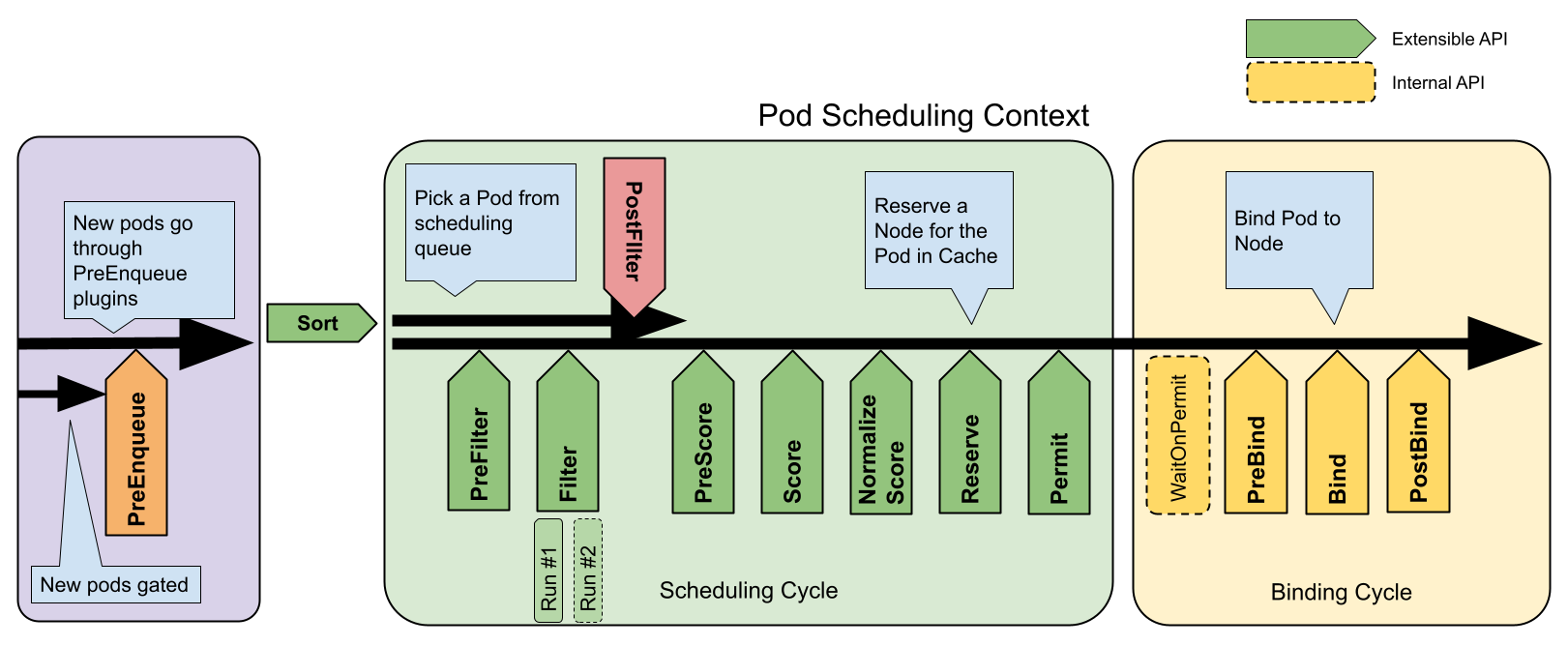
These plugins are called prior to adding Pods to the internal active queue, where Pods are marked as ready for scheduling.
Only when all PreEnqueue plugins return Success, the Pod is allowed to enter the active queue.
Otherwise, it's placed in the internal unschedulable Pods list, and doesn't get an Unschedulable condition.
For more details about how internal scheduler queues work, read Scheduling queue in kube-scheduler.
EnqueueExtension is the interface where the plugin can control whether to retry scheduling of Pods rejected by this plugin, based on changes in the cluster. Plugins that implement PreEnqueue, PreFilter, Filter, Reserve or Permit should implement this interface.
Kubernetes v1.34 [stable](enabled by default)QueueingHint is a callback function for deciding whether a Pod can be requeued to the active queue or backoff queue. It's executed every time a certain kind of event or change happens in the cluster. When the QueueingHint finds that the event might make the Pod schedulable, the Pod is put into the active queue or the backoff queue so that the scheduler will retry the scheduling of the Pod.
These plugins are used to sort Pods in the scheduling queue. A queue sort plugin
essentially provides a Less(Pod1, Pod2) function. Only one queue sort
plugin may be enabled at a time.
These plugins are used to pre-process info about the Pod, or to check certain conditions that the cluster or the Pod must meet. If a PreFilter plugin returns an error, the scheduling cycle is aborted.
These plugins are used to filter out nodes that cannot run the Pod. For each node, the scheduler will call filter plugins in their configured order. If any filter plugin marks the node as infeasible, the remaining plugins will not be called for that node. Nodes may be evaluated concurrently.
These plugins are called after the Filter phase, but only when no feasible nodes
were found for the pod. Plugins are called in their configured order. If
any postFilter plugin marks the node as Schedulable, the remaining plugins
will not be called. A typical PostFilter implementation is preemption, which
tries to make the pod schedulable by preempting other Pods.
These plugins are used to perform "pre-scoring" work, which generates a sharable state for Score plugins to use. If a PreScore plugin returns an error, the scheduling cycle is aborted.
These plugins are used to rank nodes that have passed the filtering phase. The scheduler will call each scoring plugin for each node. There will be a well defined range of integers representing the minimum and maximum scores. After the NormalizeScore phase, the scheduler will combine node scores from all plugins according to the configured plugin weights.
Kubernetes v1.33 [alpha](disabled by default)The feature gate VolumeCapacityPriority was used in v1.32 to support storage that are
statically provisioned. Starting from v1.33, the new feature gate StorageCapacityScoring
replaces the old VolumeCapacityPriority gate with added support to dynamically provisioned storage.
When StorageCapacityScoring is enabled, the VolumeBinding plugin in the kube-scheduler is extended
to score Nodes based on the storage capacity on each of them.
This feature is applicable to CSI volumes that supported Storage Capacity,
including local storage backed by a CSI driver.
These plugins are used to modify scores before the scheduler computes a final ranking of Nodes. A plugin that registers for this extension point will be called with the Score results from the same plugin. This is called once per plugin per scheduling cycle.
For example, suppose a plugin BlinkingLightScorer ranks Nodes based on how
many blinking lights they have.
func ScoreNode(_ *v1.pod, n *v1.Node) (int, error) {
return getBlinkingLightCount(n)
}
However, the maximum count of blinking lights may be small compared to
NodeScoreMax. To fix this, BlinkingLightScorer should also register for this
extension point.
func NormalizeScores(scores map[string]int) {
highest := 0
for _, score := range scores {
highest = max(highest, score)
}
for node, score := range scores {
scores[node] = score*NodeScoreMax/highest
}
}
If any NormalizeScore plugin returns an error, the scheduling cycle is aborted.
A plugin that implements the Reserve interface has two methods, namely Reserve
and Unreserve, that back two informational scheduling phases called Reserve
and Unreserve, respectively. Plugins which maintain runtime state (aka "stateful
plugins") should use these phases to be notified by the scheduler when resources
on a node are being reserved and unreserved for a given Pod.
The Reserve phase happens before the scheduler actually binds a Pod to its
designated node. It exists to prevent race conditions while the scheduler waits
for the bind to succeed. The Reserve method of each Reserve plugin may succeed
or fail; if one Reserve method call fails, subsequent plugins are not executed
and the Reserve phase is considered to have failed. If the Reserve method of
all plugins succeed, the Reserve phase is considered to be successful and the
rest of the scheduling cycle and the binding cycle are executed.
The Unreserve phase is triggered if the Reserve phase or a later phase fails.
When this happens, the Unreserve method of all Reserve plugins will be
executed in the reverse order of Reserve method calls. This phase exists to
clean up the state associated with the reserved Pod.
Unreserve method in Reserve plugins must be
idempotent and may not fail.Permit plugins are invoked at the end of the scheduling cycle for each Pod, to prevent or delay the binding to the candidate node. A permit plugin can do one of the three things:
approve
Once all Permit plugins approve a Pod, it is sent for binding.
deny
If any Permit plugin denies a Pod, it is returned to the scheduling queue.
This will trigger the Unreserve phase in Reserve plugins.
wait (with a timeout)
If a Permit plugin returns "wait", then the Pod is kept in an internal "waiting"
Pods list, and the binding cycle of this Pod starts but directly blocks until it
gets approved. If a timeout occurs, wait becomes deny
and the Pod is returned to the scheduling queue, triggering the
Unreserve phase in Reserve plugins.
FrameworkHandle),
we expect only the permit plugins to approve binding of reserved Pods that are in "waiting" state.
Once a Pod is approved, it is sent to the PreBind phase.These plugins are used to perform any work required before a Pod is bound. For example, a pre-bind plugin may provision a network volume and mount it on the target node before allowing the Pod to run there.
If any PreBind plugin returns an error, the Pod is rejected and returned to the scheduling queue.
These plugins are used to bind a Pod to a Node. Bind plugins will not be called until all PreBind plugins have completed. Each bind plugin is called in the configured order. A bind plugin may choose whether or not to handle the given Pod. If a bind plugin chooses to handle a Pod, the remaining bind plugins are skipped.
This is an informational interface. Post-bind plugins are called after a Pod is successfully bound. This is the end of a binding cycle, and can be used to clean up associated resources.
There are two steps to the plugin API. First, plugins must register and get configured, then they use the extension point interfaces. Extension point interfaces have the following form.
type Plugin interface {
Name() string
}
type QueueSortPlugin interface {
Plugin
Less(*v1.pod, *v1.pod) bool
}
type PreFilterPlugin interface {
Plugin
PreFilter(context.Context, *framework.CycleState, *v1.pod) error
}
// ...
You can enable or disable plugins in the scheduler configuration. If you are using Kubernetes v1.18 or later, most scheduling plugins are in use and enabled by default.
In addition to default plugins, you can also implement your own scheduling plugins and get them configured along with default plugins. You can visit scheduler-plugins for more details.
If you are using Kubernetes v1.18 or later, you can configure a set of plugins as a scheduler profile and then define multiple profiles to fit various kinds of workload. Learn more at multiple profiles.
Kubernetes v1.35 [stable](enabled by default)This page describes dynamic resource allocation (DRA) in Kubernetes.
DRA is a Kubernetes feature that lets you request and share resources among Pods. These resources are often attached devices like hardware accelerators.
With DRA, device drivers and cluster admins define device classes that are available to claim in workloads. Kubernetes allocates matching devices to specific claims and places the corresponding Pods on nodes that can access the allocated devices.
Allocating resources with DRA is a similar experience to dynamic volume provisioning, in which you use PersistentVolumeClaims to claim storage capacity from storage classes and request the claimed capacity in your Pods.
DRA provides a flexible way to categorize, request, and use devices in your cluster. Using DRA provides benefits like the following:
These benefits provide significant improvements in the device allocation workflow when compared to device plugins, which require per-container device requests, don't support device sharing, and don't support expression-based device filtering.
The workflow of using DRA to allocate devices involves the following types of users:
Device owner: responsible for devices. Device owners might be commercial vendors, the cluster operator, or another entity. To use DRA, devices must have DRA-compatible drivers that do the following:
Cluster admin: responsible for configuring clusters and nodes, attaching devices, installing drivers, and similar tasks. To use DRA, cluster admins do the following:
Workload operator: responsible for deploying and managing workloads in the cluster. To use DRA to allocate devices to Pods, workload operators do the following:
DRA uses the following Kubernetes API kinds to provide the core allocation
functionality. All of these API kinds are included in the resource.k8s.io/v1
API group.
A DeviceClass lets cluster admins or device drivers define categories of devices in the cluster. DeviceClasses tell operators what devices they can request and how they can request those devices. You can use common expression language (CEL) to select devices based on specific attributes. A ResourceClaim that references the DeviceClass can then request specific configurations within the DeviceClass.
To create a DeviceClass, see Set Up DRA in a Cluster.
A ResourceClaim defines the resources that a workload needs. Every ResourceClaim has requests that reference a DeviceClass and select devices from that DeviceClass. ResourceClaims can also use selectors to filter for devices that meet specific requirements, and can use constraints to limit the devices that can satisfy a request. ResourceClaims can be created by workload operators or can be generated by Kubernetes based on a ResourceClaimTemplate. A ResourceClaimTemplate defines a template that Kubernetes can use to auto-generate ResourceClaims for Pods.
The method that you use depends on your requirements, as follows:
When you define a workload, you can use Common Expression Language (CEL) to filter for specific device attributes or capacity. The available parameters for filtering depend on the device and the drivers.
If you directly reference a specific ResourceClaim in a Pod, that ResourceClaim must already exist in the same namespace as the Pod. If the ResourceClaim doesn't exist in the namespace, the Pod won't schedule. This behavior is similar to how a PersistentVolumeClaim must exist in the same namespace as a Pod that references it.
You can reference an auto-generated ResourceClaim in a Pod, but this isn't recommended because auto-generated ResourceClaims are bound to the lifetime of the Pod that triggered the generation.
To learn how to claim resources using one of these methods, see Allocate Devices to Workloads with DRA.
Kubernetes v1.34 [beta](enabled by default)You can provide a prioritized list of subrequests for requests in a ResourceClaim or ResourceClaimTemplate. The scheduler will then select the first subrequest that can be allocated. This allows users to specify alternative devices that can be used by the workload if the primary choice is not available.
In the example below, the ResourceClaimTemplate requested a device with the color black and the size large. If a device with those attributes is not available, the pod cannot be scheduled. With the prioritized list feature, a second alternative can be specified, which requests two devices with the color white and size small. The large black device will be allocated if it is available. If it is not, but two small white devices are available, the pod will still be able to run.
apiVersion: resource.k8s.io/v1
kind: ResourceClaimTemplate
metadata:
name: prioritized-list-claim-template
spec:
spec:
devices:
requests:
- name: req-0
firstAvailable:
- name: large-black
deviceClassName: resource.example.com
selectors:
- cel:
expression: |-
device.attributes["resource-driver.example.com"].color == "black" &&
device.attributes["resource-driver.example.com"].size == "large"
- name: small-white
deviceClassName: resource.example.com
selectors:
- cel:
expression: |-
device.attributes["resource-driver.example.com"].color == "white" &&
device.attributes["resource-driver.example.com"].size == "small"
count: 2
If the pod is eligible for multiple nodes in the cluster, the scheduler will use the index of chosen subrequests from any prioritized lists as one of the inputs when it scores each node. So nodes that can allocate devices requested in a higher ranked subrequest are more likely to be chosen than nodes that can only allocate devices for lower ranked subrequests.
The decision is made on a per-Pod basis, so if the Pod is a member of a ReplicaSet or similar grouping, you cannot rely on all the members of the group having the same subrequest chosen. Your workload must be able to accommodate this.
Prioritized lists is a beta feature and is enabled by default with the
DRAPrioritizedList feature gate in
the kube-apiserver and kube-scheduler.
Each ResourceSlice represents one or more devices in a pool. The pool is managed by a device driver, which creates and manages ResourceSlices. The resources in a pool might be represented by a single ResourceSlice or span multiple ResourceSlices.
ResourceSlices provide useful information to device users and to the scheduler, and are crucial for dynamic resource allocation. Every ResourceSlice must include the following information:
Drivers use a controller to reconcile ResourceSlices in the cluster with the information that the driver has to publish. This controller overwrites any manual changes, such as cluster users creating or modifying ResourceSlices.
Consider the following example ResourceSlice:
apiVersion: resource.k8s.io/v1
kind: ResourceSlice
metadata:
name: cat-slice
spec:
driver: "resource-driver.example.com"
pool:
generation: 1
name: "black-cat-pool"
resourceSliceCount: 1
# The allNodes field defines whether any node in the cluster can access the device.
allNodes: true
devices:
- name: "large-black-cat"
attributes:
color:
string: "black"
size:
string: "large"
cat:
bool: true
This ResourceSlice is managed by the resource-driver.example.com driver in the
black-cat-pool pool. The allNodes: true field indicates that any node in the
cluster can access the devices. There's one device in the ResourceSlice, named
large-black-cat, with the following attributes:
color: blacksize: largecat: trueA DeviceClass could select this ResourceSlice by using these attributes, and a ResourceClaim could filter for specific devices in that DeviceClass.
The following sections describe the workflow for the various types of DRA users and for the Kubernetes system during dynamic resource allocation.
ResourceSlice creation: drivers in the cluster create ResourceSlices that represent one or more devices in a managed pool of similar devices.
Workload creation: the cluster control plane checks new workloads for references to ResourceClaimTemplates or to specific ResourceClaims.
resourceclaim-controller generates ResourceClaims for every Pod in the
workload.ResourceSlice filtering: for every Pod, Kubernetes checks the ResourceSlices in the cluster to find a device that satisfies all of the following criteria:
Resource allocation: after finding an eligible ResourceSlice for a Pod's ResourceClaim, the Kubernetes scheduler updates the ResourceClaim with the allocation details.
Pod scheduling: when resource allocation is complete, the scheduler places the Pod on a node that can access the allocated resource. The device driver and the kubelet on that node configure the device and the Pod's access to the device.
You can check the status of dynamically allocated resources by using any of the following methods:
The PodResourcesLister kubelet gRPC service lets you monitor in-use devices.
The DynamicResource message provides information that's specific to dynamic
resource allocation, such as the device name and the claim name. For details,
see
Monitoring device plugin resources.
Kubernetes v1.33 [beta](enabled by default)DRA drivers can report driver-specific
device status
data for each allocated device in the status.devices field of a ResourceClaim.
For example, the driver might list the IP addresses that are assigned to a
network interface device.
The accuracy of the information that a driver adds to a ResourceClaim
status.devices field depends on the driver. Evaluate drivers to decide whether
you can rely on this field as the only source of device information.
If you disable the DRAResourceClaimDeviceStatus
feature gate, the
status.devices field automatically gets cleared when storing the ResourceClaim.
A ResourceClaim device status is supported when it is possible, from a DRA
driver, to update an existing ResourceClaim where the status.devices field is
set.
For details about the status.devices field, see the
ResourceClaim API reference.
Kubernetes v1.31 [alpha](disabled by default)As an alpha feature, Kubernetes provides a mechanism for monitoring and reporting the health of dynamically allocated infrastructure resources. For stateful applications running on specialized hardware, it is critical to know when a device has failed or become unhealthy. It is also helpful to find out if the device recovers.
To enable this functionality, the ResourceHealthStatus feature gate
must be enabled, and the DRA driver must implement the DRAResourceHealth gRPC service.
When a DRA driver detects that an allocated device has become unhealthy, it reports this status back to the kubelet.
This health information is then exposed directly in the Pod's status.
The kubelet populates the allocatedResourcesStatus field in the status of each container,
detailing the health of each device assigned to that container.
This provides crucial visibility for users and controllers to react to hardware failures. For a Pod that is failing, you can inspect this status to determine if the failure was related to an unhealthy device.
When you - or another API client - create a Pod with spec.nodeName already set, the scheduler gets bypassed.
If some ResourceClaim needed by that Pod does not exist yet, is not allocated
or not reserved for the Pod, then the kubelet will fail to run the Pod and
re-check periodically because those requirements might still get fulfilled later.
Such a situation can also arise when support for dynamic resource allocation was not enabled in the scheduler at the time when the Pod got scheduled (version skew, configuration, feature gate, etc.). kube-controller-manager detects this and tries to make the Pod runnable by reserving the required ResourceClaims. However, this only works if those were allocated by the scheduler for some other pod.
It is better to avoid bypassing the scheduler because a Pod that is assigned to a node blocks normal resources (RAM, CPU) that then cannot be used for other Pods while the Pod is stuck. To make a Pod run on a specific node while still going through the normal scheduling flow, create the Pod with a node selector that exactly matches the desired node:
apiVersion: v1
kind: Pod
metadata:
name: pod-with-cats
spec:
nodeSelector:
kubernetes.io/hostname: name-of-the-intended-node
...
You may also be able to mutate the incoming Pod, at admission time, to unset
the .spec.nodeName field and to use a node selector instead.
The following sections describe DRA features that are available in the Beta feature stage. For more information, see Set up DRA in the cluster.
Kubernetes v1.34 [beta](enabled by default)You can mark a request in a ResourceClaim or ResourceClaimTemplate as having privileged features for maintenance and troubleshooting tasks. A request with admin access grants access to in-use devices and may enable additional permissions when making the device available in a container:
apiVersion: resource.k8s.io/v1
kind: ResourceClaimTemplate
metadata:
name: large-black-cat-claim-template
spec:
spec:
devices:
requests:
- name: req-0
exactly:
deviceClassName: resource.example.com
allocationMode: All
adminAccess: true
If this feature is disabled, the adminAccess field will be removed
automatically when creating such a ResourceClaim.
Admin access is a privileged mode and should not be granted to regular users in
multi-tenant clusters. Starting with Kubernetes v1.33, only users authorized to
create ResourceClaim or ResourceClaimTemplate objects in namespaces labeled with
resource.k8s.io/admin-access: "true" (case-sensitive) can use the adminAccess field.
This ensures that non-admin users cannot misuse the feature.
Starting with Kubernetes v1.34, this label has been updated to resource.kubernetes.io/admin-access: "true".
The following sections describe DRA features that are available in the Alpha feature stage. They depend on enabling feature gates and may depend on additional API groups. For more information, see Set up DRA in the cluster.
Kubernetes v1.34 [alpha](disabled by default)You can provide an extended resource name for a DeviceClass. The scheduler will then select the devices matching the class for the extended resource requests. This allows users to continue using extended resource requests in a pod to request either extended resources provided by device plugin, or DRA devices. The same extended resource can be provided either by device plugin, or DRA on one single cluster node. The same extended resource can be provided by device plugin on some nodes, and DRA on other nodes in the same cluster.
In the example below, the DeviceClass is given an extendedResourceName example.com/gpu.
If a pod requested for the extended resource example.com/gpu: 2, it can be scheduled to
a node with two or more devices matching the DeviceClass.
apiVersion: resource.k8s.io/v1
kind: DeviceClass
metadata:
name: gpu.example.com
spec:
selectors:
- cel:
expression: device.driver == 'gpu.example.com' && device.attributes['gpu.example.com'].type
== 'gpu'
extendedResourceName: example.com/gpu
In addition, users can use a special extended resource to allocate devices without
having to explicitly create a ResourceClaim. Using the extended resource name
prefix deviceclass.resource.kubernetes.io/ and the DeviceClass name.
This works for any DeviceClass, even if it does not specify an extended resource name.
The resulting ResourceClaim will contain a request for an ExactCount of the
specified number of devices of that DeviceClass.
Extended resource allocation by DRA is an alpha feature and only enabled when the
DRAExtendedResource feature gate
is enabled in the kube-apiserver, kube-scheduler, and kubelet.
Kubernetes v1.33 [alpha](disabled by default)Devices represented in DRA don't necessarily have to be a single unit connected to a single machine, but can also be a logical device comprised of multiple devices connected to multiple machines. These devices might consume overlapping resources of the underlying phyical devices, meaning that when one logical device is allocated other devices will no longer be available.
In the ResourceSlice API, this is represented as a list of named CounterSets, each of which contains a set of named counters. The counters represent the resources available on the physical device that are used by the logical devices advertised through DRA.
Logical devices can specify the ConsumesCounters list. Each entry contains a reference to a CounterSet and a set of named counters with the amounts they will consume. So for a device to be allocatable, the referenced counter sets must have sufficient quantity for the counters referenced by the device.
CounterSets must be specified in separate ResourceSlices from devices. Devices can consume counters from any CounterSet defined in the same resource pool as the device.
Here is an example of two devices, each consuming 6Gi of memory from a shared counter with 8Gi of memory. Thus, only one of the devices can be allocated at any point in time. The scheduler handles this and it is transparent to the consumer as the ResourceClaim API is not affected.
apiVersion: resource.k8s.io/v1
kind: ResourceSlice
metadata:
name: resourceslice-with-countersets
spec:
nodeName: worker-1
pool:
name: pool
generation: 1
resourceSliceCount: 2
driver: dra.example.com
sharedCounters:
- name: gpu-1-counters
counters:
memory:
value: 8Gi
---
apiVersion: resource.k8s.io/v1
kind: ResourceSlice
metadata:
name: resourceslice-with-devices
spec:
nodeName: worker-1
pool:
name: pool
generation: 1
resourceSliceCount: 2
driver: dra.example.com
devices:
- name: device-1
consumesCounters:
- counterSet: gpu-1-counters
counters:
memory:
value: 6Gi
- name: device-2
consumesCounters:
- counterSet: gpu-1-counters
counters:
memory:
value: 6Gi
Partitionable devices is an alpha feature and only enabled when the DRAPartitionableDevices
feature gate
is enabled in the kube-apiserver and kube-scheduler.
Kubernetes v1.34 [alpha](disabled by default)The consumable capacity feature allows the same devices to be consumed by multiple independent ResourceClaims, with the Kubernetes scheduler managing how much of the device's capacity is used up by each claim. This is analogous to how Pods can share the resources on a Node; ResourceClaims can share the resources on a Device.
The device driver can set allowMultipleAllocations field added in .spec.devices of ResourceSlice
to allow allocating that device to multiple independent ResourceClaims or to multiple requests within a ResourceClaim.
Users can set capacity field added in spec.devices.requests of ResourceClaim to specify the device resource requirements for each allocation.
For the device that allows multiple allocations, the requested capacity is drawn from — or consumed from — its total capacity,
a concept known as consumable capacity.
Then, the scheduler ensures that the aggregate consumed capacity across all claims does not exceed the device’s overall capacity.
Furthermore, driver authors can use the requestPolicy constraints on individual device capacities to control
how those capacities are consumed.
For example, the driver author can specify that a given capacity is only consumed in increments of 1Gi.
Here is an example of a network device which allows multiple allocations and contains a consumable bandwidth capacity.
kind: ResourceSlice
apiVersion: resource.k8s.io/v1
metadata:
name: resourceslice
spec:
nodeName: worker-1
pool:
name: pool
generation: 1
resourceSliceCount: 1
driver: dra.example.com
devices:
- name: eth1
allowMultipleAllocations: true
attributes:
name:
string: "eth1"
capacity:
bandwidth:
requestPolicy:
default: "1M"
validRange:
min: "1M"
step: "8"
value: "10G"
The consumable capacity can be requested as shown in the below example.
apiVersion: resource.k8s.io/v1
kind: ResourceClaimTemplate
metadata:
name: bandwidth-claim-template
spec:
spec:
devices:
requests:
- name: req-0
exactly:
deviceClassName: resource.example.com
capacity:
requests:
bandwidth: 1G
The allocation result will include the consumed capacity and the identifier of the share.
apiVersion: resource.k8s.io/v1
kind: ResourceClaim
...
status:
allocation:
devices:
results:
- consumedCapacity:
bandwidth: 1G
device: eth1
shareID: "a671734a-e8e5-11e4-8fde-42010af09327"
In this example, a multiply-allocatable device was chosen. However, any resource.example.com device
with at least the requested 1G bandwidth could have met the requirement.
If a non-multiply-allocatable device were chosen, the allocation would have resulted in the entire device.
To force the use of a only multiply-allocatable devices, you can use the CEL criteria device.allowMultipleAllocations == true.
Kubernetes v1.33 [alpha](disabled by default)Device taints are similar to node taints: a taint has a string key, a string value, and an effect. The effect is applied to the ResourceClaim which is using a tainted device and to all Pods referencing that ResourceClaim. The "NoSchedule" effect prevents scheduling those Pods. Tainted devices are ignored when trying to allocate a ResourceClaim because using them would prevent scheduling of Pods.
The "NoExecute" effect implies "NoSchedule" and in addition causes eviction of all Pods which have been scheduled already. This eviction is implemented in the device taint eviction controller in kube-controller-manager by deleting affected Pods.
The "None" effect is ignored by the scheduler and eviction controller. DRA drivers can use it to communicate exceptions to admins or other controllers, like for example degraded health of a device. Admins can also use it to do dry-runs of pod eviction in DeviceTaintRules (more on that below).
ResourceClaims can tolerate taints. If a taint is tolerated, its effect does not apply. An empty toleration matches all taints. A toleration can be limited to certain effects and/or match certain key/value pairs. A toleration can check that a certain key exists, regardless which value it has, or it can check for specific values of a key. For more information on this matching see the node taint concepts.
Eviction can be delayed by tolerating a taint for a certain duration. That delay starts at the time when a taint gets added to a device, which is recorded in a field of the taint.
Taints apply as described above also to ResourceClaims allocating "all" devices on a node. All devices must be untainted or all of their taints must be tolerated. Allocating a device with admin access (described above) is not exempt either. An admin using that mode must explicitly tolerate all taints to access tainted devices.
Device taints and tolerations is an alpha feature and only enabled when the
DRADeviceTaints feature gate
is enabled in the kube-apiserver, kube-controller-manager and kube-scheduler.
To use DeviceTaintRules, the resource.k8s.io/v1alpha3 API version must be enabled.
You can add taints to devices in the following ways, by using the DeviceTaintRule API kind.
A DRA driver can add taints to the device information that it publishes in ResourceSlices. Consult the documentation of a DRA driver to learn whether the driver uses taints and what their keys and values are.
Kubernetes v1.35 [alpha](disabled by default)An admin or a control plane component can taint devices without having to tell the DRA driver to include taints in its device information in ResourceSlices. They do that by creating DeviceTaintRules. Each DeviceTaintRule adds one taint to devices which match the device selector. Without such a selector, no devices are tainted. This makes it harder to accidentally evict all pods using ResourceClaims when leaving out the selector by mistake.
Devices can be selected by giving the name of a DeviceClass, driver, pool, and/or device. The DeviceClass selects all devices that are selected by the selectors in that DeviceClass. With just the driver name, an admin can taint all devices managed by that driver, for example while doing some kind of maintenance of that driver across the entire cluster. Adding a pool name can limit the taint to a single node, if the driver manages node-local devices.
Finally, adding the device name can select one specific device. The device name and pool name can also be used alone, if desired. For example, drivers for node-local devices are encouraged to use the node name as their pool name. Then tainting with that pool name automatically taints all devices on a node.
Drivers might use stable names like "gpu-0" that hide which specific device is currently assigned to that name. To support tainting a specific hardware instance, CEL selectors can be used in a DeviceTaintRule to match a vendor-specific unique ID attribute, if the driver supports one for its hardware.
The taint applies as long as the DeviceTaintRule exists. It can be modified and and removed at any time. Here is one example of a DeviceTaintRule for a fictional DRA driver:
apiVersion: resource.k8s.io/v1alpha3
kind: DeviceTaintRule
metadata:
name: example
spec:
# The entire hardware installation for this
# particular driver is broken.
# Evict all pods and don't schedule new ones.
deviceSelector:
driver: dra.example.com
taint:
key: dra.example.com/unhealthy
value: Broken
effect: NoExecute
The apiserver automatically tracks when this taint was created and the eviction controller adds a condition with some information:
kubectl describe devicetaintrules
Name: example
...
Spec:
Device Selector:
Driver: dra.example.com
Taint:
Effect: NoExecute
Key: dra.example.com/unhealthy
Time Added: 2025-11-05T18:15:37Z
Value: Broken
Status:
Conditions:
Last Transition Time: 2025-11-05T18:15:37Z
Message: 1 pod evicted since starting the controller.
Observed Generation: 1
Reason: Completed
Status: False
Type: EvictionInProgress
Events: <none>
Pods get evicted by deleting them. Usually this happens very quickly, except when a toleration for the taint delays it for a certain period or when there are very many pods which need to be evicted. When it takes longer, the message provides information about the current status:
2 pods need to be evicted in 2 different namespaces. 1 pod evicted since starting the controller.
The condition can be used to check whether an eviction is currently active:
kubectl wait --for=condition=EvictionInProgress=false DeviceTaintRule/example
Beware of the potential race between scheduler and controller observing the new
taint at different times, which can lead to pods still being scheduled at a
time when the controller thinks that there are none which need to be evicted
and thus sets this condition to False. In practice, this race is made very
unlikely by updating the status only after an intentional delay of a few
seconds.
For effect: None, the message provides information about the number of
affected devices, how many of those are allocated, and how many pods would be
evicted if the effect was NoExecute. This can be used to do a dry-run before
actually triggering eviction:
Create a DeviceTaintRule with the desired selectors and effect: None.
Review the message:
3 published devices selected. 1 allocated device selected.
1 pod would be evicted in 1 namespace if the effect was NoExecute.
This information will not be updated again. Recreate the DeviceTaintRule to trigger an update.
Published devices are those listed in ResourceSlices. Tainting them prevents allocation for new pods. Only allocated devices cause eviction of the pods using them.
Edit the DeviceTaintRule and change the effect into NoExecute.
Kubernetes v1.34 [alpha](disabled by default)Device Binding Conditions allow the Kubernetes scheduler to delay Pod binding until external resources, such as fabric-attached GPUs or reprogrammable FPGAs, are confirmed to be ready.
This waiting behavior is implemented in the PreBind phase of the scheduling framework. During this phase, the scheduler checks whether all required device conditions are satisfied before proceeding with binding.
This improves scheduling reliability by avoiding premature binding and enables coordination with external device controllers.
To use this feature, device drivers (typically managed by driver owners) must publish the
following fields in the Device section of a ResourceSlice. Cluster administrators
must enable the DRADeviceBindingConditions and DRAResourceClaimDeviceStatus feature
gates for the scheduler to honor these fields.
bindingConditions: A list of condition types that must be set to True in the
status.conditions field of the associated ResourceClaim before the Pod can be bound.
These typically represent readiness signals such as "DeviceAttached" or "DeviceInitialized".bindingFailureConditions: A list of condition types that, if set to True in
status.conditions field of the associated ResourceClaim, indicate a failure state.
If any of these conditions are True, the scheduler will abort binding and reschedule the Pod.bindsToNode: if set to true, the scheduler records the selected node name in the
status.allocation.nodeSelector field of the ResourceClaim.
This does not affect the Pod's spec.nodeSelector. Instead, it sets a node selector
inside the ResourceClaim, which external controllers can use to perform node-specific
operations such as device attachment or preparation.All condition types listed in bindingConditions and bindingFailureConditions are evaluated
from the status.conditions field of the ResourceClaim.
External controllers are responsible for updating these conditions using standard Kubernetes
condition semantics (type, status, reason, message, lastTransitionTime).
The scheduler waits up to 600 seconds (default) for all bindingConditions to become True.
If the timeout is reached or any bindingFailureConditions are True, the scheduler
clears the allocation and reschedules the Pod.
This timeout duration is configurable by the user through KubeSchedulerConfiguration.
apiVersion: resource.k8s.io/v1
kind: ResourceSlice
metadata:
name: gpu-slice
spec:
driver: dra.example.com
nodeSelector:
nodeSelectorTerms:
- matchExpressions:
- key: accelerator-type
operator: In
values:
- "high-performance"
pool:
name: gpu-pool
generation: 1
resourceSliceCount: 1
devices:
- name: gpu-1
attributes:
vendor:
string: "example"
model:
string: "example-gpu"
bindsToNode: true
bindingConditions:
- dra.example.com/is-prepared
bindingFailureConditions:
- dra.example.com/preparing-failed
This example ResourceSlice has the following properties:
accelerator-type=high-performance,
so that the scheduler uses only a specific set of eligible nodes.node-3) and sets
the status.allocation.nodeSelector field in the ResourceClaim to that node name.dra.example.com/is-prepared binding condition indicates that the device gpu-1
must be prepared (the is-prepared condition has a status of True) before binding.gpu-1 device preparation fails (the preparing-failed condition has a status of True), the scheduler aborts binding.An example of configuring this timeout in KubeSchedulerConfiguration is given below:
apiVersion: kubescheduler.config.k8s.io/v1
kind: KubeSchedulerConfiguration
profiles:
- schedulerName: default-scheduler
pluginConfig:
- name: DynamicResources
args:
apiVersion: kubescheduler.config.k8s.io/v1
kind: DynamicResourcesArgs
bindingTimeout: 60s
Kubernetes v1.35 [alpha](disabled by default)Gang scheduling ensures that a group of Pods are scheduled on an "all-or-nothing" basis. If the cluster cannot accommodate the entire group (or a defined minimum number of Pods), none of the Pods are bound to a node.
This feature depends on the Workload API.
Ensure the GenericWorkload
feature gate and the scheduling.k8s.io/v1alpha1
API group are enabled in the cluster.
When the GangScheduling plugin is enabled, the scheduler alters the lifecycle for Pods belonging
to a gang pod group policy within
a Workload.
The process follows these steps independently for each pod group and its replica key:
The scheduler holds Pods in the PreEnqueue phase until:
minCount.Pods do not enter the active scheduling queue until all of these conditions are met.
Once the quorum is met, the scheduler attempts to find placements for all Pods in the group.
All assigned Pods wait at the WaitOnPermit gate during this process.
Note that in the Alpha phase of this feature, finding a placement is based on pod-by-pod scheduling,
rather than a single-cycle approach.
If the scheduler finds valid placements for at least minCount Pods,
it allows all of them to be bound to their assigned nodes. If it cannot find placements for the entire group
within a fixed timeout of 5 minutes, none of the Pods are scheduled.
Instead, they are moved to the unschedulable queue to wait for cluster resources to free up,
allowing other workloads to be scheduled in the meantime.
Kubernetes v1.14 [beta]
kube-scheduler is the Kubernetes default scheduler. It is responsible for placement of Pods on Nodes in a cluster.
Nodes in a cluster that meet the scheduling requirements of a Pod are called feasible Nodes for the Pod. The scheduler finds feasible Nodes for a Pod and then runs a set of functions to score the feasible Nodes, picking a Node with the highest score among the feasible ones to run the Pod. The scheduler then notifies the API server about this decision in a process called Binding.
This page explains performance tuning optimizations that are relevant for large Kubernetes clusters.
In large clusters, you can tune the scheduler's behaviour balancing scheduling outcomes between latency (new Pods are placed quickly) and accuracy (the scheduler rarely makes poor placement decisions).
You configure this tuning setting via kube-scheduler setting
percentageOfNodesToScore. This KubeSchedulerConfiguration setting determines
a threshold for scheduling nodes in your cluster.
The percentageOfNodesToScore option accepts whole numeric values between 0
and 100. The value 0 is a special number which indicates that the kube-scheduler
should use its compiled-in default.
If you set percentageOfNodesToScore above 100, kube-scheduler acts as if you
had set a value of 100.
To change the value, edit the
kube-scheduler configuration file
and then restart the scheduler.
In many cases, the configuration file can be found at /etc/kubernetes/config/kube-scheduler.yaml.
After you have made this change, you can run
kubectl get pods -n kube-system | grep kube-scheduler
to verify that the kube-scheduler component is healthy.
To improve scheduling performance, the kube-scheduler can stop looking for feasible nodes once it has found enough of them. In large clusters, this saves time compared to a naive approach that would consider every node.
You specify a threshold for how many nodes are enough, as a whole number percentage of all the nodes in your cluster. The kube-scheduler converts this into an integer number of nodes. During scheduling, if the kube-scheduler has identified enough feasible nodes to exceed the configured percentage, the kube-scheduler stops searching for more feasible nodes and moves on to the scoring phase.
How the scheduler iterates over Nodes describes the process in detail.
If you don't specify a threshold, Kubernetes calculates a figure using a linear formula that yields 50% for a 100-node cluster and yields 10% for a 5000-node cluster. The lower bound for the automatic value is 5%.
This means that the kube-scheduler always scores at least 5% of your cluster no
matter how large the cluster is, unless you have explicitly set
percentageOfNodesToScore to be smaller than 5.
If you want the scheduler to score all nodes in your cluster, set
percentageOfNodesToScore to 100.
Below is an example configuration that sets percentageOfNodesToScore to 50%.
apiVersion: kubescheduler.config.k8s.io/v1alpha1
kind: KubeSchedulerConfiguration
algorithmSource:
provider: DefaultProvider
...
percentageOfNodesToScore: 50
percentageOfNodesToScore must be a value between 1 and 100 with the default
value being calculated based on the cluster size. There is also a hardcoded
minimum value of 100 nodes.
In clusters with less than 100 feasible nodes, the scheduler still checks all the nodes because there are not enough feasible nodes to stop the scheduler's search early.
In a small cluster, if you set a low value for percentageOfNodesToScore, your
change will have no or little effect, for a similar reason.
If your cluster has several hundred Nodes or fewer, leave this configuration option at its default value. Making changes is unlikely to improve the scheduler's performance significantly.
An important detail to consider when setting this value is that when a smaller number of nodes in a cluster are checked for feasibility, some nodes are not sent to be scored for a given Pod. As a result, a Node which could possibly score a higher value for running the given Pod might not even be passed to the scoring phase. This would result in a less than ideal placement of the Pod.
You should avoid setting percentageOfNodesToScore very low so that kube-scheduler
does not make frequent, poor Pod placement decisions. Avoid setting the
percentage to anything below 10%, unless the scheduler's throughput is critical
for your application and the score of nodes is not important. In other words, you
prefer to run the Pod on any Node as long as it is feasible.
This section is intended for those who want to understand the internal details of this feature.
In order to give all the Nodes in a cluster a fair chance of being considered
for running Pods, the scheduler iterates over the nodes in a round robin
fashion. You can imagine that Nodes are in an array. The scheduler starts from
the start of the array and checks feasibility of the nodes until it finds enough
Nodes as specified by percentageOfNodesToScore. For the next Pod, the
scheduler continues from the point in the Node array that it stopped at when
checking feasibility of Nodes for the previous Pod.
If Nodes are in multiple zones, the scheduler iterates over Nodes in various zones to ensure that Nodes from different zones are considered in the feasibility checks. As an example, consider six nodes in two zones:
Zone 1: Node 1, Node 2, Node 3, Node 4
Zone 2: Node 5, Node 6
The Scheduler evaluates feasibility of the nodes in this order:
Node 1, Node 5, Node 2, Node 6, Node 3, Node 4
After going over all the Nodes, it goes back to Node 1.
Kubernetes v1.35 [beta](enabled by default)When scheduling large workloads, pod definitions are typically identical and require the scheduler to perform the same operations over and over again. The Opportunistic Batching feature allows the scheduler to reuse the filtering and scoring results between scheduling cycles which greatly speeds up the scheduling process.
Basically, this feature works like:
Pods with equivalent scheduling constraints have to come to the scheduling cycle back to back. When the scheduler schedules a pod with different constraints, the cache is not used, but replaced with a new one.
We apply this batching scheduling to specific pods that:
Also, to enable this feature, the scheduler configuration needs to:
IgnorePreferredTermsOfExistingPods of InterPodAffinityArgs
to true to make the batching more efficientNote that whenever:
The restrictions and conditions are expected to evolve in future releases.
In the scheduling-plugin NodeResourcesFit of kube-scheduler, there are two
scoring strategies that support the bin packing of resources: MostAllocated and RequestedToCapacityRatio.
The MostAllocated strategy scores the nodes based on the utilization of resources, favoring the ones with higher allocation.
For each resource type, you can set a weight to modify its influence in the node score.
To set the MostAllocated strategy for the NodeResourcesFit plugin, use a
scheduler configuration similar to the following:
apiVersion: kubescheduler.config.k8s.io/v1
kind: KubeSchedulerConfiguration
profiles:
- pluginConfig:
- args:
scoringStrategy:
resources:
- name: cpu
weight: 1
- name: memory
weight: 1
- name: intel.com/foo
weight: 3
- name: intel.com/bar
weight: 3
type: MostAllocated
name: NodeResourcesFit
To learn more about other parameters and their default configuration, see the API documentation for
NodeResourcesFitArgs.
The RequestedToCapacityRatio strategy allows the users to specify the resources along with weights for
each resource to score nodes based on the request to capacity ratio. This
allows users to bin pack extended resources by using appropriate parameters
to improve the utilization of scarce resources in large clusters. It favors nodes according to a
configured function of the allocated resources. The behavior of the RequestedToCapacityRatio in
the NodeResourcesFit score function can be controlled by the
scoringStrategy field.
Within the scoringStrategy field, you can configure two parameters: requestedToCapacityRatio and
resources. The shape in the requestedToCapacityRatio
parameter allows the user to tune the function as least requested or most
requested based on utilization and score values. The resources parameter
comprises both the name of the resource to be considered during scoring and
its corresponding weight, which specifies the weight of each resource.
Below is an example configuration that sets
the bin packing behavior for extended resources intel.com/foo and intel.com/bar
using the requestedToCapacityRatio field.
apiVersion: kubescheduler.config.k8s.io/v1
kind: KubeSchedulerConfiguration
profiles:
- pluginConfig:
- args:
scoringStrategy:
resources:
- name: intel.com/foo
weight: 3
- name: intel.com/bar
weight: 3
requestedToCapacityRatio:
shape:
- utilization: 0
score: 0
- utilization: 100
score: 10
type: RequestedToCapacityRatio
name: NodeResourcesFit
Referencing the KubeSchedulerConfiguration file with the kube-scheduler
flag --config=/path/to/config/file will pass the configuration to the
scheduler.
To learn more about other parameters and their default configuration, see the API documentation for
NodeResourcesFitArgs.
shape is used to specify the behavior of the RequestedToCapacityRatio function.
shape:
- utilization: 0
score: 0
- utilization: 100
score: 10
The above arguments give the node a score of 0 if utilization is 0% and 10 for
utilization 100%, thus enabling bin packing behavior. To enable least
requested the score value must be reversed as follows.
shape:
- utilization: 0
score: 10
- utilization: 100
score: 0
resources is an optional parameter which defaults to:
resources:
- name: cpu
weight: 1
- name: memory
weight: 1
It can be used to add extended resources as follows:
resources:
- name: intel.com/foo
weight: 5
- name: cpu
weight: 3
- name: memory
weight: 1
The weight parameter is optional and is set to 1 if not specified. Also, the
weight cannot be set to a negative value.
This section is intended for those who want to understand the internal details of this feature. Below is an example of how the node score is calculated for a given set of values.
Requested resources:
intel.com/foo : 2
memory: 256MB
cpu: 2
Resource weights:
intel.com/foo : 5
memory: 1
cpu: 3
FunctionShapePoint {{0, 0}, {100, 10}}
Node 1 spec:
Available:
intel.com/foo: 4
memory: 1 GB
cpu: 8
Used:
intel.com/foo: 1
memory: 256MB
cpu: 1
Node score:
intel.com/foo = resourceScoringFunction((2+1),4)
= (100 - ((4-3)*100/4))
= (100 - 25)
= 75 # requested + used = 75% * available
= rawScoringFunction(75)
= 7 # floor(75/10)
memory = resourceScoringFunction((256+256),1024)
= (100 -((1024-512)*100/1024))
= 50 # requested + used = 50% * available
= rawScoringFunction(50)
= 5 # floor(50/10)
cpu = resourceScoringFunction((2+1),8)
= (100 -((8-3)*100/8))
= 37.5 # requested + used = 37.5% * available
= rawScoringFunction(37.5)
= 3 # floor(37.5/10)
NodeScore = ((7 * 5) + (5 * 1) + (3 * 3)) / (5 + 1 + 3)
= 5
Node 2 spec:
Available:
intel.com/foo: 8
memory: 1GB
cpu: 8
Used:
intel.com/foo: 2
memory: 512MB
cpu: 6
Node score:
intel.com/foo = resourceScoringFunction((2+2),8)
= (100 - ((8-4)*100/8)
= (100 - 50)
= 50
= rawScoringFunction(50)
= 5
memory = resourceScoringFunction((256+512),1024)
= (100 -((1024-768)*100/1024))
= 75
= rawScoringFunction(75)
= 7
cpu = resourceScoringFunction((2+6),8)
= (100 -((8-8)*100/8))
= 100
= rawScoringFunction(100)
= 10
NodeScore = ((5 * 5) + (7 * 1) + (10 * 3)) / (5 + 1 + 3)
= 7
Kubernetes v1.14 [stable]
Pods can have priority. Priority indicates the importance of a Pod relative to other Pods. If a Pod cannot be scheduled, the scheduler tries to preempt (evict) lower priority Pods to make scheduling of the pending Pod possible.
In a cluster where not all users are trusted, a malicious user could create Pods at the highest possible priorities, causing other Pods to be evicted/not get scheduled. An administrator can use ResourceQuota to prevent users from creating pods at high priorities.
See limit Priority Class consumption by default for details.
To use priority and preemption:
Add one or more PriorityClasses.
Create Pods withpriorityClassName set to one of the added
PriorityClasses. Of course you do not need to create the Pods directly;
normally you would add priorityClassName to the Pod template of a
collection object like a Deployment.
Keep reading for more information about these steps.
system-cluster-critical and system-node-critical.
These are common classes and are used to ensure that critical components are always scheduled first.A PriorityClass is a non-namespaced object that defines a mapping from a
priority class name to the integer value of the priority. The name is specified
in the name field of the PriorityClass object's metadata. The value is
specified in the required value field. The higher the value, the higher the
priority.
The name of a PriorityClass object must be a valid
DNS subdomain name,
and it cannot be prefixed with system-.
A PriorityClass object can have any 32-bit integer value smaller than or equal to 1 billion. This means that the range of values for a PriorityClass object is from -2147483648 to 1000000000 inclusive. Larger numbers are reserved for built-in PriorityClasses that represent critical system Pods. A cluster admin should create one PriorityClass object for each such mapping that they want.
PriorityClass also has two optional fields: globalDefault and description.
The globalDefault field indicates that the value of this PriorityClass should
be used for Pods without a priorityClassName. Only one PriorityClass with
globalDefault set to true can exist in the system. If there is no
PriorityClass with globalDefault set, the priority of Pods with no
priorityClassName is zero.
The description field is an arbitrary string. It is meant to tell users of the
cluster when they should use this PriorityClass.
If you upgrade an existing cluster without this feature, the priority of your existing Pods is effectively zero.
Addition of a PriorityClass with globalDefault set to true does not
change the priorities of existing Pods. The value of such a PriorityClass is
used only for Pods created after the PriorityClass is added.
If you delete a PriorityClass, existing Pods that use the name of the deleted PriorityClass remain unchanged, but you cannot create more Pods that use the name of the deleted PriorityClass.
apiVersion: scheduling.k8s.io/v1
kind: PriorityClass
metadata:
name: high-priority
value: 1000000
globalDefault: false
description: "This priority class should be used for XYZ service pods only."
Kubernetes v1.24 [stable]
Pods with preemptionPolicy: Never will be placed in the scheduling queue
ahead of lower-priority pods,
but they cannot preempt other pods.
A non-preempting pod waiting to be scheduled will stay in the scheduling queue,
until sufficient resources are free,
and it can be scheduled.
Non-preempting pods,
like other pods,
are subject to scheduler back-off.
This means that if the scheduler tries these pods and they cannot be scheduled,
they will be retried with lower frequency,
allowing other pods with lower priority to be scheduled before them.
Non-preempting pods may still be preempted by other, high-priority pods.
preemptionPolicy defaults to PreemptLowerPriority,
which will allow pods of that PriorityClass to preempt lower-priority pods
(as is existing default behavior).
If preemptionPolicy is set to Never,
pods in that PriorityClass will be non-preempting.
An example use case is for data science workloads.
A user may submit a job that they want to be prioritized above other workloads,
but do not wish to discard existing work by preempting running pods.
The high priority job with preemptionPolicy: Never will be scheduled
ahead of other queued pods,
as soon as sufficient cluster resources "naturally" become free.
apiVersion: scheduling.k8s.io/v1
kind: PriorityClass
metadata:
name: high-priority-nonpreempting
value: 1000000
preemptionPolicy: Never
globalDefault: false
description: "This priority class will not cause other pods to be preempted."
After you have one or more PriorityClasses, you can create Pods that specify one
of those PriorityClass names in their specifications. The priority admission
controller uses the priorityClassName field and populates the integer value of
the priority. If the priority class is not found, the Pod is rejected.
The following YAML is an example of a Pod configuration that uses the PriorityClass created in the preceding example. The priority admission controller checks the specification and resolves the priority of the Pod to 1000000.
apiVersion: v1
kind: Pod
metadata:
name: nginx
labels:
env: test
spec:
containers:
- name: nginx
image: nginx
imagePullPolicy: IfNotPresent
priorityClassName: high-priority
When Pod priority is enabled, the scheduler orders pending Pods by their priority and a pending Pod is placed ahead of other pending Pods with lower priority in the scheduling queue. As a result, the higher priority Pod may be scheduled sooner than Pods with lower priority if its scheduling requirements are met. If such Pod cannot be scheduled, the scheduler will continue and try to schedule other lower priority Pods.
When Pods are created, they go to a queue and wait to be scheduled. The scheduler picks a Pod from the queue and tries to schedule it on a Node. If no Node is found that satisfies all the specified requirements of the Pod, preemption logic is triggered for the pending Pod. Let's call the pending Pod P. Preemption logic tries to find a Node where removal of one or more Pods with lower priority than P would enable P to be scheduled on that Node. If such a Node is found, one or more lower priority Pods get evicted from the Node. After the Pods are gone, P can be scheduled on the Node.
When Pod P preempts one or more Pods on Node N, nominatedNodeName field of Pod
P's status is set to the name of Node N. This field helps the scheduler track
resources reserved for Pod P and also gives users information about preemptions
in their clusters.
Please note that Pod P is not necessarily scheduled to the "nominated Node".
The scheduler always tries the "nominated Node" before iterating over any other nodes.
After victim Pods are preempted, they get their graceful termination period. If
another node becomes available while scheduler is waiting for the victim Pods to
terminate, scheduler may use the other node to schedule Pod P. As a result
nominatedNodeName and nodeName of Pod spec are not always the same. Also, if
the scheduler preempts Pods on Node N, but then a higher priority Pod than Pod P
arrives, the scheduler may give Node N to the new higher priority Pod. In such a
case, scheduler clears nominatedNodeName of Pod P. By doing this, scheduler
makes Pod P eligible to preempt Pods on another Node.
When Pods are preempted, the victims get their graceful termination period. They have that much time to finish their work and exit. If they don't, they are killed. This graceful termination period creates a time gap between the point that the scheduler preempts Pods and the time when the pending Pod (P) can be scheduled on the Node (N). In the meantime, the scheduler keeps scheduling other pending Pods. As victims exit or get terminated, the scheduler tries to schedule Pods in the pending queue. Therefore, there is usually a time gap between the point that scheduler preempts victims and the time that Pod P is scheduled. In order to minimize this gap, one can set graceful termination period of lower priority Pods to zero or a small number.
A PodDisruptionBudget (PDB) allows application owners to limit the number of Pods of a replicated application that are down simultaneously from voluntary disruptions. Kubernetes supports PDB when preempting Pods, but respecting PDB is best effort. The scheduler tries to find victims whose PDB are not violated by preemption, but if no such victims are found, preemption will still happen, and lower priority Pods will be removed despite their PDBs being violated.
A Node is considered for preemption only when the answer to this question is yes: "If all the Pods with lower priority than the pending Pod are removed from the Node, can the pending Pod be scheduled on the Node?"
If a pending Pod has inter-pod affinity to one or more of the lower-priority Pods on the Node, the inter-Pod affinity rule cannot be satisfied in the absence of those lower-priority Pods. In this case, the scheduler does not preempt any Pods on the Node. Instead, it looks for another Node. The scheduler might find a suitable Node or it might not. There is no guarantee that the pending Pod can be scheduled.
Our recommended solution for this problem is to create inter-Pod affinity only towards equal or higher priority Pods.
Suppose a Node N is being considered for preemption so that a pending Pod P can be scheduled on N. P might become feasible on N only if a Pod on another Node is preempted. Here's an example:
topologyKey: topology.kubernetes.io/zone).If Pod Q were removed from its Node, the Pod anti-affinity violation would be gone, and Pod P could possibly be scheduled on Node N.
We may consider adding cross Node preemption in future versions if there is enough demand and if we find an algorithm with reasonable performance.
Pod priority and preemption can have unwanted side effects. Here are some examples of potential problems and ways to deal with them.
Preemption removes existing Pods from a cluster under resource pressure to make
room for higher priority pending Pods. If you give high priorities to
certain Pods by mistake, these unintentionally high priority Pods may cause
preemption in your cluster. Pod priority is specified by setting the
priorityClassName field in the Pod's specification. The integer value for
priority is then resolved and populated to the priority field of podSpec.
To address the problem, you can change the priorityClassName for those Pods
to use lower priority classes, or leave that field empty. An empty
priorityClassName is resolved to zero by default.
When a Pod is preempted, there will be events recorded for the preempted Pod. Preemption should happen only when a cluster does not have enough resources for a Pod. In such cases, preemption happens only when the priority of the pending Pod (preemptor) is higher than the victim Pods. Preemption must not happen when there is no pending Pod, or when the pending Pods have equal or lower priority than the victims. If preemption happens in such scenarios, please file an issue.
When pods are preempted, they receive their requested graceful termination period, which is by default 30 seconds. If the victim Pods do not terminate within this period, they are forcibly terminated. Once all the victims go away, the preemptor Pod can be scheduled.
While the preemptor Pod is waiting for the victims to go away, a higher priority Pod may be created that fits on the same Node. In this case, the scheduler will schedule the higher priority Pod instead of the preemptor.
This is expected behavior: the Pod with the higher priority should take the place of a Pod with a lower priority.
The scheduler tries to find nodes that can run a pending Pod. If no node is found, the scheduler tries to remove Pods with lower priority from an arbitrary node in order to make room for the pending pod. If a node with low priority Pods is not feasible to run the pending Pod, the scheduler may choose another node with higher priority Pods (compared to the Pods on the other node) for preemption. The victims must still have lower priority than the preemptor Pod.
When there are multiple nodes available for preemption, the scheduler tries to choose the node with a set of Pods with lowest priority. However, if such Pods have PodDisruptionBudget that would be violated if they are preempted then the scheduler may choose another node with higher priority Pods.
When multiple nodes exist for preemption and none of the above scenarios apply, the scheduler chooses a node with the lowest priority.
Pod priority and QoS class
are two orthogonal features with few interactions and no default restrictions on
setting the priority of a Pod based on its QoS classes. The scheduler's
preemption logic does not consider QoS when choosing preemption targets.
Preemption considers Pod priority and attempts to choose a set of targets with
the lowest priority. Higher-priority Pods are considered for preemption only if
the removal of the lowest priority Pods is not sufficient to allow the scheduler
to schedule the preemptor Pod, or if the lowest priority Pods are protected by
PodDisruptionBudget.
The kubelet uses Priority to determine pod order for node-pressure eviction. You can use the QoS class to estimate the order in which pods are most likely to get evicted. The kubelet ranks pods for eviction based on the following factors:
See Pod selection for kubelet eviction for more details.
kubelet node-pressure eviction does not evict Pods when their usage does not exceed their requests. If a Pod with lower priority is not exceeding its requests, it won't be evicted. Another Pod with higher priority that exceeds its requests may be evicted.
Node-pressure eviction is the process by which the kubelet proactively terminates pods to reclaim resource on nodes.
The kubelet monitors resources like memory, disk space, and filesystem inodes on your cluster's nodes. When one or more of these resources reach specific consumption levels, the kubelet can proactively fail one or more pods on the node to reclaim resources and prevent starvation.
During a node-pressure eviction, the kubelet sets the phase for the
selected pods to Failed, and terminates the Pod.
Node-pressure eviction is not the same as API-initiated eviction.
The kubelet does not respect your configured PodDisruptionBudget
or the pod's
terminationGracePeriodSeconds. If you use soft eviction thresholds,
the kubelet respects your configured eviction-max-pod-grace-period. If you use
hard eviction thresholds, the kubelet uses a 0s grace period (immediate shutdown) for termination.
The kubelet attempts to reclaim node-level resources before it terminates end-user pods. For example, it removes unused container images when disk resources are starved.
If the pods are managed by a workload
management object (such as StatefulSet
or Deployment) that
replaces failed pods, the control plane (kube-controller-manager) creates new
pods in place of the evicted pods.
If you are running a static pod on a node that is under resource pressure, the kubelet may evict that static Pod. The kubelet then tries to create a replacement, because static Pods always represent an intent to run a Pod on that node.
The kubelet takes the priority of the static pod into account when creating a replacement. If the static pod manifest specifies a low priority, and there are higher-priority Pods defined within the cluster's control plane, and the node is under resource pressure, the kubelet may not be able to make room for that static pod. The kubelet continues to attempt to run all static pods even when there is resource pressure on a node.
The kubelet uses various parameters to make eviction decisions, like the following:
Eviction signals are the current state of a particular resource at a specific point in time. The kubelet uses eviction signals to make eviction decisions by comparing the signals to eviction thresholds, which are the minimum amount of the resource that should be available on the node.
The kubelet uses the following eviction signals:
| Eviction Signal | Description | Linux Only |
|---|---|---|
memory.available |
memory.available := node.status.capacity[memory] - node.stats.memory.workingSet |
|
nodefs.available |
nodefs.available := node.stats.fs.available |
|
nodefs.inodesFree |
nodefs.inodesFree := node.stats.fs.inodesFree |
• |
imagefs.available |
imagefs.available := node.stats.runtime.imagefs.available |
|
imagefs.inodesFree |
imagefs.inodesFree := node.stats.runtime.imagefs.inodesFree |
• |
containerfs.available |
containerfs.available := node.stats.runtime.containerfs.available |
|
containerfs.inodesFree |
containerfs.inodesFree := node.stats.runtime.containerfs.inodesFree |
• |
pid.available |
pid.available := node.stats.rlimit.maxpid - node.stats.rlimit.curproc |
• |
In this table, the Description column shows how kubelet gets the value of the signal. Each signal supports either a percentage or a literal value. The kubelet calculates the percentage value relative to the total capacity associated with the signal.
On Linux nodes, the value for memory.available is derived from the cgroupfs instead of tools
like free -m. This is important because free -m does not work in a
container, and if users use the node allocatable
feature, out of resource decisions
are made local to the end user Pod part of the cgroup hierarchy as well as the
root node. This script or
cgroupv2 script
reproduces the same set of steps that the kubelet performs to calculate
memory.available. The kubelet excludes inactive_file (the number of bytes of
file-backed memory on the inactive LRU list) from its calculation, as it assumes that
memory is reclaimable under pressure.
On Windows nodes, the value for memory.available is derived from the node's global
memory commit levels (queried through the GetPerformanceInfo()
system call) by subtracting the node's global CommitTotal from the node's CommitLimit. Please note that CommitLimit can change if the node's page-file size changes!
The kubelet recognizes three specific filesystem identifiers that can be used with
eviction signals (<identifier>.inodesFree or <identifier>.available):
nodefs: The node's main filesystem, used for local disk volumes,
emptyDir volumes not backed by memory, log storage, ephemeral storage,
and more. For example, nodefs contains /var/lib/kubelet.
imagefs: An optional filesystem that container runtimes can use to store
container images (which are the read-only layers) and container writable
layers.
containerfs: An optional filesystem that container runtime can use to
store the writeable layers. Similar to the main filesystem (see nodefs),
it's used to store local disk volumes, emptyDir volumes not backed by memory,
log storage, and ephemeral storage, except for the container images. When
containerfs is used, the imagefs filesystem can be split to only store
images (read-only layers) and nothing else.
Kubernetes v1.31 [beta](enabled by default)The split image filesystem feature, which enables support for the containerfs
filesystem, adds several new eviction signals, thresholds and metrics. To use
containerfs, the Kubernetes release v1.35 requires the
KubeletSeparateDiskGC feature gate
to be enabled. Currently, only CRI-O (v1.29 or higher) offers the containerfs
filesystem support.
As such, kubelet generally allows three options for container filesystems:
Everything is on the single nodefs, also referred to as "rootfs" or
simply "root", and there is no dedicated image filesystem.
Container storage (see nodefs) is on a dedicated disk, and imagefs
(writable and read-only layers) is separate from the root filesystem.
This is often referred to as "split disk" (or "separate disk") filesystem.
Container filesystem containerfs (same as nodefs plus writable
layers) is on root and the container images (read-only layers) are
stored on separate imagefs. This is often referred to as "split image"
filesystem.
The kubelet will attempt to auto-discover these filesystems with their current configuration directly from the underlying container runtime and will ignore other local node filesystems.
The kubelet does not support other container filesystems or storage configurations, and it does not currently support multiple filesystems for images and containers.
Some kubelet garbage collection features are deprecated in favor of eviction:
| Existing Flag | Rationale |
|---|---|
--maximum-dead-containers |
deprecated once old logs are stored outside of container's context |
--maximum-dead-containers-per-container |
deprecated once old logs are stored outside of container's context |
--minimum-container-ttl-duration |
deprecated once old logs are stored outside of container's context |
You can specify custom eviction thresholds for the kubelet to use when it makes eviction decisions. You can configure soft and hard eviction thresholds.
Eviction thresholds have the form [eviction-signal][operator][quantity], where:
eviction-signal is the eviction signal to use.operator is the relational operator
you want, such as < (less than).quantity is the eviction threshold amount, such as 1Gi. The value of quantity
must match the quantity representation used by Kubernetes. You can use either
literal values or percentages (%).For example, if a node has 10GiB of total memory and you want trigger eviction if
the available memory falls below 1GiB, you can define the eviction threshold as
either memory.available<10% or memory.available<1Gi (you cannot use both).
A soft eviction threshold pairs an eviction threshold with a required administrator-specified grace period. The kubelet does not evict pods until the grace period is exceeded. The kubelet returns an error on startup if you do not specify a grace period.
You can specify both a soft eviction threshold grace period and a maximum allowed pod termination grace period for kubelet to use during evictions. If you specify a maximum allowed grace period and the soft eviction threshold is met, the kubelet uses the lesser of the two grace periods. If you do not specify a maximum allowed grace period, the kubelet kills evicted pods immediately without graceful termination.
You can use the following flags to configure soft eviction thresholds:
eviction-soft: A set of eviction thresholds like memory.available<1.5Gi
that can trigger pod eviction if held over the specified grace period.eviction-soft-grace-period: A set of eviction grace periods like memory.available=1m30s
that define how long a soft eviction threshold must hold before triggering a Pod eviction.eviction-max-pod-grace-period: The maximum allowed grace period (in seconds)
to use when terminating pods in response to a soft eviction threshold being met.A hard eviction threshold has no grace period. When a hard eviction threshold is met, the kubelet kills pods immediately without graceful termination to reclaim the starved resource.
You can use the eviction-hard flag to configure a set of hard eviction
thresholds like memory.available<1Gi.
The kubelet has the following default hard eviction thresholds:
memory.available<100Mi (Linux nodes)memory.available<500Mi (Windows nodes)nodefs.available<10%imagefs.available<15%nodefs.inodesFree<5% (Linux nodes)imagefs.inodesFree<5% (Linux nodes)These default values of hard eviction thresholds will only be set if none of the parameters is changed. If you change the value of any parameter, then the values of other parameters will not be inherited as the default values and will be set to zero. In order to provide custom values, you should provide all the thresholds respectively. You can also set the kubelet config MergeDefaultEvictionSettings to true in the kubelet configuration file. If set to true and any parameter is changed, then the other parameters will inherit their default values instead of 0.
The containerfs.available and containerfs.inodesFree (Linux nodes) default
eviction thresholds will be set as follows:
If a single filesystem is used for everything, then containerfs thresholds
are set the same as nodefs.
If separate filesystems are configured for both images and containers,
then containerfs thresholds are set the same as imagefs.
Setting custom overrides for thresholds related to containersfs is currently
not supported, and a warning will be issued if an attempt to do so is made; any
provided custom values will, as such, be ignored.
The kubelet evaluates eviction thresholds based on its configured housekeeping-interval,
which defaults to 10s.
The kubelet reports node conditions to reflect that the node is under pressure because hard or soft eviction threshold is met, independent of configured grace periods.
The kubelet maps eviction signals to node conditions as follows:
| Node Condition | Eviction Signal | Description |
|---|---|---|
MemoryPressure |
memory.available |
Available memory on the node has satisfied an eviction threshold |
DiskPressure |
nodefs.available, nodefs.inodesFree, imagefs.available, imagefs.inodesFree, containerfs.available, or containerfs.inodesFree |
Available disk space and inodes on either the node's root filesystem, image filesystem, or container filesystem has satisfied an eviction threshold |
PIDPressure |
pid.available |
Available processes identifiers on the (Linux) node has fallen below an eviction threshold |
The control plane also maps these node conditions to taints.
The kubelet updates the node conditions based on the configured
--node-status-update-frequency, which defaults to 10s.
In some cases, nodes oscillate above and below soft eviction thresholds without
holding for the defined grace periods. This causes the reported node condition
to constantly switch between true and false, leading to bad eviction decisions.
To protect against oscillation, you can use the eviction-pressure-transition-period
flag, which controls how long the kubelet must wait before transitioning a node
condition to a different state. The transition period has a default value of 5m.
The kubelet tries to reclaim node-level resources before it evicts end-user pods.
When a DiskPressure node condition is reported, the kubelet reclaims node-level
resources based on the filesystems on the node.
imagefs or containerfsIf the node only has a nodefs filesystem that meets eviction thresholds,
the kubelet frees up disk space in the following order:
imagefsIf the node has a dedicated imagefs filesystem for container runtimes to use,
the kubelet does the following:
If the nodefs filesystem meets the eviction thresholds, the kubelet garbage
collects dead pods and containers.
If the imagefs filesystem meets the eviction thresholds, the kubelet
deletes all unused images.
imagefs and containerfsIf the node has a dedicated containerfs alongside the imagefs filesystem
configured for the container runtimes to use, then kubelet will attempt to
reclaim resources as follows:
If the containerfs filesystem meets the eviction thresholds, the kubelet
garbage collects dead pods and containers.
If the imagefs filesystem meets the eviction thresholds, the kubelet
deletes all unused images.
If the kubelet's attempts to reclaim node-level resources don't bring the eviction signal below the threshold, the kubelet begins to evict end-user pods.
The kubelet uses the following parameters to determine the pod eviction order:
As a result, kubelet ranks and evicts pods in the following order:
BestEffort or Burstable pods where the usage exceeds requests. These pods
are evicted based on their Priority and then by how much their usage level
exceeds the request.
Guaranteed pods and Burstable pods where the usage is less than requests
are evicted last, based on their Priority.
DiskPressure.Guaranteed pods are guaranteed only when requests and limits are specified for
all the containers and they are equal. These pods will never be evicted because
of another pod's resource consumption. If a system daemon (such as kubelet
and journald) is consuming more resources than were reserved via
system-reserved or kube-reserved allocations, and the node only has
Guaranteed or Burstable pods using less resources than requests left on it,
then the kubelet must choose to evict one of these pods to preserve node stability
and to limit the impact of resource starvation on other pods. In this case, it
will choose to evict pods of lowest Priority first.
If you are running a static pod
and want to avoid having it evicted under resource pressure, set the
priority field for that Pod directly. Static pods do not support the
priorityClassName field.
When the kubelet evicts pods in response to inode or process ID starvation, it uses the Pods' relative priority to determine the eviction order, because inodes and PIDs have no requests.
The kubelet sorts pods differently based on whether the node has a dedicated
imagefs or containerfs filesystem:
imagefs or containerfs (nodefs and imagefs use the same filesystem)nodefs triggers evictions, the kubelet sorts pods based on their
total disk usage (local volumes + logs and a writable layer of all containers).imagefs (nodefs and imagefs filesystems are separate)If nodefs triggers evictions, the kubelet sorts pods based on nodefs
usage (local volumes + logs of all containers).
If imagefs triggers evictions, the kubelet sorts pods based on the
writable layer usage of all containers.
imagesfs and containerfs (imagefs and containerfs have been split)If containerfs triggers evictions, the kubelet sorts pods based on
containerfs usage (local volumes + logs and a writable layer of all containers).
If imagefs triggers evictions, the kubelet sorts pods based on the
storage of images rank, which represents the disk usage of a given image.
containerfs.available metric. The configuration for this specific
metric will be set automatically to reflect values set for either the nodefs
or imagefs, depending on the configuration.In some cases, pod eviction only reclaims a small amount of the starved resource. This can lead to the kubelet repeatedly hitting the configured eviction thresholds and triggering multiple evictions.
You can use the --eviction-minimum-reclaim flag or a kubelet config file
to configure a minimum reclaim amount for each resource. When the kubelet notices
that a resource is starved, it continues to reclaim that resource until it
reclaims the quantity you specify.
For example, the following configuration sets minimum reclaim amounts:
apiVersion: kubelet.config.k8s.io/v1beta1
kind: KubeletConfiguration
evictionHard:
memory.available: "500Mi"
nodefs.available: "1Gi"
imagefs.available: "100Gi"
evictionMinimumReclaim:
memory.available: "0Mi"
nodefs.available: "500Mi"
imagefs.available: "2Gi"
In this example, if the nodefs.available signal meets the eviction threshold,
the kubelet reclaims the resource until the signal reaches the threshold of 1GiB,
and then continues to reclaim the minimum amount of 500MiB, until the available
nodefs storage value reaches 1.5GiB.
Similarly, the kubelet tries to reclaim the imagefs resource until the imagefs.available
value reaches 102Gi, representing 102 GiB of available container image storage. If the amount
of storage that the kubelet could reclaim is less than 2GiB, the kubelet doesn't reclaim anything.
The default eviction-minimum-reclaim is 0 for all resources.
If the node experiences an out of memory (OOM) event prior to the kubelet being able to reclaim memory, the node depends on the oom_killer to respond.
The kubelet sets an oom_score_adj value for each container based on the QoS for the pod.
| Quality of Service | oom_score_adj |
|---|---|
Guaranteed |
-997 |
BestEffort |
1000 |
Burstable |
min(max(2, 1000 - (1000 × memoryRequestBytes) / machineMemoryCapacityBytes), 999) |
oom_score_adj value of -997 for any containers in Pods that have
system-node-critical Priority.If the kubelet can't reclaim memory before a node experiences OOM, the
oom_killer calculates an oom_score based on the percentage of memory it's
using on the node, and then adds the oom_score_adj to get an effective oom_score
for each container. It then kills the container with the highest score.
This means that containers in low QoS pods that consume a large amount of memory relative to their scheduling requests are killed first.
Unlike pod eviction, if a container is OOM killed, the kubelet can restart it
based on its restartPolicy.
The following sections describe good practice for eviction configuration.
When you configure the kubelet with an eviction policy, you should make sure that the scheduler will not schedule pods if they will trigger eviction because they immediately induce memory pressure.
Consider the following scenario:
kubelet, etc.)For this to work, the kubelet is launched as follows:
--eviction-hard=memory.available<500Mi
--system-reserved=memory=1.5Gi
In this configuration, the --system-reserved flag reserves 1.5GiB of memory
for the system, which is 10% of the total memory + the eviction threshold amount.
The node can reach the eviction threshold if a pod is using more than its request,
or if the system is using more than 1GiB of memory, which makes the memory.available
signal fall below 500MiB and triggers the threshold.
Pod priority is a major factor in making eviction decisions. If you do not want
the kubelet to evict pods that belong to a DaemonSet, give those pods a high
enough priority by specifying a suitable priorityClassName in the pod spec.
You can also use a lower priority, or the default, to only allow pods from that
DaemonSet to run when there are enough resources.
The following sections describe known issues related to out of resource handling.
By default, the kubelet polls cAdvisor to collect memory usage stats at a
regular interval. If memory usage increases within that window rapidly, the
kubelet may not observe MemoryPressure fast enough, and the OOM killer
will still be invoked.
You can use the --kernel-memcg-notification flag to enable the memcg
notification API on the kubelet to get notified immediately when a threshold
is crossed.
If you are not trying to achieve extreme utilization, but a sensible measure of
overcommit, a viable workaround for this issue is to use the --kube-reserved
and --system-reserved flags to allocate memory for the system.
On Linux, the kernel tracks the number of bytes of file-backed memory on active
least recently used (LRU) list as the active_file statistic. The kubelet treats active_file memory
areas as not reclaimable. For workloads that make intensive use of block-backed
local storage, including ephemeral local storage, kernel-level caches of file
and block data means that many recently accessed cache pages are likely to be
counted as active_file. If enough of these kernel block buffers are on the
active LRU list, the kubelet is liable to observe this as high resource use and
taint the node as experiencing memory pressure - triggering pod eviction.
For more details, see https://github.com/kubernetes/kubernetes/issues/43916
You can work around that behavior by setting the memory limit and memory request the same for containers likely to perform intensive I/O activity. You will need to estimate or measure an optimal memory limit value for that container.
API-initiated eviction is the process by which you use the Eviction API
to create an Eviction object that triggers graceful pod termination.
You can request eviction by calling the Eviction API directly, or programmatically
using a client of the API server, like the kubectl drain command. This
creates an Eviction object, which causes the API server to terminate the Pod.
API-initiated evictions respect your configured PodDisruptionBudgets
and terminationGracePeriodSeconds.
Using the API to create an Eviction object for a Pod is like performing a
policy-controlled DELETE operation
on the Pod.
You can use a Kubernetes language client
to access the Kubernetes API and create an Eviction object. To do this, you
POST the attempted operation, similar to the following example:
policy/v1 Eviction is available in v1.22+. Use policy/v1beta1 with prior releases.{
"apiVersion": "policy/v1",
"kind": "Eviction",
"metadata": {
"name": "quux",
"namespace": "default"
}
}
policy/v1{
"apiVersion": "policy/v1beta1",
"kind": "Eviction",
"metadata": {
"name": "quux",
"namespace": "default"
}
}
Alternatively, you can attempt an eviction operation by accessing the API using
curl or wget, similar to the following example:
curl -v -H 'Content-type: application/json' https://your-cluster-api-endpoint.example/api/v1/namespaces/default/pods/quux/eviction -d @eviction.json
When you request an eviction using the API, the API server performs admission checks and responds in one of the following ways:
200 OK: the eviction is allowed, the Eviction subresource is created, and
the Pod is deleted, similar to sending a DELETE request to the Pod URL.429 Too Many Requests: the eviction is not currently allowed because of the
configured PodDisruptionBudget.
You may be able to attempt the eviction again later. You might also see this
response because of API rate limiting.500 Internal Server Error: the eviction is not allowed because there is a
misconfiguration, like if multiple PodDisruptionBudgets reference the same Pod.If the Pod you want to evict isn't part of a workload that has a
PodDisruptionBudget, the API server always returns 200 OK and allows the
eviction.
If the API server allows the eviction, the Pod is deleted as follows:
Pod resource in the API server is updated with a deletion timestamp,
after which the API server considers the Pod resource to be terminated. The
Pod resource is also marked with the configured grace period.Pod
resource is marked for termination and starts to gracefully shut down the
local Pod.Pod resource.Pod resource.In some cases, your applications may enter a broken state, where the Eviction
API will only return 429 or 500 responses until you intervene. This can
happen if, for example, a ReplicaSet creates pods for your application but new
pods do not enter a Ready state. You may also notice this behavior in cases
where the last evicted Pod had a long termination grace period.
If you notice stuck evictions, try one of the following solutions:
Kubernetes v1.35 [alpha](disabled by default)Kubernetes nodes use declared features to report the availability of specific
features that are new or feature-gated. Control plane components
utilize this information to make better decisions. The kube-scheduler, via the
NodeDeclaredFeatures plugin, ensures pods are only placed on nodes that
explicitly support the features the pod requires. Additionally, the
NodeDeclaredFeatureValidator admission controller validates pod updates
against a node's declared features.
This mechanism helps manage version skew and improve cluster stability, especially during cluster upgrades or in mixed-version environments where nodes might not all have the same features enabled. This is intended for Kubernetes feature developers introducing new node-level features and works in the background; application developers deploying Pods do not need to interact with this framework directly.
.status.declaredFeatures field of the Node. Only features
under active development are included in this field.NodeDeclaredFeatures plugin. This plugin:
PreFilter stage, checks the PodSpec to infer the set of node
features required by the pod.Filter stage, checks if the features listed in the node's
.status.declaredFeatures satisfy the requirements inferred for the Pod.
Pods will not be scheduled on nodes lacking the required features.
Custom schedulers can also utilize the
.status.declaredFeatures field to enforce similar constraints.nodedeclaredfeaturevalidator admission controller
can reject Pods that require features not declared by the node they are
bound to, preventing issues during pod updates.To use Node Declared Features, the NodeDeclaredFeatures
feature gate
must be enabled on the kube-apiserver, kube-scheduler, and kubelet
components.
NodeDeclaredFeatureValidator admission controller.The cluster administration overview is for anyone creating or administering a Kubernetes cluster. It assumes some familiarity with core Kubernetes concepts.
See the guides in Setup for examples of how to plan, set up, and configure Kubernetes clusters. The solutions listed in this article are called distros.
Before choosing a guide, here are some considerations:
Learn how to manage nodes.
Learn how to set up and manage the resource quota for shared clusters.
Generate Certificates describes the steps to generate certificates using different tool chains.
Kubernetes Container Environment describes the environment for Kubelet managed containers on a Kubernetes node.
Controlling Access to the Kubernetes API describes how Kubernetes implements access control for its own API.
Authenticating explains authentication in Kubernetes, including the various authentication options.
Authorization is separate from authentication, and controls how HTTP calls are handled.
Using Admission Controllers explains plug-ins which intercepts requests to the Kubernetes API server after authentication and authorization.
Admission Webhook Good Practices provides good practices and considerations when designing mutating admission webhooks and validating admission webhooks.
Using Sysctls in a Kubernetes Cluster
describes to an administrator how to use the sysctl command-line tool to set kernel parameters
.
Auditing describes how to interact with Kubernetes' audit logs.
DNS Integration describes how to resolve a DNS name directly to a Kubernetes service.
Logging and Monitoring Cluster Activity explains how logging in Kubernetes works and how to implement it.
In a Kubernetes cluster, a node can be shut down in a planned graceful way or unexpectedly because of reasons such as a power outage or something else external. A node shutdown could lead to workload failure if the node is not drained before the shutdown. A node shutdown can be either graceful or non-graceful.
The kubelet attempts to detect node system shutdown and terminates pods running on the node.
Kubelet ensures that pods follow the normal pod termination process during the node shutdown. During node shutdown, the kubelet does not accept new Pods (even if those Pods are already bound to the node).
Kubernetes v1.21 [beta](enabled by default)On Linux, the graceful node shutdown feature is controlled with the GracefulNodeShutdown
feature gate which is
enabled by default in 1.21.
Kubernetes v1.34 [beta](enabled by default)On Windows, the graceful node shutdown feature is controlled with the WindowsGracefulNodeShutdown
feature gate
which is introduced in 1.32 as an alpha feature. In Kubernetes 1.34 the feature is Beta
and is enabled by default.
Windows graceful node shutdown can not be cancelled.
If kubelet is not running as a Windows service, it will not be able to set and monitor the Preshutdown event, the node will have to go through the Non-Graceful Node Shutdown procedure mentioned above.
In the case where the Windows graceful node shutdown feature is enabled, but the kubelet is not running as a Windows service, the kubelet will continue running instead of failing. However, it will log an error indicating that it needs to be run as a Windows service.
Note that by default, both configuration options described below,
shutdownGracePeriod and shutdownGracePeriodCriticalPods, are set to zero,
thus not activating the graceful node shutdown functionality.
To activate the feature, both options should be configured appropriately and
set to non-zero values.
Once the kubelet is notified of a node shutdown, it sets a NotReady condition on
the Node, with the reason set to "node is shutting down". The kube-scheduler honors this condition
and does not schedule any Pods onto the affected node; other third-party schedulers are
expected to follow the same logic. This means that new Pods won't be scheduled onto that node
and therefore none will start.
The kubelet also rejects Pods during the PodAdmission phase if an ongoing
node shutdown has been detected, so that even Pods with a
toleration for
node.kubernetes.io/not-ready:NoSchedule do not start there.
When kubelet is setting that condition on its Node via the API, the kubelet also begins terminating any Pods that are running locally.
During a graceful shutdown, kubelet terminates pods in two phases:
The graceful node shutdown feature is configured with two
KubeletConfiguration options:
shutdownGracePeriod:
Specifies the total duration that the node should delay the shutdown by. This is the total grace period for pod termination for both regular and critical pods.
shutdownGracePeriodCriticalPods:
Specifies the duration used to terminate
critical pods
during a node shutdown. This value should be less than shutdownGracePeriod.
Ready state.
However, Pods which already started the process of termination will not be restored by kubelet
and will need to be re-scheduled.For example, if shutdownGracePeriod=30s, and
shutdownGracePeriodCriticalPods=10s, kubelet will delay the node shutdown by
30 seconds. During the shutdown, the first 20 (30-10) seconds would be reserved
for gracefully terminating normal pods, and the last 10 seconds would be
reserved for terminating critical pods.
When pods were evicted during the graceful node shutdown, they are marked as shutdown.
Running kubectl get pods shows the status of the evicted pods as Terminated.
And kubectl describe pod indicates that the pod was evicted because of node shutdown:
Reason: Terminated
Message: Pod was terminated in response to imminent node shutdown.
Kubernetes v1.24 [beta](enabled by default)To provide more flexibility during graceful node shutdown around the ordering of pods during shutdown, graceful node shutdown honors the PriorityClass for Pods, provided that you enabled this feature in your cluster. The feature allows cluster administrators to explicitly define the ordering of pods during graceful node shutdown based on priority classes.
The Graceful Node Shutdown feature, as described above, shuts down pods in two phases, non-critical pods, followed by critical pods. If additional flexibility is needed to explicitly define the ordering of pods during shutdown in a more granular way, pod priority based graceful shutdown can be used.
When graceful node shutdown honors pod priorities, this makes it possible to do graceful node shutdown in multiple phases, each phase shutting down a particular priority class of pods. The kubelet can be configured with the exact phases and shutdown time per phase.
Assuming the following custom pod priority classes in a cluster,
| Pod priority class name | Pod priority class value |
|---|---|
custom-class-a |
100000 |
custom-class-b |
10000 |
custom-class-c |
1000 |
regular/unset |
0 |
Within the kubelet configuration
the settings for shutdownGracePeriodByPodPriority could look like:
| Pod priority class value | Shutdown period |
|---|---|
| 100000 | 10 seconds |
| 10000 | 180 seconds |
| 1000 | 120 seconds |
| 0 | 60 seconds |
The corresponding kubelet config YAML configuration would be:
shutdownGracePeriodByPodPriority:
- priority: 100000
shutdownGracePeriodSeconds: 10
- priority: 10000
shutdownGracePeriodSeconds: 180
- priority: 1000
shutdownGracePeriodSeconds: 120
- priority: 0
shutdownGracePeriodSeconds: 60
The above table implies that any pod with priority value >= 100000 will get
just 10 seconds to shut down, any pod with value >= 10000 and < 100000 will get 180
seconds to shut down, any pod with value >= 1000 and < 10000 will get 120 seconds to shut down.
Finally, all other pods will get 60 seconds to shut down.
One doesn't have to specify values corresponding to all of the classes. For example, you could instead use these settings:
| Pod priority class value | Shutdown period |
|---|---|
| 100000 | 300 seconds |
| 1000 | 120 seconds |
| 0 | 60 seconds |
In the above case, the pods with custom-class-b will go into the same bucket
as custom-class-c for shutdown.
If there are no pods in a particular range, then the kubelet does not wait for pods in that priority range. Instead, the kubelet immediately skips to the next priority class value range.
If this feature is enabled and no configuration is provided, then no ordering action will be taken.
Using this feature requires enabling the GracefulNodeShutdownBasedOnPodPriority
feature gate,
and setting ShutdownGracePeriodByPodPriority in the
kubelet config
to the desired configuration containing the pod priority class values and
their respective shutdown periods.
Metrics graceful_shutdown_start_time_seconds and graceful_shutdown_end_time_seconds
are emitted under the kubelet subsystem to monitor node shutdowns.
Kubernetes v1.28 [stable](enabled by default)A node shutdown action may not be detected by kubelet's Node Shutdown Manager, either because the command does not trigger the inhibitor locks mechanism used by kubelet or because of a user error, i.e., the ShutdownGracePeriod and ShutdownGracePeriodCriticalPods are not configured properly. Please refer to above section Graceful Node Shutdown for more details.
When a node is shutdown but not detected by kubelet's Node Shutdown Manager, the pods that are part of a StatefulSet will be stuck in terminating status on the shutdown node and cannot move to a new running node. This is because kubelet on the shutdown node is not available to delete the pods so the StatefulSet cannot create a new pod with the same name. If there are volumes used by the pods, the VolumeAttachments will not be deleted from the original shutdown node so the volumes used by these pods cannot be attached to a new running node. As a result, the application running on the StatefulSet cannot function properly. If the original shutdown node comes up, the pods will be deleted by kubelet and new pods will be created on a different running node. If the original shutdown node does not come up, these pods will be stuck in terminating status on the shutdown node forever.
To mitigate the above situation, a user can manually add the taint node.kubernetes.io/out-of-service
with either NoExecute or NoSchedule effect to a Node marking it out-of-service.
If a Node is marked out-of-service with this taint, the pods on the node will be forcefully deleted
if there are no matching tolerations on it and volume detach operations for the pods terminating on
the node will happen immediately. This allows the Pods on the out-of-service node to recover quickly
on a different node.
During a non-graceful shutdown, Pods are terminated in the two phases:
out-of-service tolerations.node.kubernetes.io/out-of-service, it should be verified
that the node is already in shutdown or power off state (not in the middle of restarting).In any situation where a pod deletion has not succeeded for 6 minutes, kubernetes will
force detach volumes being unmounted if the node is unhealthy at that instant. Any
workload still running on the node that uses a force-detached volume will cause a
violation of the
CSI specification,
which states that ControllerUnpublishVolume "must be called after all
NodeUnstageVolume and NodeUnpublishVolume on the volume are called and succeed".
In such circumstances, volumes on the node in question might encounter data corruption.
The forced storage detach behaviour is optional; users might opt to use the "Non-graceful node shutdown" feature instead.
Force storage detach on timeout can be disabled by setting the disable-force-detach-on-timeout
config field in kube-controller-manager. Disabling the force detach on timeout feature means
that a volume that is hosted on a node that is unhealthy for more than 6 minutes will not have
its associated
VolumeAttachment
deleted.
After this setting has been applied, unhealthy pods still attached to volumes must be recovered via the Non-Graceful Node Shutdown procedure mentioned above.
Learn more about the following:
Kubernetes can be configured to use swap memory on a node, allowing the kernel to free up physical memory by swapping out pages to backing storage. This is useful for multiple use-cases. For example, nodes running workloads that can benefit from using swap, such as those that have large memory footprints but only access a portion of that memory at any given time. It also helps prevent Pods from being terminated during memory pressure spikes, shields nodes from system-level memory spikes that might compromise its stability, allows for more flexible memory management on the node, and much more.
To learn about configuring swap in your cluster, read Configuring swap memory on Kubernetes nodes.
There are a number of possible ways that one could envision swap use on a node. If kubelet is already running on a node, it would need to be restarted after swap is provisioned in order to identify it.
When kubelet starts on a node in which swap is provisioned and available
(with the failSwapOn: false configuration), kubelet will:
Swap configuration on a node is exposed to a cluster admin via the
memorySwap in the KubeletConfiguration.
As a cluster administrator, you can specify the node's behaviour in the
presence of swap memory by setting memorySwap.swapBehavior.
You need to pick a swap behavior to use. Different nodes in your cluster can use different swap behaviors.
The swap behaviors you can choose for Linux nodes are:
NoSwap (default)LimitedSwapIf you choose the NoSwap behavior, and you configure the kubelet to tolerate
swap space (failSwapOn: false), then your workloads don't use any swap.
However, processes outside of Kubernetes-managed containers, such as systemi services (and even the kubelet itself!) can utilize swap.
You can read configuring swap memory on Kubernetes nodes to learn about enabling swap for your cluster.
The kubelet uses the container runtime API, and directs the container runtime to
apply specific configuration (for example, in the cgroup v2 case, memory.swap.max) in a manner that will
enable the desired swap configuration for a container. For runtimes that use control groups, or cgroups,
the container runtime is then responsible for writing these settings to the container-level cgroup.
Kubelet now collects node and container level metric statistics,
which can be accessed at the /metrics/resource (which is used mainly by monitoring
tools like Prometheus) and /stats/summary (which is used mainly by Autoscalers) kubelet HTTP endpoints.
This allows clients who can directly request the kubelet to
monitor swap usage and remaining swap memory when using LimitedSwap.
Additionally, a machine_swap_bytes metric has been added to cadvisor to show
the total physical swap capacity of the machine.
See this page for more info.
For example, these /metrics/resource are supported:
node_swap_usage_bytes: Current swap usage of the node in bytes.container_swap_usage_bytes: Current amount of the container swap usage in bytes.container_swap_limit_bytes: Current amount of the container swap limit in bytes.kubectl top --show-swapQuerying metrics is valuable, but somewhat cumbersome, as these metrics
are designed to be used by software rather than humans.
In order to consume this data in a more user-friendly way,
the kubectl top command has been extended to support swap metrics, using the --show-swap flag.
In order to receive information about swap usage on nodes, kubectl top nodes --show-swap can be used:
kubectl top nodes --show-swap
This will result in an output similar to:
NAME CPU(cores) CPU(%) MEMORY(bytes) MEMORY(%) SWAP(bytes) SWAP(%)
node1 1m 10% 2Mi 10% 1Mi 0%
node2 5m 10% 6Mi 10% 2Mi 0%
node3 3m 10% 4Mi 10% <unknown> <unknown>
In order to receive information about swap usage by pods, kubectl top pods --show-swap can be used:
kubectl top pod -n kube-system --show-swap
This will result in an output similar to:
NAME CPU(cores) MEMORY(bytes) SWAP(bytes)
coredns-58d5bc5cdb-5nbk4 2m 19Mi 0Mi
coredns-58d5bc5cdb-jsh26 3m 37Mi 0Mi
etcd-node01 51m 143Mi 5Mi
kube-apiserver-node01 98m 824Mi 16Mi
kube-controller-manager-node01 20m 135Mi 9Mi
kube-proxy-ffgs2 1m 24Mi 0Mi
kube-proxy-fhvwx 1m 39Mi 0Mi
kube-scheduler-node01 13m 69Mi 0Mi
metrics-server-8598789fdb-d2kcj 5m 26Mi 0Mi
A new node status field is now added, node.status.nodeInfo.swap.capacity, to report the swap capacity of a node.
As an example, the following command can be used to retrieve the swap capacity of the nodes in a cluster:
kubectl get nodes -o go-template='{{range .items}}{{.metadata.name}}: {{if .status.nodeInfo.swap.capacity}}{{.status.nodeInfo.swap.capacity}}{{else}}<unknown>{{end}}{{"\n"}}{{end}}'
This will result in an output similar to:
node1: 21474836480
node2: 42949664768
node3: <unknown>
<unknown> value indicates that the .status.nodeInfo.swap.capacity field is not set for that Node.
This probably means that the node does not have swap provisioned, or less likely,
that the kubelet is not able to determine the swap capacity of the node.Node Feature Discovery is a Kubernetes addon for detecting hardware features and configuration. It can be utilized to discover which nodes are provisioned with swap.
As an example, to figure out which nodes are provisioned with swap, use the following command:
kubectl get nodes -o jsonpath='{range .items[?(@.metadata.labels.feature\.node\.kubernetes\.io/memory-swap)]}{.metadata.name}{"\t"}{.metadata.labels.feature\.node\.kubernetes\.io/memory-swap}{"\n"}{end}'
This will result in an output similar to:
k8s-worker1: true
k8s-worker2: true
k8s-worker3: false
In this example, swap is provisioned on nodes k8s-worker1 and k8s-worker2, but not on k8s-worker3.
Having swap available on a system reduces predictability. While swap can enhance performance by making more RAM available, swapping data back to memory is a heavy operation, sometimes slower by many orders of magnitude, which can cause unexpected performance regressions. Furthermore, swap changes a system's behaviour under memory pressure. Enabling swap increases the risk of noisy neighbors, where Pods that frequently use their RAM may cause other Pods to swap. In addition, since swap allows for greater memory usage for workloads in Kubernetes that cannot be predictably accounted for, and due to unexpected packing configurations, the scheduler currently does not account for swap memory usage. This heightens the risk of noisy neighbors.
The performance of a node with swap memory enabled depends on the underlying physical storage. When swap memory is in use, performance will be significantly worse in an I/O operations per second (IOPS) constrained environment, such as a cloud VM with I/O throttling, when compared to faster storage mediums like solid-state drives or NVMe. As swap might cause IO pressure, it is recommended to give a higher IO latency priority to system critical daemons. See the relevant section in the recommended practices section below.
On Linux nodes, memory-backed volumes (such as secret
volume mounts, or emptyDir with medium: Memory)
are implemented with a tmpfs filesystem.
The contents of such volumes should remain in memory at all times, hence should
not be swapped to disk.
To ensure the contents of such volumes remain in memory, the noswap tmpfs option
is being used.
The Linux kernel officially supports the noswap option from version 6.3 (more info
can be found in Linux Kernel Version Requirements).
However, the different distributions often choose to backport this mount option to older
Linux versions as well.
In order to verify whether the node supports the noswap option, the kubelet will do the following:
noswap option will be assumed to be supported.noswap option at startup.
If kubelet fails with an error indicating of an unknown option, noswap will be assumed
to not be supported, hence will not be used.
A kubelet log entry will be emitted to warn the user about memory-backed volumes might swap to disk.
If kubelet succeeds, the dummy tmpfs will be deleted and the noswap option will be used.
noswap option is not supported, kubelet will emit a warning log entry,
then continue its execution.See the section above with an example for setting unencrypted swap. However, handling encrypted swap is not within the scope of kubelet; rather, it is a general OS configuration concern and should be addressed at that level. It is the administrator's responsibility to provision encrypted swap to mitigate this risk.
Configuring memory eviction thresholds for swap-enabled nodes can be tricky.
With swap being disabled, it is reasonable to configure kubelet's eviction thresholds to be a bit lower than the node's memory capacity. The rationale is that we want Kubernetes to start evicting Pods before the node runs out of memory and invokes the Out Of Memory (OOM) killer, since the OOM killer is not Kubernetes-aware, therefore does not consider things like QoS, pod priority, or other Kubernetes-specific factors.
With swap enabled, the situation is more complex.
In Linux, the vm.min_free_kbytes parameter defines the memory threshold for the kernel
to start aggressively reclaiming memory, which includes swapping out pages.
If the kubelet's eviction thresholds are set in a way that eviction would take place
before the kernel starts reclaiming memory, it could lead to workloads never
being able to swap out during node memory pressure.
However, setting the eviction thresholds too high could result in the node running out of memory
and invoking the OOM killer, which is not ideal either.
To address this, it is recommended to set the kubelet's eviction thresholds
to be slightly lower than the vm.min_free_kbytes value.
This way, the node can start swapping before kubelet would start evicting Pods,
allowing workloads to swap out unused data and preventing evictions from happening.
On the other hand, since it is just slightly lower, kubelet is likely to start evicting Pods
before the node runs out of memory, thus avoiding the OOM killer.
The value of vm.min_free_kbytes can be determined by running the following command on the node:
cat /proc/sys/vm/min_free_kbytes
Under the LimitedSwap behavior, the amount of swap available to a Pod is determined automatically,
based on the proportion of the memory requested relative to the node's total memory
(For more details, see the section below).
This design means that usually there would be some portion of swap that will remain restricted for Kubernetes workloads. For example, since Kubernetes 1.35 does not permit swap use for Pods in the Guaranteed QoS class, the amount of swap that's proportional to the memory request for Guaranteed pods would remain unused by Kubernetes workloads.
This behavior carries some risk in a situation where many pods are not eligible for swapping. On the other hand, it effectively keeps some system-reserved amount of swap memory that can be used by processes outside of Kubernetes' scope, such as system daemons and even kubelet itself.
During the testing phase and based on user feedback, it was observed that the performance
of system-critical daemons and services might degrade.
This implies that system daemons, including the kubelet, could operate slower than usual.
If this issue is encountered, it is advisable to configure the cgroup of the system slice
to prevent swapping (i.e., set memory.swap.max=0).
Swap can increase the I/O load on a node. When memory pressure causes the kernel to rapidly swap pages in and out, system-critical daemons and services that rely on I/O operations may experience performance degradation.
To mitigate this, it is recommended for systemd users to prioritize the system slice in terms of I/O latency.
For non-systemd users,
setting up a dedicated cgroup for system daemons and processes and prioritizing I/O latency in the same way is advised.
This can be achieved by setting io.latency for the system slice,
thereby granting it higher I/O priority.
See cgroup's documentation for more info.
The Kubernetes project recommends running control plane nodes without any swap space configured. The control plane primarily hosts Guaranteed QoS Pods, so swap can generally be disabled. The main concern is that swapping critical services on the control plane could negatively impact performance.
The Kubernetes project recommends using encrypted swap, whenever you run nodes with swap enabled. If swap resides on a partition or the root filesystem, workloads may interfere with system processes that need to write to disk. When they share the same disk, processes can overwhelm swap, disrupting the I/O of kubelet, container runtime, and systemd, which would impact other workloads. Since swap space is located on a disk, it is crucial to ensure the disk is fast enough for the intended use cases. Alternatively, one can configure I/O priorities between different mapped areas of a single backing device.
Kubernetes 1.35 does not support allocating Pods to nodes in a way that accounts
for swap memory usage. The scheduler typically uses requests for infrastructure resources
to guide Pod placement, and Pods do not request swap space; they just request memory.
This means that the scheduler does not consider swap memory when making scheduling decisions.
While this is something we are actively working on, it is not yet implemented.
In order for administrators to ensure that Pods are not scheduled on nodes with swap memory unless they are specifically intended to use it, Administrators can taint nodes with swap available to protect against this problem. Taints will ensure that workloads which tolerate swap will not spill onto nodes without swap under load.
The storage device designated for swap space is critical to maintaining system responsiveness during high memory usage. Rotational hard disk drives (HDDs) are ill-suited for this task as their mechanical nature introduces significant latency, leading to severe performance degradation and system thrashing. For modern performance needs, a device such as a Solid State Drive (SSD) is probably the appropriate choice for swap, as its low-latency electronic access minimizes the slowdown.
The configuration of swap memory, including its limitations, presents a significant challenge. Not only is it prone to misconfiguration, but as a system-level property, any misconfiguration could potentially compromise the entire node rather than just a specific workload. To mitigate this risk and ensure the health of the node, we have implemented Swap with automatic configuration of limitations.
With LimitedSwap, Pods that do not fall under the Burstable QoS classification (i.e.
BestEffort/Guaranteed QoS Pods) are prohibited from utilizing swap memory.
BestEffort QoS Pods exhibit unpredictable memory consumption patterns and lack
information regarding their memory usage, making it difficult to determine a safe
allocation of swap memory.
Conversely, Guaranteed QoS Pods are typically employed for applications that rely on the
precise allocation of resources specified by the workload, with memory being immediately available.
To maintain the aforementioned security and node health guarantees,
these Pods are not permitted to use swap memory when LimitedSwap is in effect.
In addition, high-priority pods are not permitted to use swap in order to ensure the memory
they consume always residents on disk, hence ready to use.
Prior to detailing the calculation of the swap limit, it is necessary to define the following terms:
nodeTotalMemory: The total amount of physical memory available on the node.totalPodsSwapAvailable: The total amount of swap memory on the node that is available for use by Pods (some swap memory may be reserved for system use).containerMemoryRequest: The container's memory request.Swap limitation is configured as:
( containerMemoryRequest / nodeTotalMemory ) × totalPodsSwapAvailable
In other words, the amount of swap that a container is able to use is proportionate to its memory request, the node's total physical memory and the total amount of swap memory on the node that is available for use by Pods.
It is important to note that, for containers within Burstable QoS Pods, it is possible to opt-out of swap usage by specifying memory requests that are equal to memory limits. Containers configured in this manner will not have access to swap memory.
In order to run workloads in your cluster, you need Nodes. Nodes in your cluster can be autoscaled - dynamically provisioned, or consolidated to provide needed capacity while optimizing cost. Autoscaling is performed by Node autoscalers.
If there are Pods in a cluster that can't be scheduled on existing Nodes, new Nodes can be automatically added to the cluster—provisioned—to accommodate the Pods. This is especially useful if the number of Pods changes over time, for example as a result of combining horizontal workload with Node autoscaling.
Autoscalers provision the Nodes by creating and deleting cloud provider resources backing them. Most commonly, the resources backing the Nodes are Virtual Machines.
The main goal of provisioning is to make all Pods schedulable. This goal is not always attainable because of various limitations, including reaching configured provisioning limits, provisioning configuration not being compatible with a particular set of pods, or the lack of cloud provider capacity. While provisioning, Node autoscalers often try to achieve additional goals (for example minimizing the cost of the provisioned Nodes or balancing the number of Nodes between failure domains).
There are two main inputs to a Node autoscaler when determining Nodes to provision—Pod scheduling constraints, and Node constraints imposed by autoscaler configuration.
Autoscaler configuration may also include other Node provisioning triggers (for example the number of Nodes falling below a configured minimum limit).
Pods can express scheduling constraints to impose limitations on the kind of Nodes they can be scheduled on. Node autoscalers take these constraints into account to ensure that the pending Pods can be scheduled on the provisioned Nodes.
The most common kind of scheduling constraints are the resource requests specified by Pod containers. Autoscalers will make sure that the provisioned Nodes have enough resources to satisfy the requests. However, they don't directly take into account the real resource usage of the Pods after they start running. In order to autoscale Nodes based on actual workload resource usage, you can combine horizontal workload autoscaling with Node autoscaling.
Other common Pod scheduling constraints include Node affinity, inter-Pod affinity, or a requirement for a particular storage volume.
The specifics of the provisioned Nodes (for example the amount of resources, the presence of a given label) depend on autoscaler configuration. Autoscalers can either choose them from a pre-defined set of Node configurations, or use auto-provisioning.
Node auto-provisioning is a mode of provisioning in which a user doesn't have to fully configure the specifics of the Nodes that can be provisioned. Instead, the autoscaler dynamically chooses the Node configuration based on the pending Pods it's reacting to, as well as pre-configured constraints (for example, the minimum amount of resources or the need for a given label).
The main consideration when running a cluster is ensuring that all schedulable pods are running, whilst keeping the cost of the cluster as low as possible. To achieve this, the Pods' resource requests should utilize as much of the Nodes' resources as possible. From this perspective, the overall Node utilization in a cluster can be used as a proxy for how cost-effective the cluster is.
Nodes in your cluster can be automatically consolidated in order to improve the overall Node utilization, and in turn the cost-effectiveness of the cluster. Consolidation happens through removing a set of underutilized Nodes from the cluster. Optionally, a different set of Nodes can be provisioned to replace them.
Consolidation, like provisioning, only considers Pod resource requests and not real resource usage when making decisions.
For the purpose of consolidation, a Node is considered empty if it only has DaemonSet and static Pods running on it. Removing empty Nodes during consolidation is more straightforward than non-empty ones, and autoscalers often have optimizations designed specifically for consolidating empty Nodes.
Removing non-empty Nodes during consolidation is disruptive—the Pods running on them are terminated, and possibly have to be recreated (for example by a Deployment). However, all such recreated Pods should be able to schedule on existing Nodes in the cluster, or the replacement Nodes provisioned as part of consolidation. No Pods should normally become pending as a result of consolidation.
Autoscaler configuration may also enable triggering consolidation by other conditions (for example, the time elapsed since a Node was created), in order to optimize different properties (for example, the maximum lifespan of Nodes in a cluster).
The details of how consolidation is performed depend on the configuration of a given autoscaler.
The functionalities described in previous sections are provided by Node autoscalers. In addition to the Kubernetes API, autoscalers also need to interact with cloud provider APIs to provision and consolidate Nodes. This means that they need to be explicitly integrated with each supported cloud provider. The performance and feature set of a given autoscaler can differ between cloud provider integrations.
Cluster Autoscaler and Karpenter are the two Node autoscalers currently sponsored by SIG Autoscaling.
From the perspective of a cluster user, both autoscalers should provide a similar Node autoscaling experience. Both will provision new Nodes for unschedulable Pods, and both will consolidate the Nodes that are no longer optimally utilized.
Different autoscalers may also provide features outside the Node autoscaling scope described on this page, and those additional features may differ between them.
Consult the sections below, and the linked documentation for the individual autoscalers to decide which autoscaler fits your use case better.
Cluster Autoscaler adds or removes Nodes to pre-configured Node groups. Node groups generally map to some sort of cloud provider resource group (most commonly a Virtual Machine group). A single instance of Cluster Autoscaler can simultaneously manage multiple Node groups. When provisioning, Cluster Autoscaler will add Nodes to the group that best fits the requests of pending Pods. When consolidating, Cluster Autoscaler always selects specific Nodes to remove, as opposed to just resizing the underlying cloud provider resource group.
Additional context:
Karpenter auto-provisions Nodes based on NodePool configurations provided by the cluster operator. Karpenter handles all aspects of node lifecycle, not just autoscaling. This includes automatically refreshing Nodes once they reach a certain lifetime, and auto-upgrading Nodes when new worker Node images are released. It works directly with individual cloud provider resources (most commonly individual Virtual Machines), and doesn't rely on cloud provider resource groups.
Additional context:
Main differences between Cluster Autoscaler and Karpenter:
Node autoscaling usually works in response to Pods—it provisions new Nodes to accommodate unschedulable Pods, and then consolidates the Nodes once they're no longer needed.
Horizontal workload autoscaling automatically scales the number of workload replicas to maintain a desired average resource utilization across the replicas. In other words, it automatically creates new Pods in response to application load, and then removes the Pods once the load decreases.
You can use Node autoscaling together with horizontal workload autoscaling to autoscale the Nodes in your cluster based on the average real resource utilization of your Pods.
If the application load increases, the average utilization of its Pods should also increase, prompting workload autoscaling to create new Pods. Node autoscaling should then provision new Nodes to accommodate the new Pods.
Once the application load decreases, workload autoscaling should remove unnecessary Pods. Node autoscaling should, in turn, consolidate the Nodes that are no longer needed.
If configured correctly, this pattern ensures that your application always has the Node capacity to handle load spikes if needed, but you don't have to pay for the capacity when it's not needed.
When using Node autoscaling, it's important to set Pod resource requests correctly. If the requests of a given Pod are too low, provisioning a new Node for it might not help the Pod actually run. If the requests of a given Pod are too high, it might incorrectly prevent consolidating its Node.
Vertical workload autoscaling automatically adjusts the resource requests of your Pods based on their historical resource usage.
You can use Node autoscaling together with vertical workload autoscaling in order to adjust the resource requests of your Pods while preserving Node autoscaling capabilities in your cluster.
This section describes components providing functionality related to Node autoscaling.
The descheduler is a component providing Node consolidation functionality based on custom policies, as well as other features related to optimizing Nodes and Pods (for example deleting frequently restarting Pods).
Cluster Proportional Autoscaler and Cluster Proportional Vertical Autoscaler provide horizontal, and vertical workload autoscaling based on the number of Nodes in the cluster. You can read more in autoscaling based on cluster size.
To learn how to generate certificates for your cluster, see Certificates.
Networking is a central part of Kubernetes, but it can be challenging to understand exactly how it is expected to work. There are 4 distinct networking problems to address:
localhost communications.Kubernetes is all about sharing machines among applications. Typically, sharing machines requires ensuring that two applications do not try to use the same ports. Coordinating ports across multiple developers is very difficult to do at scale and exposes users to cluster-level issues outside of their control.
Dynamic port allocation brings a lot of complications to the system - every application has to take ports as flags, the API servers have to know how to insert dynamic port numbers into configuration blocks, services have to know how to find each other, etc. Rather than deal with this, Kubernetes takes a different approach.
To learn about the Kubernetes networking model, see here.
Kubernetes clusters require to allocate non-overlapping IP addresses for Pods, Services and Nodes, from a range of available addresses configured in the following components:
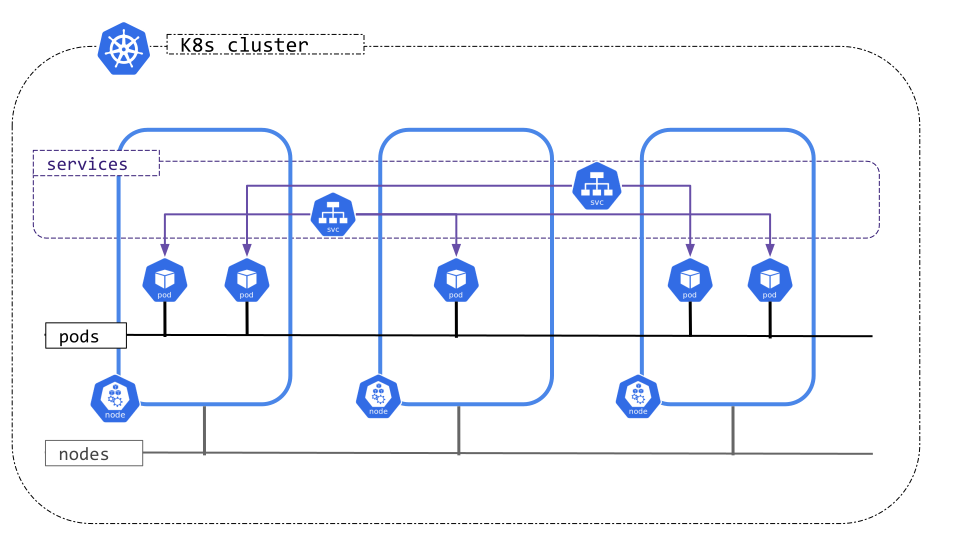
Kubernetes clusters, attending to the IP families configured, can be categorized into:
Kubernetes clusters only consider the IP families present on the Pods, Services and Nodes objects,
independently of the existing IPs of the represented objects. For example, a server or a pod can have multiple
IP addresses assigned to its interfaces, but only the IP addresses in node.status.addresses or pod.status.ips are
considered when implementing the Kubernetes network model and defining the cluster type.
The network model is implemented by the container runtime on each node. The most common container runtimes use Container Network Interface (CNI) plugins to manage their network and security capabilities. Many different CNI plugins exist from many different vendors. Some of these provide only basic features of adding and removing network interfaces, while others provide more sophisticated solutions, such as integration with other container orchestration systems, running multiple CNI plugins, advanced IPAM features etc.
See this page for a non-exhaustive list of networking addons supported by Kubernetes.
The early design of the networking model and its rationale are described in more detail in the networking design document. For future plans and some on-going efforts that aim to improve Kubernetes networking, please refer to the SIG-Network KEPs.
In Kubernetes, observability is the process of collecting and analyzing metrics, logs, and traces—often referred to as the three pillars of observability—in order to obtain a better understanding of the internal state, performance, and health of the cluster.
Kubernetes control plane components, as well as many add-ons, generate and emit these signals. By aggregating and correlating them, you can gain a unified picture of the control plane, add-ons, and applications across the cluster.
Figure 1 outlines how cluster components emit the three primary signal types.
Figure 1. High-level signals emitted by cluster components and their consumers.
Kubernetes components emit metrics in Prometheus format from their /metrics endpoints, including:
The kubelet also exposes metrics at /metrics/cadvisor, /metrics/resource, and /metrics/probes, and add-ons such as kube-state-metrics enrich those control plane signals with Kubernetes object status.
A typical Kubernetes metrics pipeline periodically scrapes these endpoints and stores the samples in a time series database (for example with Prometheus).
See the system metrics guide for details and configuration options.
Figure 2 outlines a common Kubernetes metrics pipeline.
Figure 2. Components of a typical Kubernetes metrics pipeline.
For multi-cluster or multi-cloud visibility, distributed time series databases (for example Thanos or Cortex) can complement Prometheus.
See Common observability tools - metrics tools for metrics scrapers and time series databases.
Logs provide a chronological record of events inside applications, Kubernetes system components, and security-related activities such as audit logging.
Container runtimes capture a containerized application’s output from standard output (stdout) and standard error (stderr) streams. While runtimes implement this differently, the integration with the kubelet is standardized through the CRI logging format, and the kubelet makes these logs available through kubectl logs.
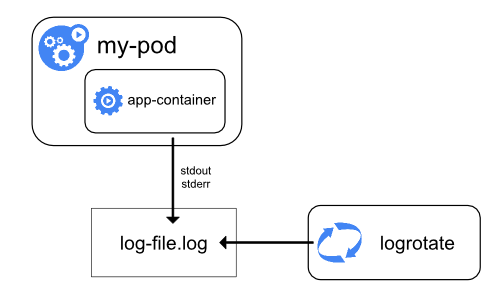
Figure 3a. Node-level logging architecture.
System component logs capture events from the cluster and are often useful for debugging and troubleshooting. These components are classified in two different ways: those that run in a container and those that do not. For example, the kube-scheduler and kube-proxy usually run in containers, whereas the kubelet and the container runtime run directly on the host.
systemd, the kubelet and container runtime write to journald. Otherwise, they write to .log files in the /var/log directory..log files in /var/log, bypassing the default container logging mechanism.System component and container logs stored under /var/log require log rotation to prevent uncontrolled growth. Some cluster provisioning scripts install log rotation by default; verify your environment and adjust as needed. See the system logs reference for details on locations, formats, and configuration options.
Most clusters run a node-level logging agent (for example, Fluent Bit or Fluentd) that tails these files and forwards entries to a central log store. The logging architecture guidance explains how to design such pipelines, apply retention, and log flows to backends.
Figure 3 outlines a common log aggregation pipeline.
Figure 3. Components of a typical Kubernetes logs pipeline.
See Common observability tools - logging tools for logging agents and central log stores.
Traces capture how requests moves across Kubernetes components and applications, linking latency, timing and relationships between operations.By collecting traces, you can visualize end-to-end request flow, diagnose performance issues, and identify bottlenecks or unexpected interactions in the control plane, add-ons, or applications.
Kubernetes 1.35 can export spans over the OpenTelemetry Protocol (OTLP), either directly via built-in gRPC exporters or by forwarding them through an OpenTelemetry Collector.
The OpenTelemetry Collector receives spans from components and applications, processes them (for example by applying sampling or redaction), and forwards them to a tracing backend for storage and analysis.
Figure 4 outlines a typical distributed tracing pipeline.
Figure 4. Components of a typical Kubernetes traces pipeline.
See Common observability tools - tracing tools for tracing collectors and backends.
Note: This section links to third-party projects that provide observability capabilities required by Kubernetes. The Kubernetes project authors aren't responsible for these projects, which are listed alphabetically. To add a project to this list, read the content guide before submitting a change.
This page provides good practices and considerations when designing admission webhooks in Kubernetes. This information is intended for cluster operators who run admission webhook servers or third-party applications that modify or validate your API requests.
Before reading this page, ensure that you're familiar with the following concepts:
Admission control occurs when any create, update, or delete request is sent to the Kubernetes API. Admission controllers intercept requests that match specific criteria that you define. These requests are then sent to mutating admission webhooks or validating admission webhooks. These webhooks are often written to ensure that specific fields in object specifications exist or have specific allowed values.
Webhooks are a powerful mechanism to extend the Kubernetes API. Badly-designed webhooks often result in workload disruptions because of how much control the webhooks have over objects in the cluster. Like other API extension mechanisms, webhooks are challenging to test at scale for compatibility with all of your workloads, other webhooks, add-ons, and plugins.
Additionally, with every release, Kubernetes adds or modifies the API with new
features, feature promotions to beta or stable status, and deprecations. Even
stable Kubernetes APIs are likely to change. For example, the Pod API changed
in v1.29 to add the
Sidecar containers feature.
While it's rare for a Kubernetes object to enter a broken state because of a new
Kubernetes API, webhooks that worked as expected with earlier versions of an API
might not be able to reconcile more recent changes to that API. This can result
in unexpected behavior after you upgrade your clusters to newer versions.
This page describes common webhook failure scenarios and how to avoid them by cautiously and thoughtfully designing and implementing your webhooks.
Even if you don't run your own admission webhooks, some third-party applications that you run in your clusters might use mutating or validating admission webhooks.
To check whether your cluster has any mutating admission webhooks, run the following command:
kubectl get mutatingwebhookconfigurations
The output lists any mutating admission controllers in the cluster.
To check whether your cluster has any validating admission webhooks, run the following command:
kubectl get validatingwebhookconfigurations
The output lists any validating admission controllers in the cluster.
Kubernetes includes multiple admission control and policy enforcement options. Knowing when to use a specific option can help you to improve latency and performance, reduce management overhead, and avoid issues during version upgrades. The following table describes the mechanisms that let you mutate or validate resources during admission:
| Mechanism | Description | Use cases |
|---|---|---|
| Mutating admission webhook | Intercept API requests before admission and modify as needed using custom logic. |
|
| Mutating admission policy | Intercept API requests before admission and modify as needed using Common Expression Language (CEL) expressions. |
|
| Validating admission webhook | Intercept API requests before admission and validate against complex policy declarations. |
|
| Validating admission policy | Intercept API requests before admission and validate against CEL expressions. |
|
In general, use webhook admission control when you want an extensible way to declare or configure the logic. Use built-in CEL-based admission control when you want to declare simpler logic without the overhead of running a webhook server. The Kubernetes project recommends that you use CEL-based admission control when possible.
If you use CustomResourceDefinitions, don't use admission webhooks to validate values in CustomResource specifications or to set default values for fields. Kubernetes lets you define validation rules and default field values when you create CustomResourceDefinitions.
To learn more, see the following resources:
This section describes recommendations for improving performance and reducing latency. In summary, these are as follows:
Mutating admission webhooks are called in sequence. Depending on the mutating webhook setup, some webhooks might be called multiple times. Every mutating webhook call adds latency to the admission process. This is unlike validating webhooks, which get called in parallel.
When designing your mutating webhooks, consider your latency requirements and tolerance. The more mutating webhooks there are in your cluster, the greater the chance of latency increases.
Consider the following to reduce latency:
Consider any other components that run in your cluster that might conflict with the mutations that your webhook makes. For example, if your webhook adds a label that a different controller removes, your webhook gets called again. This leads to a loop.
To detect these loops, try the following:
Update your cluster audit policy to log audit events. Use the following parameters:
level: RequestResponseverbs: ["patch"]omitStages: RequestReceivedSet the audit rule to create events for the specific resources that your webhook mutates.
Check your audit events for webhooks being reinvoked multiple times with the same patch being applied to the same object, or for an object having a field updated and reverted multiple times.
Admission webhooks should evaluate as quickly as possible (typically in milliseconds), since they add to API request latency. Use a small timeout for webhooks.
For details, see Timeouts.
Admission webhooks should leverage some form of load-balancing to provide high
availability and performance benefits. If a webhook is running within the
cluster, you can run multiple webhook backends behind a Service of type
ClusterIP.
Consider your cluster's availability requirements when designing your webhook.
For example, during node downtime or zonal outages, Kubernetes marks Pods as
NotReady to allow load balancers to reroute traffic to available zones and
nodes. These updates to Pods might trigger your mutating webhooks. Depending on
the number of affected Pods, the mutating webhook server has a risk of timing
out or causing delays in Pod processing. As a result, traffic won't get
rerouted as quickly as you need.
Consider situations like the preceding example when writing your webhooks. Exclude operations that are a result of Kubernetes responding to unavoidable incidents.
This section provides recommendations for filtering which requests trigger specific webhooks. In summary, these are as follows:
Admission webhooks are only called when an API request matches the corresponding webhook configuration. Limit the scope of each webhook to reduce unnecessary calls to the webhook server. Consider the following scope limitations:
kube-system namespace. If you run your own
Pods in the kube-system namespace, use an
objectSelector
to avoid mutating a critical workload.kube-node-lease system namespace. Mutating node leases might result in
failed node upgrades. Only apply validation controls to Lease objects in this
namespace if you're confident that the controls won't put your cluster at
risk.namespaceSelector.Admission controllers support multiple fields that you can use to match requests
that meet specific criteria. For example, you can use a namespaceSelector to
filter for requests that target a specific namespace.
For more fine-grained request filtering, use the matchConditions field in your
webhook configuration. This field lets you write multiple CEL expressions that
must evaluate to true for a request to trigger your admission webhook. Using
matchConditions might significantly reduce the number of calls to your webhook
server.
For details, see
Matching requests: matchConditions.
By default, admission webhooks run on any API versions that affect a specified
resource. The matchPolicy field in the webhook configuration controls this
behavior. Specify a value of Equivalent in the matchPolicy field or omit
the field to allow the webhook to run on any API version.
For details, see
Matching requests: matchPolicy.
This section provides recommendations for the scope of mutations and any special considerations for object fields. In summary, these are as follows:
Admission webhook servers send HTTP responses to indicate what to do with a
specific Kubernetes API request. This response is an AdmissionReview object.
A mutating webhook can add specific fields to mutate before allowing admission
by using the patchType field and the patch field in the response. Ensure
that you only modify the fields that require a change.
For example, consider a mutating webhook that's configured to ensure that
web-server Deployments have at least three replicas. When a request to
create a Deployment object matches your webhook configuration, the webhook
should only update the value in the spec.replicas field.
Fields in Kubernetes object specifications might include arrays. Some arrays
contain key:value pairs (like the envVar field in a container specification),
while other arrays are unkeyed (like the readinessGates field in a Pod
specification). The order of values in an array field might matter in some
situations. For example, the order of arguments in the args field of a
container specification might affect the container.
Consider the following when modifying arrays:
add JSONPatch operation instead of replace to
avoid accidentally replacing a required value.Ensure that your webhooks operate only on the content of the AdmissionReview
that's sent to them, and do not make out-of-band changes. These additional
changes, called side effects, might cause conflicts during admission if they
aren't reconciled properly. The .webhooks[].sideEffects field should
be set to None if a webhook doesn't have any side effect.
If side effects are required during the admission evaluation, they must be
suppressed when processing an AdmissionReview object with dryRun set to
true, and the .webhooks[].sideEffects field should be set to NoneOnDryRun.
For details, see Side effects.
A webhook running inside the cluster might cause deadlocks for its own deployment if it is configured to intercept resources required to start its own Pods.
For example, a mutating admission webhook is configured to admit create Pod
requests only if a certain label is set in the Pod (such as env: prod).
The webhook server runs in a Deployment that doesn't set the env label.
When a node that runs the webhook server Pods becomes unhealthy, the webhook
Deployment tries to reschedule the Pods to another node. However, the existing
webhook server rejects the requests since the env label is unset. As a
result, the migration cannot happen.
Exclude the namespace where your webhook is running with a
namespaceSelector.
Dependency loops can occur in scenarios like the following:
To avoid these dependency loops, try the following:
objectSelector.Mutating admission webhooks support the failurePolicy configuration field.
This field indicates whether the API server should admit or reject the request
if the webhook fails. Webhook failures might occur because of timeouts or errors
in the server logic.
By default, admission webhooks set the failurePolicy field to Fail. The API
server rejects a request if the webhook fails. However, rejecting requests by
default might result in compliant requests being rejected during webhook
downtime.
Let your mutating webhooks "fail open" by setting the failurePolicy field to
Ignore. Use a validating controller to check the state of requests to ensure
that they comply with your policies.
This approach has the following benefits:
In general, design your webhooks under the assumption that Kubernetes APIs might
change in a later version. Don't write a server that takes the stability of an
API for granted. For example, the release of sidecar containers in Kubernetes
added a restartPolicy field to the Pod API.
Mutating webhooks that respond to a broad range of API requests might unintentionally trigger themselves. For example, consider a webhook that responds to all requests in the cluster. If you configure the webhook to create Event objects for every mutation, it'll respond to its own Event object creation requests.
To avoid this, consider setting a unique label in any resources that your webhook creates. Exclude this label from your webhook match conditions.
Some Kubernetes objects in the API server can't change. For example, when you deploy a static Pod, the kubelet on the node creates a mirror Pod in the API server to track the static Pod. However, changes to the mirror Pod don't propagate to the static Pod.
Don't attempt to mutate these objects during admission. All mirror Pods have the
kubernetes.io/config.mirror annotation. To exclude mirror Pods while reducing
the security risk of ignoring an annotation, allow static Pods to only run in
specific namespaces.
This section provides recommendations for webhook order and designing idempotent webhooks. In summary, these are as follows:
Mutating admission webhooks don't run in a consistent order. Various factors might change when a specific webhook is called. Don't rely on your webhook running at a specific point in the admission process. Other webhooks could still mutate your modified object.
The following recommendations might help to minimize the risk of unintended changes:
Every mutating admission webhook should be idempotent. The webhook should be able to run on an object that it already modified without making additional changes beyond the original change.
Additionally, all of the mutating webhooks in your cluster should, as a collection, be idempotent. After the mutation phase of admission control ends, every individual mutating webhook should be able to run on an object without making additional changes to the object.
Depending on your environment, ensuring idempotence at scale might be challenging. The following recommendations might help:
The following examples show idempotent mutation logic:
For a create Pod request, set the field
.spec.securityContext.runAsNonRoot of the Pod to true.
For a create Pod request, if the field
.spec.containers[].resources.limits of a container is not set, set default
resource limits.
For a create Pod request, inject a sidecar container with name
foo-sidecar if no container with the name foo-sidecar already exists.
In these cases, the webhook can be safely reinvoked, or admit an object that already has the fields set.
The following examples show non-idempotent mutation logic:
For a create Pod request, inject a sidecar container with name
foo-sidecar suffixed with the current timestamp (such as
foo-sidecar-19700101-000000).
Reinvoking the webhook can result in the same sidecar being injected multiple times to a Pod, each time with a different container name. Similarly, the webhook can inject duplicated containers if the sidecar already exists in a user-provided pod.
For a create/update Pod request, reject if the Pod has label env
set, otherwise add an env: prod label to the Pod.
Reinvoking the webhook will result in the webhook failing on its own output.
For a create Pod request, append a sidecar container named foo-sidecar
without checking whether a foo-sidecar container exists.
Reinvoking the webhook will result in duplicated containers in the Pod, which makes the request invalid and rejected by the API server.
This section provides recommendations for testing your mutating webhooks and validating mutated objects. In summary, these are as follows:
Robust testing should be a core part of your release cycle for new or updated webhooks. If possible, test any changes to your cluster webhooks in a staging environment that closely resembles your production clusters. At the very least, consider using a tool like minikube or kind to create a small test cluster for webhook changes.
Your mutating webhooks shouldn't break any of the validations that apply to an object before admission. For example, consider a mutating webhook that sets the default CPU request of a Pod to a specific value. If the CPU limit of that Pod is set to a lower value than the mutated request, the Pod fails admission.
Test every mutating webhook against the validations that run in your cluster.
Before upgrading your production clusters to a new minor version, test your webhooks and workloads in a staging environment. Compare the results to ensure that your webhooks continue to function as expected after the upgrade.
Additionally, use the following resources to stay informed about API changes:
Mutating webhooks run to completion before any validating webhooks run. There is no stable order in which mutations are applied to objects. As a result, your mutations could get overwritten by a mutating webhook that runs at a later time.
Add a validating admission controller like a ValidatingAdmissionWebhook or a
ValidatingAdmissionPolicy to your cluster to ensure that your mutations
are still present. For example, consider a mutating webhook that inserts the
restartPolicy: Always field to specific init containers to make them run as
sidecar containers. You could run a validating webhook to ensure that those
init containers retained the restartPolicy: Always configuration after all
mutations were completed.
For details, see the following resources:
This section provides recommendations for deploying your mutating admission webhooks. In summary, these are as follows:
When you're ready to deploy your mutating webhook to a cluster, use the following order of operations:
failurePolicy field in the MutatingWebhookConfiguration manifest
to Ignore. This lets you avoid disruptions caused by misconfigured webhooks.namespaceSelector field in the MutatingWebhookConfiguration
manifest to a test namespace.Monitor the webhook in the test namespace to check for any issues, then roll the webhook out to other namespaces. If the webhook intercepts an API request that it wasn't meant to intercept, pause the rollout and adjust the scope of the webhook configuration.
Mutating webhooks are powerful Kubernetes controllers. Use RBAC or another authorization mechanism to limit access to your webhook configurations and servers. For RBAC, ensure that the following access is only available to trusted entities:
admissionregistration.k8s.io/v1If your mutating webhook server runs in the cluster, limit access to create or modify any resources in that namespace.
The following projects are examples of "good" custom webhook server implementations. You can use them as a starting point when designing your own webhooks. Don't use these examples as-is; use them as a starting point and design your webhooks to run well in your specific environment.
This page describes good practices when configuring a Kubernetes cluster utilizing Dynamic Resource Allocation (DRA). These instructions are for cluster administrators.
DRA is orchestrated through a number of different APIs. Use authorization tools (like RBAC, or another solution) to control access to the right APIs depending on the persona of your user.
In general, DeviceClasses and ResourceSlices should be restricted to admins and the DRA drivers. Cluster operators that will be deploying Pods with claims will need access to ResourceClaim and ResourceClaimTemplate APIs; both of these APIs are namespace scoped.
DRA drivers are third-party applications that run on each node of your cluster to interface with the hardware of that node and Kubernetes' native DRA components. The installation procedure depends on the driver you choose, but is likely deployed as a DaemonSet to all or a selection of the nodes (using node selectors or similar mechanisms) in your cluster.
DRA drivers implement the kubeletplugin package
interface.
Your driver may support seamless upgrades by implementing a property of this
interface that allows two versions of the same DRA driver to coexist for a short
time. This is only available for kubelet versions 1.33 and above and may not be
supported by your driver for heterogeneous clusters with attached nodes running
older versions of Kubernetes - check your driver's documentation to be sure.
If seamless upgrades are available for your situation, consider using it to minimize scheduling delays when your driver updates.
If you cannot use seamless upgrades, during driver downtime for upgrades you may observe that:
Your DRA driver likely implements a gRPC socket for healthchecks as part of DRA driver good practices. The easiest way to utilize this grpc socket is to configure it as a liveness probe for the DaemonSet deploying your DRA driver. Your driver's documentation or deployment tooling may already include this, but if you are building your configuration separately or not running your DRA driver as a Kubernetes pod, be sure that your orchestration tooling restarts the DRA driver on failed healthchecks to this grpc socket. Doing so will minimize any accidental downtime of the DRA driver and give it more opportunities to self heal, reducing scheduling delays or troubleshooting time.
The DRA driver is responsible for unpreparing any devices that were allocated to Pods, and if the DRA driver is drained before Pods with claims have been deleted, it will not be able to finalize its cleanup. If you implement custom drain logic for nodes, consider checking that there are no allocated/reserved ResourceClaim or ResourceClaimTemplates before terminating the DRA driver itself.
Control plane component kube-scheduler and the internal ResourceClaim controller orchestrated by the component kube-controller-manager do the heavy lifting during scheduling of Pods with claims based on metadata stored in the DRA APIs. Compared to non-DRA scheduled Pods, the number of API server calls, memory, and CPU utilization needed by these components is increased for Pods using DRA claims. In addition, node local components like the DRA driver and kubelet utilize DRA APIs to allocated the hardware request at Pod sandbox creation time. Especially in high scale environments where clusters have many nodes, and/or deploy many workloads that heavily utilize DRA defined resource claims, the cluster administrator should configure the relevant components to anticipate the increased load.
The effects of mistuned components can have direct or snowballing affects
causing different symptoms during the Pod lifecycle. If the kube-scheduler
component's QPS and burst configurations are too low, the scheduler might
quickly identify a suitable node for a Pod but take longer to bind the Pod to
that node. With DRA, during Pod scheduling, the QPS and Burst parameters in the
client-go configuration within kube-controller-manager are critical.
The specific values to tune your cluster to depend on a variety of factors like
number of nodes/pods, rate of pod creation, churn, even in non-DRA environments;
see the SIG Scalability README on Kubernetes scalability
thresholds
for more information. In scale tests performed against a DRA enabled cluster
with 100 nodes, involving 720 long-lived pods (90% saturation) and 80 churn pods
(10% churn, 10 times), with a job creation QPS of 10, kube-controller-manager
QPS could be set to as low as 75 and Burst to 150 to meet equivalent metric
targets for non-DRA deployments. At this lower bound, it was observed that the
client side rate limiter was triggered enough to protect the API server from
explosive burst but was high enough that pod startup SLOs were not impacted.
While this is a good starting point, you can get a better idea of how to tune
the different components that have the biggest effect on DRA performance for
your deployment by monitoring the following metrics. For more information on all
the stable metrics in Kubernetes, see the Kubernetes Metrics
Reference.
kube-controller-manager metricsThe following metrics look closely at the internal ResourceClaim controller
managed by the kube-controller-manager component.
sum(rate(workqueue_adds_total{name="resource_claim"}[5m])) to gauge how quickly items are added to the ResourceClaim controller.sum(workqueue_depth{endpoint="kube-controller-manager",
name="resource_claim"}) to identify any backlogs in the ResourceClaim
controller.histogram_quantile(0.99,
sum(rate(workqueue_work_duration_seconds_bucket{name="resource_claim"}[5m]))
by (le)) to understand the speed at which the ResourceClaim controller
processes work.If you are experiencing low Workqueue Add Rate, high Workqueue Depth, and/or high Workqueue Work Duration, this suggests the controller isn't performing optimally. Consider tuning parameters like QPS, burst, and CPU/memory configurations.
If you are experiencing high Workequeue Add Rate, high Workqueue Depth, but reasonable Workqueue Work Duration, this indicates the controller is processing work, but concurrency might be insufficient. Concurrency is hardcoded in the controller, so as a cluster administrator, you can tune for this by reducing the pod creation QPS, so the add rate to the resource claim workqueue is more manageable.
kube-scheduler metricsThe following scheduler metrics are high level metrics aggregating performance
across all Pods scheduled, not just those using DRA. It is important to note
that the end-to-end metrics are ultimately influenced by the
kube-controller-manager's performance in creating ResourceClaims from
ResourceClainTemplates in deployments that heavily use ResourceClainTemplates.
histogram_quantile(0.99,
sum(increase(scheduler_pod_scheduling_sli_duration_seconds_bucket[5m])) by
(le)).histogram_quantile(0.99,
sum(increase(scheduler_scheduling_algorithm_duration_seconds_bucket[5m])) by
(le)).kubelet metricsWhen a Pod bound to a node must have a ResourceClaim satisfied, kubelet calls
the NodePrepareResources and NodeUnprepareResources methods of the DRA
driver. You can observe this behavior from the kubelet's point of view with the
following metrics.
histogram_quantile(0.99,
sum(rate(dra_operations_duration_seconds_bucket{operation_name="PrepareResources"}[5m]))
by (le)).histogram_quantile(0.99,
sum(rate(dra_operations_duration_seconds_bucket{operation_name="UnprepareResources"}[5m]))
by (le)).DRA drivers implement the kubeletplugin package
interface
which surfaces its own metric for the underlying gRPC operation
NodePrepareResources and NodeUnprepareResources. You can observe this
behavior from the point of view of the internal kubeletplugin with the following
metrics.
histogram_quantile(0.99,
sum(rate(dra_grpc_operations_duration_seconds_bucket{method_name=~".*NodePrepareResources"}[5m]))
by (le)). histogram_quantile(0.99,
sum(rate(dra_grpc_operations_duration_seconds_bucket{method_name=~".*NodeUnprepareResources"}[5m]))
by (le)).Application logs can help you understand what is happening inside your application. The logs are particularly useful for debugging problems and monitoring cluster activity. Most modern applications have some kind of logging mechanism. Likewise, container engines are designed to support logging. The easiest and most adopted logging method for containerized applications is writing to standard output and standard error streams.
However, the native functionality provided by a container engine or runtime is usually not enough for a complete logging solution.
For example, you may want to access your application's logs if a container crashes, a pod gets evicted, or a node dies.
In a cluster, logs should have a separate storage and lifecycle independent of nodes, pods, or containers. This concept is called cluster-level logging.
Cluster-level logging architectures require a separate backend to store, analyze, and query logs. Kubernetes does not provide a native storage solution for log data. Instead, there are many logging solutions that integrate with Kubernetes. The following sections describe how to handle and store logs on nodes.
Kubernetes captures logs from each container in a running Pod.
This example uses a manifest for a Pod with a container
that writes text to the standard output stream, once per second.
apiVersion: v1
kind: Pod
metadata:
name: counter
spec:
containers:
- name: count
image: busybox:1.28
args: [/bin/sh, -c,
'i=0; while true; do echo "$i: $(date)"; i=$((i+1)); sleep 1; done']
To run this pod, use the following command:
kubectl apply -f https://k8s.io/examples/debug/counter-pod.yaml
The output is:
pod/counter created
To fetch the logs, use the kubectl logs command, as follows:
kubectl logs counter
The output is similar to:
0: Fri Apr 1 11:42:23 UTC 2022
1: Fri Apr 1 11:42:24 UTC 2022
2: Fri Apr 1 11:42:25 UTC 2022
You can use kubectl logs --previous to retrieve logs from a previous instantiation of a container.
If your pod has multiple containers, specify which container's logs you want to access by
appending a container name to the command, with a -c flag, like so:
kubectl logs counter -c count
Kubernetes v1.32 [alpha](disabled by default)As an alpha feature, the kubelet can split out the logs from the two standard streams produced
by a container: standard output
and standard error.
To use this behavior, you must enable the PodLogsQuerySplitStreams
feature gate.
With that feature gate enabled, Kubernetes 1.35 allows access to these
log streams directly via the Pod API. You can fetch a specific stream by specifying the stream name (either Stdout or Stderr),
using the stream query string. You must have access to read the log subresource of that Pod.
To demonstrate this feature, you can create a Pod that periodically writes text to both the standard output and error stream.
apiVersion: v1
kind: Pod
metadata:
name: counter-err
spec:
containers:
- name: count
image: busybox:1.28
args: [/bin/sh, -c,
'i=0; while true; do echo "$i: $(date)"; echo "$i: err" >&2 ; i=$((i+1)); sleep 1; done']
To run this pod, use the following command:
kubectl apply -f https://k8s.io/examples/debug/counter-pod-err.yaml
To fetch only the stderr log stream, you can run:
kubectl get --raw "/api/v1/namespaces/default/pods/counter-err/log?stream=Stderr"
See the kubectl logs documentation
for more details.
A container runtime handles and redirects any output generated to a containerized
application's stdout and stderr streams.
Different container runtimes implement this in different ways; however, the integration
with the kubelet is standardized as the CRI logging format.
By default, if a container restarts, the kubelet keeps one terminated container with its logs. If a pod is evicted from the node, all corresponding containers are also evicted, along with their logs.
The kubelet makes logs available to clients via a special feature of the Kubernetes API.
The usual way to access this is by running kubectl logs.
Kubernetes v1.21 [stable]
The kubelet is responsible for rotating container logs and managing the logging directory structure. The kubelet sends this information to the container runtime (using CRI), and the runtime writes the container logs to the given location.
You can configure two kubelet configuration settings,
containerLogMaxSize (default 10Mi) and containerLogMaxFiles (default 5),
using the kubelet configuration file.
These settings let you configure the maximum size for each log file and the maximum number of
files allowed for each container respectively.
In order to perform an efficient log rotation in clusters where the volume of the logs generated by
the workload is large, kubelet also provides a mechanism to tune how the logs are rotated in
terms of how many concurrent log rotations can be performed and the interval at which the logs are
monitored and rotated as required.
You can configure two kubelet configuration settings,
containerLogMaxWorkers and containerLogMonitorInterval using the
kubelet configuration file.
When you run kubectl logs as in
the basic logging example, the kubelet on the node handles the request and
reads directly from the log file. The kubelet returns the content of the log file.
Only the contents of the latest log file are available through kubectl logs.
For example, if a Pod writes 40 MiB of logs and the kubelet rotates logs
after 10 MiB, running kubectl logs returns at most 10MiB of data.
There are two types of system components: those that typically run in a container, and those components directly involved in running containers. For example:
DaemonSet.The way that the kubelet and container runtime write logs depends on the operating system that the node uses:
On Linux nodes that use systemd, the kubelet and container runtime write to journald
by default. You use journalctl to read the systemd journal; for example:
journalctl -u kubelet.
If systemd is not present, the kubelet and container runtime write to .log files in the
/var/log directory. If you want to have logs written elsewhere, you can indirectly
run the kubelet via a helper tool, kube-log-runner, and use that tool to redirect
kubelet logs to a directory that you choose.
By default, kubelet directs your container runtime to write logs into directories within
/var/log/pods.
For more information on kube-log-runner, read System Logs.
By default, the kubelet writes logs to files within the directory C:\var\logs
(notice that this is not C:\var\log).
Although C:\var\log is the Kubernetes default location for these logs, several
cluster deployment tools set up Windows nodes to log to C:\var\log\kubelet instead.
If you want to have logs written elsewhere, you can indirectly
run the kubelet via a helper tool, kube-log-runner, and use that tool to redirect
kubelet logs to a directory that you choose.
However, by default, kubelet directs your container runtime to write logs within the
directory C:\var\log\pods.
For more information on kube-log-runner, read System Logs.
For Kubernetes cluster components that run in pods, these write to files inside
the /var/log directory, bypassing the default logging mechanism (the components
do not write to the systemd journal). You can use Kubernetes' storage mechanisms
to map persistent storage into the container that runs the component.
Kubelet allows changing the pod logs directory from default /var/log/pods
to a custom path. This adjustment can be made by configuring the podLogsDir
parameter in the kubelet's configuration file.
It's important to note that the default location /var/log/pods has been in use for
an extended period and certain processes might implicitly assume this path.
Therefore, altering this parameter must be approached with caution and at your own risk.
Another caveat to keep in mind is that the kubelet supports the location being on the same
disk as /var. Otherwise, if the logs are on a separate filesystem from /var,
then the kubelet will not track that filesystem's usage, potentially leading to issues if
it fills up.
For details about etcd and its logs, view the etcd documentation. Again, you can use Kubernetes' storage mechanisms to map persistent storage into the container that runs the component.
If you deploy Kubernetes cluster components (such as the scheduler) to log to a volume shared from the parent node, you need to consider and ensure that those logs are rotated. Kubernetes does not manage that log rotation.
Your operating system may automatically implement some log rotation - for example,
if you share the directory /var/log into a static Pod for a component, node-level
log rotation treats a file in that directory the same as a file written by any component
outside Kubernetes.
Some deploy tools account for that log rotation and automate it; others leave this as your responsibility.
While Kubernetes does not provide a native solution for cluster-level logging, there are several common approaches you can consider. Here are some options:
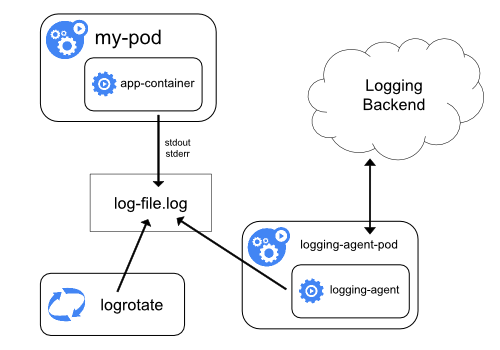
You can implement cluster-level logging by including a node-level logging agent on each node. The logging agent is a dedicated tool that exposes logs or pushes logs to a backend. Commonly, the logging agent is a container that has access to a directory with log files from all of the application containers on that node.
Because the logging agent must run on every node, it is recommended to run the agent
as a DaemonSet.
Node-level logging creates only one agent per node and doesn't require any changes to the applications running on the node.
Containers write to stdout and stderr, but with no agreed format. A node-level agent collects these logs and forwards them for aggregation.
You can use a sidecar container in one of the following ways:
stdout.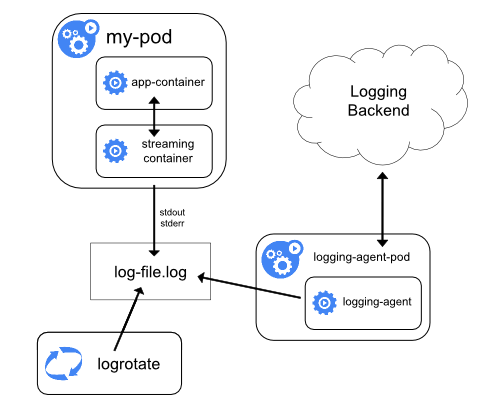
By having your sidecar containers write to their own stdout and stderr
streams, you can take advantage of the kubelet and the logging agent that
already run on each node. The sidecar containers read logs from a file, a socket,
or journald. Each sidecar container prints a log to its own stdout or stderr stream.
This approach allows you to separate several log streams from different
parts of your application, some of which can lack support
for writing to stdout or stderr. The logic behind redirecting logs
is minimal, so it's not a significant overhead. Additionally, because
stdout and stderr are handled by the kubelet, you can use built-in tools
like kubectl logs.
For example, a pod runs a single container, and the container writes to two different log files using two different formats. Here's a manifest for the Pod:
apiVersion: v1
kind: Pod
metadata:
name: counter
spec:
containers:
- name: count
image: busybox:1.28
args:
- /bin/sh
- -c
- >
i=0;
while true;
do
echo "$i: $(date)" >> /var/log/1.log;
echo "$(date) INFO $i" >> /var/log/2.log;
i=$((i+1));
sleep 1;
done
volumeMounts:
- name: varlog
mountPath: /var/log
volumes:
- name: varlog
emptyDir: {}
It is not recommended to write log entries with different formats to the same log
stream, even if you managed to redirect both components to the stdout stream of
the container. Instead, you can create two sidecar containers. Each sidecar
container could tail a particular log file from a shared volume and then redirect
the logs to its own stdout stream.
Here's a manifest for a pod that has two sidecar containers:
apiVersion: v1
kind: Pod
metadata:
name: counter
spec:
containers:
- name: count
image: busybox:1.28
args:
- /bin/sh
- -c
- >
i=0;
while true;
do
echo "$i: $(date)" >> /var/log/1.log;
echo "$(date) INFO $i" >> /var/log/2.log;
i=$((i+1));
sleep 1;
done
volumeMounts:
- name: varlog
mountPath: /var/log
- name: count-log-1
image: busybox:1.28
args: [/bin/sh, -c, 'tail -n+1 -F /var/log/1.log']
volumeMounts:
- name: varlog
mountPath: /var/log
- name: count-log-2
image: busybox:1.28
args: [/bin/sh, -c, 'tail -n+1 -F /var/log/2.log']
volumeMounts:
- name: varlog
mountPath: /var/log
volumes:
- name: varlog
emptyDir: {}
Now when you run this pod, you can access each log stream separately by running the following commands:
kubectl logs counter count-log-1
The output is similar to:
0: Fri Apr 1 11:42:26 UTC 2022
1: Fri Apr 1 11:42:27 UTC 2022
2: Fri Apr 1 11:42:28 UTC 2022
...
kubectl logs counter count-log-2
The output is similar to:
Fri Apr 1 11:42:29 UTC 2022 INFO 0
Fri Apr 1 11:42:30 UTC 2022 INFO 0
Fri Apr 1 11:42:31 UTC 2022 INFO 0
...
If you installed a node-level agent in your cluster, that agent picks up those log streams automatically without any further configuration. If you like, you can configure the agent to parse log lines depending on the source container.
Even for Pods that only have low CPU and memory usage (order of a couple of millicores
for cpu and order of several megabytes for memory), writing logs to a file and
then streaming them to stdout can double how much storage you need on the node.
If you have an application that writes to a single file, it's recommended to set
/dev/stdout as the destination rather than implement the streaming sidecar
container approach.
Sidecar containers can also be used to rotate log files that cannot be rotated by
the application itself. An example of this approach is a small container running
logrotate periodically.
However, it's more straightforward to use stdout and stderr directly, and
leave rotation and retention policies to the kubelet.
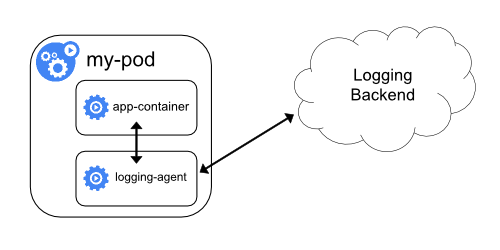
If the node-level logging agent is not flexible enough for your situation, you can create a sidecar container with a separate logging agent that you have configured specifically to run with your application.
kubectl logs because they are not controlled
by the kubelet.Here are two example manifests that you can use to implement a sidecar container with a logging agent.
The first manifest contains a ConfigMap
to configure fluentd.
apiVersion: v1
kind: ConfigMap
metadata:
name: fluentd-config
data:
fluentd.conf: |
<source>
type tail
format none
path /var/log/1.log
pos_file /var/log/1.log.pos
tag count.format1
</source>
<source>
type tail
format none
path /var/log/2.log
pos_file /var/log/2.log.pos
tag count.format2
</source>
<match **>
type google_cloud
</match>
The second manifest describes a pod that has a sidecar container running fluentd. The pod mounts a volume where fluentd can pick up its configuration data.
apiVersion: v1
kind: Pod
metadata:
name: counter
spec:
containers:
- name: count
image: busybox:1.28
args:
- /bin/sh
- -c
- >
i=0;
while true;
do
echo "$i: $(date)" >> /var/log/1.log;
echo "$(date) INFO $i" >> /var/log/2.log;
i=$((i+1));
sleep 1;
done
volumeMounts:
- name: varlog
mountPath: /var/log
- name: count-agent
image: registry.k8s.io/fluentd-gcp:1.30
env:
- name: FLUENTD_ARGS
value: -c /etc/fluentd-config/fluentd.conf
volumeMounts:
- name: varlog
mountPath: /var/log
- name: config-volume
mountPath: /etc/fluentd-config
volumes:
- name: varlog
emptyDir: {}
- name: config-volume
configMap:
name: fluentd-config
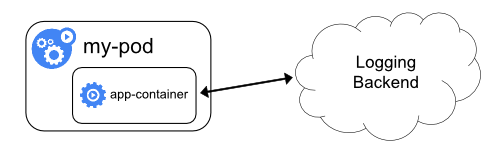
Cluster-logging that exposes or pushes logs directly from every application is outside the scope of Kubernetes.
Since release v1.32, we introduced configurable version compatibility and emulation options to Kubernetes control plane components to make upgrades safer by providing more control and increasing the granularity of steps available to cluster administrators.
The emulation option is set by the --emulated-version flag of control plane components. It allows the component to emulate the behavior (APIs, features, ...) of an earlier version of Kubernetes.
When used, the capabilities available will match the emulated version:
This enables a binary from a particular Kubernetes release to emulate the behavior of a previous version with sufficient fidelity that interoperability with other system components can be defined in terms of the emulated version.
The --emulated-version must be <= binaryVersion. See the help message of the --emulated-version flag for supported range of emulated versions.
System component metrics can give a better look into what is happening inside them. Metrics are particularly useful for building dashboards and alerts.
Kubernetes components emit metrics in Prometheus format. This format is structured plain text, designed so that people and machines can both read it.
In most cases metrics are available on /metrics endpoint of the HTTP server. For components that
don't expose endpoint by default, it can be enabled using --bind-address flag.
Examples of those components:
In a production environment you may want to configure Prometheus Server or some other metrics scraper to periodically gather these metrics and make them available in some kind of time series database.
Note that kubelet also exposes metrics in
/metrics/cadvisor, /metrics/resource and /metrics/probes endpoints. Those metrics do not
have the same lifecycle.
If your cluster uses RBAC, reading metrics requires
authorization via a user, group or ServiceAccount with a ClusterRole that allows accessing
/metrics. For example:
apiVersion: rbac.authorization.k8s.io/v1
kind: ClusterRole
metadata:
name: prometheus
rules:
- nonResourceURLs:
- "/metrics"
verbs:
- get
Alpha metric → Beta metric → Stable metric → Deprecated metric → Hidden metric → Deleted metric
Alpha metrics have no stability guarantees. These metrics can be modified or deleted at any time.
Beta metrics observe a looser API contract than its stable counterparts. No labels can be removed from beta metrics during their lifetime, however, labels can be added while the metric is in the beta stage.
Stable metrics are guaranteed to not change. This means:
Deprecated metrics are slated for deletion, but are still available for use. These metrics include an annotation about the version in which they became deprecated.
For example:
Before deprecation
# HELP some_counter this counts things
# TYPE some_counter counter
some_counter 0
After deprecation
# HELP some_counter (Deprecated since 1.15.0) this counts things
# TYPE some_counter counter
some_counter 0
Hidden metrics are no longer published for scraping, but are still available for use. A deprecated metric becomes a hidden metric after a period of time, based on its stability level:
To use a hidden metric, you must enable it. For more details, refer to the Show hidden metrics section.
Deleted metrics are no longer published and cannot be used.
As described above, admins can enable hidden metrics through a command-line flag on a specific binary. This intends to be used as an escape hatch for admins if they missed the migration of the metrics deprecated in the last release.
The flag show-hidden-metrics-for-version takes a version for which you want to show metrics
deprecated in that release. The version is expressed as x.y, where x is the major version, y is
the minor version. The patch version is not needed even though a metrics can be deprecated in a
patch release, the reason for that is the metrics deprecation policy runs against the minor release.
The flag can only take the previous minor version as its value. If you want to show all metrics hidden in the previous release, you can set the show-hidden-metrics-for-version flag to the previous version. Using a version that is too old is not allowed because it violates the metrics deprecation policy.
For example, let's assume metric A is deprecated in 1.29. The version in which metric A becomes hidden depends on its stability level:
A is ALPHA, it could be hidden in 1.29.A is BETA, it will be hidden in 1.30 at the earliest. If you are upgrading to 1.30 and still need A, you must use the command-line flag --show-hidden-metrics-for-version=1.29.A is STABLE, it will be hidden in 1.32 at the earliest. If you are upgrading to 1.32 and still need A, you must use the command-line flag --show-hidden-metrics-for-version=1.31.Controller manager metrics provide important insight into the performance and health of the controller manager. These metrics include common Go language runtime metrics such as go_routine count and controller specific metrics such as etcd request latencies or Cloudprovider (AWS, GCE, OpenStack) API latencies that can be used to gauge the health of a cluster.
Starting from Kubernetes 1.7, detailed Cloudprovider metrics are available for storage operations for GCE, AWS, Vsphere and OpenStack. These metrics can be used to monitor health of persistent volume operations.
For example, for GCE these metrics are called:
cloudprovider_gce_api_request_duration_seconds { request = "instance_list"}
cloudprovider_gce_api_request_duration_seconds { request = "disk_insert"}
cloudprovider_gce_api_request_duration_seconds { request = "disk_delete"}
cloudprovider_gce_api_request_duration_seconds { request = "attach_disk"}
cloudprovider_gce_api_request_duration_seconds { request = "detach_disk"}
cloudprovider_gce_api_request_duration_seconds { request = "list_disk"}
Kubernetes v1.21 [beta]
The scheduler exposes optional metrics that reports the requested resources and the desired limits of all running pods. These metrics can be used to build capacity planning dashboards, assess current or historical scheduling limits, quickly identify workloads that cannot schedule due to lack of resources, and compare actual usage to the pod's request.
The kube-scheduler identifies the resource requests and limits configured for each Pod; when either a request or limit is non-zero, the kube-scheduler reports a metrics timeseries. The time series is labelled by:
cpu)cores)Once a pod reaches completion (has a restartPolicy of Never or OnFailure and is in the
Succeeded or Failed pod phase, or has been deleted and all containers have a terminated state)
the series is no longer reported since the scheduler is now free to schedule other pods to run.
The two metrics are called kube_pod_resource_request and kube_pod_resource_limit.
The metrics are exposed at the HTTP endpoint /metrics/resources. They require
authorization for the /metrics/resources endpoint, usually granted by a
ClusterRole with the get verb for the /metrics/resources non-resource URL.
On Kubernetes 1.21 you must use the --show-hidden-metrics-for-version=1.20
flag to expose these alpha stability metrics.
Kubernetes v1.34 [beta]
As a beta feature, Kubernetes lets you configure kubelet to collect Linux kernel
Pressure Stall Information
(PSI) for CPU, memory and I/O usage.
The information is collected at node, pod and container level.
The metrics are exposed at the /metrics/cadvisor endpoint with the following names:
container_pressure_cpu_stalled_seconds_total
container_pressure_cpu_waiting_seconds_total
container_pressure_memory_stalled_seconds_total
container_pressure_memory_waiting_seconds_total
container_pressure_io_stalled_seconds_total
container_pressure_io_waiting_seconds_total
This feature is enabled by default, by setting the KubeletPSI feature gate. The information is also exposed in the
Summary API.
You can learn how to interpret the PSI metrics in Understand PSI Metrics.
Pressure Stall Information requires:
You can explicitly turn off metrics via command line flag --disabled-metrics. This may be
desired if, for example, a metric is causing a performance problem. The input is a list of
disabled metrics (i.e. --disabled-metrics=metric1,metric2).
Metrics with unbounded dimensions could cause memory issues in the components they instrument. To
limit resource use, you can use the --allow-metric-labels command line option to dynamically
configure an allow-list of label values for a metric.
In alpha stage, the flag can only take in a series of mappings as metric label allow-list.
Each mapping is of the format <metric_name>,<label_name>=<allowed_labels> where
<allowed_labels> is a comma-separated list of acceptable label names.
The overall format looks like:
--allow-metric-labels <metric_name>,<label_name>='<allow_value1>, <allow_value2>...', <metric_name2>,<label_name>='<allow_value1>, <allow_value2>...', ...
Here is an example:
--allow-metric-labels number_count_metric,odd_number='1,3,5', number_count_metric,even_number='2,4,6', date_gauge_metric,weekend='Saturday,Sunday'
In addition to specifying this from the CLI, this can also be done within a configuration file. You
can specify the path to that configuration file using the --allow-metric-labels-manifest command
line argument to a component. Here's an example of the contents of that configuration file:
"metric1,label2": "v1,v2,v3"
"metric2,label1": "v1,v2,v3"
Additionally, the cardinality_enforcement_unexpected_categorizations_total meta-metric records the
count of unexpected categorizations during cardinality enforcement, that is, whenever a label value
is encountered that is not allowed with respect to the allow-list constraints.
The state of Kubernetes objects in the Kubernetes API can be exposed as metrics.
An add-on agent called kube-state-metrics can connect to the Kubernetes API server and expose a HTTP endpoint with metrics generated from the state of individual objects in the cluster.
It exposes various information about the state of objects like labels and annotations, startup and termination times, status or the phase the object currently is in.
For example, containers running in pods create a kube_pod_container_info metric.
This includes the name of the container, the name of the pod it is part of, the namespace the pod is running in, the name of the container image, the ID of the image, the image name from the spec of the container, the ID of the running container and the ID of the pod as labels.
An external component that is able and capable to scrape the endpoint of kube-state-metrics (for example via Prometheus) can now be used to enable the following use cases.
Metric series generated by kube-state-metrics are helpful to gather further insights into the cluster, as they can be used for querying.
If you use Prometheus or another tool that uses the same query language, the following PromQL query returns the number of pods that are not ready:
count(kube_pod_status_ready{condition="false"}) by (namespace, pod)
Metrics generated from kube-state-metrics also allow for alerting on issues in the cluster.
If you use Prometheus or a similar tool that uses the same alert rule language, the following alert will fire if there are pods that have been in a Terminating state for more than 5 minutes:
groups:
- name: Pod state
rules:
- alert: PodsBlockedInTerminatingState
expr: count(kube_pod_deletion_timestamp) by (namespace, pod) * count(kube_pod_status_reason{reason="NodeLost"} == 0) by (namespace, pod) > 0
for: 5m
labels:
severity: page
annotations:
summary: Pod {{$labels.namespace}}/{{$labels.pod}} blocked in Terminating state.
System component logs record events happening in cluster, which can be very useful for debugging. You can configure log verbosity to see more or less detail. Logs can be as coarse-grained as showing errors within a component, or as fine-grained as showing step-by-step traces of events (like HTTP access logs, pod state changes, controller actions, or scheduler decisions).
klog is the Kubernetes logging library. klog generates log messages for the Kubernetes system components.
Kubernetes is in the process of simplifying logging in its components. The following klog command line flags are deprecated starting with Kubernetes v1.23 and removed in Kubernetes v1.26:
--add-dir-header--alsologtostderr--log-backtrace-at--log-dir--log-file--log-file-max-size--logtostderr--one-output--skip-headers--skip-log-headers--stderrthresholdOutput will always be written to stderr, regardless of the output format. Output redirection is expected to be handled by the component which invokes a Kubernetes component. This can be a POSIX shell or a tool like systemd.
In some cases, for example a distroless container or a Windows system service, those options are
not available. Then the
kube-log-runner
binary can be used as wrapper around a Kubernetes component to redirect
output. A prebuilt binary is included in several Kubernetes base images under
its traditional name as /go-runner and as kube-log-runner in server and
node release archives.
This table shows how kube-log-runner invocations correspond to shell redirection:
| Usage | POSIX shell (such as bash) | kube-log-runner <options> <cmd> |
|---|---|---|
| Merge stderr and stdout, write to stdout | 2>&1 |
kube-log-runner (default behavior) |
| Redirect both into log file | 1>>/tmp/log 2>&1 |
kube-log-runner -log-file=/tmp/log |
| Copy into log file and to stdout | 2>&1 | tee -a /tmp/log |
kube-log-runner -log-file=/tmp/log -also-stdout |
| Redirect only stdout into log file | >/tmp/log |
kube-log-runner -log-file=/tmp/log -redirect-stderr=false |
An example of the traditional klog native format:
I1025 00:15:15.525108 1 httplog.go:79] GET /api/v1/namespaces/kube-system/pods/metrics-server-v0.3.1-57c75779f-9p8wg: (1.512ms) 200 [pod_nanny/v0.0.0 (linux/amd64) kubernetes/$Format 10.56.1.19:51756]
The message string may contain line breaks:
I1025 00:15:15.525108 1 example.go:79] This is a message
which has a line break.
Kubernetes v1.23 [beta]
Migration to structured log messages is an ongoing process. Not all log messages are structured in this version. When parsing log files, you must also handle unstructured log messages.
Log formatting and value serialization are subject to change.
Structured logging introduces a uniform structure in log messages allowing for programmatic extraction of information. You can store and process structured logs with less effort and cost. The code which generates a log message determines whether it uses the traditional unstructured klog output or structured logging.
The default formatting of structured log messages is as text, with a format that is backward compatible with traditional klog:
<klog header> "<message>" <key1>="<value1>" <key2>="<value2>" ...
Example:
I1025 00:15:15.525108 1 controller_utils.go:116] "Pod status updated" pod="kube-system/kubedns" status="ready"
Strings are quoted. Other values are formatted with
%+v, which may cause log messages to
continue on the next line depending on the data.
I1025 00:15:15.525108 1 example.go:116] "Example" data="This is text with a line break\nand \"quotation marks\"." someInt=1 someFloat=0.1 someStruct={StringField: First line,
second line.}
Kubernetes v1.30 [beta]
Contextual logging builds on top of structured logging. It is primarily about how developers use logging calls: code based on that concept is more flexible and supports additional use cases as described in the Contextual Logging KEP.
If developers use additional functions like WithValues or WithName in
their components, then log entries contain additional information that gets
passed into functions by their caller.
For Kubernetes 1.35, this is gated behind the ContextualLogging
feature gate and is
enabled by default. The infrastructure for this was added in 1.24 without
modifying components. The
component-base/logs/example
command demonstrates how to use the new logging calls and how a component
behaves that supports contextual logging.
$ cd $GOPATH/src/k8s.io/kubernetes/staging/src/k8s.io/component-base/logs/example/cmd/
$ go run . --help
...
--feature-gates mapStringBool A set of key=value pairs that describe feature gates for alpha/experimental features. Options are:
AllAlpha=true|false (ALPHA - default=false)
AllBeta=true|false (BETA - default=false)
ContextualLogging=true|false (BETA - default=true)
$ go run . --feature-gates ContextualLogging=true
...
I0222 15:13:31.645988 197901 example.go:54] "runtime" logger="example.myname" foo="bar" duration="1m0s"
I0222 15:13:31.646007 197901 example.go:55] "another runtime" logger="example" foo="bar" duration="1h0m0s" duration="1m0s"
The logger key and foo="bar" were added by the caller of the function
which logs the runtime message and duration="1m0s" value, without having to
modify that function.
With contextual logging disable, WithValues and WithName do nothing and log
calls go through the global klog logger. Therefore this additional information
is not in the log output anymore:
$ go run . --feature-gates ContextualLogging=false
...
I0222 15:14:40.497333 198174 example.go:54] "runtime" duration="1m0s"
I0222 15:14:40.497346 198174 example.go:55] "another runtime" duration="1h0m0s" duration="1m0s"
Kubernetes v1.19 [alpha]
JSON output does not support many standard klog flags. For list of unsupported klog flags, see the Command line tool reference.
Not all logs are guaranteed to be written in JSON format (for example, during process start). If you intend to parse logs, make sure you can handle log lines that are not JSON as well.
Field names and JSON serialization are subject to change.
The --logging-format=json flag changes the format of logs from klog native format to JSON format.
Example of JSON log format (pretty printed):
{
"ts": 1580306777.04728,
"v": 4,
"msg": "Pod status updated",
"pod":{
"name": "nginx-1",
"namespace": "default"
},
"status": "ready"
}
Keys with special meaning:
ts - timestamp as Unix time (required, float)v - verbosity (only for info and not for error messages, int)err - error string (optional, string)msg - message (required, string)List of components currently supporting JSON format:
The -v flag controls log verbosity. Increasing the value increases the number of logged events.
Decreasing the value decreases the number of logged events. Increasing verbosity settings logs
increasingly less severe events. A verbosity setting of 0 logs only critical events.
There are two types of system components: those that run in a container and those that do not run in a container. For example:
On machines with systemd, the kubelet and container runtime write to journald.
Otherwise, they write to .log files in the /var/log directory.
System components inside containers always write to .log files in the /var/log directory,
bypassing the default logging mechanism.
Similar to the container logs, you should rotate system component logs in the /var/log directory.
In Kubernetes clusters created by the kube-up.sh script, log rotation is configured by the logrotate tool.
The logrotate tool rotates logs daily, or once the log size is greater than 100MB.
Kubernetes v1.30 [beta](disabled by default)To help with debugging issues on nodes, Kubernetes v1.27 introduced a feature that allows viewing logs of services
running on the node. To use the feature, ensure that the NodeLogQuery
feature gate is enabled for that node, and that the
kubelet configuration options enableSystemLogHandler and enableSystemLogQuery are both set to true. On Linux
the assumption is that service logs are available via journald. On Windows the assumption is that service logs are
available in the application log provider. On both operating systems, logs are also available by reading files within
/var/log/.
Provided you are authorized to interact with node objects, you can try out this feature on all your nodes or just a subset. Here is an example to retrieve the kubelet service logs from a node:
# Fetch kubelet logs from a node named node-1.example
kubectl get --raw "/api/v1/nodes/node-1.example/proxy/logs/?query=kubelet"
You can also fetch files, provided that the files are in a directory that the kubelet allows for log
fetches. For example, you can fetch a log from /var/log on a Linux node:
kubectl get --raw "/api/v1/nodes/<insert-node-name-here>/proxy/logs/?query=/<insert-log-file-name-here>"
The kubelet uses heuristics to retrieve logs. This helps if you are not aware whether a given system service is
writing logs to the operating system's native logger like journald or to a log file in /var/log/. The heuristics
first checks the native logger and if that is not available attempts to retrieve the first logs from
/var/log/<servicename> or /var/log/<servicename>.log or /var/log/<servicename>/<servicename>.log.
The complete list of options that can be used are:
| Option | Description |
|---|---|
boot |
boot show messages from a specific system boot |
pattern |
pattern filters log entries by the provided PERL-compatible regular expression |
query |
query specifies services(s) or files from which to return logs (required) |
sinceTime |
an RFC3339 timestamp from which to show logs (inclusive) |
untilTime |
an RFC3339 timestamp until which to show logs (inclusive) |
tailLines |
specify how many lines from the end of the log to retrieve; the default is to fetch the whole log |
Example of a more complex query:
# Fetch kubelet logs from a node named node-1.example that have the word "error"
kubectl get --raw "/api/v1/nodes/node-1.example/proxy/logs/?query=kubelet&pattern=error"
Kubernetes v1.27 [beta]
System component traces record the latency of and relationships between operations in the cluster.
Kubernetes components emit traces using the OpenTelemetry Protocol with the gRPC exporter and can be collected and routed to tracing backends using an OpenTelemetry Collector.
Kubernetes components have built-in gRPC exporters for OTLP to export traces, either with an OpenTelemetry Collector, or without an OpenTelemetry Collector.
For a complete guide to collecting traces and using the collector, see Getting Started with the OpenTelemetry Collector. However, there are a few things to note that are specific to Kubernetes components.
By default, Kubernetes components export traces using the grpc exporter for OTLP on the IANA OpenTelemetry port, 4317. As an example, if the collector is running as a sidecar to a Kubernetes component, the following receiver configuration will collect spans and log them to standard output:
receivers:
otlp:
protocols:
grpc:
exporters:
# Replace this exporter with the exporter for your backend
exporters:
debug:
verbosity: detailed
service:
pipelines:
traces:
receivers: [otlp]
exporters: [debug]
To directly emit traces to a backend without utilizing a collector, specify the endpoint field in the Kubernetes tracing configuration file with the desired trace backend address. This method negates the need for a collector and simplifies the overall structure.
For trace backend header configuration, including authentication details, environment variables can be used with OTEL_EXPORTER_OTLP_HEADERS,
see OTLP Exporter Configuration.
Additionally, for trace resource attribute configuration such as Kubernetes cluster name, namespace, Pod name, etc.,
environment variables can also be used with OTEL_RESOURCE_ATTRIBUTES, see OTLP Kubernetes Resource.
The kube-apiserver generates spans for incoming HTTP requests, and for outgoing requests to webhooks, etcd, and re-entrant requests. It propagates the W3C Trace Context with outgoing requests but does not make use of the trace context attached to incoming requests, as the kube-apiserver is often a public endpoint.
To enable tracing, provide the kube-apiserver with a tracing configuration file
with --tracing-config-file=<path-to-config>. This is an example config that records
spans for 1 in 10000 requests, and uses the default OpenTelemetry endpoint:
apiVersion: apiserver.config.k8s.io/v1
kind: TracingConfiguration
# default value
#endpoint: localhost:4317
samplingRatePerMillion: 100
For more information about the TracingConfiguration struct, see
API server config API (v1).
Kubernetes v1.34 [stable](enabled by default)The kubelet CRI interface and authenticated http servers are instrumented to generate trace spans. As with the apiserver, the endpoint and sampling rate are configurable. Trace context propagation is also configured. A parent span's sampling decision is always respected. A provided tracing configuration sampling rate will apply to spans without a parent. Enabled without a configured endpoint, the default OpenTelemetry Collector receiver address of "localhost:4317" is set.
To enable tracing, apply the tracing configuration. This is an example snippet of a kubelet config that records spans for 1 in 10000 requests, and uses the default OpenTelemetry endpoint:
apiVersion: kubelet.config.k8s.io/v1beta1
kind: KubeletConfiguration
tracing:
# default value
#endpoint: localhost:4317
samplingRatePerMillion: 100
If the samplingRatePerMillion is set to one million (1000000), then every
span will be sent to the exporter.
The kubelet in Kubernetes v1.35 collects spans from the garbage collection, pod synchronization routine as well as every gRPC method. The kubelet propagates trace context with gRPC requests so that container runtimes with trace instrumentation, such as CRI-O and containerd, can associate their exported spans with the trace context from the kubelet. The resulting traces will have parent-child links between kubelet and container runtime spans, providing helpful context when debugging node issues.
Please note that exporting spans always comes with a small performance overhead
on the networking and CPU side, depending on the overall configuration of the
system. If there is any issue like that in a cluster which is running with
tracing enabled, then mitigate the problem by either reducing the
samplingRatePerMillion or disabling tracing completely by removing the
configuration.
Tracing instrumentation is still under active development, and may change in a variety of ways. This includes span names, attached attributes, instrumented endpoints, etc. Until this feature graduates to stable, there are no guarantees of backwards compatibility for tracing instrumentation.
This page explains proxies used with Kubernetes.
There are several different proxies you may encounter when using Kubernetes:
The kubectl proxy:
The apiserver proxy:
The kube proxy:
A Proxy/Load-balancer in front of apiserver(s):
Cloud Load Balancers on external services:
LoadBalancerKubernetes users will typically not need to worry about anything other than the first two types. The cluster admin will typically ensure that the latter types are set up correctly.
Proxies have replaced redirect capabilities. Redirects have been deprecated.
Kubernetes v1.29 [stable]
Controlling the behavior of the Kubernetes API server in an overload situation
is a key task for cluster administrators. The kube-apiserver has some controls available
(i.e. the --max-requests-inflight and --max-mutating-requests-inflight
command-line flags) to limit the amount of outstanding work that will be
accepted, preventing a flood of inbound requests from overloading and
potentially crashing the API server, but these flags are not enough to ensure
that the most important requests get through in a period of high traffic.
The API Priority and Fairness feature (APF) is an alternative that improves upon aforementioned max-inflight limitations. APF classifies and isolates requests in a more fine-grained way. It also introduces a limited amount of queuing, so that no requests are rejected in cases of very brief bursts. Requests are dispatched from queues using a fair queuing technique so that, for example, a poorly-behaved controller need not starve others (even at the same priority level).
This feature is designed to work well with standard controllers, which use informers and react to failures of API requests with exponential back-off, and other clients that also work this way.
--max-requests-inflight flag without the API Priority and Fairness
feature enabled. API Priority and Fairness does apply to watch
requests. When API Priority and Fairness is disabled, watch requests
are not subject to the --max-requests-inflight limit.The API Priority and Fairness feature is controlled by a command-line flag
and is enabled by default. See
Options
for a general explanation of the available kube-apiserver command-line
options and how to enable and disable them. The name of the
command-line option for APF is "--enable-priority-and-fairness". This feature
also involves an API Group
with: (a) a stable v1 version, introduced in 1.29, and
enabled by default (b) a v1beta3 version, enabled by default, and
deprecated in v1.29. You can
disable the API group beta version v1beta3 by adding the
following command-line flags to your kube-apiserver invocation:
kube-apiserver \
--runtime-config=flowcontrol.apiserver.k8s.io/v1beta3=false \
# …and other flags as usual
The command-line flag --enable-priority-and-fairness=false will disable the
API Priority and Fairness feature.
API Priority and Fairness must be used carefully in recursive server scenarios. These are scenarios in which some server A, while serving a request, issues a subsidiary request to some server B. Perhaps server B might even make a further subsidiary call back to server A. In situations where Priority and Fairness control is applied to both the original request and some subsidiary ones(s), no matter how deep in the recursion, there is a danger of priority inversions and/or deadlocks.
One example of recursion is when the kube-apiserver issues an
admission webhook call to server B, and while serving that call,
server B makes a further subsidiary request back to the
kube-apiserver. Another example of recursion is when an APIService
object directs the kube-apiserver to delegate requests about a
certain API group to a custom external server B (this is one of the
things called "aggregation").
When the original request is known to belong to a certain priority
level, and the subsidiary controlled requests are classified to higher
priority levels, this is one possible solution. When the original
requests can belong to any priority level, the subsidiary controlled
requests have to be exempt from Priority and Fairness limitation. One
way to do that is with the objects that configure classification and
handling, discussed below. Another way is to disable Priority and
Fairness on server B entirely, using the techniques discussed above. A
third way, which is the simplest to use when server B is not
kube-apiserver, is to build server B with Priority and Fairness
disabled in the code.
There are several distinct features involved in the API Priority and Fairness feature. Incoming requests are classified by attributes of the request using FlowSchemas, and assigned to priority levels. Priority levels add a degree of isolation by maintaining separate concurrency limits, so that requests assigned to different priority levels cannot starve each other. Within a priority level, a fair-queuing algorithm prevents requests from different flows from starving each other, and allows for requests to be queued to prevent bursty traffic from causing failed requests when the average load is acceptably low.
Without APF enabled, overall concurrency in the API server is limited by the
kube-apiserver flags --max-requests-inflight and
--max-mutating-requests-inflight. With APF enabled, the concurrency limits
defined by these flags are summed and then the sum is divided up among a
configurable set of priority levels. Each incoming request is assigned to a
single priority level, and each priority level will only dispatch as many
concurrent requests as its particular limit allows.
The default configuration, for example, includes separate priority levels for leader-election requests, requests from built-in controllers, and requests from Pods. This means that an ill-behaved Pod that floods the API server with requests cannot prevent leader election or actions by the built-in controllers from succeeding.
The concurrency limits of the priority levels are periodically adjusted, allowing under-utilized priority levels to temporarily lend concurrency to heavily-utilized levels. These limits are based on nominal limits and bounds on how much concurrency a priority level may lend and how much it may borrow, all derived from the configuration objects mentioned below.
The above description of concurrency management is the baseline story. Requests have different durations but are counted equally at any given moment when comparing against a priority level's concurrency limit. In the baseline story, each request occupies one unit of concurrency. The word "seat" is used to mean one unit of concurrency, inspired by the way each passenger on a train or aircraft takes up one of the fixed supply of seats.
But some requests take up more than one seat. Some of these are list requests that the server estimates will return a large number of objects. These have been found to put an exceptionally heavy burden on the server. For this reason, the server estimates the number of objects that will be returned and considers the request to take a number of seats that is proportional to that estimated number.
API Priority and Fairness manages watch requests, but this involves a couple more excursions from the baseline behavior. The first concerns how long a watch request is considered to occupy its seat. Depending on request parameters, the response to a watch request may or may not begin with create notifications for all the relevant pre-existing objects. API Priority and Fairness considers a watch request to be done with its seat once that initial burst of notifications, if any, is over.
The normal notifications are sent in a concurrent burst to all relevant watch response streams whenever the server is notified of an object create/update/delete. To account for this work, API Priority and Fairness considers every write request to spend some additional time occupying seats after the actual writing is done. The server estimates the number of notifications to be sent and adjusts the write request's number of seats and seat occupancy time to include this extra work.
Even within a priority level there may be a large number of distinct sources of traffic. In an overload situation, it is valuable to prevent one stream of requests from starving others (in particular, in the relatively common case of a single buggy client flooding the kube-apiserver with requests, that buggy client would ideally not have much measurable impact on other clients at all). This is handled by use of a fair-queuing algorithm to process requests that are assigned the same priority level. Each request is assigned to a flow, identified by the name of the matching FlowSchema plus a flow distinguisher — which is either the requesting user, the target resource's namespace, or nothing — and the system attempts to give approximately equal weight to requests in different flows of the same priority level. To enable distinct handling of distinct instances, controllers that have many instances should authenticate with distinct usernames
After classifying a request into a flow, the API Priority and Fairness feature then may assign the request to a queue. This assignment uses a technique known as shuffle sharding, which makes relatively efficient use of queues to insulate low-intensity flows from high-intensity flows.
The details of the queuing algorithm are tunable for each priority level, and allow administrators to trade off memory use, fairness (the property that independent flows will all make progress when total traffic exceeds capacity), tolerance for bursty traffic, and the added latency induced by queuing.
Some requests are considered sufficiently important that they are not subject to any of the limitations imposed by this feature. These exemptions prevent an improperly-configured flow control configuration from totally disabling an API server.
The flow control API involves two kinds of resources. PriorityLevelConfigurations define the available priority levels, the share of the available concurrency budget that each can handle, and allow for fine-tuning queuing behavior. FlowSchemas are used to classify individual inbound requests, matching each to a single PriorityLevelConfiguration.
A PriorityLevelConfiguration represents a single priority level. Each PriorityLevelConfiguration has an independent limit on the number of outstanding requests, and limitations on the number of queued requests.
The nominal concurrency limit for a PriorityLevelConfiguration is not
specified in an absolute number of seats, but rather in "nominal
concurrency shares." The total concurrency limit for the API Server is
distributed among the existing PriorityLevelConfigurations in
proportion to these shares, to give each level its nominal limit in
terms of seats. This allows a cluster administrator to scale up or
down the total amount of traffic to a server by restarting
kube-apiserver with a different value for --max-requests-inflight
(or --max-mutating-requests-inflight), and all
PriorityLevelConfigurations will see their maximum allowed concurrency
go up (or down) by the same fraction.
v1beta3 the relevant
PriorityLevelConfiguration field is named "assured concurrency shares"
rather than "nominal concurrency shares". Also, in Kubernetes release
1.25 and earlier there were no periodic adjustments: the
nominal/assured limits were always applied without adjustment.The bounds on how much concurrency a priority level may lend and how much it may borrow are expressed in the PriorityLevelConfiguration as percentages of the level's nominal limit. These are resolved to absolute numbers of seats by multiplying with the nominal limit / 100.0 and rounding. The dynamically adjusted concurrency limit of a priority level is constrained to lie between (a) a lower bound of its nominal limit minus its lendable seats and (b) an upper bound of its nominal limit plus the seats it may borrow. At each adjustment the dynamic limits are derived by each priority level reclaiming any lent seats for which demand recently appeared and then jointly fairly responding to the recent seat demand on the priority levels, within the bounds just described.
--max-requests-inflight and
--max-mutating-requests-inflight. There is no longer any distinction made
between mutating and non-mutating requests; if you want to treat them
separately for a given resource, make separate FlowSchemas that match the
mutating and non-mutating verbs respectively.When the volume of inbound requests assigned to a single
PriorityLevelConfiguration is more than its permitted concurrency level, the
type field of its specification determines what will happen to extra requests.
A type of Reject means that excess traffic will immediately be rejected with
an HTTP 429 (Too Many Requests) error. A type of Queue means that requests
above the threshold will be queued, with the shuffle sharding and fair queuing techniques used
to balance progress between request flows.
The queuing configuration allows tuning the fair queuing algorithm for a priority level. Details of the algorithm can be read in the enhancement proposal, but in short:
Increasing queues reduces the rate of collisions between different flows, at
the cost of increased memory usage. A value of 1 here effectively disables the
fair-queuing logic, but still allows requests to be queued.
Increasing queueLengthLimit allows larger bursts of traffic to be
sustained without dropping any requests, at the cost of increased
latency and memory usage.
Changing handSize allows you to adjust the probability of collisions between
different flows and the overall concurrency available to a single flow in an
overload situation.
handSize makes it less likely for two individual flows to collide
(and therefore for one to be able to starve the other), but more likely that
a small number of flows can dominate the apiserver. A larger handSize also
potentially increases the amount of latency that a single high-traffic flow
can cause. The maximum number of queued requests possible from a
single flow is handSize * queueLengthLimit.Following is a table showing an interesting collection of shuffle sharding configurations, showing for each the probability that a given mouse (low-intensity flow) is squished by the elephants (high-intensity flows) for an illustrative collection of numbers of elephants. See https://play.golang.org/p/Gi0PLgVHiUg , which computes this table.
| HandSize | Queues | 1 elephant | 4 elephants | 16 elephants |
|---|---|---|---|---|
| 12 | 32 | 4.428838398950118e-09 | 0.11431348830099144 | 0.9935089607656024 |
| 10 | 32 | 1.550093439632541e-08 | 0.0626479840223545 | 0.9753101519027554 |
| 10 | 64 | 6.601827268370426e-12 | 0.00045571320990370776 | 0.49999929150089345 |
| 9 | 64 | 3.6310049976037345e-11 | 0.00045501212304112273 | 0.4282314876454858 |
| 8 | 64 | 2.25929199850899e-10 | 0.0004886697053040446 | 0.35935114681123076 |
| 8 | 128 | 6.994461389026097e-13 | 3.4055790161620863e-06 | 0.02746173137155063 |
| 7 | 128 | 1.0579122850901972e-11 | 6.960839379258192e-06 | 0.02406157386340147 |
| 7 | 256 | 7.597695465552631e-14 | 6.728547142019406e-08 | 0.0006709661542533682 |
| 6 | 256 | 2.7134626662687968e-12 | 2.9516464018476436e-07 | 0.0008895654642000348 |
| 6 | 512 | 4.116062922897309e-14 | 4.982983350480894e-09 | 2.26025764343413e-05 |
| 6 | 1024 | 6.337324016514285e-16 | 8.09060164312957e-11 | 4.517408062903668e-07 |
A FlowSchema matches some inbound requests and assigns them to a
priority level. Every inbound request is tested against FlowSchemas,
starting with those with the numerically lowest matchingPrecedence and
working upward. The first match wins.
matchingPrecedence. If multiple FlowSchemas with equal
matchingPrecedence match the same request, the one with lexicographically
smaller name will win, but it's better not to rely on this, and instead to
ensure that no two FlowSchemas have the same matchingPrecedence.A FlowSchema matches a given request if at least one of its rules
matches. A rule matches if at least one of its subjects and at least
one of its resourceRules or nonResourceRules (depending on whether the
incoming request is for a resource or non-resource URL) match the request.
For the name field in subjects, and the verbs, apiGroups, resources,
namespaces, and nonResourceURLs fields of resource and non-resource rules,
the wildcard * may be specified to match all values for the given field,
effectively removing it from consideration.
A FlowSchema's distinguisherMethod.type determines how requests matching that
schema will be separated into flows. It may be ByUser, in which one requesting
user will not be able to starve other users of capacity; ByNamespace, in which
requests for resources in one namespace will not be able to starve requests for
resources in other namespaces of capacity; or blank (or distinguisherMethod may be
omitted entirely), in which all requests matched by this FlowSchema will be
considered part of a single flow. The correct choice for a given FlowSchema
depends on the resource and your particular environment.
Each kube-apiserver maintains two sorts of APF configuration objects: mandatory and suggested.
The four mandatory configuration objects reflect fixed built-in guardrail behavior. This is behavior that the servers have before those objects exist, and when those objects exist their specs reflect this behavior. The four mandatory objects are as follows.
The mandatory exempt priority level is used for requests that are
not subject to flow control at all: they will always be dispatched
immediately. The mandatory exempt FlowSchema classifies all
requests from the system:masters group into this priority
level. You may define other FlowSchemas that direct other requests
to this priority level, if appropriate.
The mandatory catch-all priority level is used in combination with
the mandatory catch-all FlowSchema to make sure that every request
gets some kind of classification. Typically you should not rely on
this catch-all configuration, and should create your own catch-all
FlowSchema and PriorityLevelConfiguration (or use the suggested
global-default priority level that is installed by default) as
appropriate. Because it is not expected to be used normally, the
mandatory catch-all priority level has a very small concurrency
share and does not queue requests.
The suggested FlowSchemas and PriorityLevelConfigurations constitute a reasonable default configuration. You can modify these and/or create additional configuration objects if you want. If your cluster is likely to experience heavy load then you should consider what configuration will work best.
The suggested configuration groups requests into six priority levels:
The node-high priority level is for health updates from nodes.
The system priority level is for non-health requests from the
system:nodes group, i.e. Kubelets, which must be able to contact
the API server in order for workloads to be able to schedule on
them.
The leader-election priority level is for leader election requests from
built-in controllers (in particular, requests for endpoints, configmaps,
or leases coming from the system:kube-controller-manager or
system:kube-scheduler users and service accounts in the kube-system
namespace). These are important to isolate from other traffic because failures
in leader election cause their controllers to fail and restart, which in turn
causes more expensive traffic as the new controllers sync their informers.
The workload-high priority level is for other requests from built-in
controllers.
The workload-low priority level is for requests from any other service
account, which will typically include all requests from controllers running in
Pods.
The global-default priority level handles all other traffic, e.g.
interactive kubectl commands run by nonprivileged users.
The suggested FlowSchemas serve to steer requests into the above priority levels, and are not enumerated here.
Each kube-apiserver independently maintains the mandatory and
suggested configuration objects, using initial and periodic behavior.
Thus, in a situation with a mixture of servers of different versions
there may be thrashing as long as different servers have different
opinions of the proper content of these objects.
Each kube-apiserver makes an initial maintenance pass over the
mandatory and suggested configuration objects, and after that does
periodic maintenance (once per minute) of those objects.
For the mandatory configuration objects, maintenance consists of ensuring that the object exists and, if it does, has the proper spec. The server refuses to allow a creation or update with a spec that is inconsistent with the server's guardrail behavior.
Maintenance of suggested configuration objects is designed to allow
their specs to be overridden. Deletion, on the other hand, is not
respected: maintenance will restore the object. If you do not want a
suggested configuration object then you need to keep it around but set
its spec to have minimal consequences. Maintenance of suggested
objects is also designed to support automatic migration when a new
version of the kube-apiserver is rolled out, albeit potentially with
thrashing while there is a mixed population of servers.
Maintenance of a suggested configuration object consists of creating
it --- with the server's suggested spec --- if the object does not
exist. OTOH, if the object already exists, maintenance behavior
depends on whether the kube-apiservers or the users control the
object. In the former case, the server ensures that the object's spec
is what the server suggests; in the latter case, the spec is left
alone.
The question of who controls the object is answered by first looking
for an annotation with key apf.kubernetes.io/autoupdate-spec. If
there is such an annotation and its value is true then the
kube-apiservers control the object. If there is such an annotation
and its value is false then the users control the object. If
neither of those conditions holds then the metadata.generation of the
object is consulted. If that is 1 then the kube-apiservers control
the object. Otherwise the users control the object. These rules were
introduced in release 1.22 and their consideration of
metadata.generation is for the sake of migration from the simpler
earlier behavior. Users who wish to control a suggested configuration
object should set its apf.kubernetes.io/autoupdate-spec annotation
to false.
Maintenance of a mandatory or suggested configuration object also
includes ensuring that it has an apf.kubernetes.io/autoupdate-spec
annotation that accurately reflects whether the kube-apiservers
control the object.
Maintenance also includes deleting objects that are neither mandatory
nor suggested but are annotated
apf.kubernetes.io/autoupdate-spec=true.
The suggested configuration gives no special treatment to the health
check requests on kube-apiservers from their local kubelets --- which
tend to use the secured port but supply no credentials. With the
suggested config, these requests get assigned to the global-default
FlowSchema and the corresponding global-default priority level,
where other traffic can crowd them out.
If you add the following additional FlowSchema, this exempts those requests from rate limiting.
apiVersion: flowcontrol.apiserver.k8s.io/v1
kind: FlowSchema
metadata:
name: health-for-strangers
spec:
matchingPrecedence: 1000
priorityLevelConfiguration:
name: exempt
rules:
- nonResourceRules:
- nonResourceURLs:
- "/healthz"
- "/livez"
- "/readyz"
verbs:
- "*"
subjects:
- kind: Group
group:
name: "system:unauthenticated"
flow_schema and
priority_level were inconsistently named flowSchema and priorityLevel,
respectively. If you're running Kubernetes versions v1.19 and earlier, you
should refer to the documentation for your version.When you enable the API Priority and Fairness feature, the kube-apiserver exports additional metrics. Monitoring these can help you determine whether your configuration is inappropriately throttling important traffic, or find poorly-behaved workloads that may be harming system health.
apiserver_flowcontrol_rejected_requests_total is a counter vector
(cumulative since server start) of requests that were rejected,
broken down by the labels flow_schema (indicating the one that
matched the request), priority_level (indicating the one to which
the request was assigned), and reason. The reason label will be
one of the following values:
queue-full, indicating that too many requests were already
queued.concurrency-limit, indicating that the
PriorityLevelConfiguration is configured to reject rather than
queue excess requests.time-out, indicating that the request was still in the queue
when its queuing time limit expired.cancelled, indicating that the request is not purge locked
and has been ejected from the queue.apiserver_flowcontrol_dispatched_requests_total is a counter
vector (cumulative since server start) of requests that began
executing, broken down by flow_schema and priority_level.
apiserver_flowcontrol_current_inqueue_requests is a gauge vector
holding the instantaneous number of queued (not executing) requests,
broken down by priority_level and flow_schema.
apiserver_flowcontrol_current_executing_requests is a gauge vector
holding the instantaneous number of executing (not waiting in a
queue) requests, broken down by priority_level and flow_schema.
apiserver_flowcontrol_current_executing_seats is a gauge vector
holding the instantaneous number of occupied seats, broken down by
priority_level and flow_schema.
apiserver_flowcontrol_request_wait_duration_seconds is a histogram
vector of how long requests spent queued, broken down by the labels
flow_schema, priority_level, and execute. The execute label
indicates whether the request has started executing.
apiserver_flowcontrol_nominal_limit_seats is a gauge vector
holding each priority level's nominal concurrency limit, computed
from the API server's total concurrency limit and the priority
level's configured nominal concurrency shares.
apiserver_current_inqueue_requests is a gauge vector of recent
high water marks of the number of queued requests, grouped by a
label named request_kind whose value is mutating or readOnly.
These high water marks describe the largest number seen in the one
second window most recently completed. These complement the older
apiserver_current_inflight_requests gauge vector that holds the
last window's high water mark of number of requests actively being
served.
apiserver_current_inqueue_seats is a gauge vector of the sum over
queued requests of the largest number of seats each will occupy,
grouped by labels named flow_schema and priority_level.
apiserver_flowcontrol_read_vs_write_current_requests is a
histogram vector of observations, made at the end of every
nanosecond, of the number of requests broken down by the labels
phase (which takes on the values waiting and executing) and
request_kind (which takes on the values mutating and
readOnly). Each observed value is a ratio, between 0 and 1, of
the number of requests divided by the corresponding limit on the
number of requests (queue volume limit for waiting and concurrency
limit for executing).
apiserver_flowcontrol_request_concurrency_in_use is a gauge vector
holding the instantaneous number of occupied seats, broken down by
priority_level and flow_schema.
apiserver_flowcontrol_priority_level_request_utilization is a
histogram vector of observations, made at the end of each
nanosecond, of the number of requests broken down by the labels
phase (which takes on the values waiting and executing) and
priority_level. Each observed value is a ratio, between 0 and 1,
of a number of requests divided by the corresponding limit on the
number of requests (queue volume limit for waiting and concurrency
limit for executing).
apiserver_flowcontrol_priority_level_seat_utilization is a
histogram vector of observations, made at the end of each
nanosecond, of the utilization of a priority level's concurrency
limit, broken down by priority_level. This utilization is the
fraction (number of seats occupied) / (concurrency limit). This
metric considers all stages of execution (both normal and the extra
delay at the end of a write to cover for the corresponding
notification work) of all requests except WATCHes; for those it
considers only the initial stage that delivers notifications of
pre-existing objects. Each histogram in the vector is also labeled
with phase: executing (there is no seat limit for the waiting
phase).
apiserver_flowcontrol_request_queue_length_after_enqueue is a
histogram vector of queue lengths for the queues, broken down by
priority_level and flow_schema, as sampled by the enqueued requests.
Each request that gets queued contributes one sample to its histogram,
reporting the length of the queue immediately after the request was added.
Note that this produces different statistics than an unbiased survey would.
apiserver_flowcontrol_request_concurrency_limit is the same as
apiserver_flowcontrol_nominal_limit_seats. Before the
introduction of concurrency borrowing between priority levels,
this was always equal to apiserver_flowcontrol_current_limit_seats
(which did not exist as a distinct metric).
apiserver_flowcontrol_lower_limit_seats is a gauge vector holding
the lower bound on each priority level's dynamic concurrency limit.
apiserver_flowcontrol_upper_limit_seats is a gauge vector holding
the upper bound on each priority level's dynamic concurrency limit.
apiserver_flowcontrol_demand_seats is a histogram vector counting
observations, at the end of every nanosecond, of each priority
level's ratio of (seat demand) / (nominal concurrency limit).
A priority level's seat demand is the sum, over both queued requests
and those in the initial phase of execution, of the maximum of the
number of seats occupied in the request's initial and final
execution phases.
apiserver_flowcontrol_demand_seats_high_watermark is a gauge vector
holding, for each priority level, the maximum seat demand seen
during the last concurrency borrowing adjustment period.
apiserver_flowcontrol_demand_seats_average is a gauge vector
holding, for each priority level, the time-weighted average seat
demand seen during the last concurrency borrowing adjustment period.
apiserver_flowcontrol_demand_seats_stdev is a gauge vector
holding, for each priority level, the time-weighted population
standard deviation of seat demand seen during the last concurrency
borrowing adjustment period.
apiserver_flowcontrol_demand_seats_smoothed is a gauge vector
holding, for each priority level, the smoothed enveloped seat demand
determined at the last concurrency adjustment.
apiserver_flowcontrol_target_seats is a gauge vector holding, for
each priority level, the concurrency target going into the borrowing
allocation problem.
apiserver_flowcontrol_seat_fair_frac is a gauge holding the fair
allocation fraction determined in the last borrowing adjustment.
apiserver_flowcontrol_current_limit_seats is a gauge vector
holding, for each priority level, the dynamic concurrency limit
derived in the last adjustment.
apiserver_flowcontrol_request_execution_seconds is a histogram
vector of how long requests took to actually execute, broken down by
flow_schema and priority_level.
apiserver_flowcontrol_watch_count_samples is a histogram vector of
the number of active WATCH requests relevant to a given write,
broken down by flow_schema and priority_level.
apiserver_flowcontrol_work_estimated_seats is a histogram vector
of the number of estimated seats (maximum of initial and final stage
of execution) associated with requests, broken down by flow_schema
and priority_level.
apiserver_flowcontrol_request_dispatch_no_accommodation_total is a
counter vector of the number of events that in principle could have led
to a request being dispatched but did not, due to lack of available
concurrency, broken down by flow_schema and priority_level.
apiserver_flowcontrol_epoch_advance_total is a counter vector of
the number of attempts to jump a priority level's progress meter
backward to avoid numeric overflow, grouped by priority_level and
success.
When a given priority level exceeds its permitted concurrency, requests can experience increased latency or be dropped with an HTTP 429 (Too Many Requests) error. To prevent these side effects of APF, you can modify your workload or tweak your APF settings to ensure there are sufficient seats available to serve your requests.
To detect whether requests are being rejected due to APF, check the following metrics:
To prevent requests from queuing and adding latency or being dropped due to APF, you can optimize your requests by:
Keep in mind that queuing or rejected requests from APF could be induced by either an increase in the number of requests or an increase in latency for existing requests. For example, if requests that normally take 1s to execute start taking 60s, it is possible that APF will start rejecting requests because requests are occupying seats for a longer duration than normal due to this increase in latency. If APF starts rejecting requests across multiple priority levels without a significant change in workload, it is possible there is an underlying issue with control plane performance rather than the workload or APF settings.
You can also modify the default FlowSchema and PriorityLevelConfiguration objects or create new objects of these types to better accommodate your workload.
APF settings can be modified to:
kube-apiserver can be increased by increasing the values for the
max-requests-inflight and max-mutating-requests-inflight flags. Alternatively,
horizontally scaling the number of kube-apiserver instances will increase the
total concurrency per priority level across the cluster assuming there is
sufficient load balancing of requests.apf.kubernetes.io/autoupdate-spec annotation to false.For request isolation, you can create a FlowSchema whose subject matches the user making these requests or create a FlowSchema that matches what the request is (corresponding to the resourceRules). Next, you can map this FlowSchema to a PriorityLevelConfiguration with a low share of seats.
For example, suppose list event requests from Pods running in the default namespace are using 10 seats each and execute for 1 minute. To prevent these expensive requests from impacting requests from other Pods using the existing service-accounts FlowSchema, you can apply the following FlowSchema to isolate these list calls from other requests.
Example FlowSchema object to isolate list event requests:
apiVersion: flowcontrol.apiserver.k8s.io/v1
kind: FlowSchema
metadata:
name: list-events-default-service-account
spec:
distinguisherMethod:
type: ByUser
matchingPrecedence: 8000
priorityLevelConfiguration:
name: catch-all
rules:
- resourceRules:
- apiGroups:
- '*'
namespaces:
- default
resources:
- events
verbs:
- list
subjects:
- kind: ServiceAccount
serviceAccount:
name: default
namespace: defaultAdd-ons extend the functionality of Kubernetes.
This page lists some of the available add-ons and links to their respective installation instructions. The list does not try to be exhaustive.
There are several other add-ons documented in the deprecated cluster/addons directory.
Well-maintained ones should be linked to here. PRs welcome!
Kubernetes v1.33 [beta](disabled by default)Kubernetes 1.35 includes a beta feature that allows control plane components to
deterministically select a leader via coordinated leader election.
This is useful to satisfy Kubernetes version skew constraints during cluster upgrades.
Currently, the only builtin selection strategy is OldestEmulationVersion,
preferring the leader with the lowest emulation version, followed by binary
version, followed by creation timestamp.
Ensure that CoordinatedLeaderElection feature
gate is enabled
when you start the API Server: and that the coordination.k8s.io/v1beta1 API group is
enabled.
This can be done by setting flags --feature-gates="CoordinatedLeaderElection=true" and
--runtime-config="coordination.k8s.io/v1beta1=true".
Provided that you have enabled the CoordinatedLeaderElection feature gate and
have the coordination.k8s.io/v1beta1 API group enabled, compatible control plane
components automatically use the LeaseCandidate and Lease APIs to elect a leader
as needed.
For Kubernetes 1.35, two control plane components
(kube-controller-manager and kube-scheduler) automatically use coordinated
leader election when the feature gate and API group are enabled.
Kubernetes uses the Lease API to perform leader election among multiple instances of the same control-plane component in a high-availability cluster, such as kube-controller-manager or kube-scheduler.
A Lease acts as a lightweight distributed lock. stored by the Kubernetes API server. All running instances of a component watch or periodically read the relevant Lease object to determine which instance is currently acting as the leader.
The Lease API defines fields such as:
holderIdentityacquireTimerenewTimeleaseDurationSecondsleaseTransitionsThese fields indicate which instance holds leadership and how long that leadership remains valid.
When the Lease does not exist or has expired (current time > renewTime + leaseDurationSeconds), candidate instances attempt to update the Lease with their identity. Kubernetes relies on optimistic concurrency control via the object's resourceVersion: only one update succeeds due to version mismatch on concurrent attempts. The instance whose update is accepted becomes the leader.
Kubernetes uses the LeaseCandidate
API to manage leader elections. Control plane components such as kube-controller-manager and kube-scheduler register their role as a candidate by creating LeaseCandidate objects, which track all instances competing for leadership and carry metadata including the candidate's identity, binary version, and emulation version.
During an election, candidates coordinate through a shared Lease. The Kubernetes control plane guarantees that only one candidate successfully acquires the Lease and assumes the role of leader, while all others remain as followers. If the current leader fails to renew the Lease within the selected timeout period, the remaining candidates compete to acquire leadership and elect a new leader.
Once elected, the leader periodically renews its Lease by updating the renewTime field
(for example, performing renewal every leaseDurationSeconds ÷ 2, in order to avoid conflicts when the Lease is about to expire).
As long as renewals occur before the lease expires, the current leader instance retains leadership.
If the leader crashes, becomes unreachable, or stops renewing the Lease, that Lease expires. Other healthy instances detect the expired Lease and attempt a new election.
This mechanism ensures that even though multiple replicas of a component may be running for stability and recovery, only one instance actively performs control tasks at a time, while the others remain on standby, watching the Lease and ready to take over quickly if needed.
Kubernetes supports worker nodes running either Linux or Microsoft Windows.
The CNCF and its parent the Linux Foundation take a vendor-neutral approach towards compatibility. It is possible to join your Windows server as a worker node to a Kubernetes cluster.
You can install and set up kubectl on Windows no matter what operating system you use within your cluster.
If you are using Windows nodes, you can read:
or, for an overview, read:
Windows applications constitute a large portion of the services and applications that run in many organizations. Windows containers provide a way to encapsulate processes and package dependencies, making it easier to use DevOps practices and follow cloud native patterns for Windows applications.
Organizations with investments in Windows-based applications and Linux-based applications don't have to look for separate orchestrators to manage their workloads, leading to increased operational efficiencies across their deployments, regardless of operating system.
To enable the orchestration of Windows containers in Kubernetes, include Windows nodes in your existing Linux cluster. Scheduling Windows containers in Pods on Kubernetes is similar to scheduling Linux-based containers.
In order to run Windows containers, your Kubernetes cluster must include multiple operating systems. While you can only run the control plane on Linux, you can deploy worker nodes running either Windows or Linux.
Windows nodes are supported provided that the operating system is Windows Server 2022 or Windows Server 2025.
This document uses the term Windows containers to mean Windows containers with process isolation. Kubernetes does not support running Windows containers with Hyper-V isolation.
Some node features are only available if you use a specific container runtime; others are not available on Windows nodes, including:
Not all features of shared namespaces are supported. See API compatibility for more details.
See Windows OS version compatibility for details on the Windows versions that Kubernetes is tested against.
From an API and kubectl perspective, Windows containers behave in much the same way as Linux-based containers. However, there are some notable differences in key functionality which are outlined in this section.
Key Kubernetes elements work the same way in Windows as they do in Linux. This section refers to several key workload abstractions and how they map to Windows.
A Pod is the basic building block of Kubernetes–the smallest and simplest unit in the Kubernetes object model that you create or deploy. You may not deploy Windows and Linux containers in the same Pod. All containers in a Pod are scheduled onto a single Node where each Node represents a specific platform and architecture. The following Pod capabilities, properties and events are supported with Windows containers:
Single or multiple containers per Pod with process isolation and volume sharing
Pod status fields
Readiness, liveness, and startup probes
postStart & preStop container lifecycle hooks
ConfigMap, Secrets: as environment variables or volumes
emptyDir volumes
Named pipe host mounts
Resource limits
OS field:
The .spec.os.name field should be set to windows to indicate that the current Pod uses Windows containers.
If you set the .spec.os.name field to windows,
you must not set the following fields in the .spec of that Pod:
spec.hostPIDspec.hostIPCspec.securityContext.seLinuxOptionsspec.securityContext.seccompProfilespec.securityContext.fsGroupspec.securityContext.fsGroupChangePolicyspec.securityContext.sysctlsspec.shareProcessNamespacespec.securityContext.runAsUserspec.securityContext.runAsGroupspec.securityContext.supplementalGroupsspec.containers[*].securityContext.seLinuxOptionsspec.containers[*].securityContext.seccompProfilespec.containers[*].securityContext.capabilitiesspec.containers[*].securityContext.readOnlyRootFilesystemspec.containers[*].securityContext.privilegedspec.containers[*].securityContext.allowPrivilegeEscalationspec.containers[*].securityContext.procMountspec.containers[*].securityContext.runAsUserspec.containers[*].securityContext.runAsGroupIn the above list, wildcards (*) indicate all elements in a list.
For example, spec.containers[*].securityContext refers to the SecurityContext object
for all containers. If any of these fields is specified, the Pod will
not be admitted by the API server.
Workload resources including:
Services See Load balancing and Services for more details.
Pods, workload resources, and Services are critical elements to managing Windows workloads on Kubernetes. However, on their own they are not enough to enable the proper lifecycle management of Windows workloads in a dynamic cloud native environment.
kubectl execSome kubelet command line options behave differently on Windows, as described below:
--windows-priorityclass lets you set the scheduling priority of the kubelet process
(see CPU resource management)--kube-reserved, --system-reserved , and --eviction-hard flags update
NodeAllocatable--enforce-node-allocable is not implemented--kube-reserved and --system-reserved only subtract from NodeAllocatable
and do not guarantee resource provided for workloads.
See Resource Management for Windows nodes
for more information.PIDPressure Condition is not implementedThere are subtle differences in the way the Kubernetes APIs work for Windows due to the OS and container runtime. Some workload properties were designed for Linux, and fail to run on Windows.
At a high level, these OS concepts are different:
/etc/groups
or /etc/passwd back to UID+GID. Windows uses a larger binary
security identifier (SID)
which is stored in the Windows Security Access Manager (SAM) database. This
database is not shared between the host and containers, or between containers.\ instead of /. The Go IO
libraries typically accept both and just make it work, but when you're setting a
path or command line that's interpreted inside a container, \ may be needed.WM_CLOSE.SERVICE_CONTROL_STOP control codes.Container exit codes follow the same convention where 0 is success, and nonzero is failure. The specific error codes may differ across Windows and Linux. However, exit codes passed from the Kubernetes components (kubelet, kube-proxy) are unchanged.
The following list documents differences between how Pod container specifications work between Windows and Linux:
requests.cpu and requests.memory - requests are subtracted
from node available resources, so they can be used to avoid overprovisioning a
node. However, they cannot be used to guarantee resources in an overprovisioned
node. They should be applied to all containers as a best practice if the operator
wants to avoid overprovisioning entirely.securityContext.allowPrivilegeEscalation -
not possible on Windows; none of the capabilities are hooked upsecurityContext.capabilities -
POSIX capabilities are not implemented on WindowssecurityContext.privileged -
Windows doesn't support privileged containers, use HostProcess Containers insteadsecurityContext.procMount -
Windows doesn't have a /proc filesystemsecurityContext.readOnlyRootFilesystem -
not possible on Windows; write access is required for registry & system
processes to run inside the containersecurityContext.runAsGroup -
not possible on Windows as there is no GID supportsecurityContext.runAsNonRoot -
this setting will prevent containers from running as ContainerAdministrator
which is the closest equivalent to a root user on Windows.securityContext.runAsUser -
use runAsUserName
insteadsecurityContext.seLinuxOptions -
not possible on Windows as SELinux is Linux-specificterminationMessagePath -
this has some limitations in that Windows doesn't support mapping single files. The
default value is /dev/termination-log, which does work because it does not
exist on Windows by default.The following list documents differences between how Pod specifications work between Windows and Linux:
hostIPC and hostpid - host namespace sharing is not possible on WindowshostNetwork - host networking is not possible on WindowsdnsPolicy - setting the Pod dnsPolicy to ClusterFirstWithHostNet is
not supported on Windows because host networking is not provided. Pods always
run with a container network.podSecurityContext see belowshareProcessNamespace - this is a beta feature, and depends on Linux namespaces
which are not implemented on Windows. Windows cannot share process namespaces or
the container's root filesystem. Only the network can be shared.terminationGracePeriodSeconds - this is not fully implemented in Docker on Windows,
see the GitHub issue.
The behavior today is that the ENTRYPOINT process is sent CTRL_SHUTDOWN_EVENT,
then Windows waits 5 seconds by default, and finally shuts down
all processes using the normal Windows shutdown behavior. The 5
second default is actually in the Windows registry
inside the container,
so it can be overridden when the container is built.volumeDevices - this is a beta feature, and is not implemented on Windows.
Windows cannot attach raw block devices to pods.volumes
emptyDir volume, you cannot set its volume source to memory.mountPropagation for volume mounts as this is not
supported on Windows.Kubernetes v1.26 to v1.32 included alpha support for running Windows Pods in the host's network namespace.
Kubernetes v1.35 does not include the WindowsHostNetwork feature gate
or support for running Windows Pods in the host's network namespace.
Only the securityContext.runAsNonRoot and securityContext.windowsOptions from the Pod
securityContext fields work on Windows.
The node problem detector (see Monitor Node Health) has preliminary support for Windows. For more information, visit the project's GitHub page.
In a Kubernetes Pod, an infrastructure or “pause” container is first created to host the container. In Linux, the cgroups and namespaces that make up a pod need a process to maintain their continued existence; the pause process provides this. Containers that belong to the same pod, including infrastructure and worker containers, share a common network endpoint (same IPv4 and / or IPv6 address, same network port spaces). Kubernetes uses pause containers to allow for worker containers crashing or restarting without losing any of the networking configuration.
Kubernetes maintains a multi-architecture image that includes support for Windows.
For Kubernetes v1.35.0 the recommended pause image is registry.k8s.io/pause:3.6.
The source code
is available on GitHub.
Microsoft maintains a different multi-architecture image, with Linux and Windows
amd64 support, that you can find as mcr.microsoft.com/oss/kubernetes/pause:3.6.
This image is built from the same source as the Kubernetes maintained image but
all of the Windows binaries are authenticode signed by Microsoft.
The Kubernetes project recommends using the Microsoft maintained image if you are
deploying to a production or production-like environment that requires signed
binaries.
You need to install a container runtime into each node in the cluster so that Pods can run there.
The following container runtimes work with Windows:
Kubernetes v1.20 [stable]
You can use ContainerD 1.4.0+ as the container runtime for Kubernetes nodes that run Windows.
Learn how to install ContainerD on a Windows node.
Mirantis Container Runtime (MCR) is available as a container runtime for all Windows Server 2019 and later versions.
See Install MCR on Windows Servers for more information.
On Windows nodes, strict compatibility rules apply where the host OS version must match the container base image OS version. Only Windows containers with a container operating system of Windows Server 2019 are fully supported.
For Kubernetes v1.35, operating system compatibility for Windows nodes (and Pods) is as follows:
The Kubernetes version-skew policy also applies.
Refer to Hardware requirements for Windows Server Microsoft documentation for the most up-to-date information on minimum hardware requirements. For guidance on deciding on resources for production worker nodes refer to Production worker nodes Kubernetes documentation.
To optimize system resources, if a graphical user interface is not required, it may be preferable to use a Windows Server OS installation that excludes the Windows Desktop Experience installation option, as this configuration typically frees up more system resources.
In assessing disk space for Windows worker nodes, take note that Windows container images are typically larger than
Linux container images, with container image sizes ranging
from 300MB to over 10GB
for a single image. Additionally, take note that the C: drive in Windows containers represents a virtual free size of
20GB by default, which is not the actual consumed space, but rather the disk size for which a single container can grow
to occupy when using local storage on the host.
See Containers on Windows - Container Storage Documentation
for more detail.
Your main source of help for troubleshooting your Kubernetes cluster should start with the Troubleshooting page.
Some additional, Windows-specific troubleshooting help is included in this section. Logs are an important element of troubleshooting issues in Kubernetes. Make sure to include them any time you seek troubleshooting assistance from other contributors. Follow the instructions in the SIG Windows contributing guide on gathering logs.
If you have what looks like a bug, or you would like to make a feature request, please follow the SIG Windows contributing guide to create a new issue. You should first search the list of issues in case it was reported previously and comment with your experience on the issue and add additional logs. SIG Windows channel on the Kubernetes Slack is also a great avenue to get some initial support and troubleshooting ideas prior to creating a ticket.
The Kubernetes project provides a Windows Operational Readiness specification, accompanied by a structured test suite. This suite is split into two sets of tests, core and extended, each containing categories aimed at testing specific areas. It can be used to validate all the functionalities of a Windows and hybrid system (mixed with Linux nodes) with full coverage.
To set up the project on a newly created cluster, refer to the instructions in the project guide.
The kubeadm tool helps you to deploy a Kubernetes cluster, providing the control plane to manage the cluster it, and nodes to run your workloads.
The Kubernetes cluster API project also provides means to automate deployment of Windows nodes.
For a detailed explanation of Windows distribution channels see the Microsoft documentation.
Information on the different Windows Server servicing channels including their support models can be found at Windows Server servicing channels.
This page provides a walkthrough for some steps you can follow to run Windows containers using Kubernetes. The page also highlights some Windows specific functionality within Kubernetes.
It is important to note that creating and deploying services and workloads on Kubernetes behaves in much the same way for Linux and Windows containers. The kubectl commands to interface with the cluster are identical. The examples in this page are provided to jumpstart your experience with Windows containers.
Configure an example deployment to run Windows containers on a Windows node.
You should already have access to a Kubernetes cluster that includes a worker node running Windows Server.
The example YAML file below deploys a simple webserver application running inside a Windows container.
Create a manifest named win-webserver.yaml with the contents below:
---
apiVersion: v1
kind: Service
metadata:
name: win-webserver
labels:
app: win-webserver
spec:
ports:
# the port that this service should serve on
- port: 80
targetPort: 80
selector:
app: win-webserver
type: NodePort
---
apiVersion: apps/v1
kind: Deployment
metadata:
labels:
app: win-webserver
name: win-webserver
spec:
replicas: 2
selector:
matchLabels:
app: win-webserver
template:
metadata:
labels:
app: win-webserver
name: win-webserver
spec:
containers:
- name: windowswebserver
image: mcr.microsoft.com/windows/servercore:ltsc2019
command:
- powershell.exe
- -command
- "<#code used from https://gist.github.com/19WAS85/5424431#> ; $$listener = New-Object System.Net.HttpListener ; $$listener.Prefixes.Add('http://*:80/') ; $$listener.Start() ; $$callerCounts = @{} ; Write-Host('Listening at http://*:80/') ; while ($$listener.IsListening) { ;$$context = $$listener.GetContext() ;$$requestUrl = $$context.Request.Url ;$$clientIP = $$context.Request.RemoteEndPoint.Address ;$$response = $$context.Response ;Write-Host '' ;Write-Host('> {0}' -f $$requestUrl) ; ;$$count = 1 ;$$k=$$callerCounts.Get_Item($$clientIP) ;if ($$k -ne $$null) { $$count += $$k } ;$$callerCounts.Set_Item($$clientIP, $$count) ;$$ip=(Get-NetAdapter | Get-NetIpAddress); $$header='<html><body><H1>Windows Container Web Server</H1>' ;$$callerCountsString='' ;$$callerCounts.Keys | % { $$callerCountsString+='<p>IP {0} callerCount {1} ' -f $$ip[1].IPAddress,$$callerCounts.Item($$_) } ;$$footer='</body></html>' ;$$content='{0}{1}{2}' -f $$header,$$callerCountsString,$$footer ;Write-Output $$content ;$$buffer = [System.Text.Encoding]::UTF8.GetBytes($$content) ;$$response.ContentLength64 = $$buffer.Length ;$$response.OutputStream.Write($$buffer, 0, $$buffer.Length) ;$$response.Close() ;$$responseStatus = $$response.StatusCode ;Write-Host('< {0}' -f $$responseStatus) } ; "
nodeSelector:
kubernetes.io/os: windows
Check that all nodes are healthy:
kubectl get nodes
Deploy the service and watch for pod updates:
kubectl apply -f win-webserver.yaml
kubectl get pods -o wide -w
When the service is deployed correctly both Pods are marked as Ready. To exit the watch command, press Ctrl+C.
Check that the deployment succeeded. To verify:
kubectl get podscurl port 80 of your pod IPs from the Linux control plane node
to check for a web server responsekubectl execcurl the virtual service IP (seen under kubectl get services)
from the Linux control plane node and from individual podscurl the service name with the Kubernetes default DNS suffixcurl the NodePort from the Linux control plane node or machines outside of the clustercurl external IPs from inside the pod using kubectl execLogs are an important element of observability; they enable users to gain insights
into the operational aspect of workloads and are a key ingredient to troubleshooting issues.
Because Windows containers and workloads inside Windows containers behave differently from Linux containers,
users had a hard time collecting logs, limiting operational visibility.
Windows workloads for example are usually configured to log to ETW (Event Tracing for Windows)
or push entries to the application event log.
LogMonitor, an open source tool by Microsoft,
is the recommended way to monitor configured log sources inside a Windows container.
LogMonitor supports monitoring event logs, ETW providers, and custom application logs,
piping them to STDOUT for consumption by kubectl logs <pod>.
Follow the instructions in the LogMonitor GitHub page to copy its binaries and configuration files to all your containers and add the necessary entrypoints for LogMonitor to push your logs to STDOUT.
Windows containers can be configured to run their entrypoints and processes with different usernames than the image defaults. Learn more about it here.
Windows container workloads can be configured to use Group Managed Service Accounts (GMSA). Group Managed Service Accounts are a specific type of Active Directory account that provide automatic password management, simplified service principal name (SPN) management, and the ability to delegate the management to other administrators across multiple servers. Containers configured with a GMSA can access external Active Directory Domain resources while carrying the identity configured with the GMSA. Learn more about configuring and using GMSA for Windows containers here.
Users need to use some combination of taint and node selectors in order to schedule Linux and Windows workloads to their respective OS-specific nodes. The recommended approach is outlined below, with one of its main goals being that this approach should not break compatibility for existing Linux workloads.
You can (and should) set .spec.os.name for each Pod, to indicate the operating system
that the containers in that Pod are designed for. For Pods that run Linux containers, set
.spec.os.name to linux. For Pods that run Windows containers, set .spec.os.name
to windows.
IdentifyPodOS feature gate
to be able to set a value for .spec.pod.os.The scheduler does not use the value of .spec.os.name when assigning Pods to nodes. You should
use normal Kubernetes mechanisms for
assigning pods to nodes
to ensure that the control plane for your cluster places pods onto nodes that are running the
appropriate operating system.
The .spec.os.name value has no effect on the scheduling of the Windows pods,
so taints and tolerations (or node selectors) are still required
to ensure that the Windows pods land onto appropriate Windows nodes.
Users can ensure Windows containers can be scheduled on the appropriate host using taints and tolerations. All Kubernetes nodes running Kubernetes 1.35 have the following default labels:
If a Pod specification does not specify a nodeSelector such as "kubernetes.io/os": windows,
it is possible the Pod can be scheduled on any host, Windows or Linux.
This can be problematic since a Windows container can only run on Windows and a Linux container can only run on Linux.
The best practice for Kubernetes 1.35 is to use a nodeSelector.
However, in many cases users have a pre-existing large number of deployments for Linux containers,
as well as an ecosystem of off-the-shelf configurations, such as community Helm charts, and programmatic Pod generation cases, such as with operators.
In those situations, you may be hesitant to make the configuration change to add nodeSelector fields to all Pods and Pod templates.
The alternative is to use taints. Because the kubelet can set taints during registration,
it could easily be modified to automatically add a taint when running on Windows only.
For example: --register-with-taints='os=windows:NoSchedule'
By adding a taint to all Windows nodes, nothing will be scheduled on them (that includes existing Linux Pods).
In order for a Windows Pod to be scheduled on a Windows node,
it would need both the nodeSelector and the appropriate matching toleration to choose Windows.
nodeSelector:
kubernetes.io/os: windows
node.kubernetes.io/windows-build: '10.0.20348'
tolerations:
- key: "os"
operator: "Equal"
value: "windows"
effect: "NoSchedule"
The Windows Server version used by each pod must match that of the node. If you want to use multiple Windows
Server versions in the same cluster, then you should set additional node labels and nodeSelector fields.
Kubernetes automatically adds a label,
node.kubernetes.io/windows-build
to simplify this.
This label reflects the Windows major, minor, and build number that need to match for compatibility. Here are values used for each Windows Server version:
| Product Name | Version |
|---|---|
| Windows Server 2022 | 10.0.20348 |
| Windows Server 2025 | 10.0.26100 |
RuntimeClass can be used to simplify the process of using taints and tolerations.
A cluster administrator can create a RuntimeClass object which is used to encapsulate these taints and tolerations.
Save this file to runtimeClasses.yml. It includes the appropriate nodeSelector
for the Windows OS, architecture, and version.
---
apiVersion: node.k8s.io/v1
kind: RuntimeClass
metadata:
name: windows-2019
handler: example-container-runtime-handler
scheduling:
nodeSelector:
kubernetes.io/os: 'windows'
kubernetes.io/arch: 'amd64'
node.kubernetes.io/windows-build: '10.0.20348'
tolerations:
- effect: NoSchedule
key: os
operator: Equal
value: "windows"
Run kubectl create -f runtimeClasses.yml using as a cluster administrator
Add runtimeClassName: windows-2019 as appropriate to Pod specs
For example:
---
apiVersion: apps/v1
kind: Deployment
metadata:
name: iis-2019
labels:
app: iis-2019
spec:
replicas: 1
template:
metadata:
name: iis-2019
labels:
app: iis-2019
spec:
runtimeClassName: windows-2019
containers:
- name: iis
image: mcr.microsoft.com/windows/servercore/iis:windowsservercore-ltsc2019
resources:
limits:
cpu: 1
memory: 800Mi
requests:
cpu: .1
memory: 300Mi
ports:
- containerPort: 80
selector:
matchLabels:
app: iis-2019
---
apiVersion: v1
kind: Service
metadata:
name: iis
spec:
type: LoadBalancer
ports:
- protocol: TCP
port: 80
selector:
app: iis-2019
Kubernetes is highly configurable and extensible. As a result, there is rarely a need to fork or submit patches to the Kubernetes project code.
This guide describes the options for customizing a Kubernetes cluster. It is aimed at cluster operators who want to understand how to adapt their Kubernetes cluster to the needs of their work environment. Developers who are prospective Platform Developers or Kubernetes Project Contributors will also find it useful as an introduction to what extension points and patterns exist, and their trade-offs and limitations.
Customization approaches can be broadly divided into configuration, which only involves changing command line arguments, local configuration files, or API resources; and extensions, which involve running additional programs, additional network services, or both. This document is primarily about extensions.
Configuration files and command arguments are documented in the Reference section of the online documentation, with a page for each binary:
Command arguments and configuration files may not always be changeable in a hosted Kubernetes service or a distribution with managed installation. When they are changeable, they are usually only changeable by the cluster operator. Also, they are subject to change in future Kubernetes versions, and setting them may require restarting processes. For those reasons, they should be used only when there are no other options.
Built-in policy APIs, such as ResourceQuota, NetworkPolicy and Role-based Access Control (RBAC), are built-in Kubernetes APIs that provide declaratively configured policy settings. APIs are typically usable even with hosted Kubernetes services and with managed Kubernetes installations. The built-in policy APIs follow the same conventions as other Kubernetes resources such as Pods. When you use a policy APIs that is stable, you benefit from a defined support policy like other Kubernetes APIs. For these reasons, policy APIs are recommended over configuration files and command arguments where suitable.
Extensions are software components that extend and deeply integrate with Kubernetes. They adapt it to support new types and new kinds of hardware.
Many cluster administrators use a hosted or distribution instance of Kubernetes. These clusters come with extensions pre-installed. As a result, most Kubernetes users will not need to install extensions and even fewer users will need to author new ones.
Kubernetes is designed to be automated by writing client programs. Any program that reads and/or writes to the Kubernetes API can provide useful automation. Automation can run on the cluster or off it. By following the guidance in this doc you can write highly available and robust automation. Automation generally works with any Kubernetes cluster, including hosted clusters and managed installations.
There is a specific pattern for writing client programs that work well with
Kubernetes called the controller
pattern. Controllers typically read an object's .spec, possibly do things, and then
update the object's .status.
A controller is a client of the Kubernetes API. When Kubernetes is the client and calls out to a remote service, Kubernetes calls this a webhook. The remote service is called a webhook backend. As with custom controllers, webhooks do add a point of failure.
In the webhook model, Kubernetes makes a network request to a remote service. With the alternative binary Plugin model, Kubernetes executes a binary (program). Binary plugins are used by the kubelet (for example, CSI storage plugins and CNI network plugins), and by kubectl (see Extend kubectl with plugins).
This diagram shows the extension points in a Kubernetes cluster and the clients that access it.
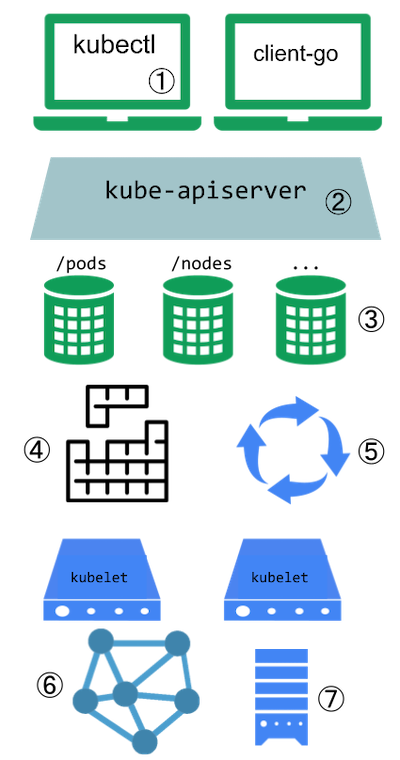
Kubernetes extension points
Users often interact with the Kubernetes API using kubectl. Plugins
customise the behaviour of clients. There are generic extensions that can apply to different clients,
as well as specific ways to extend kubectl.
The API server handles all requests. Several types of extension points in the API server allow authenticating requests, or blocking them based on their content, editing content, and handling deletion. These are described in the API Access Extensions section.
The API server serves various kinds of resources. Built-in resource kinds, such as
pods, are defined by the Kubernetes project and can't be changed.
Read API extensions to learn about extending the Kubernetes API.
The Kubernetes scheduler decides which nodes to place pods on. There are several ways to extend scheduling, which are described in the Scheduling extensions section.
Much of the behavior of Kubernetes is implemented by programs called controllers, that are clients of the API server. Controllers are often used in conjunction with custom resources. Read combining new APIs with automation and Changing built-in resources to learn more.
The kubelet runs on servers (nodes), and helps pods appear like virtual servers with their own IPs on the cluster network. Network Plugins allow for different implementations of pod networking.
You can use Device Plugins to integrate custom hardware or other special node-local facilities, and make these available to Pods running in your cluster. The kubelet includes support for working with device plugins.
The kubelet also mounts and unmounts volume for pods and their containers. You can use Storage Plugins to add support for new kinds of storage and other volume types.
If you are unsure where to start, this flowchart can help. Note that some solutions may involve several types of extensions.

Flowchart guide to select an extension approach
Plugins for kubectl are separate binaries that add or replace the behavior of specific subcommands.
The kubectl tool can also integrate with credential plugins
These extensions only affect a individual user's local environment, and so cannot enforce site-wide policies.
If you want to extend the kubectl tool, read Extend kubectl with plugins.
Consider adding a Custom Resource to Kubernetes if you want to define new controllers, application
configuration objects or other declarative APIs, and to manage them using Kubernetes tools, such
as kubectl.
For more about Custom Resources, see the Custom Resources concept guide.
You can use Kubernetes' API Aggregation Layer to integrate the Kubernetes API with additional services such as for metrics.
A combination of a custom resource API and a control loop is called the controllers pattern. If your controller takes the place of a human operator deploying infrastructure based on a desired state, then the controller may also be following the operator pattern. The Operator pattern is used to manage specific applications; usually, these are applications that maintain state and require care in how they are managed.
You can also make your own custom APIs and control loops that manage other resources, such as storage, or to define policies (such as an access control restriction).
When you extend the Kubernetes API by adding custom resources, the added resources always fall into a new API Groups. You cannot replace or change existing API groups. Adding an API does not directly let you affect the behavior of existing APIs (such as Pods), whereas API Access Extensions do.
When a request reaches the Kubernetes API Server, it is first authenticated, then authorized, and is then subject to various types of admission control (some requests are in fact not authenticated, and get special treatment). See Controlling Access to the Kubernetes API for more on this flow.
Each of the steps in the Kubernetes authentication / authorization flow offers extension points.
Authentication maps headers or certificates in all requests to a username for the client making the request.
Kubernetes has several built-in authentication methods that it supports. It can also sit behind an
authenticating proxy, and it can send a token from an Authorization: header to a remote service for
verification (an authentication webhook)
if those don't meet your needs.
Authorization determines whether specific users can read, write, and do other operations on API resources. It works at the level of whole resources -- it doesn't discriminate based on arbitrary object fields.
If the built-in authorization options don't meet your needs, an authorization webhook allows calling out to custom code that makes an authorization decision.
After a request is authorized, if it is a write operation, it also goes through Admission Control steps. In addition to the built-in steps, there are several extensions:
Device plugins allow a node to discover new Node resources (in addition to the builtin ones like cpu and memory) via a Device Plugin.
Container Storage Interface (CSI) plugins provide a way to extend Kubernetes with supports for new kinds of volumes. The volumes can be backed by durable external storage, or provide ephemeral storage, or they might offer a read-only interface to information using a filesystem paradigm.
Kubernetes also includes support for FlexVolume plugins, which are deprecated since Kubernetes v1.23 (in favour of CSI).
FlexVolume plugins allow users to mount volume types that aren't natively supported by Kubernetes. When you run a Pod that relies on FlexVolume storage, the kubelet calls a binary plugin to mount the volume. The archived FlexVolume design proposal has more detail on this approach.
The Kubernetes Volume Plugin FAQ for Storage Vendors includes general information on storage plugins.
Your Kubernetes cluster needs a network plugin in order to have a working Pod network and to support other aspects of the Kubernetes network model.
Network Plugins allow Kubernetes to work with different networking topologies and technologies.
Kubernetes v1.26 [stable]
The plugins can communicate with external services or use local files to obtain credentials. This way, the kubelet does not need to have static credentials for each registry, and can support various authentication methods and protocols.
For plugin configuration details, see Configure a kubelet image credential provider.
The scheduler is a special type of controller that watches pods, and assigns pods to nodes. The default scheduler can be replaced entirely, while continuing to use other Kubernetes components, or multiple schedulers can run at the same time.
This is a significant undertaking, and almost all Kubernetes users find they do not need to modify the scheduler.
You can control which scheduling plugins are active, or associate sets of plugins with different named scheduler profiles. You can also write your own plugin that integrates with one or more of the kube-scheduler's extension points.
Finally, the built in kube-scheduler component supports a
webhook
that permits a remote HTTP backend (scheduler extension) to filter and / or prioritize
the nodes that the kube-scheduler chooses for a pod.
This section covers extensions to your cluster that do not come as part as Kubernetes itself. You can use these extensions to enhance the nodes in your cluster, or to provide the network fabric that links Pods together.
CSI and FlexVolume storage plugins
Container Storage Interface (CSI) plugins provide a way to extend Kubernetes with supports for new kinds of volumes. The volumes can be backed by durable external storage, or provide ephemeral storage, or they might offer a read-only interface to information using a filesystem paradigm.
Kubernetes also includes support for FlexVolume plugins, which are deprecated since Kubernetes v1.23 (in favour of CSI).
FlexVolume plugins allow users to mount volume types that aren't natively supported by Kubernetes. When you run a Pod that relies on FlexVolume storage, the kubelet calls a binary plugin to mount the volume. The archived FlexVolume design proposal has more detail on this approach.
The Kubernetes Volume Plugin FAQ for Storage Vendors includes general information on storage plugins.
Device plugins allow a node to discover new Node facilities (in addition to the
built-in node resources such as cpu and memory), and provide these custom node-local
facilities to Pods that request them.
Network plugins allow Kubernetes to work with different networking topologies and technologies. Your Kubernetes cluster needs a network plugin in order to have a working Pod network and to support other aspects of the Kubernetes network model.
Kubernetes 1.35 is compatible with CNI network plugins.
Kubernetes (version 1.3 through to the latest 1.35, and likely onwards) lets you use Container Network Interface (CNI) plugins for cluster networking. You must use a CNI plugin that is compatible with your cluster and that suits your needs. Different plugins are available (both open- and closed- source) in the wider Kubernetes ecosystem.
A CNI plugin is required to implement the Kubernetes network model.
You must use a CNI plugin that is compatible with the v0.4.0 or later releases of the CNI specification. The Kubernetes project recommends using a plugin that is compatible with the v1.0.0 CNI specification (plugins can be compatible with multiple spec versions).
A Container Runtime, in the networking context, is a daemon on a node configured to provide CRI Services for kubelet. In particular, the Container Runtime must be configured to load the CNI plugins required to implement the Kubernetes network model.
Prior to Kubernetes 1.24, the CNI plugins could also be managed by the kubelet using the
cni-bin-dir and network-plugin command-line parameters.
These command-line parameters were removed in Kubernetes 1.24, with management of the CNI no
longer in scope for kubelet.
See Troubleshooting CNI plugin-related errors if you are facing issues following the removal of dockershim.
For specific information about how a Container Runtime manages the CNI plugins, see the documentation for that Container Runtime, for example:
For specific information about how to install and manage a CNI plugin, see the documentation for that plugin or networking provider.
In addition to the CNI plugin installed on the nodes for implementing the Kubernetes network
model, Kubernetes also requires the container runtimes to provide a loopback interface lo, which
is used for each sandbox (pod sandboxes, vm sandboxes, ...).
Implementing the loopback interface can be accomplished by re-using the
CNI loopback plugin.
or by developing your own code to achieve this (see
this example from CRI-O).
The CNI networking plugin supports hostPort. You can use the official
portmap
plugin offered by the CNI plugin team or use your own plugin with portMapping functionality.
If you want to enable hostPort support, you must specify portMappings capability in your
cni-conf-dir. For example:
{
"name": "k8s-pod-network",
"cniVersion": "0.4.0",
"plugins": [
{
"type": "calico",
"log_level": "info",
"datastore_type": "kubernetes",
"nodename": "127.0.0.1",
"ipam": {
"type": "host-local",
"subnet": "usePodCidr"
},
"policy": {
"type": "k8s"
},
"kubernetes": {
"kubeconfig": "/etc/cni/net.d/calico-kubeconfig"
}
},
{
"type": "portmap",
"capabilities": {"portMappings": true},
"externalSetMarkChain": "KUBE-MARK-MASQ"
}
]
}
Experimental Feature
The CNI networking plugin also supports pod ingress and egress traffic shaping. You can use the official bandwidth plugin offered by the CNI plugin team or use your own plugin with bandwidth control functionality.
If you want to enable traffic shaping support, you must add the bandwidth plugin to your CNI
configuration file (default /etc/cni/net.d) and ensure that the binary is included in your CNI
bin dir (default /opt/cni/bin).
{
"name": "k8s-pod-network",
"cniVersion": "0.4.0",
"plugins": [
{
"type": "calico",
"log_level": "info",
"datastore_type": "kubernetes",
"nodename": "127.0.0.1",
"ipam": {
"type": "host-local",
"subnet": "usePodCidr"
},
"policy": {
"type": "k8s"
},
"kubernetes": {
"kubeconfig": "/etc/cni/net.d/calico-kubeconfig"
}
},
{
"type": "bandwidth",
"capabilities": {"bandwidth": true}
}
]
}
Now you can add the kubernetes.io/ingress-bandwidth and kubernetes.io/egress-bandwidth
annotations to your Pod. For example:
apiVersion: v1
kind: Pod
metadata:
annotations:
kubernetes.io/ingress-bandwidth: 1M
kubernetes.io/egress-bandwidth: 1M
...
Kubernetes v1.26 [stable]
Kubernetes provides a device plugin framework that you can use to advertise system hardware resources to the Kubelet.
Instead of customizing the code for Kubernetes itself, vendors can implement a device plugin that you deploy either manually or as a DaemonSet. The targeted devices include GPUs, high-performance NICs, FPGAs, InfiniBand adapters, and other similar computing resources that may require vendor specific initialization and setup.
The kubelet exports a Registration gRPC service:
service Registration {
rpc Register(RegisterRequest) returns (Empty) {}
}
A device plugin can register itself with the kubelet through this gRPC service. During the registration, the device plugin needs to send:
ResourceName it wants to advertise. Here ResourceName needs to follow the
extended resource naming scheme
as vendor-domain/resourcetype.
(For example, an NVIDIA GPU is advertised as nvidia.com/gpu.)Following a successful registration, the device plugin sends the kubelet the
list of devices it manages, and the kubelet is then in charge of advertising those
resources to the API server as part of the kubelet node status update.
For example, after a device plugin registers hardware-vendor.example/foo with the kubelet
and reports two healthy devices on a node, the node status is updated
to advertise that the node has 2 "Foo" devices installed and available.
Then, users can request devices as part of a Pod specification
(see container).
Requesting extended resources is similar to how you manage requests and limits for
other resources, with the following differences:
Suppose a Kubernetes cluster is running a device plugin that advertises resource hardware-vendor.example/foo
on certain nodes. Here is an example of a pod requesting this resource to run a demo workload:
---
apiVersion: v1
kind: Pod
metadata:
name: demo-pod
spec:
containers:
- name: demo-container-1
image: registry.k8s.io/pause:3.8
resources:
limits:
hardware-vendor.example/foo: 2
#
# This Pod needs 2 of the hardware-vendor.example/foo devices
# and can only schedule onto a Node that's able to satisfy
# that need.
#
# If the Node has more than 2 of those devices available, the
# remainder would be available for other Pods to use.
The general workflow of a device plugin includes the following steps:
Initialization. During this phase, the device plugin performs vendor-specific initialization and setup to make sure the devices are in a ready state.
The plugin starts a gRPC service, with a Unix socket under the host path
/var/lib/kubelet/device-plugins/, that implements the following interfaces:
service DevicePlugin {
// GetDevicePluginOptions returns options to be communicated with Device Manager.
rpc GetDevicePluginOptions(Empty) returns (DevicePluginOptions) {}
// ListAndWatch returns a stream of List of Devices
// Whenever a Device state change or a Device disappears, ListAndWatch
// returns the new list
rpc ListAndWatch(Empty) returns (stream ListAndWatchResponse) {}
// Allocate is called during container creation so that the Device
// Plugin can run device specific operations and instruct Kubelet
// of the steps to make the Device available in the container
rpc Allocate(AllocateRequest) returns (AllocateResponse) {}
// GetPreferredAllocation returns a preferred set of devices to allocate
// from a list of available ones. The resulting preferred allocation is not
// guaranteed to be the allocation ultimately performed by the
// devicemanager. It is only designed to help the devicemanager make a more
// informed allocation decision when possible.
rpc GetPreferredAllocation(PreferredAllocationRequest) returns (PreferredAllocationResponse) {}
// PreStartContainer is called, if indicated by Device Plugin during registration phase,
// before each container start. Device plugin can run device specific operations
// such as resetting the device before making devices available to the container.
rpc PreStartContainer(PreStartContainerRequest) returns (PreStartContainerResponse) {}
}
GetPreferredAllocation() or PreStartContainer(). Flags indicating
the availability of these calls, if any, should be set in the DevicePluginOptions
message sent back by a call to GetDevicePluginOptions(). The kubelet will
always call GetDevicePluginOptions() to see which optional functions are
available, before calling any of them directly.The plugin registers itself with the kubelet through the Unix socket at host
path /var/lib/kubelet/device-plugins/kubelet.sock.
After successfully registering itself, the device plugin runs in serving mode, during which it keeps
monitoring device health and reports back to the kubelet upon any device state changes.
It is also responsible for serving Allocate gRPC requests. During Allocate, the device plugin may
do device-specific preparation; for example, GPU cleanup or QRNG initialization.
If the operations succeed, the device plugin returns an AllocateResponse that contains container
runtime configurations for accessing the allocated devices. The kubelet passes this information
to the container runtime.
An AllocateResponse contains zero or more ContainerAllocateResponse objects. In these, the
device plugin defines modifications that must be made to a container's definition to provide
access to the device. These modifications include:
DevicePluginCDIDevices feature gate
is enabled for both the kubelet and the kube-apiserver. This was added as an alpha feature in Kubernetes
v1.28, graduated to beta in v1.29 and to GA in v1.31.A device plugin is expected to detect kubelet restarts and re-register itself with the new
kubelet instance. A new kubelet instance deletes all the existing Unix sockets under
/var/lib/kubelet/device-plugins when it starts. A device plugin can monitor the deletion
of its Unix socket and re-register itself upon such an event.
There are cases when devices fail or are shut down. The responsibility of the Device Plugin
in this case is to notify the kubelet about the situation using the ListAndWatchResponse API.
Once a device is marked as unhealthy, the kubelet will decrease the allocatable count for this resource on the Node to reflect how many devices can be used for scheduling new pods. Capacity count for the resource will not change.
Pods that were assigned to the failed devices will continue be assigned to this device.
It is typical that code relying on the device will start failing and Pod may get
into Failed phase if restartPolicy for the Pod was not Always or enter the crash loop
otherwise.
Before Kubernetes v1.31, the way to know whether or not a Pod is associated with the failed device is to use the PodResources API.
Kubernetes v1.31 [alpha](disabled by default)By enabling the feature gate ResourceHealthStatus, the field allocatedResourcesStatus
will be added to each container status, within the .status for each Pod. The allocatedResourcesStatus
field
reports health information for each device assigned to the container.
For a failed Pod, or where you suspect a fault, you can use this status to understand whether
the Pod behavior may be associated with device failure. For example, if an accelerator is reporting
an over-temperature event, the allocatedResourcesStatus field may be able to report this.
You can deploy a device plugin as a DaemonSet, as a package for your node's operating system, or manually.
The canonical directory /var/lib/kubelet/device-plugins requires privileged access,
so a device plugin must run in a privileged security context.
If you're deploying a device plugin as a DaemonSet, /var/lib/kubelet/device-plugins
must be mounted as a Volume
in the plugin's PodSpec.
If you choose the DaemonSet approach you can rely on Kubernetes to: place the device plugin's Pod onto Nodes, to restart the daemon Pod after failure, and to help automate upgrades.
Previously, the versioning scheme required the Device Plugin's API version to match exactly the Kubelet's version. Since the graduation of this feature to Beta in v1.12 this is no longer a hard requirement. The API is versioned and has been stable since Beta graduation of this feature. Because of this, kubelet upgrades should be seamless but there still may be changes in the API before stabilization making upgrades not guaranteed to be non-breaking.
As a project, Kubernetes recommends that device plugin developers:
To run device plugins on nodes that need to be upgraded to a Kubernetes release with a newer device plugin API version, upgrade your device plugins to support both versions before upgrading these nodes. Taking that approach will ensure the continuous functioning of the device allocations during the upgrade.
Kubernetes v1.28 [stable]
In order to monitor resources provided by device plugins, monitoring agents need to be able to
discover the set of devices that are in-use on the node and obtain metadata to describe which
container the metric should be associated with. Prometheus metrics
exposed by device monitoring agents should follow the
Kubernetes Instrumentation Guidelines,
identifying containers using pod, namespace, and container prometheus labels.
The kubelet provides a gRPC service to enable discovery of in-use devices, and to provide metadata for these devices:
// PodResourcesLister is a service provided by the kubelet that provides information about the
// node resources consumed by pods and containers on the node
service PodResourcesLister {
rpc List(ListPodResourcesRequest) returns (ListPodResourcesResponse) {}
rpc GetAllocatableResources(AllocatableResourcesRequest) returns (AllocatableResourcesResponse) {}
rpc Get(GetPodResourcesRequest) returns (GetPodResourcesResponse) {}
}
List gRPC endpointThe List endpoint provides information on resources of running pods, with details such as the
id of exclusively allocated CPUs, device id as it was reported by device plugins and id of
the NUMA node where these devices are allocated. Also, for NUMA-based machines, it contains the
information about memory and hugepages reserved for a container.
Starting from Kubernetes v1.27, the List endpoint can provide information on resources
of running pods allocated in ResourceClaims by the DynamicResourceAllocation API.
Starting from Kubernetes v1.34, this feature is enabled by default.
To disable, kubelet must be started with the following flags:
--feature-gates=KubeletPodResourcesDynamicResources=false
// ListPodResourcesResponse is the response returned by List function
message ListPodResourcesResponse {
repeated PodResources pod_resources = 1;
}
// PodResources contains information about the node resources assigned to a pod
message PodResources {
string name = 1;
string namespace = 2;
repeated ContainerResources containers = 3;
}
// ContainerResources contains information about the resources assigned to a container
message ContainerResources {
string name = 1;
repeated ContainerDevices devices = 2;
repeated int64 cpu_ids = 3;
repeated ContainerMemory memory = 4;
repeated DynamicResource dynamic_resources = 5;
}
// ContainerMemory contains information about memory and hugepages assigned to a container
message ContainerMemory {
string memory_type = 1;
uint64 size = 2;
TopologyInfo topology = 3;
}
// Topology describes hardware topology of the resource
message TopologyInfo {
repeated NUMANode nodes = 1;
}
// NUMA representation of NUMA node
message NUMANode {
int64 ID = 1;
}
// ContainerDevices contains information about the devices assigned to a container
message ContainerDevices {
string resource_name = 1;
repeated string device_ids = 2;
TopologyInfo topology = 3;
}
// DynamicResource contains information about the devices assigned to a container by Dynamic Resource Allocation
message DynamicResource {
string class_name = 1;
string claim_name = 2;
string claim_namespace = 3;
repeated ClaimResource claim_resources = 4;
}
// ClaimResource contains per-plugin resource information
message ClaimResource {
repeated CDIDevice cdi_devices = 1 [(gogoproto.customname) = "CDIDevices"];
}
// CDIDevice specifies a CDI device information
message CDIDevice {
// Fully qualified CDI device name
// for example: vendor.com/gpu=gpudevice1
// see more details in the CDI specification:
// https://github.com/container-orchestrated-devices/container-device-interface/blob/main/SPEC.md
string name = 1;
}
cpu_ids in the ContainerResources in the List endpoint correspond to exclusive CPUs allocated
to a particular container. If the goal is to evaluate CPUs that belong to the shared pool, the List
endpoint needs to be used in conjunction with the GetAllocatableResources endpoint as explained
below:
GetAllocatableResources to get a list of all the allocatable CPUsGetCpuIds on all ContainerResources in the systemGetCpuIds calls from the GetAllocatableResources callGetAllocatableResources gRPC endpointKubernetes v1.28 [stable]
GetAllocatableResources provides information on resources initially available on the worker node. It provides more information than kubelet exports to APIServer.
GetAllocatableResources should only be used to evaluate allocatable
resources on a node. If the goal is to evaluate free/unallocated resources it should be used in
conjunction with the List() endpoint. The result obtained by GetAllocatableResources would remain
the same unless the underlying resources exposed to kubelet change. This happens rarely but when
it does (for example: hotplug/hotunplug, device health changes), client is expected to call
GetAllocatableResources endpoint.
However, calling GetAllocatableResources endpoint is not sufficient in case of cpu and/or memory
update and Kubelet needs to be restarted to reflect the correct resource capacity and allocatable.
// AllocatableResourcesResponses contains information about all the devices known by the kubelet
message AllocatableResourcesResponse {
repeated ContainerDevices devices = 1;
repeated int64 cpu_ids = 2;
repeated ContainerMemory memory = 3;
}
ContainerDevices do expose the topology information declaring to which NUMA cells the device is
affine. The NUMA cells are identified using a opaque integer ID, which value is consistent to
what device plugins report
when they register themselves to the kubelet.
The gRPC service is served over a unix socket at /var/lib/kubelet/pod-resources/kubelet.sock.
Monitoring agents for device plugin resources can be deployed as a daemon, or as a DaemonSet.
The canonical directory /var/lib/kubelet/pod-resources requires privileged access, so monitoring
agents must run in a privileged security context. If a device monitoring agent is running as a
DaemonSet, /var/lib/kubelet/pod-resources must be mounted as a
Volume in the device monitoring agent's
PodSpec.
When accessing the /var/lib/kubelet/pod-resources/kubelet.sock from DaemonSet
or any other app deployed as a container on the host, which is mounting socket as
a volume, it is a good practice to mount directory /var/lib/kubelet/pod-resources/
instead of the /var/lib/kubelet/pod-resources/kubelet.sock. This will ensure
that after kubelet restart, container will be able to re-connect to this socket.
Container mounts are managed by inode referencing the socket or directory, depending on what was mounted. When kubelet restarts, socket is deleted and a new socket is created, while directory stays untouched. So the original inode for the socket become unusable. Inode to directory will continue working.
Get gRPC endpointKubernetes v1.34 [beta]
The Get endpoint provides information on resources of a running Pod. It exposes information
similar to those described in the List endpoint. The Get endpoint requires PodName
and PodNamespace of the running Pod.
// GetPodResourcesRequest contains information about the pod
message GetPodResourcesRequest {
string pod_name = 1;
string pod_namespace = 2;
}
To disable this feature, you must start your kubelet services with the following flag:
--feature-gates=KubeletPodResourcesGet=false
The Get endpoint can provide Pod information related to dynamic resources
allocated by the dynamic resource allocation API.
Starting from Kubernetes v1.34, this feature is enabled by default.
To disable, kubelet must be started with the following flags:
--feature-gates=KubeletPodResourcesDynamicResources=false
Kubernetes v1.27 [stable]
The Topology Manager is a Kubelet component that allows resources to be co-ordinated in a Topology
aligned manner. In order to do this, the Device Plugin API was extended to include a
TopologyInfo struct.
message TopologyInfo {
repeated NUMANode nodes = 1;
}
message NUMANode {
int64 ID = 1;
}
Device Plugins that wish to leverage the Topology Manager can send back a populated TopologyInfo struct as part of the device registration, along with the device IDs and the health of the device. The device manager will then use this information to consult with the Topology Manager and make resource assignment decisions.
TopologyInfo supports setting a nodes field to either nil or a list of NUMA nodes. This
allows the Device Plugin to advertise a device that spans multiple NUMA nodes.
Setting TopologyInfo to nil or providing an empty list of NUMA nodes for a given device
indicates that the Device Plugin does not have a NUMA affinity preference for that device.
An example TopologyInfo struct populated for a device by a Device Plugin:
pluginapi.Device{ID: "25102017", Health: pluginapi.Healthy, Topology:&pluginapi.TopologyInfo{Nodes: []*pluginapi.NUMANode{&pluginapi.NUMANode{ID: 0,},}}}
Here are some examples of device plugin implementations:
Custom resources are extensions of the Kubernetes API. Kubernetes provides two ways to add custom resources to your cluster:
Custom resources are extensions of the Kubernetes API. This page discusses when to add a custom resource to your Kubernetes cluster and when to use a standalone service. It describes the two methods for adding custom resources and how to choose between them.
A resource is an endpoint in the Kubernetes API that stores a collection of API objects of a certain kind; for example, the built-in pods resource contains a collection of Pod objects.
A custom resource is an extension of the Kubernetes API that is not necessarily available in a default Kubernetes installation. It represents a customization of a particular Kubernetes installation. However, many core Kubernetes functions are now built using custom resources, making Kubernetes more modular.
Custom resources can appear and disappear in a running cluster through dynamic registration, and cluster admins can update custom resources independently of the cluster itself. Once a custom resource is installed, users can create and access its objects using kubectl, just as they do for built-in resources like Pods.
On their own, custom resources let you store and retrieve structured data. When you combine a custom resource with a custom controller, custom resources provide a true declarative API.
The Kubernetes declarative API enforces a separation of responsibilities. You declare the desired state of your resource. The Kubernetes controller keeps the current state of Kubernetes objects in sync with your declared desired state. This is in contrast to an imperative API, where you instruct a server what to do.
You can deploy and update a custom controller on a running cluster, independently of the cluster's lifecycle. Custom controllers can work with any kind of resource, but they are especially effective when combined with custom resources. The Operator pattern combines custom resources and custom controllers. You can use custom controllers to encode domain knowledge for specific applications into an extension of the Kubernetes API.
When creating a new API, consider whether to aggregate your API with the Kubernetes cluster APIs or let your API stand alone.
| Consider API aggregation if: | Prefer a stand-alone API if: |
|---|---|
| Your API is Declarative. | Your API does not fit the Declarative model. |
You want your new types to be readable and writable using kubectl. |
kubectl support is not required |
| You want to view your new types in a Kubernetes UI, such as dashboard, alongside built-in types. | Kubernetes UI support is not required. |
| You are developing a new API. | You already have a program that serves your API and works well. |
| You are willing to accept the format restriction that Kubernetes puts on REST resource paths, such as API Groups and Namespaces. (See the API Overview.) | You need to have specific REST paths to be compatible with an already defined REST API. |
| Your resources are naturally scoped to a cluster or namespaces of a cluster. | Cluster or namespace scoped resources are a poor fit; you need control over the specifics of resource paths. |
| You want to reuse Kubernetes API support features. | You don't need those features. |
In a Declarative API, typically:
Imperative APIs are not declarative. Signs that your API might not be declarative include:
Use a ConfigMap if any of the following apply:
mysql.cnf or
pom.xml.Use a custom resource (CRD or Aggregated API) if most of the following apply:
kubectl; for example, kubectl get my-object object-name..spec, .status, and .metadata.Kubernetes provides two ways to add custom resources to your cluster:
Kubernetes provides these two options to meet the needs of different users, so that neither ease of use nor flexibility is compromised.
Aggregated APIs are subordinate API servers that sit behind the primary API server, which acts as a proxy. This arrangement is called API Aggregation(AA). To users, the Kubernetes API appears extended.
CRDs allow users to create new types of resources without adding another API server. You do not need to understand API Aggregation to use CRDs.
Regardless of how they are installed, the new resources are referred to as Custom Resources to distinguish them from built-in Kubernetes resources (like pods).
Avoid using a Custom Resource as data storage for application, end user, or monitoring data: architecture designs that store application data within the Kubernetes API typically represent a design that is too closely coupled.
Architecturally, cloud native application architectures favor loose coupling between components. If part of your workload requires a backing service for its routine operation, run that backing service as a component or consume it as an external service. This way, your workload does not rely on the Kubernetes API for its normal operation.
The CustomResourceDefinition API resource allows you to define custom resources. Defining a CRD object creates a new custom resource with a name and schema that you specify. The Kubernetes API serves and handles the storage of your custom resource. The name of the CRD object itself must be a valid DNS subdomain name derived from the defined resource name and its API group; see how to create a CRD for more details. Further, the name of an object whose kind/resource is defined by a CRD must also be a valid DNS subdomain name.
This frees you from writing your own API server to handle the custom resource, but the generic nature of the implementation means you have less flexibility than with API server aggregation.
Refer to the custom controller example for an example of how to register a new custom resource, work with instances of your new resource type, and use a controller to handle events.
Usually, each resource in the Kubernetes API requires code that handles REST requests and manages persistent storage of objects. The main Kubernetes API server handles built-in resources like pods and services, and can also generically handle custom resources through CRDs.
The aggregation layer allows you to provide specialized implementations for your custom resources by writing and deploying your own API server. The main API server delegates requests to your API server for the custom resources that you handle, making them available to all of its clients.
CRDs are easier to use. Aggregated APIs are more flexible. Choose the method that best meets your needs.
Typically, CRDs are a good fit if:
CRDs are easier to create than Aggregated APIs.
| CRDs | Aggregated API |
|---|---|
| Do not require programming. Users can choose any language for a CRD controller. | Requires programming and building binary and image. |
| No additional service to run; CRDs are handled by API server. | An additional service to create and that could fail. |
| No ongoing support once the CRD is created. Any bug fixes are picked up as part of normal Kubernetes Master upgrades. | May need to periodically pickup bug fixes from upstream and rebuild and update the Aggregated API server. |
| No need to handle multiple versions of your API; for example, when you control the client for this resource, you can upgrade it in sync with the API. | You need to handle multiple versions of your API; for example, when developing an extension to share with the world. |
Aggregated APIs offer more advanced API features and customization of other features; for example, the storage layer.
| Feature | Description | CRDs | Aggregated API |
|---|---|---|---|
| Validation | Help users prevent errors and allow you to evolve your API independently of your clients. These features are most useful when there are many clients who can't all update at the same time. | Yes. Most validation can be specified in the CRD using OpenAPI v3.0 validation. CRDValidationRatcheting feature gate allows failing validations specified using OpenAPI also can be ignored if the failing part of the resource was unchanged. Any other validations supported by addition of a Validating Webhook. | Yes, arbitrary validation checks |
| Defaulting | See above | Yes, either via OpenAPI v3.0 validation default keyword (GA in 1.17), or via a Mutating Webhook (though this will not be run when reading from etcd for old objects). |
Yes |
| Multi-versioning | Allows serving the same object through two API versions. Can help ease API changes like renaming fields. Less important if you control your client versions. | Yes | Yes |
| Custom Storage | If you need storage with a different performance mode (for example, a time-series database instead of key-value store) or isolation for security (for example, encryption of sensitive information, etc.) | No | Yes |
| Custom Business Logic | Perform arbitrary checks or actions when creating, reading, updating or deleting an object | Yes, using Webhooks. | Yes |
| Scale Subresource | Allows systems like HorizontalPodAutoscaler and PodDisruptionBudget interact with your new resource | Yes | Yes |
| Status Subresource | Allows fine-grained access control where user writes the spec section and the controller writes the status section. Allows incrementing object Generation on custom resource data mutation (requires separate spec and status sections in the resource) | Yes | Yes |
| Other Subresources | Add operations other than CRUD, such as "logs" or "exec". | No | Yes |
| strategic-merge-patch | The new endpoints support PATCH with Content-Type: application/strategic-merge-patch+json. Useful for updating objects that may be modified both locally, and by the server. For more information, see "Update API Objects in Place Using kubectl patch" |
No | Yes |
| Protocol Buffers | The new resource supports clients that want to use Protocol Buffers | No | Yes |
| OpenAPI Schema | Is there an OpenAPI (swagger) schema for the types that can be dynamically fetched from the server? Is the user protected from misspelling field names by ensuring only allowed fields are set? Are types enforced (in other words, don't put an int in a string field?) |
Yes, based on the OpenAPI v3.0 validation schema (GA in 1.16). | Yes |
| Instance Name | Does this extension mechanism impose any constraints on the names of objects whose kind/resource is defined this way? | Yes, such an object's name must be a valid DNS subdomain name. | No |
When you create a custom resource, either via a CRD or an AA, you get many features for your API, compared to implementing it outside the Kubernetes platform:
| Feature | What it does |
|---|---|
| CRUD | The new endpoints support CRUD basic operations via HTTP and kubectl |
| Watch | The new endpoints support Kubernetes Watch operations via HTTP |
| Discovery | Clients like kubectl and dashboard automatically offer list, display, and field edit operations on your resources |
| json-patch | The new endpoints support PATCH with Content-Type: application/json-patch+json |
| merge-patch | The new endpoints support PATCH with Content-Type: application/merge-patch+json |
| HTTPS | The new endpoints uses HTTPS |
| Built-in Authentication | Access to the extension uses the core API server (aggregation layer) for authentication |
| Built-in Authorization | Access to the extension can reuse the authorization used by the core API server; for example, RBAC. |
| Finalizers | Block deletion of extension resources until external cleanup happens. |
| Admission Webhooks | Set default values and validate extension resources during any create/update/delete operation. |
| UI/CLI Display | Kubectl, dashboard can display extension resources. |
| Unset versus Empty | Clients can distinguish unset fields from zero-valued fields. |
| Client Libraries Generation | Kubernetes provides generic client libraries, as well as tools to generate type-specific client libraries. |
| Labels and annotations | Common metadata across objects that tools know how to edit for core and custom resources. |
There are several points to be aware of before adding a custom resource to your cluster.
While creating a CRD does not automatically add any new points of failure (for example, by causing third party code to run on your API server), packages (for example, Charts) or other installation bundles often include CRDs as well as a Deployment of third-party code that implements the business logic for a new custom resource.
Installing an Aggregated API server always involves running a new Deployment.
Custom resources consume storage space in the same way that ConfigMaps do. Creating too many custom resources may overload your API server's storage space.
Custom resources are placed into storage based upon the the current storage version of the resource, defined in the CRD spec. Any update to a custom resource will use the currently defined storage version to store the resource. All other versions either need to have all the fields of that version or define conversions to work properly.
Aggregated API servers may use the same storage as the main API server, in which case the same warning applies.
CRDs always use the same authentication, authorization, and audit logging as the built-in resources of your API server.
If you use RBAC for authorization, most RBAC roles will not grant access to the new resources (except the cluster-admin role or any role created with wildcard rules). You'll need to explicitly grant access to the new resources. CRDs and Aggregated APIs often come bundled with new role definitions for the types they add.
Aggregated API servers may or may not use the same authentication, authorization, and auditing as the primary API server.
Kubernetes client libraries can be used to access custom resources. Not all client libraries support custom resources. The Go and Python client libraries do.
When you add a custom resource, you can access it using:
kubectlField Selectors let clients select custom resources based on the value of one or more resource fields.
All custom resources support the metadata.name and metadata.namespace field
selectors.
Fields declared in a CustomResourceDefinition
may also be used with field selectors when included in the spec.versions[*].selectableFields field of the
CustomResourceDefinition.
Kubernetes v1.32 [stable](enabled by default)The spec.versions[*].selectableFields field of a CustomResourceDefinition may be used to
declare which other fields in a custom resource may be used in field selectors.
The following example adds the .spec.color and .spec.size fields as
selectable fields.
apiVersion: apiextensions.k8s.io/v1
kind: CustomResourceDefinition
metadata:
name: shirts.stable.example.com
spec:
group: stable.example.com
scope: Namespaced
names:
plural: shirts
singular: shirt
kind: Shirt
versions:
- name: v1
served: true
storage: true
schema:
openAPIV3Schema:
type: object
properties:
spec:
type: object
properties:
color:
type: string
size:
type: string
selectableFields:
- jsonPath: .spec.color
- jsonPath: .spec.size
additionalPrinterColumns:
- jsonPath: .spec.color
name: Color
type: string
- jsonPath: .spec.size
name: Size
type: string
Field selectors can then be used to get only resources with a color of blue:
kubectl get shirts.stable.example.com --field-selector spec.color=blue
The output should be:
NAME COLOR SIZE
example1 blue S
example2 blue M
The aggregation layer allows Kubernetes to be extended with additional APIs, beyond what is offered by the core Kubernetes APIs. The additional APIs can either be ready-made solutions such as a metrics server, or APIs that you develop yourself.
The aggregation layer is different from Custom Resource Definitions, which are a way to make the kube-apiserver recognise new kinds of object.
The aggregation layer runs in-process with the kube-apiserver. Until an extension resource is
registered, the aggregation layer will do nothing. To register an API, you add an APIService
object, which "claims" the URL path in the Kubernetes API. At that point, the aggregation layer
will proxy anything sent to that API path (e.g. /apis/myextension.mycompany.io/v1/…) to the
registered APIService.
The most common way to implement the APIService is to run an extension API server in Pod(s) that run in your cluster. If you're using the extension API server to manage resources in your cluster, the extension API server (also written as "extension-apiserver") is typically paired with one or more controllers. The apiserver-builder library provides a skeleton for both extension API servers and the associated controller(s).
Extension API servers should have low latency networking to and from the kube-apiserver. Discovery requests are required to round-trip from the kube-apiserver in five seconds or less.
If your extension API server cannot achieve that latency requirement, consider making changes that let you meet it.
Alternatively: learn how to extend the Kubernetes API using Custom Resource Definitions.
Operators are software extensions to Kubernetes that make use of custom resources to manage applications and their components. Operators follow Kubernetes principles, notably the control loop.
The operator pattern aims to capture the key aim of a human operator who is managing a service or set of services. Human operators who look after specific applications and services have deep knowledge of how the system ought to behave, how to deploy it, and how to react if there are problems.
People who run workloads on Kubernetes often like to use automation to take care of repeatable tasks. The operator pattern captures how you can write code to automate a task beyond what Kubernetes itself provides.
Kubernetes is designed for automation. Out of the box, you get lots of built-in automation from the core of Kubernetes. You can use Kubernetes to automate deploying and running workloads, and you can automate how Kubernetes does that.
Kubernetes' operator pattern concept lets you extend the cluster's behaviour without modifying the code of Kubernetes itself by linking controllers to one or more custom resources. Operators are clients of the Kubernetes API that act as controllers for a Custom Resource.
Some of the things that you can use an operator to automate include:
What might an operator look like in more detail? Here's an example:
The most common way to deploy an operator is to add the Custom Resource Definition and its associated Controller to your cluster. The Controller will normally run outside of the control plane, much as you would run any containerized application. For example, you can run the controller in your cluster as a Deployment.
Once you have an operator deployed, you'd use it by adding, modifying or deleting the kind of resource that the operator uses. Following the above example, you would set up a Deployment for the operator itself, and then:
kubectl get SampleDB # find configured databases
kubectl edit SampleDB/example-database # manually change some settings
…and that's it! The operator will take care of applying the changes as well as keeping the existing service in good shape.
If there isn't an operator in the ecosystem that implements the behavior you want, you can code your own.
You also implement an operator (that is, a Controller) using any language / runtime that can act as a client for the Kubernetes API.
Following are a few libraries and tools you can use to write your own cloud native operator.
